Adapting your SEO for an AI-driven world requires a clear, actionable plan. It’s about understanding the new rules of the game and adjusting your tactics accordingly. This guide moves beyond theory to provide a practical checklist for modern SEO. We will cover how to optimize your content for voice and visual search, improve your site’s Core Web Vitals for a better user experience, and find the right balance between AI-generated efficiency and human-led creativity. You will learn how to create content that not only ranks but also offers unique value that makes users want to click through from an AI-generated summary.
Key Takeaways
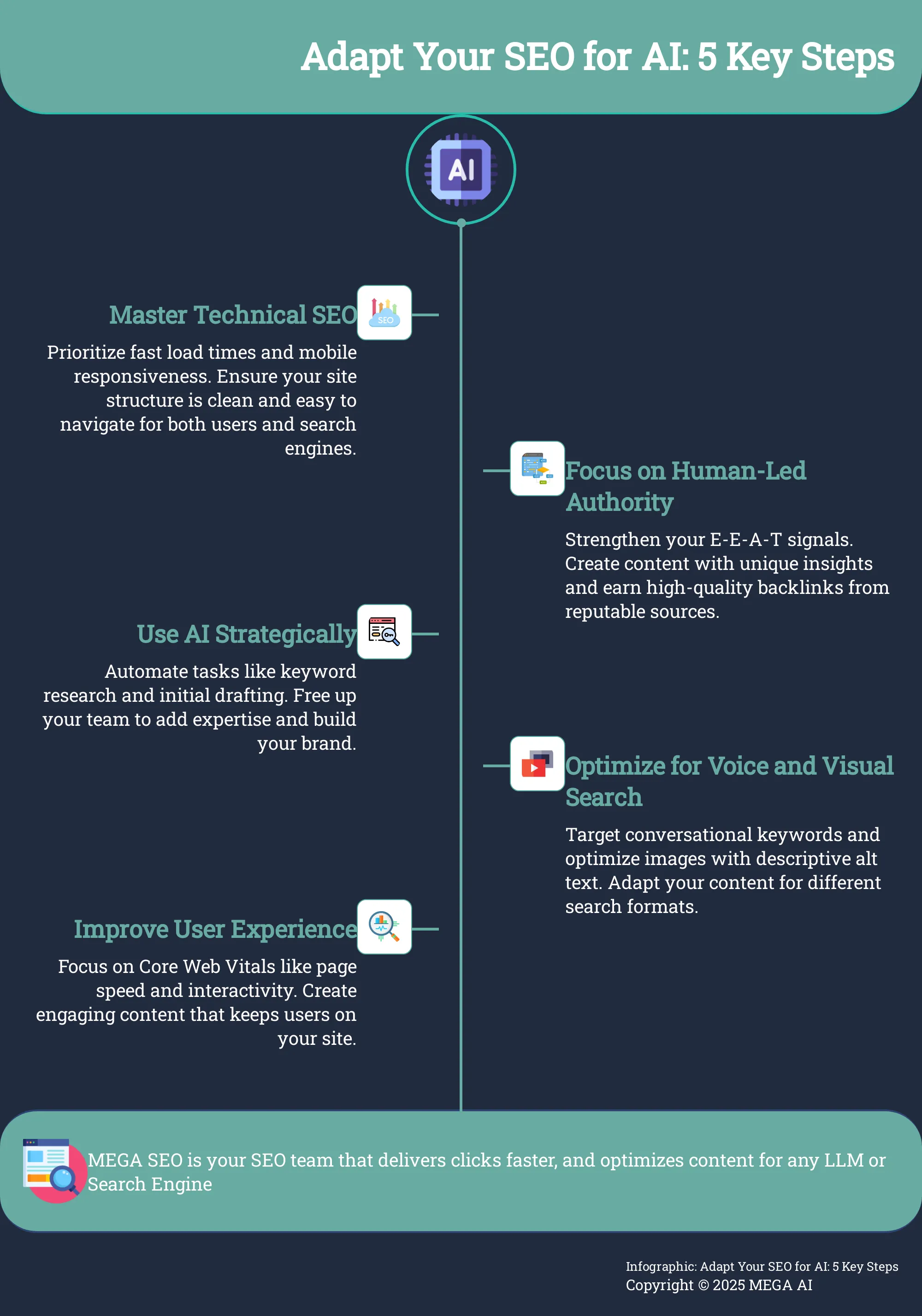
- Focus on Human-Led Authority: In an AI-driven search landscape, your greatest advantage is human experience. Strengthen your E-E-A-T signals, earn high-quality backlinks, and create content with unique insights that AI cannot generate on its own.
- Master Your Technical SEO Foundation: A positive user experience is a direct ranking factor. Prioritize fast load times, mobile responsiveness, and a clean site structure to meet Google's Core Web Vitals and prepare your content for new formats like voice and visual search.
- Use AI Strategically for Efficiency: Treat AI as a powerful assistant, not a replacement for strategy. Use it to automate time-consuming tasks like keyword research and initial drafting, which frees up your team to focus on adding unique expertise and building your brand.
How to Adapt Your SEO for AI in Search
The rise of AI in search engines, particularly Google's Search Generative Experience (SGE), is changing how users find information. Instead of just getting a list of links, users are now often presented with a direct, AI-generated answer at the top of the page. This shift doesn't mean SEO is obsolete, but it does require a new approach. Your goal is no longer just to rank number one; it's to maintain visibility and traffic in an environment where users may not need to click through to your site. Adapting your strategy means understanding how these AI answers work and adjusting your content and tactics to stay relevant and continue driving valuable traffic to your business.
What are AI-driven direct answers?
An AI-driven direct answer is a response generated by AI that appears directly in the search results. When someone types a question into Google, the search engine uses its AI to synthesize information from various web pages and present a comprehensive answer on the spot. This is a core feature of the Search Generative Experience and fundamentally changes the user journey. Instead of clicking multiple links to piece together information, the user gets a convenient summary. While this is great for the user, it means your website might not get the click, even if your content was used to create the answer. Understanding this is the first step to adjusting your strategy.
How to maintain visibility and traffic
With AI answering questions directly, some predict a decline in organic traffic. To keep your audience engaged and clicking through, your content needs to offer something the AI summary can't. Focus on creating in-depth articles that go beyond simple definitions. Include unique data, expert opinions, case studies, and personal experiences that an AI can't easily replicate. The goal is to become a destination brand that users seek out by name. You should also aim to have your content cited as a source in the AI-generated answers. You can achieve this by creating clear, well-structured, and authoritative content that MEGA AI's SEO tools can help you optimize and maintain.
Increase content production to stay competitive
The reality is that AI has made content creation faster and more accessible for everyone. Your competitors are likely using it to increase their output, and to keep up, you may need to do the same. Publishing more high-quality content helps you build topical authority and cover a wider range of keywords, increasing your chances of appearing in both traditional and AI-powered search results. This isn't about quantity over quality. It's about using AI to scale your production efficiently. With a platform like MEGA AI, you can automate content generation and optimization, allowing you to publish more frequently without a massive increase in cost or effort.
Prioritize High-Quality Backlinks
Even with AI changing the search landscape, backlinks remain a powerful signal to Google that your site is credible and authoritative. Think of them as votes of confidence from other sites. However, the game has shifted from quantity to quality. Gone are the days of collecting as many links as possible from any source you could find. Now, the focus is on earning relevant, high-authority links that genuinely endorse your content. A handful of strong links from respected sites will do more for your SEO than hundreds of low-quality ones. This approach not only strengthens your site's authority but also makes it more resilient to future algorithm updates that are designed to weed out manipulative link schemes. When you prioritize quality, you're investing in a long-term asset. These links send trust signals that are hard to fake, telling search engines that your content is a valuable resource within your industry. This is especially important as AI-generated content becomes more common; authoritative backlinks act as a human-powered verification of your content's worth. Focusing on high-quality links also aligns your efforts with creating genuinely useful content, which is the cornerstone of any successful marketing strategy.
Build a diverse backlink profile
Building a diverse backlink profile is crucial for a healthy, long-term SEO strategy. This means getting links from a variety of sources, such as industry blogs, news sites, directories, and educational resources. Relying on just one type of link makes your site vulnerable. A varied profile helps protect your site against algorithm changes that might devalue a specific type of link. Aim for a natural mix of dofollow and nofollow links, with varied anchor text. This signals to search engines that your links are earned organically, not manipulated, which is key to building a resilient SEO foundation.
Use ethical link building methods
Adopting ethical link building methods is non-negotiable for sustainable success. Search engines are quick to penalize sites that use manipulative tactics, so you should avoid common pitfalls like buying links or participating in link schemes. The best approach is to focus your energy on creating valuable content that people naturally want to share and link to. This could be in-depth guides, original research, or free tools. Other ethical tactics include guest posting on reputable sites in your niche and finding and fixing broken links on other websites that could point to your content instead.
Use digital PR for link acquisition
Digital PR is an effective way to earn high-quality backlinks from authoritative news outlets and top-tier blogs. It involves creating newsworthy content or stories and promoting them to journalists and editors. This isn't just for big corporations. A small business could conduct a local survey, create an interesting infographic from the data, or share a unique case study. By creating compelling stories and getting them in front of the right people, you can secure powerful backlinks that also increase your brand's visibility and credibility. This approach turns link building into a brand-building activity, helping you learn the basics of digital PR to earn authoritative links that are difficult for competitors to replicate.
Balance AI and Human-Written Content
AI has fundamentally changed content creation, but it hasn’t replaced the need for human creativity and experience. The most successful SEO strategies don't treat it as an either/or situation. Instead, they find a smart balance, using AI to handle the heavy lifting and freeing up human experts to add the unique value that machines can't replicate. This hybrid approach allows you to scale your content production without sacrificing the quality and authenticity that builds a loyal audience and earns top rankings.
Use AI for efficient content creation
Let's be clear: using AI to write content won't get you penalized by Google. The key is to produce content that is helpful to the reader, regardless of how it was created. For small teams and startups, AI is a game-changer for efficiency. It can help you move from idea to a full draft in a fraction of the time it would take to write from scratch. You can use AI-powered SEO tools to automate time-consuming tasks like keyword research, outlining, and initial drafting. This allows you to increase your content output and compete with larger players, all while maintaining a consistent publishing schedule.
Add a human touch and unique insights
While AI is great at compiling facts, it can't replicate genuine human experience. Think about it: if you’re looking for the best pizza in a new city, you don't want a robot's summary of online data. You want a recommendation from a local foodie who has actually tasted the pizza. This is the value of the human touch. You can infuse your content with personality by sharing personal stories, customer case studies, or your own expert opinions. This is what builds trust and creates a memorable brand. People connect with other people, and that connection is something AI can’t fake.
Make your content unique to stand out
Much of the AI-generated content online simply rephrases what’s already been published. To truly stand out and provide value, your content needs to fill an 'information gap' by adding something new to the conversation. This means going beyond summarizing the top search results. You can do this by conducting your own research, surveying your audience for fresh data, or interviewing experts for unique quotes. Once you’ve identified what’s missing, you can create content that is genuinely original and helpful. This is the kind of high-value material that Google is increasingly rewarding.
Optimize for Voice and Visual Search
The way people search for information is changing. It’s no longer just about typing keywords into a search bar. More and more, users are asking questions out loud to their smart speakers or using their phone's camera to search with an image. To stay visible, your SEO strategy needs to account for these shifts in user behavior. This means thinking beyond traditional text-based queries and preparing your content to be found through sound and sight.
Apply voice and visual search tactics
Optimizing for voice search means focusing on conversational keywords that mirror how people actually speak. For example, instead of typing “local coffee shop,” a user might ask their phone, “Where’s the best coffee shop near me?” Your content should aim to answer these kinds of long-tail, question-based phrases. For visual search, the focus is on your images. High-quality, relevant pictures are a must, but you also need to tell search engines what they are. Use descriptive, keyword-rich alt text for every image on your site. This not only helps search engines understand the visual content but also improves accessibility for users with visual impairments.
Adapt content for different search formats
To show up in voice search results, create content that directly answers common questions. A dedicated FAQ page is a great way to do this, as it allows you to target specific queries your audience is asking. Since many voice searches are local, make sure your business information is accurate and consistent across all local listings. For visual search, ensure your website is mobile-friendly, as most of these searches happen on a phone. Use clear, high-resolution images and organize them in a way that’s easy for users to browse. By adapting your content for these different formats, you meet your audience where they are and improve your chances of being the go-to answer.
Improve User Experience for Better SEO
Google's main goal is to provide users with the best possible answers and experiences. This means how users interact with your website is a major ranking factor. A site that's slow, clunky, or hard to use will struggle to rank, no matter how great the content is. Focusing on user experience (UX) isn't just about making people happy; it's a fundamental part of a modern SEO strategy that directly influences your performance in search results. Improving your site's technical health and user-friendliness can be managed with tools that automate technical SEO improvements.
What are Core Web Vitals?
Core Web Vitals are a specific set of metrics Google uses to measure the real-world user experience of a webpage. Think of them as a technical report card for your site's performance, focusing on three key areas: loading speed, interactivity, and visual stability. The main metrics are Largest Contentful Paint (LCP), which measures how quickly the main content loads; Interaction to Next Paint (INP), which assesses how responsive your page is to user clicks and taps; and Cumulative Layout Shift (CLS), which checks if elements on the page move around unexpectedly as it loads. Mastering these vitals is essential for providing a smooth experience that Google rewards.
Improve site speed and mobile responsiveness
A fast, responsive website is the foundation of good user experience. To improve your site's performance, start by optimizing large image files, which are a common cause of slow load times. You can also leverage browser caching and minimize your site's code (like JavaScript and CSS) to speed things up. Since Google uses mobile-first indexing, ensuring your site is fully responsive and easy to use on a smartphone is critical. A site that loads quickly and works flawlessly on mobile not only keeps users happy but also sends strong positive signals to search engines, directly impacting your rankings.
Create interactive and engaging content
Once your site is technically sound, you need to give users a reason to stick around. Engaging content turns a passive visitor into an active participant. This goes beyond just text on a page. You can incorporate multimedia elements like videos and infographics, build interactive tools like calculators or quizzes, or encourage user-generated content such as reviews and comments. When users spend more time on your site, it signals to Google that your content is valuable. This increased engagement often leads to more social shares and natural backlinks, which are powerful drivers for improving your SEO performance.
Strengthen Your E-E-A-T Signals
Google’s E-E-A-T guidelines—Experience, Expertise, Authoritativeness, and Trustworthiness—are not just a set of best practices; they are a core part of how the search engine evaluates content quality. In an environment filled with AI-generated articles, demonstrating these signals is how you prove your content is reliable and valuable to users. Think of it as Google’s quality filter. Focusing on E-E-A-T helps you build a resilient SEO strategy that can withstand algorithm updates and stand out from the competition. It’s about creating content that people and search engines can trust.
Demonstrate expertise and trustworthiness
With the rapid adoption of AI, it's more important than ever to prove there's a real expert behind your content. Google is very aware of the limitations of large language models, from misinterpretations to factual errors. Your goal is to show that your content is created or vetted by a human with deep knowledge. You can do this by creating detailed author bios that list credentials and relevant experience. Make sure your content is factually accurate, cites credible sources, and offers unique insights that go beyond a surface-level summary. Using an AI SEO tool can help you generate a solid first draft, but the final touch of human expertise is what builds true authority and trust.
Build a strong online reputation
Your site’s reputation isn’t built in a vacuum. Google looks at sitewide signals, meaning the company you keep online matters. As one expert noted, if you host third-party content on your site or subdomains, that content can affect your entire site's perceived authority. Be selective about guest posts or any user-generated content you allow. A strong online reputation is also built through positive reviews on your Google Business Profile, mentions in reputable industry publications, and genuine customer testimonials. Consistently managing your brand’s presence across the web sends strong signals to Google that you are a legitimate and trustworthy entity in your field. This is a key part of a long-term digital PR strategy.
Use user engagement to show authority
How users interact with your site provides direct feedback to Google about your content's quality and authority. Positive engagement signals—like longer time on page, low bounce rates, and high click-through rates (CTR)—tell search engines that users find your content valuable. The feedback loop is faster than ever, meaning improvements to your site can be recognized quickly. To improve engagement, focus on creating a seamless user experience, improving site speed, and making your content interactive. You can also use tools like MEGA AI's Maintenance Agent to automatically update and re-optimize existing articles, which helps improve CTR from the search results page and shows Google your content is relevant and engaging.
Adapt Your Local SEO Strategy
Local search is more important than ever for businesses with a physical presence or a defined service area. When potential customers search for products or services "near me," you want your business to be the one they find. Adapting your strategy means going beyond basic listings and actively engaging with your local community online. This involves a combination of on-page optimizations and managing your presence on key local platforms.
Get more visibility in local search
To show up more often in local searches, you need a hyper-localized strategy. This means creating content and web pages that target specific neighborhoods or communities you serve. For example, a plumber in a large city could create separate landing pages for "downtown pipe repair" and "suburban water heater installation." This targeted approach helps search engines understand exactly where you operate and what you do, which can significantly improve your local search rankings. Think about the specific terms your local customers use and build your content around them. This makes your website more relevant to their needs and more visible in their search results.
Use your Google Business Profile effectively
Your Google Business Profile (GBP) is one of the most powerful free tools for local SEO. Claiming and fully optimizing your profile is a critical first step. Ensure all your information—address, phone number, hours—is accurate and consistent everywhere online. Beyond the basics, you should actively use your profile. Regularly upload photos of your work or location, respond to every customer review (both positive and negative), and use Google Posts to share updates, offers, and events. This consistent activity signals to Google that your business is active and credible, helping you dominate local search and build trust with potential customers before they even visit your website.
Keep Up with SEO Rules and Guidelines
The world of SEO is always changing. Google frequently updates its algorithms, and what worked yesterday might not work tomorrow. Staying on top of these changes isn't just good practice; it's essential for maintaining your online visibility. This means keeping an eye on new guidelines, understanding what practices to avoid, and adapting your strategy.
Adapt to new SEO restrictions
To succeed in SEO, you have to be adaptive. Google's algorithm updates can shift the ranking landscape overnight, so it's important to keep abreast of industry trends and best practices. This allows you to adjust your strategy proactively instead of reacting after a traffic drop. Think of this as continuous learning by reading industry publications and following official announcements from Google. For small teams, this can feel like a full-time job. This is where automation can help. Tools that automatically update your content based on performance data can help you stay aligned with the latest ranking signals without constant manual intervention.
Stay compliant with new guidelines
Following the rules is fundamental to sustainable SEO. Google has specific guidelines for what it considers high-quality, helpful content, and straying from them can result in penalties that harm your visibility. Understanding how penalties work and avoiding common mistakes is crucial for keeping your website in good standing. This means steering clear of black-hat tactics like keyword stuffing, cloaking, or buying spammy links. These shortcuts might offer a temporary gain but almost always lead to long-term problems. Instead, focus on creating genuinely useful content for your audience. Using SEO tools built on ethical practices helps you stay compliant and build for lasting success.
What is parasite SEO (and how to avoid it)
A tactic that has recently come under fire is "parasite SEO." This is when a brand publishes content on a high-authority, often unrelated, third-party site—like a news publication's sponsored content section—to rank for its own keywords. For a while, this worked because the host domain had so much authority it could make almost any content rank. However, Google is now penalizing this practice, causing significant traffic loss for sites that relied on it. The core issue is that this content is often low-quality and doesn't match the host site's purpose. Avoid shortcuts like parasite SEO and instead invest in building authority on your own domain.
Use Advanced Tools and AI for SEO
The conversation around AI in SEO has shifted from “if” to “how.” AI is no longer a futuristic concept but a practical tool that can handle complex tasks, from data analysis to content creation. For small businesses and startups, this technology makes it possible to compete with larger companies by automating time-consuming SEO processes.
Think of AI as a powerful assistant. It can process vast amounts of data to find patterns and opportunities that a human might miss. However, it works best when guided by human strategy and insight. Your expertise is still the driving force behind any successful campaign. The key is to use AI to execute tasks efficiently, freeing you up to focus on high-level strategy, creative thinking, and understanding your audience on a deeper level.
What are the latest SEO technologies?
The latest SEO technologies are centered on end-to-end automation. With some experts predicting that the vast majority of online content will be AI-assisted, Google has adapted its stance to focus on quality, not origin. This means you can use AI without fear of penalties, as long as the final product is helpful and valuable to the reader. Modern platforms can now handle everything from automated keyword research and content generation to technical SEO fixes and internal linking. This allows you to scale your content production and optimization efforts in ways that were previously impossible without a large team.
Use AI for data analysis and strategy
While AI is excellent at execution, its real power for strategy comes from data analysis. AI won't replace the need for human strategists; people will always value the input of other people. Instead, it acts as a powerful analytical tool. You can use it to monitor performance data from sources like Google Search Console and identify actionable insights. For example, an AI tool can analyze your existing articles, identify content gaps, and even suggest updates to improve your click-through rate (CTR). This partnership allows you to make data-driven decisions quickly and refine your strategy with precision.
How to Handle Google Updates
Google updates are a regular part of the SEO landscape. While they can feel disruptive, they are ultimately aimed at improving the search experience for users. Instead of reacting with panic each time an update rolls out, the best approach is to build a resilient SEO strategy that can withstand these changes. This means focusing on creating a high-quality, user-centric website that aligns with Google’s long-term goals.
A solid plan for managing algorithm updates rests on three key pillars: proactive prevention, efficient recovery, and continuous education. By taking steps to protect your site from penalties, knowing how to respond if your traffic is affected, and staying current with industry changes, you can treat Google updates as a normal part of business. This approach allows you to adapt thoughtfully rather than scramble reactively, keeping your strategy on track.
Take proactive steps to prevent penalties
The most effective way to handle a Google update is to build a site that’s unlikely to be penalized in the first place. This starts with a commitment to quality. If you use AI for content creation, it's crucial to review everything carefully. Check for factual accuracy, fix any mistakes, and ensure the content provides genuine value to your audience. Understanding how penalties work and avoiding common missteps are fundamental to maintaining a healthy website.
Consistently applying SEO best practices is your best defense. This includes creating helpful content, ensuring a positive user experience, and building a natural backlink profile. Tools that help you maintain and improve existing content, like MEGA AI's Maintenance Agent, can automatically update articles to keep them fresh and aligned with quality guidelines, reducing your risk during algorithm updates.
How to recover after an update
If your site’s traffic does take a hit after an update, try not to panic. The first step is to diagnose the issue by analyzing your data to see which pages or sections of your site were most affected. Often, the path to recovery involves improving or removing low-quality content that the update targeted.
The good news is that recovery can be faster than ever. Google has stated that its quality classifiers run continuously, which means that if you fix the issues on your site today, you could see improvements very quickly. Focus on making meaningful changes based on the likely intent of the update. Re-optimizing your content to better meet user needs is a powerful recovery tactic that aligns your site with Google’s objectives and can help you regain lost rankings.
Stay informed about Google's changes
The world of SEO is always evolving, so staying informed is non-negotiable. Make it a habit to keep up with industry news, algorithm updates, and best practices so you can adapt your strategy proactively. Following reputable SEO publications and experts can provide valuable insights into what’s changing and why.
One of the best sources of information is Google itself. Use Google Search Console to monitor your site’s performance, identify issues, and receive messages directly from Google. The platform is essential for managing your site’s presence in search results. For a solid foundation, Google’s own SEO Starter Guide is an excellent resource for understanding what the search engine values, helping you make informed decisions that support long-term success.
Related Articles
- The Role of Artificial Intelligence in SEO: Transforming Search Engine Optimization - MEGA SEO | Blog
- AI SEO: A Modern Guide to Optimizing for AI
- AEO (Answer Engine Optimization): The Ultimate Guide
- Backlinks AI: The Ultimate Guide (2024)
- AI Content and SEO: Benefits, Risks, and Strategy
Frequently Asked Questions
Will Google penalize my site for using AI-generated content? No, Google's focus is on the quality and helpfulness of the content, not on how it was created. You can use AI as a tool to help you draft articles, research topics, and scale your production. The key is to ensure a human is involved to review, edit, and add unique insights, experience, and factual accuracy. As long as the final piece is valuable to the reader, its origin doesn't matter.
With AI providing direct answers, how can I still get traffic to my website? The goal is to create content that offers more value than a simple AI summary. Focus on publishing in-depth articles that include unique data, original research, expert interviews, or personal case studies. This type of content provides a level of detail and authenticity that AI cannot easily replicate, giving users a compelling reason to click through to your site for the full story.
What is E-E-A-T, and why is it so important now? E-E-A-T stands for Experience, Expertise, Authoritativeness, and Trustworthiness. It's the framework Google uses to assess the quality and credibility of your content. In an environment where anyone can generate content with AI, demonstrating E-E-A-T is how you prove that your information is reliable and comes from a knowledgeable source. It's about showing there's a real, qualified human behind your content.
What's the most important thing to focus on to prepare for a Google update? Instead of reacting to every update, focus on building a resilient website founded on quality. The most effective preparation is to consistently create genuinely helpful content for your audience, ensure your site provides a great user experience with fast load times, and build a strong, authoritative reputation in your niche. A site that truly serves its users is less likely to be negatively affected by algorithm changes.
How can a small team use AI for SEO without sacrificing quality? Think of AI as an assistant that handles the time-consuming tasks. Use it to conduct keyword research, generate outlines, or create initial drafts. This frees up your team to focus on higher-value work like strategy, fact-checking, and infusing the content with unique brand personality and expert insights. This hybrid approach allows you to increase your output efficiently while maintaining the human touch that builds trust.