
Your customers are talking, but is your website listening? Voice search is no longer a futuristic concept; it's a daily habit for millions. This presents a unique challenge: how do you optimize for queries that are longer, more natural, and often phrased as direct questions? Simply guessing won't cut it. You need data-driven insights to understand what your audience is asking and how to answer them effectively. That's where understanding how to use SEMrush for voice search optimization comes into play. We'll explore the specific features within SEMrush that can help you uncover these conversational keywords and refine your content strategy for this evolving search behavior.
Key Takeaways
- Understand Spoken Queries: Shift your keyword focus from short phrases to the full, conversational questions people ask their voice-activated devices.
- Create for Direct Answers and Local Needs: Develop content that provides clear, concise answers suitable for featured snippets, and ensure your local business information is accurate and accessible for "near me" searches.
- Track Performance and Adapt Your Strategy: Regularly use SEO tools to monitor how your content ranks for voice queries and refine your approach based on data insights to stay effective.
What is Voice Search Optimization?
Voice search optimization is all about fine-tuning your online content so it’s easily found when people ask questions to their smart speakers or use voice commands on their phones. Think of it as making sure your website speaks the same language as your customers when they’re not typing. As more people turn to voice assistants for quick answers and local information, understanding how to optimize for these spoken queries is becoming a key part of a strong digital strategy. It’s not just a fleeting trend; it’s a shift in how users interact with search engines and find businesses like yours.
Why Voice Search Matters More Than Ever
The way people search for information is evolving, and voice search is a big part of that change. Its growth isn't just a small uptick; it's a significant shift. Consider that a large number of consumers, around 60%, are using voice search to find products, services, and general information. Nearly half of those users are specifically looking for local services, which is a huge opportunity for businesses with a local presence.
This daily reliance is also notable, with reports showing that about 28% of consumers in places like the US and UK use voice assistants every single day. This isn't just about convenience; it's becoming an ingrained habit. For businesses, this means a growing audience is using their voice to find what you offer, making it essential to be visible in these types of search results.
How Voice Search Changes the Game
So, how exactly is voice search different from the typed queries we’re all used to? The main distinction lies in its conversational nature. When people use voice search, they tend to speak more naturally, as if they're talking to another person. For example, someone might ask their phone, "What's the best bakery in Toronto?" instead of typing a shorter phrase like "best bakery Toronto."
This shift means that the keywords people use in voice searches are often longer and phrased as questions – think "How do I bake a cake?" rather than just "cake recipe." To effectively reach this audience, your content strategy needs to adapt. This involves creating content that directly answers these conversational queries and ensuring your website is mobile-friendly, as many voice searches happen on the go.
Use SEMrush for Voice Search
SEMrush is a valuable resource when you aim to refine your content for voice search. It provides a collection of tools designed to help you understand how people use voice commands to find information and, more importantly, how you can make your website more discoverable in these searches. Consider it your guide for figuring out precisely what your audience is asking their devices.
The core idea is to adjust your thinking from traditional, text-based SEO. Voice searches tend to be more conversational, often longer, and usually phrased as direct questions. SEMrush can assist you in identifying these specific patterns and adapting your strategy. By using its features, you gain a clearer view of the voice search environment and where your business fits. Let's look at some particular tools and how to prepare your workspace for effective voice search optimization.
SEMrush Features for Voice Search
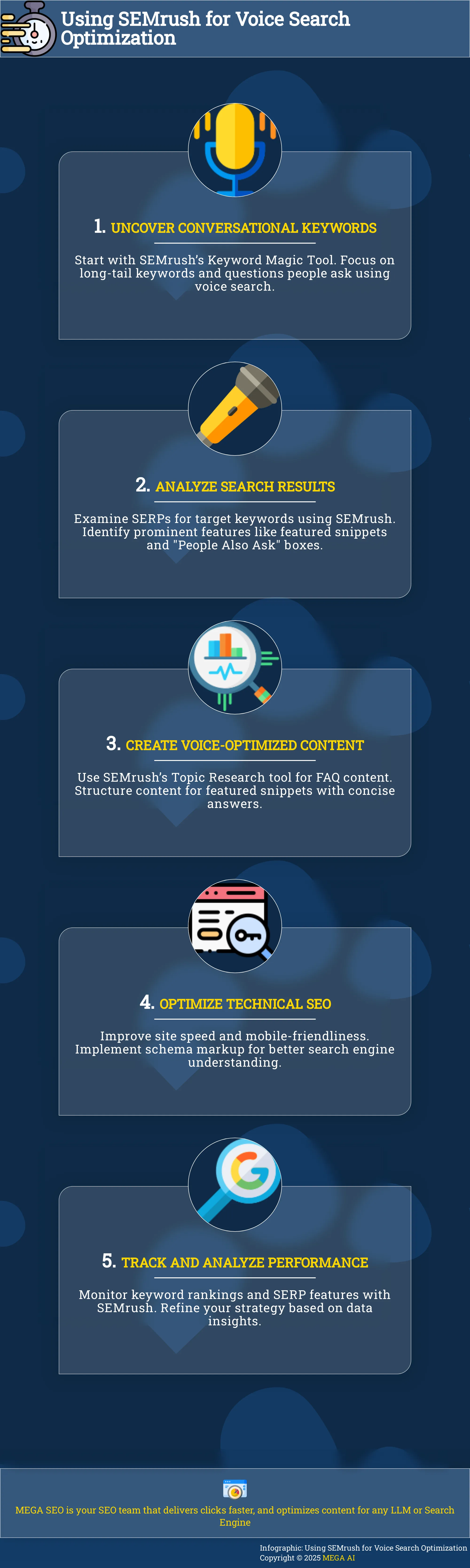
SEMrush offers several features that are especially helpful for voice search optimization. First, its keyword research capabilities are key. You'll want to concentrate on long-tail keywords—those longer, more specific phrases people naturally use when speaking. The Keyword Magic Tool is particularly effective for uncovering these conversational phrases and question-based keywords.
Next, analyzing search results is vital. Voice assistants frequently pull answers directly from SERP features like featured snippets and "People Also Ask" boxes. SEMrush allows you to examine the SERPs for your target keywords to see which features are prominent. You can then structure your content to target these positions. To monitor your progress, the Position Tracking tool lets you see your website's rankings and how often you appear in these SERP features. Since many voice searches occur on mobile devices, ensuring your site is mobile-friendly is essential. The Site Audit tool can help find any mobile SEO issues. Lastly, using schema markup helps search engines understand your content better, and SEMrush can help check its implementation.
Set Up Your SEMrush Workspace
Before you get started with the tools, take some time to truly understand your customer. What questions would they ask their voice assistant that relate to your products, services, or the problems you solve? This initial understanding will make your work within SEMrush much more focused and productive.
With a good grasp of your customer's likely voice search behavior, you can begin to configure your SEMrush workspace. Get familiar with tools like Keyword Overview, Domain Overview, and Organic Research to get a general sense of your current online standing and that of your competitors. The Keyword Magic Tool will be a primary resource for brainstorming voice search queries. As you compile your keyword lists, remember the criteria for a strong voice search keyword: high relevance to your business, reasonable search volume, relatively low ranking difficulty, and, crucially, alignment with the user's search intent. Setting up projects in SEMrush will enable you to track these keywords and your overall voice search performance effectively.
Find Keywords for Voice Search
Finding the right keywords is a cornerstone of any effective SEO strategy, and it’s just as crucial when we're talking about voice search. The way people interact with voice assistants, however, calls for a shift in our keyword research approach. When you type a search query, you likely use shorter, more direct phrases. But when you ask a question out loud to your smart speaker or phone, you tend to use complete sentences and a more natural, conversational tone. This often means your spoken queries are longer and phrased as questions.
To truly optimize your content for voice search, your goal is to identify these longer, highly specific phrases. It’s about moving beyond the typical short-tail keywords and zeroing in on terms that accurately reflect how people actually speak. Fortunately, platforms like SEMrush provide robust tools designed to help you discover these valuable voice search keywords. Grasping the subtleties of spoken queries allows you to create content that directly addresses what users are asking. This not only makes your website more discoverable in voice search results but also positions your brand as a helpful resource. It’s a fundamental change from just finding keywords to deeply understanding a distinct search behavior and refining your content strategy to match.
Use the Keyword Magic Tool for Long-Tail Keywords
SEMrush’s Keyword Magic Tool is a fantastic resource for uncovering long-tail keywords, which are essential for voice search. Voice searches are typically longer and more specific than typed searches. For instance, someone might type "pizza delivery" but ask their voice assistant, "Where can I get a pepperoni pizza delivered near me now?" That longer phrase is a perfect example of a long-tail keyword.
The Keyword Magic Tool allows you to explore a vast database of keywords and apply filters to find these specific, conversational phrases. When using the tool, focus on phrases that are three or more words long. You can also look for question-based keywords directly by filtering for terms like "how," "what," "where," and "when." This approach helps you identify the exact questions your audience is asking, making your content highly relevant.
Identify Conversational and Question-Based Queries
Voice searches are inherently conversational. People tend to ask questions just like they would to another person. Instead of typing "best coffee shop Austin," a voice search user is more likely to ask, "What's the best coffee shop in Austin?" or "Where can I find a good coffee shop near me?" This natural, spoken language is what you need to target.
To find these queries, think about how your audience speaks. Use tools like SEMrush's Keyword Magic Tool to specifically search for question keywords by including common question words such as "who," "what," "when," "where," "why," and "how." These modifiers will help you discover the precise phrasing people use in voice searches, allowing you to create content that directly addresses their spoken inquiries and provides immediate value.
Analyze User Intent in Voice Searches
Understanding the intent behind a search query is always important in SEO, and it’s particularly vital for voice search. When someone uses voice search, they usually have a clear goal in mind. Are they looking for information, trying to find a specific website, wanting to make a purchase, or seeking a local business?
There are generally four types of search intent you'll encounter:
- Informational: The user is seeking answers or knowledge (e.g., "How do I bake a cake?").
- Navigational: The user wants to go to a specific website or page (e.g., "Go to the MEGA AI blog").
- Commercial: The user is researching products or services, often comparing options (e.g., "Best noise-canceling headphones reviews").
- Transactional: The user is ready to make a purchase or complete an action (e.g., "Order a taxi now"). By analyzing the intent behind potential voice search keywords, you can create content that directly meets the user's needs at that specific moment.
Create Voice-Optimized Content with SEMrush
Once you've identified promising voice search keywords, the next step is to create content that directly addresses these queries. This is where your research translates into tangible assets that can capture voice search traffic. SEMrush offers several tools that can help you craft compelling, voice-friendly content. Let's look at how you can use them to your advantage, ensuring your message resonates clearly with both search engines and your audience.
Use the Topic Research Tool for FAQ-Style Content
Voice searches often take the form of questions, making FAQ-style content highly effective. SEMrush’s Topic Research tool is particularly helpful here. When you input a core topic, the tool uncovers related subtopics and common questions users are asking. You should look for the "Questions" cards and also draw inspiration from the 'People Also Ask' boxes in Google search results, which this tool helps identify. Use these insights to build dedicated FAQ pages or weave Q&A sections into your existing articles, providing direct answers to your audience's spoken queries.
Structure Content for Featured Snippets
Voice assistants frequently source their answers from featured snippets, those answer boxes appearing at the top of Google's results, often called 'Position Zero.' To improve your chances of securing a featured snippet and being the voice assistant's choice, structure your content for clarity. This means providing concise, direct answers to common questions. Think in terms of short paragraphs, ideally around 40 to 50 words, or use bullet points and numbered lists. When SEMrush helps you pinpoint a question-based keyword, craft a succinct answer that Google can easily pull for a snippet.
Use SEO Writing Assistant for Natural Language
People use natural, conversational language when performing voice searches, so your content should mirror this style. Write as if you're explaining something to a friend, using simple sentences and an active voice while avoiding unnecessary jargon. SEMrush’s SEO Writing Assistant is a valuable tool for this. As you compose your content, it analyzes your text for readability and tone. It can guide you in simplifying complex phrasing and ensuring your language flows naturally, making it more accessible for voice search and enhancing the overall user experience.
Technical SEO for Voice Search
Technical SEO forms the foundation of a website that performs well in any search, and voice search is no different. Think of it as ensuring your website communicates effectively with search engines and voice assistants. When someone asks their device a question, you want your site to be a primary candidate for providing that answer. This means making sure your site is fast, easy to use on any device, and clearly understood by search engines. Getting these technical aspects right is like building a strong stage for your content to perform on; without it, even the best content might not be heard by voice assistants. Voice search queries often demand immediate, concise answers, and a technically sound website is far more likely to deliver that.
Many businesses find the technical side of SEO a bit daunting, but it's really about making your website accessible and understandable. While platforms like MEGA AI can automate many technical SEO improvements, understanding these core elements helps you direct your overall strategy and make informed decisions. It’s about creating a seamless experience for both users and search engine crawlers. For voice search, this seamless experience is even more critical because users aren't browsing; they're listening for a direct response. We'll explore some key technical areas where a tool like SEMrush can help you identify opportunities and refine your site for better voice search results, ensuring your message reaches your audience clearly and efficiently. These areas include site speed, mobile-friendliness, structured data, and local signals, all of which play a significant role in how voice assistants find and present information.
Improve Site Speed and Mobile-Friendliness
Many voice searches happen on mobile devices, making a speedy, mobile-friendly website essential. Users expect quick answers, and a slow site means they might leave before your content even loads. Your website needs responsive design to adapt to different screen sizes, with easy-to-read content. Long, dense paragraphs are a no-go for mobile users, especially when they're looking for a quick voice response. You can use tools like Semrush's Site Audit to find and fix technical problems that slow your site or cause mobile display issues, ensuring a smooth user experience for everyone.
Implement Schema Markup
Schema markup is code you add to your website to help search engines better understand your content—it provides extra context. For voice search, this is highly valuable because search engines often pull answers from clearly defined content. For instance, schema can specify if content is an FAQ, a recipe, or an event, making it easier for search engines to recognize your page as a relevant source for a voice query. Think of it as giving search engines a cheat sheet for your content. Google's Structured Data Markup Helper can assist in generating this code, and Semrush's Site Audit can then check its validity, ensuring it's implemented correctly.
Enhance Local SEO for Voice Queries
Many voice searches have local intent, like "coffee shops near me" or "hardware store open now." To capture this significant traffic, strong local SEO is crucial. Start by optimizing your Google Business Profile with accurate, complete information, including your address, hours, and services. Encouraging customer reviews also plays a big part. You should also use local keywords naturally within your website content. Tools such as Semrush's Listing Management tool can help you manage your local listings across various directories, ensuring consistency and accuracy, which are vital for voice assistants providing local information to users on the go.
Optimize for Local Voice Searches
Voice search is a big deal for local businesses, and it's easy to see why. Think about how often people ask their phones or smart speakers for "pizza places near me" or "bookstores open now." These are inherently local queries. To effectively capture this ready-to-act local traffic, your online presence needs to be finely tuned for how people actually speak when they search. This means ensuring your business information is not just accurate, but also consistently presented and easily accessible across the web. Many voice searches are location-based, so if your details are muddled or outdated, you're likely missing out on customers who are actively looking for what you offer.
A solid local SEO strategy is foundational here. While specific tools can help manage your listings, remember that your overall website's SEO health also contributes significantly. A well-structured, fast, and mobile-friendly site is more likely to perform well in all types of searches, including voice. For businesses looking to streamline these efforts, exploring platforms that offer end-to-end optimization can be a game-changer. If you're curious about how comprehensive AI-driven SEO can simplify this, you might consider booking a demo to see it in action. The goal is to make it as easy as possible for voice assistants to find and recommend your business when a local customer comes calling. Making sure your digital storefront is as welcoming and informative as your physical one is key to converting those voice inquiries into actual foot traffic or online orders.
Use SEMrush's Listing Management Tool
One effective way to manage your local online presence for voice search is by using SEMrush's Listing Management tool. Think of this tool as your central command for ensuring your business's core information—your Name, Address, and Phone number (NAP)—is accurate and consistent everywhere it appears online. It helps you distribute and monitor your listings across a multitude of platforms, from major directories to niche sites.
Why is this consistency so important for voice search? Voice assistants rely on these online listings to pull information. If your NAP details are uniform across the web, it signals to search engines that your information is reliable. This increases the likelihood that your business will be suggested when someone makes a relevant local voice query. Inconsistent information can confuse search engines and may lead to your business being overlooked, even if you're the perfect match for the user's request. This tool helps you avoid that pitfall by simplifying the often tedious task of keeping all your local citations in sync.
Improve Your Google Business Profile
Your Google Business Profile (GBP) is a critical asset for local voice search optimization. For many local queries, especially on Android devices or Google Home speakers, Google will heavily rely on the information within GBP listings. Therefore, claiming and thoroughly optimizing your profile is an essential step. Start by ensuring your Name, Address, and Phone number (NAP) are precisely correct and match what’s on your website and other online directories.
Beyond the basics, enhance your GBP to make it more informative and engaging. Add high-quality photos of your business, products, or services. Post regular updates, such as special offers, new arrivals, or events. Actively encourage your satisfied customers to leave reviews, and be sure to respond to them. These elements not only improve your visibility in local map packs and search results but also provide rich, current data that voice assistants can use to answer user queries more effectively, significantly increasing your chances of being featured.
Track and Analyze Voice Search Performance
Creating voice-optimized content is a great first step, but the work continues after publishing. To understand what resonates with your audience and how voice assistants interpret your pages, consistently track and analyze your performance. This ongoing process helps refine your approach and ensure your efforts are effective.
Set Up Position Tracking for Voice Search Keywords
Knowing where you stand is key to improvement. Keep a close eye on how your website ranks for specific voice search keywords—long-tail, conversational phrases and questions. Tools like Semrush's Position Tracking allow you to monitor your website's rankings and SERP features, which, as SEMrush notes, "helps you see what's working and what needs improvement."
Regularly checking these rankings helps gauge the impact of your content changes and technical optimizations. A dip signals a need to investigate; an improvement shows you’re on the right track. This data is vital for informed decisions.
Monitor SERP Features for Voice Search
Voice assistants often pull answers directly from SERP features like featured snippets, "People Also Ask" boxes, and local packs. These are prime spots for voice search visibility. It's essential to "examine the search engine results pages (SERPs) for your keywords. Pay close attention to SERP features...because voice assistants often pull answers from these."
When you monitor these features for target keywords, you can identify opportunities to capture them. If a competitor holds a featured snippet, analyze their content to provide a better, more concise answer. Securing these SERP features significantly increases your content's chances for a voice search response.
Analyze Metrics and Refine Your Strategy
Voice search optimization is a continuous cycle: implement, analyze, refine. As the landscape and user behavior change, your strategy must adapt. You should "regularly analyze your performance metrics to refine your strategy and ensure you are meeting the evolving needs of voice search users."
Look at keyword ranking trends, owned SERP features, and user engagement. Are FAQ pages performing well? Are local listings driving queries? Use these insights to fine-tune content, adjust keywords, or explore new voice-friendly content. Platforms like MEGA AI can support this by helping you optimize existing content using performance data. This iterative process keeps you ahead.
Avoid Common Voice Search Optimization Mistakes
Optimizing for voice search can feel like a new frontier, but by sidestepping a few common pitfalls, you can set your strategy up for success. It’s about understanding how people actually talk to their devices and ensuring your online presence is ready to meet those queries head-on. Let's look at some key areas where marketers sometimes stumble and how you can steer clear, making your content more accessible to voice assistants and the people using them.
Don't Neglect Conversational Keywords
One of the biggest shifts with voice search is the language itself. People don't typically type "best pizza downtown" into a search bar, but they might ask their smart speaker, "Hey Google, where's the best pizza downtown?" This means your keyword strategy needs to adapt. Instead of focusing solely on short, abrupt keywords, you'll want to incorporate long-tail keywords and complete questions that people naturally use in conversation. Think about the "who, what, when, where, why, and how" questions related to your products or services. Tools designed for keyword research can be incredibly helpful for uncovering these conversational phrases and understanding the specific questions your audience is asking their voice assistants.
Don't Overlook Local SEO
A significant portion of voice searches carry local intent. Consider how often you might have asked your phone for "coffee shops near me" or "hardware store open now." If your business serves a local clientele, this presents a substantial opportunity. It's crucial to ensure your Google Business Profile is meticulously updated with your correct name, address, and phone number (NAP). Selecting the appropriate business categories and actively encouraging customer reviews also plays a vital role. These "near me" searches are a staple of voice assistant interactions, so ensuring your local information is accurate and easily accessible is fundamental for attracting customers in your vicinity.
Don't Ignore Technical SEO
The technical health of your website is foundational for voice search success. Voice assistants prioritize delivering answers quickly and efficiently. This means your website needs to load fast, especially on mobile devices, as many voice searches happen while people are on the go. A responsive design that seamlessly adapts to any screen size is essential. Furthermore, your site must be secure, consistently using HTTPS. Regularly performing a site audit with comprehensive SEO tools or checking your site's speed with resources like Google PageSpeed Insights can help you identify and fix technical issues that could hinder your voice search performance. These elements contribute to a smooth user experience, which search engines tend to favor.
Advanced Voice Search Strategies with SEMrush
Once you've covered the basics of voice search optimization, it's time to explore more advanced strategies to truly get ahead. This involves looking closely at what your competitors are doing and staying flexible as voice search technology continues to evolve. Using a powerful tool like SEMrush can provide the data and insights you need to refine your approach.
Use Competitive Research for Voice Search Insights
Understanding what your competitors are doing successfully can give you a significant edge in voice search. Start by examining the search engine results pages (SERPs) for your target keywords. Pay special attention to SERP features like featured snippets, "People Also Ask" boxes, and local packs, as voice assistants frequently pull answers directly from these elements.
SEMrush offers tools that allow you to research keywords, analyze your competitors, and pinpoint terms that have good search volume but lower difficulty. For instance, the Keyword Gap Tool is particularly helpful. It compares your website's keywords to those of a competitor, revealing terms they rank for that you might be missing. This insight allows you to identify new content opportunities or areas where you can improve existing pages to better capture voice search traffic.
Adapt to New Voice Search Trends
The way people find information online is constantly changing, and voice search is a major driver of this transformation. It’s creating fresh opportunities for businesses that are ready to adapt. One key shift is the move towards more conversational queries. Instead of typing "best pizza downtown," someone might ask their voice assistant, "Where can I find the best pizza near me right now?" This means your content needs to align with this natural, question-based language.
Voice search is especially significant for local businesses. Make sure your Google Business Profile is fully optimized with accurate name, address, and phone number (NAP) information, and that you’ve selected the most relevant business categories. Staying informed about new developments in voice search technology and user behavior is also vital for maintaining your competitive advantage and ensuring your strategies remain effective.
Related Articles
- Optimizing Your Website for Voice Search: A Comprehensive SEO Guide - MEGA SEO | Blog
- How to Optimize Your Website for Voice Search in 2024
- Master Majestic for Voice Search Optimization
- Emerging SEO Trends: Harnessing AI and Voice Search for Your Blog - MEGA SEO | Blog
- Local SEO for Roofing Companies: A 2024 Guide
Frequently Asked Questions
What's the most significant difference I should keep in mind when optimizing for voice search versus traditional typed search? The biggest shift is how people phrase their searches. With voice, queries are much more conversational and often take the form of full questions, like "What are the best running shoes for beginners?" instead of just typing "best running shoes." This means your content needs to anticipate and directly answer these natural language questions.
How can a tool like SEMrush help me find the right kind of keywords for voice search? SEMrush is really useful for uncovering those longer, more conversational phrases people use when speaking to their devices. Its Keyword Magic Tool, for example, can help you identify question-based keywords—think phrases starting with "how," "what," or "where"—which are very common in voice searches. This helps you target the exact language your audience uses.
Why is local information so critical for voice search, and what's one simple thing I can do to improve my local voice search presence? Many voice searches are for local businesses or services, like "find a coffee shop near me." If your business serves a local area, being visible in these searches is key. A fundamental first step is to ensure your Google Business Profile is completely filled out and accurate with your correct name, address, phone number, and business hours.
My content is great, but how do I increase its chances of being chosen for a featured snippet, which voice assistants often use? Voice assistants love clear, concise answers. To aim for featured snippets, structure parts of your content to directly answer common questions related to your topic. Think about providing short, to-the-point paragraphs or well-organized lists that Google can easily pull as a direct response.
Is optimizing for voice search something I do once, or does it require ongoing effort? Voice search optimization isn't a set-it-and-forget-it task. User behavior and search engine algorithms are always evolving. It's important to regularly track how your content is performing for voice search queries, monitor if you're appearing in SERP features, and be prepared to refine your content and keyword strategy based on what you learn.