Turning your local business into a neighborhood name requires more than just great service; it demands a strong online presence where local customers can easily find you. Local SEO is the critical component for achieving this, but it often requires a dedicated approach and the right set of tools to manage effectively. If you're looking for a clear roadmap to improve your visibility in local search results, SEMrush offers a powerful solution. This article moves beyond theory, providing actionable steps and practical guidance. We will focus on how to use SEMrush for local SEO, breaking down its features into manageable tasks that you can implement to optimize your listings, find the right local keywords, and ultimately connect with more customers in your community.
Key Takeaways
- Build a Strong Local Base: Start by ensuring your Google Business Profile is accurate and complete, then use SEMrush to find the precise search terms your local audience uses.
- Understand Your Local Scene: Regularly manage your online reviews to build customer confidence, and use SEMrush to learn from your local competitors' online tactics.
- Refine and Monitor Your Approach: Develop content that addresses your local community's specific interests using SEMrush data, and keep an eye on your local search performance to make informed adjustments.
What is Local SEO & Why Your Business Needs It
If your business serves customers in a specific geographic area, understanding local SEO is incredibly valuable. Think of local SEO as a specialized part of search engine optimization that focuses on making your business more visible in local search results. When someone nearby searches on Google or Google Maps for terms like "best pizza near me" or "electrician in [your city]," local SEO is what helps your business appear. It's distinct from general SEO because search engines, particularly Google, use different signals to rank local businesses, emphasizing relevance to the searcher's current location.
So, why is this so important for your business? Consider that billions of local searches occur every single month. That represents a vast number of potential customers actively looking for the products or services you offer. If your business isn't optimized for these local searches, you're likely missing out on opportunities to connect with these nearby customers. A critical aspect of local SEO involves ensuring your business's Name, Address, and Phone number (often called NAP) are consistent and accurate across all online platforms. By investing in a solid local SEO strategy, you can effectively drive more foot traffic to your physical store or generate more inquiries for your services, which directly contributes to increasing your sales and growing your business.
Set Up SEMrush for Local SEO Success
Getting your local SEO strategy off the ground means starting with a solid foundation. While SEMrush is a powerful platform with many features, a focused setup will help you make the most of its capabilities for your local business. Think of it as drawing your map before you start your journey. By configuring SEMrush correctly from the outset, you ensure that the data you gather and the actions you take are truly relevant to attracting customers in your specific service area. This initial setup is key to unlocking insights that can make a real difference to your visibility in local search results. Let's walk through how to get your SEMrush account ready to tackle local SEO.
Discover Key SEMrush Features for Local Search
SEMrush offers a suite of tools specifically designed to help businesses improve their local search presence. For instance, its keyword research capabilities allow you to find the specific words and phrases people use when searching for businesses like yours locally. Beyond that, the Listing Management tool is essential; it helps you distribute and maintain accurate business information across numerous online directories, which is crucial for local SEO consistency. Another valuable asset is the Map Rank Tracker, allowing you to monitor how your business ranks on Google Maps for your target keywords in specific geographic areas. You can even see how competitors are faring. Finally, the Review Management tool centralizes your customer reviews from platforms like Google Business Profile, helping you monitor feedback and engage with your audience effectively. Understanding these features will help you prioritize your efforts.
Configure Your SEMrush Account for Local SEO
To effectively use SEMrush for local SEO, begin by connecting and optimizing your Google Business Profile (GBP). SEMrush often provides direct integrations or guidance for this. Ensure your GBP information, such as your business name, address, phone number (NAP), and operating hours, is accurate and consistent. Next, you will want to conduct local keyword research. Use tools like SEMrush's Keyword Magic Tool, filtering for your specific location to find terms your local customers are actually searching for. Set up a project in SEMrush for your website and configure the Position Tracking tool. Add your target local keywords and specify your business's location to accurately monitor your rankings in the geographic areas that matter most to your business. This initial configuration will provide a clear dashboard for your local SEO performance.
Find Winning Local Keywords with SEMrush
Finding the right keywords is really the foundation of a strong local SEO strategy. You want to make sure you’re connecting with customers right in your neighborhood who are actively looking for what you offer. It’s not just about guessing what people type into Google; it’s about using data to discover those terms. This is where a powerful tool like SEMrush can make a huge difference. It helps you uncover those "winning" local keywords that can really improve your visibility in local search results and bring relevant customers to your business.
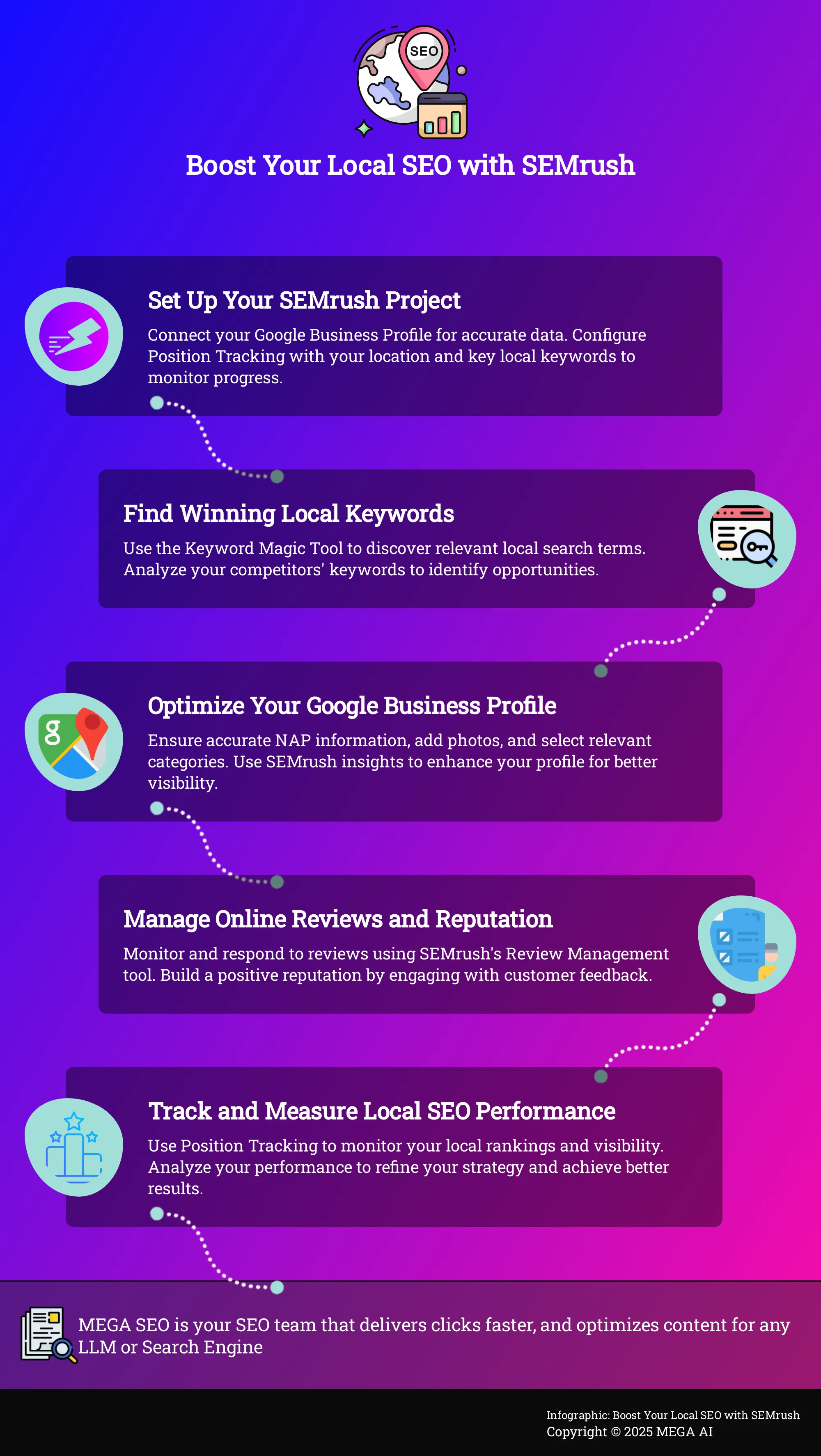
Think of SEMrush as your local keyword detective. It has a bunch of features designed to help you understand what your local audience is searching for, what terms your local competitors are ranking for, and how challenging it might be to rank for those terms yourself. When you use these insights, you can build a focused keyword list. This list becomes the backbone of your local content strategy, how you optimize your Google Business Profile, and even your efforts to build local links. Let's walk through how you can use specific SEMrush features to find the most impactful keywords for your local business, making sure your marketing efforts are both smart and effective.
Use the Keyword Magic Tool for Local Terms
To effectively find local keywords, SEMrush's Keyword Magic Tool is a fantastic starting point. Begin by typing in your main services along with your city or specific service area—for instance, "bakery Springfield." The tool then generates related keywords. It's helpful to focus on keywords based on their user intent; prioritize terms with 'commercial' (C) and 'transactional' (T) intent, as these usually mean people are researching options or are ready to buy.
Also, consider the search volume, as higher volume suggests more potential customers. Crucially, assess the Keyword Difficulty (KD) score. Aim for keywords with a low KD (often green or yellow in SEMrush), as these are generally easier to rank for. A KD score of 0-49% is a good target, especially for newer local businesses looking to gain traction without battling highly competitive terms. This approach helps you find achievable targets.
Analyze Your Local Competitors' Keywords
A really smart way to get ideas for effective local keywords is to see what’s already working well for your competitors. Start by doing a few Google searches for your main services in your local area, just like a potential customer would. Note down the businesses that consistently show up at the top of the local search results; these are your direct local competitors. Once you have this list, you can analyze their online strategies.
Copy a competitor's website URL and paste it into SEMrush's Domain Overview tool. This feature gives you a lot of information, including the organic keywords they are ranking for. This provides a direct look into the terms that are successfully bringing local traffic to businesses similar to yours. You can then look at these keywords for their relevance to what you offer, their search volume, and their KD score to decide if they are good ones for you to target.
Pinpoint Local Search Intent
Understanding what your local target audience is actually searching for is so important. This goes beyond just knowing the words they use; it’s about understanding the reason behind their search. Are they looking for information, comparing different options, or are they ready to buy something right now? Conducting thorough local keyword research helps you pinpoint this search intent so you can create content that truly meets their needs.
Use tools like SEMrush's Keyword Magic Tool to discover a wide range of local search terms related to your business. As you look through these terms, think about the implied intent. For example, a search like "best coffee shop open late near me" has clear intent. Additionally, you can analyze your competitors' websites using SEMrush's Organic Research tool. By identifying the keywords they rank for, especially on their key service pages, you can get more clues about the search intent that leads to conversions in your local market. This helps you refine your own keyword strategy effectively.
Optimize Your Google Business Profile with SEMrush
Your Google Business Profile (GBP) is often the first impression local customers have of your business. Think of it as your digital storefront. Keeping it polished and current is key, and SEMrush offers tools to help you manage and enhance it. A well-optimized GBP makes it easier for local searchers to find you and choose your business. Let's see how SEMrush can make your GBP shine.
Audit and Enhance Your Current GBP
First, ensure your Google Business Profile accurately represents your business. If you haven't already, claim and verify your GBP listing. Once claimed, meticulously review every detail: business name, address, phone number (NAP), website, and current operating hours, including holiday adjustments. Select the most relevant categories and add specific attributes like "dine-in available" or "curbside pickup." High-quality photos are vital; Google notes they significantly increase direction requests and website clicks. SEMrush's listing management tool can help audit these details across various directories, ensuring consistency.
Apply SEMrush Tips for Better Local Visibility
With your foundational GBP information in place, SEMrush can help you take it a step further to improve local visibility. Start by understanding what local customers are searching for. You can use tools like SEMrush’s Keyword Magic Tool to uncover relevant local search terms. Think about how people in your area might look for your products or services. Beyond keywords, analyze your local competitors. SEMrush's Organic Research tool allows you to see which keywords they rank for, giving you insights into terms you might have missed. Ensure your GBP is not just complete but also compelling, with excellent photos and accurate hours.
Track Your Local Rankings and Performance
Optimizing your GBP isn't a one-time task; it requires ongoing attention. You'll want to know how your efforts are paying off and where you might need to make adjustments. This is where SEMrush's Position Tracking tool becomes invaluable. You can regularly monitor your rankings in Google Maps and the local pack results within Google Search for your target keywords. This tool can track your performance down to a specific ZIP code level, giving you a precise view of how visible you are to your local audience. By keeping an eye on your rankings and how they change, you can adapt your local SEO strategy.
Manage Online Reviews & Reputation with SEMrush
Online reviews and your business's reputation are incredibly important for local SEO. Think about it – when you're looking for a local service, what's one of the first things you check? Reviews, right? They build trust with potential customers and can even influence your search rankings. Managing this aspect of your online presence might seem like a lot, but SEMrush offers some handy tools to make it much more manageable. Let's look at how you can use SEMrush to keep your online reputation shining and attract more local customers.
Use SEMrush to Monitor and Respond to Reviews
Keeping an eye on what customers are saying about you online is a must. Positive reviews are fantastic for building trust and can give your local search rankings a nice lift. SEMrush offers a Review Management tool designed to help you track reviews from various platforms all in one place. This centralization is key because it saves you from hopping between different sites. More importantly, it allows you to promptly respond to both happy customers and those who might have had a less-than-perfect experience. Engaging with all types of feedback shows you value your customers and are committed to providing great service, which can turn a neutral or even negative situation around.
Build Your Reputation with Review Management Tools
Beyond just monitoring, actively building a positive reputation is where the real magic happens. SEMrush's tools can help you establish a solid online review management process. For instance, their Listing Management tool not only helps you monitor reviews from places like your Google Business Profile but also uses AI to suggest thoughtful responses. Some tools even offer automated reply options for straightforward reviews, saving you time, and can provide insights into how your competitors are faring with their reviews. Remember to actively encourage satisfied customers to leave reviews – just be sure you're not offering incentives for them, as that can go against platform policies. Consistently managing and responding to all reviews is a cornerstone of a strong local reputation.
Analyze & Outperform Local Competitors with SEMrush
Understanding your local competition is a cornerstone of a successful local SEO strategy. It’s not just about knowing who they are, but also what they’re doing right and where their weaknesses lie. When you have a clear picture of the competitive landscape, you can make smarter decisions to help your business stand out. SEMrush offers a powerful suite of tools that can help you dissect your competitors' online presence, benchmark your own performance, and ultimately, find ways to outmaneuver them in local search results. Think of it as getting a behind-the-scenes look at what makes your local rivals tick, so you can fine-tune your own approach for maximum impact. Let's explore how you can use SEMrush to get this valuable insight and use that knowledge to your advantage.
Identify Your Top Local Competitors
Before you can effectively compete, you need to know exactly who you’re up against in your specific area. A practical first step is to search on Google for the services or products you offer, much like a potential customer would. Note the businesses that consistently appear. Once you have this initial list, SEMrush can help you dig deeper. By copying a competitor's website URL and pasting it into SEMrush's Domain Overview tool, you can quickly discover the organic keywords they are ranking for. This insight is invaluable because it helps you understand which competitors are truly vying for the same audience and search terms, giving you a clear view of the competitive field.
Benchmark Your Performance
After identifying your key local competitors, the next step is to see how your own business measures up. Benchmarking your performance is essential for understanding your current standing in the local market and for setting realistic improvement goals. SEMrush provides robust local SEO tools that allow you to track your daily online performance with precision. You can monitor your rankings for specific keywords, see how you perform on different devices like desktops versus mobile phones, compare your visibility against competitor domains, and even analyze search engine performance right down to the ZIP code level. This detailed data offers important insights into your visibility and effectiveness in local search, highlighting areas where you're strong and where you need to focus your efforts.
Uncover Competitor Strategies with SEMrush
Knowing who your competitors are and how you stack up is just the beginning. To truly gain a competitive edge, you need to understand their strategies. SEMrush's Organic Research tool is incredibly useful for this. By entering a competitor's website into this tool, you can see the keywords they rank for, which of their pages attract the most traffic, and even get an idea of their overall content strategy. Understanding their keyword targeting and how they structure their content can provide a wealth of inspiration for your own approach. This isn't about simply copying them, but rather about identifying effective tactics and finding opportunities to differentiate your business and refine your strategy to better serve your local audience.
Build a Strong Local Link Strategy with SEMrush
Think of backlinks as votes of confidence from other websites. When another site links to yours, it signals to search engines that your content is valuable and trustworthy. For local businesses, this is especially powerful. Getting links from other well-regarded local websites can significantly improve your visibility in local search results. It's like getting a recommendation from a respected neighbor – it carries weight, helping potential customers in your area find you more easily.
Building a strong local link strategy might sound a bit involved, but it’s a crucial piece of the local SEO puzzle. The good news is that tools like SEMrush can simplify this process considerably. Instead of manually scouring the internet for potential link partners, SEMrush helps you identify relevant opportunities and track your progress. It’s about working smarter, not just harder, to build those valuable local connections that tell search engines you’re a key player in your community. This focused effort can lead to more local customers finding your business when they need your products or services. Remember, quality often trumps quantity here; a few strong, relevant local links can be more beneficial than many generic ones. Investing time in this area can yield substantial returns for your local presence.
Find Local Link Opportunities Using SEMrush
To kickstart your local link-building efforts, you need to know where to look. SEMrush offers features that can help you uncover these valuable opportunities. As the experts at SEMrush point out, "To enhance your local SEO, it’s crucial to get links from other websites to your own. Focus on acquiring links from relevant local websites, as these will have a greater impact on your local search rankings."
Think about local community blogs, business associations, non-competing local businesses you partner with, or even local event sponsorships. SEMrush can help you analyze the backlink profiles of your local competitors to see who is linking to them – these could be great prospects for you too. You can also use its tools to search for mentions of your brand or relevant local keywords, which might reveal websites already talking about you or your industry locally, making them prime candidates for a link request.
Monitor and Improve Your Local Backlinks
Securing backlinks is just the first step; understanding their impact is an ongoing process. SEMrush provides tools to help you keep an eye on your local backlink profile. For instance, you can "Utilize SEMrush's Position Tracking tool to monitor your local backlinks. This tool allows you to see which strategies are effective and which areas require improvement, ensuring that your local link-building efforts are optimized." This helps you see if your efforts are improving your rankings for local keywords.
A strong backlink strategy is often supported by other solid SEO practices. As highlighted in insights on using SEMrush for local SEO, you should also "leverage SEMrush to identify the best keywords for your business and optimize your Google Business Profile. Creating high-quality, locally relevant content will further enhance your backlink strategy." Valuable local content naturally attracts links. Regularly checking your backlink profile in SEMrush also helps you spot and manage any potentially harmful links.
Track & Measure Local SEO Performance with SEMrush
Understanding how your local SEO efforts are performing is key to refining your strategy and achieving better results. SEMrush offers robust tools to help you monitor this effectively. By focusing on the right metrics and utilizing specific features, you can gain clear insights into your local search visibility and make data-driven decisions. Let's explore how you can track and measure your success.
Key Metrics for Local SEO Success
To effectively gauge your local SEO performance, it's important to focus on what Google prioritizes: relevance, distance, and prominence. Relevance refers to how well your business profile aligns with a person's search query. Distance considers the physical proximity of your business to the searcher. Prominence reflects how well-known and reputable your business is, often indicated by online reviews and your overall digital footprint. Keeping these key metrics central to your strategy will guide your optimization efforts, helping you become more visible to potential local customers. Understanding these elements clarifies where to direct your energy for the most significant impact.
Use SEMrush Position Tracking for Local Ranks
SEMrush's Position Tracking tool is a powerful asset for your local SEO. This feature is incredibly useful because it allows you to monitor your daily online performance with precision. You can track keyword rankings, see how you’re performing on different device types, monitor competitor domains, and even check search engine performance at a ZIP code level. Using these local SEO tools helps you understand exactly how your business appears in local search results, including the important local pack. This detailed insight allows you to make targeted adjustments to your campaigns.
Analyze Your Local Search Visibility
Consistently analyzing your local search visibility is essential for understanding what’s effective and where adjustments are needed. With SEMrush's Position Tracking tool, you get a clear picture of your performance over time. This ongoing analysis isn't just about checking your rank; it’s about understanding the real impact of your SEO activities. Are your chosen keywords delivering results? Are you gaining on local competitors? By regularly reviewing your visibility, you can refine your local SEO strategy, ensuring you remain competitive and continue to attract local customers.
Optimize Local Content with SEMrush Insights
Crafting content that truly connects with your local customers is a cornerstone of effective local SEO. It’s about understanding what people in your area are searching for and providing them with valuable solutions. SEMrush offers a powerful suite of tools to help you uncover these local insights. By leveraging this information, you can ensure your website speaks directly to your community, making your business their first choice. Let's explore how to use SEMrush to refine your content and attract more local customers.
Spot Local Content Gaps and Opportunities
To genuinely connect with your local audience, you first need to understand what they're looking for. This begins with thorough local keyword research. You can use tools like SEMrush's Keyword Magic Tool to discover the specific terms and phrases people in your geographic area use when searching for businesses like yours. Think about terms such as "best coffee shop in downtown [Your City]" or "emergency plumber near me."
Beyond identifying individual keywords, it's also wise to see what your local competitors are ranking for. By analyzing their websites with SEMrush's Organic Research tool, you can see which keywords are driving their local traffic. This process helps you spot gaps in your own content or identify opportunities to target keywords your competitors might have missed, allowing you to create more impactful local content.
Enhance Existing Content for Your Local Audience
Once you have a list of promising local keywords, the next step is to integrate them into compelling, location-specific content. This could mean creating dedicated service pages for different neighborhoods, writing blog posts about local events your business is involved in, or developing guides relevant to your local area. When deciding which keywords to focus on, SEMrush's Keyword Difficulty metric can be very helpful, as it allows you to prioritize terms that offer a good balance of search volume and ranking potential.
Remember, your goal is to create content that is not only optimized but also genuinely useful and comprehensive for your local audience. Address common questions your local customers might have and aim to provide thorough answers. Original, data-driven content that showcases your local expertise will always perform better and help build trust within your community.
Use SEMrush Writing Assistant for Optimized Local Content
Creating excellent local content is a great start, but ensuring it's perfectly optimized for search engines takes it to the next level. SEMrush's On Page SEO Checker is an invaluable tool in this regard. It analyzes your existing pages and provides clear, actionable recommendations to improve critical on-page SEO elements, which are vital for boosting your local search visibility.
This tool can guide you in refining everything from your URLs, ensuring they are SEO-friendly, to optimizing your title tags and meta descriptions to be concise and appealing to local searchers. It also offers advice on the correct use of header tags (H1-H6) for better content structure and highlights opportunities to add internal links with descriptive anchor text. Additionally, it can help you identify ways to improve website speed, a key factor for both user experience and search rankings.
Advanced SEMrush Tips for Multi-Location Businesses
If your business operates in several locations, you understand that local SEO isn't a one-size-fits-all campaign—it's a series of targeted efforts, all running simultaneously. Each of your storefronts or service areas exists within its own unique community, facing distinct competitors and a specific local search landscape. The core challenge is twofold: maintaining a cohesive brand identity and high operational standards across all your locations, while also customizing your SEO strategy to connect authentically with each local audience. This means diligently managing multiple Google Business Profiles, ensuring your Name, Address, and Phone number (NAP) details are accurate and consistent everywhere online, and effectively scaling your keyword research and content creation without your resources becoming stretched too thin. It’s a considerable task, but having the right tools in your arsenal can transform this complexity into a manageable process. SEMrush, with its comprehensive suite of features, provides robust solutions to streamline these multifaceted efforts. It empowers you to centralize your local SEO management, offering clear visibility into the performance of each individual location and helping you pinpoint growth opportunities across your entire business network. Consider it your strategic command center for conquering local search. The following advanced tips will walk you through specific SEMrush functionalities that are particularly beneficial for multi-location businesses, helping you not just manage, but truly optimize your local online presence for sustained success.
Manage Multiple Google Business Profiles Effectively
For businesses with several storefronts or service areas, keeping each Google Business Profile (GBP) optimized and active is fundamental. Your GBP is often the first interaction a local customer has with your brand. It's essential to complete your Google Business Profile for each location with precise information, including address, phone number, hours, and services. High-quality photos and videos can also make a significant difference. Beyond the initial setup, regular updates and posts keep your profiles fresh and engaging. Encourage your customers to leave reviews and make it a practice to respond to them—both positive and negative. This interaction shows potential customers that you value feedback. While SEMrush itself doesn't directly manage GBP content updates, its tools can help you track the performance impact of your GBP efforts, such as monitoring local rankings which are heavily influenced by a well-maintained GBP. You can also use SEMrush to find keywords that should be incorporated into your GBP descriptions and posts.
Scale Local SEO Across All Your Locations
Scaling your local SEO efforts effectively across numerous locations requires a systematic approach to keyword research and performance tracking. You need to understand how customers search for your services in each specific area. SEMrush's Keyword Magic Tool can be invaluable here. You can use it to discover location-specific keywords, perhaps by appending city names or "near me" to your core service terms. Also, consider using tools like the Keyword Gap tool within SEMrush to see what local keywords your competitors are ranking for in specific areas. Once you have your target keywords for each location, consistently track your rankings in Google Maps and local search results. SEMrush allows you to set up tracking for multiple geographic locations, giving you a clear view of how each branch is performing. This regular monitoring helps you see the impact of your local SEO strategies and make timely adjustments. If a particular location is underperforming, you can then dive deeper into its specific challenges.
Integrate SEMrush with Other Key Local SEO Tools
SEMrush provides a robust suite of local SEO tools, but its power can be further amplified when integrated or used alongside other essential local SEO platforms. One of the most critical aspects of local SEO is managing your business citations—mentions of your business name, address, and phone number (NAP) across various online directories. Consistency in your NAP information is vital for building trust with search engines. SEMrush's Listing Management tool is designed specifically for this. You can use this tool to check your business information across dozens of directories, identify inconsistencies, and distribute correct data. This helps ensure your information is accurate everywhere, which is a significant ranking factor for local search. By combining the analytical power of SEMrush for keyword research and rank tracking with specialized tools for citation management, you create a more comprehensive and effective local SEO strategy for all your business locations.
Related Articles
- Local SEO - MEGA SEO | Blog
- SEMrush Keyword Research: 2023 Step-by-Step Guide
- Google Business Profile Optimization: The Ultimate Guide
- Importance of Reviews and Ratings: How Positive Reviews Can Improve Local Search Rankings - MEGA SEO | Blog
- Mastering SEO for Local Businesses: Proven Techniques to Boost Community Visibility - MEGA SEO | Blog
Frequently Asked Questions
I'm new to SEMrush. What's the absolute first step I should take to get started with local SEO? If you're just getting started, your best first move is to set up a Project for your business in SEMrush. Make sure to connect your Google Business Profile and configure the Position Tracking tool with your primary business location and a handful of your most important local keywords. This creates a home base for your local SEO efforts and starts gathering essential data right away.
How regularly should I be looking at my local SEO performance in SEMrush? Is it a daily thing? While you don't necessarily need to check in daily, making it a habit to review your local SEO performance weekly or bi-weekly is a smart approach. This allows you to spot trends, see how your optimizations are working, and catch any issues early using tools like Position Tracking. Consistent monitoring helps you stay agile.
My business serves a local area, but I don't have a physical shop customers visit. Can SEMrush still help my local SEO? Yes, absolutely. Local SEO is just as important for service-area businesses. SEMrush can help you uncover the specific search terms people in your service area use to find businesses like yours. You can then use these insights to optimize your online presence, including your Google Business Profile and website content, so you appear in those crucial local searches, even without a traditional storefront.
SEMrush has so many features. Is there one that's particularly useful for local SEO that people might not immediately think of? Many people know SEMrush for keyword research, but its competitor analysis tools are incredibly valuable for local SEO. Examining what keywords your local competitors are ranking for and what their top-performing content looks like can give you a wealth of ideas for your own strategy. It’s like getting a peek at their playbook to find opportunities they might be missing.
Managing local SEO for several business locations sounds like a lot. How does SEMrush make this easier? It definitely can be a handful, but SEMrush offers features designed to streamline managing multiple locations. For instance, you can track keyword rankings for each specific location within a single project, making it easier to monitor performance across the board. Tools like the Listing Management feature also help ensure your business information is consistent and accurate for all your branches, which is a huge time-saver.