
Link building can sometimes feel like a treasure hunt, and "seed prospects" are your first crucial clues. These aren't just random websites; they are the initial, high-quality sites that have already linked to content similar to yours or even to your direct competitors. Uncovering these seed prospects is like finding the "X" that marks the spot, revealing why certain content earns links and how you can replicate that success. It’s about understanding the motivations, the context, and the patterns that drive linking decisions in your specific niche. This article will equip you with the techniques to become a skilled prospect detective, turning those initial clues into a robust list of valuable link-building opportunities.
Key Takeaways
- Understand Linking Motivations: Go beyond just identifying who links to similar content; dig into the reasons why they link to build a strong foundation for your outreach strategy.
- Combine Efficient Discovery with Diligent Vetting: Employ smart research methods, like competitor analysis, to find potential seed prospects, then thoroughly evaluate each one for relevance and quality to ensure they’re a good fit.
- Craft Personalized, Ethical Outreach: Develop outreach messages that clearly show you've done your homework on each prospect and offer genuine value, always prioritizing ethical practices to build lasting relationships.
What Are Seed Prospects in Link Building?
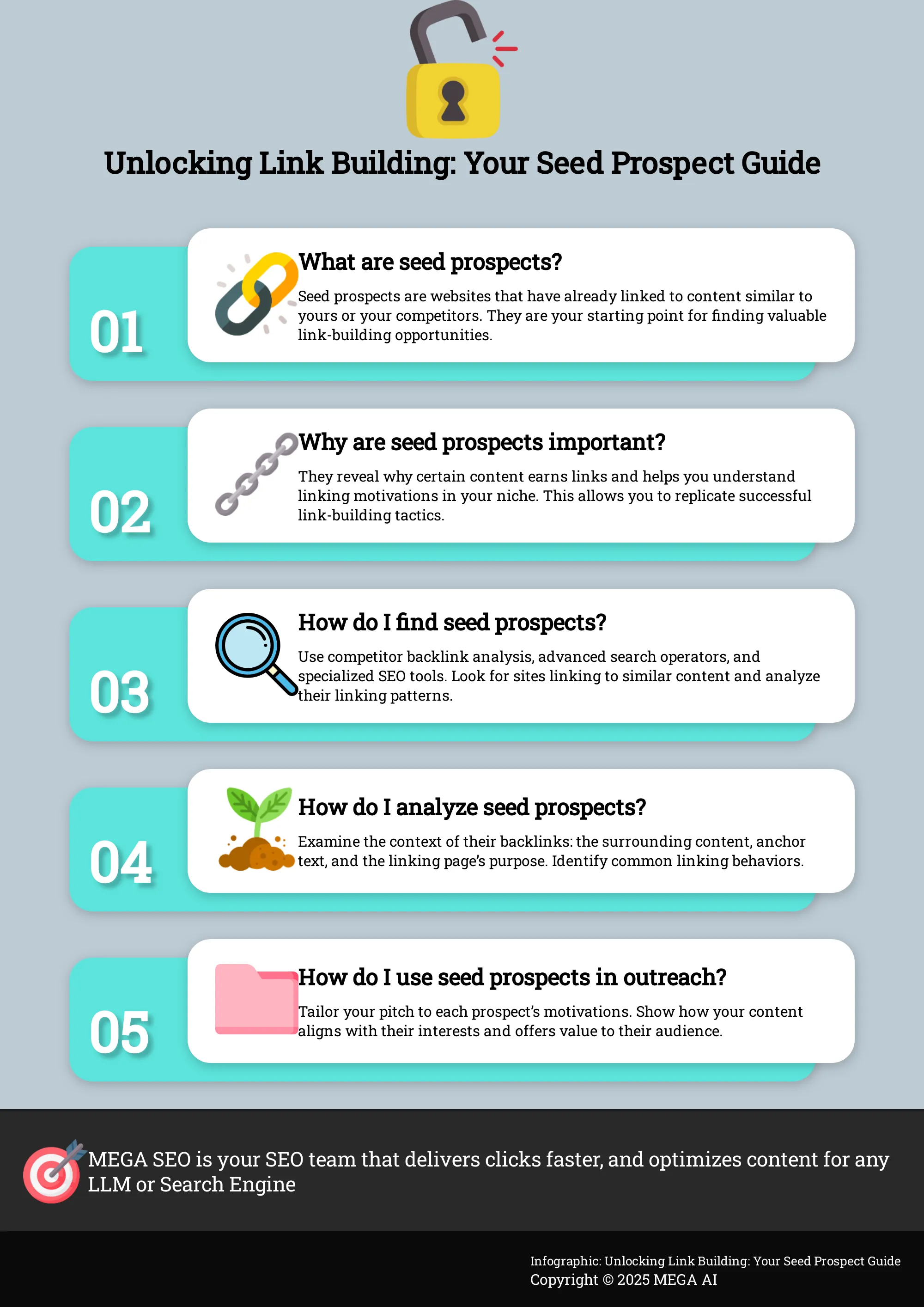
So, what exactly are "seed prospects" when we talk about link building? Think of them as your starting point, your initial group of websites or people who have already linked to content similar to yours, or even to your competitors. These aren't just any sites; seed prospects are those who link for a specific reason. For instance, did they link because a particular point resonated with them, or perhaps they admire the brand, or maybe it was something else entirely that caught their attention? Understanding this "why" is the core of identifying strong seed prospects.
Finding these initial linkers is super important for a couple of key reasons. First, it helps you truly understand why people are linking to a certain page or piece of content in your niche. What motivates them? What kind of information do they value enough to share with their audience? Second, once you know their motivation, you'll have a much clearer idea of how to approach them—and others like them—in your outreach. Your pitch will be more targeted and, frankly, more likely to succeed because it speaks directly to their interests. The real skill here is learning to identify patterns in why these sites link out. It’s about looking at the context of their existing backlinks to figure out their linking habits and preferences. This initial group will then "seed" your larger list of potential link-building opportunities, forming a solid foundation for your SEO strategy.
Why Seed Prospects Are Key to Effective Outreach
Think of seed prospects as the foundation of your entire link-building outreach. Getting this part right makes everything that follows smoother and much more effective. When you take the time to identify strong seed prospects, you're not just randomly collecting websites; you're gathering crucial intelligence that will shape your entire approach.
One of the biggest advantages of focusing on seed prospects is understanding why people link to certain content in the first place. As the team at Ahrefs explains, knowing the motivation behind an existing link is invaluable. Did they link because it was a comprehensive guide, a unique data point, or a helpful tool? Once you understand this "why," you'll have a much clearer idea of how to frame your outreach pitch to similar sites. You're no longer guessing what might appeal to them; you have evidence.
Beyond individual motivations, identifying seed prospects helps you spot broader patterns. Are many of your competitor's backlinks coming from resource pages, guest posts on industry blogs, or mentions in news articles? Recognizing these common linking patterns allows you to tailor your outreach strategy. If you see a pattern of sites linking to statistical roundups, and you have a great piece of content full of fresh data, you know exactly who to target and what angle to take. This targeted approach significantly increases your chances of success compared to a scattergun method.
Ultimately, building links in the right context is what truly strengthens your SEO efforts. When you secure links from relevant and authoritative seed prospects, your website becomes more authoritative and trustworthy in the eyes of both search engines and users. This isn't just about quantity; it's about the quality and relevance of those links. Failing to properly analyze potential link building prospects is a common misstep that can waste time and resources. Thorough seed prospect identification helps you avoid this pitfall and focus your energy where it counts. This careful selection also contributes to a diverse backlink profile, which search engines favor, rather than having too many links from just a few sources.
How to Analyze Backlink Patterns and Context
Understanding where your competitors' backlinks come from is a solid starting point, but to truly craft a winning link building strategy, you need to dig deeper. It’s not just about the quantity of links; the quality and, crucially, the context are what make a backlink valuable. This means looking at the surrounding content, the linking page's purpose, and identifying patterns in how websites in your niche tend to link to one another. When you analyze backlinks with this level of detail, you move beyond simple counting and start uncovering strategic insights that can significantly shape your approach.
This deeper understanding helps you identify high-quality link building opportunities that are more likely to result in actual backlinks for your own site. Think of it as understanding the "why" behind a link. Why did that particular site choose to link to that specific piece of content? Was it an authoritative resource, a unique data point, or an insightful opinion? By examining these motivations and spotting common linking behaviors, you can refine your own content strategy and outreach efforts. This allows you to focus your energy on creating content that naturally attracts links and on approaching prospects who have a demonstrated history of linking to similar material. It’s about working smarter, not just harder, to build a powerful and relevant backlink profile.
Uncover Link Motivations and Relevance
To really understand a backlink, you need to figure out why it was given. Was it a genuine editorial mention, part of a resource list, a guest post contribution, or something else? Look closely at the anchor text used and the content surrounding the link on the linking page. What is the overall topic of that page, and how does the linked content fit in? This detective work helps you determine if the link is truly relevant and adds value, or if it's just a low-quality citation. Understanding these motivations is key to replicating successful link building tactics and identifying prospects who are genuinely interested in the type of content you offer.
Spot Common Linking Patterns
As you analyze backlink profiles, you'll start to notice recurring themes or patterns. For instance, you might find that many sites in your industry link to comprehensive guides, original research, or free tools. Perhaps there's a trend of educational institutions linking to specific types of informational content. Identifying these common linking patterns helps you understand what kind of content attracts links in your niche. This insight is invaluable because it guides your content creation strategy, showing you what types of assets are most likely to earn backlinks. An effective analysis involves not just seeing individual links, but recognizing these broader trends to inform your approach.
Use Tools and Metrics for Smart Backlink Analysis
Manually sifting through every backlink can be overwhelming, which is where specialized tools come in handy. Platforms like Ahrefs, SEMrush, or Moz offer robust backlink analysis tools that provide a wealth of data. These tools can show you the number of referring domains, the authority of those domains (often measured by metrics like Domain Rating or Domain Authority), and the specific pages being linked to. Pay attention to the anchor text distribution as well, as it can reveal how other sites perceive the linked content. Many find Ahrefs a top choice due to its extensive link database, allowing you to get a comprehensive view of any site's backlink profile and make data-driven decisions for your link building efforts.
Master Seed Prospect Research Techniques
Once you understand what seed prospects are and why they matter for your link building efforts, the next step is to get really good at finding them. Think of this stage as laying the critical groundwork for a successful outreach campaign. It’s a bit like detective work, but for your website – you’re meticulously searching for those initial, high-quality sites that can unlock a much larger pool of link building opportunities. These aren't just any sites; they are the ones that signal relevance and authority, guiding you towards others in the same valuable ecosystem.
Mastering a few key research techniques will make this process not only more effective but also more strategic. It’s about moving beyond random searches and adopting a methodical approach. This means understanding how to dig deep, filter out the noise, and identify prospects that genuinely align with your content and goals. Consider this the foundation of your link building house; the stronger your initial research and the quality of your seed prospects, the more stable and impactful your entire link building structure will be. Without this careful groundwork, you might find yourself wasting time on outreach that doesn’t convert or, worse, acquiring links that don’t help your SEO. So, let's explore how you can refine your search, evaluation, and scaling skills to build a powerful list of seed prospects.
Use Advanced Search Operators and Filters
Think of advanced search operators as your secret toolkit for sifting through the vastness of the internet. Instead of just typing general keywords into a search engine, you can use specific commands to get much more precise results. For example, using site:.gov "keyword" or inurl:resources "keyword" can help you find specific types of pages on particular kinds of websites. This is incredibly useful when you're trying to identify sites that link to content similar to yours or find resource pages in your niche.
Learning to combine these operators can really sharpen your prospecting. You might search for “your keyword” + “guest post by” to find sites that accept guest contributions, or related:yourcompetitor.com to find sites similar to your competitors. Spend some time experimenting with these. It might feel a little technical at first, but once you get the hang of it, you’ll wonder how you ever managed without them. This precision helps you find relevant seed prospects faster, cutting down on the time you spend wading through irrelevant search results.
Evaluate Prospect Quality and Authority
Finding a potential prospect is just the first step; the crucial next part is figuring out if they're actually a good fit. Not all websites are created equal, and linking from a low-quality or irrelevant site can do more harm than good. It's a common misstep to skip a thorough analysis of potential link building prospects, but taking a few extra minutes here pays off. Look at the overall quality of the site: Is the design professional? Is the content well-written and current? Does it have a clear purpose and a real audience?
Beyond the look and feel, consider the site's authority and relevance. Tools can give you metrics like Domain Authority (DA) or Domain Rating (DR), which offer a general idea of a site's strength. However, always prioritize relevance. A site with slightly lower metrics but highly relevant content is often more valuable than a high-authority site in a completely unrelated niche. As experts suggest, you should always aim to build links on sites with content closely related to your industry to strengthen your SEO.
Scale Your Research Process Efficiently
Finding one or two great seed prospects is good, but to build a robust link profile, you need a scalable process. This doesn't mean sacrificing quality for quantity; it means working smarter. One of the most effective ways to scale is by analyzing your competitors' backlink profiles. See who is linking to them, especially to content similar to yours. This can reveal a wealth of opportunities you might not find otherwise. Many backlink analysis tools can help you do this efficiently, showing you where your competitors get their links.
Another way to scale is by developing systems. Create templates for your outreach, use spreadsheets or CRM tools to track prospects, and batch similar tasks together. For instance, dedicate a block of time just for identifying prospects, another for evaluating them, and another for outreach. While manual research is important for quality, leveraging tools like MEGA AI's SEO automation features can significantly speed up tasks like keyword research and identifying content gaps, freeing you up to focus on strategy and relationship building.
Avoid These Common Seed Prospect Identification Mistakes
Don't Ignore Relevance and Context
The relevance of a potential linking site to your niche is crucial. Imagine selling coffee beans; a link from a baking blog makes sense, but not from a car parts site. Outreach Monks advises to "build links on sites" with closely related content. This isn't just for SEO; it builds genuine authority. Relevant links signal trustworthiness to search engines and offer value to users. Always ask if a link aligns with your audience and brand, ensuring it strengthens your site's credibility in the right context.
Don't Depend on Just One Tactic or Source
If one link-building tactic works well, resist relying on it exclusively. This approach is risky and can make your backlink profile look unnatural. Should that single source or tactic fail, your strategy could suffer. Editorial.Link notes that "using only one link-building tactic" restricts link diversity. A healthy backlink profile shows variety. Incorporate guest posts, resource page links, and other ethical methods. This diversification builds a more resilient and natural-looking portfolio, protecting your efforts long-term.
Recognize the Value of Nofollow Links
It's easy to focus only on 'dofollow' links for their authority-passing benefits, but dismissing 'nofollow' links is a mistake. A backlink profile composed solely of dofollow links can appear artificial. As Outreach Monks mentions, "ignoring nofollow links" can create an unnatural profile and harm credibility. Nofollow links from reputable sites still drive relevant traffic and increase brand visibility. They contribute to a more natural and trustworthy link profile, playing a role in a balanced SEO strategy.
Perform Quick Audits on Potential Prospects
Before outreach, quickly vet potential link prospects. B2B Digital Marketers points out that many skip "analyzing the link building prospect" properly, which can lead to issues. A brief audit helps. Check site quality: Is it professional and updated? What's its domain rating? Examine its existing outbound links for spammy connections. Associating your brand with quality is vital. Using tools, like MEGA AI's SEO features, can simplify this analysis, helping you identify suitable, high-quality opportunities more efficiently.
How to Create Personalized Outreach Strategies
Once you've identified your seed prospects, the next crucial step is crafting outreach messages that actually get noticed and, more importantly, get a "yes." Gone are the days when a generic template blasted to hundreds of contacts would yield results. Today, personalization is paramount. It's about showing the prospect that you've done your homework, understand their needs, and are offering something genuinely valuable.
Think of it from their perspective: their inbox is likely overflowing. A message that clearly speaks to their specific interests or challenges will always stand out from the boilerplate requests. This doesn't mean you need to write a novel for each prospect, but it does mean taking the time to tailor your approach. This personalized touch not only increases your chances of acquiring a link but also helps in building genuine, long-term relationships, which are the cornerstone of sustainable link building. Effective outreach is a blend of understanding your prospect's world and clearly articulating how your content fits into it. Tools that help you analyze content and identify these connection points can be incredibly helpful in streamlining this process.
Tailor Your Pitch to Prospect Motivations
Understanding why someone might link to content similar to yours is the secret sauce to a compelling pitch. As the team at Ahrefs explains, knowing the motivation behind existing links on a prospect's site helps you understand how to approach them in your outreach. Are they frequently linking to pages with original data, in-depth tutorials, or perhaps expert commentary? Once you identify this pattern, you can frame your pitch to align with their preferences.
For instance, if a prospect often links to statistical roundups, and your content features fresh, relevant data, highlight that in your outreach. If they favor comprehensive guides, explain how your piece offers a thorough look at a topic their audience would appreciate. This targeted approach shows you've considered their content strategy and aren't just asking for a link blindly.
Show Value and Relevance in Your Content
Your outreach message needs to quickly and clearly answer the prospect's unspoken question: "What's in it for me and my audience?" It's not enough to just say your content is great; you need to demonstrate its specific value and relevance to them. Look at the anchor text and surrounding content of links on their site. These "linkable points," as Ahrefs calls them, reveal what they find valuable and why they chose to link to a particular piece of content.
When you reach out, reference a specific article or section on their website where your content would be a natural fit. Explain how your resource complements, updates, or expands upon information they've already shared. Perhaps your article offers a different perspective, newer data, or a practical solution to a problem their audience faces. By explicitly connecting your content to theirs, you make it easy for them to see the mutual benefit.
Develop Strong Value Propositions for Different Prospects
Not all prospects are motivated by the same things, so a one-size-fits-all value proposition won't be effective. You'll need to adapt your approach based on the type of website and the likely goals of the person you're contacting. For example, a blogger might be interested in fresh content ideas or a co-marketing opportunity, while the editor of a resource page might prioritize comprehensive, authoritative information.
Before reaching out, it's wise to do a quick check of the prospect's site to ensure it's a good quality site, a practice recommended by Link Building HQ. Then, segment your prospects and think about what unique value you can offer each group. This might mean offering an exclusive quote, a custom graphic, or simply a well-researched piece of content that perfectly fills a gap they have.
Address Challenges in Finding Seed Prospects
Finding the right seed prospects for your link-building efforts can sometimes feel like searching for a needle in a haystack. You might encounter messy data, struggle with finding that sweet spot between enough prospects and high-quality ones, or find your pipeline drying up. It's a common part of the process, but with a few smart approaches, you can manage these hurdles effectively and keep your outreach on track. Let's look at how to tackle some of these typical challenges.
Handle Noisy or Incomplete Backlink Data
When you start digging into backlink profiles, you'll quickly realize that not all data is clean or complete. Some tools might show outdated links, or the information might lack the context you need to make an informed decision. It's tempting to take every piece of data at face value, but that can lead you down the wrong path. A common misstep is "not analyzing the link building prospect by doing some light backlink audit, just to ensure that the website, where you want to build a backlink is a good prospect."
To cut through the noise, it's wise to perform a quick check on potential prospects. Look beyond just the number of backlinks. Consider the quality of the sites linking to them and whether those links seem natural and relevant. Tools that offer SEO analysis can help you filter and make sense of this data, allowing you to focus on prospects that genuinely align with your strategy rather than getting bogged down by irrelevant or low-quality information.
Balance Quality and Quantity in Your Prospect List
It's easy to get caught up in building a massive list of potential link prospects. While having options is good, prioritizing quantity over quality can dilute your efforts and lead to poor results. You want links that genuinely add value to your site and your audience. As experts often say, "Building links in the right context strengthens your SEO efforts and makes your website more authoritative and trustworthy in the eyes of search engines and users."
Focus on identifying prospects whose audience and content align with yours. A link from a highly relevant, authoritative site is far more valuable than dozens of links from unrelated or low-quality sources. Think about the user experience: would a link from this prospect make sense to your visitors? This approach ensures your link-building efforts contribute positively to your site's search engine ranking and overall credibility.
Build a Sustainable and Diverse Prospect Pipeline
Relying on just one method or source for finding seed prospects can leave your pipeline vulnerable. What happens if that source dries up or becomes less effective? The key to long-term success is to build a sustainable and diverse pipeline. This means exploring various avenues for discovering potential link partners. A great starting point is to analyze competitor backlinks.
"Checking your competitor’s backlinks can help you discover new places to get links for your website." Tools like Ahrefs, SEMrush, or even Google Search Console can reveal who is linking to your competitors, providing a ready-made list of relevant sites that are already interested in your niche. Beyond competitors, consider industry directories, guest blogging opportunities, and relevant communities. Diversifying your sources ensures a steady flow of prospects and reduces your reliance on any single tactic.
Follow Ethical Link Building Practices
Building links is a fundamental part of a robust SEO strategy, but the way you acquire those links is just as important as the links themselves. Ethical link building focuses on creating a sustainable, reputable online presence. This approach helps you earn high-quality backlinks that search engines value, rather than pursuing risky tactics that could harm your site in the long run.
Respect Prospect Preferences and Guidelines
Before reaching out for a link, invest time in understanding the website you're targeting. Many sites have specific preferences or guidelines for guest contributions and link placements, often found on "write for us" or contact pages. As the team at Outreach Monks advises, "Always build links on sites with content closely related to your niche or industry. Building links in the right context strengthens your SEO efforts and makes your website more authoritative and trustworthy." Demonstrating that you've done this initial research shows respect for their platform and significantly increases your chances of a positive reception, rather than having your request overlooked.
Be Transparent in Your Outreach
Clear and honest communication is crucial when building professional relationships, including those for link acquisition. When you contact a prospect, clearly state who you are, what your website offers, and why a link from their site would be relevant and beneficial to their audience. Vague requests or misleading subject lines are unlikely to yield good results. It's also a good practice to lightly vet potential sites. B2B Digital Marketers note that a common error is "not analyzing the link building prospect by doing some light backlink audit, just to ensure that the website, where you want to build a backlink is a good prospect." This diligence shows you're serious and value their site's integrity.
Build Genuine, Mutually Beneficial Relationships
Approach link building as an opportunity to create lasting connections, not just as a one-off transaction. Aim to establish relationships that offer value to both your site and the prospect's. Instead of simply asking for a link, think about what you can provide in return, such as exceptional content, a relevant reciprocal opportunity, or sharing their work with your own audience. As Link Building HQ suggests, "Pick one prospect from your list and perform a surface-level backlink audit...to make sure it doesn't contain a toxic backlink profile." This ensures you're partnering with quality sites, which is a win-win and can lead to more fruitful collaborations.
Use AI and Automation Responsibly in Your Link Building
Artificial intelligence and automation can be fantastic partners in your link building efforts, helping you work smarter, not just harder. When you thoughtfully integrate these technologies, you can process large amounts of information and streamline some of the more repetitive tasks. This frees you up to concentrate on what truly matters: building genuine connections and creating content that resonates. The trick is to strike the right balance, using technology to enhance your human efforts rather than replace them entirely. Platforms like MEGA AI are designed to help you automate SEO tasks intelligently, ensuring your link building is both effective and ethical. Let’s look at how you can responsibly use AI and automation to make your link building more efficient.
Apply AI for Backlink Analysis and Pattern Recognition
Understanding your own backlink profile, as well as your competitors', is a cornerstone of any solid SEO plan. As the team at Foundation Marketing puts it, "Analyzing backlinks is an essential part of any SEO strategy. It allows you to understand the strength of your off-site SEO and provides insights into your competitive landscape." AI is particularly good at sifting through extensive data to find patterns and insights you might otherwise miss. You can use AI-driven backlink analysis tools to quickly evaluate the quality and relevance of links. This tech helps you see common linking behaviors, identify key authoritative sites in your niche, and learn what types of content tend to attract valuable links, guiding your strategy.
Automate Prospect Qualification and Prioritization
Finding the right websites for backlink outreach can take a lot of time. Automation, guided by AI, can really speed up the early stages of figuring out who to contact. Instead of manually checking every potential site, you can use tools to filter prospects based on criteria you set, like domain authority, relevance, or traffic levels. It's still important to, as LinkBuildingHQ suggests, "perform a surface-level backlink audit... to make sure it doesn't contain a toxic backlink profile." AI can help with this initial check, flagging sites that meet your standards and setting aside those that don’t. This lets your team focus their detailed review on the most promising opportunities, ensuring your outreach is well-targeted.
Balance Automation with Human Insight
While AI and automation bring amazing efficiencies, they shouldn't take the place of human judgment in your link building. B2B Digital Marketers wisely note that "Not properly analyzing potential link building prospects... is a very common link building mistake that many make." AI can identify potential leads from data, but a human touch is often needed to truly assess a website's context and quality. Effective link building means ensuring that "Building links in the right context strengthens your SEO efforts and makes your website more authoritative and trustworthy," as highlighted by Outreach Monks. Human insight is key for crafting personalized messages, understanding content nuances, and building real relationships. Use automation for data crunching and initial filtering, but always apply human oversight.
Measure and Improve Your Seed Prospect Strategy
Finding the right seed prospects isn't a set-it-and-forget-it task; it's an ongoing process that you'll want to refine over time. Think of it like tending a garden – you need to regularly check in, see what’s flourishing, and adjust your approach accordingly. Regularly analyzing your current backlinks is a great starting point. This helps you understand what types of sites are already linking to you and can give you clues about what’s working and where new opportunities might lie.
As you build your list of potential seed prospects, it's wise to perform quick checks on them. Before you invest time in outreach, take a moment to evaluate a prospect's backlink profile using your preferred SEO tool. This step helps ensure you're targeting sites that meet your quality standards and aren't associated with spammy practices. Remember, the goal is to build connections that genuinely add value.
A core part of improving your strategy involves a consistent focus on contextual relevance. Pursuing links that make sense within the context of your content and for your audience will always yield better results. This means getting better at identifying sites where your content would be a natural fit and provide real value to their readers. Consistently evaluating link quality goes hand-in-hand with this, looking beyond simple metrics to understand the true potential of a link.
Finally, don’t be afraid to learn from your experiences. Not every outreach attempt will be successful, and that’s okay. Each interaction provides data. Pay attention to what resonates with prospects and what doesn't. Understanding and avoiding common link building mistakes, such as not thoroughly vetting prospects, will help you sharpen your seed prospect identification skills continuously. This iterative process of measuring, learning, and adjusting is what leads to a more effective and sustainable link building strategy.
Related Articles
- Link Building Strategies: The Ultimate Guide (2024)
- Off-Page Authority Building: 5 Powerful Strategies
- Backlinko Link Building: The Definitive Guide (2024)
- How to Use SEMrush for Backlink Analysis: Step-by-Step
- Startup Link Building: The Ultimate Guide (2024)
Frequently Asked Questions
What's the real difference between just any website I find and a "seed prospect"? Think of seed prospects as your starting lineup. They're not just random sites; they are websites that have already shown a tendency to link to content like yours or your competitors' for specific, identifiable reasons. The key is that "specific reason" – understanding their motivation for linking is what makes them a valuable seed to grow your larger outreach list from.
Why do you emphasize figuring out why a site linked to something before calling it a seed prospect? Understanding the "why" is like getting a peek into their content strategy and what they value. If you know a site links to content because it’s data-rich, or because it offers a unique perspective, you can then approach them (and similar sites) with content that you know aligns with their interests. It makes your outreach much more targeted and likely to succeed.
Is there a magic number of seed prospects I should find before I start broader outreach? There isn't a strict number, but you want enough to see clear patterns in why sites are linking within your niche. Instead of focusing on a quantity, focus on the quality of insights you gain. Once you feel you have a solid understanding of the common linking motivations and the types of sites that link, you can then use those patterns to find more prospects.
It sounds like finding seed prospects involves a lot of manual digging. Are there tools that can help? Manual analysis is definitely important for understanding context and motivation. However, SEO tools can significantly speed up the initial discovery process. You can use them to see who links to your competitors or to content similar to yours. Then, you apply your human insight to analyze those initial findings and identify the true seed prospects.
What if I find a website with really high authority, but its topic isn't a perfect match for mine? Is it still a good seed prospect? While high authority is tempting, relevance usually trumps general authority for seed prospects. A link from a highly relevant site, even if its authority metrics are a bit lower, often provides more value because it sends stronger contextual signals to search engines and is more likely to drive interested traffic. Your seed prospects should ideally be both relevant and reasonably authoritative.