
Voice search is undeniably changing how your customers find you online. They're asking questions aloud to their devices, expecting quick, direct answers. This fundamental shift means your traditional SEO tactics might not be cutting it anymore. You need to ensure your website speaks the language of voice assistants and is structured to provide those immediate responses. That's where a powerful tool like Screaming Frog SEO Spider comes into play. It’s well-regarded for its deep website crawling capabilities, but many marketers and business owners are now asking how to use Screaming Frog for voice search optimization? This article is your practical guide, walking you through configuring the tool, identifying key voice search ranking factors, and fixing technical hitches so your site is truly ready to be heard by your audience.
Key Takeaways
- Use Screaming Frog for Thorough Voice Search Checks: This tool acts like a detailed investigator for your website, helping you spot technical snags and content areas that could hinder voice assistants from accessing your information.
- Customize Screaming Frog for Targeted Voice Data: Set up custom extractions to pull specific details relevant to voice search, like question-phrased headings or schema markup, and connect it with Google Analytics and Search Console for a fuller picture of user behavior.
- Make Voice Search Optimization an Ongoing Process: Regularly use Screaming Frog to address technical issues, ensure your content uses natural, conversational language, and monitor your progress to maintain strong voice search performance.
What is Screaming Frog and How Can It Help with Voice Search?
If you're looking to refine your SEO approach, particularly for voice search, you've likely come across Screaming Frog. It’s a well-regarded tool among SEO professionals, and for good reason. Understanding its features can offer a significant advantage in optimizing your site for how people are searching today – often by speaking their queries. Let's look at what Screaming Frog is and how it specifically assists in preparing your website for voice search success.
Understanding Screaming Frog's Role in Voice Search
At its heart, "Screaming Frog is a powerful and flexible site crawler, able to crawl both small and very large websites efficiently, while allowing you to analyse the results in real-time." Consider it a detailed investigator for your website, meticulously checking every page and component. This crawling function is essential because it helps you view your website much like a search engine does. For voice search, this means it can identify technical issues or content gaps that might hinder voice assistants from easily finding and understanding your information.
By conducting a site audit, Screaming Frog helps you pinpoint areas needing attention for improved voice search performance. This could involve assessing mobile-friendliness, page speed, or the presence of clear, concise answers that voice assistants favor. It establishes the foundation for a more voice-friendly website by providing a thorough overview of your site's current SEO health and structure.
Why Voice Search Matters for Your SEO
Voice search is more than a passing trend; it represents a fundamental change in how people interact with technology and access information. Increasingly, users ask questions to their smart speakers or phones rather than typing queries into a search bar. Consequently, "Voice search queries are usually longer, more conversational, and use natural language and question words." This evolution means your SEO strategy must adapt.
Optimizing for voice search requires focusing on natural speech patterns and the types of questions people ask. It’s about delivering direct answers and ensuring your content is structured for easy comprehension by voice assistants. When you cater to these conversational queries, you not only improve your chances of appearing in voice search results but also enhance the overall user experience on your site. This can lead to greater visibility and engagement, making it a vital component of modern search optimization.
Key Screaming Frog Features for Voice Search Analysis
Screaming Frog is equipped with features particularly beneficial for voice search optimization. One of the most important is its capability to analyze structured data. As Screaming Frog explains, "Structured data provides search engines with explicit clues about the meaning of pages and their components and can enable special search result features and enhancements in Google." This is crucial for voice search, as it helps voice assistants quickly interpret and convey your content.
Moreover, "Screaming Frog offers multiple crawl modes that cater to specific use cases," enabling you to customize your analysis. You can configure crawls to concentrate on aspects directly affecting voice search, such as identifying pages with FAQ schema or analyzing content for question-based keywords. Once set up, "The SEO Spider will start extracting data from the pages and validating them," offering a clear view of what needs adjustment or improvement to better align with voice search best practices. This includes checking for thin content, slow loading times, or missing meta descriptions that could be optimized for conversational queries.
How to Set Up Screaming Frog for Voice Search Analysis
Getting Screaming Frog ready for voice search analysis involves a few key setup steps. By configuring the tool correctly and telling it exactly what to look for, you can gather precise data to inform your voice search optimization strategy. This initial setup is important because it ensures the information you collect is relevant and actionable, saving you time and effort down the line. Think of it as giving your powerful crawler a clear map and a specific mission.
Essential Configuration for Voice Search
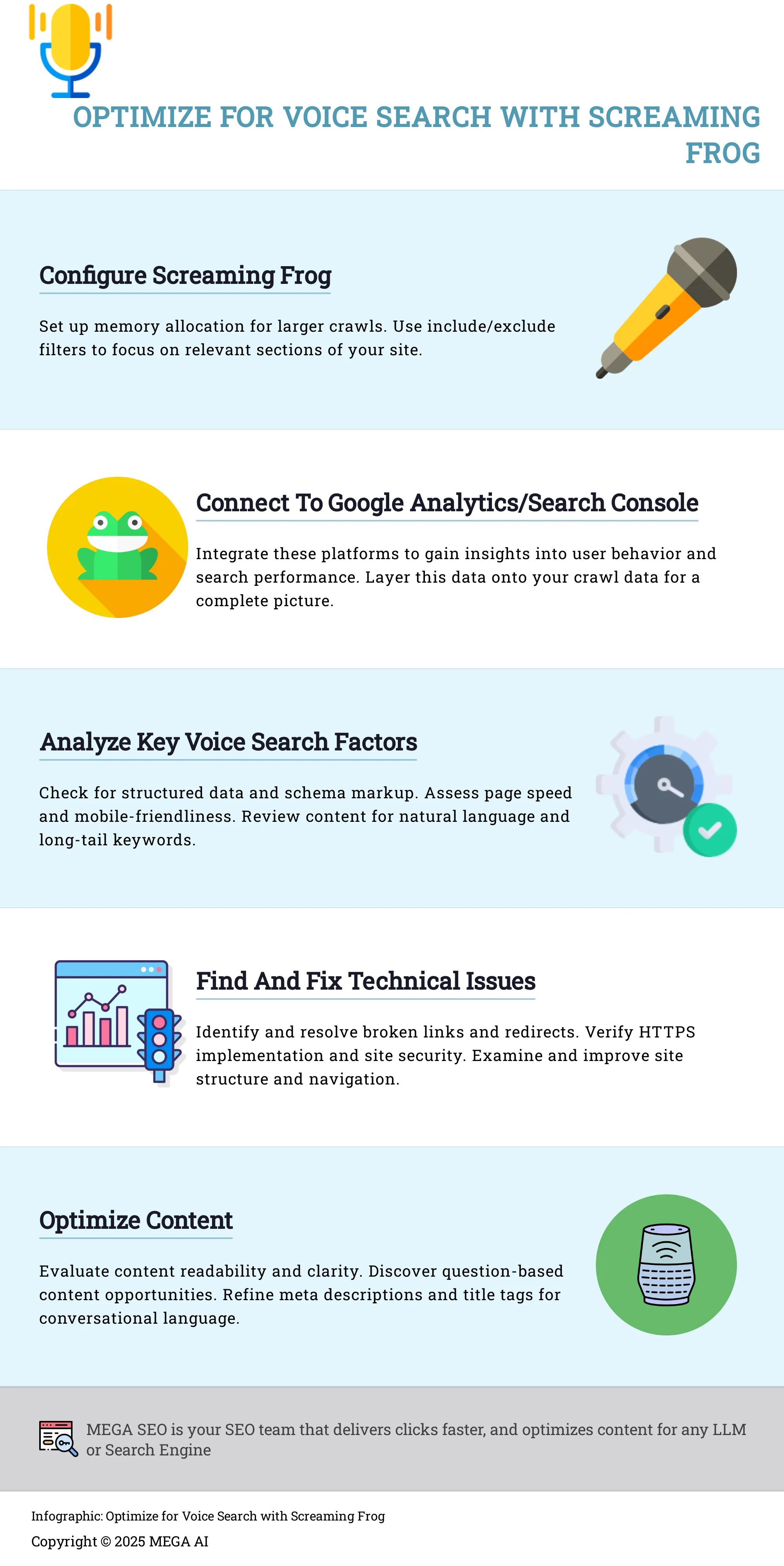
First things first, you'll need to download and install the Screaming Frog SEO Spider. It’s available for Windows, macOS, and Ubuntu, so it's accessible for most users. Once it's installed, a practical tip, especially if you're planning to crawl larger websites, is to consider increasing the memory allocation. You can find this setting under Configuration > System > Memory Allocation. Giving Screaming Frog more memory allows it to crawl more URLs without slowing down, which is particularly helpful when you're digging deep for voice search opportunities across many pages. This ensures the tool can handle the scope of your analysis efficiently.
Create Custom Extractions and Filters for Voice Search Data
Screaming Frog works by crawling your website much like a search engine bot would. To make this process efficient for voice search analysis, you'll want to guide its focus. If you're working with a very large site, the 'Include' feature (under Configuration > Include) is quite useful. It allows you to specify URL patterns that Screaming Frog should crawl, helping you concentrate its efforts on the most relevant sections of your site, like blog posts or FAQ pages where voice search queries are often answered.
Beyond just including specific URLs, you can set up custom extractions to pull out particular pieces of information relevant to voice search. For instance, you might want to extract all H2 headings that are phrased as questions or identify pages that use FAQPage schema. You can configure custom extractions using XPath, CSS Path, or Regex, allowing you to pinpoint data that directly informs your voice search strategy.
Connect Screaming Frog with Google Analytics and Search Console
To get an even richer dataset, you can connect Screaming Frog to your Google Analytics (GA) and Google Search Console (GSC) accounts. This integration is a significant advantage because it layers real user data and search performance metrics onto the crawl data Screaming Frog collects. You can do this via Configuration > API Access.
By linking these tools, you can pull in metrics like click-through rates, impressions, and actual user queries from GSC, or page views and bounce rates from GA, directly into your Screaming Frog interface. This allows you to see which pages are already getting some traction for voice-like queries or identify pages that are technically sound but aren't performing well in search, giving you a holistic view for your voice search optimization efforts.
Analyze Key SEO Factors for Voice Search with Screaming Frog
With Screaming Frog ready to go, let's explore the SEO elements vital for your voice search success. Voice search isn't just a fleeting trend; it's a fundamental shift in how people interact with technology and find information. Users expect quick, conversational, and highly relevant answers delivered directly to them, often while they're on the move or multitasking. This immediacy means search engines like Google prioritize websites that can meet these demands efficiently. Factors such as clear structured data, rapid page load times, mobile-friendliness, and content that speaks naturally are no longer just 'nice-to-haves'—they are essential for visibility in voice search results.
Screaming Frog SEO Spider acts as your detailed auditor in this process. While it's known for its comprehensive website crawling capabilities for traditional SEO, its features are equally powerful for dissecting your site's readiness for voice. It allows you to systematically check technical foundations and content characteristics that influence how easily voice assistants can find and relay your information. By using Screaming Frog to examine areas like schema markup, site performance, and content relevance, you're not just ticking boxes; you're strategically positioning your website to be the go-to source for voice queries in your niche. This proactive analysis helps you identify weaknesses and opportunities, forming the basis for actionable improvements. We'll cover how Screaming Frog helps you inspect these key factors in more detail.
Check Structured Data and Schema Markup
Structured data essentially provides search engines with a clear guide to your website's content. It employs a specific vocabulary, like Schema.org, to identify various page elements such as recipes, reviews, or FAQs. This is particularly useful for voice search because it helps search engines quickly understand your information's context and meaning, simplifying the process of extracting direct answers for voice commands. Well-structured content also improves your likelihood of appearing in rich snippets or "position zero" results—valuable spots for voice assistants. Screaming Frog includes a structured data testing and validation tool that crawls your site and reports on existing schema markup. This allows you to see implemented structured data types, pinpoint errors, and discover pages lacking schema. This process simplifies how you ensure your site effectively communicates with search engines, an important part of voice optimization.
Assess Page Speed and Mobile-Friendliness
People using voice search typically want immediate answers. If your website loads slowly, you risk losing that visitor, and search engines recognize this. This makes page load speed a crucial factor for voice search success. Also, because most voice searches occur on mobile devices, a mobile-friendly site is essential. A poor mobile experience can cause users to leave quickly, indicating to search engines that your site isn't suitable for mobile queries. Screaming Frog helps you evaluate your site's performance. While it doesn't measure page speed directly like Google PageSpeed Insights, it can find large image files, slow resources, or site architecture problems that might hinder speed. You can also look for mobile configuration issues. Addressing these technical points helps your site provide the quick, smooth experience voice search users anticipate.
Review Content for Natural Language and Long-Tail Keywords
How people search with their voice differs significantly from typed searches. Voice queries are usually longer, more conversational, and often framed as questions—for instance, "What is the best way to bake a cake?" rather than "cake recipe." Your content should reflect these natural language patterns and include relevant long-tail keywords. If your content sounds unnatural or focuses only on short, generic keywords, it's less likely to match a voice query. Screaming Frog can assist in analyzing your current content. By crawling your site, you can pull page titles, headings, and meta descriptions to check if they use conversational language. While Screaming Frog doesn't pinpoint exact long-tail keywords, examining your content structure can reveal chances to rephrase headings as questions or add more natural phrases. This makes your pages more apt to appear for common voice search queries.
Target Featured Snippets and Position Zero
Featured snippets, sometimes known as "position zero," are the information boxes highlighted at the top of Google's search results. They provide direct answers, so users don't always need to click on a page. These are extremely valuable for voice search, as voice assistants often source their answers directly from featured snippets. Securing this spot can greatly enhance your voice search visibility. A key method to improve your chances of getting featured snippets is to implement schema markup. As mentioned, structured data aids search engines in understanding your content. Screaming Frog can help you find pages where schema can be added or enhanced, especially for content types frequently found in featured snippets, such as FAQs, how-to articles, or lists. Identifying these opportunities allows you to strategically refine your content to be the primary answer for relevant voice searches.
Find and Fix Technical Issues for Voice Search
Technical glitches can quickly derail your voice search efforts. When users ask a question, they expect a fast, accurate answer, and a technically sound website is the foundation for delivering that. Unlike traditional text-based search, voice search often relies on a single, definitive answer pulled quickly by the assistant. If your site has underlying problems like slow loading times, broken pathways, or security concerns, voice assistants might struggle to find or present your content effectively, or they might choose a competitor's smoother-performing site instead. This means missed opportunities to connect with your audience through this growing channel. This is where a tool like Screaming Frog becomes invaluable for digital marketers and small businesses aiming to enhance their online presence. It allows you to perform a comprehensive health check on your site, much like a doctor examining a patient, to diagnose issues that could be hampering your voice search performance. By systematically finding and fixing these technical problems, you ensure your website is primed to meet the demands of voice search users and that your valuable content gets heard. Think of it as clearing the path so voice assistants can smoothly access and deliver your information, ultimately helping you reach your target audience more effectively.
Crawl Your Site for Voice Search Specifics
To truly optimize for voice, you need to see your site as search engines do. Screaming Frog excels here, as it mimics how a search engine crawls your site and is commonly used to address site issues related to search engine optimization. This crawl is crucial for identifying technical elements vital for voice search, such as slow page load times and mobile-friendliness. Voice search users are often on the go and expect immediate results, so a fast, responsive site is non-negotiable. By using Screaming Frog, you can pinpoint these specific areas for improvement, ensuring your content is quickly accessible and presentable for a voice result. A thorough site crawl is your foundational step for technical voice search optimization.
Examine Your Site's Structure and Navigation
A clear and logical site structure is fundamental for voice search success. When your website is well-organized with intuitive navigation, search engines can more easily understand your content's context and relevance for specific voice queries. This helps them match user questions to the best answers on your site. Screaming Frog provides the necessary analytics and data insights to thoroughly review your site’s architecture. By examining how pages are interlinked and how information flows, you can identify any confusing pathways or orphaned content. Ensuring a straightforward structure means voice assistants can efficiently find and interpret the information users are seeking, directly improving your site's visibility in voice search results.
Resolve Broken Links and Redirects
Broken links and improperly configured redirects can significantly harm the user experience and your search rankings, and this is especially true for voice search. Voice search users expect immediate, seamless answers. If a voice assistant attempts to retrieve information from a page that results in a 404 error or a faulty redirect, the user gets nothing, leading to frustration. Screaming Frog is adept at identifying these common technical SEO issues across your entire site. Regularly using the tool to find and fix broken links and ensure redirects lead to the correct, live pages is a fundamental practice for maintaining a smooth experience and a strong, reliable voice search presence.
Verify HTTPS Implementation and Site Security
Site security is a cornerstone of user trust and a confirmed ranking factor for search engines. For voice search, where answers are often delivered without the user seeing the source URL immediately, this trust is even more critical. Ensuring your site uses HTTPS (Hypertext Transfer Protocol Secure) protects user data and signals credibility to both users and search engines. Screaming Frog can help you pinpoint technical issues on your site, including checking for mixed content (HTTP elements on HTTPS pages) or verifying that all site versions correctly redirect to the secure HTTPS version. A secure, properly configured site is fundamental for performing well in all types of search, including the increasingly important voice search.
Optimize Your Content for Voice Search Using Screaming Frog
With technical aspects addressed, focus on refining your content for voice search. Users want quick, direct answers, so your content's structure and style must align. Screaming Frog helps analyze content and spot voice search opportunities, acting as a detective to make your pages more appealing to voice assistants and users. It helps you sharpen messaging to be clear, concise, and answer conversational queries effectively.
Evaluate Content Readability and Clarity
Clear, understandable content is vital, as voice assistants often pull answers directly from pages. While Screaming Frog doesn't score readability, extract content (e.g., from the ‘Word Count’ tab) for analysis with other tools. Well-structured content also aids search engine understanding. Implement structured data to provide explicit clues about page components, improving how search engines interpret and present your information for voice queries, making parsing easier.
Discover Question-Based Content Opportunities
Voice queries are often questions like "How do I...?" or "Where is...?". Screaming Frog's 'Custom Search' helps find opportunities by scanning URLs and headings for question words (who, what, where, etc.). This reveals pages needing expansion or gaps for new FAQ content. Since voice queries are conversational and use natural language, your content should mirror this by providing direct, complete answers to attract more voice search users.
Refine Meta Descriptions and Title Tags
Title tags and meta descriptions impact voice search. Compelling titles boost clicks, and well-written descriptions might be read aloud. Screaming Frog audits these site-wide for issues like length or duplication. It's adept at finding duplicate content issues, ensuring unique page information. For voice, make titles and descriptions concise, conversational, and accurately reflective of content, using natural language for potential voice queries.
Use Screaming Frog's Content Reports for Voice Search Insights
Screaming Frog’s reports offer valuable data for voice search strategy. The 'Word Count' tab identifies thin content lacking depth for voice answers. Analyzing H1/H2 tags shows content structure and topic clarity. Because Screaming Frog simulates search engine crawling, its reports offer that perspective. Look for patterns—are answers buried? Is key info clear? Use these insights to make content scannable and digestible for all users.
Get More from Screaming Frog: Advanced Voice Search Techniques
Once you've mastered the basics of using Screaming Frog for voice search, you can explore some of its more advanced features to gain even deeper insights. These techniques will help you fine-tune your strategy and uncover specific opportunities that can make a real difference in how your site performs in voice search results. Think of these as your power-ups for taking your voice search optimization to the next level. By digging a bit deeper into Screaming Frog’s capabilities, you can extract highly specific data, filter for voice-related patterns, and manage large datasets efficiently. This means you’re not just scratching the surface; you’re getting actionable intelligence to guide your efforts. Let's look at a few ways you can really make Screaming Frog work harder for your voice search goals.
Use Custom Extraction for Key Voice Search Metrics
Screaming Frog is incredibly powerful because it mimics how a search engine crawls your site. One of its standout features for voice search analysis is Custom Extraction. This allows you to tell Screaming Frog exactly what pieces of information to pull from your web pages. Instead of just getting standard SEO data, you can gather specific data points crucial for understanding your site's voice search readiness. For example, you could extract the text content of all H2 headings to see how many are phrased as questions, or check for the presence of FAQPage schema markup. You can even extract specific HTML elements or text patterns that you've identified as important for your voice search strategy. This targeted approach helps you quickly assess which pages are well-optimized and which need attention.
Apply Regular Expressions to Analyze Voice Queries
Regular expressions, often shortened to regex, are a powerful way to search for specific patterns in text. While they might seem a bit technical at first, they are invaluable for voice search analysis within Screaming Frog. You can use the "Include" feature in Screaming Frog's configuration to scan for URLs or page content that matches patterns common in voice queries. For instance, you could use regex to find pages that contain phrases like "how to," "what is," or "best way to." By applying regular expressions, you can filter and analyze potential voice queries more effectively, helping you identify patterns and optimize your content accordingly. This is particularly useful on websites with a large number of URLs, allowing you to quickly pinpoint pages that are strong candidates for voice search optimization.
Export and Analyze Voice Search Data in Bulk
Modern versions of Screaming Frog are designed to handle large websites efficiently, often by relying on database storage for crawls. This capability is a huge advantage when you're dealing with a lot of data, which is common when analyzing for voice search. Once your crawl is complete and you've used features like custom extraction, you can export all this rich data. This allows you to analyze voice search data in bulk, often in a CSV file that you can open in spreadsheet software like Excel or Google Sheets. Working with the data in bulk makes it much easier to sort, filter, identify trends, and derive actionable insights. This data-driven approach is key to making informed decisions and refining your voice search optimization strategy over time.
Understand Your Screaming Frog Results and Make Improvements
So, you've run your Screaming Frog crawl and now you're faced with a wealth of data. It might seem a bit overwhelming initially, like trying to read a complex map. But this is precisely where you can find the insights to make significant improvements for voice search. Consider Screaming Frog your helpful assistant, highlighting where your site can better serve voice queries. It’s less about just spotting problems and more about identifying opportunities. By carefully reviewing these reports, you can develop a straightforward plan to improve your site’s visibility and how users experience it when they search using their voice. Let's look at how to transform this data into actionable steps.
Prioritize Fixes Based on Their Voice Search Impact
When Screaming Frog presents its findings, the urge to tackle every item immediately is understandable. However, a strategic approach is more effective. Not all fixes offer the same benefit, particularly for voice search. Focus your efforts on changes that directly help search engines comprehend your content and present it for spoken queries. For example, implementing structured data is key; it provides search engines with clear context, positioning your content well for voice answers.
Also, consider issues Screaming Frog identifies concerning page speed and mobile-friendliness. Since voice searches frequently occur on mobile devices, a quick, responsive site is essential. Addressing these areas first can lead to more immediate improvements in your voice search performance. Review your Screaming Frog reports from the perspective of a voice search user: what changes would enhance their experience and provide better answers to their questions?
Create Actionable Plans from Screaming Frog Reports
While data provides valuable insights, taking action is what drives results. Screaming Frog excels at identifying technical SEO issues such as broken links, absent alt text, or duplicated content. Your next move is to convert these findings into a clear to-do list. For instance, if the report indicates several pages are missing FAQ schema markup, your plan could involve updating a specific number of these pages weekly, beginning with your highest-traffic content.
Dividing larger tasks into smaller steps makes them more approachable and manageable. Think about using a project management tool or a basic spreadsheet to itemize issues, delegate tasks if you have a team, and establish deadlines. Addressing these technical elements aids voice search and also enhances your site's overall user experience, potentially leading to improved search engine rankings. For those looking to simplify this workflow, platforms like MEGA AI provide SEO automation features that can assist with managing and implementing these updates.
Track Progress and Measure Your Voice Search Success
Optimizing for voice search is not a one-time task; it's a continuous cycle of refinement. After implementing your initial fixes, make it a habit to regularly re-crawl your site with Screaming Frog. This helps you assess the impact of your changes and identify any new issues that may have arisen. The tool enables thorough examinations of your website's architecture, assisting you in finding areas for additional improvements.
For instance, when you review structured data, Screaming Frog’s SEO Spider can extract and help you confirm its validity. Beyond correcting errors, monitor metrics that signal voice search success. Are you securing more featured snippets? Is there an uptick in traffic from long-tail, conversational keywords? These indicators can show your efforts are effective. Regular monitoring and adjustments are crucial for sustaining and enhancing your voice search performance.
Maintain Your Voice Search Success: Best Practices
Optimizing for voice search isn't a task you can check off your list and forget. Think of it more like nurturing a garden; it requires consistent attention and care to truly thrive. After you've laid the groundwork and aligned your website with voice search best practices, perhaps using a tool like Screaming Frog, the journey continues with maintaining that progress. The digital world, especially how people interact with voice assistants, is always changing. What works effectively today might need adjustments tomorrow to keep pace.
Staying ahead in voice search means committing to ongoing monitoring and making refinements as needed. This proactive stance ensures your website consistently meets the evolving needs of voice search users and holds its ground in voice search results. It’s about crafting a sustainable strategy that can adapt to new user behaviors and search engine algorithm updates. By regularly checking your site's health and how it’s performing, you can spot potential issues before they become major problems and use data to make informed decisions. This consistent effort will help solidify your rankings and continue to draw valuable voice search traffic to your site.
Establish Regular Crawling and Monitoring Routines
Consistency is a cornerstone of effective SEO, and this holds true for voice search optimization. Setting up a regular schedule to crawl your website helps you keep a finger on the pulse of its technical health and quickly identify any new issues that could hinder your voice search performance. Consider it a routine health screening for your online presence. Many tools, Screaming Frog included, offer features to schedule automatic crawls and exports. This automation is incredibly helpful, ensuring you consistently gather vital data without needing to manually initiate the process each time.
By establishing these routines, you can effectively monitor changes in your site’s structure, find new broken links, or catch problems with your structured data before they negatively impact your rankings. This proactive approach to monitoring is fundamental to maintaining your website's overall SEO health over time, ensuring it remains well-optimized for the way users are searching with their voices.
Keep Up with Evolving Voice Search Trends
The landscape of voice search is notably dynamic; user behaviors shift, and search engine algorithms are continually refined. To maintain your success, it's crucial to stay informed about these developments. This includes understanding new ways people phrase their voice queries, the kinds of information they typically seek using voice commands, and any updates to how search engines process and rank voice search results. For example, ensuring your structured data is always current is a fundamental best practice. As the team at Bird Marketing points out, keeping structured data on your site accurate and up-to-date is essential to maximize your chances of ranking well in voice search.
Subscribing to reputable industry blogs, following SEO news outlets, and paying close attention to announcements from major search engines like Google can provide you with valuable insights. This commitment to ongoing learning allows you to adapt your strategy effectively, ensuring your content and technical setup continue to align with the latest voice search trends and user expectations.
Continuously Improve Your Strategy with Screaming Frog
Screaming Frog is much more than a tool for an initial website audit; it’s a valuable ally for the continuous process of voice search optimization. As SEO experts often note, Screaming Frog is a powerful tool that can significantly improve SEO efforts by providing detailed website data and robust analysis capabilities. Regularly using its features allows you to refine your approach based on the freshest data available. For instance, its structured data testing feature is incredibly useful for voice search. This feature, as detailed in Screaming Frog's own tutorials, helps ensure search engines can explicitly understand the meaning of your pages and their components, which can enable special search result features.
By periodically re-crawling your site and thoroughly examining Screaming Frog’s reports, you can identify new opportunities for improvement, verify the correct implementation of your schema markup, and ensure your content remains friendly and accessible to voice search. This iterative cycle of analysis, adjustment, and refinement is central to achieving and maintaining long-term success in the voice search arena.
Your Toolkit for Voice Search Optimization
When you're aiming to refine your website for voice search, having the right tools in your corner can really streamline the process. While a solid understanding of voice search SEO principles is your foundation, specific software can help you efficiently spot technical hitches, uncover new opportunities, and monitor how your efforts are paying off. Think of these tools as your dedicated assistants, gathering the essential data you need to make smart, informed decisions about your strategy. Many platforms offer a comprehensive suite of features, so you might find one that becomes your primary resource, or you might prefer to use a combination of tools to cover all your bases. Let's explore some well-regarded options that can effectively support your work in optimizing for voice search, helping you understand your site's current standing and how to improve it for users who prefer to ask their questions out loud.
Screaming Frog SEO Spider
Screaming Frog SEO Spider is a website crawler that meticulously works through your website, much like a search engine bot would. It's a fantastic asset for detailed technical SEO audits. For voice search, this means you can use it to "crawl both small and very large websites efficiently," which helps you identify issues such as slow page load times or pages not optimized for mobile—both crucial elements for voice search success. A particularly strong feature is its capability to inspect for structured data. As the folks at Screaming Frog point out, "Structured data provides search engines with explicit clues about the meaning of pages," which can significantly improve your content's chances of being selected for voice answers. You can set up your crawls to specifically look for schema markup and quickly find pages where it’s either missing or not implemented correctly.
SEMrush
SEMrush is a broad SEO platform packed with a variety of tools, many of which are quite helpful for voice search optimization. You can leverage its keyword research functionalities to discover the conversational, long-tail keywords that people typically use in voice queries. It’s also effective for analyzing how your competitors are performing in the voice search landscape. SEMrush highlights the importance of schema, advising users to "Implement schema markup," describing it as "a structured data vocabulary that helps search engines better understand the information on your website." This deeper understanding is vital if you want your content to surface in voice search results, particularly for featured snippets. Their tools allow you to track your rankings for these types of queries and spot opportunities to capture those valuable "answer box" positions.
Ahrefs
Ahrefs is another robust SEO toolset, widely recognized for its comprehensive backlink index and strong keyword research features. When focusing on voice search, Ahrefs' Keywords Explorer becomes especially useful. You can use it to find question-based keywords—those queries often starting with "who," "what," "where," "when," "why," and "how"—which are very common in voice interactions. Looking at the "SERP overview" for these keywords can reveal which websites are currently ranking and whether they are utilizing featured snippets. Additionally, Ahrefs' Content Explorer can help you find popular content related to these questions, sparking ideas for your own voice-search-friendly content. This can guide you to create content that directly addresses user queries.
Moz Pro
Moz Pro provides a suite of SEO tools that can assist your voice search strategy, covering areas from keyword research and site audits to rank tracking. Its Keyword Explorer enables you to research and prioritize keywords, including the long-tail phrases and question-based queries that are fundamental to voice search. You can also use it to identify potential opportunities for featured snippets. The site crawl feature within Moz Pro can help you uncover technical SEO problems that might be holding back your voice search performance, such as issues with website speed or mobile usability. Consistently tracking your rankings for specific voice search queries in Moz Pro will help you gauge the impact of your optimization work and make informed adjustments as needed.
DeepCrawl (now Lumar)
DeepCrawl, which has transitioned to Lumar, is a technical SEO platform particularly suited for larger, enterprise-level websites, though its insights are valuable for any site taking voice search seriously. It delivers thorough technical audits, enabling you to ensure your website is easily crawlable and indexable—a basic requirement for appearing in any search result, including voice. For voice search, Lumar helps you monitor critical elements like site speed, mobile-friendliness, and the correct implementation of structured data. By setting up regular crawls, you can maintain good technical SEO health, identify problems that could negatively affect how voice assistants access your content, and ensure your site architecture supports a positive user experience.
OnCrawl
OnCrawl is another technical SEO platform that excels at providing actionable data through detailed log file analysis, crawl data, and integrations with other tools. For voice search, understanding how search engines interact with your site is crucial, and OnCrawl can offer deep insights by examining server log files. This can show you how often search engine bots crawl your pages and if they encounter any difficulties. It also assists in monitoring site performance, pinpointing thin content, and verifying the proper implementation of structured data across your entire site. By combining crawl data with analytics and log files, OnCrawl gives you a holistic view of your site’s SEO health, which is essential for fine-tuning your approach to the specific demands of voice search.
Related Articles
- Optimizing Your Website for Voice Search: A Comprehensive SEO Guide - MEGA SEO | Blog
- How to Use Screaming Frog: Mobile Optimization Guide
- How to Optimize Your Website for Voice Search in 2024
- Master Majestic for Voice Search Optimization
Frequently Asked Questions
Why is Screaming Frog particularly helpful for voice search when it's a general SEO tool? Screaming Frog's strength for voice search lies in its ability to thoroughly examine your site's technical health and content structure. Voice assistants need to quickly find and understand information, so Screaming Frog helps you identify things like slow pages, missing structured data, or content that isn’t phrased naturally – all key for voice.
I'm new to Screaming Frog. What's the first thing I should focus on for voice search analysis? Start by getting a clear picture of your site's current state. Run a basic crawl and pay close attention to reports on page speed, mobile-friendliness, and any structured data you might already have. These foundational elements are critical for how voice assistants access and deliver your content.
Can Screaming Frog tell me exactly which voice search queries my site will rank for? Screaming Frog itself doesn't predict specific voice query rankings. However, it helps you analyze your content for question-based keywords and natural language, which are common in voice searches. By connecting it with Google Search Console, you can see actual queries your site appears for, and then use Screaming Frog to optimize those pages further.
Is optimizing for voice search with Screaming Frog a one-time task? Voice search optimization is an ongoing process. User habits and search engine algorithms change. Regularly using Screaming Frog to crawl your site helps you maintain its technical health, adapt to new trends, and continuously refine your content to meet the needs of voice search users.
How does improving my site for voice search with Screaming Frog benefit my overall SEO? Many elements crucial for voice search, like fast load times, mobile-friendliness, clear content, and structured data, are also fundamental to good overall SEO. When you use Screaming Frog to enhance these aspects for voice, you're generally improving your site's quality and user experience, which search engines favor.