
The term "AI" gets thrown around a lot, often describing simple tools that still require you to do all the strategic thinking. You might use software to schedule emails or analyze data, but you’re the one making all the decisions. True AI agents are different. They are active partners, not passive tools. Instead of just executing a command, an agent can devise an entire SEO strategy, write the content, and run paid ad campaigns to support it. This is a fundamental shift from a tool you have to manage to an autonomous system that works for you, removing the expertise gap that holds so many small businesses back from effective growth.
Key Takeaways
- Embrace autonomous agents over passive tools: Unlike traditional software that requires constant management, AI agents independently strategize, execute, and optimize your sales and marketing campaigns, effectively acting as a member of your team.
- Automate lead generation and qualification: AI can manage the entire top of your sales funnel by researching prospects, scoring leads, and nurturing them with personalized follow-ups, allowing your team to focus exclusively on closing high-quality opportunities.
- Achieve scalable growth without the high cost: AI provides a cost-effective alternative to traditional scaling methods like hiring more staff or retaining an agency, giving you access to the capabilities of a full marketing team for a predictable monthly cost.
What Barriers Keep Sales Teams Small?
Scaling a sales team often seems straightforward: hire more people, close more deals. But for most small businesses, it’s rarely that simple. Several fundamental challenges can stop growth in its tracks, turning the scaling process into a slow and expensive effort. These barriers aren't about a lack of ambition; they're about real-world constraints on time, technology, and budget that many founders and lean teams face every day.
The Time and Personnel Trap
There are never enough hours in the day for a growing sales team. Prospecting, qualifying leads, sending follow-ups, and nurturing relationships are all critical, but they are also incredibly time-consuming. The traditional solution is to hire more salespeople, but that introduces its own set of problems. Finding, training, and paying new team members is a slow and costly process. This creates a huge responsibility from both a time and personnel standpoint, forming a significant barrier to scalability that keeps teams from reaching their full potential.
The Technology and Expertise Gap
Many teams rely on a patchwork of tools that only solve part of the problem. While traditional AI in sales applications can help with data analysis, it doesn't do the heavy lifting. Modern generative AI, on the other hand, actively contributes to the sales process by creating content and drafting communications. Without these advanced tools, teams miss out on major efficiency gains across all their work activities. This issue is often compounded by a lack of in-house expertise. You might not have a dedicated specialist for paid ads or SEO, making it difficult to generate a consistent flow of high-quality leads for your sales team.
The High Cost of Traditional Growth
For many small businesses, the biggest hurdle is simple economics. The two main paths to scaling—hiring a larger sales team or outsourcing to a marketing agency—are expensive. As many founders know, "Agencies are cost-prohibitive but we need professional marketing." When every dollar counts, investing tens of thousands per month into new salaries or agency retainers isn't always feasible. This cost barrier forces businesses to grow slower than they're capable of, leaving potential revenue on the table while they try to manage everything themselves.
Why Traditional Sales Scaling Methods Fail
Every founder and manager wants to grow their business, but scaling sales often feels like trying to fill a bucket with a hole in it. You pour more resources in—more hires, more tools, more ad spend—but the results don't always match the investment. The traditional playbook for scaling sales involves a linear approach: to get more output, you need more input. This model is becoming increasingly unsustainable for lean teams and small businesses.
The reality is that old methods are often slow, expensive, and demand a level of expertise that most small teams simply don't have in-house. As one founder put it, "We're all overloaded and marketing keeps getting deprioritized." This sentiment is common because the traditional paths to growth are riddled with fundamental barriers that prevent true, efficient scaling. Before you can break through them, you have to understand what they are.
The Time Trap
Time is the one resource you can't buy more of. For a sales team, the day is a constant balancing act between prospecting for new leads, nurturing existing ones, creating proposals, and closing deals. Each of these steps is crucial, but they all consume significant time. This creates a natural ceiling on how many clients a single person can effectively manage. To grow, you have to hire another person, who then faces the same time constraints. This linear growth model makes it incredibly difficult to scale exponentially without your payroll costs spiraling. The time required for manual, repetitive tasks is a major barrier to achieving breakout sales productivity.
The Personnel Problem
The most obvious solution to the time trap is to hire more people. But this introduces a new set of challenges. Finding, hiring, and training the right talent is a slow and expensive process. Beyond salary, you have to account for benefits, equipment, and the management overhead required to keep everyone aligned. Many small businesses find that "agencies are cost-prohibitive but we need professional marketing." The same applies to building an in-house team. You end up paying skilled professionals to handle routine, automatable tasks, which is an inefficient use of both time and money. This makes it difficult to build a scalable sales model that doesn't break the bank.
The Expertise Gap
Modern sales and marketing require a wide range of specialized skills. You need someone who understands SEO, someone who can run paid ad campaigns, a content creator, and a data analyst to make sense of it all. For a small business, finding a single person with deep expertise in all these areas is next to impossible. Building a team of specialists is often financially out of reach. This expertise gap means that even if you have the time and the people, you may lack the specific knowledge to execute effective campaigns that drive growth. Without the right strategy and execution, your scaling efforts can easily fall flat, wasting valuable resources.
How AI Agents Break Through Scaling Barriers
AI agents offer a fundamentally new way to approach growth. Instead of just providing tools that require your constant input, they act as autonomous members of your team. They don't just execute tasks; they strategize, learn, and manage entire channels to drive sales. This approach removes the traditional roadblocks of time, cost, and the need for specialized expertise.
Automate Decisions, Not Just Tasks
Traditional automation is about completing a predefined task, like sending a templated email. AI agents go a step further by making decisions. They analyze data to determine the best course of action, whether that’s choosing which keywords to target, what ad copy to write, or how to adjust a campaign budget. As MEGA AI puts it, "These are real Agents who come up with a strategy and execute the tasks needed to hit your goals." This means you're not just offloading work; you're delegating strategic thinking. This approach allows you to improve customer engagement by creating communications that are not only automated but also intelligent and context-aware.
How AI Learns and Adapts Over Time
An AI agent isn't a static tool. It's a dynamic system that improves with experience. By analyzing performance data, it learns what resonates with your audience and what drives conversions. For example, MEGA AI’s platform is built on "proprietary models trained on 450 million Google Search data points" and over a billion advertising data points. This massive dataset allows the AI to identify patterns and make predictions that a human team might miss. Over time, the agent becomes more efficient at lead generation, content creation, and campaign optimization. This continuous learning cycle means your sales and marketing efforts don't just run on their own; they get progressively better.
Integrate All Your Channels Seamlessly
Managing a consistent message across your website, social media, and ad campaigns is a major challenge for small teams. AI agents solve this by acting as a central hub for your marketing efforts. They can provide personalized communication across all your channels, ensuring a cohesive customer experience. MEGA AI, for instance, integrates with over 50 platforms, including popular CMSs like WordPress, Shopify, and Webflow. This allows its SEO agent to optimize your website content while its Paid Ads agent runs campaigns that are perfectly aligned with your organic strategy. This seamless integration ensures your marketing works as a unified system, not a collection of separate, disconnected tactics.
What Makes AI Different from Traditional Sales Tools?
If you’ve been in business for a while, you’re likely familiar with sales tools like CRMs and email automation platforms. These systems are great for organizing contacts and scheduling messages, but they are fundamentally passive. They hold your data and execute simple, pre-programmed commands. You still have to do the heavy lifting: interpreting the data, deciding on a strategy, and writing all the content. They are tools you operate.
AI agents, on the other hand, are active partners. Instead of just storing information, they analyze it to make independent decisions and take action. This is a crucial shift from a tool you have to manage to an agent that works for you. As MEGA AI puts it, "This isn't another AI chat interface you need to wrestle with to get the output you want." An AI agent can devise a strategy and execute the tasks needed to reach your goals, often without needing your input for every step.
The key difference lies in generative AI, which actively contributes to the sales process. While traditional automation sends the template you wrote, generative AI writes a unique email for you. This capability allows for consistent, personalized communication across all your channels at a scale that would be impossible for a person to handle. It’s the difference between using a mail merge field for a first name and creating a completely customized sales pitch based on a prospect’s specific needs and industry. This level of personalization helps you build stronger connections and improve engagement from the very first touchpoint.
Use AI to Generate and Qualify Leads
Generating a steady stream of high-quality leads is the lifeblood of any sales operation, but it’s also one of the most time-consuming parts of the job. From finding potential customers to figuring out if they’re a good fit, the process can quickly drain your team’s resources. This is where AI agents change the game. Instead of just providing you with a list of contacts, AI can manage the entire top-of-funnel process, from initial research to qualification.
Platforms like MEGA AI use intelligent agents to run SEO and paid ad campaigns that attract the right audience from the start. This ensures the leads entering your pipeline are already interested in what you offer. From there, AI can take over the manual work of sifting through and vetting those leads, allowing your sales team to focus their energy on conversations with prospects who are ready to buy. This shift from manual prospecting to automated lead generation is fundamental to scaling sales without scaling your headcount.
Automate Prospect Research
Before you can reach out to a potential customer, you need to understand their business and their needs. Traditionally, this involves hours of manual research—scrolling through websites, LinkedIn profiles, and industry news. AI agents can condense this work into a matter of seconds. By analyzing vast amounts of public data, AI can build detailed profiles of your ideal customers, identifying their pain points, decision-makers, and recent business activities.
This goes beyond simple data collection. Generative AI tools can use this research to help you create customized sales presentations and outreach messages that speak directly to a prospect’s specific needs. Instead of using a generic template, your first touchpoint can be highly relevant and personalized, which significantly increases your chances of getting a response. This level of automation allows you to prepare for sales calls more efficiently and effectively.
Score Leads with Intelligence
Not all leads are created equal. A key challenge in scaling sales is knowing which prospects to prioritize. AI-driven lead scoring provides a solution by using data to predict a lead's likelihood to convert. It analyzes dozens of signals—like company size, industry, website activity, and engagement with your marketing materials—to assign a score that ranks leads from most to least promising.
This intelligent scoring helps your team focus on the opportunities with the highest potential. As one MEGA AI user noted, their AI agent was able to identify that while many incoming leads weren't a good fit, a solid percentage were highly qualified and ready for a conversation. This process of automatically separating high-intent prospects from the noise ensures your sales team spends their time on activities that directly generate revenue, rather than manually sifting through a crowded inbox.
Nurture Leads in Real Time
Once a lead shows interest, timing is everything. A slow follow-up can mean a lost opportunity. AI agents can engage with leads instantly, ensuring every inquiry gets a timely response, 24/7. These agents can handle initial conversations, answer frequently asked questions, and provide relevant information to keep the prospect engaged.
Modern AI-powered CRM systems can even automate the creation of follow-up emails and personalized sales pitches. The AI can recommend the next best action for a salesperson to take, providing real-time guidance during calls. This automated nurturing keeps your business top-of-mind and warms up leads until they are ready for a direct conversation with a member of your sales team, ensuring no potential customer falls through the cracks.
Re-engage Past and Dormant Leads
Your database of past and dormant leads is a hidden goldmine. These are prospects who have already shown interest in your business but didn't convert for one reason or another. Manually re-engaging this audience is a massive undertaking, but AI makes it simple. An AI agent can systematically work through thousands of old contacts, using updated data to personalize outreach and revive cold conversations.
For example, an AI agent can be tasked with contacting a list of 18,000 past leads, a project that would take a human team months to complete. The agent can tailor its messaging based on the lead's previous interactions and current needs, turning a cold list into a new source of qualified opportunities. This ability to re-engage leads at scale unlocks a valuable revenue stream that most businesses don't have the resources to tap into.
How Can AI Transform Your Sales Follow-Up Process?
Consistent follow-up is where many sales opportunities are won or lost. Yet, it’s often the first thing to fall through the cracks when your team is stretched thin. Manually tracking leads, sending personalized emails, and knowing the right moment to reach out requires significant time and effort. AI agents change this dynamic entirely by taking over the persistent, intelligent work of nurturing leads. Instead of just setting reminders, an AI can execute the entire follow-up strategy for you, ensuring no lead goes cold and every interaction is meaningful. This allows your team to focus on closing deals with prospects who are already warmed up and engaged.
Manage Follow-Up Sequences Automatically
Imagine a system that not only sends a follow-up email but also manages the entire communication sequence based on a prospect's actions. That’s what AI brings to the table. AI-powered systems can automate complex tasks like drafting tailored follow-up emails and scheduling them at optimal times. These tools can analyze a prospect's needs and past interactions to provide real-time guidance and support sales effectiveness. An AI agent can determine if a lead opened your email, clicked a link, or visited your pricing page, and then trigger the next appropriate step in the sequence, whether it's another email, a text message, or an alert for a human salesperson to call.
Personalize Communication at Scale
One of the biggest challenges in scaling sales is maintaining a personal touch. Automation has historically meant generic, one-size-fits-all messages that prospects easily ignore. Generative AI flips that script. It allows you to provide personalized communication across all your channels, at a scale that would be impossible for a human team. By analyzing data from your CRM and other sources, an AI agent can reference a prospect’s specific industry, job title, or previously expressed pain points in its outreach. This ensures that every message feels relevant and directly addresses the recipient's needs, dramatically increasing the chances of getting a response.
Create and Optimize Content Dynamically
Effective follow-up isn't just about sending messages; it's about delivering the right content at the right time. AI can enhance this process by creating and optimizing sales materials on the fly. For instance, an AI agent can generate a customized sales presentation that highlights the features most relevant to a specific prospect. It can also identify which of your blog posts or case studies would be most persuasive for a lead at their current stage in the sales funnel. Platforms like MEGA AI take this further by using their Paid Ads agent to create hundreds of ad variations or their SEO agent to update articles, ensuring your content is always optimized to attract and convert.
What About Cost and Implementation Barriers?
Adopting new technology often brings up concerns about high costs and complicated setups. For many small businesses, the idea of implementing AI can seem overwhelming. However, modern AI agents are designed to be both affordable and easy to integrate, turning these perceived barriers into a clear path for growth. Instead of viewing AI as another line item expense, it's more accurate to see it as a strategic investment that makes your existing resources far more effective. Let's look at how to approach the cost, integration, and performance measurement of adding AI to your sales process.
Compare AI Costs to Traditional Scaling
When you need to scale sales, the usual paths involve hiring more staff or outsourcing to an agency, both of which are expensive. A full-time marketing manager can cost thousands per month, and agency retainers are often just as steep. This is a common frustration, with many business owners feeling that, "Agencies are cost-prohibitive but we need professional marketing."
AI agents provide a different model. An AI-powered platform can deliver the output of an entire team for a fraction of the cost. For example, a comprehensive plan for SEO and paid ads can cost less than a junior employee's monthly salary. This approach transforms your sales operations by automating key processes to enhance your return on investment. By comparing the fixed, transparent pricing of an AI platform to the high costs of traditional hiring, the financial benefit is clear.
Integrate AI with Your Existing Systems
The last thing you need is a new tool that disrupts your entire workflow. The best AI sales and marketing agents are built to connect directly with the systems you already use. This means you don't have to start from scratch or spend weeks on training. For instance, MEGA AI integrates with over 50 platforms, including common tools like WordPress, Shopify, and Wix. This allows the AI to publish content, update your site, and manage campaigns without you needing to manually move information between systems.
Think of it as an enhancement to your current operations, not a replacement. This seamless integration ensures a smooth transition and allows you to start seeing results quickly, without the technical headaches that often come with new software.
Measure Your ROI and Performance
How do you know if your investment in AI is paying off? Unlike some traditional marketing efforts where results can be hard to pin down, AI platforms provide clear, data-driven insights into their performance. You should have complete visibility into the tasks being performed and the results they generate, from lead generation numbers to conversion rates.
This focus on measurement is critical. A Gartner study shows that 80% of customers are more likely to buy from businesses that provide personalized experiences. AI excels at creating this personalization at scale, and its impact can be tracked directly through sales figures. When you book a demo for an AI platform, be sure to ask how it tracks performance and demonstrates ROI. This will give you confidence that you’re investing in measurable growth.
How to Measure Your AI Sales Success
Adopting AI is about more than just automating tasks; it's about achieving measurable growth. Unlike traditional methods where results can be murky and hard to attribute, AI-driven platforms provide clear data on what’s working. The key is to move beyond vanity metrics and focus on the key performance indicators (KPIs) that directly impact your bottom line. When you let an AI agent handle your marketing and sales outreach, you gain access to a wealth of performance data that shows exactly how your efforts are translating into tangible results.
This transparency allows you to see which campaigns are driving qualified leads, how quickly your system is engaging with prospects, and what the ultimate return on your investment is. For small businesses, this level of insight is critical. It means you can make informed decisions based on real-time feedback instead of guesswork. By focusing on the right metrics, you can continuously refine your strategy and ensure your AI sales engine is running at peak efficiency, turning prospects into loyal customers.
Track Lead Quality and Conversions
One of the most significant advantages of AI is its ability to sift through the noise and identify high-quality leads. Instead of just tracking the total number of leads, focus on the percentage that are actually qualified. A good AI system can analyze prospect data to score leads, helping you prioritize follow-ups. As one MEGA AI user noted, their system quickly identified that while many leads were unqualified, a solid percentage were "qualified, good leads" ready for a conversation.
You can also measure how AI improves your conversion rates. Because AI can create customized sales materials based on a prospect's specific needs and past interactions, your outreach becomes far more effective. Track the journey from initial contact to closed deal to see how AI-powered personalization is turning more prospects into paying customers.
Monitor Response Times and Engagement
In sales, speed matters. A slow response can mean a lost opportunity. AI agents work around the clock, ensuring every inquiry gets an immediate and relevant reply. A critical metric to monitor is your average response time. You should see this number drop significantly after implementing an AI solution. This speed is crucial for maintaining momentum with interested prospects.
Beyond just speed, track how prospects engage with your automated communications. Are they opening emails, clicking links, or replying to messages? AI tools excel at delivering consistent, personalized communication at scale, which keeps leads warm and engaged. High engagement rates are a strong indicator that your messaging is resonating with your target audience and moving them effectively through the sales funnel.
Analyze Revenue and Efficiency Gains
Ultimately, the success of any sales strategy is measured in revenue. Track the revenue generated specifically from AI-driven leads to calculate your return on investment (ROI). Compare this to your previous sales efforts to see the direct financial impact. You should also see a shorter sales cycle, as AI can nurture leads and automate follow-ups, moving them toward a decision more quickly.
Don't forget to measure efficiency gains. By automating routine processes like lead management and initial outreach, AI frees up your team to focus on high-value activities like closing deals and building customer relationships. Calculate the number of hours saved and translate that into cost savings. This enhancement to your ROI demonstrates how AI helps you scale sales without scaling your headcount or your budget.
What to Know About AI Security and Compliance
Handing over key sales and marketing functions to an AI agent naturally brings up questions about security. How is your data being used? Can you trust an AI to follow privacy regulations? These are important considerations, and any reputable AI platform should have clear answers. The goal is to scale your sales, not your risks.
Responsible AI development isn't a free-for-all; it operates within a structured framework. Think of it as a set of rules and best practices for managing risks and ensuring ethical use. This concept, often called AI compliance, is what separates professional-grade tools from experimental ones. It ensures that the AI is not only effective but also safe and trustworthy. For you, this means peace of mind knowing that your business and customer data are handled responsibly.
At MEGA, our AI agents are built on a foundation of security. Our proprietary models are trained on massive, secure datasets, and we are aligned with major data privacy frameworks like GDPR and CCPA. When our agents connect to your systems, they use secure authentication methods like OAuth 2.0, so your credentials and data are protected. We provide complete visibility into every task the AI performs, so you’re never in the dark about what’s happening in your accounts.
Perhaps the most important security feature is our commitment to human oversight. While our AI agents can operate with full autonomy—and 85% of our customers choose to use this "autopilot" feature—we also have a "human-in-the-loop" process for complex tasks. This hybrid approach ensures that you get the speed and scale of AI without sacrificing the judgment and control that keeps your brand safe. Choosing the right AI partner means you can focus on growth, confident that the security and compliance pieces are already handled.
How to Start Scaling Sales with AI
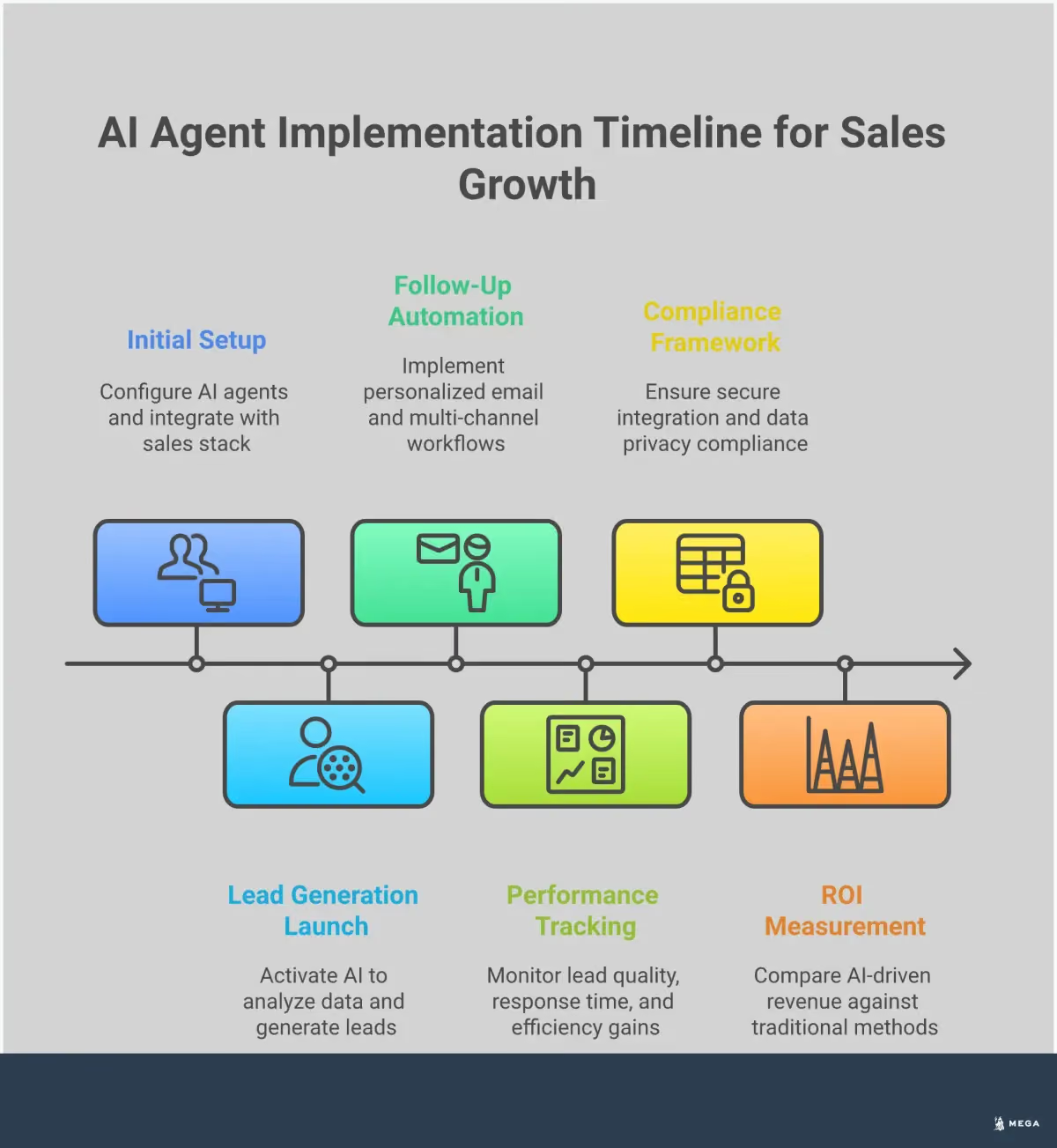
Making the move to an AI-driven sales strategy doesn't have to be a massive, disruptive overhaul. The key is to start with a clear plan that focuses on your most significant challenges first. Instead of trying to adopt every AI tool at once, think about this as a two-step process: identifying the specific capabilities that will make the biggest impact and then setting a practical schedule for implementation.
For many small businesses, the goal is to find a solution that acts more like a team member than just another piece of software. This is where AI agents come in. Unlike a simple chatbot or a dashboard you have to manage, an AI agent can autonomously plan and execute campaigns. Platforms like MEGA AI are designed to compress the capabilities of a full-stack growth agency into a single AI agent that delivers measurable results quickly. The right approach is to find a partner that can handle the heavy lifting, allowing you to focus on closing the high-quality leads it generates. You can book a demo to see how an agent-based model works in practice.
Find the Right Features
When evaluating AI solutions, focus on features that directly address your biggest sales bottlenecks. Look for platforms that can automate repetitive tasks, freeing up your time for more strategic work. This could include automating prospect research, personalizing outreach emails, or managing follow-up sequences.
Effective AI agents also provide deep, actionable insights from sales data, helping you understand what’s working and what isn’t. The most powerful systems go a step further by combining different AI models and data management to automate entire processes like lead generation and qualification. Instead of just giving you data, they use it to find and nurture leads for you, turning raw information into qualified appointments.
Set a Realistic Timeline
Adopting new technology can feel daunting, but you don't need to change everything overnight. Many businesses start by running pilot programs for specific use cases. For example, a recent study found that 82 percent of retailers have conducted pilots for AI in customer service alone. You can take a similar approach.
Start with one clear goal, like improving lead quality from your paid ad campaigns or increasing organic traffic through SEO. Set a 30- or 60-day timeline to test the AI's performance on that single objective. This allows you to measure the return on investment quickly and build confidence before expanding its role. With an autonomous AI agent, you can often see tangible results in days, not months, making it easier to justify the investment and scale up your efforts.