
Writing in active voice is one of the most effective ways to add punch to your prose. It transforms flabby, indirect sentences into clear, concise statements that command attention. But what exactly is active voice, and why does it matter so much? In this guide, we'll break down the mechanics of active voice, showing you how to identify passive constructions and rewrite in active voice. We'll explore the benefits of active voice, from improved clarity and readability to increased reader engagement. Plus, we'll share some handy tools and techniques to help you make active voice a consistent part of your writing toolkit.
Key Takeaways
- Active voice creates clear, concise content: Make your writing more direct and impactful by having the subject perform the action. Readers understand active sentences more quickly.
- Identify and rewrite passive voice: Spot passive voice by looking for the use of "by" or forms of "to be" combined with past participles. Restructure the sentence to improve clarity.
- Use active voice strategically: While active voice is generally preferred, passive voice is suitable in certain situations. Learn when to use each for effective communication.
What is Active Voice and Why Does It Matter?
Active voice is a grammatical construction where the subject of a sentence performs the action. It creates clear, concise, and engaging writing. Think of it as the subject "acting" rather than being "acted upon." This directness makes your writing more impactful and easier for readers to understand. In contrast, passive voice makes your writing less direct because the subject is the recipient of the action.
Define Active Voice
In active voice, the subject performs the action expressed by the verb. The formula is simple: Subject + Verb + Object. For example, "The dog chased the ball." The dog (subject) performs the action of chasing (verb) the ball (object). This straightforward structure immediately tells the reader who did what. Passive voice, conversely, makes the subject the recipient of the action, creating a less direct sentence structure, as this Outwrite article explains.
Benefits of Active Voice
Why should you care about active voice? Because it strengthens your writing and makes it more effective. Active voice enhances clarity, concision, and engagement, making it a valuable tool for all writers. When you use active voice, your sentences are typically shorter and get straight to the point. This direct style keeps your readers engaged and helps them understand your message quickly. Rewriting passive voice to active voice is key for clear and engaging writing, as this Mega SEO post explains. Whether you're crafting website copy, writing blog content, or sending a quick email, active voice helps ensure your message resonates.
Find Passive Voice in Your Writing
Before you can rewrite anything, you need to learn how to spot passive voice. It's easier than you think. This section covers common indicators that can help you quickly identify passive voice in your writing.
Common Passive Voice Indicators
One telltale sign of passive voice is when the subject of the sentence receives the action instead of performing it. For example, "The ball was thrown by the pitcher" is passive. The ball (the subject) is receiving the action. The more direct, active version is, "The pitcher threw the ball." Notice how the active voice is also more concise? Wordiness is a common side effect of passive voice. These longer sentences can make your writing feel cumbersome, according to TextCortex. Look for phrases that include "by" following the verb. This often highlights the true actor and points to a passive construction, as explained in this Outwrite article.
Another common indicator is the use of forms of "to be" (is, am, are, was, were, be, being, been) combined with a past participle (e.g., thrown, eaten, written). While this combination doesn't always mean passive voice, it's a good flag to investigate the sentence further. For example, in "The report was finished," "was" is a form of "to be" and "finished" is a past participle. This signals potential passive voice. Rewriting it as "I finished the report" clarifies the actor and makes the sentence active.
Practice Spotting Passive Constructions
The best way to get good at finding passive voice is to practice. Start by reviewing your own writing. Look for the indicators we just discussed: sentences where the subject is acted upon, the use of "by," and forms of "to be" with past participles. This MEGA SEO guide offers helpful examples and solutions for common challenges.
Here's a quick exercise: Which of these sentences is passive?
- The email was sent by the marketing team.
- The marketing team sent the email.
- She wrote the report.
If you guessed number one, you're right. The subject "email" receives the action of being sent. Sentence two is the active version, and sentence three is also active. This MEGA SEO article provides further examples and a clear framework for rewriting passive sentences. With a little practice, you'll be able to spot passive voice like a pro.
Rewrite Sentences in Active Voice
This section provides a practical, step-by-step guide to transform passive voice into active voice, along with tips for handling more complex sentence structures.
Transform Passive to Active: A Step-by-Step Guide
Rewriting sentences in active voice is often simpler than it seems. It involves identifying the subject, the verb, and the object, then rearranging them so the subject performs the action. Let's break it down:
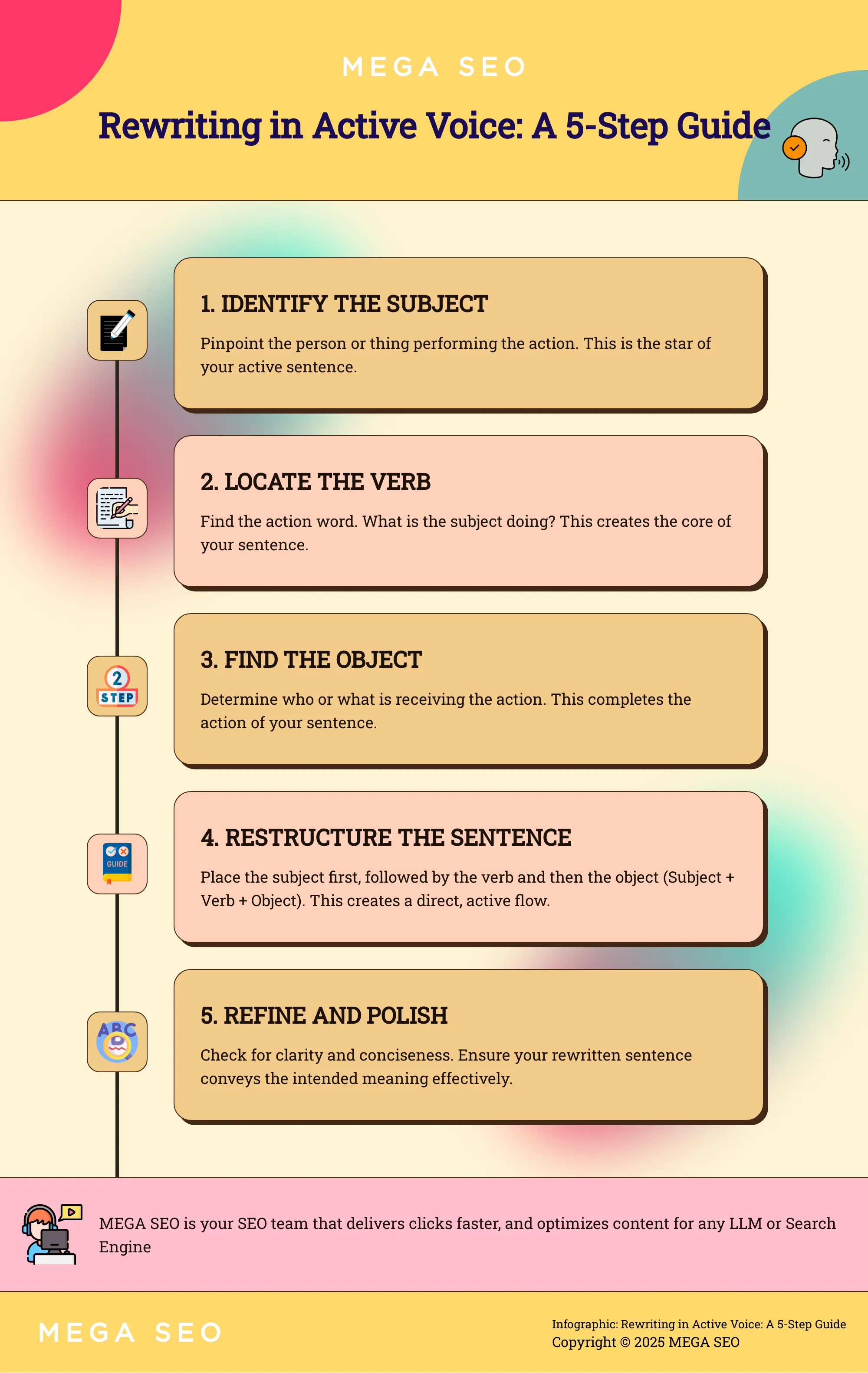
- Identify the subject and verb: Find who or what is performing the action (the subject) and the action itself (the verb). In passive voice, the subject is often at the end or implied.
- Move the subject to the beginning: Place the subject at the start of the sentence, making it the actor. This instantly makes the sentence more direct. This simple restructuring clarifies who is doing what.
- Adjust the verb: Change the verb tense as needed to reflect the active voice. This often means removing the "to be" verb (is, are, was, were) and using a more active verb form.
- Place the object after the verb: Position the object (the thing receiving the action) after the verb. This completes the active voice structure: Subject + Verb + Object.
For example, "The ball was thrown by the boy" becomes "The boy threw the ball." This creates a more concise and impactful statement. For a deeper dive into active voice conversion, see this helpful guide.
Handle Challenging Sentence Structures
While the basic steps are straightforward, some sentences present unique challenges. Here's how to tackle them:
- Sentences with implied subjects: If the subject isn't stated, you'll need to infer it from the context before converting.
- Sentences with multiple clauses: Break down complex sentences into smaller clauses and convert each to active voice.
- Sentences with multiple objects: Ensure each object is clearly linked to the subject's action in the active voice construction. For more on common challenges and their solutions, see this resource.
Remember, passive voice isn't always wrong. Sometimes it's appropriate, such as when the actor is unknown or unimportant. However, active voice generally creates stronger, clearer writing. It's worth noting that passive sentences are often wordier than their active counterparts, making active voice more concise. You can learn more about rewriting sentences in active voice and making them stronger.
How Active Voice Improves Reader Engagement
Active voice does more than just make your writing stronger; it strengthens the connection with your readers. It creates a clear, direct line of communication that keeps them engaged and makes your message resonate. Let's explore how this works.
Write with Clarity and Directness
Active voice shines when it comes to clarity. By placing the subject at the forefront of the sentence, performing the action, you eliminate ambiguity. Readers immediately understand who is doing what. This directness cuts through the clutter, allowing your main points to land effectively. Instead of a vague "mistakes were made," active voice owns the action: "The team made mistakes." This direct style builds trust and keeps readers focused on the core message. It's like having a face-to-face conversation, where clear communication is key. Think of how MEGA SEO's content generation features use active voice to create compelling website copy that converts.
Improve Readability and Comprehension
Beyond clarity, active voice significantly improves readability. Shorter, more direct sentences are easier to digest, especially in online content where readers often skim. This improved readability leads to better comprehension. When readers can easily follow your train of thought, they're more likely to absorb and retain the information. Active voice and plain language work together to create a smooth, engaging reading experience. This is particularly important for websites, blog posts, and marketing materials where capturing and holding attention is paramount. By making your content accessible and easy to understand, you invite readers to stay longer and explore further. Learn more about overcoming barriers to using active voice.
Active Voice Conversion Tools and Software
Several tools can help you identify and convert passive voice to active voice, simplifying the rewriting process. These range from comprehensive writing assistants to focused converters.
MEGA SEO
MEGA SEO offers a built-in passive voice converter that streamlines switching between active and passive voice. This feature integrates with its other SEO tools, allowing users to enhance clarity and boost SEO performance. You can explore MEGA SEO's features and book a demo for a personalized look at how it can improve your content. For more information on passive voice conversion, visit MEGA SEO's resources page.
Grammarly
Grammarly is a widely used writing assistant that checks grammar and spelling and suggests sentence structure improvements. It highlights passive voice and offers active voice alternatives, making it easier to improve clarity and engagement. Learn more about how Grammarly can polish your writing.
Hemingway Editor
The Hemingway Editor helps make your writing bold and clear. It highlights passive voice and suggests active voice revisions, which is particularly useful for simplifying prose and improving readability. Check out the Hemingway Editor to refine your writing style.
ProWritingAid
ProWritingAid offers in-depth reports on various aspects of writing, including voice. It identifies passive voice and suggests active voice conversions, helping you create more engaging content. Explore the features of ProWritingAid for comprehensive writing support.
Quillbot
Quillbot is an AI-powered paraphrasing tool that helps rephrase sentences from passive to active voice. With various rewriting modes, it's a versatile option for enhancing writing style and clarity. See how Quillbot can transform your sentences.
Wordtune
Wordtune is an AI writing assistant that helps rewrite sentences for clarity and engagement. It suggests active voice alternatives for passive constructions, making it easier to convey your message effectively. Discover how Wordtune can strengthen your writing.
Avoid These Active Voice Mistakes
While active voice strengthens your writing, using it effectively also means understanding a few common pitfalls. Let's explore how to sidestep these issues and keep your content clear and engaging.
Overusing Active Voice
Like any writing technique, active voice can be overused. Sometimes, passive voice is the better choice, especially when the action is more important than who performed it. Forcing active voice into every sentence can make your writing sound unnatural. As the ContentWriters blog points out, "Using the active voice consistently in your content writing can be challenging if you haven't mastered it." Focus on using active voice strategically to create a natural flow and maintain reader interest. The goal is to project confidence and encourage engagement, not to follow a rigid rule. A confident tone improves reader engagement.
Maintain Proper Context and Emphasis
When rewriting passive sentences in active voice, pay attention to context and emphasis. Simply moving the subject to the beginning, as suggested in MEGA SEO's guide, isn't always enough. You need to ensure the rewritten sentence still conveys the intended meaning and emphasizes the right information. Rewriting for active voice should enhance clarity, not create confusion. If a sentence becomes awkward or loses its original meaning after converting to active voice, consider revising it further or sticking with the passive construction.
Use Active Voice Consistently
Once you’ve learned how to rewrite sentences in active voice, make it a regular practice. Weaving active voice into your writing style strengthens your communication and keeps your content clear and engaging. It’s more than just a grammatical rule—it’s a way to connect directly with your readers.
Develop an Active Voice Mindset
Think of active voice as the default setting for your writing. Start by crafting lively and concise sentences. This approach keeps your audience's attention and makes your message more impactful. Focus on clarity and directness from the moment you begin writing. Imagine you're speaking directly to your reader—what's the most straightforward way to express your point? Consider using MEGA SEO's content generation tools to help you consistently create content in active voice.
Proofread for Voice Consistency
After you’ve finished writing, review your work specifically for passive voice. This step is where you polish your writing and ensure your message hits the mark. MEGA SEO's guide offers a helpful framework for identifying and transforming passive constructions into active ones. Consistent use of active voice makes your writing more dynamic and easier to understand. For an added layer of polish, explore MEGA SEO's Maintenance Agent to automatically refine your existing content and ensure consistent active voice throughout.
When to Use Passive Voice
While active voice strengthens most writing, passive voice has its place. Knowing when to use passive voice effectively adds nuance and precision.
Situations Where Passive Voice Works
Sometimes, who performed the action is unknown or unimportant. In these cases, passive voice keeps the focus where it should be. Imagine writing about a historical event with an unknown cause. "The library was burned down" is more direct and impactful than "Someone burned down the library." The emphasis remains on the library and its destruction. Similarly, when explaining a scientific process, "The solution was heated" might be more appropriate than "The researchers heated the solution," especially if the action itself is the primary focus. Grammarly's blog discusses this use of passive voice.
Passive voice can also create a more objective or formal tone, valuable in specific contexts like scientific reports or legal documents. Phrasing like "The results were analyzed" maintains neutrality, whereas "We analyzed the results" feels more subjective. This objective tone is often preferred in academic writing, as Purdue OWL explains.
Balance Active and Passive Voice
The key is balance. Overusing passive voice makes writing vague and indirect. However, strategic use adds depth and variety. Think of active voice as your default, and passive voice as a tool for specific situations. When you want to emphasize the action or the recipient, or when the actor is unknown or irrelevant, consider passive voice. But always prioritize clarity and conciseness. If you can express the same idea more effectively in active voice, do it.
Active Voice in Different Writing Styles
Whether you're crafting a marketing email, a research paper, or a short story, understanding how active voice functions in different writing styles is key. Let's explore how active voice strengthens business writing, academic papers, and creative narratives.
Business Writing
In business writing, active voice is your secret weapon for clear, concise communication. You want proposals, reports, and emails to be easily understood and inspire action. Active voice helps you achieve this. When you write "The team completed the project," rather than "The project was completed by the team," you project confidence and clarity. This directness is essential in business communication, where time is valuable. It also helps build trust with your audience, as it shows you're taking ownership of your message. Learn more about active voice in business writing. MEGA SEO's content generation features can help ensure your business writing always hits the mark with its active voice optimization.
Academic Writing
Precision and clarity are paramount in academic writing. You're presenting research, analyzing data, and building arguments, and active voice ensures your points are sharp and easy to follow. Instead of writing "The experiment was conducted," use "We conducted the experiment." This clarifies who took action and adds authority to your writing. By clearly stating the actor and the action, you strengthen your sentences and make your research more impactful. See how to rewrite sentences in active voice. This directness is crucial for effectively communicating complex ideas.
Creative Writing
Active voice injects life and energy into your storytelling. When you write, "The detective chased the thief," instead of "The thief was chased by the detective," you create a more dynamic and engaging experience for your reader. Active voice helps you create memorable stories that resonate with your audience. It pulls them into the narrative and allows them to experience the story as it unfolds. Discover the power of active voice in storytelling. By prioritizing active voice, you can craft compelling narratives.
Related Articles
- Emerging SEO Trends: Harnessing AI and Voice Search for Your Blog - MEGA SEO | Blog
- Optimizing Your Website for Voice Search: A Comprehensive SEO Guide - MEGA SEO | Blog
- The Power of Alt Text in SEO: Enhancing Accessibility and Search Visibility - MEGA SEO | Blog
- Unpopular SEO Opinions: Debunking Myths and Revealing Harsh Realities - MEGA SEO | Blog
- The Role of Artificial Intelligence in Generating SEO-Friendly Content - MEGA SEO | Blog
Frequently Asked Questions
Why is active voice important for my writing? Active voice makes your writing clearer, more concise, and more engaging. It helps readers quickly understand who is doing what, creating a more direct and impactful message. This is especially valuable for online content where capturing and holding attention is crucial.
How can I tell if a sentence is in passive voice? Look for sentences where the subject receives the action rather than performing it. Phrases like "was received by," "were made by," or forms of "to be" (is, are, was, were) combined with a past participle (e.g., thrown, eaten) often indicate passive voice. Also, look for wordiness—passive sentences are often longer than their active counterparts.
How do I rewrite a sentence from passive to active voice? First, identify the subject, verb, and object. Then, rearrange the sentence so the subject performs the action. For example, "The report was written by me" becomes "I wrote the report." Adjust the verb tense as needed and ensure the object follows the verb.
Are there tools that can help me identify and convert passive voice? Yes, several tools can help. MEGA SEO offers a built-in passive voice converter, while other writing assistants like Grammarly, ProWritingAid, and the Hemingway Editor can also identify passive voice and suggest active alternatives. Tools like Quillbot and Wordtune can help rephrase sentences for clarity and engagement.
Is passive voice always bad? Not necessarily. Passive voice can be appropriate when the actor is unknown or unimportant, or when you want to emphasize the action itself. It can also create a more objective or formal tone. The key is to use passive voice strategically and prioritize clarity.