
AI writing tools like ChatGPT can be game-changers for content creation, but they also present a new set of challenges. How do you leverage the speed and efficiency of AI while ensuring your work remains original and undetectable by AI detection software? This article provides actionable strategies on how to rewrite ChatGPT to not get caught. We'll cover everything from basic paraphrasing techniques to more advanced methods like restructuring sentences, enhancing vocabulary, and adding your own unique insights. By the end of this article, you'll have a clear understanding of how to use ChatGPT responsibly and ethically, creating content that is both engaging and original.
Key Takeaways
- Original thinking is key: AI writing tools offer support, but your unique perspective, insights, and analysis are crucial for creating high-quality, engaging content. Always add value beyond the AI's initial output.
- Paraphrasing requires a deep understanding: Don't just swap words. Restructure sentences, incorporate your own examples, and ensure the final product reflects your understanding of the topic.
- AI detection tools are constantly evolving: Stay informed about the latest advancements in AI detection and adapt your writing strategies accordingly. Regularly test your content using multiple detection tools.
What are the Risks of Using Unmodified ChatGPT Content?
Submitting AI-generated content without modification carries several risks. As AI writing tools become more sophisticated, so do the methods for detecting AI-generated text. Educational institutions and content platforms are increasingly using AI detection tools to identify work that hasn't been properly cited or revised. Services like GPTZero, Winston AI, Copyleaks, and Sapling AI Detector are becoming more common, raising the stakes for those trying to pass off AI-generated content as their own.
Using unmodified ChatGPT content can lead to issues with plagiarism. While ChatGPT generates text based on vast datasets, it doesn't produce truly original thought. Submitting this content as your own can result in penalties, ranging from a failing grade to expulsion from school or removal from a content platform. Even paraphrasing with AI tools may not be enough, as plagiarism checkers like Turnitin can often detect similarities and flag content for review. Even small changes might trigger a similarity flag, so rewriting and adding your own insights is crucial. Remember, the best way to avoid plagiarism is to understand and correctly cite all your sources.
How to Paraphrase ChatGPT-Generated Text
Paraphrasing well is key to making AI-generated content your own. It’s more than just swapping out a few words; it's about truly understanding the meaning and expressing it in a way that reflects your unique perspective. This section breaks down how to effectively paraphrase ChatGPT text, ensuring originality and avoiding AI detection.
Restructure Sentences
One of the most effective ways to paraphrase is to restructure sentences. This involves changing the order of information and using different grammatical constructions. For example, instead of a simple declarative sentence like "The cat sat on the mat," you could say, "On the mat sat the cat," or "The mat held the weight of the lounging cat." This technique not only helps disguise the AI origin but also makes the writing more dynamic and engaging. Changing sentence structure is a fundamental step in effective paraphrasing, as highlighted in this article on avoiding AI detection.
Replace Words
Another essential paraphrasing strategy is to replace words with synonyms or related phrases. A thesaurus can be a helpful tool, but be careful not to simply choose the first synonym listed. Consider the nuances of meaning and select words that fit the overall tone and context of your writing. Replacing words thoughtfully not only helps avoid detection but also allows you to refine the text and make it sound more natural.
Add Insights and Examples
The most impactful way to paraphrase is to add your own insights and examples. Think about how the information relates to your own experiences or consider real-world examples that illustrate the concepts. This personal touch makes the content more engaging for readers and demonstrates your unique understanding. This resource emphasizes how adding insights and examples enhances originality and makes the content truly yours. MEGA SEO's Maintenance Agent can help identify areas where adding these elements can further optimize your content for better search engine rankings.
Tools for Modifying AI-Generated Content
Using AI writing tools can save time and effort, but relying solely on their output can lead to generic, robotic content. Modifying and enhancing AI-generated text is crucial for creating engaging, original work that resonates with your audience. This section explores some helpful tools for refining AI-generated text.
Text Spinners and Paraphrasers
AI paraphrasing tools can be valuable assets when refining AI-generated content. Services like QuillBot help rewrite sections of AI-generated text, making it less detectable by AI detection software and improving overall readability. These tools offer various paraphrasing modes, from simple word swaps to more complex sentence restructuring, giving you flexibility in how you modify the text. Remember, however, that over-reliance on paraphrasing tools can sometimes lead to awkward or nonsensical phrasing. Always review and edit the output to ensure it maintains clarity and accuracy. Wordtune is another popular option for rephrasing and refining your writing.
Thesaurus and Vocabulary Builders
A thesaurus is a classic tool for any writer, and it's especially useful when working with AI-generated content. Thesauruses help you diversify your vocabulary by suggesting synonyms and alternative phrases, allowing you to replace common or overused words. This can significantly enhance the originality and sophistication of your writing. Beyond simple synonyms, exploring vocabulary-building resources can broaden your understanding of word usage and nuance, further improving your ability to refine AI-generated content effectively.
Readability Analyzers
Readability analyzers are essential for ensuring your content is clear, concise, and easy to understand. Tools like the Hemingway Editor assess sentence complexity, word choice, and overall readability, highlighting areas that might be confusing or difficult for your audience to process. When modifying AI-generated content, readability analyzers can help you identify sections that sound robotic or unnatural. By using these tools, you can refine the text to create a more engaging and human-like reading experience. Combining readability analysis with AI detection tools can give you a comprehensive view of your content's strengths and weaknesses, allowing you to make informed revisions.
Best Practices for Using AI Writing Tools
AI writing tools like ChatGPT can be powerful allies in content creation, helping you overcome writer's block and generate ideas quickly. However, using these tools effectively and ethically requires a strategic approach. Here are some best practices to keep in mind:
Brainstorm with ChatGPT
ChatGPT excels at brainstorming. Think of it as a digital sounding board. Instead of staring at a blank page, use ChatGPT to generate various topic ideas, outlines, and even initial drafts. Asking open-ended questions—who, what, when, why, how—can unlock creative avenues you might not have considered. For example, if you're writing about SEO, you could ask, "What are the biggest challenges small businesses face with SEO?" The more specific your prompts, the more targeted and useful ChatGPT's responses will be. Remember, though, that AI-generated suggestions are a starting point. Always refine and polish the output to ensure it aligns with your brand's voice and the intent of your content. This brainstorming technique can help you create unique, engaging content.
Fact-Check Information
While AI tools can generate text quickly, they don't always guarantee accuracy. Think of AI as a helpful assistant, not an infallible source. Always fact-check any information generated by AI writing tools. Verify statistics, dates, and claims using reputable sources. This not only ensures accuracy but also protects your credibility. Tools like Turnitin use sophisticated algorithms to detect plagiarism, so verifying information is crucial for maintaining integrity.
Keep Your Unique Voice
AI writing tools can be helpful for generating content, but they shouldn't replace your own unique voice. Your perspective, insights, and experiences are what make your content valuable and engaging. Don't simply copy and paste AI-generated text. Instead, integrate the AI's suggestions with your own original thoughts, analysis, and research. This approach not only helps you avoid detection as AI-generated content but also strengthens your writing and builds a stronger connection with your audience. Remember, the goal is to use AI responsibly as a tool to enhance, not replace, your own creative process.
How to Rewrite ChatGPT Output
Rewriting ChatGPT output effectively involves a multi-pronged approach. It's not just about changing a few words; it's about transforming the content into something distinctly yours. Here’s how to refine AI-generated text:
Analyze Content
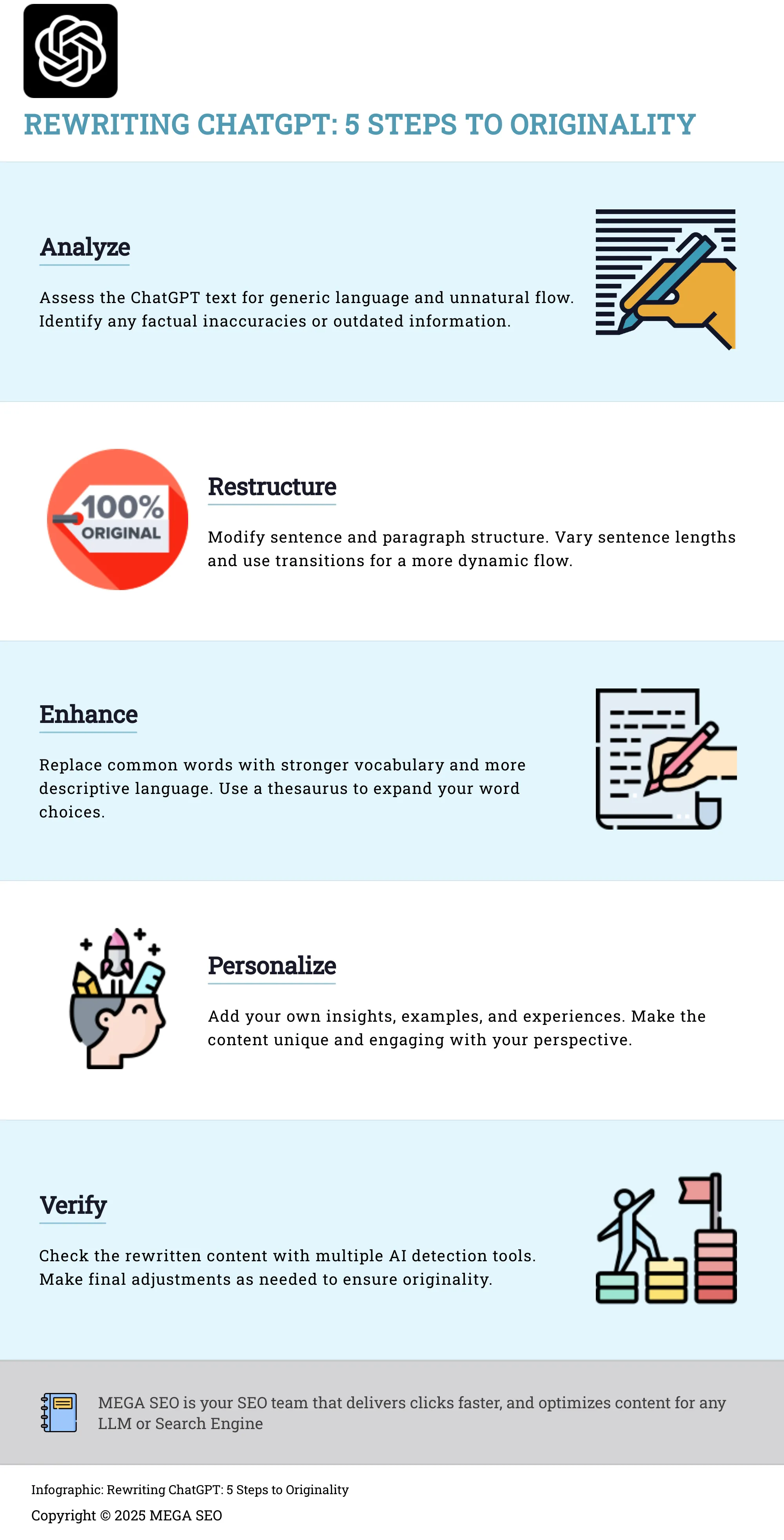
Before diving into revisions, take a moment to analyze the ChatGPT output. Identify any areas where the language feels generic, robotic, or lacks a natural flow. Pinpoint factual inaccuracies or outdated information that needs correction. This initial assessment will guide your rewriting efforts. Use AI detection tools to gauge the likelihood of the content being flagged as AI-generated. Running the text through multiple AI detection tools provides a more comprehensive analysis.
Modify Structure
Restructuring sentences and paragraphs is key to making AI-generated content your own. Vary sentence lengths, combine short sentences for a more complex structure, and break down long sentences for improved readability. Experiment with different phrasing and transitions to create a more dynamic and engaging flow. Paraphrase and rewrite the AI-generated text extensively, changing sentence structure and word choice while adding your own examples and insights.
Enhance Vocabulary
While ChatGPT can generate grammatically correct text, its vocabulary can sometimes feel generic. Look for opportunities to replace common words with more specific and descriptive alternatives. A thesaurus can be a helpful tool for this purpose. Consider using AI rewriting tools like Quillbot to refine the text further. This can help add nuance and personality to the writing, making it sound more human.
Add Original Thoughts and Examples
Infuse the content with your unique perspective and insights. Share personal anecdotes, real-world examples, or case studies to support the information presented. This not only makes the content more engaging but also demonstrates your expertise and authority on the topic. Don't simply copy and paste from ChatGPT. Instead, use it for brainstorming, outlining, research assistance, and proofreading, but never for direct plagiarism. Remember to add your own original thoughts, analysis, and research to the AI-generated content.
How to Check Rewritten Content for AI Detection
After rewriting your AI-generated content, it's crucial to check it for AI detection. This step helps ensure your content appears original and avoids any potential issues.
Use AI Detection Tools
Test your rewritten content with several AI detection tools. Don't rely on just one; using multiple tools gives you a broader perspective on how detectable your content might be. The more tools you use, the better. MEGA SEO offers a suite of free tools, including an AI content detector, to help you assess your content's originality.
Interpret Detection Results
Understanding how these tools work is key to interpreting their results. Many AI detectors, like Turnitin, compare your writing against a vast database of text, looking for similarities in wording, sentence structure, and overall ideas. They don't specifically detect ChatGPT use, but rather identify patterns and similarities that might indicate AI involvement. Knowing this helps you focus your revisions effectively.
Make Final Adjustments
Even if your content passes initial AI detection checks, consider making final adjustments to further enhance its originality. Paraphrasing and rewriting AI-generated text extensively is a good starting point. Change sentence structure, word choice, and add your own examples and insights. This not only reduces the likelihood of AI detection but also strengthens your content's overall quality and impact. Book a demo with MEGA SEO to learn how our platform can help you create unique, high-quality content that ranks well and engages your audience.
Common Pitfalls to Avoid When Rewriting AI Content
When using AI tools like ChatGPT for content creation, it's tempting to take shortcuts. However, understanding the potential downsides is crucial for responsible and effective content creation. Here are some common mistakes to steer clear of:
-
Submitting AI-generated content as is: One of the biggest mistakes is using AI-generated output without any changes. This approach not only risks detection by platforms and AI detection tools, but also results in generic content that fails to engage readers. Search engines like Google prioritize original, high-quality content, so rewriting and adding your own insights is essential for ranking well.
-
Over-reliance on AI: While AI can be a powerful tool, it shouldn't replace your own thinking. The goal is to use AI responsibly, integrating your unique perspective and original thought into the content. Think of AI as a starting point, not the final product. Our MEGA SEO tools can assist in blending AI-generated content with your own insights seamlessly.
-
Inadequate paraphrasing: Simply replacing a few words or rearranging sentences isn't enough. True paraphrasing involves understanding the meaning of the text and expressing it in your own words, with your own examples and insights. Superficial changes won't fool sophisticated plagiarism checkers like Turnitin, which can often detect paraphrased content, even if it's been rewritten using AI.
-
Ignoring proper citation: Whether you're paraphrasing or quoting directly, always cite your sources correctly. This not only avoids plagiarism issues but also adds credibility to your work. Understanding how to cite sources correctly is fundamental to ethical writing. Consider exploring our resources at MEGA SEO for tools and information on maintaining ethical writing practices.
Balance AI Assistance with Original Thinking
AI writing tools like ChatGPT can be powerful allies in content creation. They can help you brainstorm ideas, overcome writer's block, and even generate initial drafts. However, the real magic happens when you blend this AI assistance with your own original thinking. Think of AI as a partner in your creative process, not a ghostwriter. Your unique perspective, insights, and voice are what truly make your content resonate with your audience.
One of the best ways to leverage AI is for brainstorming and outlining. Let ChatGPT help you structure your thoughts and explore different angles, but don't simply copy and paste the output. Instead, treat it as a springboard for your own ideas. Weave in your own analysis, research, and personal experiences to make the content richer and more compelling. Don't just reword the AI-generated text; transform it. Ask yourself: "How can I infuse this with my own unique perspective?" CustomWritings.com offers practical advice on how to avoid AI detection by infusing your own thoughts and research into the content.
Remember, ethical use of AI isn't about avoiding detection—it's about responsible integration. It's about acknowledging AI's assistance while showcasing your own intellectual contributions. This balanced approach not only creates more engaging and authentic content, but also ensures you're using AI in a way that respects both the technology and your own creative process. Ultimately, it's about using AI to amplify your voice, not replace it.
Ethical AI Writing Practices
AI writing tools offer incredible potential, but it's crucial to use them ethically. The goal isn't to trick AI detection software, but to integrate these tools responsibly into your writing process. Think of AI as a helpful assistant, not a ghostwriter. Your original thoughts and creative input should always be front and center.
One key aspect of ethical AI writing is transparency. If you're using AI tools for brainstorming, drafting, or research, consider acknowledging their role in your work. This not only demonstrates integrity but also fosters open conversations about how AI is changing the writing landscape. Remember, many educators and publishers are more concerned with responsible use than simply avoiding AI altogether.
Another important consideration is plagiarism. While AI can generate text, it often draws from existing online content. Always double-check AI-generated content for plagiarism and correctly cite any sources, whether you're paraphrasing or quoting directly. This respects the intellectual property of others and ensures your work is original.
Finally, prioritize learning and understanding. AI can be a valuable tool for research and exploring new ideas, but over-reliance on it can hinder true learning. Use AI to jumpstart your writing process or generate a first draft, but always revise, refine, and add your own unique insights. This ensures that you're actively engaging with the material and developing your own understanding. By balancing AI assistance with original thinking, you can harness the power of these tools while maintaining ethical writing practices.
Adapt to Advancements in AI Detection
AI detection technology changes rapidly. What works today to modify AI-generated content might not be effective tomorrow. Staying informed and adapting your approach is essential for anyone using AI writing tools.
Regularly explore resources like CustomWritings.com to keep up with advancements in AI detection. Their insights into how AI detection works, and how to avoid it, can be invaluable. Understanding the methods used to identify AI-generated text is the first step in adapting your writing strategies. Sites like OneClickHuman offer further information on how tools like Turnitin are evolving to catch even paraphrased AI content. The existence of services like Undetectable.ai, which offer tools to make AI text seem human-written, demonstrates the constant back-and-forth between AI generation and detection.
Diversify your modification techniques. Combine methods like sentence restructuring, synonym replacement, and adding your own original insights. The more you transform the AI-generated text, the less likely it is to trigger detection software. Remember, the objective isn't to trick detection tools, but to use AI responsibly as a tool that supports your writing, not as a substitute for it. Prioritize integrating your unique voice and perspective. This makes the content more engaging and helps it stand apart from generic AI-generated text. Regularly test your rewritten content with available AI detection tools to confirm your modifications are working.
Related Articles
- Harnessing User-Generated Content for Enhanced SEO Performance - MEGA SEO | Blog
- Google's SGE Launch in the USA Sparks Major Concerns Among SEO Professionals - MEGA SEO | Blog
- Unpacking the Google Algorithm Leak: Insights and Reactions - MEGA SEO | Blog
- The Role of Artificial Intelligence in Generating SEO-Friendly Content - MEGA SEO | Blog
- Google Algorithm Rolls Out Tomorrow: Site Reputation Abuse Unpacked - MEGA SEO | Blog
Frequently Asked Questions
Why shouldn't I just submit content directly from ChatGPT?
Submitting content directly from ChatGPT carries significant risks. It can be easily detected by AI detection software, leading to penalties or having your content removed. More importantly, it lacks originality and may contain inaccuracies. Search engines prioritize unique, high-quality content, so adding your own insights and revisions is essential for ranking well and engaging your audience.
What's the most effective way to paraphrase ChatGPT text?
The most effective paraphrasing involves a combination of restructuring sentences, replacing words with thoughtful synonyms, and, most importantly, adding your own insights and examples. It's about transforming the AI-generated text into something that reflects your unique understanding and perspective.
Are there tools that can help me modify AI-generated content?
Yes, several tools can assist you. Paraphrasing tools like QuillBot can help rewrite sections of text. Thesauruses and vocabulary builders can expand your word choices. Readability analyzers like the Hemingway Editor can ensure your content is clear and engaging. AI detection tools can help you assess the likelihood of your content being flagged as AI-generated.
How can I use AI writing tools ethically?
Ethical AI writing involves transparency, acknowledging AI assistance when appropriate. It also means avoiding plagiarism by checking AI-generated content and citing sources correctly. Prioritize learning and understanding by using AI as a tool to support, not replace, your own thinking and research.
How can I stay ahead of advancements in AI detection?
Stay informed about the latest developments in AI detection technology. Regularly explore resources and articles that discuss AI detection methods and best practices for modifying AI-generated content. Diversify your modification techniques and test your rewritten content with various AI detection tools to ensure its originality.