
Getting ahead in search engine rankings often feels like a complex puzzle. One of the most effective ways to find the missing pieces is by looking at what’s already working for others in your field. SEO competitor reverse engineering is the process of carefully examining your competitors' online strategies to extract actionable insights. It’s not just about seeing who ranks above you; it’s about understanding why they rank there. By analyzing their keyword choices, content depth, site structure, and backlink sources, you can uncover specific tactics that you can adapt and improve upon for your own website, leading to more targeted traffic and better online visibility.
Key Takeaways
- Deconstruct Competitor SEO for Strategic Insights: Analyze your competitors' keywords, content, and backlink profiles to understand what works for them and how you can enhance your own approach.
- Pinpoint Gaps to Create Unique Opportunities: Use competitor data to find underserved keywords, content areas needing more depth, and untapped link-building avenues for your distinct advantage.
- Iterate and Adapt Your Plan for Ongoing Success: Apply your findings, track performance diligently, and consistently adjust your SEO strategy to improve results while emphasizing your unique value.
What is SEO Competitor Reverse Engineering?
Understanding what your competitors are doing well in search engines is a smart move. SEO competitor reverse engineering is essentially looking closely at the strategies your top competitors use to rank high and attract organic traffic. It’s about dissecting their approach so you can gather insights to strengthen your own. Think of it as learning from the best to make your own efforts even more effective.
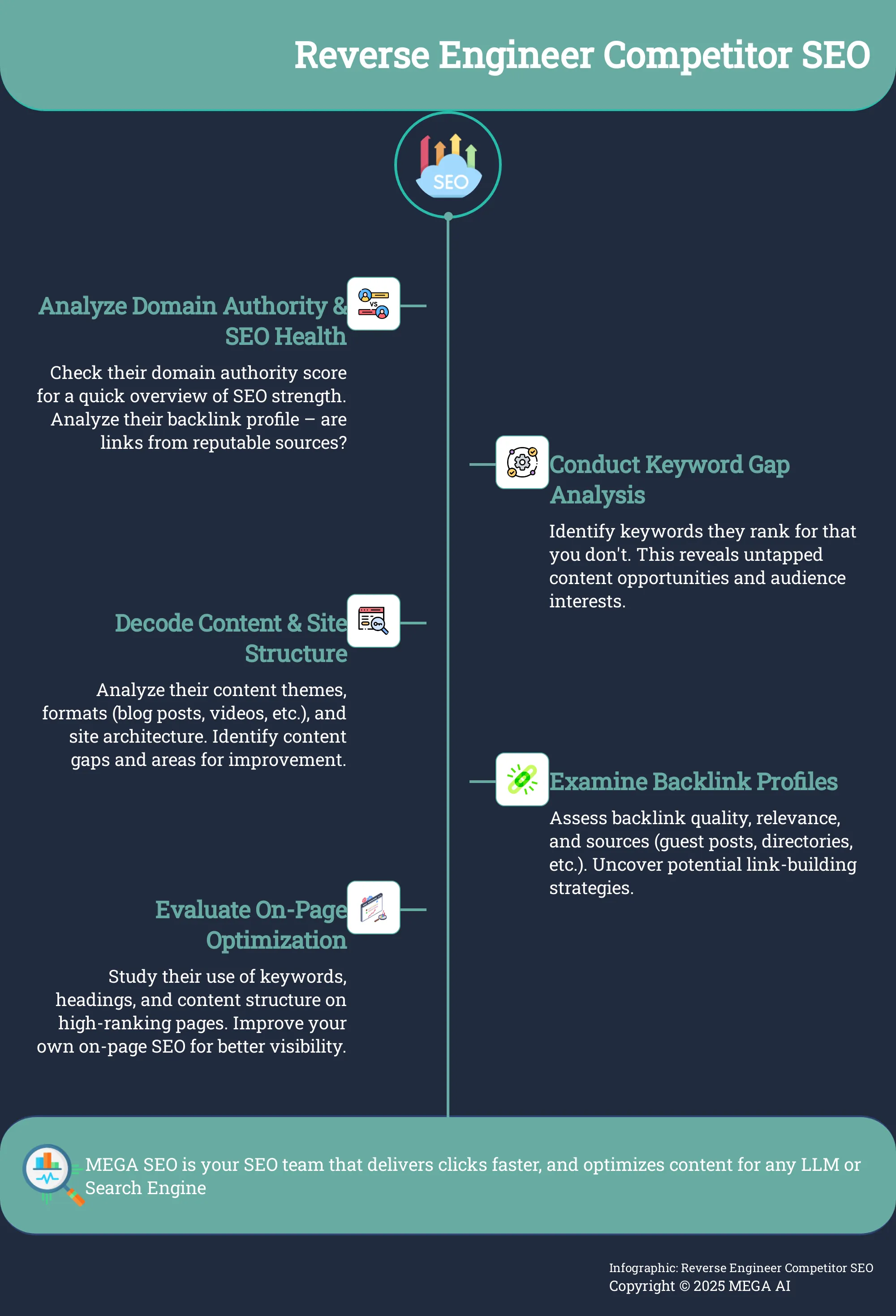
What It Is and Why It Matters
At its core, SEO competitor reverse engineering means systematically analyzing your competitors' online presence to figure out their search engine optimization tactics. This isn't about copying them directly, but rather about understanding the "why" and "how" behind their success. By examining their keywords, content, backlinks, and technical setup, you gain valuable intelligence. This matters because it allows you to identify opportunities you might have missed and refine your own SEO approach. The goal is to turn these insights into an actionable plan, focusing on areas where competitors excel and identifying gaps you can fill. Platforms like MEGA AI can help streamline this analysis, turning complex data into clear actions for your SEO strategy.
Key Benefits for Your SEO Strategy
The advantages of looking into your competitors' SEO are quite significant. One major benefit is uncovering valuable keyword opportunities. By seeing which terms your competitors rank for, especially those you aren't currently targeting, you can discover new avenues to expand your content and reach a wider audience. You also get a clearer picture of their strengths and weaknesses. For instance, analyzing their backlink profiles and on-site optimization techniques helps you understand what they’re doing right and where you might have an edge. This information is crucial for creating high-quality, optimized content that can perform well in search results. With tools that automate parts of this research, you can focus on building out these new content areas more efficiently.
Essential Tools for Competitor Analysis
To effectively understand what your competitors are doing right in SEO, you need the right set of tools and a clear focus on the data that truly matters. Think of this process as equipping yourself with a detective's kit; the more precise your tools and the sharper your eye for important details, the clearer the path to improving your own strategy becomes. This initial data gathering is a crucial first step before you can build an SEO approach that truly stands out.
Software for Analyzing Traffic and Backlinks
Your first step is to gather organic traffic and backlink data for your competitors. This is where specialized SEO software becomes invaluable. Tools like Ahrefs, SEMrush, or Moz are widely used because they offer a deep dive into competitor performance, providing information that would be incredibly time-consuming to find manually. For example, you can simply enter a competitor's domain into these platforms to see estimates of their organic traffic, the keywords they rank for, and which websites are linking to them.
Many of these platforms also provide API access. This feature can be particularly helpful if you plan to integrate this data into custom reports or use it with other analytical tools. While MEGA AI offers powerful SEO automation to streamline many tasks, understanding the raw data from these foundational tools gives you a solid grasp of the competitive environment you're operating in. The aim here is to get a comprehensive picture of who your main online competitors are and how they are currently performing in search results.
Key Metrics for Actionable Insights
Once you have access to competitor data, knowing which metrics to examine will help you find actionable insights. It’s important to look beyond just the surface-level numbers. For instance, consider the average word count of your competitors' pages that rank well. While word count itself isn't a direct ranking factor, it often reflects the depth of the content and how well a competitor has established topic authority on a specific subject. If their top-performing pages are consistently detailed and comprehensive, it signals the level of quality search engines likely expect for those queries.
Another important metric is the ratio of a competitor's website pages that have backlinks. This isn't just about the total number of backlinks, but rather how widely that link equity is spread across their site. A higher ratio often suggests that many of their pages are considered valuable by other websites, which is a strong indicator of trust and authority. Understanding these details helps you see not just what your competitors are doing, but why it might be effective. This allows you to make more informed decisions for your own strategy, and tools like MEGA AI's Maintenance Agent can then assist in applying these insights by optimizing your existing content to build similar authority.
How to Conduct a Comprehensive Domain Analysis
Think of a domain analysis as giving your competitor's website a thorough check-up. It’s about getting a clear picture of their overall online presence and how strong their SEO game is. This step is important because it helps you understand who you're up against and where their digital strengths and vulnerabilities lie. By looking at their website as a whole, you can start to see patterns and strategies that you can learn from or find ways to outperform. It’s less about individual keywords at this stage and more about the big picture of their domain's authority and health. This initial overview will guide your deeper analysis into their specific tactics later on.
Evaluate Competitor Domain Authority and SEO Health
First, let's talk about Domain Authority. While it's a score developed by Moz and not a direct Google ranking factor, it gives you a good estimate of how likely a website is to rank in search results. A higher score generally suggests a stronger ability to rank. When you evaluate a competitor's website, look beyond just this number. You'll want to monitor their backlink profiles and their on-site SEO practices. Understanding their domain authority in conjunction with these elements provides a much clearer insight into their overall SEO health and how effective they are at ranking for the keywords they target.
Consider the quality and quantity of websites linking to them. Are these links from reputable sources, or do they seem low-quality? Also, take a look at their on-site SEO. Are their pages well-structured? Do they use header tags effectively? This initial assessment helps you gauge the general strength you're competing against.
Identify Their Strengths and Weaknesses
Once you have a sense of their overall SEO health, it's time to pinpoint what they do exceptionally well and where they might be dropping the ball. This isn't about copying them; it's about learning. By understanding their approach, you can refine your own SEO strategy, focusing on areas where they excel and, more importantly, identifying gaps you can strategically fill.
A structured way to do this is through a competitive content analysis. This process helps you break down their content strategy to uncover their top-performing pieces and also find their weak spots. For instance, do they have fantastic blog content but a poor user experience on their product pages? Or perhaps their informational content is strong, but they lack compelling case studies. These observations highlight their competitive advantages and, crucially, your potential opportunities. Look for content areas they haven't covered thoroughly or where their existing content is outdated. These are your openings.
How to Master Keyword Gap Analysis
Keyword gap analysis is a smart technique for discovering the search terms your competitors are ranking for, but your own website isn't quite hitting the mark on yet. Think of it as finding hidden pathways to potential customers. This process is all about systematically identifying these keyword differences. When you know what terms your audience is searching for that lead them to competitors, you can then build a plan to capture some of that attention yourself. It’s a fundamental part of a strong SEO strategy because it directly shows you where you can grow.
By pinpointing these gaps, you're essentially getting a roadmap of content ideas that are already proven to attract interest in your niche. Instead of guessing what topics to cover, you're using data-driven insights. This allows you to create new content or refine existing pages to specifically target these overlooked phrases. The goal is to make your website a more comprehensive resource for your audience, ensuring that when they search for solutions you offer, they find you. This isn't just about getting more visitors; it's about attracting the right visitors—those actively looking for what you provide. Regularly performing this analysis helps keep your content fresh and relevant in a constantly evolving search landscape. Many businesses find that using tools to automate SEO tasks can make this process much more efficient.
Find Valuable Keyword Opportunities
Think of keyword gap analysis as your secret weapon for content strategy. It’s a highly effective way to increase your website traffic and get a leg up on the competition. By methodically finding the keywords your competitors rank for that you currently don't, you can uncover some truly valuable opportunities. This allows you to strategically expand your content plan and start capturing more of that organic search traffic. It’s not just about finding a long list of keywords; it’s about identifying the specific terms that can lead to meaningful engagement and bring more potential customers to your site.
Prioritize Keywords Effectively
Once your keyword gap analysis reveals a list of potential terms, the next vital step is to prioritize them. You can't realistically target every single keyword, so making smart choices is key. A frequent misstep is looking at the wrong competitors; it's important to remember that your SEO competitors aren't always the same businesses you compete with directly for sales. Concentrate on keywords that are highly relevant to your offerings, show a decent search volume, and give you a practical chance of ranking. Consistently performing a keyword gap analysis and updating your approach ensures you stay ahead in the SEO game.
How to Decode Competitor Content and Site Structure
Understanding what your competitors are publishing and how they organize their websites is like getting a peek at their playbook. This knowledge helps you find opportunities to create better, more effective content and improve your own site’s user experience. Let's look at how you can analyze their approach.
Analyze Their Site Architecture and Content
A good starting point is a competitive content analysis, which is the process of looking at your competitors' content strategies in a structured way. By breaking this down, it's easier to find their top-performing content, see where they might be falling short, and identify your own advantages. Begin by examining their website's main navigation and how they categorize information. Look at their URL structures – are they clean and keyword-focused?
Identify the core themes or pillars around which their content revolves. Note the different formats they use, such as blog posts, case studies, or videos, and how frequently they publish. This isn't just about cataloging; it's about understanding the "why" behind their choices. For instance, platforms like MEGA AI can assist in automating parts of your SEO by analyzing these patterns to inform your own content creation and site organization.
Spot Content Gaps and Technical SEO Advantages
Once you have a sense of what your competitors are doing, you can start looking for what they aren't doing, or where you can do better. Regularly conducting a keyword gap analysis and updating your strategy is key to maintaining an edge. By understanding what your competitors are doing, you can enhance your own content plan to improve search rankings and drive more organic traffic.
Look for topics they only touch upon superficially; these are prime opportunities for you to create comprehensive, in-depth pieces. Also, identify if they have technical advantages like superior site speed, excellent mobile-friendliness, or effective use of structured data. These insights can inform your own technical SEO efforts. Tools like MEGA AI's Maintenance Agent can even help identify new content to add to your existing articles, effectively filling gaps and optimizing your current pieces for better performance.
How to Examine Competitor Backlink Profiles
Alright, let's talk about backlinks. Think of them as votes of confidence from other websites to your competitor's site. The more quality "votes" they have, the more authoritative their site appears to search engines like Google. Examining where your competitors are getting their backlinks is like getting a peek into their networking strategy. It helps you understand who finds their content valuable and, more importantly, identifies potential link-building opportunities for your own site. This process is a cornerstone of effective search engine optimization.
This isn't just about counting links; it's about understanding the story behind them. Are they earning links from high-authority news sites, niche blogs, or industry partners? Are their links predominantly from guest posts, resource pages, or perhaps directory listings? Knowing this can significantly shape your own outreach efforts. By carefully analyzing their backlink profiles, you can build a more effective plan and create content that naturally attracts valuable links. This step is crucial for building your site's authority and improving your search rankings over time. It’s a bit like detective work, but the clues you uncover can lead to some serious SEO wins, showing you which types of content attract attention and which domains are worth connecting with. This insight allows you to refine your content strategy and focus your link-building efforts where they'll have the most impact.
Assess Their Link Quality, Relevance, and Authority
When you start looking at a competitor's backlinks, remember that quality trumps quantity every single time. A handful of links from highly respected, relevant websites will do more for their SEO than hundreds of links from low-quality or unrelated sites. So, your first job is to assess the quality of these incoming links.
Look for metrics like Domain Authority (DA) and Page Authority (PA). These scores, typically ranging from 1 to 100, give you an idea of a website's overall strength and the specific page's linking power. Higher scores generally indicate better quality. Equally important is relevance. A link from a leading blog in your industry is far more valuable than a link from a completely unrelated field, no matter how high its DA. Tools can help you gather this data, allowing you to focus on understanding the true strength of your competitor's link profile.
Uncover Link-Building Tactics and Opportunities
Once you have a sense of the quality and authority of your competitors' backlinks, the next step is to figure out how they got them. Analyzing their backlink profiles can reveal their link-building tactics and highlight strategies you might adopt. Look for patterns: Do they frequently contribute guest posts to other blogs? Are they listed on many resource pages or industry directories? Perhaps they have strong partnerships that result in mentions.
Identifying these patterns can open up a world of opportunities for your own site. For instance, if you see a competitor getting a lot of links from guest blogging, you can start researching similar blogs for your own outreach. SEO tools can also help you pinpoint which specific pages on their site are attracting the most backlinks. This tells you what kind of content resonates with their audience and earns those valuable links, giving you a clear direction for your own content creation efforts.
Get On-Page Optimization Insights from Competitors
Understanding what your competitors are doing with their backlinks and site structure provides a solid foundation. Now, it’s time to zoom in and look closer at their individual pages. Examining their on-page optimization can show you precisely how they target specific keywords and engage users effectively. Think of it less as a way to copy them directly, and more as a method to understand the successful tactics already working in your niche. With this knowledge, you can then build an even stronger, more refined approach for your own website. By carefully dissecting their on-page elements—like how they use headings, structure content, and integrate keywords—you can uncover valuable patterns and identify clear opportunities to improve your own content and technical setup.
This detailed view helps you see beyond just what topics they cover, and into how they present information to both search engines and readers. Ultimately, this gives you a clearer path to making impactful improvements on your own pages, ensuring your content not only ranks well but also resonates with your target audience. This step is crucial because even with great off-page signals, if your on-page elements aren't optimized, you might be missing out on significant ranking potential and user engagement. It’s about making sure that when users and search engines land on your page, they immediately understand its value and relevance.
Evaluate Their On-Page Elements
When you look at a competitor's high-ranking page, pay close attention to how they use their target keywords. You'll want to see if the primary keyword appears in crucial spots: the URL, the page title, the meta description, and the main H1 heading. Also, observe how they incorporate it, along with related terms, naturally within the body content and subheadings (H2s, H3s, etc.). Performing a structured content analysis can help you systematically break down these elements. This process reveals how they signal relevance to search engines and provide clarity to users, essentially offering a blueprint of their on-page strategy that you can learn from.
Strategies to Improve Your Own On-Page SEO
Once you've gathered these on-page insights, it's time to apply them to your own site. The main idea is to refine your SEO strategy by identifying areas where your competitors are strong and, more importantly, where you can find an edge. Focus on creating high-quality content that’s thoroughly optimized with relevant, high-volume keywords. This might mean updating existing pages to better target user intent or developing new content to fill gaps your competitors haven't addressed. Carefully plan your keyword targeting to ensure each page has a clear purpose and effectively communicates its value to both search engines and your audience.
Create Your Action Plan
Alright, you've done the detective work and gathered a wealth of information about your competitors. Now, let's transform those valuable insights into a concrete plan that will help your own SEO efforts. This is where the real work begins – turning analysis into action and setting yourself up for success.
Prioritize SEO Tasks from Competitor Insights
Once you've reverse-engineered your competitor's SEO approach, the immediate next step is to translate those findings into actionable tasks. Gather all the data you've collected and use it to sharpen your existing SEO strategy. Pinpoint the areas where your competitors are clearly succeeding; these are opportunities for you to learn and adapt. Equally important is identifying the gaps in their strategy—these are the openings you can strategically fill. By understanding what your competitors are doing well, you can enhance your own content plan, which in turn can lead to improved search engine rankings and more organic traffic to your site. This focused approach ensures you're channeling your energy into activities with the highest potential impact.
Develop Your Implementation Strategy
With your priorities set, it's time to build out your implementation strategy. This involves creating high-quality content that’s thoughtfully optimized with relevant, high-volume keywords. You'll want to plan your keyword targeting carefully to ensure you're reaching the right audience. It’s also a good practice to stay informed about the latest SEO trends and techniques, as the digital landscape is always evolving. Consider looking at what tactics seem to be working for your competitors in terms of converting visitors. Analyzing their approach can offer useful clues for refining your own methods and achieving your business objectives. Remember, a good strategy is one that is both well-researched and flexible enough to adapt.
Implement and Refine Your SEO Strategy
Alright, you’ve done the detective work and gathered a wealth of information about your competitors. Now comes the exciting part: putting those insights into action to sharpen your own SEO efforts. This is where careful planning meets consistent execution, turning data into tangible results for your business. Remember, the goal isn't just to copy what others are doing, but to understand their successes and failures to build an even stronger, more effective strategy for yourself.
Platforms like MEGA AI can simplify this phase by helping you automate keyword research and even generate initial content drafts based on identified opportunities. This allows you to focus more on the strategic integration of these learnings rather than getting bogged down in manual tasks. Let's look at how you can effectively integrate these findings and keep your strategy dynamic.
Integrate Competitor Learnings into Your Approach
The first step is to translate your competitor analysis into concrete actions. Start by focusing on content. If your analysis revealed that competitors are ranking well for specific high-volume keywords you're not targeting, it's time to plan your keyword targeting strategies more carefully. This means creating high-quality, optimized content around these terms. Think about how you can offer a unique perspective or more comprehensive information than what’s already out there.
Beyond individual keywords, look at their overall content approach. Are they using particular formats effectively, like in-depth guides or video content? Understanding what resonates with their audience—which is likely similar to yours—can help you enhance your own content strategy. Compile all your findings to refine your SEO strategy, pinpointing areas where competitors excel and, importantly, identifying gaps or weaknesses you can capitalize on.
Monitor Progress and Adapt for Ongoing Success
SEO isn't a one-and-done task; it’s an ongoing process of refinement. Once you’ve implemented changes based on your competitor analysis, you need to monitor your progress closely. Keep an eye on your rankings for target keywords, organic traffic, and engagement metrics. This will tell you what’s working and what needs further adjustment.
Regularly conducting a keyword gap analysis is crucial for maintaining a competitive edge. This involves systematically identifying keywords your competitors rank for that you currently don't. This process helps you uncover valuable opportunities to expand your content and capture more organic traffic. Tools like MEGA AI’s Maintenance Agent can assist by identifying new content to add to existing articles, helping to optimize your content continuously and improve its ranking potential. By staying vigilant and adaptable, you ensure your SEO strategy remains effective over time.
Avoid Common Pitfalls in Competitor Analysis
Reverse engineering your competitors' SEO strategies can offer a lot of useful information, but it's a path where you can easily stumble if you're not careful. Simply gathering data isn't the whole picture; understanding its context and, importantly, its limitations is what truly makes it work for you. Many businesses find their competitive analysis efforts don't quite hit the mark because they overlook common errors or misinterpret what they find. To make sure your hard work leads to effective action, it’s helpful to be aware of these potential traps from the start. This awareness will help you build a more solid and impactful SEO strategy, turning competitor insights into your own success.
Recognize Limitations and Potential Biases
It's a common situation: competitive analysis reports that are put together quickly, only scratch the surface, or are built on unverified assumptions. When that's the case, the insights aren't just unhelpful; they can actively steer your strategy down the wrong path. Remember that data tells a story, but it might not be the complete one. Tools can show you numbers, but they don't always capture the 'why' behind a competitor's performance.
Be mindful of your own biases too. You might overestimate a well-known competitor or underestimate a newer one. To address this, always question the data. Ask yourself if there are other explanations for what you're seeing and consider what information might be missing. Acknowledging these common mistakes in competitive intelligence is a key step toward a more objective and useful analysis.
Balance Insights with Your Unique Value
The difference between truly useful competitive analysis and just collecting information without a clear purpose can be quite small. It's easy to fall into the trap of trying to copy everything your competitors do, especially if they appear successful. However, your aim isn't to become an exact replica. Instead, you want to identify what works for them and then thoughtfully adapt those learnings to fit your unique brand, your specific audience, and your overall business goals.
Use competitor insights to find gaps and opportunities, but always bring it back to your core strengths. What makes your business different? How can you serve your audience in a way your competitors don't? When you analyze your competitors, breaking it down into steps makes it easier to see their top content and weak spots, which helps you highlight your own advantages.
Related Articles
- How to Use Ahrefs for Competitor Analysis: Boost Rankings
- Ahrefs Competitor Analysis Guide to Win More Traffic
- Ultimate Keyword Research Checklist for SEO
- Backlinko Link Building: The Definitive Guide (2024)
- On-Page SEO: The Ultimate Guide to Ranking Higher
Frequently Asked Questions
What's the real point of looking at my competitors' SEO? Is it just to do what they do? Think of it more like learning from a classmate who aces every test. You're not trying to turn in their exact paper, but you do want to understand their study habits and how they approach the material. Looking at competitor SEO helps you see what strategies are effective in your field, what kind of content resonates with your shared audience, and where there might be opportunities for you to offer something even better or different.
I'm just starting out or have a small team. Where's the best place to begin with competitor analysis if I can't do everything? That's a great question. If your resources are tight, I'd suggest starting with a keyword gap analysis. This helps you find search terms your competitors are ranking for that you aren't, which can give you some really clear ideas for new content. Also, take a look at their most successful pieces of content; understanding what topics and formats are working well for them can guide your own content creation without needing to analyze every single aspect of their strategy.
How often do I need to peek at what my competitors are doing with their SEO? You don't need to check in daily, as that can become a distraction. Instead, aim for regular reviews, perhaps quarterly, or when you're planning a significant content push or website update. It's also wise to take a look if you notice major shifts in your own rankings or if there's a big search engine algorithm update, as this can change the competitive landscape.
If my competitor is ranking for a specific keyword, should I automatically go after it? Not necessarily. Seeing a competitor rank for a keyword is a good signal that it might be relevant, but your next step is to evaluate if that keyword truly aligns with your specific products or services and your audience's needs. You'll also want to consider the search volume for that keyword and realistically assess if you have the resources and authority to compete effectively for it. Sometimes, focusing on less competitive, more niche keywords can be a smarter move.
It's clear how to see what competitors are doing, but how do I find the things they aren't doing well or at all? This is where you can really find your edge. Look for topics they've only covered lightly where you could provide much more depth and value. Check if their content is up-to-date; outdated information is a clear opening for you. You can also look for user questions in forums or social media related to your industry that your competitors haven't addressed thoroughly on their sites. These gaps are your opportunities to shine.