
As a business owner, your deepest expertise lies within your own company and its market. You understand its strengths, weaknesses, and opportunities better than anyone. So, when profits start to flow, does it make more sense to venture into unfamiliar investment territories, or to capitalize on what you already know best? The reinvestment-over-diversification strategy champions the latter. It’s about channeling your financial gains back into your core business to amplify its success. This article will guide you through the benefits of this focused approach, helping you identify high-impact areas for reinvestment and understand how leveraging your existing knowledge can lead to more substantial and sustainable growth before you consider broader diversification.
Key Takeaways
- Prioritize Core Reinvestment: Channel profits back into your main business during growth stages to build on existing strengths and speed up expansion.
- Plan Your Reinvestment: Strategically reinvest by identifying high-impact areas tied to your long-term goals and regularly measuring the results.
- Adapt Your Approach Over Time: Recognize when focused reinvestment yields diminishing returns and begin to gradually diversify to build broader financial resilience as your business matures.
What is the Reinvestment-Over-Diversification Strategy?
The reinvestment-over-diversification strategy is a game plan for growing your wealth, especially when you're building up your business or investment portfolio. Instead of spreading your profits thinly across many different assets—which is what diversification usually means—this approach encourages you to put that money right back into your main business or your most promising ventures. The core idea is to increase your business's value and really push its growth forward.
Imagine your business is doing well and starting to bring in good profits. With this strategy, instead of immediately taking those earnings and scattering them into various stocks, bonds, or real estate, you thoughtfully reinvest them into parts of your business that can generate even better returns. This might mean enhancing your products or services, boosting your marketing, bringing on key team members, or investing in technology to make things run smoother. The aim is to accelerate your growth much more quickly than if you were to divide your attention and capital among several, less familiar investment options. It’s about concentrating on what’s already performing well and has the potential to become much larger, creating a solid foundation for significant long-term success before you start to widen your financial scope.
Why Prioritize Focused Reinvestment?
When your business starts generating profit, the big question becomes: what’s next for that money? While diversifying your investments might seem like a safe, traditional path, there's a strong case for prioritizing focused reinvestment back into your core operations. This approach isn't about spreading your resources thinly; it's about concentrating your financial power where it can make the most significant impact, especially in the early and growth stages of your business. By channeling funds back into what you already do well, you create a powerful cycle of improvement and expansion. This strategy allows you to build on existing successes and deepen your market penetration, rather than diluting your efforts across unfamiliar ventures.
Fueling Compound Growth in Your Core Business
Think of reinvestment as adding fuel to a fire that’s already burning strong. Instead of seeking out entirely different investment opportunities, you should consider reinvesting in your business because this allows you to accelerate your growth much faster. Each dollar put back into your operations—whether it's for enhancing your product, improving your marketing, or streamlining your processes—doesn't just add to your business; it multiplies its potential. This is the power of compound growth. The profits generated from these improvements can then be reinvested again, creating a snowball effect that can lead to substantial, sustainable expansion over time. It’s about making your money work harder for you within the framework you’ve already successfully established.
Using Your Expertise and Market Knowledge
One of the most significant advantages you have as a business owner is your intimate understanding of your own company and the market it operates in. The key is often not to diversify into areas you know little about, but to double down on what you know and what you’re good at. When you reinvest in your core business, you're leveraging this invaluable expertise. You're making decisions based on firsthand experience and data, rather than speculating on unfamiliar industries. A successful reinvestment strategy often involves identifying areas within your business that have already shown strong historical growth and stability. This allows you to make more informed choices, allocate resources effectively, and ultimately, achieve better returns on your reinvested capital.
The Risks of Diversifying Too Early
Many entrepreneurs and small business owners feel the pressure to diversify their efforts and investments early on. The idea of not putting all your eggs in one basket sounds sensible, right? While diversification certainly has its place in a mature wealth-building strategy, jumping in too soon can actually hinder your growth rather than protect it. Think of it like trying to nurture a dozen tiny saplings with a limited supply of water and sunlight; it's likely that none of them will receive enough to truly flourish into strong trees. This early pull towards diversification often stems from a fear of missing out or a misunderstanding of how sustainable growth is built.
When your primary business or core strategy is still in its growth phase, it demands your undivided attention and the bulk of your resources. Diverting these precious commodities—your capital, time, and expertise—to multiple, less-developed ventures can mean that your main engine of growth sputters. Instead of building a strong, resilient foundation in one area, you might end up with several weak and vulnerable ones. This isn't just about financial capital; it's also about your team's energy and your mental bandwidth, all critical resources for scaling a business. Understanding the psychology of diversification can help you recognize when it's a strategic move versus a premature distraction that could dilute your impact. Before you consider spreading out, ensure your core operations, perhaps your primary product line or your foundational SEO strategies, are robust, optimized, and generating consistent, predictable returns.
Spreading Your Focus and Resources Thin
One of the most immediate downsides of diversifying too early is how it dilutes your focus and stretches your resources. Every new venture, product line, or market you enter demands attention, capital, and operational effort. If your core business isn't yet self-sustaining or fully optimized, pulling resources away can be detrimental. As investment psychology highlights, merely holding many different assets doesn't automatically guarantee protection from losses, especially when those assets aren't well understood or managed. For a growing business, managing multiple fledgling efforts often means none receive the dedicated nurturing needed for significant success. This can lead to a situation where you're doing many things adequately, but nothing exceptionally well, ultimately slowing down your overall progress.
Losing Out on Key Growth Opportunities
When you shift your attention and capital to new, unproven areas too soon, you risk neglecting the golden opportunities within your primary business. Often, the most significant growth comes from doubling down on what’s already working and scaling your core strengths. Premature diversification can mean you miss the chance to capture a larger market share, innovate further in your niche, or solidify your brand before competitors catch up. Waiting to fully exploit your core business's potential is like leaving money on the table. Understanding that a focused approach is key will help you steer clear of common diversified investment myths and keep your primary venture on the right track for substantial growth.
When Should You Prioritize Reinvestment?
Deciding when to channel profits back into your business instead of diversifying your investments isn't always a straightforward choice. However, certain signals can guide you toward reinvestment as the more strategic move for growth. It really comes down to recognizing moments of significant opportunity and having a clear understanding of your business's unique position in the market. Prioritizing reinvestment often makes the most sense when you can clearly see paths to substantial growth, when current market conditions are favorable, or when you have the chance to further build upon what your business already does exceptionally well.
Think of it this way: if your primary engine is performing strongly and has the capacity to go even faster, your first instinct should be to provide it with more fuel, rather than immediately diverting resources to construct a smaller, secondary engine. For startups and small businesses, particularly those looking to scale their SEO efforts or enhance their paid advertising campaigns, identifying these prime moments for reinvestment is a critical skill. Let's explore how you can spot these valuable opportunities.
Spotting High-Growth Potential
One of the most compelling reasons to reinvest is when you identify areas within your business that exhibit strong growth potential. This involves looking for services, products, or market segments that have not only shown consistent positive performance historically but also appear poised for a significant breakout. As experts suggest, identifying assets that demonstrate robust historical growth and stability is fundamental to a successful reinvestment strategy.
For instance, if a particular service you offer consistently outperforms others, or if a specific marketing channel is delivering exceptional returns on investment, these are clear indicators for where additional funds could make a big impact. You might also observe emerging market trends that your business is uniquely positioned to capitalize on. The objective is to direct your capital towards areas that are already proving their value or show strong signs of future success, rather than spreading your resources too thinly across unproven ventures.
Reading Market Conditions and Timing
The broader economic landscape and current market dynamics play a crucial role in making sound reinvestment decisions. A keen understanding of market conditions and appropriate timing is essential because it allows you to make well-informed choices about when and where to allocate your capital effectively. Sometimes, fluctuations within the market can create unexpected openings. For example, if your competitors are scaling back their operations or marketing spend, it might present the perfect opportunity for you to reinvest and capture a larger share of the market.
Similarly, during periods of rapid technological advancement, reinvesting in new tools, software, or employee skills can provide a significant competitive edge. For businesses utilizing platforms like MEGA AI for their Paid Ads, reinvestment could mean allocating an increased budget to campaigns that are performing exceptionally well due to favorable market responses, or it might involve exploring new automation features that can create numerous ad variations tailored for different audience segments.
Knowing Your Business's Core Strengths
Many successful companies that prioritize profit reinvestment achieve this by strategically doubling down on what they inherently do best. Your core strengths are those unique capabilities and advantages that distinguish your business from the competition. Reinvesting in these specific areas can further solidify your market position, enhance customer satisfaction, and build greater brand loyalty.
If your business excels in providing outstanding customer service, reinvesting in additional training for your team or implementing new customer relationship management tools can transform satisfied customers into enthusiastic advocates for your brand. If your primary strength lies in highly efficient operations, channeling funds into further streamlining processes can lead to reduced costs and improved profit margins. For a digital marketing agency, a core strength might be its deep expertise in content optimization. Reinvesting in advanced tools or specialized training to enhance this capability, perhaps through a platform offering automated content updates and optimization, directly supports that foundational strength and fuels sustainable growth.
What to Consider for Reinvestment Decisions
Making smart reinvestment decisions is about more than just having extra cash; it's about strategically fueling your business's next phase of growth. Before you decide where to put those hard-earned profits, there are a few key areas you'll want to carefully evaluate. Think of it as choosing the most fertile ground to plant your seeds for the biggest harvest. This means looking inward at your business's capabilities and outward at the market landscape. Getting this right can be the difference between steady progress and a significant leap forward. For businesses looking to enhance their online presence, tools like MEGA AI can play a crucial role in making these reinvestments count, especially in areas like search engine optimization and paid advertising campaigns.
Your Business's Scalability and Innovation
When you're thinking about reinvesting, one of the first places to look is at the parts of your business that can truly grow and innovate. Ask yourself: which areas, if given more resources, could handle significantly more volume or break new ground? Experts suggest that "the key to a successful reinvestment strategy lies in identifying assets that demonstrate strong historical growth and stability," and this often points to scalable operations or innovative projects. Perhaps it’s refining a product that customers already love, or investing in technology that automates a time-consuming process. For instance, if your marketing efforts are manual and slow, reinvesting in a platform that offers automated keyword research could free up your team to focus on strategy, allowing you to scale your content output significantly.
Market Saturation and Your Competition
Understanding your market and who you're up against is vital. Is your market still wide open, or is it getting crowded? Knowing this helps you decide if reinvesting in your current offerings will yield strong returns or if you need to innovate to stand out. While some might consider diversifying when markets get tough, as "by diversifying, companies aim to reduce dependence on a single product or market, thereby enhancing their resilience to market fluctuations," a focused reinvestment can often be more powerful, especially if it helps you carve out a stronger niche. Look at what your competitors are doing, identify gaps, and see where a strategic reinvestment can give you a distinct advantage. This could mean improving your product based on competitor weaknesses or optimizing your content to capture search traffic they’re missing.
Calculating Return on Invested Capital (ROIC)
It’s essential to measure how effectively your reinvestments are working. That’s where Return on Invested Capital (ROIC) comes in. ROIC helps you see how much profit you’re generating from the capital you’ve invested back into your business. As noted, "Successful Companies that Prioritize Profit Reinvestment exemplify how diverse industries and companies have harnessed the power of customer satisfaction to achieve substantial growth and success," and tracking ROIC is a way to ensure your reinvestments are indeed leading to that growth. If you’re reinvesting in marketing, for example, you’d want to see a clear return in terms of new customers or increased sales. Tools that help you optimize ad spend automatically can directly contribute to a healthier ROIC by ensuring your budget is always working its hardest.
How to Reinvest Effectively
Alright, so you're ready to put those hard-earned profits back into your business. That's a fantastic step. But simply putting money back in isn't quite enough; we want to reinvest effectively. This means being smart and strategic about where those funds go to ensure they work hardest for you, fueling real, sustainable growth. It’s about making deliberate choices that will support your current operations and pave the way for future success.
Focus on High-Impact Areas
When you're deciding where to reinvest, it’s essential to pinpoint the parts of your business that will give you the most return. As experts often note, "Identifying assets that demonstrate strong historical growth and stability is crucial for a successful reinvestment strategy." This means looking at what’s already working well or has the clearest potential for significant improvement. Perhaps your SEO strategy is bringing in a steady stream of leads, or a particular service you offer has a high profit margin and growing demand. By "concentrating on high-impact areas, investors can maximize their returns and ensure that their reinvestment efforts yield significant benefits." So, take a good look at your data, identify your star performers, and channel your resources there first.
Match Reinvestment with Long-Term Goals
Reinvesting isn't just about quick wins or addressing immediate needs. It’s a powerful tool for building the future you envision for your business. It's wise to remember that "reinvesting your profits is not just about immediate gains; it’s about aligning your reinvestment strategy with your long-term business goals." Are you aiming to expand into new markets, develop innovative products, or perhaps significantly scale your operations? Your reinvestment choices should directly support these ambitions. This strategic alignment "can help increase the overall value of your business in the future, ensuring that your efforts today translate into substantial rewards down the line." Before you allocate funds, ask yourself how this specific reinvestment helps you get closer to your big-picture objectives.
Speed Up Growth with Strategic Reinvestment
A smart reinvestment strategy can do more than just sustain your business; it can actively accelerate its growth. When you thoughtfully decide where to put your profits, you're essentially creating a roadmap for faster progress. We know that "a tailored reinvestment strategy can create resilience and long-term success." This involves more than just spending money; it's about "adaptive planning" that allows your business to respond to market changes and seize opportunities. For instance, investing in tools that automate key processes, like AI-driven paid advertising, can free up resources and allow you to scale more quickly. By making these kinds of strategic choices, you can "accelerate their growth and navigate changing market conditions effectively," building a stronger, more agile business.
How to Balance Reinvestment and Risk
Finding the right balance between putting money back into your business and managing potential downsides is a cornerstone of steady, long-term growth. It’s less about picking one path exclusively and more about understanding how to weave these strategies together effectively. Think of it like captaining a ship: you need to know when to open the sails wide to catch the wind (that’s your reinvestment) and when to adjust course or drop anchor to weather a storm (that’s managing risk and considering diversification). This equilibrium will naturally shift as your business evolves and as the market landscape changes. Your main objective is to keep your primary engine—your business—humming along powerfully, while methodically building safety nets and alternative supports. This approach allows you to fully leverage your core strengths and seize growth opportunities without overexposing your venture to unnecessary hazards. By establishing clear guidelines for your financial decisions and staying well-informed about your business’s performance and market trends, you can make intelligent choices that support both your company's expansion and your broader financial security.
Define Your Reinvestment Thresholds
A practical first step in striking this balance is to define your reinvestment thresholds. These are essentially your own set rules or conditions that dictate how much of your profit gets funneled back into the business. For example, you might decide that until your company hits a specific annual revenue target or captures a certain percentage of market share, a significant portion, say 70-80%, of profits will be reinvested. As business expert Marjorie A. Perry wisely states, "[r]einvesting your profits puts money back into your business. This can help increase its value in the future." This reinvested capital can then fund vital improvements, such as enhancing your SEO strategy to draw in more organic traffic or developing innovative features for your products or services. By setting these thresholds, you establish a disciplined framework, ensuring you consistently fuel growth during crucial development phases, while also having a clear plan for when to begin exploring other uses for your hard-earned profits.
Introduce Diversification Gradually
Once your business is standing on solid ground and generating reliable returns, you can begin to explore diversification. The key here is to introduce it slowly and thoughtfully. Avoid the temptation to quickly scatter your investments across numerous different areas, especially early on. Investology Hub offers a pertinent insight: "[a] prevalent misconception is that merely holding a large number of different assets guarantees protection against losses." Instead, start by identifying and researching a small number of investment opportunities that genuinely align with your long-term financial objectives and your comfort level with risk. This might involve investing in a different industry or a type of asset that complements your main business operations. The aim is to make well-informed decisions, ensuring that each new investment truly contributes to a more resilient overall financial picture without diluting the focus or resources needed for your core business to thrive.
Keep Control and Oversight
Whether you are channeling significant funds back into your business or beginning to diversify your assets, maintaining active control and thorough oversight is absolutely essential. This means staying deeply involved in understanding exactly where your money is allocated and how those investments are performing. It’s not a "set it and forget it" situation. You'll want to regularly review your reinvestment strategy and any diversified holdings. As First Citizens Bank advises, "[u]nderstanding diversified investments, avoiding the misconceptions and sticking to a smart approach will help you steer clear of any pitfalls and stay on the right track." This level of understanding empowers you to make timely adjustments, whether that involves reallocating funds within your business to more effective paid ad campaigns or fine-tuning your external investment portfolio. Consistent and active oversight ensures your financial strategy remains aligned with your overarching goals and can adapt effectively to changing market conditions or business needs.
Common Myths About Diversification
When we talk about reinvesting in your core business, it’s natural for the idea of diversification to come up. Diversification certainly has its place, particularly as your business matures and starts generating substantial, stable profits. However, for growing startups and small businesses, an early or unfocused approach to diversification can sometimes slow you down rather than help you grow. It's helpful to understand a few common misunderstandings about diversification so you can make more informed decisions for your business's financial strategy and decide when it's truly the right time to branch out.
The "More Assets = More Safety" Myth
It’s a common belief that the more things you invest in—whether that’s different marketing channels, new product lines, or various financial assets—the safer your overall position becomes. The idea is that if one area doesn't perform well, others will compensate. While there's some logic to this, simply accumulating a larger number of different assets doesn't inherently protect you from losses. What's often overlooked is the importance of how these assets relate to each other. If your various ventures are highly correlated, meaning they tend to react similarly to market conditions, they might not provide the safety net you expect. For instance, if you launch paid ad campaigns across several platforms but they all target the same narrow audience with a similar message, a single shift in that audience's preferences could impact all campaigns negatively.
Thinking Diversification Cuts All Risk
Another frequent misconception is that a well-diversified strategy can eliminate all potential downsides. While diversification is quite effective at reducing what’s known as unsystematic risk—the kind of risk specific to a particular company, product, or marketing channel—it doesn’t remove systematic risk. Systematic risk affects the entire market or large segments of it, such as economic downturns or major industry-wide technological shifts. For example, even if your business offers a diverse range of services, a significant update to Google's search algorithm can impact your SEO performance across all of them if your strategies aren't robust. Understanding this distinction helps avoid a false sense of security and highlights that some risks require adaptive strategies beyond just spreading your efforts.
The Dangers of Over-Diversifying
While spreading your resources can seem like a prudent move, there's a point where you can stretch them too thin. This is known as over-diversification, and it carries its own set of challenges. When you divide your capital, attention, and team efforts across too many different initiatives, you risk diluting your potential returns. Your best-performing areas—perhaps your core product or your most effective marketing channel—might not receive the focused investment they need to truly excel because resources are being diverted to less promising ventures. For a startup or small business, this can lead to a lot of activity without substantial forward momentum. It can also make managing everything far more complex. Often, concentrating your reinvestment on areas where you already have traction and expertise, such as optimizing your existing content for higher engagement and search rankings, can yield much greater results than scattering your efforts too widely.
Putting Your Reinvestment Strategy into Action
Alright, we've explored why focused reinvestment can be a powerful engine for your business. Now, let's get practical and discuss how you can actually put this strategy to work. It’s about moving from understanding the concept to making it a reality in your day-to-day operations. This involves a clear-eyed look at your business, some careful planning, and a commitment to staying agile. Think of it as building a roadmap for your business’s financial growth, ensuring every dollar reinvested is working as hard as possible for you.
Successfully implementing a reinvestment strategy isn't just about throwing money back into the business; it's about smart, targeted actions. It requires you to be both an analyst and a strategist, identifying where your business has the most room to grow and then creating a structured approach to get there. And remember, this isn't a one-time task. It's an ongoing process of evaluation and adjustment to keep your business on the path to success. This means you'll need to consistently assess your business's performance and market position to make informed decisions.
Analyze Your Business's Growth Potential
Before you decide where to reinvest, you need a solid understanding of where your business truly has the potential to expand. This means looking beyond just your current revenue streams. As experts often point out, "The key to a successful reinvestment strategy lies in identifying assets that demonstrate strong historical growth and stability." So, take a deep dive into your business's performance. Which products or services are your star performers? Where are you seeing consistent customer demand and positive feedback?
Consider market trends too. Are there emerging opportunities that align with your core strengths? For instance, using tools that offer automated keyword research can help you uncover new content areas or customer needs you haven't yet tapped into, showing you where reinvestment in content or SEO could yield significant returns. This analysis forms the foundation of a smart reinvestment plan, helping you pinpoint exactly where your money will make the biggest impact.
Create Your Structured Reinvestment Plan
Once you've identified areas with strong growth potential, the next step is to create a structured plan. This isn't about vague intentions; it's about outlining concrete steps. Think about how "reinvesting your profits puts money back into your business. This can help increase its value in the future. It also provides funds for making improvements to services and products, which ultimately increases customer satisfaction and overall retention rates." Your plan should detail how reinvested funds will achieve these outcomes.
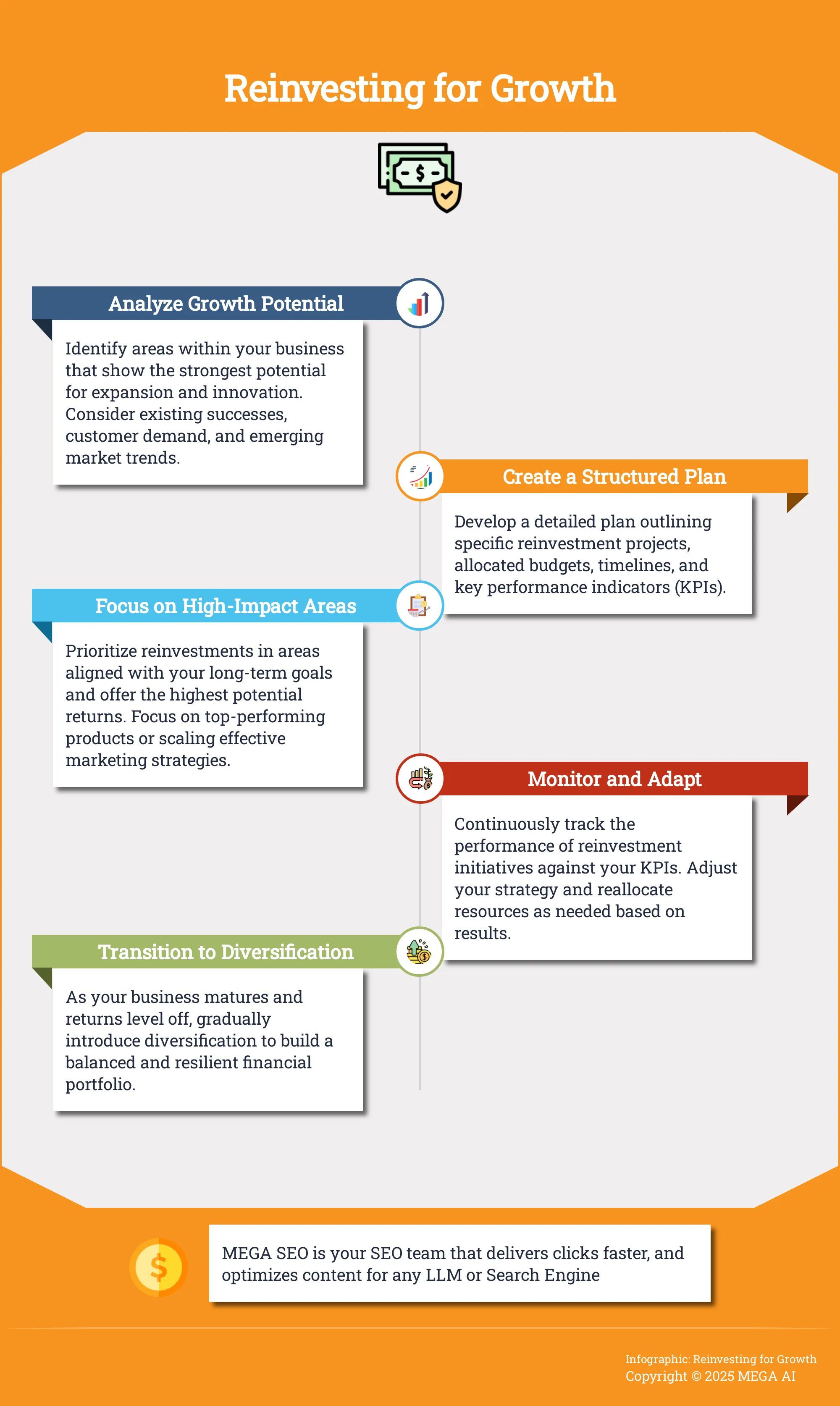
What specific projects will you fund? Will you invest in developing new features for your flagship product, expanding your marketing efforts, or perhaps hiring key talent? For example, if customer acquisition is a priority, your plan might include allocating a budget to Paid Ads optimization to reach a wider audience more effectively. Set clear goals, timelines, and allocate specific amounts to each initiative to ensure accountability and track progress.
Monitor and Adapt Your Strategy
A reinvestment strategy isn't something you set once and then forget. The market changes, your business evolves, and what worked yesterday might not be the best approach tomorrow. It's crucial to continuously monitor your strategy's performance and be ready to adapt. As one case study on strategic reinvestment highlights, a "tailored strategy can help investors create resilience and long-term success through thoughtful diversification and adaptive planning." While their focus includes diversification, the principle of adaptive planning is key for reinvestment too.
Establish key performance indicators (KPIs) for each reinvestment initiative. Are you seeing the expected returns? Is customer satisfaction improving? Are you gaining market share? Regularly review these metrics. If a particular area isn't delivering, don't be afraid to reallocate those funds to more promising ventures. Platforms that offer features like automatic budget reallocation in ad campaigns or content updates to improve rank inherently support this adaptive approach, helping you stay nimble.
When to Shift: From Reinvestment to Diversification
While pouring resources back into your core business often feels like the most direct path to growth, and for good reason during certain stages, there inevitably comes a point where the landscape starts to change. The significant returns fueled by focused reinvestment might begin to show signs of slowing, or perhaps your personal financial aspirations and risk tolerance evolve as your business matures. This is the critical juncture when the conversation naturally shifts from solely reinvesting in your primary operations to strategically introducing diversification into your financial plan. It’s not about abruptly halting the reinvestment that built your success, but rather about thoughtfully reallocating a portion of your profits to build a more resilient, varied, and ultimately more secure financial future. Recognizing the signals for this shift—whether they are internal to your business performance or external market factors—is crucial. It involves a clear-eyed assessment of when your main engine of wealth creation could benefit from supporting structures, allowing you to not only continue growing your wealth but also to safeguard it more effectively against unforeseen market shifts or the natural evolution of your business’s lifecycle. The objective is to thoughtfully transition towards a more balanced portfolio of efforts. In this model, your core business continues to thrive with smart, targeted reinvestment, while new, diversified avenues begin to contribute to your overall financial well-being and long-term stability.
Spotting Signs of Lower Returns
One of the clearest indicators that it might be time to consider diversification is when you notice diminishing returns from your reinvestment efforts. Perhaps the new product features you’re developing aren’t attracting customers as they once did, or your marketing spend isn't delivering the same impressive ROI. Initially, reinvesting profits into areas like product innovation or aggressive marketing can yield substantial growth. However, as markets mature or competition intensifies, the impact of each additional dollar reinvested can lessen. Experts note that "the key to a successful reinvestment strategy lies in identifying assets that demonstrate strong historical growth and stability." When that growth starts to slow despite your best efforts, it’s a signal. This doesn’t mean your business is struggling; it simply suggests that the high-growth phase might be transitioning, and exploring other opportunities for your capital could be more beneficial.
Aligning with Your Financial Goals and Risk Comfort
Your decision to diversify should also be deeply connected with your broader financial objectives and your comfort level with different types of risk. Early in your business journey, "investing your business profit back into your business can help increase its value in the future," and this focused reinvestment often aligns with goals of rapid expansion. However, as your business matures, or as your personal financial needs change—perhaps you’re thinking more about wealth preservation or generating passive income—your investment strategy should adapt accordingly. It's common for entrepreneurs to think, as some sources point out, that "'my business is my only investment' or 'I'll start later.'" But proactively considering diversification when your business is stable, rather than waiting for a downturn, allows you to make choices from a position of strength, aligning your investments with your evolving life and business goals.
Building a Balanced Approach to Wealth
Ultimately, the shift towards diversification is about constructing a more balanced and resilient financial foundation. While it's true that "successful companies that prioritize profit reinvestment have harnessed the power of customer satisfaction to achieve substantial growth and success," true long-term wealth security often comes from not having all your resources tied to a single venture. Diversification, when approached thoughtfully, helps mitigate risks. It’s important to understand that, as some analyses suggest, "diversification is often misunderstood in investment psychology." It's not a foolproof shield against all market volatility. However, by spreading your investments across different asset classes or ventures, you reduce your dependency on the performance of a single entity. This balanced approach means your core business can continue to be a strong performer, supported by strategic reinvestment, while other investments contribute to steady, diversified growth and protection of your overall wealth.
Related Articles
- Wealth Building 101: The Ultimate Guide
- SEO Angel Investing: A Smart Guide for Beginners
- Help Startups Win With This SEO Guide for Investors
- Legal Basics for Startups: A Comprehensive Guide
- How to Start an Online Business: Step-by-Step Guide
Frequently Asked Questions
What's the core idea of choosing reinvestment over immediate diversification? The main thought behind this strategy is to channel your business profits back into your primary operations, especially when things are going well. Instead of spreading your earnings across many different types of investments right away, you focus on strengthening and expanding what's already proven successful, aiming to significantly increase its value and growth momentum first.
When does it make the most sense to prioritize reinvesting in my own business? Prioritizing reinvestment is often a smart move when you can clearly identify areas within your business that have strong potential for further growth. This could be when market conditions are particularly favorable for your industry, or when you have an opportunity to build even further on your company's core strengths and most successful offerings.
Are there any drawbacks to diversifying my investments too early on? Yes, diversifying too soon can sometimes stretch your financial and mental resources quite thin. When your main business is still in a crucial growth phase, diverting capital and attention to multiple new ventures can mean that none of them receive the full focus needed to truly thrive, potentially slowing down your overall progress.
How can I figure out the best areas within my business for reinvestment? To decide where to reinvest, take a close look at which parts of your business show the most promise for scalability and innovation. Consider the current market landscape and your competition to find opportunities where your investment can make a real difference. It's also helpful to think about how each potential reinvestment could contribute to a solid return on that capital.
At what point should I consider shifting from reinvestment to diversification? The time to begin thinking more seriously about diversification often comes when you notice that the returns from reinvesting in your core business are starting to plateau. It can also be prompted by changes in your personal financial goals or your comfort level with risk as your business matures and becomes more stable.