
You have invested significant time and resources into developing a library of articles, blog posts, and web pages. But is all that existing content still delivering its maximum potential for your business? Often, older content possesses untapped value that a strategic refresh can unlock. The process of identifying these opportunities and effectively implementing updates can be intricate. AI tools simplify this by providing data-driven insights and automation capabilities. This piece will guide you through leveraging AI to effectively refresh your existing content, helping you extract more value from your current assets and enhance your overall online presence and search engine performance.
Key Takeaways
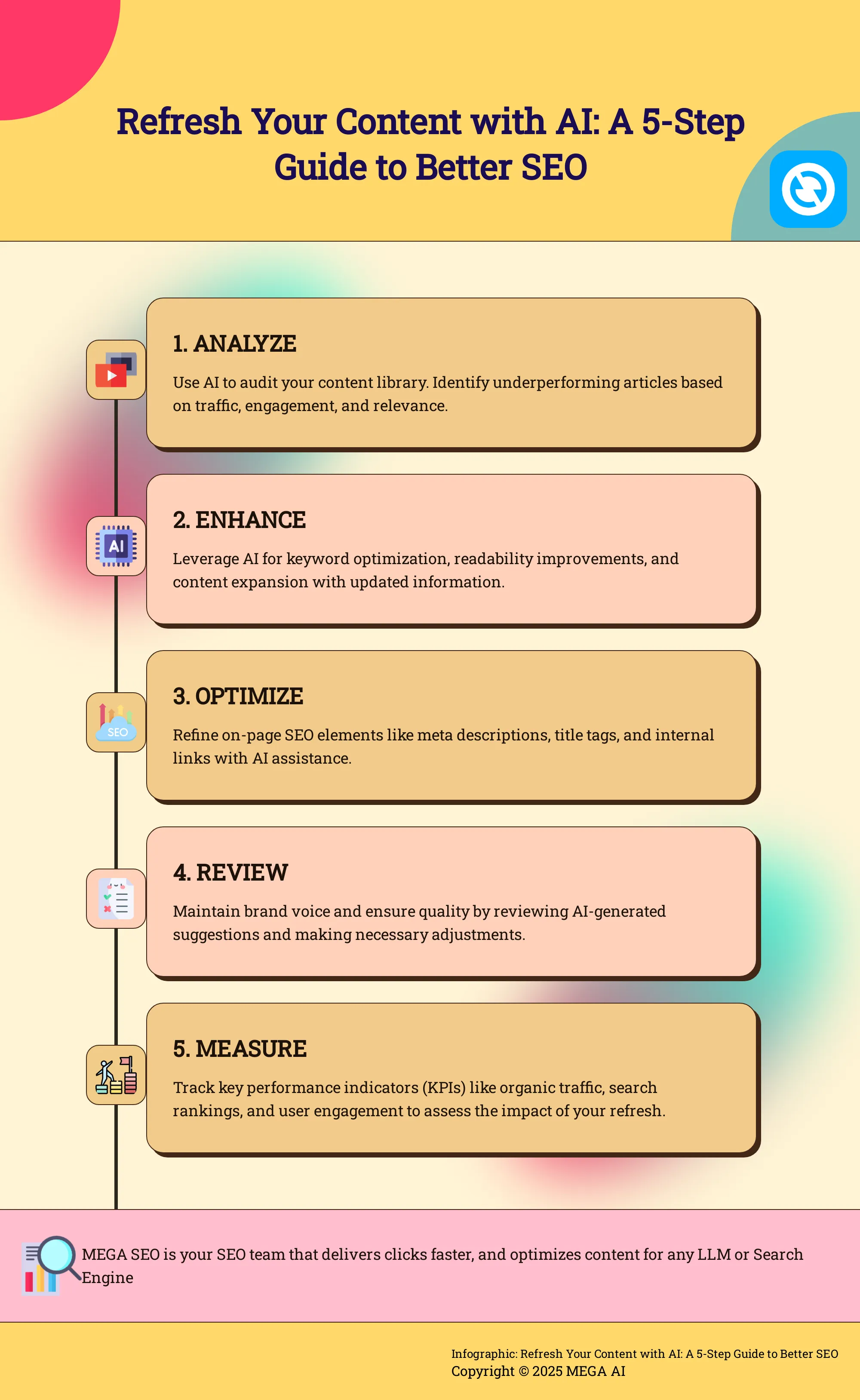
- Identify High-Impact Refresh Opportunities with AI: Direct AI to analyze your content's performance and relevance, pinpointing articles where updates will yield the greatest SEO benefits.
- Leverage AI for Comprehensive Content Enhancement: Employ AI tools to refine keywords, improve readability and structure, update information, and sharpen essential on-page SEO components.
- Maintain Quality and Measure Impact Through Strategic Oversight: Combine AI's power with your human expertise to preserve brand voice and ensure content quality, while consistently tracking key metrics to refine your refresh strategy.
How AI Helps Refresh Content for Better SEO
Keeping your website's content fresh and relevant is a cornerstone of good SEO, but let's be honest, it can feel like a never-ending chore. Content naturally ages, information becomes outdated, and what worked yesterday might not work today. This is where AI steps in as a powerful ally. AI tools, armed with sophisticated algorithms and natural language processing, can efficiently analyze your entire library of content. They quickly identify articles that are losing traction, pinpoint areas needing modification, and help you understand which pieces require a refresh to align with current SEO best practices. This means you can stop guessing and start making data-driven decisions about your content updates.
Once AI helps you spot the content that needs attention, it also provides the means to improve it significantly. For instance, AI can assist in conducting thorough keyword research to ensure your articles target the terms your audience is actually searching for. It can also suggest ways to improve content structure for better readability and help implement on-page optimization techniques. By leveraging AI for these tasks, you can breathe new life into existing posts, making them more valuable to readers and more appealing to search engines. This focus on improved keyword relevance and readability directly contributes to better user engagement, keeping visitors on your page longer.
The ultimate goal of refreshing content is, of course, to improve your SEO performance. A single, strategically executed content refresh, guided by AI insights, can make a substantial difference. It can lead to higher search rankings, increased organic traffic, and ultimately, more conversions for your business. Tools like MEGA AI's Maintenance Agent take this a step further by automating parts of this process, identifying new content to add to existing articles, and re-optimizing them to maintain peak performance. This makes the ongoing task of content upkeep much more manageable and effective.
Find Content That Needs a Refresh
Creating great content takes time and effort, and it's natural to want every piece to perform well indefinitely. However, the digital landscape is always changing, which means some of your older content might not be as effective as it once was. Identifying which articles or pages need a refresh is the first crucial step in revitalizing your content strategy and ensuring your efforts continue to yield results. Think of it like tending a garden; some plants will thrive with minimal intervention, while others need a bit more care to keep them blooming.
Before you can use AI to update your content, you need a clear system for pinpointing which pieces offer the best opportunities for improvement. This involves looking at a mix of data, understanding user expectations, and ensuring your information is still accurate. By regularly auditing your existing content, you can discover hidden gems that, with a little polishing, can once again drive traffic, engage readers, and support your SEO goals. This proactive approach not only saves you from creating entirely new content from scratch but also maximizes the value of the assets you already possess. We'll explore a few key areas to focus on to find those prime candidates for a refresh.
Analyze Traffic and Engagement Metrics
Your website analytics are a goldmine of information when it comes to identifying content that’s ripe for an update. Start by looking at organic traffic; a significant drop in visitors from search engines to a specific page is often a tell-tale sign that it's losing relevance or ranking. Don't stop at just traffic numbers, though. Dive deeper into engagement metrics like bounce rate, average time on page, and click-through rates (CTR) from search results. If visitors are leaving quickly or not clicking through to your page, it suggests the content isn't meeting their needs or expectations.
Establishing clear metrics before you begin refreshing content allows for an accurate assessment of your efforts. Tracking these Key Performance Indicators will help you evaluate the effectiveness of your updates. For instance, MEGA AI's platform can help monitor these metrics, and its Maintenance Agent is specifically designed to improve CTR and help content rank more highly by identifying areas for optimization. A consistent decline in these key figures signals that a piece of content is a strong candidate for a refresh.
Assess Search Intent and Content Relevance
Search intent—the underlying reason why someone performs a specific search—can change over time. What users were looking for a year or two ago might be different now. If your article no longer aligns with the type of content that’s currently ranking for your target keywords, it’s a clear signal that you need to adjust your content to better meet that evolving search intent. For example, a "beginner's guide" might need to incorporate new foundational concepts, or a "top tools" list might be missing newer, more relevant software.
Take a look at the current top-ranking pages for your target keywords. What topics do they cover? What format are they in (e.g., listicles, how-to guides, case studies)? How deep do they go? If your content significantly differs, it might be missing the mark. AI tools can be particularly helpful here, as they can analyze SERPs at scale and help identify how your content stacks up against current top performers, suggesting enhancements that align with current SEO practices and user expectations.
Check Content Accuracy and Timeliness
Nothing erodes trust faster than outdated or incorrect information. Regularly review your content for accuracy, especially if it includes statistics, dates, product information, or references to external resources. Broken links, old data, or mentions of discontinued products can make your content seem neglected and unreliable. This is crucial for maintaining credibility with your audience and with search engines, which prioritize fresh, accurate information.
Updating old posts to fix outdated information and refresh old statistics is essential for keeping your content accurate. For instance, an article titled "Best Marketing Strategies for 2022" immediately signals that it's out of date. Refreshing it to "Best Marketing Strategies for [Current Year]" or even looking ahead, like "best AI tools for 2025," tells search engines and users that the information is current and relevant. This simple act of updating dates and ensuring all information is correct can significantly impact your content's performance.
Use AI Tools to Enhance Your Content
Artificial intelligence offers more than just a helping hand; it’s a practical partner that can significantly refine how you refresh and improve your existing content. Think of AI as an extension of your team, capable of sifting through vast amounts of data, identifying patterns, and even assisting with the writing and optimization process. When you integrate AI tools into your workflow, you empower your content to perform better, ensuring it remains relevant, engaging, and finely tuned for search engines. This strategic approach means you can direct your creative energy towards high-level strategy and unique insights, while AI manages many of the detailed, data-intensive tasks.
For startups, small businesses, and digital marketing agencies, this means gaining access to sophisticated optimization techniques without needing a large, specialized team. AI can help you identify underperforming articles, discover new keyword opportunities, and ensure your information is always current and well-presented. It’s about making smart, data-driven decisions to get the most out of every piece of content you’ve already created. Whether it's updating old blog posts to reflect new industry standards or ensuring your product descriptions are perfectly optimized, AI provides the analytical power to make these enhancements efficiently. Let's explore some specific ways AI can contribute to your content strategy, making your existing assets work harder for you.
Automate Content Audits and Performance Tracking
Knowing which content needs attention is the first step in any refresh strategy. AI tools are particularly effective here. Instead of spending hours manually reviewing analytics for each article, AI can automate content audits, swiftly identifying pieces that are underperforming or have become outdated. These systems analyze traffic, engagement metrics, and current search rankings to highlight content that would benefit most from an update.
Furthermore, AI can suggest specific improvements. For example, it might flag an article with declining readership and recommend updating its statistics, adding new sections based on emerging trends, or re-optimizing it for different keywords. This allows you to be more strategic, concentrating your efforts on updates likely to yield the most significant improvements in SEO and user engagement.
Optimize Keywords and Analyze Trends with AI
Understanding what your audience searches for is crucial for effective SEO, and AI excels in this area. AI-powered tools can analyze search trends with remarkable speed and accuracy, moving beyond basic keyword matching. They help you grasp the nuances of searcher intent and uncover relevant long-tail keywords you might otherwise miss. These longer, more specific phrases often face less competition and can attract a highly targeted audience.
By using AI, you ensure your refreshed content aligns with current search behaviors. An AI tool might suggest incorporating new industry terminology or rephrasing headings to better match common questions. This keeps your content discoverable and relevant, directly supporting its ability to rank well in search results. Platforms like MEGA AI offer automated keyword research to make this process straightforward.
Improve Readability and Structure with AI
Even the most insightful content can lose its impact if it's difficult to read or poorly organized. AI tools can serve as an objective reviewer, analyzing your text for clarity, conciseness, and overall readability. These tools can identify overly complex sentences, suggest simpler phrasing, or point out paragraphs that are too dense, which is especially helpful when refreshing older content that may not adhere to current best practices for online reading.
AI also assists with content structure. It can recommend breaking up long sections of text with subheadings, bullet points, or numbered lists, making the information easier for readers to scan and absorb. As NPWS points out, tools like ChatGPT can quickly analyze content and pinpoint areas for modification, speeding up the optimization process. This ensures your refreshed content is not only informative but also accessible and user-friendly.
Expand and Update Information Using AI
Keeping your content current and comprehensive is vital for maintaining authority and relevance in your field. AI, particularly generative AI, can make this traditionally time-consuming task much more efficient. If you have an older article that holds value but lacks recent developments, AI can help you identify information gaps and even draft new sections to bring it up to date. For instance, it can summarize recent studies, incorporate new statistics, or add details about emerging industry trends.
This doesn’t mean AI takes over the writing entirely; human oversight remains essential for accuracy and brand voice. However, AI can significantly accelerate the research and drafting stages. With tools like MEGA AI's Maintenance Agent, you can even add net new content to existing articles, ensuring they remain thorough and valuable resources. This efficiency allows you to refresh more content, more frequently, keeping your entire content library fresh and accurate.
Optimize On-Page SEO with AI's Help
Once your core content has been enhanced with AI's help, the next vital step is to sharpen its on-page SEO elements. These are the critical signals search engines like Google use to understand precisely what your page is about and how well it matches a user's search query. AI can be a fantastic partner in this phase, helping you make data-driven decisions that can significantly improve your visibility in search results. Imagine AI as your super-efficient assistant, meticulously analyzing your content, spotting subtle opportunities for improvement you might overlook, and suggesting enhancements based on vast datasets of what currently performs well. This doesn't mean relinquishing control; rather, it's about using AI's analytical power to make your on-page optimization efforts more effective and far less time-consuming. Whether it's refining those all-important meta descriptions and title tags that draw users in, structuring your content to capture valuable featured snippets and voice search queries, or building a smart internal linking strategy to guide both users and search engines, AI offers tools to make every aspect of your on-page SEO more potent. By focusing on these details, you ensure your refreshed content has the best possible chance to connect with your audience and achieve its ranking potential.
Refine Meta Descriptions and Title Tags
Your title tag and meta description are often a user's first impression of your page in search results. They need to be engaging enough to earn that click and accurately summarize your page's content. AI tools can analyze your existing titles and descriptions, comparing them against top-ranking content and current SEO best practices. For instance, AI can help you identify which articles need refreshing and suggest enhancements that align with current SEO practices, as experts point out. MEGA AI's Maintenance Agent can assist by suggesting improvements to these elements to improve click-through rates. It can suggest incorporating relevant keywords naturally, optimizing for length, and crafting language that resonates with your target audience, ultimately helping your refreshed content perform better.
Optimize for Featured Snippets and Voice Search
Featured snippets, those answer boxes appearing at the top of Google, and voice search are becoming increasingly important for visibility. To capture these coveted spots, your content needs to provide clear, direct answers to common questions. AI can be a great help in identifying these question-based queries related to your topics. It can also assist in structuring your refreshed content in a way that’s easily digestible for both search engines and users, perhaps by suggesting the use of clear headings, bullet points, or numbered lists. Some AI tools can even suggest how to rephrase parts of your content to better align with the conversational nature of voice search optimization, making your information more accessible. This allows content creators to focus on more strategic work rather than manual identification of these opportunities.
Streamline Your Internal Linking
Internal links are vital for good SEO. They help search engines discover all your content, understand the relationships between different pages on your site, and distribute link equity effectively. Manually identifying the best internal linking opportunities across a large website can be very time-consuming. AI can help automate this by scanning your content and suggesting relevant internal links from your existing articles to your newly refreshed pieces. Updating your old content is critical, and combining these updates with a solid internal linking strategy can draw additional traffic and improve rankings. MEGA AI's SEO capabilities include features for internal linking, helping to ensure you’re building a strong, interconnected site structure. This not only aids search engine crawlers but also improves user experience by guiding visitors to related, valuable content.
Keep Your Brand Voice Strong with AI
Using AI to refresh your content can be a fantastic way to improve your SEO, but it's important that your unique brand personality doesn't get lost in translation. Your brand voice is what truly connects you with your audience and sets you apart from the competition. The great news is that AI can be an excellent partner in maintaining that voice, provided you guide it effectively. Think of AI as a highly skilled assistant; it needs clear instructions to perform tasks in a way that reflects your brand's specific style and values. By implementing a few key strategies, you can ensure that your AI-assisted content remains authentically yours, continues to resonate with your audience, and consistently reinforces your brand identity. This approach allows you to efficiently scale your content refresh efforts without sacrificing the core messaging and distinct feel that your audience has come to expect from your brand.
Train AI on Your Brand's Voice
To achieve the best results when using AI for your content updates, the first crucial step is to teach the AI what your brand sounds like. This involves feeding the AI ample examples of your existing content—pieces that you feel perfectly encapsulate your desired tone, style, and specific language. You'll want to define key attributes of your brand voice, such as whether it's formal or conversational, humorous or serious, and the particular vocabulary you favor or avoid. The more high-quality examples and clear parameters you provide, the more adept the AI will become at mirroring your unique style. Consider creating a concise style guide specifically for the AI, outlining the do's and don'ts for tone, terminology, and overall messaging. This initial investment in training will yield significant returns by producing refreshed content that genuinely reflects your brand.
Ensure Consistent Voice in Refreshed Content
Once your AI has a solid understanding of your brand voice, it becomes a powerful tool for maintaining that voice across all your refreshed materials. AI tools can analyze your existing content library, using it as a benchmark to ensure that any new or updated pieces align with your established communication style. This consistency is vital because it helps build brand recognition and trust with your audience. When customers consistently encounter a familiar voice and messaging style, they become more comfortable with your brand and what it represents. This reliability makes your content more engaging and helps solidify your brand’s presence, encouraging deeper connections and long-term loyalty from your audience.
Balance AI Automation with Human Oversight
While AI tools are incredibly efficient at generating and updating content, human oversight remains an indispensable part of the process. It's always a good practice to have a human team member review AI-generated suggestions before they are published. This critical step ensures the content is not only accurate and factually sound but also fully aligns with your brand's values and the subtle nuances of your messaging. A human touch can catch slight errors, awkward phrasing, or contextual misunderstandings that an AI might overlook, thereby safeguarding the integrity of your content. This balance between AI automation and human review helps maintain the authenticity your audience values, ensuring your brand voice remains clear, consistent, and true.
Create Your AI-Powered Content Refresh Plan
Having a clear plan is key to making your content refresh efforts successful and sustainable. Instead of randomly picking articles to update, a structured approach ensures you’re using your time and AI tools effectively. This plan will help you stay organized, prioritize tasks, and consistently improve your content's performance. Let's look at how to build a solid strategy that keeps your content working hard for you.
Set a Regular Content Audit Schedule
Think of a content audit as a regular health check for your website's articles. Setting a consistent schedule, perhaps quarterly or bi-annually, helps you proactively identify content that’s losing relevance or not performing as well as it could. AI tools can be incredibly helpful here; they can assist in flagging articles that need refreshing and even suggest enhancements to align with current SEO best practices. By making content audits a routine, you ensure your material stays fresh and valuable to your audience. This regular review process is fundamental to maintaining a strong online presence and preventing your older posts from becoming outdated.
Prioritize Updates for the Biggest Impact
Not all content updates will yield the same results, so it's smart to prioritize. Focus your energy on pieces that offer the greatest potential for improvement. This might include articles that are already ranking on the second page of search results and just need a nudge, or high-traffic posts that have seen a dip in engagement. Updating and optimizing old content is a proven strategy for improving SEO traffic and rankings. AI can help analyze data to pinpoint these high-impact opportunities, allowing you to make strategic decisions about where to invest your refresh efforts for maximum return and better search visibility.
Integrate AI Tools into Your Workflow
To truly make your content refresh process efficient, integrating AI tools directly into your workflow is essential. With generative AI tools at your disposal, what was once a time-consuming task of manually sifting through and updating old content becomes much more manageable. Platforms like MEGA AI offer features such as the Maintenance Agent, which can identify areas for improvement in existing articles, suggest new content additions, and help re-optimize posts. By incorporating these tools, you can automate parts of the audit, analysis, and even the rewriting process, freeing up your time to focus on strategy and creative oversight.
Measure the Success of Your AI-Refreshed Content
Once you’ve used AI to breathe new life into your existing articles, the next crucial step is to measure how well those changes are performing. Simply updating content isn't enough; you need to understand the impact of your efforts. Think of it like this: you’ve carefully renovated a room, and now you want to see if people are spending more time in it, if it’s easier to get around, and if it’s serving its new purpose effectively. Tracking specific metrics will show you whether your AI-powered refresh is truly improving your SEO, engaging your audience, and helping you reach your business goals. This data is invaluable for refining your content strategy, demonstrating the return on your investment in AI tools, and making smarter decisions for future content updates. Without this measurement step, you're essentially working in the dark, unsure if your AI enhancements are hitting the mark or if adjustments are needed. For instance, you might see an increase in traffic but a decrease in time on page, indicating that while your refreshed content is attracting visitors, it might not be holding their attention as well as it could. By setting up a clear measurement framework, you can turn insights like these into actionable steps for continuous improvement, ensuring your content consistently performs at its best and contributes to your overall marketing success. This systematic approach allows you to learn from each refresh cycle, making your future efforts even more effective and data-driven.
Track Key Performance Indicators (KPIs)
Before you even begin your AI content refresh, it’s wise to define the Key Performance Indicators (KPIs) you'll use to gauge success. Knowing what you want to achieve will help you focus your efforts and accurately assess the results. Key metrics to watch include organic search visibility, which tells you how prominently your content appears in search results for your target keywords. You'll also want to monitor changes in organic traffic to see if more people are finding your content. Another important KPI is the click-through rate (CTR) from search results; an increase here suggests your refreshed titles and meta descriptions are more compelling. Platforms offering SEO services can often help you keep an eye on these vital numbers, making it easier to see the direct impact of your updates.
Analyze Improvements in Search Rankings
A primary goal of refreshing content, especially with AI, is to improve its standing in search engine results. After your AI-enhanced content has been live for a bit, you’ll want to check if it’s climbing the ranks for your chosen keywords. Are you appearing on the first page for terms that were previously out of reach? Has your position improved for keywords you already ranked for? Tools that analyze search performance can provide detailed reports on these changes. Remember, AI can help identify new keyword opportunities during the refresh process, so be sure to track those as well. Higher rankings generally lead to increased visibility and more organic traffic, which are clear indicators that your AI refresh strategy is working effectively.
Monitor User Engagement and Conversions
Beyond just attracting more visitors, it’s important to see how users are interacting with your newly refreshed content. Metrics like bounce rate (the percentage of visitors who leave after viewing only one page), time on page, and scroll depth can reveal whether your content is truly engaging and meeting user needs. If users are spending more time on the page and scrolling further, it suggests the AI-driven improvements have made the content more relevant and readable. Ultimately, you want your content to drive action. Keep an eye on conversion rates – whether that’s newsletter sign-ups, demo requests, or product purchases. Improved engagement often translates to better conversion outcomes, showing that your AI-refreshed content isn't just ranking well, but also effectively guiding users toward your business objectives.
Handle Common Challenges with AI Content Refreshes
Using AI to refresh your content can significantly improve your SEO, but it’s helpful to be aware of a few common challenges. Understanding these potential hurdles from the outset will allow you to use AI effectively, maintain high content quality, and keep your SEO strategy on track. Let's explore some of these challenges and how you can manage them.
Address Potential Content Quality Issues
One of the most significant benefits of AI is its speed. AI tools can quickly analyze your existing articles and identify areas that need updating, making the initial phase of refreshing old content much faster. However, this speed doesn't automatically guarantee perfect quality. Content that has been generated or assisted by AI still requires a human touch to ensure it aligns with your standards.
It's important to remember that AI-generated content needs careful human oversight. Implementing strong governance is key to safeguarding the accuracy, compliance, and overall trustworthiness of your refreshed pieces. Think of AI as a highly capable assistant; it handles much of the groundwork, but you remain the editor responsible for the final output. This involves reviewing for factual correctness, maintaining a consistent tone, and ensuring the content genuinely serves your audience.
Understand and Work with AI's Limitations
AI can make the often time-consuming task of revitalizing old content far more efficient. With the right prompts, you can guide AI tools to act as virtual assistants, helping you brainstorm new angles or draft sections of updated content. This ability to generate material rapidly means you can produce a larger volume of refreshed content in a shorter period.
However, it's crucial to recognize AI's limitations. It doesn't possess true understanding, and its output is based on the data it was trained on. This means it might occasionally miss nuances or generate content that sounds generic without proper guidance. The best approach is to use AI for its strengths—speed and pattern recognition—while relying on human expertise for critical thinking, creativity, and ensuring your content offers genuine insight.
Stay Aligned with Search Engine Guidelines
When refreshing content, your primary goal is to improve its SEO performance. AI can certainly assist with tasks like updating keyword targeting, refining metadata, and improving internal linking structures. It can even help identify opportunities for depth enhancement by suggesting related topics or questions to cover, signaling to search engines that your content is fresh and comprehensive.
While AI helps with these technical aspects, your refreshed content must remain aligned with search engine guidelines, particularly the emphasis on creating helpful, reliable, people-first content. A straightforward way to refresh content is to update old sources and ensure all information is current. Always review AI-assisted refreshes to confirm they genuinely add value for the reader, rather than just being superficially altered. The focus should consistently be on quality and user experience, which search engines prioritize.
Key Practices for Success with AI Content Refreshes
Using AI to refresh your content can significantly streamline your SEO efforts, but it's not just about flipping a switch and hoping for the best. To truly get the best results and make a lasting impact, a thoughtful, strategic approach is essential. Think of AI as an incredibly capable collaborator – one that brings remarkable speed and deep, data-driven insights to your content creation process. However, this powerful collaboration truly thrives when it's guided by human strategy, creative oversight, and a keen understanding of the ever-evolving digital landscape. Many businesses are now looking to AI-powered platforms to assist with these tasks.
By incorporating a few key practices, you can ensure your AI-driven content refreshes are not only efficient but also highly effective, consistently maintain your brand's unique voice, and genuinely connect with your target audience. These core practices revolve around the smart integration of human expertise with AI capabilities, a steadfast commitment to ongoing improvement and learning from data, and the crucial agility to adapt to the dynamic world of SEO. Implementing these practices will help you move beyond simple automation to truly strategic content optimization, ensuring your efforts yield meaningful improvements in engagement and search performance. Let's explore how you can make these fundamental principles work effectively for your content strategy and achieve sustainable success.
Combine AI Insights with Human Expertise
AI tools are fantastic for quickly analyzing existing content and pinpointing areas that could use an update. They can sift through data to suggest keyword improvements, identify outdated information, or even help restructure for better flow. For instance, AI can act as your virtual assistant, efficiently helping revitalize old content by flagging sections for modification.
However, the most compelling content often comes from a blend of these AI-driven suggestions and human creativity. While AI can identify what to change, your human touch determines how those changes resonate with your audience. Use AI to handle the heavy lifting of data analysis and initial drafting, then apply your expertise to refine the tone, ensure factual accuracy from a nuanced perspective, and inject the unique insights that define your brand. This partnership ensures your refreshed content is not only optimized but also engaging and authentic.
Continuously Refine AI for Better Outcomes
The journey with AI in content optimization is an iterative one. Your initial AI-driven refreshes provide valuable data, but the real impact comes when you use this information to fine-tune your approach. Start by setting clear key performance indicators (KPIs) that align with your business goals, such as engagement metrics, conversion rates, or search engine rankings. Many AI tools offer analytics, and platforms like MEGA AI can help you monitor performance and identify areas for improvement, for instance, by suggesting updates to improve click-through rates.
By regularly reviewing how your AI-assisted content performs against your KPIs, you can identify what’s working and where adjustments are needed. This could mean tweaking AI prompts or re-evaluating content choices. This continuous feedback loop helps your AI become a more effective partner, leading to progressively better results.
Adapt to Changing SEO Trends and Algorithms
The world of SEO is anything but static; search engine algorithms evolve, and user search behaviors shift. A content refresh strategy that worked wonders six months ago might need adjustments today. This is where the adaptability of AI, guided by your awareness of current trends, becomes invaluable. Regularly updating keyword targeting, refining internal linking strategies, and optimizing metadata are crucial for maintaining relevance and visibility.
Stay informed about major algorithm updates and emerging SEO best practices. Use AI tools to help you identify how these changes might impact your existing content and to discover new opportunities. For example, AI can help you quickly analyze top-ranking content for new keyword patterns or structural approaches after a Google update. By combining AI's analytical speed with your strategic oversight, you can ensure your content refresh efforts remain effective and keep your pages performing well.
What's Next for AI in Content Optimization?
Artificial intelligence is already changing how we approach content, and its role in optimization is only set to grow. We're seeing AI tools become even smarter at helping us keep our content fresh and effective. For instance, AI can pinpoint which of your articles could use an update and even suggest specific improvements to align with current SEO best practices. This means you can maintain relevance more easily in the fast-moving digital landscape.
Beyond just refreshing existing pieces, AI is also becoming a valuable partner in brainstorming. It can suggest new content ideas, which frees up your time to focus on the bigger picture and more creative aspects of your strategy. Imagine having a tireless assistant that helps you discover new angles and topics your audience will love. This allows for a more innovative approach to how you develop content.
The efficiency AI brings to managing and updating content is a significant advantage. What used to be a time-consuming task of sifting through old posts and manually updating them can now be streamlined. This allows marketing teams to scale their content efforts more effectively. Even a single, well-executed content refresh, guided by AI insights, can lead to noticeable improvements in search rankings and traffic. As AI continues to develop, we can expect even more sophisticated tools, like MEGA AI's SEO features, that help measure the impact of these changes, ensuring your content strategy is always delivering results.
Related Articles
- How to Create SEO-Friendly Content: Essential Hacks for Keeping It Fresh
- Top Content Optimization Tools for Better SEO Results
- The Role of Artificial Intelligence in SEO: Transforming Search Engine Optimization
- Unlock AI-Human Synergy to Elevate Your Marketing Game
- How to Update Content Dates (And Why It Matters)
Frequently Asked Questions
I have a lot of old content. Where do I even start with AI-powered refreshing? A great starting point is to first identify which pieces of your existing content offer the most potential for improvement. You can use AI tools to help audit your content, looking at metrics like declining traffic or engagement. This helps you focus your efforts on articles where a refresh could make a significant difference, rather than trying to tackle everything at once.
How exactly can AI help my refreshed content show up higher in search results? AI can assist in several ways to improve your content's visibility. It can help you find the most relevant keywords your audience is searching for and ensure they are naturally incorporated. AI tools can also suggest improvements for on-page elements like title tags and meta descriptions, and help you build a better internal linking structure, all of which are important signals for search engines.
I'm worried AI will make my refreshed content sound generic. How can I avoid that? That's a common concern, but you can guide AI to maintain your unique brand voice. Providing the AI with examples of your best content helps it learn your style. Think of AI as an assistant; it can handle the initial drafting or suggest ideas, but it's always best to have a human review and refine the content to ensure it truly reflects your brand and connects with your audience.
After I use AI to update an article, how can I tell if it made a difference? You'll want to track key performance indicators to see the impact. Look at changes in organic traffic to that specific page, its search engine ranking for target keywords, and user engagement metrics like how long people stay on the page. An increase in these areas, or even in conversions related to that content, suggests your AI-assisted refresh was successful.
What if I'm not very technical? Can I still use AI tools to help refresh my website's content? Absolutely. Many AI platforms, including tools like MEGA AI, are designed to be user-friendly, even if you don't have a deep technical background. These tools aim to simplify tasks like identifying content for updates or finding new keyword opportunities, making the process more accessible for everyone looking to improve their content.