
Your website is a powerful tool for connecting with your audience, but are visitors sticking around long enough to get your message? That's where understanding 'bounce rate' becomes essential. It measures the percentage of people who land on one of your pages and then leave without exploring further. Lowering this number isn't just about improving a statistic; it's about enhancing the entire user journey on your site. When visitors stay longer, they engage more deeply with your content, which can lead to better outcomes for your business. We're going to explore precisely this: the tangible benefits of bounce rate reduction for increased organic traffic? This guide will provide clear explanations, actionable strategies, and insights into how a more engaged audience can transform your site's performance.
Key Takeaways
- Interpret Bounce Rate Wisely: Use this metric as a diagnostic tool, understanding that a high rate isn't inherently bad and always depends on your page's specific goal and user intent.
- Enhance User Experience to Reduce Bounces: Focus on practical improvements like faster load times, compelling content, intuitive navigation, and clear calls-to-action to encourage deeper site exploration.
- Connect Lower Bounce Rates to SEO Success: Recognize that a better user experience, leading to lower bounce rates, sends positive signals to search engines, contributing to improved organic visibility and traffic growth over time.
What is Bounce Rate and Why Should You Care?
If you've spent any time looking at your website's performance data, you've probably encountered the term "bounce rate." It’s a common metric, but what does it actually tell you about your site and your visitors? Understanding your bounce rate is a fundamental step in figuring out how well your website captures and holds user attention. Think of it as an initial diagnostic for your site's engagement power.
A high bounce rate might seem like bad news, but it’s actually a valuable signal. It can point you toward areas of your website that might need a little TLC—maybe the content isn't quite hitting the mark, or perhaps the user journey isn't as smooth as it could be. By understanding what bounce rate is and why it matters, you can start to make effective changes.
How is Bounce Rate Defined and Calculated?
So, what exactly is bounce rate? Simply put, bounce rate "is the percentage of visitors who leave your website after viewing only one page." Imagine someone peeking into a shop, glancing around from the entrance, and then immediately turning around and leaving—that’s a bounce in the online world. They came, they saw one page, and they left without interacting further or visiting other pages on your site.
To calculate it, you take the total number of single-page sessions (visits where only one page was viewed) and divide it by the total number of sessions on your website. This result is then expressed as a percentage. For instance, if 100 people visit your site and 35 of them leave after seeing just the initial page, your bounce rate is 35%.
Why Bounce Rate Matters for Web Analytics
Tracking your bounce rate is more than just keeping an eye on a number; it’s a key part of understanding how people are interacting with your website. This metric offers important clues about the effectiveness of your landing pages and the overall user experience you provide. As the team at Diggrowth notes, "monitoring and managing your bounce rate effectively is essential for enhancing user experience and boosting your site's ROI and conversion rates."
A consistently high bounce rate on important pages can indicate that it’s time to review your content strategy, page layout, or even how you're attracting visitors. On the other hand, a low bounce rate generally means visitors are engaged and finding what they need, which is a positive sign for any website owner.
How Bounce Rate Impacts User Experience and SEO
Your bounce rate offers a direct window into your site's user experience. If visitors land on a page and quickly depart, it often means the content wasn't what they expected, the page was difficult to use, or it didn't load quickly enough. According to Direction, "A high bounce rate typically indicates that site content is not engaging or relevant to visitors." Conversely, they also state that "low bounce rates indicate visitors are engaging with content, clicking deeper into websites and finding relevant information."
While Google has clarified that bounce rate isn't a direct factor in their ranking algorithms, it can indirectly affect your search engine optimization. As Rock Content highlights, "a high bounce rate might signal other problems (slow loading times, poor content, etc.) that do affect SEO." Search engines aim to deliver high-quality, relevant results. If users frequently bounce from your site, it might suggest to search engines that your page isn't the best answer for certain queries, potentially impacting your visibility.
Unlock Key Benefits: Reduce Bounce Rate for More Organic Traffic
Seeing visitors arrive on your website only to leave quickly can be disheartening. This isn't just a fleeting interaction; it often signals that something in their experience isn't hitting the mark. Working to reduce your bounce rate goes beyond chasing a specific number. It's about making meaningful improvements to your site that enhance how users interact with your content. These improvements can significantly affect your site's overall performance, leading to more organic traffic and helping you achieve your business objectives. Let's look at the key benefits you can expect.
Improve User Engagement and Time on Site
When your bounce rate decreases, it’s a strong indicator that visitors are finding value in what you offer and are choosing to explore further. Think of it this way: users who stay longer are more likely to click through to other pages, read your articles, or watch your videos. This deeper interaction shows that your site is meeting their needs and keeping them interested. As the experts at Backlinko explain, a high bounce rate can point to issues with your site's content, design, or overall user experience. By identifying and fixing these areas, you not only lower your bounce rate but also create a more welcoming environment that encourages visitors to spend more quality time with your brand. This sustained engagement is a win for building relationships and for signaling site quality.
Enhance Search Engine Visibility
It's true that Google doesn't list bounce rate as a direct signal for ranking websites. However, a high bounce rate can act like a red flag, pointing to other issues that definitely influence your SEO performance. For instance, if visitors are leaving quickly, it could be due to slow loading times, a confusing mobile layout, or content that simply doesn't align with what they were searching for. Rock Content suggests that a high bounce rate often coexists with these SEO-affecting problems. When search engines see users frequently leaving your page right away, they might infer that your page isn't the best resource for that particular query. By focusing on improvements that lower your bounce rate, you're often addressing these core user experience and technical SEO elements, leading to a healthier site that search engines are more likely to view favorably.
Increase Conversions and Achieve Your Goals
Every website has goals, whether it's encouraging a purchase, collecting sign-ups for a newsletter, or prompting a demo request. If visitors leave your site almost immediately, they don't have the chance to take these important actions. Lowering your bounce rate means more people are staying to see what you offer, giving you valuable opportunities to guide them towards these desired outcomes. When users explore more of your site, they become more familiar with your brand and your value proposition. As Neil Patel's findings show, effective bounce rate reduction can correlate with better rankings and more organic traffic—both of which are key ingredients for higher conversion rates. Keeping visitors engaged is a fundamental step in transforming casual browsers into committed customers or leads.
Deliver a Better Overall User Experience
When you set out to lower your bounce rate, you naturally start focusing on making your website a better place for your visitors. This means taking a close look at everything from your site's visual appeal and ease of navigation to how clear your content is and how quickly your pages load. By making changes based on how users actually interact with your site, you craft a smoother, more enjoyable journey for everyone. As the team at Scalenut emphasizes, keeping an eye on your bounce rate allows you to make informed decisions that enhance the end-user experience. A positive experience does more than just keep people from leaving; it builds trust, makes your brand more memorable, and encourages visitors to come back again.
Debunking Common Bounce Rate Myths
Bounce rate is one of those metrics that often causes a bit of panic among website owners and marketers. It's frequently misunderstood, leading to well-intentioned but sometimes misguided efforts to "fix" it. Before you consider a major overhaul of your entire website based on this single number, it's crucial to get clear on what bounce rate truly signifies and, just as importantly, what it doesn't. Many common beliefs surrounding bounce rate are oversimplifications or outright myths that can lead you down the wrong path. When these myths guide your strategy, you might spend valuable time and resources on changes that don’t actually improve performance or, worse, could inadvertently harm your user experience by trying to artificially lower a number. Debunking these common misconceptions is the first step toward using bounce rate as a helpful diagnostic tool rather than a source of anxiety. This understanding will empower you to focus your SEO efforts more effectively and avoid chasing phantom problems. By grasping the nuances, you can interpret your website analytics more accurately, make smarter decisions about your content strategy and site design, and ultimately, enhance your user experience in ways that genuinely contribute to organic traffic growth and achieving your business goals. Let's clear up some of these common misunderstandings so you can approach this metric with confidence and make data-informed decisions that truly benefit your site and your audience.
When is a High Bounce Rate Okay?
It might surprise you, but a high bounce rate isn't always a red flag signaling poor page performance or user dissatisfaction. Sometimes, it simply means a visitor landed on your page, found exactly what they were looking for quickly, and left satisfied. Think about a blog post that directly answers a very specific question, a page with a quick definition, or a contact page where someone just needs your phone number or address. In these scenarios, a quick visit and exit – which registers as a bounce – indicates success, not failure. The visitor accomplished their goal efficiently. The key is to understand user intent for each page. If the page's primary purpose is to provide a concise piece of information or a quick answer, a high bounce rate can be perfectly acceptable and even expected. You might also see higher bounce rates on informational pages that link out to external resources, as users click those links and leave your site.
Bounce Rate vs. Exit Rate: What's the Difference?
These two terms are often used interchangeably, but they measure distinct user behaviors, and understanding the difference is key to accurate analysis. Bounce rate specifically refers to single-page sessions: a visitor lands on a page and then leaves your website without interacting further or visiting any other pages on your site during that same session. It’s an all-or-nothing metric for that initial page view. On the other hand, exit rate tells you the percentage of visitors who leave your site from a particular page, regardless of how many other pages they viewed before landing on that exit page. So, while every bounce is an exit (from the first page visited), not every exit is a bounce. For example, a user might read three blog posts and then leave from the third one; that page has an exit, but it's not a bounce for the session. Grasping this distinction is crucial for accurately interpreting your website analytics.
How Bounce Rate Varies by Page Type
What's considered a "good" or "bad" bounce rate isn't a one-size-fits-all number; it can change dramatically depending on the type of page and its specific purpose. For instance, blog posts or news articles might naturally have higher bounce rates, sometimes ranging from 60% to even 90%. This is often because people arrive from search engines or social media to consume that one specific piece of content and then leave. Conversely, e-commerce product pages or service pages where the goal is to guide users deeper into the site – perhaps to add an item to their cart or request a quote – typically aim for lower bounce rates, often in the 20% to 45% range. A high bounce rate on a critical landing page designed for conversions, however, is a more serious concern. Always consider the context and the primary objective of the page when evaluating its bounce rate.
Implement Effective Strategies to Lower Your Bounce Rate
Seeing a high bounce rate can be a bit of a wake-up call, but it's actually a valuable piece of feedback. It tells you that something on your page might not be connecting with your visitors as well as it could. The great news is that you have the power to change this. By focusing on a few key areas, you can encourage people to stay longer, explore more of what your site offers, and in turn, see a positive impact on your organic traffic. It’s all about creating an online environment that users find helpful, engaging, and easy to use. When visitors have a good experience, they're more likely to stick around and even convert. Let's explore some practical strategies you can implement to make your website more inviting and effective, ultimately helping you achieve your business goals. These steps involve refining your site's usability, ensuring your content hits the mark, and making it clear what you want visitors to do next.
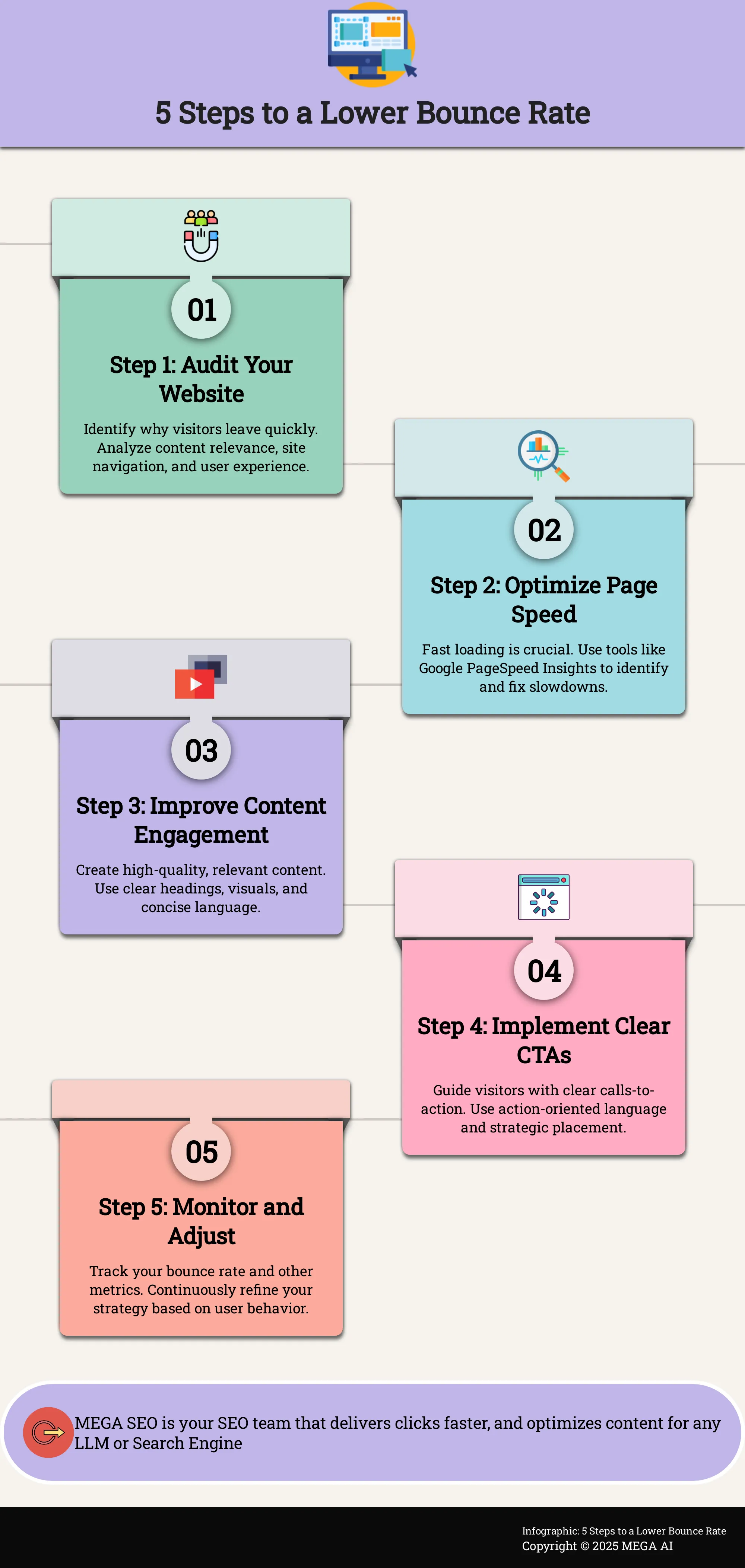
Improve Your Website Design and Navigation
Think of your website's design as its first handshake. If it's cluttered, confusing, or looks like it hasn't been updated in years, visitors might leave before they even discover your valuable content. A high bounce rate can often point to issues with your website's design or user experience. Aim for a clean, professional look with readable fonts and a logical page structure. Your navigation should be straightforward, allowing users to find what they need without frustration. Clear menus, well-organized content categories, and a prominent search bar can significantly improve how users interact with your site, encouraging them to explore further instead of bouncing away.
Optimize Page Load Speed
We all know the feeling of clicking a link and then staring at a loading screen. In today's fast-paced digital world, patience is a scarce commodity. Slow loading times are a common reason for high bounce rates because they frustrate visitors quickly. If your page takes more than a few seconds to appear, many users will simply give up and try a different site. You can use tools like Google's PageSpeed Insights to identify what's slowing your site down and get actionable recommendations. Often, compressing images, minifying code, and utilizing browser caching can make a big difference, leading to a smoother, faster experience that keeps users engaged.
Create Engaging and Relevant Content
Ultimately, people visit your website for its content. If they land on a page and don't find what they were looking for, or if the information is poorly presented or uninteresting, they're likely to leave. A high bounce rate frequently signals that visitors aren't finding what they want or are encountering a less-than-ideal experience. Concentrate on producing high-quality, original content that directly addresses the needs and search intent of your audience. Use clear headings, break up text with visuals, and ensure your information is both valuable and easy to digest. When your content truly connects, visitors have a compelling reason to stay and learn more.
Implement Clear Calls-to-Action
So, a visitor has landed on your page and is reading your content – that's great. But what's next? Without a clear prompt, they might not know what to do and could end up leaving. Implementing clear calls-to-action (CTAs) is vital for guiding visitors toward the next step you want them to take. This could be anything from reading another blog post, signing up for your newsletter, or requesting a demo. Well-placed and persuasive CTAs can effectively reduce bounce rates by keeping users actively involved with your site. Make your CTAs stand out, use action-oriented language, and ensure they are a logical next step in the user's journey.
Ensure Your Site is Mobile-Friendly
A significant portion of web browsing now happens on smartphones and tablets. If your website isn't optimized for these devices, you risk providing a poor experience for many of your visitors, which can lead to higher bounce rates. It's essential to ensure your website looks good and works well on all devices to keep users engaged, regardless of how they access your site. A responsive design, which automatically adapts your site's layout to different screen sizes, is standard practice. Regularly test your site on various mobile devices to check for readability, ease of navigation, and to make sure all interactive elements like buttons and links are easy to tap.
How to Measure and Analyze Your Bounce Rate Reduction Efforts
Once you've started making changes to lower your bounce rate, the next crucial step is to track your progress. Understanding how to measure your efforts and analyze the data will show you what's working and where you might need to adjust your approach. This isn't just about watching a number go down; it's about gaining deeper insights into user behavior and the overall health of your website. Let's look at how you can effectively monitor these changes and ensure your strategies are making a real impact.
What Tools Track Bounce Rate?
To keep a close watch on your bounce rate, you'll need the right tools. Thankfully, there are several options available. Comprehensive web analytics platforms like Google Analytics are a common starting point, offering a wealth of data including bounce rate for your entire site and individual pages. These platforms are essential for understanding how users interact with your content and form the foundation of your analysis.
Beyond general analytics, specialized bounce rate check tools can provide real-time insights into digital experience metrics. These tools help you pinpoint performance issues and identify optimization opportunities more quickly. By regularly using these resources, you can continuously monitor your website's performance and make informed, data-driven decisions to improve the end-user experience and see how your reduction strategies are panning out.
What Key Metrics Should You Monitor with Bounce Rate?
While bounce rate is a valuable indicator, it doesn’t tell the whole story on its own. To get a complete picture of user engagement and website performance, you should monitor it alongside other key metrics. For instance, look at ‘Average Time on Page’ and ‘Pages per Session’. An increase in these metrics, coupled with a decreasing bounce rate, suggests users are finding your content more engaging and are exploring your site further.
Another critical metric is your conversion rate. Ultimately, a lower bounce rate should contribute to achieving your website’s goals, whether that’s making a sale, generating a lead, or encouraging a newsletter subscription. Tracking bounce rate alongside conversion rates helps you understand if your efforts to keep users on the site are translating into desired actions. This holistic view is essential for refining your strategies effectively.
Set Realistic Improvement Goals
When you start working to reduce your bounce rate, it's important to set achievable and realistic goals. While it's tempting to aim for a dramatic drop, remember that an "ideal" bounce rate can vary significantly based on your industry, website type, and the specific purpose of each page. For example, a blog post might naturally have a higher bounce rate than a product page, and that’s often okay because a user might find exactly what they need on that single page.
Instead of chasing an arbitrary number, focus on steady improvement. Research industry benchmarks to get a general idea, but tailor your goals to your site’s unique context and content. The objective is to see a positive trend over time, indicating that your changes are enhancing user experience and encouraging more engagement. This approach allows you to celebrate incremental wins and maintain a sustainable strategy for improvement.
Connect Bounce Rate to Long-Term Organic Traffic Growth
Reducing your bounce rate does more than just keep visitors on your page for a few extra seconds. It’s a fundamental piece of your long-term organic traffic strategy. Think of it as building a strong foundation for sustainable growth. When users stick around, it signals to search engines that your content is valuable and relevant. Over time, these positive signals can significantly influence your site's authority and ranking, leading to a steady increase in organic visitors. While you might not see a massive jump overnight, the cumulative impact of a lower bounce rate is a powerful driver for lasting online visibility. This is where tools that help you optimize existing content can play a crucial role in refining user experience and, consequently, your bounce rate.
Understand Short-Term vs. Long-Term Effects on Organic Visibility
It's helpful to distinguish between the immediate feedback a bounce rate provides and its more gradual influence on your site’s standing. In the short term, a high bounce rate on a specific page can quickly indicate a mismatch between what users expected and what they found. This might mean the content isn't engaging or doesn't satisfy their search query.
Search engines notice these patterns. Consistently low bounce rates, on the other hand, suggest visitors are finding value, clicking deeper into your website, and engaging with your material. Over the long haul, this pattern helps build your site's reputation as a reliable source, which search engines reward with improved organic visibility and more stable rankings.
How Lower Bounce Rates Lead to Sustained Traffic Increases
Lowering your bounce rate is an efficient way to make your current marketing efforts work harder for you. When visitors stay on your site longer, they're not just browsing; they're showing genuine interest. This increased engagement often translates into a higher likelihood of them returning, becoming loyal readers, or even customers.
This sustained engagement sends strong positive signals to search engines. For example, some businesses have seen remarkable growth in organic search traffic and new users after focusing on reducing their bounce rates. It’s a clear indicator that by improving user experience to keep visitors engaged, you pave the way for significant and lasting increases in organic traffic.
Balance Bounce Rate Reduction with Other SEO Goals
It's easy to get tunnel vision on a single metric like bounce rate, but it's important to remember that it’s just one instrument in your larger marketing orchestra. True success comes from understanding how bounce rate interacts with your other objectives and ensuring your efforts contribute to your overall search engine optimization strategy. When all elements work together harmoniously, you create a much stronger online presence.
Align Bounce Rate Optimization with Your Overall SEO Strategy
Think of a high bounce rate not as an isolated issue, but more like a symptom. Often, it signals underlying problems such as slow page loading times, a confusing website layout, content that doesn’t quite match what your visitors were searching for, or a site that isn’t easy to use on mobile devices. The encouraging part is that addressing these fundamental website issues typically improves both your bounce rate and your search rankings. So, as you work to lower that bounce rate, you're frequently making core improvements that benefit your site’s health and visibility across the board.
Avoid Over-Optimization and Keep Users First
While data is incredibly useful, try to avoid becoming so focused on the bounce rate number that you lose sight of the actual people visiting your site. Bounce rate itself isn't a direct factor Google uses for ranking. However, the actions you take to improve it—like enhancing user experience—often do have a positive, indirect effect on your SEO. Your primary aim should always be to provide valuable, relevant content that genuinely helps your audience. A high bounce rate can indicate that your site content isn't engaging visitors or fulfilling their needs. By prioritizing a user-first approach, you’ll likely see natural improvements in engagement, including a more favorable bounce rate.
Put Your Bounce Rate Reduction Strategy into Action
Alright, you've learned the ins and outs of bounce rate, why it matters, and how to tackle it. Now, it's time to roll up our sleeves and put that knowledge into practice. Turning theory into tangible results requires a clear plan. Let's walk through how to effectively implement your bounce rate reduction strategy, step by step, so you can start seeing those organic traffic numbers climb.
Conduct a Website Audit
First, you need to understand why visitors are leaving your site prematurely. A thorough website audit is your starting point. Think of it as a health check-up for your website, looking for clues related to high bounce rates. A high bounce rate often signals that your site content isn't hitting the mark. As Direction points out, "the mismatch between the user’s search intent and the actual content creates a poor user experience, increasing the site’s bounce rate." Your audit should examine page content for relevance and clarity. Also, assess the overall user experience, including navigation ease and design appeal, to pinpoint areas causing friction.
Prioritize Improvements for Maximum Impact
After your audit, you'll likely have a list of potential fixes. Prioritize these changes to focus on what offers the biggest impact on your bounce rate and user engagement, rather than trying to fix everything at once. Data is key here. Continuously monitoring your bounce rate helps you "make data-driven optimizations to improve the end-user experience," as Scalenut notes. Tools that track bounce rate can help identify these high-impact opportunities. For example, MEGA AI's Maintenance Agent can identify and implement content updates to existing articles, ensuring they stay relevant and optimized, directly addressing audit findings.
Monitor and Adjust Your Strategy Over Time
Reducing bounce rate is an ongoing commitment, not a one-time fix. After making initial changes, keep a close eye on your metrics and be ready to adjust your strategy. As Diggrowth states, "Monitoring and managing your bounce rate effectively is essential for enhancing user experience and boosting your site's ROI and conversion rates." This continuous loop of implementing, monitoring, and tweaking is vital for long-term success. Regularly review your analytics, observe how changes perform, and find new areas for refinement. This iterative process helps your website meet user expectations and achieve your organic traffic goals.
What's Next for Bounce Rate in SEO and User Engagement?
The digital landscape is always shifting, and how we measure user engagement is evolving right along with it. While bounce rate has been a long-standing metric, its role and interpretation are becoming more nuanced. Understanding these changes can help you better gauge your website's performance and its impact on your SEO. It's less about chasing a single number and more about understanding the broader picture of user satisfaction.
How Search Algorithms and User Metrics are Evolving
Search engines like Google are getting much smarter at figuring out if users are truly satisfied with a search result. They look beyond simple clicks. For instance, Google pays attention to a behavior sometimes called 'pogo-sticking,' where a user clicks on your page from the search results, quickly realizes it’s not what they wanted, and immediately returns to the search results to pick another option. This isn't the same as bounce rate, but a high bounce rate combined with a very short time spent on the page (low dwell time) can signal this kind of negative experience. Search algorithms are increasingly sophisticated, aiming to reward content that genuinely meets user needs, not just pages that manage to get a click.
Prepare for Future Changes in Engagement Evaluation
So, what does this mean for your strategy? While bounce rate isn't the only metric that matters, it still offers valuable clues. A consistently high bounce rate on important pages might indicate that your content isn't aligning with what visitors expect, or perhaps the page experience itself is lacking. It’s a signal to investigate your content and user journey.
However, remember that context is key. A high bounce rate isn't always a red flag, as bounce rate itself can be a somewhat flawed metric. If someone lands on your contact page, finds your phone number, and leaves, they’ve achieved their goal. The bounce, in this case, is perfectly fine. The key is to continuously monitor your bounce rate alongside other engagement metrics. This allows you to make informed decisions and refine your website to better serve your audience, which is always a good move for long-term SEO success.
Related Articles
- Site Navigation Benefits: Lower Your Bounce Rate
- Optimize Your Content for Google Search Objectives
- Boost Google SEO With These Content Optimization Tips
- Time in SEO: A Comprehensive Guide for 2024
- Increase SEO Dwell Time: The Ultimate Guide (2023)
Frequently Asked Questions
Is there a specific bounce rate percentage I should aim for? It's tempting to look for a magic number, but a "good" bounce rate really depends on your specific page and its purpose. For example, a blog post answering a quick question might naturally have a higher bounce rate than a page trying to get someone to sign up for a service. Instead of fixating on one number, focus on understanding why people might be leaving a particular page and if that page is meeting their needs.
My homepage has a high bounce rate. Is that always bad? A high bounce rate on your homepage can be a concern because it's often the first impression visitors get. If they leave right away, they're not exploring what else you offer. However, consider what your homepage is designed to do. If it clearly directs users to different sections and they click through, that's great. If they land and leave without going anywhere else, it’s worth investigating if your message is clear and if the design guides them effectively.
How long does it usually take to see a lower bounce rate after I make improvements? The time it takes to see changes in your bounce rate can vary. Some technical fixes, like improving page load speed, might show results relatively quickly once search engines recrawl your site. Content and design changes might take a bit longer as you gather data on how users are responding. The key is to monitor your analytics consistently and be patient; meaningful improvements often build over time.
If Google says bounce rate isn't a direct ranking factor, why focus on it so much? That's a great question. While bounce rate itself isn't directly plugged into Google's ranking algorithm, it often points to other issues that do affect your SEO. Things like slow load times, poor mobile experience, or content that doesn't match what people searched for can lead to a high bounce rate. Fixing these underlying problems not only improves user experience but also tends to positively influence factors Google does care about for rankings.
My bounce rate is alarmingly high across my whole site. What's the very first thing I should check? If your overall bounce rate is very high, a good first step is to check your website's loading speed and mobile-friendliness. These are common culprits that can frustrate visitors and cause them to leave quickly, regardless of your content. Tools like Google's PageSpeed Insights can give you a quick diagnostic and point you toward initial fixes.