
Your audience has developed "content blindness." With an endless stream of posts flooding their feeds every day, they’ve learned to automatically tune out anything that looks generic or fails to offer immediate value. This presents a huge challenge for brands. If you’re still focused on churning out content just to meet a daily quota, you’re likely contributing to the noise your audience is trying to ignore. So, how do you break through? The answer isn’t to post more frequently, but to post more thoughtfully. This means creating original, relevant content that solves a real problem or offers a unique perspective. This article provides a practical framework for moving from a quantity-first to a quality-first mindset, helping you create posts that capture attention and drive real engagement.
Key Takeaways
- Focus on quality over quantity: A high-volume posting schedule is less effective than creating valuable, original content. Prioritize posts that offer a unique perspective to build a more engaged and loyal audience.
- Create a framework for original content: Consistently produce standout posts by defining your unique brand voice, finding underserved topics through audience research, and using storytelling to make your message memorable.
- Let data inform your content strategy: Track engagement metrics like shares, comments, and saves to understand what truly connects with your audience. Use these insights to consistently refine your approach and create more of what works.
Why Quality Beats Quantity in Social Media
For a long time, the prevailing wisdom for social media was simple: post more. The idea was that a constant stream of content would keep your brand top-of-mind. While consistency is still important, the "more is better" approach is no longer effective on its own. The digital landscape is crowded, with billions of new content pieces appearing every single day. Your audience isn't just seeing your posts; they're seeing a constant flood of information from every direction.
In this saturated environment, simply adding to the noise won't help you connect with customers. Instead, the brands that succeed are the ones that prioritize quality. They focus on creating content that is original, relevant, and genuinely useful to their audience. This means moving beyond surface-level updates and creating posts that offer a unique perspective or solve a real problem. To create content that provides real value, you must have something truly helpful to share—a new idea, a unique insight, or a fresh perspective.
Focusing on quantity often leads to generic, uninspired posts that fail to capture attention. This can dilute your brand message and lead to low engagement. Quality content, on the other hand, encourages meaningful interactions. Metrics like shares, comments, and saves reveal how effectively your content resonates with your audience. This shift from a quantity-first to a quality-first mindset is essential for building a loyal following and achieving meaningful business results. It’s about making every post count.
Why the Social Media Landscape Has Changed
The old playbook for social media—post consistently, post often—is showing its age. While consistency is still important, the sheer volume of content has fundamentally changed the game. Success on social media is no longer about who can shout the loudest or the most frequently. Instead, it’s about who can provide the most value. This shift is driven by two major forces: an overwhelming flood of content and a more discerning audience with higher expectations. Understanding these changes is the first step toward building a social media strategy that actually works.
Dealing with content saturation
Every time someone opens a social media app, they face an endless stream of posts. In this saturated digital environment, being memorable is a real challenge for any brand. You aren't just competing with direct competitors anymore; you're up against every piece of content that vies for the audience's attention. This constant exposure has led to a phenomenon called "content blindness." Much like how people learn to ignore banner ads, they are becoming desensitized to generic content. If your posts don't offer immediate value or a unique point of view, they simply get lost in the noise. Pushing out more of the same only adds to the problem.
Meeting new audience expectations
With so much content to choose from, audiences have become incredibly selective. They are no longer passive consumers; they actively seek out content that is original, relevant, and engaging. People are looking for posts that are not only informative but also tailored to their specific needs. Creating content just for the sake of hitting a posting quota is one of the biggest mistakes a brand can make. Without a clear purpose, your posts lack direction and fail to connect with the people you want to reach. Every piece of content should have a goal, whether it's to educate, entertain, or build a relationship with your audience.
What Makes Social Media Content Stand Out?
In a crowded social feed, standout content does more than just grab attention; it holds it. This type of content connects with your audience on a deeper level because it’s original, relevant, and genuinely useful. It’s not about shouting the loudest but about saying something that matters to the people you want to reach.
Creating this kind of content starts with a clear understanding of what "quality" means for your specific brand and audience. It’s a mix of your unique perspective, your audience’s needs, and the value you can provide. When you get this right, you create content that not only gets seen but also gets shared, saved, and talked about, building a loyal community around your brand.
Define what quality means for your brand
Quality isn't a one-size-fits-all metric; it’s something you must define for your own brand. To create content of value, you need to communicate something genuinely helpful or new, whether it's a fresh insight or proprietary research. This means moving beyond generic posts and focusing on what makes your brand’s perspective unique.
Think about what your audience is looking for and how you can meet that need in a way no one else can. Standout content requires a focus on originality and relevance. Is your content educational, entertaining, or inspiring? Answering this question helps you build a framework for what a high-quality post looks like for your business, ensuring every piece of content serves a clear purpose.
How great content drives engagement
Great content is the engine behind meaningful audience engagement. Metrics like likes, comments, and shares reveal how effectively your content resonates with your target audience. These interactions go beyond simple views to show how deeply people connect with what you’re sharing. High engagement is a clear signal that your content provides genuine value and meets a real user need.
When you create a powerful campaign with content people want to share, you achieve ideal results. For example, some of the best content marketing case studies show that a single, high-value piece of content can generate more reach and discussion than dozens of low-effort posts. This is because quality content sparks conversations and encourages people to become advocates for your brand.
The Real Cost of Prioritizing Quantity
Focusing on churning out as much content as possible might feel productive, but it often comes at a steep price. When quantity becomes the main goal, quality inevitably suffers, which can dilute your brand message and waste valuable resources. Instead of building a loyal audience, you risk getting lost in the noise or, worse, pushing potential followers away.
A "more is more" approach rarely translates to better engagement or a stronger brand presence. It's a strategy that prioritizes activity over impact, leading to a feed full of forgettable posts. Let's break down the specific ways this approach can backfire.
The problem with content overload
With over 4.6 billion pieces of content created daily, your audience is already swimming in information. This massive volume has led to a phenomenon known as "content blindness," where people automatically tune out anything that doesn't seem immediately valuable or different. When you add to the noise with generic or repetitive posts, you’re not just being ignored; you're contributing to the problem.
Users don't need more of the same regurgitated information. They are looking for fresh perspectives and original ideas that solve their problems or entertain them. Pushing out content just to meet a quota means you're competing in an oversaturated space without offering anything unique. This makes it nearly impossible to capture attention, let alone build a meaningful connection with your audience.
How posting too much affects your brand
Publishing content without a clear purpose is one of the most common content marketing mistakes. When you prioritize quantity, your social media feed can quickly become a chaotic mix of posts that lack a cohesive message or strategy. This scattergun approach can confuse your audience about what your brand stands for and who you're trying to reach. It signals a lack of direction and can make your brand appear less professional and authoritative.
Ultimately, this strategy harms your brand's reputation. Each low-quality post chips away at the trust you're trying to build. Instead of seeing you as a valuable resource, your audience may start to see your content as spam. This can lead to unfollows, low engagement rates, and a tarnished brand image that is difficult to repair.
How to Create Original Content
Creating content that truly connects with your audience means moving beyond templates and generic posts. Originality is what helps you build a memorable brand and a loyal following. It’s not about reinventing the wheel with every post, but about finding your unique angle and consistently delivering value that your audience can’t get anywhere else. The key is to combine a distinct voice with fresh ideas and then use data to refine your approach. This process ensures your content not only stands out but also achieves your business goals. Let's walk through how to make this happen.
Develop your unique voice
Your brand voice is the personality your business takes on in its communications. It’s what makes your content instantly recognizable. Are you witty and informal, or are you more authoritative and educational? Defining this is the first step toward originality. As the team at Alpha Social notes, "Embracing your brand's uniqueness is essential to break through the digital noise and connect with your audience effectively." A strong voice builds trust and makes your audience feel like they’re connecting with people, not just a faceless company. To find yours, think about your company’s core values and the audience you want to attract. Then, create a simple style guide to ensure everyone on your team applies it consistently.
Generate fresh content ideas
Coming up with new ideas can feel daunting, especially when it seems like every topic has been covered. According to Neil Patel, with billions of content pieces created daily, "audiences are looking for new insights rather than repetitive information." Instead of recycling the same popular topics, look for gaps. What questions are your customers asking that no one is answering well? What unique experiences or expertise can you share? You can use automated keyword research to discover what your audience is searching for and identify underserved topics. Brainstorm with your team, survey your customers, and pay attention to comment sections to find inspiration for content that offers a fresh perspective.
Use data to find what works
Originality for its own sake isn’t the goal; you want to create original content that performs. Data is your guide to understanding what resonates with your audience. As MentorCruise points out, "By analyzing [engagement] metrics, you can gain insights into what types of content drive deeper interactions and refine your strategy accordingly." Pay close attention to key performance indicators like shares, comments, and saves. These actions show that your content is valuable enough for your audience to engage with or return to later. Use these insights to double down on what works. If a certain format or topic consistently gets high engagement, explore how you can create more content like it while keeping your ideas fresh.
How to Find Untapped Content Opportunities
Finding a topic that hasn’t been covered a thousand times can feel like searching for a needle in a haystack. With billions of new content pieces published daily, the digital landscape is crowded. The key to breaking through the noise isn't to shout louder, but to speak about something new or offer a fresh perspective that your audience is actively looking for. Untapped content opportunities exist where audience interest is high and competitor content is low.
Instead of recycling the same popular subjects, focus on finding the gaps. These gaps represent the specific questions, problems, and interests of your audience that are currently underserved. Creating content that fills these voids positions your brand as a thoughtful, valuable resource rather than just another voice in the crowd. This approach requires a bit of detective work, but the payoff is a more engaged audience and a stronger brand identity. By combining trend analysis with a deep understanding of your audience, you can consistently uncover fresh ideas for your SEO strategy.
Identify relevant trends
With over 4.6 billion pieces of content created every day, originality is essential. Your audience doesn't need another post that rehashes the same information they can find elsewhere. Instead, they are looking for fresh content on new topics. Identifying relevant trends allows you to join emerging conversations and provide timely insights. This doesn't mean you have to chase every fleeting meme. It's about spotting shifts in your industry, new technologies, or evolving customer behaviors that you can speak to with authority. By doing so, you create content that feels current and necessary.
Align content with audience interests
An opportunity is only valuable if it aligns with what your audience actually cares about. To create content that resonates, you need to offer something genuinely helpful and unique. This could be a new idea, a fresh insight, or proprietary research that they can't get anywhere else. Dig into customer feedback, support tickets, and social media comments to understand their biggest challenges and unanswered questions. When you create content that directly addresses these specific needs, you build trust and establish your brand as an indispensable resource.
Use trend analysis tools
You don't have to guess what people are searching for. Trend analysis tools give you the data to back up your content ideas. Platforms like AnswerThePublic show you the questions, prepositions, and comparisons people are using in their searches around a specific keyword. This helps you find topics that have existing demand but not enough content to satisfy it. These tools are excellent for validating your intuition and ensuring you invest your time creating content that people are actively seeking. This data-driven approach removes the guesswork and points you directly toward your next high-impact content idea.
How to Craft High-Impact Content
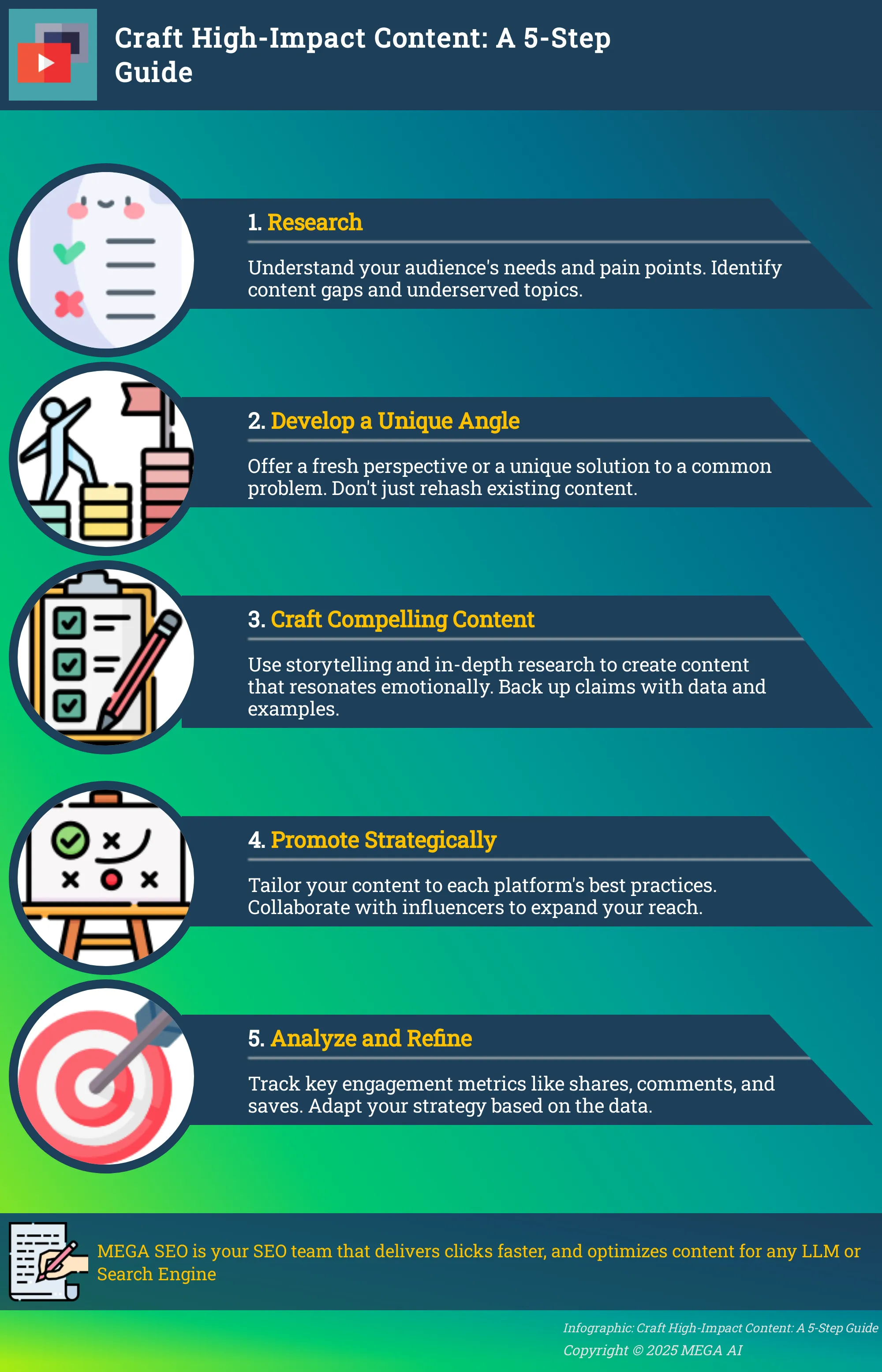
Creating content that truly resonates with your audience goes beyond just following trends. It’s about building a connection through value, authenticity, and a clear point of view. High-impact content is memorable because it gives the audience something they can’t get anywhere else—whether that’s a new piece of information, an emotional connection, or a fresh perspective on a familiar topic. This requires a more thoughtful approach than simply churning out posts. By focusing on deep research, compelling storytelling, and a unique angle, you can create content that not only captures attention but also builds lasting brand loyalty. Let’s look at how to put these principles into practice.
Conduct in-depth research
To create content that stands out, you need to go deeper than a quick search. Your audience is looking for substance, not just another summary of information they can find elsewhere. As Forbes notes, "To create content of value, you must have something truly helpful to communicate that's unique or fresh." This means digging into your audience’s real questions and pain points, analyzing what your competitors are doing, and finding data or insights that offer a new angle. A great starting point is to perform keyword research not just for volume, but for intent. What is the underlying problem someone is trying to solve with their search? Answering that question is the foundation of valuable content.
Use storytelling to connect
Facts and data provide credibility, but stories create connection. People remember how you make them feel far longer than they remember a specific statistic. Engaging content often uses storytelling to frame information in a way that resonates emotionally with the audience. This doesn't have to be a grand narrative. It can be as simple as sharing a customer's success story, explaining the "why" behind your brand's mission, or walking through a problem-and-solution scenario. This approach helps transform your brand from a faceless entity into a relatable partner. By weaving a brand story into your content, you give your audience a reason to care and invest in your message on a deeper level.
Offer a unique perspective
In a crowded digital space, a unique perspective is your greatest asset. With so much competition, simply adding to the noise won’t get you very far. Your goal is to provide a viewpoint that only you can offer. This could come from your team's specific expertise, proprietary data, or even a contrarian take on an industry norm. Think about what makes your brand different and lean into it. Your unique voice is what will attract a loyal following. While content generation tools can provide a solid foundation, the final piece—that distinct, human perspective—is what makes the content truly yours and gives your audience a reason to listen.
How to Balance Quality and Consistency
Finding the sweet spot between quality and consistency can feel like a constant struggle. You know you need to post regularly to stay relevant, but you also know that churning out mediocre content just to fill a quota won't get you very far. The good news is that you don’t have to choose one over the other. Balancing the two is achievable with a smart, sustainable approach. It means focusing your energy on creating fewer, more impactful pieces that serve a clear purpose and strengthen your brand.
Set realistic content goals
Before you create anything, you need to know why you’re creating it. This starts with defining your goals, target audience, and key messages to ensure that your content adds value and resonates with your audience. This clarity is the foundation of a quality-driven strategy. Your goals should be specific and measurable, like increasing website clicks from social media by 15% or generating 20 qualified leads per month. It’s also important to be honest about what your team can handle without sacrificing the quality of your work. This focus ensures every post has a purpose and moves you closer to your business objectives.
Build a sustainable content calendar
A content calendar is your roadmap for consistency, but it should be a tool that serves you, not one that creates stress. A well-structured content calendar allows you to plan a consistent schedule while ensuring each piece is thoughtfully crafted to meet your audience's needs. The most important word here is "sustainable." Your calendar should reflect your team’s actual capacity. If that means three high-quality posts a week instead of two low-effort posts a day, that’s a win. Use your calendar to plan themes and schedule posts in advance to avoid last-minute scrambling. Automating parts of your paid ads workflow can free up even more time for creative planning.
Adapt based on audience feedback
Your social media strategy shouldn't exist in a vacuum. It’s a dynamic process that should evolve based on how your audience responds. Engagement metrics reveal how effectively your content resonates, allowing you to adapt your strategy and focus on what works best. Pay close attention to likes, comments, and shares, as these are all forms of feedback. If a certain format gets high engagement, make more of it. This continuous feedback loop is what allows you to refine your approach and consistently deliver content your audience truly values. Some tools can even help optimize content automatically based on performance metrics like click-through rate.
How to Measure Content Quality and Impact
Creating high-quality content is only half the battle; you also need to understand if it's working. Measuring your content’s impact helps you prove the value of a quality-focused strategy and gives you the insights needed to refine your approach. It’s about moving beyond simple follower counts to see how your audience truly interacts with what you share. By tracking the right metrics, you can make data-driven decisions that improve your content over time.
Key metrics to track performance
To gauge content quality, look at engagement. These metrics show how well your content resonates with your audience by measuring the actions they take. On social media, this includes likes, comments, shares, and saves. These actions are a direct signal that your content is valuable enough for someone to interact with or save for later. Another important metric is the click-through rate (CTR) on any links you share, which tells you if your content successfully prompts your audience to take the next step. Tracking these engagement metrics reveals how deeply visitors connect with your work, moving beyond surface-level views.
The long-term benefits of quality
Focusing on quality delivers benefits that accumulate over time. When you consistently provide helpful, unique, and insightful content, you build trust and establish your brand as an authority in your field. High engagement is an indicator that your content provides genuine value and meets user needs. This fosters a loyal community that is more likely to support your business in the long run. A smaller, highly engaged audience that trusts your brand is far more valuable than a large, indifferent one. This approach strengthens brand perception and turns followers into advocates.
Use analytics to optimize content
Analytics are essential for an effective content strategy. Most social platforms provide built-in analytics for tracking performance, giving you direct access to data on likes, shares, and follower growth. Use this information to identify patterns. Which topics get the most comments? What formats earn the most shares? Answering these questions allows you to make data-driven decisions and create more of what your audience loves. You can also use tools to optimize your content strategy further, helping you identify which pieces are performing well and where opportunities for improvement exist. This continuous loop of creating, measuring, and optimizing is the key to a successful, quality-driven social media presence.
How to Integrate Quality into Your Social Strategy
Shifting from a quantity-focused mindset to a quality-first approach requires a deliberate strategy. It’s not just about making your posts look better; it’s about fundamentally changing how you plan, create, and distribute content. Integrating quality means ensuring every post has a purpose, is tailored to its platform, and resonates deeply with your audience. This strategic pivot helps you build a stronger brand presence and foster a more engaged community. By focusing on value, you create a social media feed that people want to follow, not one they scroll past. The following steps will help you build a framework for consistently producing high-impact content that aligns with your business goals.
Align content with brand objectives
Every piece of content you share should have a clear purpose that connects back to your larger business goals. Before you create a post, ask yourself what you want to achieve. Are you trying to drive traffic, generate leads, educate your audience, or build brand loyalty? Quality content has a job to do. To create content of value, you must have something truly helpful to communicate that's unique or fresh. This means moving beyond generic updates and offering real insights that your audience can’t get elsewhere. When your content strategy is aligned with your SEO goals, for example, each post works harder to build your brand’s authority and online visibility.
Follow platform-specific best practices
Quality is not a one-size-fits-all concept. What works on Instagram may not perform well on LinkedIn. Each social media platform has its own audience expectations, content formats, and best practices. Take the time to understand the nuances of each channel you use. Pay attention to the top-performing content in your niche and analyze what makes it successful. Social platforms provide built-in analytics for tracking likes, shares, and comments. Use this data to understand what resonates with your audience on each specific platform and refine your approach accordingly. This is especially important for Paid Ads, where platform-native content performs significantly better.
Collaborate with influencers and experts
You don’t have to create every piece of high-quality content on your own. Collaborating with industry experts and influencers can add credibility and a fresh perspective to your social media feed. With 92% of consumers trusting influencer content over what they see in paid ads, these partnerships are an effective way to build trust and reach new audiences. Identify creators and experts whose values align with your brand and whose audience overlaps with yours. By leveraging their expertise, you can produce content that is both authoritative and authentic, driving real results for your brand. Freeing up your team's time with automation allows you to focus on building these valuable relationships, and you can book a demo to see how.
Related Articles
- Mastering SEO: The Importance of Content Quality and Relevance for Startup Success - MEGA SEO | Blog
- Social Media Marketing: The Ultimate Guide (2024)
- Crafting Compelling, Original Content for SEO Success - MEGA SEO | Blog
- Content Quality: What It Really Is & How to Achieve It
- How to Create Educational Social Media Posts That Work
Frequently Asked Questions
If I post less often, won't the social media algorithms penalize my account? This is a common concern, but algorithms have grown more sophisticated. They tend to prioritize engagement over sheer volume. A single post that receives a high number of shares, comments, and saves signals to the platform that your content is valuable. This can lead to greater reach than dozens of posts that receive little to no interaction. The goal is to make each post count, creating a stronger signal of quality that the algorithm can reward.
How do I know if my content is actually high-quality? You can determine the quality of your content by looking at how your audience interacts with it. Go beyond surface-level metrics like likes and follower count. Instead, focus on engagement that shows genuine interest, such as shares, saves, and thoughtful comments. These actions indicate that your content was useful enough for someone to pass along or return to later. Tracking these deeper metrics will give you a clear picture of what truly resonates with your audience.
I'm a small business with a tiny budget. How can I realistically create quality content? Creating quality content is more about resourcefulness than a large budget. Start by focusing on your specific area of expertise. Your unique perspective is a valuable asset that costs nothing to share. You can also repurpose a single, well-researched piece of content into multiple formats, such as turning a blog post into a series of social media graphics or a short video. This allows you to create a variety of high-value posts from one core idea.
What's the best way to find original content ideas without just guessing? The best ideas come from listening to your audience. Pay close attention to the questions they ask in comments, emails, and customer service interactions. You can also use keyword research tools to see what problems people are trying to solve related to your industry. Look for questions that have high interest but few comprehensive answers. This data-driven approach helps you find gaps where your unique perspective can provide real value.
How long does it take to see results from a quality-first strategy? Shifting to a quality-first strategy is about building a long-term asset for your brand, not achieving overnight virality. While a single high-impact post can certainly perform well, the true benefits come from consistency over time. You should start to see deeper engagement within a few months, but the larger goals of building trust, authority, and a loyal community are gradual. This approach builds a more sustainable foundation for growth.