
Pouring time and effort into creating blog content, only to see minimal traffic and engagement, can be incredibly disheartening. If you're tired of the content hamster wheel and wondering why your publishing efforts aren't moving the needle, you're not alone. Often, the issue isn't how often you post, but what you post and how well it's optimized to be found. This article shifts the focus from quantity to quality and strategic search engine optimization. We'll show you how crafting targeted, valuable content can attract the right audience and deliver sustainable results, making your content work smarter, not just harder.
Key Takeaways
- Prioritize High-Impact Content: Shift your efforts from frequent posting to creating deeply researched, keyword-focused articles that directly address what your audience needs to know.
- Master Search Intent and Keyword Targeting: Get to the heart of why your audience searches and the exact phrases they use. This ensures your content resonates and attracts the right visitors.
- Turn SEO Traffic into Customers: Ensure your content is discoverable by search engines and strategically designed to guide readers toward becoming customers, tracking conversions to measure real business impact.
Stop Chasing Blog Frequency: Why Quality and SEO Matter More
It's a common belief that the more you blog, the more traffic you'll get. While consistency has its place, the relentless pursuit of high blog frequency can often lead to burnout and, more importantly, a dip in content quality. The reality is, when it comes to driving meaningful results, quality and strategic SEO trump sheer quantity every single time. You don't actually need to publish a massive volume of content to attract significant traffic each month. The key is to focus on creating content that truly resonates with your audience and is optimized to rank well in search engine results.
Instead of churning out posts just to meet an arbitrary quota, shift your energy towards crafting targeted content. This means identifying very specific keywords that are closely related to your business and building high-value articles around them. The goal isn't just to publish; it's to create content that ranks high in Google for these chosen keywords, thereby bringing new, qualified customers to your site. Think about it: a single, exceptionally well-written and optimized article can potentially build your entire business. If an article attracts a large volume of readers, even a small conversion rate can translate into a substantial number of customers and significant revenue. This underscores the power of quality over quantity. High-quality, keyword-optimized content acts as a strong relevance signal to search algorithms, which can lead to improved rankings and more organic traffic—a key indicator of your website's health and the effectiveness of your SEO strategy.
Define Search Intent and Target Keywords Effectively
Before you even think about how often to publish blog posts, let's talk about something far more crucial: understanding what your audience is actually looking for and the language they use to find it. This is the bedrock of any successful content strategy. When you clearly define search intent—the why behind a search query—and pinpoint the right keywords, you're not just creating content; you're creating solutions that your audience actively seeks. This foundational step ensures your efforts aren't wasted on articles that miss the mark, failing to attract the right visitors or achieve your business objectives.
Think of it like this: if your content doesn't align with what people are searching for, it's like shouting into an empty room. No matter how frequently you shout, no one will hear you. Focusing on search intent and effective keyword targeting means you're entering a room full of people already interested in what you have to say. This approach allows you to create content that resonates deeply, answers specific questions, and guides users naturally towards your products or services. For startups and small businesses, where resources are often precious, getting this right from the start means more impactful results with less wasted effort. It’s about working smarter, not just harder, to make your online presence truly count.
Align Content with User Needs and Business Goals
The sweet spot for content is where user needs and your business goals intersect. Your content should always aim to satisfy the user's reason for searching. Are they looking for information, trying to make a purchase, or comparing options? Understanding this user intent is the first step. Once you know what your audience wants, you can craft content that directly addresses their questions and pain points.
But it doesn't stop there. This valuable content also needs to subtly guide users toward your business objectives. This might mean encouraging them to book a demo, make a purchase, or simply build brand awareness. Creating high-quality content around keywords involves thorough research to understand your target audience and their search queries. By grasping these principles, businesses can effectively optimize their online presence and achieve higher visibility.
Conduct Thorough Keyword Research
Effective keyword research goes beyond just picking a few broad terms. It's about uncovering the specific phrases and questions your ideal customers are typing into search engines. This means identifying not only primary keywords but also related terms, long-tail keywords (longer, more specific phrases), and the topics your audience is exploring. Think about the different ways someone might search for solutions your business offers.
A comprehensive keyword research strategy involves analyzing search volume (how often a keyword is searched), keyword difficulty (how hard it is to rank for), and competitor strategies. What terms are your competitors ranking for, and where are the gaps you can fill? Avoiding common mistakes, like targeting keywords that are too broad or irrelevant to user intent, is crucial. This detailed approach forms a solid foundation for optimizing your content and attracting qualified traffic.
Create Powerful Keystone Articles
Instead of feeling the need to constantly publish new blog posts, you might find more success by focusing your energy on creating a few truly exceptional pieces of content. These are often called keystone articles or pillar pages, and they act as the foundational content for a specific, important topic on your website. Think of them as the main, comprehensive guides that other, more specific articles can link back to. This approach helps build a strong internal linking structure and establishes your authority in your niche.
The impact of such an article can be quite significant. As the team at Ahrefs once pointed out, "You can build your entire business around a single article." They further explain that if a high-traffic article converts even "half of a percent of all these people into customers, that's over a thousand customers every month." This really shows how one incredibly well-crafted piece can become a major asset, continuously attracting visitors and potential customers long after it's published. This strategy shifts your focus from a numbers game to one centered on creating lasting value. These keystone articles aim to be the most thorough and helpful resources available on their subject, making your site the go-to place for that information. Developing such content is a core part of a strong SEO strategy, and using tools can help streamline this process.
Create Comprehensive, Evergreen Content
For a keystone article to truly deliver results, it needs to be both comprehensive and evergreen. "Comprehensive" means it explores the subject thoroughly, addressing the primary questions and concerns your audience might have. It should leave the reader feeling well-informed and satisfied. "Evergreen" refers to content that stays relevant and valuable over time, not becoming quickly outdated by current events or fleeting trends. As Search Engine Land aptly states, "Creating high-quality, helpful content that drives search traffic is more important than ever."
This kind of high-value content, especially when it’s well-researched and keyword-optimized, effectively "signals relevance to search algorithms, leading to improved rankings," as noted by SEOBotAI. By investing the effort to produce such detailed and timeless pieces, you’re not just publishing another blog post; you’re building a durable asset that can consistently draw in organic traffic and strengthen your website's credibility in your field.
Optimize for Long-Tail Keywords
While your main keystone articles will likely target broader, more competitive keywords, they also present a fantastic opportunity to incorporate long-tail keywords. These are longer, more specific search phrases, often phrased as questions or detailed queries, that suggest a user is further along in their research or decision-making process. According to Copy.ai, "Long-tail keywords help you attract visitors who are specifically interested in your products, services, or content."
Effective keyword research strategies "involve identifying not only the primary keywords but also related terms, phrases, and topics that your target audience may use in their search queries," as StyleAI explains. By naturally weaving these specific phrases into your comprehensive keystone content, you can capture a highly qualified audience looking for precise answers. This makes your pillar pieces even more effective at covering all aspects of a topic and connecting with users at different stages of their journey.
Maximize SEO Traffic Through Strategic Content
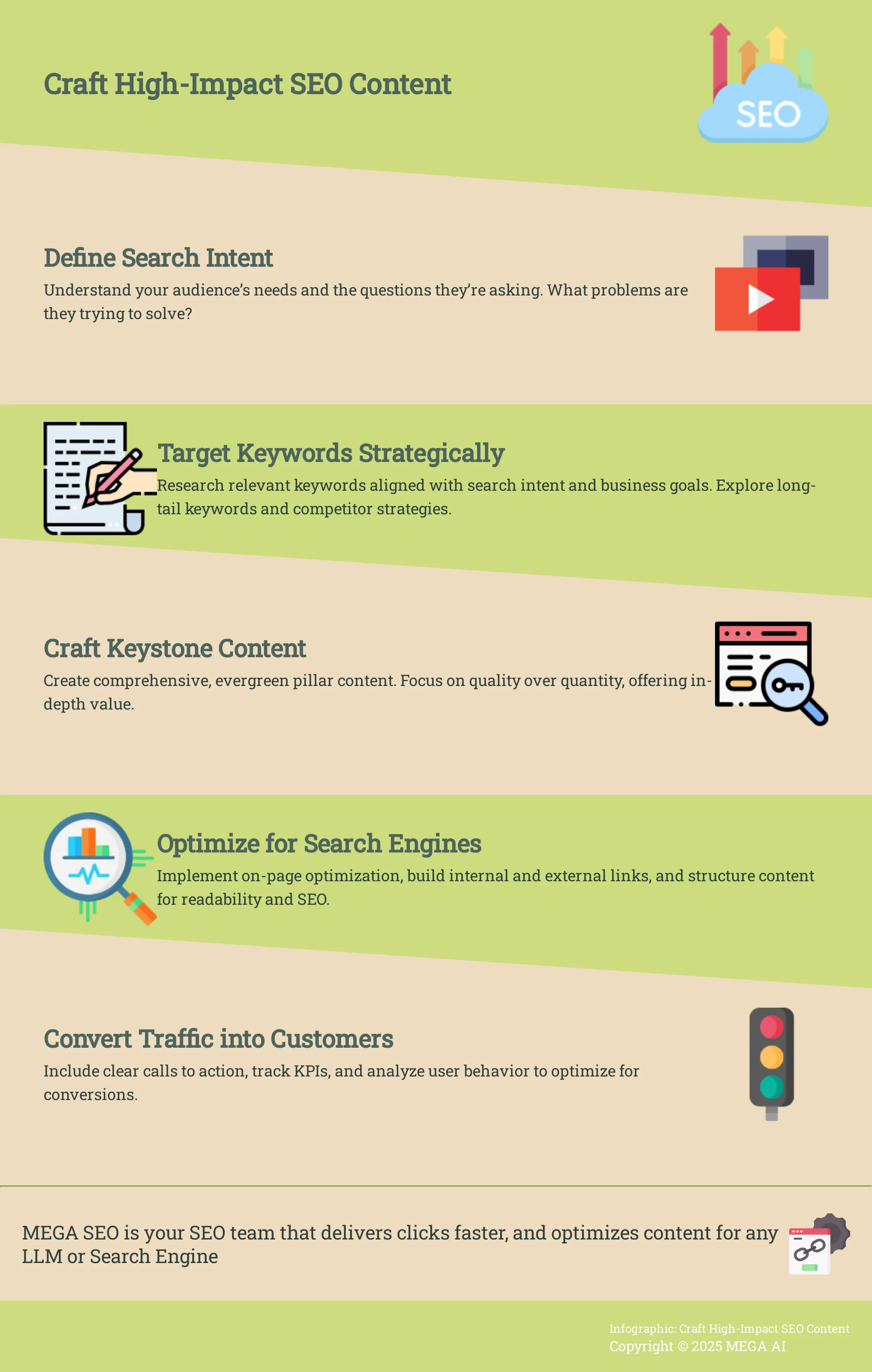
Once you've pinpointed search intent and keywords, and perhaps outlined keystone articles, ensure your content strategically attracts maximum organic traffic. This means optimizing each piece for search engines. Focusing on smart on-page techniques, strong linking, and effective content structure improves search visibility, signaling your content's value and relevance.
Apply On-Page Optimization Techniques
On-page optimization means preparing your content to be easily understood by both your readers and search engines. As Search Engine Land highlights, "Creating high-quality, helpful content that drives search traffic is more important than ever." This involves careful attention to elements like your title tags, meta descriptions, header tags, and image alt text, ensuring each naturally incorporates your target keywords. Beyond these technical aspects, your content must be well-crafted and offer genuine value. Platforms like MEGA AI can simplify this by assisting with content generation, ensuring articles are ready to perform.
Build Internal and External Links
Links act as pathways, guiding users and search engine crawlers. Internal links are vital for your site’s architecture and for spreading link equity. As Analytics Insight points out, "Internal links connect your content, helping users and search engines navigate your site." You should strategically connect relevant articles within your site to create a seamless user journey. External links, or backlinks from other credible websites, serve as powerful endorsements, signaling to search engines that your content is authoritative. While earning these backlinks can require consistent effort, they are incredibly valuable for improving your SEO.
Leverage Content Structure for Better SEO
Content structure significantly impacts readability and SEO. Clear, well-organized content is easier for users to digest and for search engines to crawl. "High-quality, keyword-optimized content signals relevance to search algorithms," according to SEOBotAI, who add that "Semantic SEO strategies like using related keywords and creating comprehensive topic clusters can further boost...visibility." Use header tags (H1, H2s, H3s) for logical hierarchy. Break up text with short paragraphs and images. This improves user experience and helps search engines understand topics. Consider organizing content into topic clusters, a strategy SEO tools can help plan.
Convert SEO Traffic into Customers
Attracting visitors to your website through search engine optimization is a fantastic first step, but the journey doesn't end there. Think of traffic as potential energy; the real kinetic energy—the kind that moves your business forward—is unleashed when those visitors become customers. It might sound like a huge leap, but even a small percentage of conversions from a steady stream of organic traffic can significantly impact your bottom line. As industry insights suggest, "Even if you convert half of a percent of all these people into customers, that's over a thousand customers every month, which is clearly a ton of money." This isn't just a hopeful statistic; it's a tangible possibility when you approach your content strategically.
The key is to consciously guide your visitors along a path, from their initial information search to the point where they take a desired action. This involves more than just having well-ranked content; it requires a thoughtful approach to how your content is structured, the value it offers, and the clarity with which it prompts engagement. By focusing on the user experience and clearly demonstrating how your offerings meet their needs, you can effectively transform readers into loyal customers. This entire process hinges on two critical actions: first, optimizing your existing content specifically for conversions, and second, diligently measuring your success to understand what resonates and how to refine your approach. Let's explore how you can make this happen for your business.
Optimize Your Content for Conversions
Once you have visitors on your page, your content needs to do the heavy lifting to encourage them to take the next step. "Creating high-quality, helpful content that drives search traffic is more important than ever." This quality and helpfulness directly translate into conversion potential. When your content genuinely addresses a visitor's pain points, answers their questions thoroughly, and offers clear solutions, you build trust and credibility, making them more receptive to your offerings.
To optimize for conversions, ensure your articles include clear calls-to-action (CTAs). What do you want the reader to do next? Sign up for a newsletter, download a resource, or perhaps explore your services? Make these CTAs visible and compelling. Furthermore, "high-quality, keyword-optimized content signals relevance to search algorithms," which also signals relevance and authority to your human readers. Tools like MEGA AI's Maintenance Agent can further refine your existing articles, improving click-through rates and ensuring your content is primed not just for search engines, but for turning visitors into leads.
Measure Success and Calculate ROI
Understanding how your SEO efforts translate into tangible business results is crucial. While rankings are a good indicator, they don't tell the whole story. "Organic traffic is often a key indicator of the health of your website and the effectiveness of your SEO strategy," but you need to dig deeper to see the full picture. Look at conversion rates from organic traffic: how many visitors are completing your desired actions after arriving from a search? This is where you start to see the real return on your content investment.
To truly gauge performance, you'll want to "discover the diverse range of eighteen valuable metrics these professionals use to gauge performance beyond traditional search engine rankings." This includes tracking metrics like bounce rate, time on page, and, most importantly, goal completions. By setting up conversion tracking in your analytics, you can directly attribute sales or leads to your SEO content. This data allows you to calculate the ROI of your content marketing efforts, justify your SEO strategy, and make informed decisions about where to focus your resources for maximum impact.
Reap the Long-Term Benefits of a Quality-Focused SEO Strategy
Focusing on quality over quantity in your SEO strategy isn't just a preference; it's a smart, sustainable approach that pays dividends in the long run. When you shift your energy from churning out content to crafting truly valuable pieces, you start building a solid foundation for lasting online success. This means attracting the right audience consistently and establishing your brand as a go-to resource, all while managing your resources more effectively. It’s about working smarter, not just harder, to achieve meaningful results that grow with your business.
Build Authority in Your Niche
When you consistently produce high-quality content centered on specific keywords relevant to your business, you begin to establish yourself as an authority. You don't necessarily need a massive volume of articles to see significant traffic. As the team at Ahrefs notes, the goal is to "create content around very specific keywords, closely related to our business, and make our content rank high in Google for these keywords so that it would bring us new customers." Even a small conversion rate from this targeted traffic can translate into a substantial number of new customers each month, as Ahrefs highlights. This focused approach helps you attract an audience genuinely interested in what you offer.
Reduce Content Maintenance Costs
Creating fewer, more impactful articles also means you'll spend less time and money on upkeep. Instead of constantly trying to update dozens of pieces, you can concentrate on a select few "keystone articles" that consistently draw in potential customers. This approach aligns with the idea that creating high-quality, helpful content is paramount for driving search traffic. Such content inherently performs better because it improves relevance and user engagement. With tools like MEGA AI's Maintenance Agent, part of our comprehensive SEO services, you can further streamline this by ensuring your best content stays optimized and continues to perform, adapting to search engine updates or even new platforms without a complete overhaul each time.
Essential Tools and Techniques for High-Quality SEO Content
Creating content that truly resonates with your audience and ranks well on search engines involves more than just stringing words together. It’s about a thoughtful approach that combines smart strategies with the right tools. Think of it like cooking a gourmet meal – you need quality ingredients (your ideas and research), the right kitchen gadgets (SEO tools), and a solid recipe (your content strategy). When these elements come together, you can create something truly satisfying for both your readers and search engines. Many businesses, especially startups and small teams, find this challenging, but it doesn't have to be an overwhelming task when you have a clear framework.
The good news is, you don’t have to figure this all out on your own. There are established techniques and innovative tools designed to help you craft high-quality SEO content efficiently. From understanding what your audience is searching for to analyzing what your competitors are doing, these methods can give you a significant edge. By focusing on creating genuinely helpful and well-optimized content, you’re not just chasing rankings; you’re building a sustainable foundation for organic growth and establishing your brand as an authority. Let's explore some key techniques that can make a real difference in your content creation process, helping you develop content that performs consistently.
Balance AI Assistance with Human Expertise
Artificial intelligence has become an incredible ally in content creation, helping us research keywords and generate outlines. Tools like MEGA AI can significantly speed up these processes, freeing you to focus on the bigger picture. However, the magic truly happens when AI assistance is balanced with human expertise. As Copy.ai notes, "Understanding how to research, select, and integrate relevant keywords into your content significantly improves search engine rankings, attracts targeted traffic, and enhances your overall content strategy."
While AI can identify patterns and process vast amounts of data, it’s your human understanding of nuance, brand voice, and your specific audience’s needs that adds the final polish and ensures authenticity. Use AI as a powerful assistant to handle the heavy lifting, but always apply your critical thinking and creativity to refine the output. This ensures it aligns perfectly with your strategic goals and truly connects with your readers.
Analyze Competitor Content
Understanding what your competitors are doing successfully is a crucial step in developing your own high-impact content strategy. By examining their top-performing articles, you can gain insights into the topics that resonate within your niche, the types of content formats that work well, and the keywords they are ranking for. This isn't about copying, but about learning and identifying opportunities. As Keyword Search points out, "By identifying valuable keywords, creating high-quality content, and diligently implementing best practices, companies large and small have transformed their digital marketing efforts."
Look for content gaps – topics your competitors haven’t covered thoroughly or angles they might have missed. This analysis can help you create content that is not only comprehensive but also offers a unique perspective, making it more valuable to your audience and more likely to stand out in search results.
Utilize Heuristic Methods and Understand Search Algorithms
Creating content that search engines love starts with creating content that people love. Heuristic methods in content creation are essentially common-sense approaches focused on providing genuine value to the user. This means crafting clear, well-structured, and helpful content that directly addresses the searcher's intent. When your primary goal is to satisfy the user, you're naturally aligning with what search engines aim to achieve.
Understanding search algorithms, even at a foundational level, also plays a key role. This includes grasping how search engines use keywords and context to deliver relevant results. As StyleAI highlights, effective "Keyword research strategies involve identifying not only the primary keywords but also related terms, phrases, and topics that your target audience may use in their search queries." By understanding these nuances, you can create more comprehensive content that covers a topic thoroughly. Platforms like MEGA AI can further assist by helping to optimize existing content to align with these principles and adapt to algorithm updates.
Implement Your Quality-Driven Content Strategy
Putting your quality-driven content strategy into action is where your careful planning truly comes to life, translating thoughtful concepts into measurable results for your business. This implementation stage is critical; it’s about more than just hitting 'publish' on new articles. It involves establishing a consistent, methodical approach to creating and managing content that genuinely serves your audience and aligns with your core objectives. Think of it as building the operational backbone for your content marketing efforts, one that prioritizes impact and resonance over sheer volume. A successful implementation hinges on several key pillars. First, you need realistic and specific goals tied directly to business outcomes, moving beyond simple output metrics. Second, the ability to adapt to the ever-evolving digital ecosystem, particularly search engine algorithm changes, is paramount for sustained visibility and success. Finally, leveraging data and analytical thinking allows you to make smarter choices, optimize your resources, and continuously improve your content's performance. By focusing on these practical steps, you can ensure your commitment to quality content translates into a powerful and sustainable growth driver. Let's explore how to effectively execute these elements.
Set Realistic Goals and Timelines
When you shift your focus to quality, your goals will naturally reflect this. Instead of aiming for a certain number of posts per week, your objective becomes creating content that truly resonates. As Ahrefs highlights, a smart goal is to "create content around very specific keywords, closely related to our business, and make our content rank high in Google for these keywords so that it would bring us new customers." This means identifying the search terms your potential customers are actually using and building comprehensive resources around them.
Achieving this level of quality takes time. Research, writing, editing, and optimizing aren't tasks you can rush if you want to produce standout content. Therefore, your timelines should be realistic, allowing for the depth and attention to detail that high-quality pieces require. Consider how tools like MEGA AI can streamline your SEO workflow, helping you manage these timelines effectively without sacrificing the integrity of your content.
Adapt to Algorithm Updates
The digital landscape is always evolving, and search engine algorithms are no exception. Google, for instance, "is constantly and actively trying to find ways to discover how websites are manipulating search results through poor-quality content, low-quality links, and other black hat SEO efforts," as noted by Keywords Everywhere. This means that a static content strategy simply won’t cut it. You need to be prepared to adapt.
Staying informed about major algorithm updates and understanding their implications for your content is crucial. This doesn't mean overhauling your entire strategy with every minor tweak, but rather being flexible enough to make necessary adjustments. For example, MEGA AI’s Maintenance Agent can help you re-optimize existing content to align with new algorithm requirements or even adapt it for different platforms, ensuring your hard work continues to perform well over time.
Incorporate Simulation and Game Theory Principles
Making informed decisions is at the heart of a successful content strategy. This is where principles akin to simulation and game theory come into play, helping you anticipate outcomes and allocate resources wisely. By analyzing data, you can make more educated choices. For instance, Ahrefs mentions that "traffic estimates will help you make educated data-driven decisions and better prioritize your budget, efforts and resources." This data-first approach allows you to understand potential ROI before heavily investing in a particular content piece or keyword.
Think of it as understanding the 'game' of SEO: knowing what your competitors are doing, how users are likely to behave, and where your content can make the biggest impact. This involves looking at search volumes, keyword difficulty, and user intent to predict which content pieces will yield the best results. Utilizing platforms that offer end-to-end SEO automation can provide the insights needed to make these strategic choices, helping you to effectively prioritize your content creation efforts.
Avoid Common SEO Content Creation Mistakes
Creating content that truly connects with your audience and performs well in search results can sometimes feel like walking a tightrope. It's pretty common to make a few missteps along the way, but knowing what to watch out for can make all the difference. A big one I see often is not quite nailing the user intent. Think about it – if someone lands on your page and it doesn’t answer the real question behind their search, they’re likely to click away pretty fast. That tells search engines your content might not be the best fit for that query.
Another area where things can go sideways is with keyword selection. It's tempting to go after those high-volume keywords, but if they aren't truly relevant to what your audience is looking for or what your business offers, you're not hitting the mark. It's about targeting keywords that align with actual needs. And don't forget about all the different ways people search. Ignoring keyword variations and synonyms means you could be missing out on connecting with a wider audience. A solid SEO strategy always considers these nuances.
It’s also surprising how many people skip the step of checking out what their competitors are up to. Looking at the content that’s already ranking well in your niche can give you so many clues about what resonates with your shared audience and what search engines value. Lastly, and this is a big one, resist the urge to choose quantity over quality. Pushing out a ton of thin or unhelpful articles won’t build trust or authority. It’s far better to create fewer, really valuable pieces that genuinely help your readers.
Measure Success: Look Beyond Rankings to Real Business Impact
It's easy to get caught up in the pursuit of that top spot on Google. While seeing your content climb the search engine results pages (SERPs) is certainly satisfying, it doesn't paint the complete picture of your SEO success. True success is about understanding how your content efforts translate into real business outcomes. This means shifting your focus from solely tracking rankings to measuring the actual impact your content has on your audience and, ultimately, your bottom line.
Think of it this way: a number one ranking is a great achievement, but if it doesn't lead to more website visitors, engaged readers, or conversions, its value is somewhat limited. To truly assess the effectiveness of your quality-driven content strategy, you need to examine a broader set of metrics. We'll explore how to track key performance indicators (KPIs) that tell a more comprehensive story and how to analyze user engagement to determine if your content genuinely connects with your audience. This approach helps you refine your strategy, demonstrate the value of your content, and make data-informed decisions for sustainable growth. By understanding these deeper metrics, you can better utilize tools that help optimize your content for genuine user satisfaction and business results.
Track Key Performance Indicators (KPIs)
When we talk about measuring SEO success, certain Key Performance Indicators (KPIs) offer a clear view of what’s effective. Organic traffic, for instance, shows how many visitors find your site through search engines without paid advertisements; a consistent increase here often indicates a healthy SEO strategy. Another vital metric is the Click-Through Rate (CTR). This tells you the percentage of people who see your content in search results and actually click through to visit your page. A higher CTR can suggest that your titles and descriptions are compelling and relevant to searchers.
Of course, monitoring your keyword rankings for terms important to your business remains a valuable practice. It allows you to track your SEO performance for your most significant keywords over time. However, these rankings become more meaningful when viewed alongside traffic and CTR. Together, these KPIs provide a more complete picture, helping you understand not just if you're visible, but if you're attracting the right audience and encouraging them to engage further.
Analyze User Engagement and Behavior
Beyond that initial click, understanding how users interact with your content is fundamental. Metrics such as time on page, pages per session, and bounce rate provide deep insights into user engagement. For example, if someone searches for 'best running shoes,' clicks on your link, spends several minutes reading your content, and then continues to explore other parts of your site, that’s a strong indication your content is valuable and meeting their needs. This kind of user behavior is something search engines also consider.
A low bounce rate (meaning fewer people leave after viewing only one page) and a high average time on page suggest your content is engaging and pertinent. Conversely, a high bounce rate might indicate a mismatch between what users expected and what they found, or that the page experience itself could be improved. Analyzing these behaviors helps you refine your content, enhance site navigation, and ultimately, create an experience that encourages users to return and moves them closer to becoming customers.
Related Articles
- Mastering Blog Setup: Critical Dos and Don'ts for SEO Success
- High-Intent Keywords: The Ultimate Guide (2024)
- Listicle Template: Guide to Boost Your SEO & Content
- Essential Tips for Writing SEO-Optimized Content
- SEO for Lead Generation: Strategies That Actually Convert
Frequently Asked Questions
I'm juggling a lot with my small business. Is it truly more effective to publish one really strong article occasionally rather than several shorter posts more frequently? Absolutely. Think of it this way: one deeply researched, genuinely helpful article that perfectly matches what your ideal customer is searching for can attract consistent, targeted traffic for years. Several quick posts might create a temporary blip, but a high-quality piece builds lasting authority and can become a real workhorse for your business, drawing in the right people without you constantly needing to feed the content machine.
If I want to get serious about my blog's SEO but feel a bit lost, what's the most important first step I should take? The very first step is to get crystal clear on what your audience is actually searching for. This means understanding their needs and the specific words or phrases they type into Google. Before you write anything, dedicate time to keyword research and defining user intent. This ensures your content directly answers their questions and solves their problems, making it far more likely to be found and valued.
You talked about 'keystone articles.' What exactly makes an article a 'keystone,' and why are they such a big deal for my website? A keystone article is a comprehensive, in-depth piece that covers a core topic for your business thoroughly. It aims to be the go-to resource on that subject. They're a big deal because they act as a central pillar for your content, attracting significant traffic and establishing your expertise. Other, more specific articles can then link back to this main piece, strengthening your site's structure and signaling its importance to search engines.
It's great to see more visitors, but how can I tell if my SEO work is actually bringing in new customers and helping my business grow? That's an excellent question. Beyond just website visits, you will want to look at how those visitors behave. Are they spending time on your pages, exploring other content, or taking actions like signing up for your newsletter or contacting you? Setting up conversion tracking in your analytics tools will help you connect the dots between your SEO traffic and actual leads or sales, giving you a clear picture of your return on investment.
Search engines are always updating their rules. What's the best way to ensure the content I create today will still perform well and attract readers in the future? The best defense against algorithm changes is to consistently create high-quality, user-focused content. When your primary goal is to provide genuine value and answer searchers' questions comprehensively, your content tends to be more resilient. Also, plan to periodically review and refresh your most important articles to ensure they remain accurate, up-to-date, and continue to meet user needs. This proactive approach helps maintain their relevance over time.