
Meta's advertising AI is a powerful force, constantly learning and optimizing to find the right audience for your ads. If you're still relying solely on outdated manual targeting methods or guessing what creatives will resonate, you might be fighting an uphill battle and leaving money on the table. The key to unlocking consistent results on Facebook today lies in understanding how to work with this sophisticated AI, not against it. This means feeding it high-quality data, especially through a well-conditioned Meta Pixel, and trusting its ability to find your ideal customers. This article will demystify the AI's role in your campaigns. We'll show you how to provide the clear signals it needs to perform at its best, helping you move from manual guesswork to AI-driven precision for more efficient and profitable advertising outcomes.
Key Takeaways
- Develop Irresistible Offers and Partner with Meta's AI: Pinpoint your audience's urgent needs to create truly compelling offers, then provide Meta's AI with clear conversion data so it can effectively find more ideal customers.
- Build High-Impact Ads and Learn from the Landscape: Use the hook-value-CTA formula to structure ads that grab attention and inspire action, and regularly explore the Meta Ad Library for competitor strategies and successful ad formats.
- Keep Campaigns Vibrant and Optimize with Analytics: Regularly refresh your ad creatives to prevent audience fatigue and maintain engagement, and consistently track key performance metrics to make informed decisions that improve your results.
What is Facebook's Advertising Ecosystem?
Facebook's advertising ecosystem, which is now part of Meta, is a comprehensive platform designed to help businesses like yours connect effectively with your ideal customers. Think of it as an extensive toolkit, packed with features that allow you to create, manage, and analyze your ad campaigns with a good degree of control. One of the real strengths of this ecosystem is the variety of ad formats you can use. You have options ranging from straightforward image ads and dynamic video ads to interactive carousel ads that let you showcase several products, or even collection ads that provide a more immersive browsing experience for users. This flexibility means you can choose the format that best tells your story and highlights your products or services, helping you craft campaigns that genuinely capture attention.
Beyond the visual aspects, the ecosystem offers robust tools for defining precisely who you want to reach, managing your advertising budget, and meticulously tracking how your ads are performing. It’s built to support businesses of all sizes, whether you're a startup just dipping your toes into advertising or a more established company aiming to expand your reach. The platform's core advantage lies in its ability to connect you with a vast global audience with remarkable precision. Getting a handle on how these different components—targeting, ad delivery, and performance analysis—interact is your first step toward running truly profitable campaigns. It might seem a bit complex at first glance, but when you break it down into its main functions, it becomes much more approachable.
How Meta's Targeting Works
Meta's approach to targeting has become quite sophisticated, moving well beyond basic demographic selections. A crucial concept to understand here is "pixel conditioning." The Meta Pixel is a small snippet of code that you install on your website. This code gathers data about the actions visitors take, such as making a purchase or signing up for your email list. When you provide Meta's AI with clear and consistent conversion data through this pixel, it begins to learn what your ideal customers look like. As advertising expert Neil Patel puts it, "When Meta sees conversions, real purchases, real leads, it aggressively hunts for more just like them."
This highlights just how important the quality of your data is. The current best practice involves shifting away from manually layering numerous interest categories and instead allowing Meta's AI to optimize your campaigns based on actual conversion patterns. The AI is engineered to identify users who are most likely to take the action you desire, which ultimately makes your ad spend more efficient. So, concentrating on collecting clean and reliable conversion data is a fundamental step for effective targeting on the platform.
How the Facebook Algorithm Affects Ad Performance
The Facebook (or Meta) algorithm is a central player in determining who sees your ads and how frequently they appear. Achieving success isn't about discovering hidden "hacks"; rather, it's about understanding and collaborating with the algorithm. High-performing Facebook campaigns, as Neil Patel notes, "are about feeding the algorithm with what it needs to scale smartly and profitably." This means supplying it with high-quality inputs, which include compelling ad creatives and, critically, a strong and appealing offer.
When your offer genuinely connects with your target audience and addresses a real problem for them, the algorithm is more inclined to favor your ad. A compelling offer can significantly improve your click-through rates (CTR) and conversion rates. On the flip side, if your offer is weak or unclear, the algorithm may show your ad less often, leading to higher costs for impressions (CPM) and lower overall engagement. In essence, a truly great offer encourages the algorithm to work more effectively on your behalf, helping you reach more of the right people without needing to inflate your budget.
Create Compelling Offers That Convert
Crafting an offer that truly converts is the heart of any successful Facebook ad campaign. It’s about much more than simply applying a discount to a product; it’s about deeply understanding what your audience genuinely needs and presenting a solution so valuable they feel an immediate urge to act. When your offer hits the mark, it makes every other component of your advertising efforts, from targeting to creative design, function more effectively. Think of your offer as the central promise you make – a promise to solve a specific problem, deliver a clear outcome, or provide a unique benefit that resonates.
A strong offer doesn't just capture attention; it captures the right kind of attention. It speaks directly to the desires and pain points of your ideal customer, making your ad feel less like an interruption and more like a perfectly timed solution. This clarity is also vital for Meta's AI. A well-defined offer provides the algorithm with clear signals about who your ideal buyer is, making your ad spend more efficient and ultimately improving your campaign performance. Without a compelling offer, even the most sophisticated ad setup can fall short. So, before you get lost in ad creatives or targeting options, dedicating time to develop an irresistible offer is your most crucial first step. It’s the solid foundation upon which profitable campaigns are built.
Pinpoint Your Audience's Urgent Problems
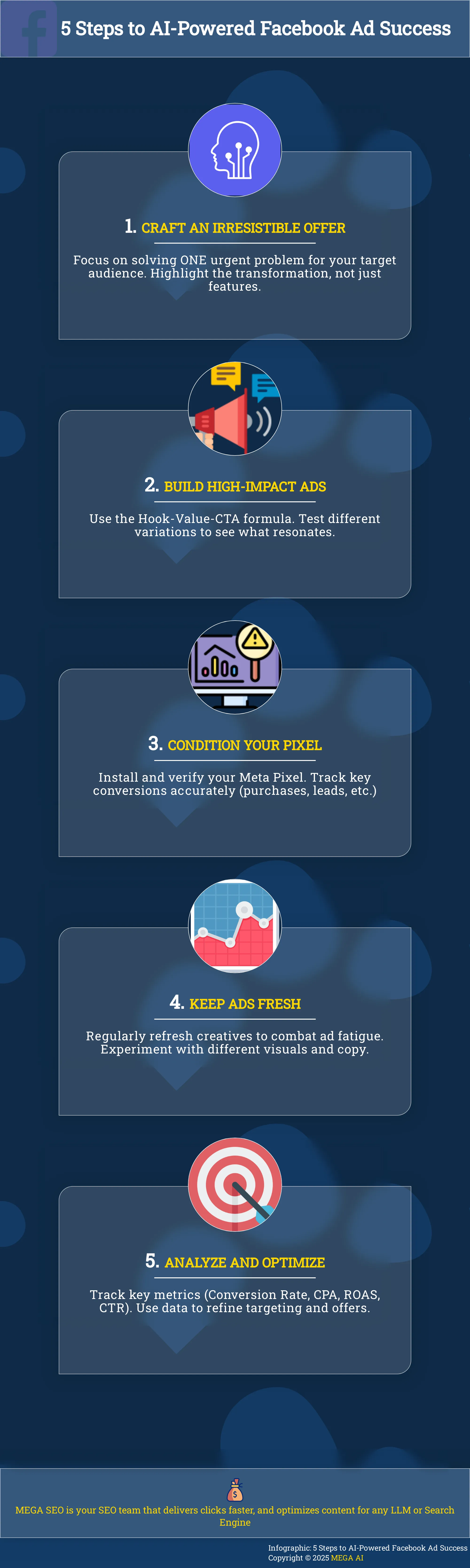
The most effective offers focus on solving one urgent problem for your target audience. Instead of overwhelming potential customers with an extensive list of features, your primary aim should be to address the single, most pressing issue they are currently grappling with. What specific challenge keeps them thinking? What particular outcome are they earnestly striving to achieve? Your offer needs to clearly and concisely articulate how your product or service provides the solution to that specific problem. This requires a genuine understanding of your audience and their immediate needs. When you highlight the transformation or relief your solution brings, rather than just its technical specifications, you forge a much stronger, more persuasive connection. Differentiating your solution with a unique value proposition will make your offer stand out even more distinctly.
Develop Solutions That Resonate and Convert
Once you've identified that urgent problem, the next step is to frame your solution in a manner that truly resonates with your audience and motivates them to take action. A "killer offer," as marketing expert Neil Patel aptly describes it, simplifies the decision-making process for your audience and, importantly, gives Meta's AI a clear reason to find your ideal buyer. This is where the presentation of your offer becomes absolutely key. You can leverage Facebook's diverse ad formats—from striking image and video ads to engaging carousel and collection ads—to craft compelling, visually captivating campaigns. Your ad creative should clearly communicate the value of your solution, making it incredibly easy for people to see how it solves their specific problem and why they should choose your offering over any other available alternative.
Use the Three-Part Ad Formula for Better Impact
Creating Facebook ads that consistently deliver results doesn't have to feel like a guessing game. While the platform's AI is powerful, the creative elements you provide are the foundation of any successful campaign. A structured approach to your ad copy and creative can make a significant difference in how your audience responds. One of the most reliable frameworks for crafting compelling ads is the three-part formula: a strong hook, clear value communication, and a decisive call to action.
This formula provides a simple yet effective roadmap for structuring your ad content. It ensures you capture attention immediately, quickly convey why your offer matters, and then guide the viewer towards the desired next step. Think of it as a mini-story that unfolds in seconds, designed to resonate with your target audience and prompt them to engage. By mastering these three components, you can build ads that are not only creative but also strategically sound, leading to better engagement and higher conversion rates. Platforms like MEGA AI can then help you take these well-structured ad components and efficiently create numerous variations, testing what resonates best with different segments of your audience. This combination of a solid creative framework and AI-powered optimization can be a game-changer for your campaigns, helping you manage your advertising spend more effectively.
Write Attention-Grabbing Hooks
The first few seconds of your ad are crucial. In a crowded feed, your hook is what stops the scroll and earns you a moment of your audience's attention. A great hook piques curiosity, addresses a pain point, or presents a surprising statement. As marketing expert Neil Patel advises, "What I like doing is remixing proven formats... I'll take what's working for competitor A, what's working for competitor B, and what's working for competitor C. I then take the best parts and it gives me ideas on what I should do within my own Facebook ad to generate the sales." This approach allows you to leverage successful strategies from others while crafting your unique message. Your goal is to make the viewer think, "This is for me," or "I need to know more."
Communicate Clear Value
Once you've hooked your audience, you need to quickly deliver on the promise of that initial attention. This is where you clearly communicate the value of your product or service. According to Neil Patel, "Strong offers solve one urgent problem. When you're trying to create a good offer, you need to think about how you can solve one urgent problem. You need to highlight outcomes, not features, and differentiate with a unique value proposition." This focus on solving a specific problem will resonate more with your audience and drive engagement. Instead of just listing features, explain how your offer makes their life better or easier. This clarity helps them recognize the solution you're offering to their pressing needs, making your ad far more persuasive.
Develop Strong Calls to Action
After capturing attention with a hook and demonstrating value, the final piece of the puzzle is a strong call to action (CTA). This is where you explicitly tell your audience what you want them to do next. Don't leave them guessing. Neil Patel emphasizes the importance of this structure: "Create your ads like this if you want them to work forever. There's a proven three-part ad formula that I love using: hook, value, and CTA." Whether it's "Shop Now," "Learn More," "Sign Up Today," or "Get Your Free Trial," your CTA should be clear, concise, and compelling. It should create a sense of urgency or make the next step seem easy and beneficial, transforming passive viewers into active leads or customers.
Use the Meta Ad Library for Strategic Insights
If you're looking to sharpen your Facebook ad strategy, the Meta Ad Library is a resource you simply can't overlook. Think of it as a transparent window into the advertising world on Meta's platforms. It’s a publicly available, searchable database of all active ads running across Facebook, Instagram, Messenger, and Audience Network. This tool is incredibly useful for understanding what your competitors are doing, what messages are currently resonating in your industry, and how successful campaigns are structured.
Instead of starting your ad creation process from scratch or relying purely on intuition, the Ad Library allows you to gather real-world data and inspiration. You can see the exact creatives, copy, and calls to action that other businesses are using. This isn't about copying, but about learning and identifying patterns of success. By observing what’s already working, you can make more informed decisions for your own campaigns, potentially saving you time and budget that might otherwise be spent on less effective approaches. For businesses, especially startups and small enterprises aiming to optimize their paid ad spend, this kind of insight is invaluable for crafting ads that genuinely connect with potential customers and drive results.
Analyze Competitor Strategies and Ads
One of the most powerful ways to use the Meta Ad Library is for competitor analysis. By simply searching for your competitors' brand names, you can pull up all the ads they are currently running. Pay close attention to ads that have been active for a longer period. As marketing expert Neil Patel points out in his Facebook Ads tutorial, "The longer the ad's been running, that means there's a higher probability that the ad is generating a positive ROI." This simple observation can help you pinpoint their most successful campaigns.
When you find these long-running ads, take the time to dissect them. What hooks are they using in their headlines and opening lines of copy. What angles or pain points are they addressing. What kind of messaging seems to resonate. Analyzing these elements gives you a clearer picture of what your shared target audience responds to, helping you refine your own approach without making costly guesses.
Identify Trends and Successful Ad Formats
Beyond looking at individual competitors, the Meta Ad Library is fantastic for spotting broader industry trends and identifying which ad formats are gaining traction. Are video ads prevalent in your niche. Are carousels being used effectively to showcase multiple products or features. By observing the landscape, you can understand the current advertising meta. Neil Patel also emphasizes that by examining what works for others, "you can stop guessing, and that way you'll start generating conversions way quicker with your ads versus throwing up a lot of duds."
This strategic examination allows you to adapt your campaigns based on proven success rather than relying on trial and error. For instance, if you notice many successful advertisers in your field are using user-generated content style videos, it might be a strong signal to experiment with that format yourself. This helps you stay current and ensures your ad creatives are more likely to capture attention and engage your audience effectively.
Optimize Campaigns for AI Performance
Facebook's advertising power increasingly comes from its sophisticated AI. To make your ads truly profitable, you need to understand how to work with this AI, not against it. This means feeding it the right signals and data so it can effectively find your ideal customers. When you optimize your campaigns for AI performance, you're essentially helping the system help you achieve better results and a stronger return on your ad spend.
Why Pixel Conditioning Matters
Think of the Meta Pixel as your primary communication line with Facebook's AI. It’s a piece of code on your website that tracks visitor actions. "Pixel conditioning" is the process of teaching this AI what a valuable customer looks like by showing it who is converting. As Jeremy Haynes aptly puts it, "Every ad platform—Facebook, TikTok, Google—relies on the pixel to make its predictions. Without proper conditioning, you're tossing your money at random." A well-conditioned pixel allows Meta's AI to build an accurate profile of your ideal customer. This leads to more precise targeting and, ultimately, a more efficient use of your advertising budget, ensuring your message reaches those most likely to be interested.
Give Clear Conversion Data to Meta's AI
Once your pixel is in place, the quality of the data it sends to Meta's AI is crucial. You need to ensure you're accurately tracking the most important actions, like purchases or lead submissions. Neil Patel highlights this by saying, "When Meta sees conversions, real purchases, real leads, it aggressively hunts for more just like them. But bad or missing data trains the system in the wrong direction." Providing clear, consistent, and accurate conversion data helps the AI learn faster and more effectively. This enables it to find users who are genuinely likely to convert for your business, rather than chasing irrelevant leads.
Adapt to Algorithm Changes
Meta's advertising algorithms are constantly evolving, and there's a clear trend towards relying more on AI-driven optimization. As Neil Patel also notes, "Meta wants you to stop using outdated interest stacks and instead rely on AI to optimize based on conversion data from your pixel." This means that overly granular, manual targeting through detailed interest stacking is becoming less effective. Instead, the focus should be on providing high-quality data via your pixel and allowing Meta's AI to find your audience. Adapting to these changes by trusting the AI, fueled by good data, is key to maintaining and improving campaign performance over time.
Keep Ads Fresh and Engaging
One of the surest ways to see your Facebook ad performance dip is by letting your creatives become stale. Think about it – how many times have you scrolled past the same ad without a second glance? Your audience does the same. Keeping your ads fresh isn't just about aesthetics; it's a core strategy for maintaining engagement, keeping costs down, and ensuring your message continues to resonate. When your audience sees the same ad repeatedly, they start to tune it out, a phenomenon known as ad fatigue. This can lead to decreased click-through rates and increased costs per result.
Regularly updating your ad creatives signals to Meta's algorithm that you're actively managing your campaigns, which can positively influence ad delivery. It also gives you more opportunities to test different angles, visuals, and copy, helping you understand what truly clicks with your audience. Platforms like MEGA AI can simplify this process by helping you remix content and generate numerous variations quickly, making it easier to keep your campaigns vibrant and effective without a massive time investment. This approach helps you stay ahead and maintain a strong connection with potential customers.
How to Regularly Refresh Creatives
If your ads have been running for a while, you might notice your costs per mille (CPMs) start to creep up. This is often a sign of audience fatigue. As marketing expert Neil Patel notes, "Meta punishes stale creatives. Eventually, you have audience fatigue, and you'll notice that the costs go up." The solution is to have a system for regularly introducing new ad variations. This doesn't mean you need a complete overhaul every week. Instead, think about creating multiple versions of your ads from the start.
Having several variations on hand allows you to swap them in and out, which Patel explains, "not only does it help protect your performance, it keeps your CPMs down overall." This proactive approach prevents your ads from becoming too familiar and losing their impact. Consider how tools that automate ad creation can help you build a library of creatives, so you're always ready to refresh your campaigns and keep your audience engaged without adding hours to your workload.
Balance Consistency and Novelty in Ads
While freshness is key, you also want to maintain some level of brand consistency. The sweet spot lies in balancing familiar brand elements with novel approaches. A practical way to achieve this is by creating multiple versions of each ad component. For instance, Neil Patel shares his process: "When I film ads, I film multiple versions of each part. So, multiple versions of the hook, multiple versions of the value, which is mainly the body, and multiple versions of the call to action."
This method allows you to test which specific elements—a particular hook or a certain call to action—perform best, without completely reinventing the wheel each time. You can then mix and match these components to create new ad combinations. This iterative testing helps you refine your messaging and visuals based on data, ensuring that while your ads evolve, they remain aligned with what resonates most with your audience and your core brand identity.
Find Effective Ad Formats and Content Strategies
Don't be afraid to experiment with different ad formats. Facebook offers a wide array, from image and video ads to carousels and collection ads, allowing you to craft compelling campaigns that capture attention. Sometimes, the ad formats that perform best are the ones that feel most authentic and less like traditional advertising. For example, Neil Patel points out that "raw lowfi content like Tik Tok style clips or selfie videos or behind-the-scenes footage often outperforms highly produced ads."
This suggests that relatability and authenticity can be powerful drivers of engagement. Try incorporating user-generated content (with permission, of course) or simple, direct-to-camera videos. The key is to test various formats and content styles to see what your specific audience responds to. Using a platform that allows you to easily upload content in bulk across different ad platforms can make this experimentation process much more manageable, letting you discover your winning ad formats faster.
Measure and Analyze Campaign Performance
Running Facebook ads without keeping an eye on their performance is a bit like navigating a ship without a compass. To ensure your investment translates into real growth, it's essential to regularly measure your campaign results and understand what the data reveals. This process goes beyond simply checking if your ads are active; it’s about uncovering insights that help you refine your strategy and achieve better outcomes. By consistently analyzing your performance, you can make informed decisions that lead to more profitable advertising.
What Key Metrics to Track and Analyze
To truly understand how your Facebook ads are performing, focus on a few essential metrics. First, look at your Conversion Rate: this tells you the percentage of people who complete your desired action (like making a purchase or signing up) after clicking your ad. A healthy conversion rate means your ad is effectively reaching and persuading your target audience.
Next, consider your Cost Per Acquisition (CPA), which is how much you're spending to gain one new customer. Alongside this, Return on Ad Spend (ROAS) measures the revenue you earn for every dollar spent on ads. Finally, Click-Through Rate (CTR) shows how often people click your ad after seeing it, indicating its relevance and appeal. As marketing expert Neil Patel notes, successful Facebook campaigns depend on feeding the algorithm with the right data to scale smartly.
Use Data to Make Strategic Adjustments
Gathering data is just the first step; the real power comes from using it to make smart changes. For example, if you see that one demographic group is converting at a much higher rate, you might decide to allocate more of your budget towards reaching them. Or, if an ad's CTR is low, it could be a sign to tweak your creative or headline.
This data-driven approach helps you continuously refine your campaigns. As digital strategist Jeremy Haynes highlights, "The event you optimize for dictates who the pixel will target." By analyzing which actions lead to your desired outcomes, you can fine-tune your targeting and make your ad spend work harder. Consistently reviewing your metrics and making these strategic adjustments is key to improving your ad performance and achieving better results for your business.
Scale Facebook Ad Campaigns Profitably
Once you've found a winning ad formula and your campaigns are consistently bringing in positive results, the next logical step is to scale. Scaling your Facebook ad campaigns means carefully increasing your budget to reach a wider audience and generate more conversions, all while maintaining profitability. It's a balancing act that requires a good understanding of when to push the accelerator and how to expand your reach without diluting your return on investment. With a strategic approach, you can grow your impact significantly. Platforms like MEGA AI's Paid Ads service can help automate parts of this process, allowing you to focus on strategy.
When and How to Increase Ad Spend
Deciding when to increase your ad spend is crucial. You don't want to pour money into a campaign that isn't ready for it. A key indicator is the strength of your offer. As marketing expert Neil Patel points out, "When you have a really good compelling offer, the algorithm works harder for you. And without it, your CPM skyrockets and your CTR stinks." So, before you even think about upping the budget, ensure your offer is truly resonating with your audience.
Another important factor is consistent performance. Look for ads that have been running successfully for a period. Patel also notes, "The longer the ad's been running, that means there's a higher probability that the ad is generating a positive ROI." If an ad consistently delivers results, it’s a good candidate for a budget increase. When you do decide to increase spend, do it gradually—typically no more than 20-25% every few days—to allow the algorithm to adjust without resetting the learning phase.
Expand Audience Reach and Maintain ROI
Expanding your audience reach while keeping your return on investment (ROI) healthy is the core challenge of scaling. It’s not about quick fixes or "hacks." Instead, successful scaling involves "feeding the algorithm with what it needs to scale smartly and profitably." This means providing Meta's AI with clear and consistent conversion data.
Meta’s platform is increasingly reliant on its AI to find the best audiences for your ads. It's recommended to "stop using outdated interest stacks and instead rely on AI to optimize based on conversion data from your pixel." When your Meta Pixel is well-conditioned with accurate purchase or lead data, the AI gets better at finding more people like your existing customers. "When Meta sees conversions, real purchases, real leads, it aggressively hunts for more just like them." This data-driven approach allows you to broaden your targeting with more confidence, knowing the AI is working to maintain your campaign's efficiency.
Overcome Common Facebook Advertising Challenges
Running Facebook ads often comes with its share of challenges, from working with budget constraints to keeping up with platform updates. The good news is that these hurdles are common, and with the right strategies, you can address them effectively. Let's explore how to handle two frequent issues: working with limited budgets and adapting to the dynamic nature of Facebook's advertising environment.
Work with Limited Budgets and Resources
Many believe you need a large budget for Facebook ads to succeed, but that's not always the case. With limited resources, you can still run profitable campaigns by adopting a smart, structured approach. Advertising expert Neil Patel highlights that a solid system allows you to manage profitable Facebook ad campaigns effectively, "whether it's spending $100 or $10,000 a day." The focus here is on efficiency and making every dollar count.
To make your budget go further, concentrate on creating what Neil Patel terms a "killer offer." He points out that "a killer offer makes everything cheaper and easier because it gives Meta's AI a clear reason to find your ideal buyer." When your offer genuinely connects with your target audience by addressing their urgent problems, your ads naturally become more persuasive. This results in improved engagement and higher conversion rates, making your ad spend more efficient. Using tools to analyze market trends and sharpen your messaging can be incredibly helpful in ensuring your offer resonates.
Adapt to Platform Changes and Consumer Behavior
Facebook's advertising landscape is always changing, with new features, algorithm updates, and shifts in consumer behavior. To remain effective, adaptability is key. Meta's platform increasingly uses its AI to optimize ad delivery. Rather than sticking to older methods like narrow interest targeting, the platform now advises advertisers to "rely on AI to optimize based on conversion data from your pixel." This change underscores the importance of providing the algorithm with high-quality data.
Effective campaigns are not about quick fixes; they are about understanding how to "feed the algorithm with what it needs to scale smartly and profitably." Robust tracking is a crucial component. Correctly setting up both the Facebook Pixel and the Conversion API ensures accurate server-side tracking. This configuration "allows Meta to learn exactly who's buying," providing its AI with the detailed data necessary to identify more potential customers. Utilizing platforms that streamline ad management and optimization can help you remain agile and respond effectively to these platform shifts.
Future-Proof Your Facebook Ad Strategy
The Facebook advertising landscape is always changing, so what works today might not work tomorrow. To keep your campaigns effective in the long run, you need a strategy that’s built to last. This means not only understanding the platform deeply but also keeping a keen eye on where the industry is headed. By focusing on these two areas, you can create ads that continue to deliver results, no matter how the platform evolves. Let's explore how you can build this forward-thinking approach.
Build Expertise in Facebook's Ad Platform
To truly succeed with Facebook ads, it’s essential to develop a solid understanding of its ad platform. Think of it like learning the rules of a game before you can win. When you have a really compelling offer, the platform's algorithm actually works harder for you, finding the right people for your message. It’s not about chasing short-term "hacks"; sustainable success comes from consistently feeding the algorithm the right information and understanding how it uses your conversion data. This expertise allows you to run profitable campaigns, whether you're spending a little or a lot, by making smart, informed decisions.
Stay Ahead of Industry Trends
The world of social media advertising moves fast, and Facebook is no exception. To keep your ads effective, you’ll want to stay updated on emerging trends. For instance, raw, authentic content like TikTok-style clips, selfie videos, or behind-the-scenes footage often performs better than highly polished ads. You can also experiment with user-generated content (UGC) in formats like carousel mini-stories to stand out. Importantly, Meta is increasingly guiding advertisers to rely on its AI for optimization, using data from your pixel, rather than older methods like detailed interest stacking. Embracing these shifts will help your ads resonate with current audiences.
Related Articles
- Unlocking Facebook Ads: Secrets for Effective Campaigns
- Master Facebook Ads: 6 Easy Steps to Boost Success
- Boost FB Post: Reach More People in 2024
- How to Boost FB Post: A Simple Step-by-Step Guide
- Average Facebook Ads CPC in 2024: Industry Benchmarks
Frequently Asked Questions
What's the single most crucial element for a successful Facebook ad campaign? Before you even think about ad design or targeting, your offer needs to be absolutely solid. A truly compelling offer that solves an urgent problem for your ideal customer is the foundation. When your offer is irresistible, it makes every other part of your campaign, including how Meta's AI finds your audience, work much more effectively.
My ads aren't getting much attention. What can I do to make them more engaging? If your ads are being ignored, start by looking at your hook – that very first thing people see or read. It needs to grab attention immediately. Also, make sure you're not letting your ads get stale. Regularly refreshing your visuals and copy, even by testing small variations, can keep your audience interested and prevent them from simply scrolling past.
Should I spend a lot of time picking specific interests for targeting, or is there a better way? While understanding your audience is important, the trend is moving away from layering tons of specific interests. Instead, focus on "conditioning" your Meta Pixel with clear conversion data. When you show Meta's AI who is actually buying or signing up, it becomes much better at finding more people just like them, often more effectively than manual interest stacking.
How can I tell if my Facebook ad budget is actually bringing in good results? You'll want to keep an eye on a few key numbers. Your conversion rate will show you if people are taking the action you want after seeing your ad. Also, track your cost per acquisition to see how much you're spending for each new customer, and your return on ad spend to understand the revenue generated from your ads. These metrics give you a clear picture of your campaign's financial performance.
I'm just starting out with a small budget. Can Facebook ads still work for me? Absolutely. You don't need a massive budget to see results, especially if you're smart about it. The key is to create an incredibly strong offer that truly resonates with a specific audience. When your offer is compelling, your ads work harder, and Meta's AI can more efficiently find the right people, making your smaller budget go further.