
Think of your website's authority like a well-designed irrigation system. If the water (authority) only reaches a few main channels, many valuable plants (your important pages) won't thrive. Effective Page Authority distribution ensures this vital resource is channeled correctly, nourishing every part of your site. This isn't just an abstract SEO concept; it directly impacts how people use your website. When authority flows logically, users find clear paths to the information they seek, making their journey smoother and more satisfying. The benefits of page authority distribution for enhanced user experience? include better content discovery and a more intuitive site structure. We'll show you how to optimize this flow for a healthier, higher-performing website.
Key Takeaways
- Guide Page Authority for Better Rankings and User Experience: Purposefully directing authority across your website helps your pages rank higher and makes your site easier for people to use and enjoy.
- Focus on Smart Internal Links and Valuable Content: To effectively spread Page Authority, concentrate on building a thoughtful internal linking system and producing high-quality content that shares strength with your most important pages.
- Regularly Check PA Distribution and Adapt Your Plan: Use SEO tools to monitor how authority flows through your site, identify areas that need attention, and adjust your strategy to ensure your key content gets the support it requires.
What is Page Authority and How is it Calculated?
Understanding Page Authority (PA) is a great first step if you're looking to improve how your individual web pages perform in search results. It’s a helpful metric that gives you an idea of a specific page's strength in the eyes of search engines. Let's break down what it is, how it's determined, and what those scores actually mean for your website.
Defining Page Authority
Page Authority, often called PA, is a score created by the SEO software company Moz. It’s designed to predict how well a specific page on your website might rank in search engine results pages (SERPs). Think of it like a grade for each individual page, ranging from one to 100. A higher score suggests a stronger ability for that particular page to appear prominently when people search for relevant terms. It’s important to remember that PA is page-specific, not site-wide. This means your homepage could have one PA score, while a blog post or a product page on the very same website could have entirely different scores, each reflecting their individual strengths and optimization efforts.
Key Factors That Influence Page Authority
Several elements come together to determine a page's Authority. A major one is its backlink profile – essentially, how many other websites link to your page and, crucially, the quality of those linking sites. Links from well-respected, authoritative sources carry more weight than links from newer or less credible sites. Beyond backlinks, effective on-page SEO is vital. This involves optimizing elements like your page titles, meta descriptions, header tags, and image alt text with relevant keywords. Good content quality is also key; search engines tend to favor pages that offer thorough, unique, and valuable information that genuinely helps users.
The Moz Scale: What PA Scores Mean
Page Authority scores operate on a 100-point logarithmic scale. This simply means it's generally easier to improve a score from, say, 20 to 30 than it is to go from 70 to 80. So, what's a "good" score? It really depends on your industry and who you're competing against. A brand-new page might start with a PA of 1, while pages on very established websites can reach scores in the 80s or 90s. Generally, a PA of 50 or higher is often seen as good, but this can vary. The most practical approach is to analyze the PA scores of pages that are already ranking well for your target keywords. This gives you a more realistic benchmark for your own pages.
What is Page Authority Distribution?
Understanding how "authority" flows through your website can feel a bit like trying to map out a hidden network of streams. But once you grasp the concept of Page Authority (PA) and how it's distributed, you'll have a much clearer picture of why some pages perform better in search results than others. Essentially, Page Authority is a score that predicts how well a specific page on your website is likely to rank on search engine results pages (SERPs). Think of it as a measure of a single page's strength.
Page Authority distribution, then, is all about how this strength is spread across your entire site. It’s not just about having one super-strong homepage; it’s about ensuring that authority is shared effectively with other important pages. This distribution happens primarily through links – both internal links (from one page on your site to another) and external backlinks (from other websites to yours). A well-structured distribution means that "link equity" or "link juice" flows logically, helping to lift the authority of many pages, not just a select few. This, in turn, can significantly impact your site's overall visibility and how users find your content. For businesses looking to enhance their online presence, like those using MEGA AI's SEO tools, understanding PA distribution is a fundamental step.
The Core Concept of PA Distribution
At its heart, Page Authority (PA) is a score developed by Moz that ranges from one to 100. A higher score suggests a greater ability for that specific page to rank in search results. It’s important to remember that PA is not the same as Google's old PageRank system. While PageRank focused heavily on backlinks, PA takes a broader view, considering factors like the quality of your content, how users engage with your page, and the overall health of your page's link profile.
So, when we talk about PA distribution, we're looking at how this authority is spread from page to page within your website. Imagine your highest authority pages as reservoirs of ranking potential. Through strategic internal linking, you can channel this potential to other pages, helping them to perform better. This ensures that value isn't just hoarded by a few pages but is shared, strengthening your website's overall SEO structure.
Why PA Distribution Matters for Your Website
Effective Page Authority distribution is a cornerstone of a solid SEO strategy. When authority is well-distributed, it helps more of your pages become competitive in search rankings. This isn't just about pleasing search engines; it directly impacts how users discover and interact with your site. For instance, thoughtful internal linking doesn't just pass authority; it guides visitors to related content, making your site easier to use and keeping them engaged longer.
Understanding your site's PA distribution allows you to pinpoint which pages are strong and which ones might need more support. It helps you plan how to improve your website's search rankings and even compare your site's page strengths against competitors. By focusing on strategies like creating valuable, link-worthy content and earning quality backlinks from respected sites, you can improve both individual Page Authority scores and their overall distribution, leading to better online visibility.
How Page Authority Distribution Improves User Experience
When you strategically distribute Page Authority across your website, you're doing more than just optimizing for search engines; you're actively making your site a better place for your visitors. A thoughtful approach to how authority flows through your pages directly translates into a smoother, more intuitive, and ultimately more satisfying experience for anyone who lands on your site. It’s about effectively guiding them and helping them find the value you offer, which benefits both your audience and your site's overall performance. Let's explore how this works in practice.
Improve Site Navigation and Content Discovery
Think of Page Authority distribution, largely managed through your internal linking strategy, as creating clear pathways throughout your website. When you connect related pages to one another, you're essentially handing your visitors a well-drawn map. This makes it much simpler for them to move from one piece of content to another relevant one, allowing them to explore topics more deeply without feeling lost or overwhelmed.
Good internal linking doesn't just assist users; it also "provides critical context to search engines about the linked page's content," as experts at Hashmeta explain. This means users are more likely to find precisely what they're looking for quickly, whether they arrive from a search engine results page or are already browsing your site. This enhanced ability to discover content keeps them engaged and encourages them to explore more of what your website has to offer.
Give Users Faster Access to Information
A significant benefit of careful Page Authority distribution is that it helps users get to the information they need more quickly. When important pages receive more "authority" through relevant internal links, they tend to be more visible and accessible within your site structure. This means users spend less time clicking around in search of answers and more time engaging with your valuable content.
As Hashmeta also points out, "Thoughtful internal linking significantly enhances user experience. It helps visitors discover related content, provides navigational assistance, and keeps them engaged with your site longer." By making your site easy to get around and ensuring that key information is readily available, you reduce potential frustration and make the entire interaction more efficient for your visitors. This efficiency is a cornerstone of a positive user journey.
Increase User Engagement and Satisfaction
User engagement and satisfaction are deeply connected to how easily visitors can use your site and find what they are looking for. Effective Page Authority distribution contributes to a seamless experience, which in turn encourages users to stay on your site longer and interact more meaningfully with your content. When pages load quickly and information is logically structured, users are simply more content with their experience.
Moz emphasizes that "Factors such as page loading speed, mobile responsiveness, and overall user experience are important. A positive user experience can enhance your Page Authority." This highlights a beneficial cycle: a good user experience can contribute to higher PA, and well-distributed PA helps create that positive experience. Focusing on these elements leads to users who are more likely to return and perhaps even request a demo of your services.
Build Trust and Credibility with Users
A website that is easy to use and provides clear paths to authoritative information naturally feels more trustworthy. When users see that content is well-organized and that important pages are given appropriate prominence (partly through how Page Authority is distributed), it signals professionalism and reliability. This helps to build their confidence in your brand and the information you provide.
While high-quality backlinks are crucial for building Page Authority—DashClicks notes that "links from trusted sources in your industry are far more valuable"—the resulting authority also influences user perception. A site that is recognized as authoritative, often reflected by strong PA on key pages, inherently feels more credible. Ensuring your most important content is well-supported by your site’s internal link structure reinforces this essential sense of trust with your audience.
How to Optimize Page Authority Distribution
Optimizing how Page Authority flows through your website isn't just a technical SEO task; it's a fundamental part of creating a better experience for your visitors and signaling value to search engines. When you strategically manage PA distribution, you guide both users and search engine crawlers to your most important content. This involves a combination of thoughtful site structure, high-quality content, and smart linking practices. By focusing on these areas, you can significantly improve how your pages are perceived and how easily users can find what they need. Let's look at some key strategies to make this happen.
Strengthen Your Internal Linking
Think of internal links as the pathways within your website. A well-planned internal linking strategy is crucial because, as research suggests, "Internal linking within a website helps distribute Page Authority and improve user experience." When you link relevant pages together, you're not just helping users discover more of your content; you're also telling search engines how your pages relate to one another and which ones are most important. A "systematic approach to internal linking provides critical context to search engines about the linked page's content." This means using descriptive anchor text and ensuring that your most authoritative pages link to other important pages, effectively sharing their strength. This helps newer or less-visited pages gain visibility and authority.
Create High-Quality, Linkable Content
At the heart of any successful website is valuable content. As experts often say, "Creating great content is key. Make your webpages informative, interesting, and useful." Pages that offer genuine value are more likely to naturally attract links from other websites, which is a primary driver of Page Authority. "High-quality, in-depth, and unique content is essential." This isn't just about initial creation; "regularly updating existing content keeps it fresh and relevant," signaling to search engines that your site is a current and authoritative source. When your content is truly helpful, others will want to reference it, building your PA and making it easier to distribute that authority across your site. For businesses looking to scale their content efforts, tools that assist with content generation can be incredibly beneficial.
Implement Effective On-Page SEO
On-page SEO involves optimizing the elements on your actual web pages to make them more understandable and attractive to search engines and users. This includes things like your page titles, meta descriptions, headings (H1-H6), and image alt text. According to SEO best practices, "Optimizing page titles, meta descriptions, headers, and images with relevant keywords improves how search engines understand your content." When search engines can clearly grasp what your page is about, they are better able to assess its relevance and authority. Consequently, "a higher Page Authority often correlates with better rankings." Ensuring your on-page elements are clear, concise, and keyword-focused helps each page stand on its own and contribute effectively to your site's overall authority structure.
Use External Links Strategically
While internal links distribute authority within your site, external links (or backlinks) bring authority to your site from elsewhere on the web. "High-quality backlinks from reputable websites are crucial" for building Page Authority. It's important to remember that "not all backlinks are equal; links from trusted sources in your industry are far more valuable." Earning these authoritative endorsements tells search engines that your content is credible and valuable. Strategically, this means focusing on creating content worthy of such links and potentially engaging in outreach to relevant, high-authority sites. Managing both your internal and external linking strategy is a core component of effective SEO and PA distribution.
What Happens with Ineffective PA Distribution?
When page authority isn't distributed thoughtfully across your website, it’s not just a missed opportunity—it can actively hinder your site's performance. Think of it like a poorly planned irrigation system; if authority doesn't flow to all the right places, parts of your website will struggle. This can lead to several problems affecting how search engines see your site and how users experience it. Let's explore the key issues that arise from ineffective PA distribution.
Reduced Search Visibility and User Engagement
When your website's authority isn't spread effectively, especially through weak internal linking, search engines struggle to understand your content's hierarchy. This confusion often leads to lower search rankings, meaning fewer people will find your pages. Consequently, user engagement can suffer, as poor visibility often translates to higher bounce rates and less time on site. These metrics signal to search engines that your website may not be meeting user needs, making it harder to attract and retain an audience if authority isn't flowing correctly.
Risking Lost Traffic and Conversions
If page authority isn't distributed well, your internal linking strategy likely suffers. Internal links are vital pathways for users and search engine crawlers. Without a clear plan, valuable content can become buried and hard to find, directly leading to lost traffic and conversions. Consider a visitor on a blog post with no clear path to related products or a contact form—that's a missed chance. Every undiscovered page represents a potential lead gone. Making sure important pages receive and pass authority helps them get indexed and found, a crucial first step for conversions. Businesses can optimize this flow effectively using dedicated SEO tools.
Creating an Inconsistent User Experience
Poor page authority distribution often creates a confusing journey for visitors. Users might land on low-authority pages—perhaps with thin content or weak links—making them feel lost. This contributes to an inconsistent user experience and can cause frustration. Conversely, thoughtful PA distribution, reinforced by strong internal linking, builds clear pathways. This allows users to easily find related information and move smoothly towards their goals, like finding answers or making a purchase. An intuitive experience encourages users to stay longer and return, benefiting your site's performance.
How to Measure and Monitor Page Authority Distribution
Understanding how Page Authority (PA) is spread across your website is key to refining your SEO strategy and improving user experience. It’s not just about knowing individual page scores; it’s about seeing the bigger picture of how authority flows and where you can make impactful changes. Regularly measuring and monitoring this distribution helps you identify which pages are your powerhouses, which ones need more support, and whether your efforts to strengthen your site are paying off. This ongoing process allows you to make data-driven decisions, ensuring your most important content gets the visibility it deserves and users can easily find what they're looking for. For businesses, especially startups and small to medium-sized enterprises, efficiently managing SEO efforts is crucial, and understanding PA distribution is a significant part of that. Let's look at how you can effectively keep tabs on your PA distribution.
Tools to Track PA Across Your Site
To get a clear view of Page Authority across your website, you'll want to use some reliable SEO tools. You can check your PA using Moz's Link Explorer, which is a great starting point for understanding individual page scores and even peeking at your competitors. For a more comprehensive analysis, platforms like SEMrush, Ahrefs, or Majestic offer robust features. These tools allow you to conduct a domain analysis that provides a broader look at how authority is distributed, helping you pinpoint strengths and weaknesses across your entire site. Consistently using these tools will give you the data needed to track changes and measure the impact of your optimization efforts, making your SEO work more targeted and effective.
Key Metrics to Keep an Eye On
When you're monitoring Page Authority, several key metrics directly influence your scores and tell a story about your page's health. The number and quality of backlinks are significant; pages with more high-quality links tend to have higher PA. Don't overlook on-page SEO elements, the quality of your content, your internal linking structure, and overall website performance, as these are also crucial factors affecting Page Authority. A PA score between 50 and 70 is generally considered good, indicating a page has a strong likelihood of ranking well. Keeping an eye on these metrics helps you understand what’s driving your PA and where to focus your efforts for improvement, ensuring your content performs optimally.
How to Analyze PA Distribution Patterns
Analyzing how Page Authority is distributed across your site involves looking for patterns and trends over time. Consistently tracking your PA will show you whether your SEO strategies are yielding positive results. For instance, you might notice that certain types of content consistently gain more authority, or that specific internal linking strategies are effectively channeling PA to important pages. It's also wise to implement a systematic approach to canonicalization and internal linking. This helps maximize visibility for valuable content and prevents issues with duplicate content, ensuring that authority is consolidated effectively. This ongoing analysis helps you refine your approach and build a stronger, more authoritative website.
Balance Page Authority Distribution with Other SEO Elements
Distributing Page Authority effectively is a powerful piece of your SEO puzzle, but it doesn't work in isolation. To truly see results, you need to ensure this strategy works in harmony with other fundamental SEO elements. Think of it like a well-orchestrated symphony – every instrument needs to play its part at the right time for the music to sound beautiful. Let's look at how PA distribution fits into your broader SEO efforts, helping your website perform its best.
The Role of Domain Authority
You've likely heard of Domain Authority (DA). It's a score, typically from 0 to 100, developed by Moz, that predicts how well your entire website is likely to rank in search engine results. A higher DA generally suggests a stronger chance of ranking. This score is influenced by several factors, including the quantity and quality of backlinks pointing to your site, your website's age, the overall quality of your content, and user experience signals. While Page Authority focuses on individual pages, your site's Domain Authority provides the foundational strength. A higher DA can make it easier for new pages to gain PA more quickly, as your domain is already seen as credible by search engines.
How to Integrate PA Distribution into Your SEO Strategy
Integrating Page Authority distribution into your SEO strategy means being intentional about how you structure your site and link your content. One of the most direct ways to do this is through smart internal linking. Your internal links act as pathways, guiding both users and search engine crawlers through your website. When you link from a high-authority page to another relevant page on your site, you pass some of that authority along. Use descriptive, keyword-rich anchor text for these links, and ensure your site has a logical linking structure. This not only helps distribute PA but also improves site navigation and user experience, which are key components of any solid SEO plan.
Align PA Distribution with Your Content Strategy
Your content strategy and Page Authority distribution are deeply intertwined. Creating high-quality, informative, and engaging content is the cornerstone of attracting both users and backlinks. When you produce valuable articles that people genuinely want to read and share, you naturally encourage other websites to link to you. These external backlinks are a primary driver of Page Authority. Think about crafting content that serves as a resource or provides unique insights. Furthermore, connecting with other respected sites in your niche and creating content they find valuable can help you earn quality backlinks, significantly amplifying your PA and overall online visibility. This synergy ensures your best content gets the authority it deserves.
Common PA Distribution Mistakes (And How to Fix Them)
Distributing Page Authority effectively sounds straightforward, but it's easy to stumble along the way. Many website owners and marketers make common errors that can hinder their efforts to improve user experience and search rankings. The good news is that these mistakes are often simple to identify and correct. By understanding these pitfalls, you can refine your strategy and ensure your website’s authority flows where it's needed most, creating a better journey for your visitors and signaling strength to search engines. Let's look at some frequent missteps and how you can steer clear of them.
Mistake: Neglecting Internal Links
It’s surprising how often internal linking gets overlooked, yet it's a cornerstone of effective Page Authority distribution. When you don't strategically link between your own pages, you're missing a prime opportunity to guide both users and search engine crawlers. As SBHinter points out, "Internal links guide users and search engines through your site, boosting rankings and user experience. Failing to use them reduces page authority." Without these connections, individual pages can become isolated, making it harder for authority to spread from stronger pages to weaker ones.
To fix this, start by developing a clear internal linking strategy. Identify your most authoritative pages and link from them to relevant, less authoritative pages that you want to support. Use descriptive anchor text that gives context to the linked page. Think of it as creating pathways through your site. For instance, a comprehensive blog post could link to related product pages or service descriptions. Tools like MEGA AI can even assist with automated internal linking, ensuring your content is well-connected and authority is distributed efficiently.
Mistake: Over-Focusing on Homepage Authority
Many people pour all their energy into building the authority of their homepage, believing it's the only page that truly matters. While your homepage is undoubtedly important, "Many website owners mistakenly believe that only their homepage needs to have high authority, neglecting the importance of distributing authority across all pages," as Pixolabo notes. This tunnel vision means your valuable product pages, informative blog posts, and crucial service pages might be left languishing with low authority, making them less likely to rank for their specific keywords.
The fix here is to adopt a more holistic view of your website's authority. While your homepage will naturally attract many backlinks, actively work to build authority for your other key pages as well. This means seeking out linking opportunities for your deeper content and ensuring your internal linking structure effectively channels some of the homepage's strength to these subpages. A well-balanced site where authority is spread thoughtfully will perform much better overall.
Mistake: Ignoring Mobile Optimization
In an age where so many users browse on their phones, neglecting mobile optimization is a significant oversight that indirectly impacts Page Authority distribution. If your site is clunky, slow, or difficult to use on a smartphone, users will quickly leave. This high bounce rate signals a poor user experience to search engines. As highlighted by SBHinter, "Mobile optimization ensures your site performs well on smartphones, improving user experience and rankings due to Google’s mobile-first indexing." If users aren't engaging with your mobile site, the authority of those pages effectively goes to waste.
To address this, prioritize making your website fully responsive. This means it should adapt seamlessly to any screen size. Pay attention to mobile page speed, ensure tap targets are large enough, and that content is easily readable without excessive zooming. Regularly test your site's mobile-friendliness and user experience on various devices. A smooth mobile experience keeps users on your pages longer, allowing them to benefit from the content and the authority you've built.
Mistake: Forgetting to Update Older Content
Content isn't a "set it and forget it" affair. Over time, information can become outdated, statistics can change, and user intent can evolve. Letting your older content gather dust can lead to a decline in user engagement and, consequently, its authority. As Amy Pierquet mentions in a LinkedIn article on common website mistakes, "Regularly updating your content is crucial; outdated content can lead to a decline in user engagement and authority." Search engines favor fresh, relevant content, so neglecting updates can cause your once-authoritative pages to slip in rankings.
The solution is to implement a content audit and refresh schedule. Periodically review your existing articles and pages. Update them with current information, add new insights, or expand on topics to provide more value. For instance, MEGA AI’s Maintenance Agent product can identify opportunities to add new content to existing articles or re-optimize them, helping to maintain and improve their rank and authority over time. This proactive approach keeps your content valuable for users and signals continued relevance to search engines.
Implement Your Page Authority Distribution Strategy
Putting a page authority distribution strategy into action is a practical process that can significantly impact your website's performance. It’s not just about having great content; it’s about ensuring that the 'authority' or 'link equity' your pages earn is shared effectively across your site. Think of it as creating a well-organized network of pathways that guide both search engines and users to your most valuable information. When done right, this helps your key pages rank higher and makes your site easier for visitors to use. Many businesses invest heavily in content creation, but without a clear strategy for how that content supports the authority of other important pages, much of that effort can be diluted. A strong distribution strategy ensures that every piece of content contributes to the bigger picture of your site's SEO health.
The core idea is to move from a haphazard approach to a deliberate one. This involves first understanding how authority currently flows through your site, then creating a thoughtful plan to improve that flow, and finally, committing to ongoing monitoring and adjustments. This isn't a set-it-and-forget-it task, as your website, your content, and even search engine algorithms are constantly evolving. By systematically managing how page authority is distributed, you're actively working to enhance your site’s visibility and the overall user journey. This structured approach can make a real difference, especially for businesses looking to maximize their online presence without getting lost in overly technical jargon. It’s about making smart, informed decisions that lead to sustainable growth. We'll explore the key steps to make this happen, helping you build a more authoritative and user-friendly website.
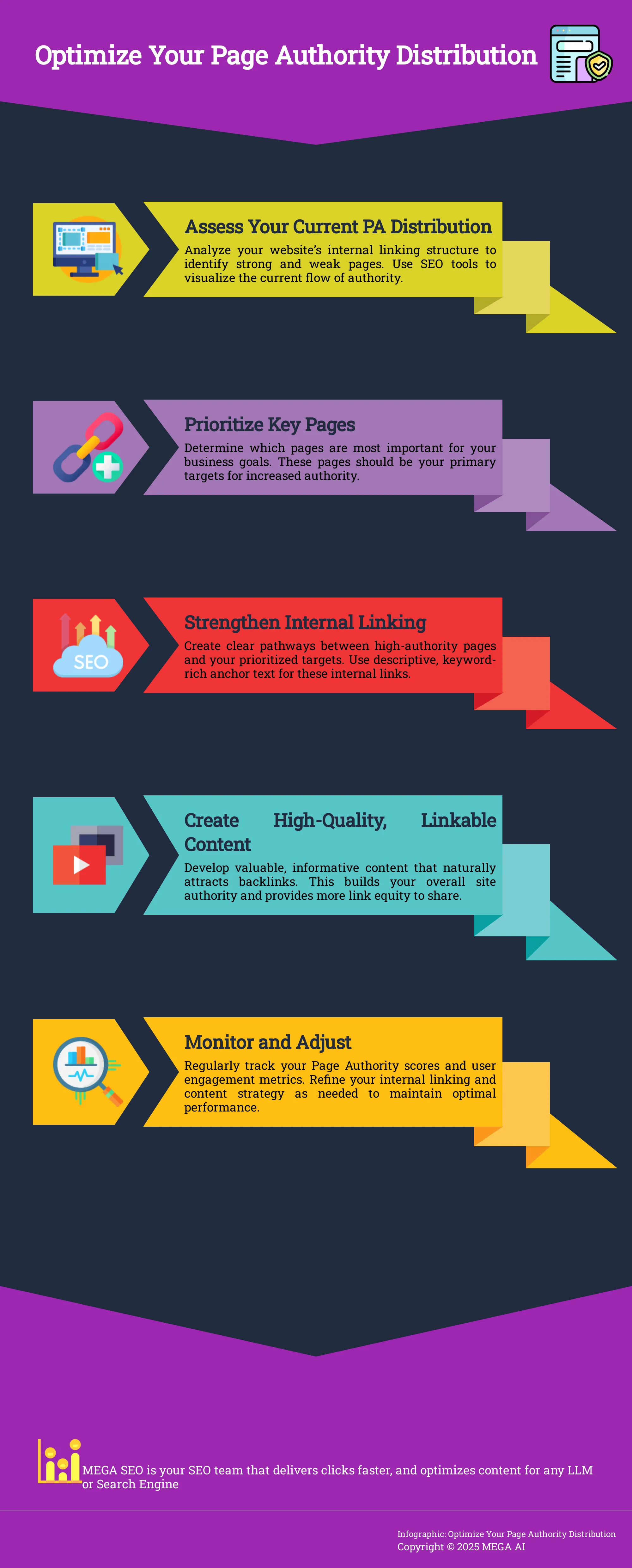
Assess Your Current PA Distribution
Before you can improve how page authority flows through your site, you first need a clear picture of the current situation. Think of it like checking the plumbing in a house – you want to see where the water is going and if there are any leaks or blockages. A key part of this assessment involves looking at your internal linking structure. These internal links are crucial as they guide users and search engines through your site, directly impacting rankings and user experience; neglecting them can reduce your page authority.
Start by mapping out how your key pages are interconnected. Are your high-value pages receiving enough internal links from other relevant, authoritative pages on your site? Conversely, are less important pages unintentionally hoarding authority? Tools that crawl your website can help visualize your link structure and identify orphaned pages or areas where link equity isn't flowing optimally.
Create Your Plan for Improvement
Once you understand your current PA distribution, it’s time to develop a plan to optimize it. This plan should focus on strengthening your website's architecture through strategic internal linking, which can truly transform your SEO performance and improve user experience. Your goal is to ensure that authority flows logically from high-authority pages to important subpages. Identify your cornerstone content – the most important, comprehensive pieces on your site – and make sure they are well-linked from relevant supporting articles.
Your plan should also consider how you create valuable content that naturally attracts links, both internal and external. High-quality, informative content is more likely to be linked to, which in turn helps build the authority of those pages. Think about opportunities to create new internal links from older, authoritative content to newer, relevant pages, and vice-versa. This helps spread authority and keeps your entire site well-connected.
Monitor and Adjust Your Strategy Continuously
Implementing your strategy isn't a one-time task; it requires ongoing attention. Search engine algorithms change, your content evolves, and user behavior shifts, so your PA distribution strategy needs to adapt as well. Regularly monitor key metrics like individual page authority scores, organic traffic to key pages, and user engagement signals. Remember, a positive user experience can enhance your Page Authority, so pay attention to how easily users can find information and complete their goals on your site.
Based on what you observe, be prepared to make adjustments. This might involve adding new internal links, updating older content to improve its relevance and linkability, or even re-evaluating your site structure. Adopting a systematic approach to your internal linking will help maximize visibility for your important pages. Consistent monitoring and tweaking will help you maintain an effective flow of authority across your website, ensuring your efforts continue to yield results.
How PA Distribution Impacts Different Website Types
Page Authority distribution isn't a one-size-fits-all strategy. How you approach it, and the benefits you'll see, can vary depending on your website type. Whether you're selling products, sharing information, or offering services, understanding PA flow can significantly impact your users and search performance. Considering your site structure and user goals helps tailor your approach, ensuring authority flows logically to your most important pages.
Impact on E-commerce Sites
For e-commerce sites, effective Page Authority distribution is vital for product visibility. With potentially thousands of product pages, you need customers and search engines to find them. Strong internal linking spreads PA from authoritative pages like your homepage or categories to individual product listings, improving their search ranking potential.
Beyond rankings, good PA distribution enhances the shopping experience. When users can easily navigate from a category to a product or find related items, they're more likely to stay and buy. Creating valuable content like buying guides can also attract quality backlinks, strengthening page authority and, through internal links, your product pages.
Impact on Content-Heavy Websites
If your website focuses on content—blogs, news, or resource hubs—Page Authority distribution is key for audience discovery. Thoughtful internal linking does more than pass PA; it guides visitors to related articles, encouraging deeper site exploration. This increased engagement, such as more time on site and lower bounce rates, signals to search engines that your content is valuable.
When PA is distributed effectively, your cornerstone content can act as hubs, passing authority to specific, related posts. This ensures even niche content gets visibility. A well-structured site with good PA flow makes it easier for users to find information, establishing your site as a go-to resource.
Impact on Service-Based Business Sites
For service-based businesses, Page Authority distribution is crucial for guiding potential clients to convert. Your main service pages, case studies, and contact forms are high-value, needing sufficient authority. Effective internal linking helps users and search engines understand connections between informational content (like blog posts) and your core service offerings.
A positive user experience is essential. When potential customers easily find service information, see expertise, and know how to contact you, they're more likely to proceed. Distributing PA effectively means users landing on a blog post can seamlessly move to a relevant service page, smoothing their journey and improving your conversion funnel.
Related Articles
- Domain Authority: The Ultimate Guide (2023)
- How to Rank Higher After Google's Helpful Content Update
- PageRank Sculpting: Boost Key Pages With Smart Linking
- Beyond PageRank Sculpting: SEO Best Practices for Link Equity
- Enhancing the Authoritativeness of Your Site Through Effective SEO Practices - MEGA SEO | Blog
Frequently Asked Questions
My homepage has a decent Page Authority score. Isn't that what matters most? While a strong Page Authority for your homepage is a great start, it's only one piece of the puzzle. Think of your website like a team; you want all your key players—your important product pages, service descriptions, and informative blog posts—to be strong too. Distributing authority effectively means sharing some of that homepage strength with these other vital pages, helping them perform better in search results and ensuring users can find all the valuable content you offer.
How does improving Page Authority distribution actually make my website better for visitors? When Page Authority is well-distributed, it often means your site is structured more logically. This translates to a smoother experience for your visitors. They can find information more easily, move intuitively from one related topic to another, and generally have a less frustrating time navigating your site. It’s about creating clear pathways that guide them to what they need, which naturally leads to greater satisfaction.
What's a simple first step I can take to improve how Page Authority is spread across my site? A really effective first step is to look at your internal linking. Take some time to review how your pages connect to each other. Are your most important pages receiving links from other relevant pages on your site? Are you using clear, descriptive text for those links? Strengthening these internal connections helps guide both users and search engines, and it’s a foundational way to share authority more effectively.
Is Page Authority a metric Google uses directly to rank my pages? Page Authority is a score developed by Moz, not a direct ranking factor used by Google. However, it’s designed to predict how well a page might rank because it considers many of the same signals Google values, such as the quality and quantity of incoming links. So, while Google doesn't look at your PA score itself, improving the factors that contribute to a good PA score generally aligns with what Google wants to see.
If I focus on better Page Authority distribution, how quickly can I expect to see changes in my rankings? Improving your site's SEO, including Page Authority distribution, is more of a marathon than a sprint. While making positive changes like enhancing your internal linking and creating quality content is crucial, it typically takes some time for search engines to recognize these efforts and for you to see a noticeable impact on your rankings. Consistency is key, so keep at it, and the improvements should follow.