
An effective SEO strategy is all about smart resource allocation. Search engines operate on a finite crawl budget, meaning they only dedicate so much time to discovering the content on your website. Your Page Authority distribution acts as a roadmap, telling search engine bots which pages are priorities and deserve the most attention. A well-planned distribution ensures your crawl budget is spent on your most valuable content, not wasted on unimportant or isolated pages. This directly addresses the question: what are the benefits of page authority distribution for better indexation? It makes your site more efficient for search engines to process. This guide will teach you how to optimize this flow, ensuring your key pages are crawled, indexed, and given the best possible chance to rank.
Key Takeaways
- Spread the Authority Around: Don't let your homepage hoard all the link equity. A balanced Page Authority distribution gives your important product pages, services, and blog posts the strength they need to rank, creating more opportunities for users to find you.
- Use Internal Links to Direct the Flow: Think of internal links as the channels that direct your site's authority. Strategically linking from strong pages to weaker ones is the most effective way to guide search engine crawlers and ensure no valuable content is left isolated.
- Better Distribution Leads to Better Indexation: A well-distributed Page Authority acts as a clear map for search engines, helping them find and index your content more efficiently. When crawlers can easily see the importance of your pages, they are more likely to prioritize them, improving visibility across your entire site.
What is Page Authority?
Page Authority, or PA, is a score that predicts how well a single page on your website is likely to rank in search engine results. Developed by the SEO software company Moz, this score ranges from one to 100. A higher score suggests a stronger ability for that specific page to rank for its target keywords. Think of it as a forecast for a page's ranking potential. It’s not a metric used by Google itself, but it’s a powerful way to gauge your page's strength compared to competitors and track your SEO progress over time. Understanding your PA helps you see which pages are your strongest assets and which ones might need more attention.
How Page Authority is calculated
Page Authority isn't based on just one thing; it's a complex score calculated from dozens of factors. The most significant of these is a page's backlink profile. Moz looks at the number and quality of websites linking to your page, the authority of the overall domain, and even the specific words used in the links, known as anchor text. It’s a comprehensive look at how other sites on the web perceive your page's credibility. By reviewing past Page Authority scores alongside your traffic and conversion data, you can even start to predict what it will take to outrank your competitors for important keywords.
Why it matters for search rankings
So, why should you care about a score that Google doesn't directly use? Because the factors that determine your Page Authority are closely aligned with what search engines like Google value. A strong backlink profile from reputable sources has long been a cornerstone of successful SEO. A higher PA is a strong indicator that your page has the kind of authority and trustworthiness that search engines want to show their users. This generally leads to better visibility in search results and, ultimately, more organic traffic to your site. Improving these foundational elements is a key part of any effective SEO strategy.
What is Page Authority distribution?
Page Authority (PA) is a score, originally developed by Moz, that predicts how well a specific page is likely to rank on search engine results pages (SERPs). Think of it as a measure of a single page's strength. It’s best used as a comparative metric to see how your pages stack up against competitors or even against each other.
Page Authority distribution, then, is simply how that strength is spread across all the pages on your website. An ideal distribution ensures that authority isn't just hoarded by your homepage. Instead, it flows logically throughout your site, giving important product pages, service pages, and blog posts the authority they need to rank. This flow is primarily directed by your internal linking structure, which acts as the circulatory system for your site's authority. A well-planned distribution helps search engines understand which pages you consider most important, which ultimately influences how your entire site is indexed and ranked.
How link equity flows through your site
Imagine your website's authority, or link equity, as a reservoir of water. Your homepage is often the largest reservoir because it typically has the most backlinks. Every internal link you create is a channel that allows that water to flow from one page to another. When a high-authority page links to another page, it passes a portion of its equity, giving the receiving page a helpful lift.
A strategic internal linking plan ensures this equity is distributed efficiently. Without it, you might have "orphaned pages" that receive no link equity, leaving them with little chance to rank. By monitoring how your Page Authority is distributed, you can see the direct impact of your linking strategies. You can identify which pages are hoarding authority and which ones are being starved, allowing you to adjust your links to create a more balanced and powerful flow across your entire site.
Its effect on overall site performance
A balanced Page Authority distribution has a direct and significant effect on your site's overall performance. When link equity flows effectively, more of your pages have the potential to rank for their target keywords, leading to an increase in organic traffic. By analyzing historical data, you can see a clear connection between improved PA scores and key performance indicators like higher SERP rankings and more conversions.
This is where you can move from guessing to data-driven strategy. Instead of just building links randomly, you can set specific PA targets for key pages needed to achieve your business goals. By using AI to generate expert-level content and perform targeted SEO research, you can systematically improve your site's authority. Tools like MEGA AI's Maintenance Agent can even automate this process, identifying opportunities to add new content and optimize internal links to enhance Page Authority distribution and drive meaningful results.
How does Page Authority distribution affect indexation?
Think of your website as a map and Page Authority as the major highways. If all the highways lead to just one or two landmarks, other important areas of the city get neglected. Similarly, how Page Authority is distributed across your site directly influences how search engines find and rank your pages. It’s not enough to have a high-authority homepage; that authority needs to be shared strategically with other important pages through internal links.
A well-planned distribution acts as a roadmap for search engine bots, showing them which content is most valuable. When authority flows logically from your strongest pages to others, it signals that your entire site is a cohesive, high-quality resource. This process helps search engines understand the structure and hierarchy of your content, which is a critical factor in determining which pages get indexed and how they perform in search results. A lopsided distribution can leave valuable pages undiscovered, while a balanced one ensures your whole site gets the attention it deserves.
Guiding search engine crawlers
An effective internal linking strategy is one of the most powerful tools you have for guiding search engine crawlers. When a high-authority page links to another page on your site, it passes along a portion of its authority, essentially telling crawlers, "This page is important, too." This flow of link equity helps search bots discover new or deeper pages that they might otherwise miss.
By connecting your content thoughtfully, you create pathways that spread Page Authority and make your site easier to navigate for both users and search engines. This prevents important content from becoming "orphaned" or isolated, ensuring that crawlers can access and understand the full scope of your website. A strong internal linking structure helps every page get seen.
Determining indexation priority
Search engines operate on a finite crawl budget, meaning they can only dedicate so much time and resources to crawling any single website. Your Page Authority distribution helps them prioritize which pages to crawl and how often. Pages with higher authority are seen as more credible and are typically crawled more frequently, leading to faster indexation and better ranking potential.
Because Page Authority is a comparative metric, it helps search engines determine which of your pages have more powerful link profiles than others. By strategically building authority to key pages—like product pages or cornerstone content—you signal that they are a priority. This tells search engines to invest more of their crawl budget on that content, increasing its chances of being indexed and appearing in search results.
Why a balanced Page Authority distribution matters
Having a high Page Authority score on your homepage is a great start, but it’s only one piece of the puzzle. The real power for your SEO comes from how that authority is shared across your entire website. Think of it like a power grid: one massive power plant is useful, but a network that distributes electricity everywhere is what keeps all the lights on. A balanced distribution ensures your important content gets the attention it deserves from search engines and users. This approach strengthens your site’s foundation, leading to more sustainable growth in rankings and traffic.
Increase site visibility and organic traffic
A balanced Page Authority distribution can significantly enhance your site's visibility in search results. When authority isn't just hoarded by your homepage, other pages on your site have a better chance to rank for their target keywords. This creates more entry points for users to find you through organic search. By building out topic clusters around central pillar pages, you create a web of interconnected content. This structure not only distributes link equity effectively but also signals to search engines that you are an authority on the subject, helping you rank for a wider array of search queries and driving more relevant traffic to your site.
Improve crawl efficiency and link equity flow
A smart internal linking strategy is the key to distributing Page Authority, and it directly impacts how search engines interact with your site. When high-authority pages link to other relevant pages, they pass along a portion of their strength, improving the receiving page's ability to rank. This flow of link equity helps search engine crawlers discover and index your content more efficiently, especially new or deeper pages that might otherwise be missed. Because Page Authority is a comparative metric, the goal is to create a strong internal link profile that lifts the authority of your entire site, ensuring no valuable page is left behind.
Create a better user experience
A website with a logical structure and a balanced authority distribution isn't just good for search engines—it's great for users. When visitors can easily move from one piece of content to a related one, they are more likely to stay on your site longer, engage with more pages, and find the answers they need. This positive user experience sends strong signals to Google that your site is valuable and helpful. By monitoring how your internal linking strategy affects user behavior, you can gauge its impact on site visibility and overall success. A site that is easy for people to use is also easy for search engines to understand and reward with better rankings.
How to optimize Page Authority distribution
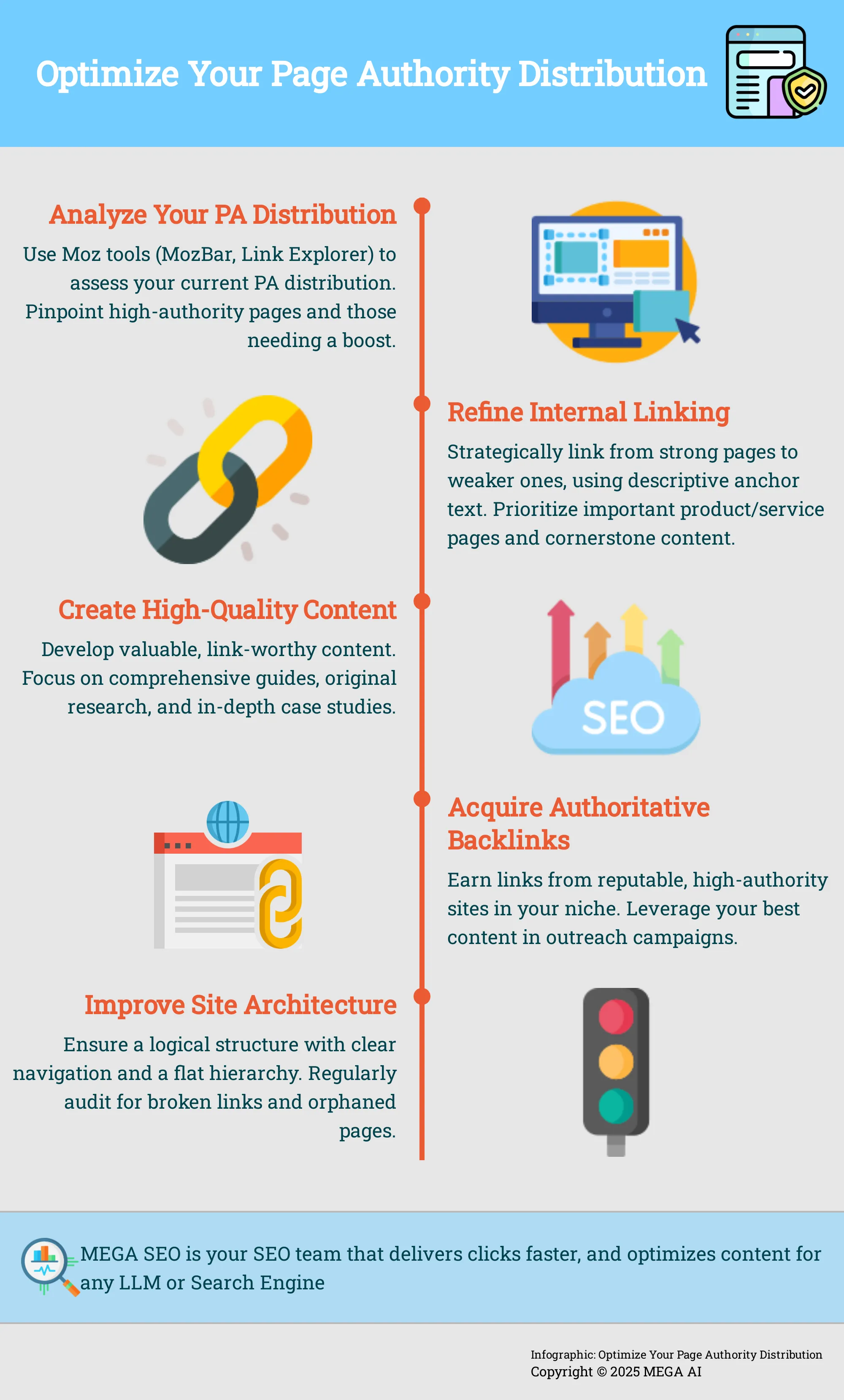
Optimizing your Page Authority distribution is about strategically guiding link equity throughout your website to improve the authority of key pages. It’s not about getting one page to a high score, but about creating a strong, interconnected site where authority flows logically. This process involves a mix of on-page and off-page SEO tactics that work together to signal to search engines which pages are most important. When done correctly, a well-distributed Page Authority can lead to better indexation, higher rankings, and more organic traffic.
The core of this strategy lies in four key areas. First, you need a smart internal linking plan to direct authority where it’s needed most. Second, creating high-quality, linkable content is essential for attracting both internal links and valuable external backlinks. Third, you must actively acquire authoritative backlinks from reputable sources to bring new authority into your site. Finally, all of this needs to be supported by a clean and logical site architecture that allows search engine crawlers to move through your site efficiently. By focusing on these four pillars, you can build a powerful network of pages that support each other and strengthen your site’s overall performance.
Refine your internal linking structure
Your internal linking structure is the primary tool for distributing Page Authority across your site. Think of it as a system of roads that guides both users and search engine crawlers to your most important content. By strategically linking from high-authority pages (like your homepage or popular blog posts) to pages you want to improve, you pass some of that authority along. As WDD notes, "By strategically linking to important pages within your site, you can enhance their visibility and authority."
To do this effectively, use descriptive anchor text that tells search engines what the destination page is about. Avoid generic phrases like "click here." Instead, use keywords relevant to the linked page. A well-planned internal linking strategy ensures that no page is left isolated and that link equity flows to your priority pages, helping them get indexed and rank higher. MEGA AI's SEO platform can automate this process, identifying opportunities and building links to ensure authority is distributed optimally.
Create high-quality, linkable content
Content is the foundation of any successful SEO strategy, and it’s crucial for earning the links that build Page Authority. High-quality content acts as a magnet for both internal links from your own team and, more importantly, external backlinks from other websites. According to Tely, "High-quality, linkable content not only attracts backlinks but also improves overall page authority." This means creating content that is so valuable people naturally want to reference and share it.
Focus on developing cornerstone content, such as comprehensive guides, original research, or in-depth case studies. These "pillar pages" serve as authoritative hubs on a topic, making them prime targets for backlinks. When you create expert-level material, you establish your site as a credible source, which encourages others to link to you. MEGA AI’s content generation tools can help you produce this type of authoritative content at scale, giving you the assets needed to attract valuable links.
Acquire authoritative backlinks
While internal links distribute the authority you already have, external backlinks bring new authority to your site. Acquiring links from reputable, high-authority websites is one of the most powerful ways to increase your Page Authority. As The HOTH explains, "...if you want to rank on the first page of Google, you will first need to begin your link building journey and build backlinks from authority sites." A single link from a trusted industry publication can be more impactful than dozens of links from low-quality sites.
Focus your efforts on earning links from websites that are relevant to your niche and have strong authority scores themselves. You can achieve this through various link-building strategies, such as guest blogging, digital PR, or reaching out to sites that have mentioned your brand but haven't linked to it. The high-quality content you create serves as the perfect asset to offer in these outreach campaigns, making it easier to secure valuable placements.
Improve site architecture
Your website's architecture is the blueprint that determines how easily search engines can find and index your content. A logical, well-organized structure ensures that link equity can flow from your homepage to your most important pages in just a few clicks. According to AgencyAnalytics, "A well-structured site architecture facilitates better distribution of page authority." If your key pages are buried deep within your site, they will receive less link equity and may struggle to rank.
Aim for a flat site architecture where no page is more than three or four clicks away from the homepage. Use clear navigation menus, breadcrumbs, and a logical URL structure to help both users and crawlers understand the hierarchy of your site. Regularly auditing your site for broken links or orphaned pages is also critical for maintaining a healthy flow of authority. MEGA AI’s technical SEO features can help you analyze your site structure and identify issues that could be hindering Page Authority distribution.
Common Page Authority distribution challenges
Even with the best intentions, distributing Page Authority effectively across your site can be tricky. Several common website issues can act like dams, blocking the flow of link equity and preventing important pages from getting the authority they need to be indexed and ranked. Addressing these challenges is fundamental to a strong SEO strategy, ensuring that search engines can find and value all of your important content. By understanding these potential roadblocks, you can take proactive steps to keep your site’s authority flowing freely.
Fix orphaned pages and duplicate content
Orphaned pages are pages on your site that have no internal links pointing to them. Because crawlers follow links to discover content, these pages are often invisible to search engines and users alike, trapping any Page Authority they might have. By monitoring changes in page authority distribution patterns, you can identify orphaned pages that lack sufficient internal links, which can hinder their indexation. Similarly, duplicate content can dilute your authority by forcing search engines to choose between multiple identical or near-identical pages, splitting the link equity among them. Regularly auditing your site for these issues and building a smart internal linking strategy is crucial for consolidating and directing your Page Authority effectively.
Manage pagination and infinite scroll
Features like pagination (e.g., page 1, 2, 3 of a blog archive) and infinite scroll are great for user experience but can create headaches for SEO if not handled correctly. Effective internal linking is vital for managing pagination and infinite scroll, which can complicate how page authority is distributed across a site. Without proper signals like rel="next/prev" tags or a "view all" page, crawlers might see paginated pages as a series of thin, low-value pages. This can trap authority on the first page and prevent crawlers from discovering content buried deep within your site’s structure. A clear strategy for these features ensures that link equity flows through to older posts or products.
Balance authority between new and existing pages
A common challenge is deciding how to distribute authority between brand-new content and your established, high-performing pages. You want to give new pages enough of a push to get indexed and start ranking, but you don’t want to siphon too much authority away from your cornerstone content. Reviewing past Page Authority scores alongside key metrics like rankings and traffic makes it easier to determine the support new pages need. A strategic approach involves updating older, relevant articles to link to your new content. This not only passes authority but also keeps your existing content fresh and relevant, creating a symbiotic relationship that benefits your entire site.
How to analyze your Page Authority distribution
Analyzing your Page Authority distribution isn't about checking the score of a single page. It’s about mapping out how authority flows across your entire website. This process helps you see which pages are hoarding link equity, which ones are being starved, and how effectively your internal linking strategy is working. Think of it as creating a heat map of your site's authority, showing you exactly where the power is concentrated.
Page Authority is best used as a comparative metric, not an absolute score. When you analyze its distribution, you can compare pages within your own site to identify which ones have stronger link profiles and are more likely to rank. This analysis reveals opportunities to pass authority from high-PA pages to those that need a lift, such as new blog posts or important product pages. By understanding these patterns, you can make strategic decisions to improve your site’s overall SEO performance and ensure search engines can easily find and index your most valuable content.
Tools for measuring Page Authority
To start your analysis, you need the right data. The most direct way to check Page Authority is by using tools developed by Moz, the creator of the metric. You can use the MozBar, a browser extension that displays PA scores as you browse, or dive deeper with their Link Explorer tool for a more comprehensive view of your site's link profile. These tools provide the raw numbers for each page on your site.
Once you have this data, you can export it into a spreadsheet to sort and visualize the distribution. This allows you to quickly identify your highest-authority pages and find any low-authority outliers or orphaned pages. For digital marketing agencies, tracking and reporting on PA improvements over time is a powerful way to demonstrate the value of your SEO services to clients. It provides a tangible metric that shows your strategies are successfully strengthening their website.
How to set up effective monitoring
A one-time analysis is useful, but continuous monitoring is what drives long-term success. Setting up a system to track your Page Authority distribution over time allows you to measure the impact of your SEO efforts, such as changes to your internal linking or new backlink campaigns. By monitoring these patterns, you can see if your strategies are effectively distributing authority to the pages that matter most.
If you’re unsure what to aim for, look at your historical data. Reviewing past PA scores alongside key performance indicators like SERP rankings and organic traffic can help you set realistic targets. For example, you might find that pages with a PA above 40 consistently rank on the first page for your target keywords. This insight turns an abstract metric into an actionable goal. Regular monitoring helps you stay proactive, allowing you to adjust your strategy and maintain a healthy site structure with tools that provide ongoing SEO optimization.
How to maintain a healthy Page Authority distribution
Maintaining a healthy Page Authority distribution isn’t a one-time fix; it’s an ongoing process. Think of it as regular maintenance for your website’s SEO health. It requires a consistent cycle of auditing your content, refining your internal linking, and ensuring your site offers a fantastic user experience. When you actively manage how authority flows through your site, you guide search engines to your most important pages and help them understand your site's structure. This proactive approach allows you to adapt to algorithm changes and keep your site performing at its best, supporting both your business goals and your users' needs.
Conduct regular content audits and updates
A content audit is your chance to see what’s working and what isn’t. By regularly reviewing your pages, you can identify content that has high authority but isn't driving conversions, or find pages that could perform much better with a few updates. Reviewing past Page Authority scores alongside your key metrics like SERP ranking and organic traffic helps you see what's needed to increase keyword rankings and hit your targets. This process helps you find opportunities to refresh older posts with new information or consolidate weak pages, ensuring your content remains valuable. MEGA AI's SEO tools can even automate this process, identifying which articles to update for better performance.
Implement a strong internal linking strategy
Your internal linking structure is one of the most powerful tools you have for guiding Page Authority. A smart strategy involves linking from your high-authority pages—like your homepage or popular blog posts—to pages you want to improve, such as new product pages or important service pages. One of the key benefits of internal linking is its direct impact on page authority. By monitoring changes in your site's authority distribution, you can see how your linking strategy is affecting your overall visibility. This practice helps spread authority more evenly, preventing it from getting stuck on just a few top-level pages and ensuring deeper pages get the recognition they deserve.
Focus on user experience and site speed
A positive user experience is fundamental to maintaining Page Authority. Search engines prioritize sites that are fast, easy to use, and mobile-friendly. If visitors land on your page and immediately leave because it’s slow to load or difficult to use, it sends a negative signal that can harm your rankings over time. By focusing on creating a seamless experience, you encourage visitors to stay longer and engage with your content. This includes building out foundational content like pillar pages that not only attract traffic but also guide visitors through your site, improving both user satisfaction and your site’s authority.
How to use Page Authority for better indexation
Understanding your site's Page Authority distribution is more than just a numbers game. It’s about having a clear roadmap to guide search engines to your most important content, ensuring it gets indexed and ranked. By strategically using Page Authority insights, you can take control of how search engines perceive and crawl your site, leading to better visibility and performance. Here’s how you can put this knowledge into action.
Prioritize high-value pages
First, identify your most important pages—these are typically your core product or service pages, or cornerstone blog content that drives conversions. Your goal is to funnel link equity to these high-value pages. A strong internal linking strategy is your best tool for this. By linking from pages with higher PA to these priority pages, you're essentially telling search engines, "Hey, this page is important." You can gauge the impact of your internal linking by monitoring how Page Authority shifts across your site over time. Regularly check that your most valuable content is receiving the internal link support it needs to maintain its authority and visibility in search results.
Optimize your crawl budget
Search engines don't have unlimited time to crawl every single page on your website. They allocate a "crawl budget" and prioritize pages they believe are most valuable. Pages with higher Page Authority are seen as more credible and are often crawled more frequently. This means any updates you make to these pages get noticed and indexed faster. You can use past Page Authority scores to back-calculate the authority needed to hit specific traffic or ranking goals. By focusing on improving the PA of key pages, you’re not just aiming for higher rankings; you’re also making your site more efficient for search engines to process, which is a win-win.
Increase your site's overall authority
Improving the Page Authority of individual pages creates a rising tide that lifts your entire site. The link-based factors that form the foundation of the Page Authority metric are closely tied to what search engines use to rank websites. By building strong pillar pages and content clusters, you create a well-organized site structure that naturally distributes authority. When you focus on creating high-quality, linkable assets, you attract backlinks that strengthen your entire domain. Using AI-powered tools like MEGA AI can help you enhance your pillar pages, ensuring they have the depth and internal linking needed to become authoritative hubs that support your entire SEO strategy.
What's next for Page Authority in SEO?
The world of SEO is anything but static. As search engines evolve, so do the metrics and strategies we use to measure and improve performance. Page Authority, while a durable indicator of a page's ranking potential, is also influenced by these shifts. Staying ahead means understanding how major algorithm updates affect authority and embracing new trends that can give you an edge. The core principles of creating valuable content and building quality links remain, but the methods for achieving this are constantly being refined. Looking forward, the focus is shifting towards a more holistic view of authority, where individual page strength contributes to a broader topical relevance that search engines are increasingly prioritizing.
The impact of algorithm updates
Google's algorithm updates can feel like a constant curveball, changing the rules of the game overnight. While Page Authority is a Moz metric, not a Google one, its calculation is designed to mirror what Google values. When an update rolls out, you might see fluctuations in your rankings and, consequently, your PA scores. The key is to analyze what the update prioritized. Reviewing your past Page Authority scores alongside your main KPIs like organic traffic and conversion rates helps you understand what it takes to hit your targets. This is where AI-powered tools become invaluable. For instance, MEGA AI's Maintenance Agent can automatically re-optimize your content after an update, ensuring it aligns with the new standards and helping you recover or even improve your rankings.
Emerging optimization trends
One of the most significant trends is the move toward building topical authority. Instead of just focusing on individual keywords, the goal is to be seen as a comprehensive resource on a whole subject. This is where pillar pages come in. Pillar pages are indispensable for modern SEO, acting as a central hub for a topic and linking out to more detailed cluster pages. This structure creates a powerful internal linking web that effectively distributes Page Authority. Utilizing AI to generate expert-level material and perform targeted SEO research can help you build these resources efficiently. With MEGA AI, you can automate the content generation for both your pillar and cluster pages, ensuring you cover a topic thoroughly and establish your site as an authority.
Related Articles
- Domain Authority: The Ultimate Guide (2023)
- Enhancing the Authoritativeness of Your Site Through Effective SEO Practices - MEGA SEO | Blog
- PageRank Sculpting: Boost Key Pages With Smart Linking
- Internal Links: Boost Crawling & Indexing for SEO
- Mastering the Art of SEO-Friendly Content: Best Practices for Internal and External Linking - MEGA SEO | Blog
Frequently Asked Questions
If Google doesn't use Page Authority, why should I care about it? That's a great question. While it's true that Page Authority is a metric from Moz, not Google, its value lies in what it measures. The score is calculated based on factors like the quality and quantity of backlinks, which are things Google absolutely cares about. Think of Page Authority as a reliable proxy that helps you track your progress on the foundational SEO work that does lead to better rankings and more traffic.
What's the difference between Page Authority and Domain Authority? It's easy to mix these two up. Page Authority (PA) predicts the ranking strength of a single, specific page on your website. In contrast, Domain Authority (DA) predicts the ranking strength of your entire website or domain. A strong site can have a high DA, but if an important product page has no internal or external links pointing to it, its individual PA score could still be quite low.
Is it enough to just have a high Page Authority score on my homepage? Focusing only on your homepage's authority is a common mistake. A high PA score on your homepage is a fantastic asset, but if that authority isn't shared with the rest of your site, its power is limited. Through strategic internal linking, you can distribute that strength to your important product, service, and content pages, giving them the support they need to rank for their own keywords.
What's the most effective first step to improve my site's Page Authority distribution? The best place to start is by refining your internal linking structure. This is something you have complete control over. Begin by identifying your pages with the highest authority and then find relevant opportunities to link from them to other important pages that need a lift. This simple action starts creating pathways for authority to flow throughout your site.
How long does it typically take to see an increase in Page Authority? Improving Page Authority is a marathon, not a sprint. Because the score is heavily influenced by earning backlinks from other sites and giving search engines time to recognize those links, you won't see changes overnight. With consistent effort in creating quality content and building a strong link profile, you can typically expect to see meaningful improvement over the course of several months.