
Many website owners focus on acquiring backlinks to build authority, which is important. However, the way authority is spread within your own site through internal linking is an equally powerful, yet often underutilized, aspect of SEO. Each link can act as a conduit, sharing strength from one page to another. This article delves into the benefits of page authority distribution for improved site authority? and provides actionable steps to ensure your internal linking strategy effectively channels strength to your most important content, helping more of your pages perform better in search.
Key Takeaways
- Understand Page Authority: Use this page-specific score to pinpoint which content is performing well and where to direct your SEO efforts for better ranking predictions.
- Spread Authority with Smart Linking: Strategically use internal links to channel strength from your high-performing pages to others, improving overall site visibility and structure.
- Prioritize Quality Content and User Experience: Develop valuable content that earns links and ensure your site is user-friendly, as these are fundamental to boosting Page Authority and site success.
What is Page Authority and Why Should You Care?
If you're looking to improve how your website performs in search results, understanding Page Authority is a really helpful step. It’s one of those metrics that, once you get a handle on it, can truly help you focus your SEO efforts where they matter most. Think of Page Authority as a way to predict how well a specific page on your site is likely to rank when someone searches for relevant terms. For anyone aiming to get their content in front of a larger audience, learning about Page Authority is definitely worthwhile. It gives you a clearer picture of which pages are performing strongly and which ones might need a bit more attention to start climbing those search engine rankings. This insight is valuable for making informed decisions about your content strategy and link-building activities.
Page Authority: Let's Break It Down
So, what exactly is Page Authority? In simple terms, Page Authority (PA) is a score that predicts how well a specific page on your website will rank on search engine result pages (SERPs). This scoring system, which ranges from one to 100, was developed by Moz, a well-known name in the SEO industry. A higher Page Authority score suggests a greater ability for that page to achieve good rankings. For example, a page with a PA of 70 is generally expected to rank better than a page with a PA of 30.
It’s important to remember that Page Authority is specific to each individual page. This means your homepage, a blog post, or a product page will each have its own unique score. This level of detail is incredibly useful because it allows you to identify which individual pages are your SEO powerhouses and which ones could benefit from some optimization.
Page Authority vs. Domain Authority: What's the Difference?
You might have also come across the term Domain Authority (DA), and it's quite common to mix these two up. The main distinction lies in their scope: Page Authority measures the predictive ranking strength of a single, specific page, whereas Domain Authority assesses the strength of your entire website or domain. Both scores are calculated using similar factors and are valuable for understanding your site's overall online presence and its potential to rank in search results.
Consider it this way: Domain Authority is like the overall reputation of a well-regarded publication, while Page Authority is akin to the credibility and impact of a single, standout article within that publication. Both metrics are important, but they offer different perspectives. Knowing both your PA and DA provides a more complete view of your SEO landscape, helping you strategize more effectively for individual content pieces as well as your site as a whole.
How Page Authority Influences Your Search Rankings
Now, let's discuss why Page Authority truly matters for your website. A higher Page Authority score generally indicates that your page has a better chance of appearing higher up in search engine results. When your page secures a better ranking, more people are likely to see it, which can lead to a noticeable increase in website traffic. For many businesses and content creators, this increased visibility is a primary objective, as it means more potential customers, readers, or clients discovering what you offer.
Essentially, Page Authority serves as a strong indicator of a page's ability to compete effectively in search results. Pages with higher authority are often perceived as more credible and relevant by search engines. This is why understanding Page Authority is so vital for your website's success; improved rankings directly translate into more eyes on your content and, consequently, more opportunities for engagement and conversions. By focusing on enhancing the authority of your key pages, you are actively working to attract more organic traffic to your site.
How Does Page Authority Spread Across Your Site?
Understanding how page authority moves through your website is quite important for improving your site's overall SEO performance. It’s not just about having a few strong pages; it’s about how that strength is shared and distributed to lift your entire site. When authority flows effectively, search engines can better understand the importance and relevance of your content, which can lead to improved visibility in search results. This means more eyes on your pages and, ultimately, more opportunities for your business.
See How Authority Flows Through Your Website
Think of page authority like a current that flows through your website. This current, often called "link juice," is primarily directed by your internal links. When a page on your site that has accumulated some authority links to another page on your site, it passes a portion of that authority along. This process helps search engines figure out the relative importance of pages within your domain.
A well-structured internal linking strategy ensures that this authority doesn't just pool on a few pages. Instead, it's distributed to other relevant pages, including newer content or deeper pages that might otherwise be harder for search engines to find and value. This flow helps to strengthen the SEO of individual pages and your site as a whole, making your content more discoverable.
Link Equity: What It Is and Why It Matters
Link equity is essentially the value or authority that one page passes to another through a hyperlink. It's important to remember that not all links pass the same amount of equity. Links from high-authority, relevant pages generally pass more value than links from low-authority or irrelevant pages. This concept applies to both internal links (links within your own website) and external links (links from other websites to yours).
Why does this matter so much? Because the amount of link equity a page accumulates directly influences its ability to rank in search engine results. Pages with higher link equity are often seen as more credible and important by search engines. Effective internal linking is crucial for distributing this equity efficiently across your site, ensuring that important pages receive the authority they need to perform well and attract organic traffic.
Distributing Authority: Internal vs. External Links
Both internal and external links play vital roles in how authority is distributed, but they function differently. Internal links are your primary tool for spreading existing authority throughout your own website. When you link from one page on your site to another, you're guiding search engine crawlers and distributing page authority. This helps search engines discover new content and understand the hierarchical structure and topical relevance of your pages.
External links, or backlinks, are links from other websites to yours. These are powerful because they bring new authority into your site from external sources, acting like votes of confidence. While internal links redistribute the authority your site already has, external links increase your site's overall authority pool. A balanced strategy involves acquiring quality external links and then using smart internal linking to spread that newly acquired authority to relevant pages across your site, creating a stronger overall presence.
Why Effective Page Authority Distribution is a Game-Changer
Understanding how page authority works is one thing, but seeing how its smart distribution can transform your website's performance is where things get really exciting. When you actively manage how authority flows through your site, you're not just tweaking a few numbers; you're setting the stage for significant SEO improvements. This isn't about quick fixes, but about building a resilient and authoritative online presence. Effective distribution means every part of your site works harder for you, helping search engines understand your content's value and, in turn, showing it to more of the right people. For businesses, especially startups and small enterprises looking to make their mark, getting this right can mean the difference between being found and being lost in the digital crowd. Let's look at the specific ways this can make a real difference to your site's visibility and success.
Strengthen Your Overall Site Authority
Think of your website as a connected network. When you strategically use internal links, you're essentially creating pathways for authority to flow from your stronger pages to those that might need a little help. This process helps distribute authority across your entire site. As a result, you can improve the performance of pages that aren't doing so well by sharing some of the "link equity" from your star performers. This doesn't just lift individual pages; it strengthens your website's authority as a whole. A site with well-distributed authority is seen as more credible and valuable by search engines, which can lead to better rankings across the board. It’s about making your entire digital ecosystem healthier and more robust, ensuring each piece of content contributes to your site's overall standing.
Get More Pages Seen in Search Results
If a page on your site isn't linked to from anywhere else, it's like an isolated island – hard for search engine crawlers and users to find. These are often called "orphaned pages." Effective page authority distribution, primarily through a smart internal linking strategy, ensures that these pages become discoverable. When search engines can easily crawl your site and find all your content, they get a better picture of what your site is about. Pages that are well-connected are more likely to be indexed and, consequently, have a chance to appear in search results. Without these internal connections, some of your valuable content might remain invisible, providing no way for users or search engines to discover more of your related material, which is a missed opportunity for engagement and conversions.
Drive More Organic Traffic
Ultimately, a key goal for any website is to attract more visitors, and effective page authority distribution plays a direct role here. When you strategically place internal links, you're not just helping search engines; you're also guiding your users to relevant content, improving their experience. This improved user experience, combined with better site architecture, signals to search engines that your site is valuable and user-friendly. As Content Whale notes, this approach can improve SEO and create a well-organized site. Better SEO and a positive user journey naturally lead to higher rankings for relevant keywords, which in turn drives more organic traffic to your website. It’s a cycle where good structure supports better visibility, leading to more visitors and potential customers.
Make Every Link Count: Maximize Link Equity
Link equity, sometimes called "link juice," is the value or authority that one page passes to another through a link. When a page with high authority links to another page on your site, it essentially vouches for that page, passing along some of its own strength. According to Mailchimp, when a high-authority page links internally, it passes some of that authority to the linked page. By being mindful of how you distribute this authority, you can ensure that your most important pages receive the equity they need to rank well. This means strategically linking from your high-authority pages (like your homepage or popular blog posts) to other key pages you want to perform better. It’s about making sure every internal link serves a purpose in strengthening your site and guiding both users and search engines effectively.
Smart Ways to Optimize Page Authority Distribution
Knowing how page authority works is a solid start. The next step is to actively guide how that authority spreads throughout your website. Picture it like a well-planned garden hose ensuring water reaches every plant, not just the ones closest to the tap. When you thoughtfully distribute page authority, you can really strengthen your site's overall SEO.
This involves a few key actions working in concert. You'll want to build a strong internal linking structure so authority can flow easily. It’s also about creating content that naturally draws in links from other reputable sites and being intentional with the external links you pursue. Plus, it’s important to think about how you share authority between brand-new articles and your established, high-value pages. Focusing on these areas helps more of your content get seen in search results, which can drive more organic traffic your way. Let's look at some practical methods.
Build a Solid Internal Linking Foundation
A smart internal linking plan is one of your best tools for spreading page authority. Internal links are simply links from one page on your site to another page on your own site. When a page with more authority links to another page on your domain, it shares some of that authority—often called 'link equity.' As Mailchimp explains, these "internal links play a role in distributing authority... across a website."
Imagine your site as a connected web. Good internal linking prevents authority from just sitting on your homepage or main service pages. Instead, it helps authority reach your blog posts, product details, and other useful resources. PageTraffic rightly points out that "Effective internal linking enhances your site's architecture and can improve your search engine rankings by distributing page authority across your site." This helps search engines see how your content connects and makes your site easier for visitors to use.
Create Content That Earns Links
Internal links move existing authority around, but you also want to bring new authority to your site. The most effective way is by producing top-notch, original content that other websites naturally want to reference—this is "link earning." When respected external sites link to you, they share some of their authority, which can really improve your page's standing.
Think about crafting detailed research, thorough guides, or persuasive case studies. White Beard Strategies notes, "Case studies play an essential role in building relationships with your audience by providing tangible evidence of your expertise and success in solving real-world problems." This kind of content serves your readers and establishes your expertise, encouraging others to link to you. Linkstorm also mentions that content showing real results can "significantly enhance your Page Authority."
Strategically Build External Links
Alongside creating link-worthy content, actively building external links offers significant benefits. This means finding relevant, high-authority websites in your field and seeking opportunities for them to link to you, perhaps through guest posts or collaborations.
The important word here is "strategically." Your goal isn't just a high number of links; it's about getting links from trustworthy sources. As Linkstorm points out, "High DA benefits all pages on a website, helping identify high-authority sites for guest posting campaigns." One link from a respected site is far more valuable than many links from low-quality ones. Concentrate on forming relationships with established names in your industry to earn backlinks that truly add to your site's authority. This thoughtful approach to your backlink profile is key to a strong SEO strategy.
Balance Authority: New vs. Existing Content
As your site expands with new articles and updates to older ones, it's vital to spread page authority effectively between them. New content often needs an initial authority lift, while your established pages might have plenty of authority to share. Internal linking is key to managing this.
WDD highlights that "Properly implemented internal linking allows websites to account for two essential ranking factors: page authority and relevance." When you publish something new, find relevant, high-authority existing pages to link from. Also, make sure your new pieces link back to important older content. This helps create a balanced authority flow. Content Whale advises, "By strategically placing internal links within your content, you can boost SEO, enhance the user experience, and create a well-organized site architecture." Regularly checking your internal links ensures authority is well-distributed.
How to Measure Page Authority: Tools and Metrics
Knowing how to measure Page Authority and interpret the scores is key to understanding how search engines view your pages. Let's explore the tools, essential metrics, and how to make sense of PA scores to inform your SEO strategy.
Top Tools for Measuring Page Authority
You have several good options for checking a page's authority. Moz, the company that developed Page Authority, provides free tools such as Link Explorer and the MozBar browser extension. These are excellent starting points for viewing the PA score of any page you're analyzing. Beyond Moz, comprehensive SEO platforms like Ahrefs, SEMrush, and Majestic also feature Page Authority or their own similar metrics to evaluate page-level link strength. While the exact calculations might differ slightly if a tool uses its own specific metric, their common goal is to provide a score that reflects a page's potential to rank. Using one or a combination of these tools will equip you well for tracking this key metric.
Essential Metrics for Tracking Page Authority
Page Authority is a score, but its real value lies in its impact on other key performance indicators (KPIs). A higher PA often means a page can rank better in search results. This can lead to more organic traffic for that page. Review PA scores alongside metrics like search rankings for target keywords, organic traffic volume, and conversion rates for pages with specific actions. Tracking these together helps you see correlations and understand how improving PA can influence your broader SEO goals. For example, a rising PA with better rankings and more traffic signals your efforts are working.
Making Sense of Page Authority Scores
Page Authority scores range from 1 to 100; higher scores suggest a stronger ability to rank. However, there's no universal 'good' PA score. A strong PA is relative, depending on your industry and competitors' authority. Instead of focusing on a specific number, it's better to analyze the PA scores of pages already ranking well for your target keywords. This provides a relevant benchmark for your niche. If top pages have PAs in the 40s, aiming for a similar score for your content is a sensible goal. View PA as a comparative metric to guide strategy, not an absolute measure of success.
Common Hurdles in Page Authority Distribution
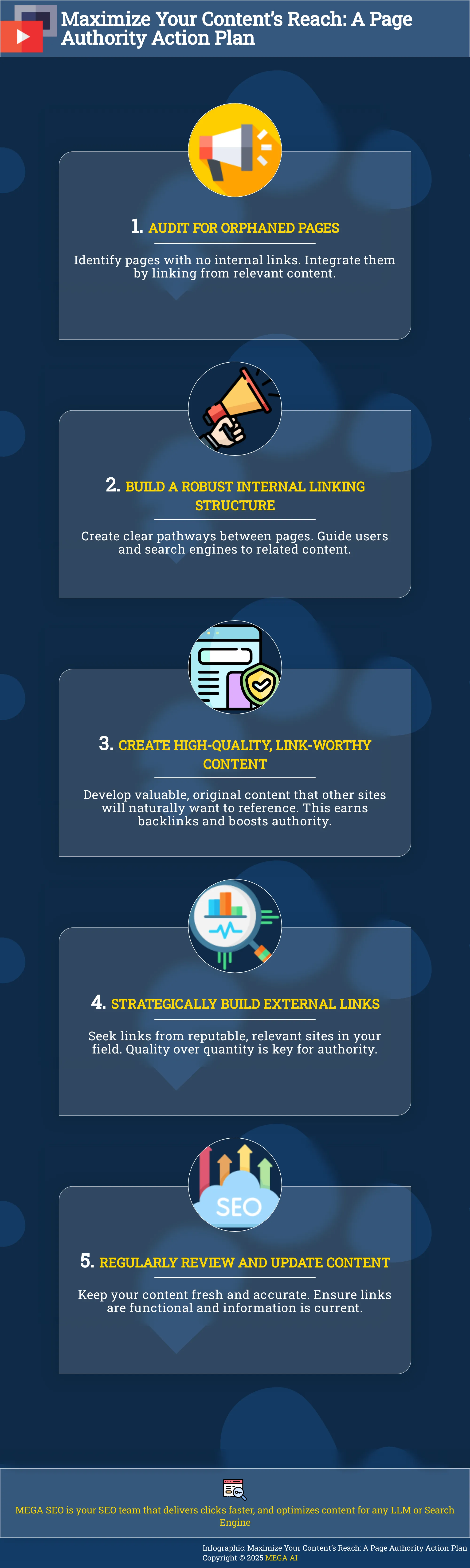
Effectively distributing page authority across your site is a smart goal, but actually making it happen can bring up a few common challenges. Knowing what these potential roadblocks are is the first step to navigating around them. This way, you can ensure your site’s authority flows smoothly to the pages where it will make the biggest impact. Let's explore some typical hurdles you might encounter.
Tackling Orphaned Pages
Orphaned pages are essentially digital islands—they exist on your site but have no internal links pointing to them. As the team at LinkVector puts it, "Pages without any internal links are dead-ends, providing no way for users or search engines to discover more of your related content." This means any authority these pages might have, or could potentially build, stays isolated. Search engine crawlers can easily miss them, and your visitors won't stumble upon them while browsing.
To address this, it's a good practice to regularly perform site audits to uncover these disconnected pages. Once you find them, you can weave them back into your site's fabric by linking from relevant parent pages or related articles. Using tools that offer automated internal linking can be a real time-saver here, helping to prevent pages from becoming orphaned in the first place.
Prevent Authority Dilution
It’s not just about the quantity of links; the quality and relevance are crucial. Linking without a clear strategy can actually dilute your page authority instead of strengthening it. Mailchimp highlights this well: "One of the most common mistakes in internal linking is ignoring the relevance of the links. Ensuring that internal links are contextually relevant helps maintain the authority of the pages involved." When you link to pages that aren't closely related, you can send mixed signals to search engines about your content's main topic, potentially weakening the authority passed along.
Your focus should be on creating internal links that genuinely add value for your reader and make sense in context. Each link should have a clear purpose, guiding both users and search engines to further relevant, valuable information. This thoughtful approach helps preserve and properly channel link equity throughout your site.
Smart Distribution Across Different Page Types
Your website likely consists of various kinds of pages—blog posts, product descriptions, service pages, and perhaps some in-depth cornerstone articles. Distributing authority effectively means understanding how these different page types can support each other. As PageTraffic notes, "Effective internal linking enhances your site's architecture and can improve your search engine rankings by distributing page authority across your site."
Think strategically about your internal linking to ensure your most important pages receive the authority they deserve. For example, your high-value cornerstone content should be well-supported with links from related blog posts and other relevant pages. This helps to "create a well-organized site architecture that benefits both users and search engines," as Content Whale aptly describes. Pinpoint which pages are most critical to your business objectives and ensure your linking strategy actively supports their visibility and authority. Platforms that provide SEO optimization tools can be very helpful in identifying these strategic linking opportunities.
Keep Your Site Authority Strong: Best Practices
Maintaining and growing your site's authority isn't a one-time task; it's an ongoing commitment. Think of it like tending a garden – consistent care yields the best results. By adopting a few key practices, you can ensure your website remains a trusted resource in the eyes of both users and search engines. These efforts help your pages rank well and attract valuable organic traffic, contributing significantly to the long-term health and success of your online presence.
Regularly Audit and Update Your Content
Your content forms the foundation of your site's authority. To keep it strong, it's essential to treat your articles and pages as living documents. As experts point out, "High-quality, in-depth, and unique content is key to attracting links and user engagement. Regularly updating content is also important." Set a schedule to periodically review your existing content, ensuring information is current, links are functional, and the material still resonates with your audience. Fresh, accurate content not only satisfies users but also signals to search engines that your site is actively maintained and valuable. This consistent effort helps pages retain and even increase their authority over time.
Continuously Manage Your Link Profile
Your website's link profile, encompassing both internal links between your own pages and external links from other sites, plays a crucial role in how authority is distributed. It's well understood that "Internal links contribute to a website's SEO by distributing page authority throughout the site." This means when one page gains authority, it can pass some of that strength to other pages through thoughtful internal linking. Regularly examine your internal linking structure to ensure you’re effectively channeling authority to your most important pages. Also, keep an eye on your backlink profile. While you can't fully control who links to you, understanding your backlink sources helps you gauge the quality of your incoming link equity.
Adapt to Search Engine Updates
Search engines are constantly refining their algorithms to provide users with the best possible results. While "only Google knows its own algorithms and controls its own SERPs," staying informed about major updates and adhering to established best practices is key. When an update occurs, focus on understanding its core intent, which usually revolves around content quality, user experience, and expertise. Rather than making drastic, reactive changes, ensure your site consistently offers valuable, user-focused content. Tools that help re-optimize existing content can be particularly useful for adapting to these shifts and maintaining your rankings, ensuring your material stays fresh and relevant.
Align Page Authority with Your Overall SEO Strategy
Page Authority is more than just a standalone metric; it’s a tool that should directly support your broader SEO and business objectives. It's helpful to connect improvements in Page Authority to tangible outcomes for your site. As industry analysis suggests, "Reviewing past Page Authority scores alongside achieved KPIs like SERP ranking, organic traffic, and conversion rates makes it easier to back-calculate the required Page Authority to increase keyword rankings, improve organic traffic, and hit revenue targets." By tracking Page Authority in conjunction with your main key performance indicators, you can better understand its impact and refine your SEO strategy to achieve meaningful results for your business.
What's Next for Page Authority in SEO?
Understanding Page Authority is valuable, but the digital landscape is always shifting. Staying informed about how authority metrics are evolving and how search engines might adjust their evaluations will help you keep your SEO strategy effective. It’s about building a resilient site that can adapt to future changes.
New Trends in Authority Metrics
While specific scores like Moz's Page Authority offer a useful benchmark, the trend is towards a more holistic view of a page's influence. Think of PA as a comparative tool, not an absolute score; it helps you see how one page's link profile stacks up against another. We're looking beyond a single number to grasp a page's real value.
Instead of fixating on one metric, the focus is broadening to signals that indicate true value and trustworthiness. If benchmarks aren't clear, reviewing your site's historical PA data alongside KPIs like rankings and traffic can help you set realistic targets for improvement. This approach offers a more nuanced understanding of authority's role in SEO success.
How Search Engines Might Change Page Authority Evaluation
Search engines like Google constantly refine their algorithms to better understand content. While the exact formulas are secret, they're clearly getting smarter at identifying genuine authority and quality. This means assessing not just backlinks, but their context, the content's expertise, and user experience. Only Google truly knows its algorithms, but we observe evolving patterns.
We anticipate greater emphasis on signals difficult to manipulate, like E-E-A-T (Experience, Expertise, Authoritativeness, Trustworthiness). Consistently improving Page Authority through legitimate SEO practices helps your rankings and demonstrates the quality of your optimization efforts, which is a positive signal for any business.
Prepare Your Site for What's Ahead
To prepare for future changes in Page Authority evaluation, focus on building a fundamentally strong website. Start by creating high-quality, original content that genuinely serves your audience. Valuable content naturally attracts links and engagement, key components of authority.
Effective internal linking is also crucial. By carefully planning these links, you guide users and search engines, ensuring important pages get attention. This practice enhances site architecture and can improve rankings by distributing page authority effectively. Prioritizing user experience—easy navigation, speed, mobile-friendliness—also boosts perceived quality and authority.
Better User Experience Through Smart Page Authority Distribution
Distributing page authority effectively does more than just please search engines; it directly shapes how people experience your website. When you spread authority thoughtfully, users can move through your site more easily and find exactly what they're looking for. This isn't some obscure technical detail—it's fundamental to creating a site that feels intuitive and helpful. A well-structured site, where authority flows logically, means visitors are less likely to get frustrated or lost. Instead, they'll
Help Users Find Content Easier
Imagine walking into a store where nothing is labeled, and items are scattered randomly. Frustrating, right? Your website can feel the same if users can't easily find what they need. Smart internal linking, a key part of distributing page authority, acts like clear signage. When a page with good authority links to another relevant page, it’s not just passing SEO value; it’s telling visitors, 'If you found this useful, you’ll probably like this too.' As Mailchimp notes, these internal links guide users to discover related content more easily. This creates an intuitive journey where users feel understood and efficiently find information. They spend less time searching and more time engaging with your content, leading to a more satisfying and productive visit for them.
Deliver More Relevant and Valuable Content
Your visitors aren't just looking for any content; they want information that’s truly relevant and valuable to their specific needs, and they usually want it quickly. Effective page authority distribution is vital here. When your site’s architecture is well-organized, with authoritative pages strategically linking to other key pieces of content, you’re essentially leading users to your most helpful material. They are far more likely to land on pages that directly address their questions or solve their problems. As PageTraffic points out, this kind of thoughtful internal linking ensures users find information that genuinely adds value to their visit. This not only keeps them engaged but also helps establish your site as a reliable and authoritative resource in their minds.
Quicker Pages with Optimized Links
A slow website is a quick way to lose visitors. If pages take too long to load, people often click away before your valuable content even appears. Optimized internal linking, a core component of distributing page authority, contributes to a much quicker user experience. A well-structured site with strategic links can improve page load times. Content Whale mentions that this kind of optimization creates a more seamless experience for users as they move through your site. Think of it as well-maintained pathways that allow for swift travel. Faster loading pages mean less frustration for your audience, which can reduce bounce rates and keep them on your site longer. Tools like MEGA AI's SEO platform can assist in refining your internal linking for both search engine performance and that smooth, fast experience users expect.
Related Articles
- Enhancing the Authoritativeness of Your Site Through Effective SEO Practices - MEGA SEO | Blog
- PageRank Sculpting: Boost Key Pages With Smart Linking
- Domain Authority: The Ultimate Guide (2023)
- Boost Your Site’s Authority with Effective SEO Practices
- Off-Page SEO Strategies: Mastering Link Building and Site Authority - MEGA SEO | Blog
Frequently Asked Questions
What's the simplest way to understand the difference between Page Authority and Domain Authority? Think of it like this: Domain Authority is like the overall reputation of your entire website, say, a popular magazine. Page Authority, on the other hand, is the credibility of a single article within that magazine. Both are important, but Page Authority gives you a focused look at how well an individual page might perform in search results.
Why is it so important how Page Authority is spread out across my website? When authority flows well through your site, usually thanks to smart internal linking, it helps search engines discover all your content and understand its importance. This means more of your pages have a better chance of showing up in search results, not just your homepage or a few star articles. It makes your whole site stronger.
What are a couple of practical things I can do to help my pages gain more authority? Two really effective actions are creating truly helpful, original content that others will want to link to, and building a strong internal linking structure. When you link related pages on your own site, you help share authority. And when other reputable sites link to your great content, that brings new authority in.
Is there a magic Page Authority number I should be trying to hit? Not really. Page Authority scores are best used for comparison rather than aiming for a specific number. Take a look at the Page Authority of sites that are already ranking well for the terms you're targeting. This gives you a more realistic benchmark for your own pages within your specific industry.
What's a common misstep when trying to manage Page Authority, and how can I avoid it? A frequent oversight is having "orphaned pages" – pages on your site that no other pages link to. This makes them hard for search engines and users to find, and any authority they might have stays isolated. You can avoid this by regularly checking your site for such pages and making sure to link to them from other relevant content on your site.