
Every business wants more conversions, but the path to getting them is not always clear. You can spend your budget on ads or focus on attracting new traffic, but what if you could get more value from the assets you already have? Your website's pages hold ranking potential, measured by a score called Page Authority. When you learn how to strategically spread this authority from your strongest pages to others, you create a powerful ripple effect. This process strengthens your entire site, improves visibility for key product pages, and builds trust with your audience. So, what are the benefits of page authority distribution for increased conversion rates? Let's explore how this strategy turns your SEO efforts into tangible business growth.
Key Takeaways
- Prioritize Quality Over Quantity: A high Page Authority score is built on relevant, high-quality backlinks and in-depth content. Focus on creating valuable resources that earn trust and links, rather than simply chasing a high link count.
- Strategically Distribute Authority: Use internal links to pass ranking strength from your strongest pages to other important ones. This improves the visibility of key product or service pages and strengthens your entire site.
- Connect Authority to Conversions: Use Page Authority as a guide to improve business results. Focus your efforts on pages with high conversion potential and ensure the content aligns with user intent to turn better rankings into more customers.
What Is Page Authority?
Page Authority, or PA, is a score developed by Moz that predicts how well a specific page on your website will rank on search engine result pages (SERPs). The score runs on a 100-point logarithmic scale, meaning it’s much easier to grow your score from 20 to 30 than it is to go from 70 to 80. A higher score corresponds to a greater ability to rank for relevant keywords.
It’s important to remember that Page Authority is not a metric used by Google in its algorithms. Instead, it’s a predictive tool designed to give you a sense of a page’s ranking strength based on dozens of factors, with the most influential being the quantity and quality of links pointing to that page. Think of it as a comparative metric. Rather than focusing on the absolute number, you should use PA to gauge your page’s strength against your competitors’ pages. This helps you understand the competitive landscape and set realistic ranking goals for your content.
Page Authority vs. Domain Authority
While Page Authority measures the strength of an individual page, Domain Authority (DA) measures the predictive ranking strength of your entire website. Think of your website as a library. Domain Authority is the reputation of the entire library, while Page Authority is the reputation of a single book on a shelf. A well-regarded library might give its books an initial advantage, but each book must ultimately build its own reputation.
A high DA provides a solid foundation, but each page still needs to earn its own authority through quality content and relevant backlinks. A comprehensive SEO strategy involves improving both, as a strong domain supports its pages, and strong pages contribute to the domain's overall authority.
How Page Authority Affects Conversion Rates
A high Page Authority score is more than just a number; it has a direct impact on your bottom line. The connection is straightforward: a higher PA often leads to better search engine rankings, which drives more organic traffic to your page. More traffic means more opportunities to convert visitors into customers.
The strategies used to improve PA—such as building high-quality backlinks, creating valuable content, and on-page optimization—are the same ones that build trust with your audience. When a visitor lands on a well-structured, informative page, they are more likely to view your brand as credible. This trust is essential for guiding them to take action, which is why efforts to improve ranking potential often lead to higher conversion rates.
What Influences Page Authority?
Page Authority isn't a metric you can directly control, but you can certainly influence it. Think of it as a grade for your page's overall strength and likelihood to rank in search results. Search engines look at a combination of signals to determine this score. Understanding these factors is the first step to strategically improving your pages' authority and, in turn, their performance. The key is to focus on creating a great experience for both users and search engine crawlers through a mix of quality links, excellent content, and a solid technical foundation.
Backlink Quality and Quantity
Backlinks are a cornerstone of Page Authority. When another website links to your page, it acts as a vote of confidence. However, not all votes are equal. A single, relevant link from a highly respected site in your industry carries far more weight than dozens of links from low-quality or irrelevant websites. Your goal should be to earn a healthy backlink profile built on quality over quantity. Focus on creating content so valuable that other authoritative sites want to reference it. This signals to search engines that your page is a trustworthy resource, directly contributing to its authority score.
Content Relevance and User Experience
High-quality, useful, and relevant content is essential. A page that thoroughly answers a user's question or solves their problem will naturally have higher authority. This means creating comprehensive content that keeps visitors engaged. When users spend more time on your page and don't immediately return to the search results, it sends positive signals to search engines. Tools like MEGA AI's Maintenance Agent can help by identifying new content to add to existing articles, ensuring they remain fresh, comprehensive, and highly relevant to what users are searching for.
On-Page SEO Elements
The way you structure your content matters. Proper on-page SEO helps search engines understand what your page is about, making it easier for them to rank it for the right queries. This includes optimizing elements like your page title, meta description, headings (H1, H2, H3), and image alt text. Each of these components should be clear, descriptive, and incorporate relevant keywords naturally. A well-optimized page is easier for search engines to crawl and index, which is a fundamental part of building authority.
Technical SEO Health
A page can't have high authority if it's built on a shaky technical foundation. Factors like page speed, mobile-friendliness, and site security (HTTPS) are critical. If a page loads slowly or is difficult to use on a mobile device, users are likely to leave, which can harm your rankings. Ensuring your site meets Google's Core Web Vitals is a great starting point. A technically sound website provides a smooth user experience, which is a major factor that search engines consider when evaluating your page's overall quality and authority.
How to Distribute Page Authority
Distributing Page Authority is about strategically guiding the strength of your most powerful pages to other important pages across your website. Think of it as sharing the influence. When one of your pages earns a high Page Authority score, usually from attracting quality backlinks, it holds a certain amount of power. By linking from that high-authority page to other pages on your site, you pass along some of that power, helping those other pages rank better in search results.
This process is crucial for a healthy and effective SEO strategy. It ensures that your entire site benefits from your successes, not just a single page. A well-planned distribution of authority helps search engines understand which of your pages are most important, improves the visibility of key product or service pages, and creates a stronger, more interconnected site structure. Instead of having a few superstar pages and a lot of underperformers, your goal is to create a strong team where every page contributes to your overall goals. This holistic approach can lead to more stable rankings and better performance for your entire domain. With the right strategy, you can systematically improve the authority of pages that are critical for driving conversions and growing your business.
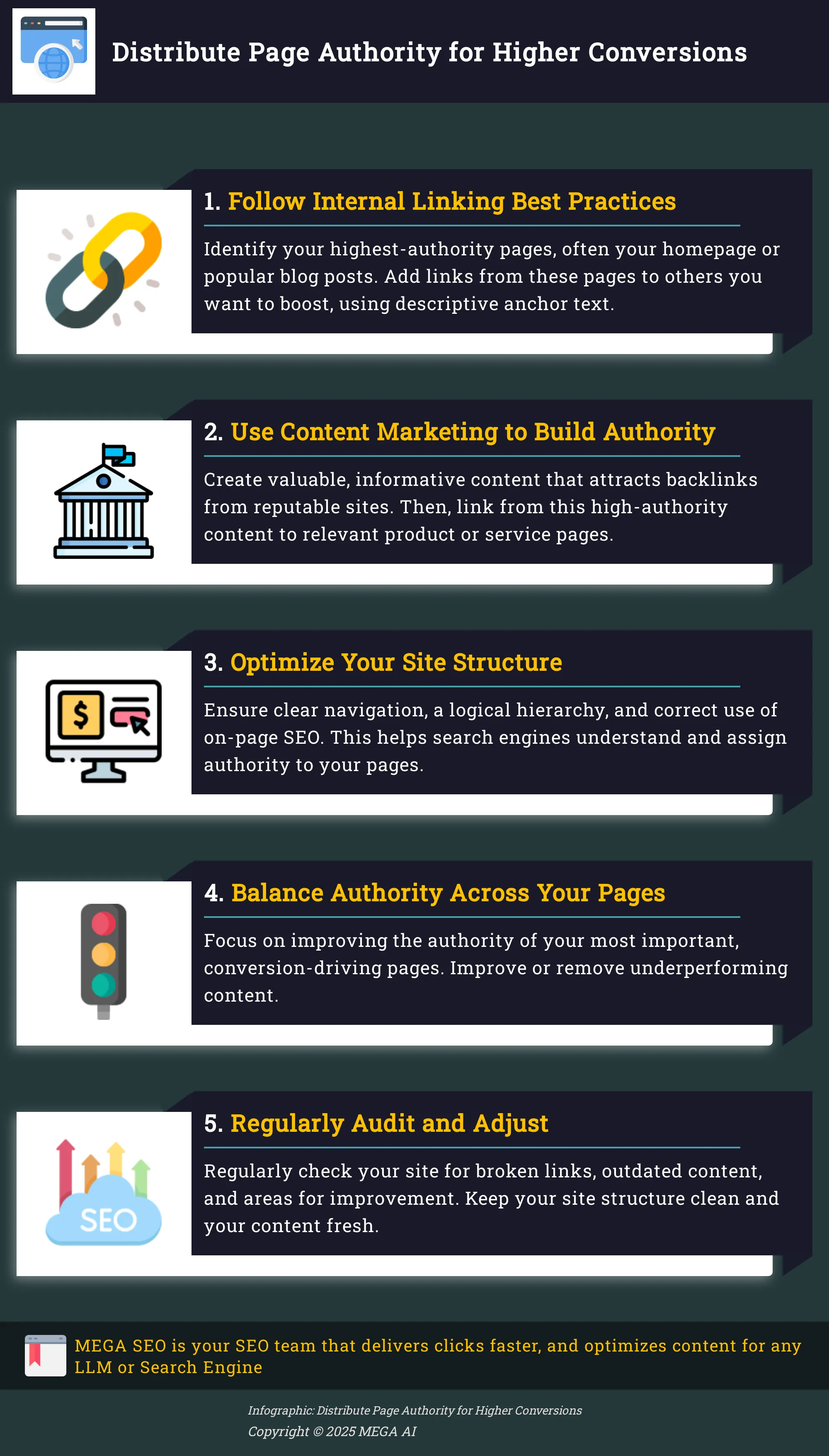
Follow Internal Linking Best Practices
One of the most effective ways to distribute Page Authority is through a smart internal linking strategy. When you link from one page on your site to another, you create a pathway for both users and search engine crawlers. As DashClicks notes, "Linking to other pages on your website helps search engines understand your site's structure and can improve the Page Authority of those linked pages." Start by identifying your pages with the highest authority—these are often your homepage or a popular blog post.
From these powerhouse pages, add links pointing to pages you want to strengthen, such as new product pages or important service offerings. Use descriptive anchor text that tells both users and search engines what the linked page is about. This practice not only passes authority but also improves the user experience. Automating this process with a tool like MEGA AI's SEO platform can help you find the most impactful linking opportunities without spending hours on manual analysis.
Use Content Marketing to Build Authority
High-quality content is the foundation of any authority-building effort. When you create valuable, informative, and engaging articles, you naturally attract backlinks from other reputable websites, which is a primary factor in Page Authority. According to Nestify, "Creating high-quality, informative, and engaging content that satisfies user search intent is key to building Page Authority." This content becomes an asset that accumulates authority over time.
Once a blog post or guide gains authority from external links, you can use it as a hub to distribute that authority internally. Link from that high-authority content to relevant product or service pages to pass on some of that link equity. This is where a solid content marketing strategy becomes a powerful SEO tool. It not only attracts an audience but also builds a reservoir of authority that you can strategically direct across your site to support your business goals.
Optimize Your Site Structure
A logical and clean website structure is essential for distributing Page Authority effectively. If search engines can't easily crawl and understand your site, they won't be able to properly assign authority to your pages. Optimizing your site structure involves clear navigation, a logical hierarchy, and the correct use of on-page SEO elements. As AgencyAnalytics points out, "Properly using keywords, meta descriptions, and HTML tags helps search engines understand your page, which is crucial for optimizing your site structure and improving Page Authority."
Think of your website like a well-organized filing cabinet. A clear structure helps search engines find and index your most important content quickly. This ensures that when you do earn authority, it can flow smoothly through your site. A well-organized site also provides a better user experience, which can lead to lower bounce rates and higher engagement—signals that also contribute to your site's overall authority.
Balance Authority Across Your Pages
Distributing Page Authority isn't about making every page equally strong; it's about being strategic. You need to identify your most important pages—typically those that drive conversions—and focus your efforts there. As Hawksem's research suggests, you should "Focus on improving the Page Authority of your most important pages, like product or landing pages, while also ensuring that lower-performing pages are optimized or removed." This prevents low-quality pages from diluting your site's overall authority.
Regularly audit your site to find pages with high potential and direct internal links toward them. At the same time, identify underperforming content. You can either improve these pages by updating them with fresh, relevant information or, if they serve no real purpose, remove them. Tools like MEGA AI can help you identify which pages need an update to improve their performance. You can book a demo to see how its Maintenance Agent can re-optimize existing content to better support your goals.
Use Page Authority to Improve Conversions
A high Page Authority score is more than just a number to show your boss. It’s a direct indicator of a page’s potential to rank and, more importantly, to convert visitors into customers. By strategically using Page Authority, you can turn your highest-ranking pages into powerful conversion engines. It’s about connecting your SEO efforts to tangible business outcomes.
Identify High-Potential Pages
Your first step is to find the pages that offer the biggest opportunity. These are often pages with moderate authority and high commercial value, like product pages or service comparisons. Focus your link-building efforts on these specific pages, as a single, authoritative link can be more valuable than dozens of low-quality ones. You can use SEO tools to identify these pages and track their authority scores over time, allowing you to concentrate your resources where they will have the most impact on your bottom line.
Align Page Authority with User Intent
A high-authority page will only convert if it gives users what they came for. Your content must directly address the search intent behind the keywords it ranks for. For example, if a user is searching for "best running shoes for beginners," a high-authority page that only lists technical specs will likely fail to convert. Instead, a detailed guide that compares models, explains features in simple terms, and offers clear recommendations provides more value and aligns with the user's goal. Creating useful, in-depth content is a fundamental way to build authority and satisfy visitors, making them more likely to trust your recommendations and make a purchase.
A/B Test for Better Conversions
Once you have an authoritative page that aligns with user intent, you can fine-tune it for maximum conversions. This is where A/B testing comes in. By creating two versions of a page (an 'A' and a 'B' version) and showing them to different segments of your audience, you can see which one performs better. You can test different headlines, call-to-action buttons, images, or page layouts. Even small changes can lead to significant improvements in your conversion rate. Continuously testing and refining your high-authority pages ensures you’re not leaving money on the table and are getting the most value from your SEO traffic.
How to Measure and Analyze Page Authority
Once you understand what influences Page Authority, the next step is to measure where your pages currently stand. Analyzing your PA scores helps you identify which pages are strong performers and which ones need more attention. This process isn't about chasing a perfect score; it's about gathering actionable data to guide your internal linking and content strategy. By consistently tracking your PA, you can see the direct impact of your SEO efforts and make informed decisions that align with your conversion goals. This analysis forms the foundation of any successful authority distribution plan, helping you move from theory to tangible action.
Tools to Track Page Authority
Page Authority (PA) is a score developed by Moz that predicts a specific page's ranking potential. You can check PA using Moz's free tools, like its Link Explorer. However, because it's such a foundational metric, many other SEO platforms have integrated Moz's data into their dashboards. This means you might already have access to PA scores through your current SEO software. An end-to-end platform like MEGA AI can help you monitor your SEO performance by tracking PA alongside other critical metrics, saving you from switching between different tools and reports.
How to Interpret Page Authority Metrics
Page Authority is scored on a 100-point logarithmic scale. This means it’s much easier to grow your score from 20 to 30 than it is to go from 70 to 80. There is no universal "good" score; what matters most is how your PA compares to the pages you're competing against on the search results page. While a score between 50 and 70 is generally strong, a brand-new website might have a PA closer to 10. The key is to use Page Authority as a relative metric. Your goal should be to achieve a higher score than your direct competitors for your target keywords.
Use Data to Inform Your SEO Strategy
Tracking your PA score is only half the battle. The real value comes from using that data to shape your strategy. Start by analyzing your PA scores alongside other key performance indicators like organic traffic, keyword rankings, and conversions. A page with high authority but low traffic might need better on-page optimization or a more relevant internal linking structure. Use historical data and competitor analysis to set realistic improvement goals. Platforms that automate SEO can help you take action on these insights, identifying opportunities to update content or add internal links to distribute authority more effectively. You can book a demo to see how AI can turn your data analysis into an actionable plan.
Overcome Common Page Authority Challenges
Building and distributing page authority is a core part of any successful SEO strategy, but it’s not always a smooth process. Many businesses run into roadblocks that can stall their progress or even hurt their rankings. These challenges often stem from past decisions, aggressive tactics that backfire, or the simple fact that the digital landscape is always changing. Understanding these common hurdles is the first step to clearing them. By addressing legacy issues, focusing on quality over quantity, and staying flexible, you can build a resilient strategy that supports sustainable growth and higher conversions.
Manage Legacy Site Structures
If your website has been around for a few years, it might be carrying some baggage. Legacy site structures, often created before modern SEO was a priority, can be complicated and disorganized. This makes it difficult for search engines to crawl your site efficiently and for page authority to flow logically to your most important pages. A messy structure also creates a confusing experience for users, which can increase bounce rates and lower conversions.
The solution is to conduct a thorough site audit to identify issues like broken links, redirect chains, and orphaned pages. From there, you can map out a more logical site architecture that guides both users and search engine crawlers to your key content. This isn't a one-time fix; think of it as ongoing maintenance. As you add new content, regularly review your structure to keep it clean.
Avoid Over-Optimization Penalties
In the quest for higher rankings, it’s easy to go too far. Over-optimization happens when you try too hard to please search engines, often at the expense of user experience. This includes tactics like stuffing keywords into your content, creating an unnatural internal linking profile, or acquiring a large number of low-quality backlinks. While these methods might have offered short-term gains in the past, search engines are much smarter now.
Today, these practices can lead to penalties that cause your rankings to plummet. Google’s spam policies are clear: content should be created for users, not just for search engines. Instead of focusing on keyword density, prioritize creating genuinely helpful and relevant content that answers your audience's questions. Build a natural backlink profile by earning links from reputable sites in your industry. A balanced approach that puts the user first is the best way to build lasting authority.
Adapt to Algorithm Updates
Search engine algorithms are constantly evolving. An update can roll out at any time, changing the rules for how pages are ranked. A strategy that was effective yesterday could become obsolete or even detrimental overnight. If you aren't prepared to adapt, you risk losing the page authority you’ve worked so hard to build. Staying informed about major updates is crucial for maintaining your site’s performance.
Being adaptable means not putting all your eggs in one basket. Diversify your strategy and be ready to pivot when an update changes the landscape. This is where automation can be a significant advantage. MEGA AI’s Maintenance Agent is designed to help you stay ahead of these changes. It can re-optimize your content to align with new algorithm requirements, whether it’s for Google, an LLM, or another platform. This ensures your pages remain relevant and authoritative, protecting your rankings and conversions through every update.
Create Your Page Authority Strategy
Building a strong Page Authority profile doesn't happen by accident. It requires a clear, intentional plan that you can execute, measure, and refine over time. By breaking the process down into manageable steps, you can systematically improve your pages' ability to rank and convert. A solid strategy involves understanding where you currently stand, deciding what to do next, and consistently tracking your progress to make smart adjustments along the way.
Conduct a Page Authority Audit
Before you can improve your Page Authority, you need a baseline. An audit involves checking the current Page Authority (PA) score for your most important pages. PA is a metric developed by Moz that predicts a specific page's ranking potential on a scale of 0 to 100. Use a tool like Moz's Link Explorer to find the PA score for your key landing pages, blog posts, and product pages. This initial SEO audit will reveal which pages are your authority powerhouses and which ones need more attention, giving you a clear starting point for your efforts.
Develop a Prioritized Action Plan
With your audit data in hand, you can create a focused plan. Prioritize your efforts on pages that have high conversion potential but may have lower PA scores. Your action plan should focus on three core areas: creating high-quality content, performing on-page optimization, and building quality backlinks from reputable sites. For instance, you can use MEGA AI's SEO features to generate optimized content and build an internal linking structure that distributes authority effectively. Set realistic goals based on historical data and competitor performance, focusing on steady, incremental improvements rather than chasing a perfect score overnight.
Monitor and Adjust Your Strategy
Improving Page Authority is an ongoing process, not a one-time task. Regularly monitor your PA scores to see how your efforts are paying off. However, remember that PA is just one piece of the puzzle. You should track it alongside other important SEO KPIs like organic traffic, keyword rankings, and conversion rates to get a complete picture of your performance. As you gather data, be prepared to adjust your strategy. If a certain type of content is earning valuable backlinks, create more of it. If on-page tweaks are improving rankings, apply those learnings to other pages.
The Benefits of Distributing Page Authority
Spreading Page Authority throughout your site is more than a technical box to check. It’s a strategic approach that strengthens your entire digital presence. When you intentionally direct authority from high-performing pages to other important ones, you create a more resilient and effective website. This process doesn't just help you rank for more keywords; it directly impacts your business goals by building a foundation for sustainable growth, enhancing user trust, and ultimately, driving more conversions.
Achieve Long-Term SEO Success
Think of Page Authority as a measure of a page's potential to rank in search results. When you distribute this authority, you're not just propping up one page; you're building a stronger, more interconnected site. This strategy helps you achieve more stable and lasting SEO results because your site's success isn't dependent on a single page. Instead, you create a network of authoritative pages that can each rank for relevant terms. Improving your site's overall Page Authority involves a consistent focus on high-quality content and backlinks, which signals to search engines that your entire domain is a valuable resource. This creates a competitive advantage that is difficult for others to replicate quickly, securing your rankings for the long haul.
Build User Trust and Credibility
A high Page Authority score often translates to a better reputation, not just with search engines but with your audience. When users land on a page that feels authoritative and well-supported, it builds immediate trust. Distributing authority ensures that this feeling of credibility extends beyond your homepage to your blog posts, product pages, and other key areas of your site. Think of it as a site-wide reputation score. A user who finds a helpful, in-depth article is more likely to trust your brand and explore what else you have to offer. This trust is the foundation for building relationships with customers and encouraging them to take the next step in their journey with you.
Improve Website Performance and Conversions
Ultimately, the goal of SEO is to support business growth. Distributing Page Authority is a direct path to improving your site's performance and conversions. By channeling authority to your most important conversion-focused pages—like service pages or product descriptions—you increase their visibility in search. When these pages rank higher, they attract more qualified traffic. Combining this increased visibility with a strong focus on user experience and clear calls-to-action creates a powerful formula for success. You're not just bringing more people to your site; you're guiding them to the pages that are specifically designed to turn visitors into customers, which can significantly improve your overall conversion rates.
The Future of Page Authority
Page Authority isn't a static number. As search engines refine their algorithms, the factors that contribute to a page's ranking potential will also shift. Staying ahead means understanding where search is going and preparing your strategy for what comes next. This proactive approach ensures your efforts continue to deliver results, keeping your high-value pages visible and effective.
Emerging Trends in Search Algorithms
Search algorithms are always getting smarter and more sophisticated. While Google doesn't use Moz's Page Authority score directly, the score is designed to predict ranking potential based on factors Google values. Page Authority (PA) is a helpful estimate, but it's important to remember that it can change. An algorithm update, a competitor's new backlink campaign, or even your own content becoming outdated can cause your PA scores to fluctuate. The key is to see PA not as a final grade but as a dynamic indicator of your page's health in a constantly evolving search landscape. This means your SEO strategy can't be a one-and-done task; it requires ongoing attention.
Prepare for Evolving Metrics
Preparing for the future of search means focusing on a holistic SEO strategy rather than chasing a single score. Improving your Page Authority is an ongoing process that involves a mix of tactics: earning high-quality backlinks, creating a clear sitemap, and consistently publishing relevant, high-quality content. It's also crucial to view PA as part of a larger picture. You should analyze it alongside other metrics like Domain Authority, organic traffic, and keyword rankings to get a complete view of your performance. A comprehensive strategy that addresses all these areas is the best way to build a resilient site that can adapt to future changes. An end-to-end SEO platform can help manage these moving parts, ensuring your strategy remains effective over time.
Common Page Authority Mistakes to Avoid
Building page authority is a marathon, not a sprint. Along the way, it’s easy to fall into common traps that can slow your progress or even set you back. Understanding these pitfalls is the first step to avoiding them. By steering clear of these mistakes, you can create a more effective and sustainable strategy that builds genuine authority and drives meaningful results for your business. Let's look at some of the most frequent missteps marketers make.
Focusing on Link Quantity Over Quality
One of the oldest mistakes in the SEO book is chasing a high number of backlinks without considering where they come from. It's tempting to think that more links automatically equal more authority, but search engines are much smarter than that. A single, relevant link from a highly respected site in your industry is worth more than hundreds of low-quality links from irrelevant or spammy domains. Focusing on quantity over quality can actually harm your site's reputation. Instead, prioritize building relationships and creating content that naturally earns high-quality backlinks.
Neglecting User Experience
You can have perfectly optimized content and a strong backlink profile, but if visitors have a bad experience on your page, your authority will suffer. High bounce rates and low engagement tell search engines that your page isn't satisfying user intent. Many brands create visually appealing websites but overlook the fundamentals of a good user experience, like intuitive navigation, fast load times, and mobile-friendliness. Ensure your pages are not only informative but also easy and enjoyable for people to use. A positive user experience keeps visitors on your page longer, signaling its value to search engines.
Ignoring On-Page SEO
On-page SEO provides the essential foundation for page authority. If you neglect the basics, search engines will struggle to understand what your content is about, no matter how well-written it is. This includes properly using title tags, meta descriptions, header tags, and internal links. Each element helps provide context and structure, making your content more accessible to both users and search engine crawlers. Consistently applying on-page SEO best practices across your site ensures that every page is positioned to build authority and rank for its target keywords.
Failing to Track Your Metrics
Building page authority is not a one-and-done task; it's an ongoing process that requires constant attention. A common mistake is to launch a strategy and then fail to monitor its performance. Without tracking your metrics, you have no way of knowing what’s working and what isn’t. You should regularly analyze your page authority scores, organic traffic, keyword rankings, and backlink profile. This data provides crucial feedback, allowing you to refine your approach over time. Using tools to track SEO metrics helps you make informed decisions and adapt your strategy to achieve long-term success.
Related Articles
- Domain Authority: The Ultimate Guide (2023)
- How to Rank Higher After Google's Helpful Content Update
- How Quality Backlinks Contribute to Authoritativeness and Trustworthiness Under the E-A-T Principles - MEGA SEO | Blog
- Optimizing On-Page Elements for Improved SEO Rankings - MEGA SEO | Blog
- PageRank Sculpting: Boost Key Pages With Smart Linking
Frequently Asked Questions
What is a good Page Authority score to aim for? There isn't a universal "good" score to target. Page Authority is best used as a comparative metric, not an absolute one. Instead of focusing on reaching a specific number, you should analyze the scores of the pages that are currently ranking on the first page for your target keywords. Your goal should be to build a Page Authority score that is in the same range as, or higher than, your direct competitors.
How long does it typically take to see an increase in Page Authority? Improving Page Authority is a long-term effort, not an overnight fix. Because the score is heavily influenced by the quality and quantity of backlinks, progress depends on your ability to consistently create valuable content that earns links from other reputable sites. You can typically expect to see gradual improvements over several months of sustained effort, but the exact timeline will vary based on your industry's competitiveness and the intensity of your strategy.
If my page has high authority but isn't converting, what should I do? A high Page Authority score is great for getting traffic, but it doesn't guarantee conversions. If your page is ranking well but failing to convert visitors, the issue likely lies with the content or user experience. Re-evaluate the page to ensure it directly matches the searcher's intent and provides a clear, compelling solution to their problem. You should also check that your calls-to-action are visible and easy to follow.
Can a page with low authority still rank well in search results? Yes, it is possible, especially for less competitive, long-tail keywords. If a page perfectly satisfies a very specific search query and provides an excellent user experience, it can sometimes outrank pages with higher authority but less relevant content. However, for more competitive and broader search terms, a higher Page Authority is almost always necessary to compete effectively.
Why did my Page Authority score suddenly drop? Page Authority is a dynamic metric, so fluctuations are normal. A sudden drop can happen for a few reasons. You may have lost some valuable backlinks that were contributing to your score, or a competitor may have acquired a significant number of new, high-quality links. It's also possible that Moz, the creator of the metric, updated its own algorithm for calculating the score, which can cause shifts across the web.