
Search is changing. Instead of just getting a list of links, your customers now see direct answers generated by AI at the top of the page. If your website isn't the source for those answers, you're becoming invisible. This is where large language model optimization (LLMO) comes in. It’s the practice of structuring your content so AI tools like ChatGPT and Google's AI Overviews can easily understand and cite your business. This guide will show you how to adapt your website, making sure you’re not just another link, but the trusted authority that AI relies on for answers.
Key Takeaways
- Use Structured Data to Communicate Directly with AI: Implement schema markup to label key business information like your services, hours, and location. This provides clear context that helps AI models understand your content and trust it as a reliable source for generating answers.
- Structure Your Content for Easy Extraction: Organize your content with clear headings, short paragraphs, and dedicated FAQ sections. Answering questions directly makes it simple for AI to pull specific information from your site and feature it as a cited source in its responses.
- Strengthen Your Technical SEO to Guide AI Crawlers: Focus on core technical elements like page speed, mobile-friendliness, and a logical internal linking strategy. A technically sound website is easier for AI to crawl and index, signaling that your site is an authoritative and high-quality resource.
What Is LLM Optimization and Why Does It Matter?
If you've spent any time on SEO, you know the goal is to show up when customers search for what you offer. But how they search and what they find is changing. Instead of just a list of links, search engines and AI tools are providing direct answers. This is where LLM optimization comes in. Large language model optimization (LLMO) is the practice of structuring your website's content so AI tools like ChatGPT and Google's AI Overviews can easily understand and use it. It’s about making your site the trusted source for the answers these AIs provide, ensuring your business stays visible in this new landscape.
How AI Answers Are Changing Search
The days of users clicking through ten blue links to piece together an answer are fading. AI is changing the search experience by providing direct, summarized answers at the top of the page. When someone asks a question, tools like Google's AI Overviews or ChatGPT aim to deliver a complete response instantly. For your business, this means the goal is no longer just to rank number one; it's to be the source cited in that AI-generated answer. When your content is optimized for AI, it has a better chance of appearing in these summaries and even in voice search results, putting your brand directly in front of potential customers.
How LLMs Read and Understand Your Website
Large language models don't browse your website with their eyes. They read the underlying code and data to understand what your content is about. Think of it like giving the AI a neatly organized filing cabinet instead of a messy pile of papers. The better you organize your information, the easier it is for the AI to find what it needs. As one expert put it, LLMs are looking for "nicely organized information." By structuring your content clearly with things like schema markup—which we'll cover later—you're essentially translating your website into a language that AI understands. This helps them trust your site as a reliable source for assembling their answers.
How Do LLMs Find and Use Your Content?
Think of large language models as incredibly advanced researchers. They don't just browse the web like a person; they consume and process vast amounts of information to find the most reliable facts and direct answers to user questions. Unlike traditional search engines that primarily rank a list of links, LLMs synthesize information from multiple sources to create a single, conversational response.
This means your website's content needs to be more than just keyword-optimized. It must be structured, clear, and authoritative enough for an AI to trust it as a source. The goal is for the LLM to not only find your content but also understand it deeply enough to cite it in an AI-generated answer. This process involves a few key stages, from initial discovery to the final ranking of your information within an AI response. Understanding how this works is the first step to making your business visible in this new search landscape.
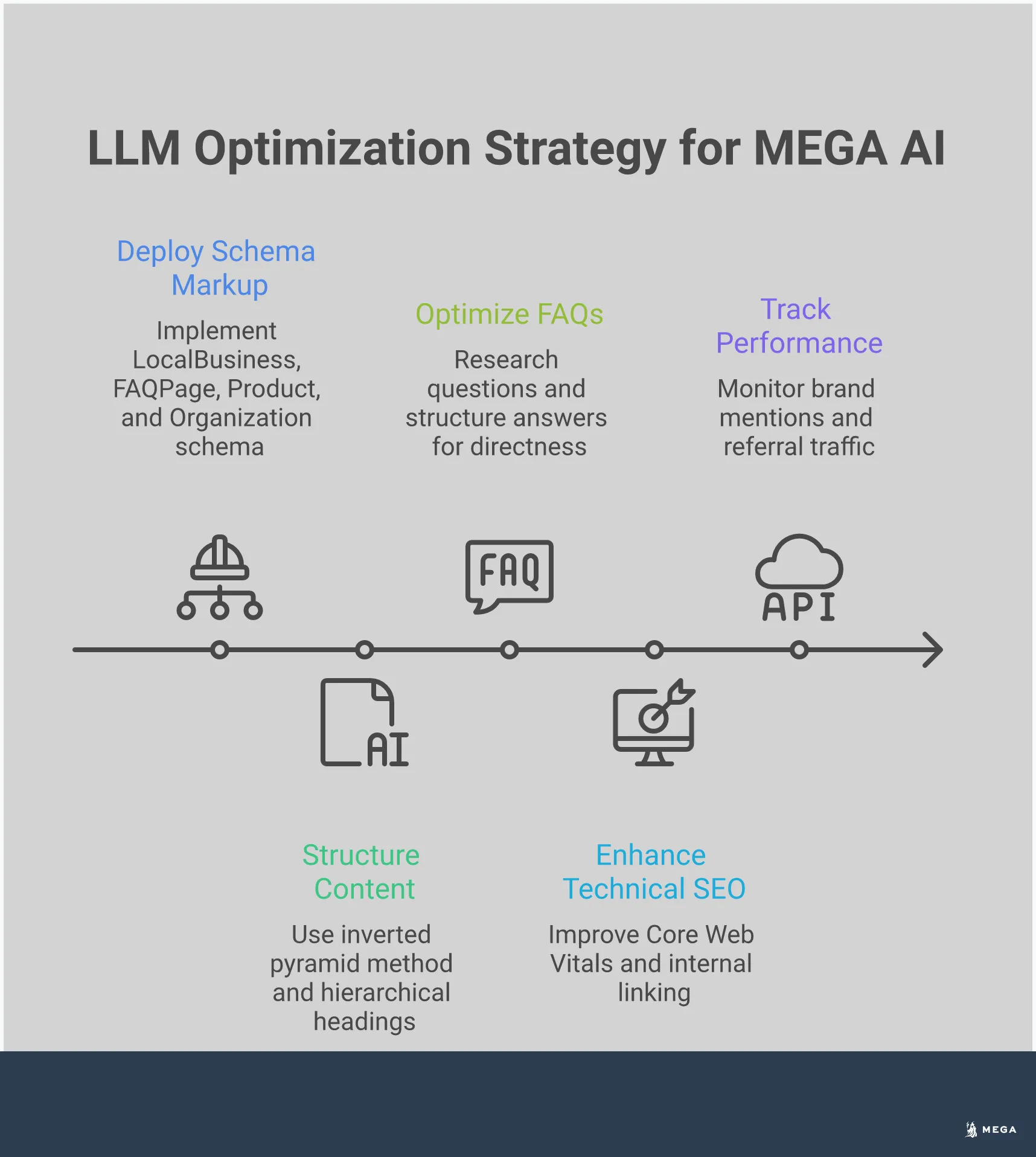
The Crawling and Indexing Process for AI
Just like traditional search engines, LLMs use crawlers to discover and index content across the web. However, AI crawlers are on a mission to find structured, factual information they can easily digest. This is where schema markup becomes essential. Schema is a type of code you add to your website that acts like a set of labels, explicitly telling AI what your content is about.
Instead of making an AI guess that "555-1234" is your business phone number, schema markup clearly labels it as such. This structured data format is exactly what AI models are looking for. They can quickly identify key details about your business—like your address, hours, services, and reviews—without having to interpret unstructured text. A well-marked-up site is like a neatly organized file cabinet for an AI, making your information easy to find, verify, and use.
How AI Extracts and Interprets Your Information
Once an LLM finds your content, it begins the process of extraction and interpretation. It’s not just scanning for keywords; it’s identifying entities (people, places, things), attributes (like prices or ratings), and the relationships between them. For a local business, this is a huge opportunity. With the right schema, an AI can instantly understand your services, service area, and customer ratings.
For example, an AI can pull your specific pricing, hours, and contact details directly from your site's code to feature in an AI Overview. It connects the dots, understanding that your business is a "LocalBusiness" that offers "Plumbing Services" and has a "5-star rating." By providing this information in a clear, machine-readable format, you supply the raw material that AI models trust when assembling answers for users.
What Ranking Factors Influence LLM Visibility?
Visibility in LLM results isn't about a single ranking factor. It’s about a combination of signals that build trust and authority. While traditional SEO factors like backlinks and domain authority still play a role, LLMs place a heavy emphasis on content quality, clarity, and structured data. A website with correctly implemented schema is more likely to have its information featured in AI-generated answers.
Beyond schema, LLMs favor content that is clear, concise, and directly answers common questions. They look for expertise and authoritativeness, often cross-referencing information across multiple trusted sources. A successful schema markup implementation requires careful planning and ongoing monitoring, but the payoff is greater trust from both users and AI. Ultimately, the more you can do to make your content easy for AI to understand and verify, the better your chances of gaining visibility.
Use Schema Markup to Help LLMs Understand Your Content
Think of schema markup as a secret language that helps your website communicate directly with search engines and AI. It’s a set of special tags you add to your website’s code. These tags don’t change how your site looks to visitors, but they provide critical context for machines. For a large language model, this is incredibly valuable. Instead of just guessing what your content is about, schema markup explicitly tells it, "This is a recipe," "This is a local business," or "This is a frequently asked question."
This structured data is exactly what LLMs need to understand the meaning and relationship between different pieces of information on your site. When an AI can confidently understand your content, it's far more likely to use it as a source for its generated answers. Without well-structured schema, your site might never appear as a cited source, leaving you invisible in this new search landscape. While you can implement schema manually, platforms like MEGA AI’s SEO agent can automate the process, ensuring your site speaks the language of AI without any heavy lifting on your part.
Key Schema Types for AI
While there are hundreds of types of schema markup, you don’t need to use all of them. For LLM optimization, focusing on a few key types will give you the most impact. Schema markup works by labeling the key entities on your website—the people, places, things, and concepts your content is about. These labels help AI agents and assistants discover key aspects of your site in a format they can easily process.
For example, Article schema can define the author, publication date, and headline, while Product schema can specify the price, availability, and reviews. By using the right schema, you’re essentially handing the LLM a neatly organized file about your content, making its job of interpreting your information much simpler and more accurate.
Use FAQPage Schema for Direct Answers
One of the most powerful schema types for LLMs is FAQPage. This markup is designed for pages that present information in a question-and-answer format. It explicitly tells an AI, "Here is a specific question, and here is the direct, concise answer." This structure is a perfect match for how LLMs often formulate their responses. When an AI finds a question on your site that matches a user's query, it can easily extract the answer you’ve provided.
However, it's crucial that the schema matches the content visible on the page. A common mistake is adding FAQPage markup to a page that doesn't actually have a Q&A section. This mismatch can confuse search engines and AI, potentially hurting your visibility. When used correctly, this schema is one of the best ways to get your content cited in AI-generated answers.
Implement LocalBusiness and Organization Schema
For small and local businesses, LocalBusiness and Organization schema are non-negotiable. This type of markup establishes your business as a real-world entity in the eyes of an LLM. It provides clear, structured information about who you are, what you do, and where you are located. You can specify essential details like your business name, address, phone number, website, hours of operation, and the services you offer.
This information is vital for appearing in AI-generated responses to local queries, such as "best plumber near me" or "restaurants open now." Adding LocalBusiness schema can make you eligible for rich results in search, which helps you stand out and can lead to higher organic traffic and more customers. It’s a foundational step for any local SEO strategy.
A Step-by-Step Guide to Implementing Schema
Implementing schema might sound technical, but it’s a manageable process. The first step is to develop a strategy by identifying the key entities on your site. For each page, determine the main subject—is it a product, an article, an event, or your business itself?
Next, choose the appropriate schema type that matches your content. You can use free tools like Google’s Structured Data Markup Helper to generate the necessary code without writing it from scratch. Once you have the code (usually in a format called JSON-LD), you add it to the <head> section of your page’s HTML. Finally, use a tool like the Rich Results Test to validate your markup and ensure there are no errors. This final check confirms that search engines and LLMs can read and understand it correctly.
How to Structure Content for Maximum AI Impact
How you organize information on your website is just as important as the information itself. Large language models don't just scan for keywords; they analyze the structure of your page to understand context, hierarchy, and key takeaways. To get your content featured in AI-generated answers, you need to make it as easy as possible for these models to read, interpret, and trust your information.
Structuring your content for AI isn't about complicated coding or technical tricks. It’s about clarity and logic. By using proper headings, writing direct answers, and formatting your text for scannability, you create clear signals that guide AI to the most important information. These practices also happen to create a better experience for your human visitors, who are often looking for quick, reliable answers. A well-structured page is more likely to be seen as authoritative, increasing its chances of being used as a source in AI Overviews and chatbot responses. MEGA AI's SEO agent is designed to create and format content that performs well with both traditional search engines and new AI platforms.
Write Clear, Concise Answers for AI
Large language models are built to find and deliver answers. The most effective way to get their attention is to provide those answers clearly and directly. Think about the questions your potential customers are asking, and write the answers in simple, straightforward language. Avoid jargon and long, winding sentences. A good practice is to state the answer in the first sentence of a paragraph and use the rest of the paragraph to provide supporting detail. This approach makes your content highly scannable and allows an AI to easily extract the exact piece of information it needs to satisfy a user’s query.
Organize Information with Proper Headings
Think of headings (H1, H2, H3, etc.) as the table of contents for your webpage. They create a logical hierarchy that tells both users and AI models what the page is about and how the information is organized. Your main title should always be the H1, followed by H2s for major sections and H3s for subsections. This structure breaks your content into digestible chunks and signals the relationship between different topics. For an LLM, this roadmap is essential for understanding the context of your content, allowing it to pull accurate summaries and feature your site in relevant AI-generated results.
Focus on Entities and Topic Clusters
Entities are the specific people, places, organizations, and concepts that your content is about. For a small business, key entities include your company name, your products or services, and your physical location. AI models build their understanding of the world by connecting these entities. To optimize for this, make sure your content clearly defines who you are and what you do. You can strengthen your authority by building topic clusters—a core "pillar" page about a main subject that links to several related, in-depth articles. This strategy shows AI that you are an expert on your topic, making your site a more trustworthy source.
Format Your Content to Earn Citations
When an AI model uses information from your website, it often provides a citation linking back to the source. To increase your chances of earning these valuable citations, format your content to be easily quotable. Use bullet points and numbered lists to break down processes or highlight key features. Keep paragraphs short and focused on a single idea. This scannable formatting makes it simple for an AI to pull out specific facts, statistics, or definitions. When combined with structured data, this approach effectively labels your key information, making it prime material for inclusion in AI-generated answers.
Create FAQ Sections That Serve Both Users and AI
A well-crafted Frequently Asked Questions (FAQ) page is one of the most powerful tools for LLM optimization. By its very nature, an FAQ page is a structured collection of questions and direct answers—exactly the format AI models are designed to understand and use. When you create a helpful FAQ section, you’re not just assisting customers who land on your site; you’re also providing clear, extractable content that LLMs can pull into their search responses, giving your business a direct line to potential customers.
This approach creates a positive cycle: you answer your audience’s most pressing questions, which improves their experience and builds trust. In turn, AI models recognize your site as a helpful authority, increasing your visibility in AI-powered search results.
Find the Right Questions to Answer
The most effective FAQ sections start with a deep understanding of your audience. Your goal is to anticipate their needs and answer their questions before they even have to ask. Start by looking at the data you already have. Comb through customer service emails, support chat logs, and social media comments to identify recurring themes and questions. What are the common points of confusion or hesitation for your customers?
You can also use keyword research to discover what people are asking online. Look for queries that start with "who," "what," "where," "why," and "how" related to your products or industry. When you research the most common questions your audience has, you create content that is immediately valuable and highly relevant for both human users and AI crawlers.
Best Practices for Structuring Your FAQs
Once you have your list of questions, organization is the next critical step. A long, jumbled list of questions can be overwhelming for users and difficult for AI to parse. Instead, group related questions into logical categories, such as "Shipping & Delivery," "Sizing Information," or "Billing & Payments." This structure makes it easy for visitors to find the information they need quickly.
Each question should serve as a clear, descriptive heading. This not only helps with on-page navigation but also allows AI models to quickly identify the topic of each answer. The purpose of an FAQ page is to provide visitors with quick and simple answers in an organized manner. A clean, intuitive structure is fundamental to achieving that goal and making your content more accessible to LLMs.
Format Answers for Easy Extraction
When an LLM pulls information for an answer, it’s looking for a concise, authoritative snippet. To make your content a prime candidate, you need to format your answers for easy extraction. The key is to be direct and clear. Start your answer with a straightforward response before elaborating with more detail. For example, if the question is "What is your return policy?" begin with "We offer a 30-day return policy on all unopened items."
Keep your sentences and paragraphs short. Use bullet points or numbered lists to break down complex information or steps. According to best practices for writing an effective FAQ page, answers should be as brief as possible while still being thorough. This approach helps users get what they need faster and makes it simple for AI to lift your answer directly into a search result.
Make Your FAQs Easy to Find
A brilliant FAQ page is only effective if people—and crawlers—can find it. Make it a prominent part of your website’s navigation. The most common and effective placements are in your main navigation menu, the website footer, and on your contact page. This ensures that users can access it from anywhere on your site.
You can also link to specific, relevant questions from other pages. For instance, on a product page, you could link to an FAQ about shipping times or material care. By making this resource highly visible, you improve the user experience and demonstrate to AI that you have a well-structured, helpful site. As a bonus for your business, a comprehensive and easy-to-find FAQ page can significantly reduce the number of support tickets you receive, freeing up your team for other tasks.
Fine-Tune Your Technical SEO for LLMs
Beyond the words on the page, your website's technical foundation plays a huge role in how well large language models can find, read, and trust your content. Think of it like building a house. You need a solid foundation and a logical floor plan before you can start decorating. For LLMs, a technically sound website is that strong foundation.
When an AI model crawls your site, it’s looking for signals that your website is reliable, easy to access, and well-organized. A clean technical setup helps these models process your information efficiently and accurately. This means they can better understand the context of your content, the relationships between your pages, and the overall authority of your site. Getting these technical elements right is a critical step in making your content a go-to source for AI-generated answers.
Prioritize Page Speed and Mobile-Friendliness
A slow-loading website is a major roadblock for both users and AI. If your pages take too long to load, people will leave, and AI crawlers may struggle to access and index your content. LLMs are designed to pull information from high-quality, user-friendly sources, and a fast, responsive site is a primary indicator of quality.
Make sure your website loads quickly and looks great on any device, especially mobile phones. A clunky or outdated design can signal to AI that your site isn't well-maintained, which could make it less likely to be used as a source. You can use Google's PageSpeed Insights tool to check your site’s performance and get actionable recommendations for improvement.
Build an Internal Linking Strategy for AI
Internal links are the threads that connect your content, creating a web of information that helps AI understand your expertise. When you link from one page on your site to another relevant page, you’re showing AI how your ideas and topics relate to each other. This helps establish your topical authority.
For example, if you have a main blog post about "Local SEO Tips," you should link from it to other posts you've written about "Google Business Profile" or "Customer Reviews." This strategy creates a map for AI crawlers, guiding them through your content and demonstrating the depth of your knowledge on a subject. A strong internal linking structure helps AI see your site as a comprehensive resource worth citing.
Design a Site Architecture AI Can Understand
Your site architecture is the way your website's pages are organized. A clear, logical structure makes it easy for both users and AI models to find what they’re looking for. Think of it as the blueprint of your website. A simple, hierarchical structure is often best, with your homepage at the top, followed by major category pages, and then individual articles or product pages.
This kind of systematic planning ensures that your most important content is easy to discover. When an AI can easily navigate your site, it can better understand the main topics you cover and how different pieces of content support each other. A clean architecture helps AI correctly interpret your site’s purpose and expertise, making your content more likely to be featured in its responses.
Validate and Test Your Structured Data
After you’ve added schema markup to your site, the final step is to make sure it’s working correctly. Errors in your structured data can confuse AI models or even cause them to ignore your markup entirely. Taking a moment to validate your code ensures your hard work pays off.
Use a tool like the Schema Markup Validator to check for errors and warnings. This tool will show you exactly how AI models see your structured data and help you fix any issues. Regularly testing your implementation, especially after making changes to your site, is a crucial part of ongoing maintenance. It confirms that you’re clearly communicating with AI and giving your content the best possible chance to be understood and used.
What Are the Biggest LLM Optimization Mistakes to Avoid?
As you begin optimizing your website for AI, it’s helpful to know what not to do. LLM optimization is a new discipline, but some common missteps can undermine your efforts before they even get started. Avoiding these mistakes will save you time and help you build a solid foundation for getting your content featured in AI-generated answers. Think of it as learning the rules of the road before you start your journey. By steering clear of these pitfalls, you put your business in a much better position to connect with customers through this emerging channel.
Common Schema Markup Errors
One of the fastest ways to confuse an LLM is with improper schema markup. A frequent error is applying schema types that don't match your content, like using "Article" schema on a product page instead of the correct "Product" schema. This sends mixed signals about what the page is about. Another common issue is using conflicting markups on the same page, which can cancel out any potential benefits. But the biggest mistake is not using structured data at all. Without it, you’re leaving it up to the AI to guess the context of your content, making it much less likely that your site will be used as an authoritative source in AI-generated answers.
Content Quality Issues That Block AI
Even with perfect technical SEO, low-quality content will hold you back. LLMs are designed to find and synthesize expert, trustworthy information to provide helpful answers. Pages with "thin content" that barely scratch the surface of a topic are often ignored. If your content doesn't thoroughly answer a user's question, an AI model will look elsewhere for a better source. Similarly, poor structure can make your content invisible. Information buried in long, dense paragraphs without clear headings or lists is difficult for AI to parse and extract. Well-organized content that is easy for a human to read is also easy for an AI to understand and use.
Over-Optimization Mistakes That Can Backfire
In the rush to optimize for AI, it’s possible to try too hard in the wrong areas. A classic mistake is optimizing your structured data only for Google’s rich results. While important, this narrow focus ignores other AI platforms like ChatGPT and Perplexity that also rely on this data to understand your content. You should also avoid outdated tactics like keyword stuffing. Modern LLMs are sophisticated enough to understand natural, conversational language. Forcing keywords into your text where they don’t belong makes for a poor user experience and can signal low-quality content to AI models. Always prioritize writing for your human audience first.
How to Measure Your LLM Optimization Success
Optimizing your website for large language models is a new practice, and measuring its success looks a little different from tracking traditional SEO. While you’ll still care about traffic and rankings, LLM optimization introduces new indicators of visibility and authority. The goal is to see your brand and content appear as trusted sources within AI-generated answers. This means tracking not just clicks, but citations, mentions, and placement in AI summaries. When your content is used by an LLM, it's a strong signal of trust and relevance that can build your brand's reputation in a way that a simple blue link cannot.
Monitoring these new metrics helps you understand if your content is effectively communicating with AI systems. It shows whether your schema markup is working, if your content structure is clear, and if you’re successfully establishing your site as a reliable source of information. Think of it as a feedback loop for your content strategy. By focusing on the right performance indicators, you can refine your approach and ensure your efforts are translating into meaningful visibility on the AI-powered web. This approach moves beyond simple traffic numbers to measure your actual influence and authority in your niche, which is critical for long-term growth.
Key Metrics to Track for AI Visibility
Success with LLM optimization is less about your rank on a results page and more about your presence within an AI-generated response. Start by tracking how often your website is cited as a source in answers from tools like ChatGPT or Google’s AI Overviews. These citations are a direct signal that an LLM trusts your content. You should also monitor for brand mentions, even without a direct link, as this builds brand authority. Another key metric is the appearance of your content in rich results and featured snippets, as these are often the building blocks for AI summaries.
Tools to Monitor Traffic from LLMs
While direct traffic from LLMs can be tricky to isolate, you can find clues in your analytics. Look for referral traffic from domains associated with AI search tools. More importantly, use tools to validate the technical foundation of your LLM optimization. You can check if your structured data is correctly implemented with Google's Rich Results Test. This helps you confirm that AI agents can easily parse the key information on your site. Regularly running these checks ensures your schema remains error-free and effective for AI discovery.
Performance Indicators Beyond Traditional SEO
Think of your website as a source of raw material for AI. Your success depends on how well you label that material. A key performance indicator is how often your structured data is used to answer specific queries, like your business hours appearing in a local search summary. Another is the quality of the traffic you receive. Are visitors coming from highly specific, long-tail questions answered by an AI? This suggests your content is seen as an authoritative source on niche topics. Ultimately, the goal is to become a trusted entity that LLMs rely on, which strengthens your entire SEO strategy over time.
How MEGA AI Streamlines LLM Optimization
Implementing a full LLM optimization strategy involves technical details, consistent content creation, and ongoing monitoring. For a small business owner, this can feel like a second full-time job. You need to understand structured data, write content that directly answers questions, and keep up with a constantly changing landscape of AI tools. Instead of trying to manage all these moving parts yourself, you can use an autonomous system designed to handle it for you.
MEGA AI’s platform uses intelligent agents to plan and execute your entire SEO strategy. This isn't just another tool you have to learn and operate. Our agents come up with a strategy and do the work for you, including the complex tasks required to get your website visible in AI-generated answers. The system is built to handle the technical details, create content at scale, and adapt to the new rules of search. This allows you to get all the benefits of LLM optimization without needing to become an expert yourself, so you can focus on running your business. We provide complete visibility into every task our agents perform, so you always know what work is being done to grow your online presence.
Automate Your Schema Markup
Schema markup is the language that helps AI agents and search engines make sense of your website. It’s a powerful tool, but implementing it correctly requires technical knowledge and can be time-consuming. For small businesses, getting this wrong can mean being invisible to AI search tools, even if your content is perfect.
MEGA AI removes this technical barrier completely. Our SEO agent, Lindsay, automatically implements the correct schema markup across your site. It identifies opportunities to add structured data for your products, services, location, and FAQs, ensuring that LLMs can easily extract key information. This process happens autonomously, so you don’t have to write a single line of code.
Generate LLM-Ready Content Automatically
LLMs prioritize content that is clear, well-structured, and directly answers user questions. Consistently creating this type of content is a significant challenge. You need to research topics, structure articles with proper headings, and focus on entities, not just keywords.
Our platform automates this entire workflow. The Research Agent analyzes search results, forums, and news to understand what information users and AI are looking for. Then, the Content Generation Agent writes articles that are optimized for both traditional search and LLMs. Because our system can generate content at scale, your site stays fresh with helpful information that AI models are more likely to use and cite in their answers.
Optimize for All AI Platforms at Once
The world of AI search is constantly evolving, with new platforms like ChatGPT, Perplexity, and Google’s AI Overviews all competing for users. Optimizing your site for each one individually is an impossible task. A successful strategy requires a unified approach that prepares your content for any AI-powered search engine.
MEGA AI is designed for this new reality. Our "LLM Placement" feature specifically works to improve how your business appears across all major AI tools. We handle the systematic planning and ongoing monitoring needed to ensure your content is structured for discovery, no matter where users are searching. This future-proofs your online presence, making sure you’re ready for the next evolution of search. You can book a demo to see how our agents can manage this for you.
Build Your LLM Optimization Strategy
Optimizing your website for AI search isn't about throwing out your current marketing plan. It’s about making thoughtful adjustments to what you’re already doing to ensure your business shows up in AI-generated answers on platforms like ChatGPT and Google's AI Overviews. A solid strategy involves both immediate actions and long-term planning. You can start with a few high-impact tasks that help LLMs understand your site right away, then build a sustainable plan that integrates LLM optimization into your regular SEO workflow. This approach ensures your efforts are consistent and build on each other over time, making your website a helpful and authoritative source for both human users and AI systems.
Where to Start: Quick Wins for Your Business
The best place to begin is with Schema markup. Think of it as a set of labels you add to your website’s code. While visitors won’t see these labels, they help AI systems instantly understand what your content is about. Adding schema clarifies your business hours, location, services, and products, making it easier for LLMs to pull accurate information for their answers. This is a foundational step for what’s known as LLM answer SEO, where you optimize content so AI can easily find and use it. Another quick win is to create a dedicated FAQ page that answers your customers' most common questions directly and concisely.
Plan Your Long-Term AI Search Strategy
Once you’ve handled the quick wins, it’s time to think about your long-term approach. A successful strategy requires systematic planning and ongoing attention. Start by creating a content plan that prioritizes answering customer questions in-depth. Think about the problems your audience faces and create comprehensive articles, guides, and blog posts that solve them. You should also schedule regular content audits to update existing pages with fresh information, statistics, and examples. LLMs favor current and accurate content, so maintaining your site is just as important as creating new pages. This consistent effort establishes your site as a reliable resource over time.
Integrate LLM Optimization with Your Current SEO
LLM optimization and traditional SEO are closely connected. Many of the practices that help you rank on Google also improve your visibility with AI. When implemented correctly, schema markup can help your content appear in AI overviews and voice search results. Similarly, a clear site structure, fast page speeds, and high-quality content are crucial for both. Instead of treating LLM optimization as a separate task, weave it into your existing SEO workflow. When you research keywords, also look for common questions to answer. When you write a new blog post, make sure it’s formatted with clear headings and includes structured data from the start.
Related Articles
- What is LLM Optimization? A 5-Step Guide
- Boost SERP Visibility with Schema Markup: Advanced SEO Tips
- Schema Markup: The Ultimate Guide for 2024
Frequently Asked Questions
What's the main difference between traditional SEO and LLM optimization? Traditional SEO is about getting your website to rank in a list of links. LLM optimization is about getting your content featured directly inside an AI-generated answer. While many of the same principles apply, like creating quality content, LLMO puts a much stronger emphasis on structured data and providing direct, clear answers that an AI can easily understand and cite as a source.
Do I need to be a developer to add schema markup to my site? Not at all. While schema markup involves adding code to your site, you don't need to write it from scratch. Many tools can generate the code for you. More importantly, platforms like MEGA AI can automate the entire process, identifying the right schema for your content and implementing it for you without you ever needing to touch the code.
How can I tell if my LLM optimization efforts are working? Measuring success here is a bit different from just tracking website traffic. You'll want to look for signs that AI models are trusting your content. This includes seeing your website cited as a source in AI Overviews or chatbot responses. You can also monitor if your business information, like hours or services, starts appearing in rich results and local search summaries, as this often means your structured data is being used effectively.
Is it better to create new content for LLMs or update my existing pages? A balanced approach is best. You should definitely create new content that directly answers the questions your customers are asking. However, updating your existing, high-performing pages is a powerful and efficient strategy. You can add FAQ sections, implement schema markup, and refine the structure of your older posts to make them more accessible to AI, giving them a new life in AI-powered search.
Will LLM optimization help my local business show up in 'near me' searches? Yes, absolutely. This is one of the most important benefits for local businesses. By using LocalBusiness schema, you provide AI with clear, structured information about your location, services, and hours. This makes it much easier for AI models to confidently recommend your business when someone performs a local search, whether through a traditional search engine or a voice assistant.