
When a potential customer asks an AI for a recommendation, will your business show up in the answer? If your off-page strategy still revolves only around backlinks, the answer is likely no. Large Language Models (LLMs) are the new gatekeepers of information, and they form their opinions by analyzing your entire digital presence. They watch your videos, read transcripts of your podcast appearances, and scan press releases for facts. This article breaks down how to create the off-page signals that matter now, ensuring your brand is visible and recommended when customers turn to AI for answers.
Key Takeaways
- Think beyond backlinks: AI search evaluates your entire digital presence, so build authority with content on platforms like YouTube, podcasts, and news sites to establish expertise.
- Make your content AI-friendly: Structure your information with clear headlines, relevant keywords, and schema markup to help AI models easily understand and cite your business in generated answers.
- Build authority to compete: Small businesses can build trust with AI by consistently creating high-quality content that answers customer questions, allowing you to gain visibility based on expertise, not just budget.
What is Off-Page SEO in the Age of AI?
Off-page SEO used to be almost entirely about backlinks. Today, it’s about managing your brand’s entire digital footprint. With the rise of AI-powered search, your off-page strategy now needs to account for a new audience: the Large Language Models (LLMs) behind tools like ChatGPT and Google’s AI Overviews. These models learn about your business by reading everything available online—not just websites with links, but also YouTube videos, podcast transcripts, news articles, and forum discussions. They synthesize this information to form a comprehensive understanding of your brand's authority and expertise.
This new reality is centered on what experts call AI visibility, which describes how accurately and frequently your business appears in AI-generated answers. The goal is no longer just to rank on a results page but to become a trusted source that AI systems cite and recommend. Building a strong, consistent brand presence across multiple platforms is the new foundation of off-page SEO. An AI-powered SEO agent can help manage this by creating and distributing content across the channels that AI models use for their training data, ensuring your brand is part of the conversation.
How AI Changes Traditional Off-Page SEO
While backlinks from authoritative sites are still valuable, AI has expanded the definition of an off-page signal. LLMs don't just count links; they read and synthesize information to understand context, expertise, and trustworthiness. A mention of your brand in a relevant podcast or an in-depth product review on YouTube can be just as powerful as a traditional backlink. This is because AI models are designed to find and present the most helpful information, regardless of its format. As a result, things like press releases are no longer just for journalists. Now, "press releases feed AI models," turning your company news into source material for AI-generated answers.
Why Your Brand Needs to Be Visible to LLMs
Your brand needs to be visible to LLMs because they are the new gatekeepers of information. When a user gets a direct answer from an AI, they often don't click through to a website. If your business isn't part of that AI-generated summary, you’ve lost a potential customer. To earn a spot, you must make it easy for AI to understand what your business does. Pages that clearly explain services, locations, and pricing provide the essential context AI systems need. For local businesses, using structured data is especially important. Implementing LocalBusiness schema markup helps AI systems accurately display your information across maps and voice searches, connecting you directly with customers in your area.
How YouTube, Podcasts, and Press Releases Get You Noticed by AI
Traditional off-page SEO focused heavily on backlinks. While links are still important, the rise of Large Language Models (LLMs) like those powering ChatGPT and Google's AI Overviews means we need to think bigger. These AI models learn from a vast range of sources across the internet to form their understanding of the world. They don't just crawl links; they read articles, watch videos, and listen to conversations to identify experts and authorities on different topics.
This shift is great news for small businesses. You no longer have to compete on backlinks alone. By creating and distributing content on platforms like YouTube, podcasts, and through press releases, you can directly influence how AI perceives your brand. These channels allow you to build a strong digital footprint and establish your expertise in a way that AI models can easily understand and reference. The goal is to create a "share of voice" that makes your brand a go-to source in your niche. It's about building a comprehensive online presence that proves your authority from multiple angles. MEGA's SEO agent, Lindsay, actively researches these sources to inform content strategy, recognizing their growing importance in establishing brand authority.
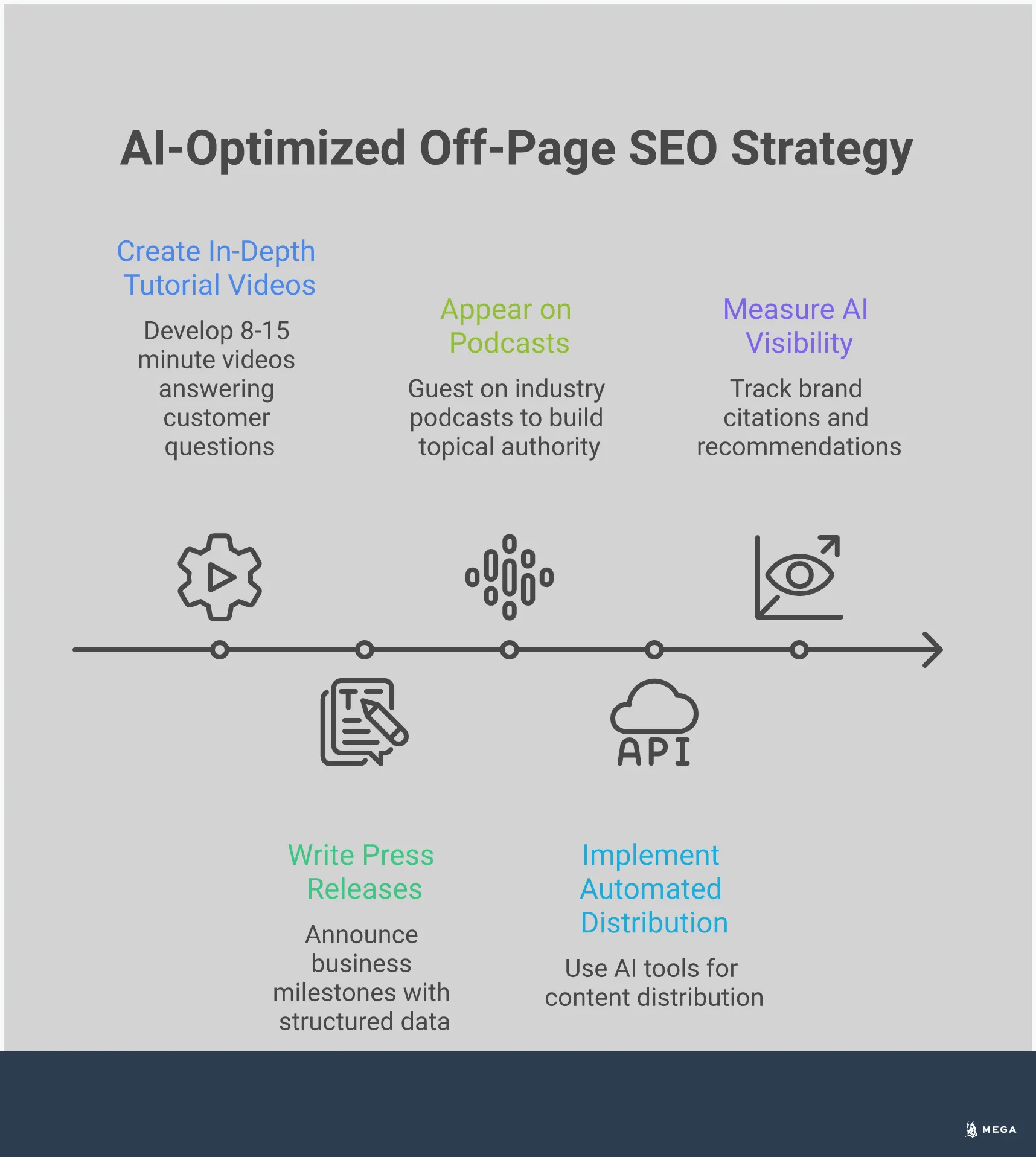
Use YouTube to Build Trust with AI Models
YouTube is one of the most powerful platforms for building trust with AI models. As a Google-owned property with a massive library of transcribed video content, it's a primary source of information for LLMs. When you create in-depth videos that answer common questions and demonstrate your expertise, you're essentially training the AI to see you as a credible source. As marketing expert Solomon Thimothy notes, AI models run on algorithms, and "if you can figure that out... it's not impossible." Creating consistent, high-quality video content is a direct way to show the algorithm that you are an authority in your field, making it more likely that an AI will cite your business in its answers.
Establish Authority Through Podcast Mentions
Podcasts provide conversational context that AI models find incredibly valuable. When you appear as a guest on podcasts in your industry, you create audio and text signals (from transcripts) that link your name and brand to specific topics. This helps you build topical authority and a wider digital presence. Each mention serves as a citation, reinforcing your expertise. Thimothy emphasizes that "share of voice in media is key," and podcasts are an accessible way for any brand to increase its visibility. Getting featured on relevant shows puts your expertise in front of new audiences and feeds AI models with more proof of your credibility.
Structure Your Brand Information with Press Releases
Think of press releases as a way to feed AI models structured, factual information about your business. When you announce a new service, partnership, or milestone, a press release distributes that information across news outlets and syndication networks. According to an article from Notified, "Your news becomes part of how AI answers people’s questions." By using a strategic approach to press releases, you can ensure that AI models have access to accurate, up-to-date information about your brand. This helps control your narrative and makes it easier for AI to understand who you are, what you do, and why you matter.
Why Off-Page Signals Matter More for Small Businesses
For small and local businesses, competing with large corporations online can feel like an uphill battle. Big brands have massive budgets for advertising and extensive on-page SEO. However, the rise of AI-powered search creates a new opportunity. AI models look for authority and expertise across the entire web, not just on a single website. This means a smart off-page strategy, focused on creating valuable content on platforms like YouTube, podcasts, and through press releases, can help you build brand authority and gain visibility where it matters most.
Level the Playing Field with Content
In the past, ranking on Google often meant having the most backlinks or the largest website. AI search changes this dynamic by prioritizing expertise and clear information. As writer Chris Essey explains, "AI visibility describes how often and how accurately a business appears in AI-powered search tools." For a small business, this is a huge advantage. You can create focused, high-quality content that directly answers your customers' specific questions. An in-depth YouTube tutorial or a detailed blog post can establish your expertise on a niche topic, making your business a go-to source for AI models seeking reliable answers. This allows you to compete on the quality of your information, not the size of your budget.
Build Authority Beyond Your Website
Trust is a major factor for AI models when they decide which sources to cite. They determine this trust by looking at signals from across the web. When your business is mentioned in a press release, featured on a podcast, or cited by a local news outlet, it tells AI that you are a legitimate and authoritative entity. According to Notified, when you issue a press release, "your news becomes part of how AI answers people’s questions." For small businesses, building this off-site presence is critical. Each mention contributes to a broader digital footprint that AI can verify, strengthening your brand's credibility far more than your website alone ever could.
Compete with Big Brands Using Different Content Formats
Large companies may dominate traditional search results, but AI offers new ways to get noticed. AI-powered search often delivers direct answers and summaries, pulling information from various sources. By using formats like structured data, you can feed AI the exact information you want it to share. As Peak Advisers notes, "If your business info isn’t structured for AI, you risk being invisible in these high-impact new search results." A well-crafted press release with structured data about your services, hours, and location can appear directly in an AI-generated answer. This allows you to bypass traditional rankings and place your business right in front of potential customers, giving you a competitive edge. You can see how an AI agent can help structure and distribute this information for you.
How to Make Your YouTube Content AI-Friendly
YouTube is more than just a video platform; it’s the second-largest search engine in the world and a key source of information for AI models. When an LLM needs to understand a topic, it often turns to trusted, authoritative video content. For small businesses, this is a huge opportunity. Creating the right kind of YouTube content helps you build a direct relationship with your audience while also feeding AI models the exact information they need to see you as a credible source.
Think of your YouTube channel as a visual library of your expertise. Every video you publish is a chance to demonstrate your knowledge, answer customer questions, and build brand authority. AI models analyze video transcripts, titles, descriptions, and engagement signals to determine which content is trustworthy and relevant. By optimizing your videos for AI, you’re not just trying to rank on YouTube; you’re positioning your brand to be the go-to answer in AI-generated search results. This is a core part of a modern off-page SEO strategy that builds influence far beyond your own website.
Show Your Expertise with In-Depth Videos
To stand out to both viewers and AI, focus on creating in-depth videos that prove you know your stuff. This means going beyond short, superficial clips. Instead, create comprehensive tutorials, detailed product demonstrations, or deep-dive Q&A sessions that thoroughly answer a specific question. This approach "not only builds trust with your viewers but also aligns with the algorithms that prioritize quality content." When an AI model sees a video that spends significant time exploring a topic, it interprets that content as more authoritative and useful, making it a more likely candidate for citation in its answers.
Focus on the Engagement Metrics AI Cares About
Engagement tells AI models that real people find your content valuable. Metrics like watch time, likes, shares, and comments are powerful signals of authority. A video with high watch time indicates that the content is compelling enough to hold a viewer's attention. Similarly, a high number of shares and comments shows that the content is sparking conversation and providing value worth sharing. You can encourage this interaction by ending your videos with a question to prompt comments or by creating content that directly addresses common customer pain points, making it highly shareable.
Optimize Your Video Descriptions and Structured Data
A well-written video description full of relevant keywords is still essential, but you can give AI an even clearer signal by using structured data. Think of schema markup as a way to label your content so search engines and AI can instantly understand what it’s about. By adding this code to your video’s information, you can specify details like what the video is, who created it, and what topics it covers. This helps your content stand out and increases its chances of being featured in AI-generated results, as it removes any ambiguity about the video’s purpose and context.
Use Press Releases to Improve Your LLM Presence
Press releases are a powerful tool for communicating factual, timely information about your business. While their traditional audience was journalists, their new audience includes the AI models powering search. A well-crafted press release directly feeds these systems the exact information you want them to know about your brand, products, or company milestones. By structuring this information clearly, you make it easy for AI to verify facts and use them in search results. This is a key part of a modern AI SEO strategy, turning a public relations tool into a direct line of communication with the algorithms shaping online visibility.
Help AI Understand Your Business with Structured Data
AI models thrive on structured data because it removes ambiguity. When you embed information in a clear, machine-readable format, you’re giving the AI a cheat sheet for your business. Using structured data like LocalBusiness schema markup in your press releases helps AI systems accurately understand your location, hours, and services. This is especially important for local businesses. When someone asks a voice assistant for "plumbers near me," a well-structured press release about your new service area can help ensure your business is the one recommended. It’s about making your key business details easy for machines to process.
Distribute Press Releases Where AI Will Find Them
Writing a great press release is only half the battle; you also need to make sure AI models can find it. Distributing your release through reputable newswires ensures it gets published on hundreds of news sites, creating a widespread digital footprint. Each publication becomes another data point that reinforces your message. AI models crawl these news sources to learn about the world, so your news becomes part of their knowledge base. A strategic approach to press release distribution helps you influence AI search results and ensures your brand’s story is told accurately across the web.
What to Include for Maximum Impact
To maximize your press release's impact, focus on clarity and substance. Go beyond the basic announcement and include details that answer common customer questions. Clearly explain your services, define your service areas, and provide context around your pricing. This information helps AI systems understand your business on a deeper level. Many small businesses miss out on AI visibility because their online information is vague. By including these essential details in your press releases, you create a rich source of information that AI can use to confidently recommend your business to potential customers.
Why Your Small Business Needs a Podcast Strategy
Podcasting might seem like just another marketing channel to add to your list, but it’s becoming a critical tool for getting noticed by AI search engines. Large language models (LLMs) like the ones powering Google’s AI Overviews and ChatGPT learn from a wide range of content, and the natural, conversational style of podcasts is a rich source of information for them. Unlike a structured webpage, a podcast conversation provides context, nuance, and authentic language that helps AI understand who you are and what you do.
For a small business, this is a huge opportunity. You can share your expertise and tell your brand’s story in a way that resonates with both human listeners and AI models. By appearing as a guest on relevant podcasts or starting your own, you create a library of audio content that establishes your authority. This content helps AI models see you as a credible source, making it more likely they will cite your business in their answers. Think of it as building your brand’s reputation directly with the AI that is increasingly guiding customer decisions. An AI-powered SEO agent can then track how these off-page signals contribute to your overall visibility.
Provide Conversational Context for AI
AI models are designed to understand and replicate human conversation. When they scan the web for information, they look for content that explains topics in a natural, easy-to-understand way. Podcasts are a perfect source for this. Engaging in podcast interviews gives AI a conversational context to learn about your business. Every time you discuss your industry, services, or customer stories on a podcast, you’re essentially feeding the AI a transcript of your expertise. This helps it connect your brand name with key topics, making you a more relevant result for related searches.
Build Topical Authority with Audio Content
To rank well in any search engine, you need to be seen as an authority on your topic. Podcasts are an excellent way to build this credibility over time. Consistently producing or appearing on podcasts where you discuss your area of expertise sends a strong signal to AI that you know your stuff. This consistent "share of voice" helps you establish topical authority, which is crucial for showing up in AI-generated answers. The more high-quality audio content you have associated with your brand, the more confident AI models become in recommending you as a trusted resource.
Create FAQ Content That AI Can Use for Answers
Many people turn to search engines to ask specific questions. AI is getting better at providing direct answers, and it pulls that information from content that is clear and structured. You can use a podcast to create a library of answers to your customers’ most common questions. Dedicate episodes or segments to addressing specific pain points or inquiries. This creates a valuable resource that AI can easily parse and use to formulate its responses. By directly answering questions people are already asking, you position your business as the go-to source for solutions in your niche.
How to Automate Your Off-Page Optimization
Manually managing your off-page SEO—from finding podcast opportunities to distributing press releases—is a full-time job. For small business owners, it’s often an impossible one. Automation is what makes a sophisticated off-page strategy accessible. By using AI-powered tools, you can handle the research, content creation, and distribution that builds your brand’s authority without spending all your time on it. An AI SEO agent can act as your dedicated marketing arm, letting you execute at scale while you focus on running your business.
Automate Research and Content Distribution
Effective off-page SEO starts with knowing where to show up. AI tools can automate this research, identifying relevant blogs, podcasts, and publications in your niche and generating a prioritized list of opportunities. When you have content, like a press release, automation helps you get it in front of the right people. Using a PR distribution network ensures your news is sent to journalists and outlets, feeding the AI models that shape search answers and getting your brand into the discussions that LLMs use as source material.
Optimize for Placement in LLM Results
Getting your content out there is only half the battle; it also needs to be structured so AI models can understand it. If your business information isn't formatted correctly, you risk being invisible in AI-generated search results. This is where technical optimization comes in. Implementing schema markup, especially LocalBusiness schema for local companies, helps AI systems accurately display your address, hours, and services. Automating this ensures all your content is properly tagged, improving your chances of appearing in AI Overviews, map packs, and voice search answers.
Combine AI Tools with Human Oversight
Automation provides speed and scale, but human insight adds the creativity and connection that builds a brand. The best strategies find a balance between AI and human input. Use AI to analyze data, generate drafts, and manage distribution, but rely on your expertise to ensure the final product reflects your brand’s voice. This human-in-the-loop approach lets you maintain quality control while benefiting from automation's efficiency. Combining AI's analytical power with a human, creative vision leads to a strategy that is both impactful and authentic.
Key Elements for Effective Off-Page Signals
No matter which channels you choose—YouTube, podcasts, or press releases—a few core principles will make your off-page content more effective for AI search. These are the foundational elements that help AI models find, understand, and trust your information. By focusing on clarity, consistency, and usefulness, you give your brand the best chance of being featured in AI-generated answers.
Write Clear Headlines and Use Relevant Keywords
Clear, descriptive headlines are your first handshake with an AI model. For a YouTube video, a podcast episode, or a press release, the title should state exactly what the content is about. Use the same keywords your audience uses when they search for information. This is a core part of any good SEO strategy, and it's just as important for AI visibility. This clarity, combined with good structured data, helps search engines and AI systems quickly grasp the context of your content, making it easier for them to recommend it to the right people.
Integrate Multimedia Across All Your Channels
Your brand story becomes more powerful when you tell it across different platforms. When an AI model sees your business mentioned in a press release, discussed on a podcast, and demonstrated in a YouTube video, it builds a more complete picture of your authority. These interconnected signals reinforce your expertise. For instance, effective press releases can announce a new product, and you can embed a link to a YouTube demo within that release. This strategy feeds AI models with consistent, multi-format information, making your brand a more reliable source in their eyes.
Answer Common Questions Directly in Your Content
Large language models are built to answer questions. You can make your content a prime source for their responses by directly addressing common customer queries. Create YouTube videos that start with a question, dedicate podcast segments to answering FAQs, or include a Q&A section in your press releases. When you clearly explain services, pricing, and processes, you provide the exact kind of factual, helpful information that AI systems look for. This positions your business as a helpful authority and increases the likelihood that your answers will be used to inform AI-generated results.
How to Measure Your Success with LLMs
Measuring your off-page SEO success is different when your target is an AI model. While traditional metrics like backlinks and keyword rankings still have their place, they don’t paint the full picture of your visibility in AI-generated search results. Success in this new landscape is less about hitting the number one spot on a results page and more about becoming a trusted, citable source for the AI itself.
The goal is to have your brand, products, and expertise woven directly into the answers that LLMs provide. This requires a shift in focus toward metrics that reflect authority, accuracy, and brand presence across the web. Instead of just tracking your website's rank, you’ll need to monitor how your brand is mentioned, how accurately your information is presented by AI, and whether your content is being used to answer user questions. This means looking at your digital footprint as a whole—from YouTube videos to press releases—to see if you’re building a reputation that AI models can recognize and trust.
Track Mentions and Citations from AI
One of the most direct ways to measure your impact is to track when and how AI models mention your brand. This involves regularly querying tools like ChatGPT, Perplexity, and Google’s AI Overviews with questions related to your industry, products, or services. Are you cited as a source? Is your business recommended? When your content is well-structured and distributed widely, it feeds these AI models. Your news and expertise become part of how AI answers people’s questions, making your brand a go-to resource. Document these mentions over time to see if your off-page efforts are successfully positioning your business as an authority.
Monitor Your Brand Authority Everywhere
Your brand’s authority isn’t just about direct citations; it’s about the overall perception of your expertise across multiple platforms. This concept, often called AI visibility, measures how often and how accurately your business appears in AI-powered tools. Are AI assistants pulling the correct hours for your local shop? Do AI summaries accurately describe what your company does? Monitoring this means checking how your brand is represented everywhere, not just on your website. Consistent and accurate information across all your off-page channels—like your YouTube channel, podcast interviews, and local directories—builds a strong, trustworthy signal for AI models to follow.
Look Beyond Traditional SEO Metrics
To truly understand your performance, you need to look beyond clicks and rankings. Metrics related to how well machines can understand your content are becoming more important. For example, using structured data on your website and in your press releases helps AI models comprehend the context of your information. This makes it easier for them to pull accurate details like product prices, event dates, or business locations. Pay attention to whether your content is being featured in rich snippets or knowledge panels, as these are often precursors to being included in AI-generated answers. The more you can do to make your information clear and machine-readable, the better your chances of success.
Get Started with Your AI-Optimized Off-Page Strategy
Putting these ideas into practice doesn't require a massive team or budget. It’s about making smart, strategic choices and building a system that works for you. The goal is to create a consistent presence on the platforms where AI models are learning about the world. By focusing your efforts and creating a repeatable process, you can build a strong off-page foundation that gets your brand noticed by both customers and AI.
Prioritize Channels for the Best Results
Start by focusing on the channels that offer the most impact for AI visibility. Press releases, for example, are a powerful tool because they directly feed AI models with structured, factual information about your business. When your news becomes part of how AI answers questions, you gain a significant advantage. Your AI visibility describes how accurately your business appears in AI-powered search tools and summaries. If your business information isn’t structured for AI, you risk becoming invisible in these new high-impact search results. Choose one or two channels, like YouTube or press releases, and commit to creating high-quality, consistent content there first.
Build a Sustainable Content Distribution System
Once you create content, you need a reliable way to distribute it. For press releases, use PR distribution networks but also share the release on your own website to maximize its reach. For all your content, implementing structured data is essential. Structured data helps search engines and AI models understand the context of your content, which can lead to more informative and visible results. An automated tool like MEGA AI’s SEO agent can help manage this process, ensuring your content is properly optimized and distributed for both traditional search engines and new AI platforms. This creates a sustainable system for building your brand’s authority online.
Related Articles
- How to Master AI SEO & Get Featured by Google
- The Role of Artificial Intelligence in SEO: Transforming Search Engine Optimization - MEGA SEO | Blog
- AI in SEO: How Artificial Intelligence is Changing Search
- What Is Sightless SEO? Your Guide to AI Search
Frequently Asked Questions
Do I need to be on YouTube, run a podcast, and write press releases all at once? Not at all. The idea is to build a presence on the channels that make the most sense for your business, not to be everywhere at once. Start with one. If you have a new service to announce, a press release is a great, focused way to feed factual information to AI models. If you're more comfortable on camera, creating a few in-depth YouTube videos that answer common customer questions can be a powerful starting point. The key is consistency on your chosen platform, not overwhelming yourself with all of them.
What's the single most important takeaway for my small business? The most important thing to understand is that your expertise is now a key asset for AI visibility. Your goal is to make it easy for AI models to recognize you as an authority in your field. You can do this by clearly and consistently sharing your knowledge across the web, whether that's in a video, an article, or a press release. Think of it as building a public resume of your brand's credibility for an AI to read.
How is building 'AI visibility' different from traditional link building? Traditional link building focuses on getting other websites to link back to yours as a signal of authority. AI visibility is much broader. It considers your entire digital footprint, including mentions of your brand in videos, podcast transcripts, and news articles, even without a direct link. It's less about the number of links and more about the quality and consistency of information about your brand across the entire internet.
How can I tell if my off-page efforts are actually influencing AI? Measuring this is an evolving practice, but you can get a good sense by directly querying AI tools. Ask ChatGPT or Google’s AI Overviews questions that your customers would ask, and see if your business is mentioned or cited as a source. You can also monitor whether AI-powered results, like map packs or knowledge panels, are pulling accurate and up-to-date information about your business. Seeing your brand consistently and correctly represented is a strong sign of success.
Why is structured data mentioned so often in the context of AI? Structured data is essentially a way of labeling the information on your website so that machines can understand it perfectly. Think of it as a cheat sheet for AI. For a local business, it explicitly tells an AI your exact address, hours, and services. This removes any guesswork and makes it much more likely that the AI will use your information correctly when answering a user's question, like "find a plumber near me that's open now."