
AI is no longer a future concept in search; it's the current reality. Search engines are integrating large language models to provide direct answers, and platforms like ChatGPT are becoming go-to sources for information. This shift means your SEO strategy must evolve beyond traditional keyword targeting. The goal is now to become a trusted source that AI models cite. This requires a deeper understanding of how these algorithms work and a more comprehensive approach to content. This guide provides a new playbook for winning in an AI-driven search world, covering everything from content creation to technical optimization for new search formats.
Key Takeaways
- Own the Entire Search Page: Don't just aim for the top organic spot. A modern strategy involves optimizing for rich snippets, the local pack, and video carousels to maximize your visibility and connect with users in multiple ways.
- Extend Your Strategy Beyond Google: Your audience is active on YouTube, social media, and industry forums. Building a consistent brand presence on these platforms creates more discovery opportunities and strengthens your overall authority.
- Create Content for Questions, Not Just Keywords: Adapt to AI and voice search by structuring your content to directly answer the questions your audience is asking. Regularly updating your articles keeps them relevant and establishes your site as a trusted source for both users and search engines.
What is a Modern SEO Strategy?
If you think SEO is just about stuffing keywords into a page, it's time for an update. Modern SEO has evolved far beyond its original definition. Today, it's a central piece of your entire digital marketing puzzle. A successful strategy isn't built in a silo. It requires a deep understanding of multiple elements, from technical site health and content creation to user experience and brand messaging. The best SEOs know that their work impacts, and is impacted by, every other marketing effort. It's about creating a seamless experience for your audience, from the moment they discover you in a search result to the time they become a customer.
This also means looking beyond a single search engine. A modern SEO strategy is a multi-platform strategy. Your audience isn't just on Google; they're on YouTube, social media, forums, and industry-specific sites. True visibility means meeting them where they are. This requires a consistent approach to your brand and messaging, ensuring brand cohesion no matter where someone finds you.
Of course, you can't improve what you don't measure. A key part of any modern strategy is measuring SEO success with a multi-dimensional approach that ties back to your business objectives. This data helps you identify what's working, what isn't, and where to adapt. It's about making informed decisions to overcome barriers and continuously refine your approach for better results.
How Search Has Changed
If you still picture a simple list of ten links when you think of Google, it’s time for an update. The way people find information online has fundamentally shifted, and search engines have evolved right along with them. Understanding this new landscape is the first step to building a strategy that actually works. It’s not just about ranking anymore; it’s about showing up in all the places your audience is looking.
What today's SERPs look like
The days of ranking in 10 blue links are long gone. Today’s search engine results page, or SERP, is a dynamic and crowded space. When you search for something, especially a local service or product, you’re met with a variety of features. You’ll likely see paid ads at the top, a map with a local pack of businesses, a “People Also Ask” section with dropdown questions, and maybe even image carousels or video results.
Relying only on traditional organic rankings is a risky game. If your only goal is to be one of the blue links, you’re missing out on huge opportunities for visibility. The modern approach is to think about how you can capture as much SERP real estate as possible. This means your SEO strategy needs to be comprehensive enough to target these different features, from optimizing for the local pack to creating content that answers common questions.
Why you need a multi-platform strategy
This idea of capturing more real estate extends beyond Google’s search results. Your customers are on YouTube, LinkedIn, TikTok, and other platforms, and your presence there matters more than you might think. All of that visibility and brand awareness funnels into the large language models that are increasingly powering search. When people see your brand consistently across different channels, it builds trust and authority that search engines recognize.
For example, if you’re a local business, your Google Business Profile is a critical asset for getting found in AI-powered search results. For other businesses, having a strong YouTube presence can help you dominate video results. Building a multi-platform presence isn't easy, but it's what you must do to perform long-term. Businesses that invest in this holistic approach are the ones that will build a durable, future-proof brand. Automating this process can make a multi-platform strategy much more manageable, letting you focus on growth instead of manual tasks.
How to Maximize Your SERP Visibility
Getting to the top of Google isn’t just about securing the number one organic spot anymore. The search engine results page (SERP) is a dynamic mix of maps, shopping ads, Q&A boxes, videos, and AI-generated summaries. Maximizing your visibility means showing up in as many of these places as possible. This multi-front approach ensures you can connect with your audience, no matter how they search or what features Google displays. It’s about owning the entire screen, not just a single line of text.
Win with rich snippets and search features
Rich snippets and other search features are your chance to stand out on a crowded results page. These enhanced listings—which can include star ratings, prices, or event dates—are pulled from structured data you add to your site’s code. They give users a quick snapshot of your page’s value before they even click. Google often shows its priorities through the SERP layout; features like 'People Also Ask' and AI-powered overviews are becoming more prominent. To win these spots, you need to create clear, concise content that directly answers common questions from your audience. Think of it as giving the search engine exactly what it needs to feature your content.
Dominate the local pack
For any business with a local presence, the map pack is prime real estate. Your Google Business Profile is essentially your digital storefront, and optimizing it is one of the most impactful local SEO activities you can undertake. Neglecting it is a common mistake that can seriously hurt your local rankings. Start by ensuring your business name, address, and phone number (NAP) are consistent everywhere online. Then, fill out every section of your Google Business Profile, upload high-quality photos, and actively encourage and respond to customer reviews. This builds trust with both Google and potential customers, making you a top contender for those coveted map pack positions.
Capture more SERP real estate
A modern SEO strategy is about capturing as much SERP real estate as possible. This means you aren't just fighting for one blue link; you're aiming to appear in the local pack, image results, video carousels, and featured snippets all at once. To succeed with online marketing now, "you need to be everywhere. You need to be fighting many, many battles." This requires a multi-dimensional approach where you track progress across different fronts, not just a single keyword ranking. By diversifying your presence, you build brand authority and create multiple touchpoints for users to find you. Managing these different fronts is where an end-to-end SEO platform can simplify your efforts and ensure no opportunity is missed.
Optimize for Local SEO and Google Business Profile
For businesses that serve a specific geographic area, local search isn't just a part of SEO—it's the most important part. When potential customers search for products or services "near me," you want your business to appear prominently in Google's local pack and on Maps. This is where your Google Business Profile (GBP) becomes your most valuable asset. A well-managed profile can be the difference between a customer walking through your door or visiting a competitor down the street.
What makes a Google Business Profile effective
A well-optimized Google Business Profile can significantly improve your local search presence and drive more foot traffic or online inquiries. Think of it less as a static listing and more as a dynamic storefront on Google. An effective profile is complete, accurate, and active. This means filling out every section, from your business hours and service areas to accessibility attributes. It also involves regularly uploading high-quality photos, encouraging and responding to customer reviews, and using features like Google Posts to share updates. Many businesses make mistakes that limit their GBP's effectiveness, but keeping your profile fresh and engaging sends strong signals to Google that your business is active and relevant to local searchers.
Strategies to improve local visibility
To improve your visibility in local search, you need to focus on a few key areas beyond your profile itself. A core strategy is maintaining consistent NAP (Name, Address, Phone number) information across the web. Any discrepancy in your business details on different websites or directories can confuse search engines and hurt your rankings. You should also actively manage your online reviews. Responding promptly and professionally to all feedback shows both customers and Google that you value customer service. Building local citations by getting your business listed in reputable online directories also reinforces your location and legitimacy, further strengthening your local SEO foundation.
Tactics for your Google Business Profile
Common mistakes can harm your local search rankings, but avoiding these pitfalls ensures your business information remains clear and accessible. Start by using the Google Posts feature to share weekly updates, special offers, or event announcements. Regularly add new, high-quality photos and videos of your storefront, products, and team in action. Proactively use the Q&A section by adding frequently asked questions and providing clear, helpful answers. Make sure you've selected all relevant primary and secondary business categories to help Google understand exactly what you do. Enabling the messaging feature also provides a direct line for customers to connect with you, improving engagement and making it easier to generate leads.
Build a Strong Multi-Platform Presence
A modern SEO strategy extends far beyond your website. To maximize visibility, you need to think of your brand as a presence that exists across the entire digital ecosystem. This means meeting your audience where they are, whether they're scrolling social media, watching videos, or asking questions on community forums. Engaging across multiple online streams is essential for building a resilient and far-reaching online presence. While it requires a coordinated effort, the payoff is a brand that's discoverable from multiple angles, not just a single search query. This approach protects you from algorithm shifts and opens up new avenues for customer acquisition.
How to diversify your online visibility
To successfully establish your brand, you need to engage across multiple channels like social media and your business website by creating valuable content. Relying solely on your website means you’re missing conversations happening elsewhere. Think about platforms like Reddit or industry forums where potential customers are asking questions you can answer. Being a helpful participant builds authority and drives referral traffic. The main challenge is creating a consistent presence across these streams. A strong content strategy ensures your message is cohesive, making your brand recognizable and trustworthy wherever it appears.
Key platforms to use besides Google
Your audience doesn't just live on Google. They're on YouTube, TikTok, Instagram, and LinkedIn, and each platform is a search engine in its own right. Users are actively looking for solutions and products on these sites. Maintaining brand consistency is a common challenge when you expand your presence across these channels. Your brand voice and core messaging need to feel aligned everywhere. This is where having a central system for content management becomes critical. For example, tools that help you manage paid ads across Meta and LinkedIn from one place can simplify the process, ensuring your campaigns are cohesive.
Use video content for SEO
Video, especially short-form, is no longer just a social media tactic; it's a core part of SEO. Google increasingly features a carousel of short videos from YouTube, TikTok, and Instagram directly on the search results page. This is a huge opportunity because many of these videos aren't optimized for specific keywords. You can gain a competitive edge by creating simple, helpful videos built around the search terms your audience uses. This doesn't require a massive production budget. A clear message and a keyword-focused title can be enough to start capturing this valuable SERP real estate and driving awareness with short videos.
Create Relevant Content That Ranks
Creating content that resonates with your audience is the foundation of any successful SEO strategy. In the past, you might have focused solely on hitting specific keywords. Today, search engines are much smarter. They prioritize content that genuinely satisfies a user's needs. As one expert puts it, "Relevance is the most important thing. Hands down." Your goal is to create the best, most helpful, and most relevant answer to a person's query. This approach not only helps you rank higher but also builds trust and authority with your audience, turning searchers into loyal customers.
Align content with user intent
Every time someone types a query into a search bar, they have a specific goal in mind. This is called user intent, and aligning your content with it is non-negotiable. Before you write a single word, you need to understand what the searcher is trying to accomplish. Are they looking for information (e.g., "how to start a podcast"), trying to find a specific website (e.g., "MEGA AI"), or are they ready to buy something (e.g., "best price for microphone")? Analyzing the top-ranking pages for your target keyword gives you direct clues into what Google believes is the most relevant type of content for that query. Matching that intent is your first and most important step.
Techniques to improve relevance and engagement
Once you understand user intent, you can focus on creating high-quality content that keeps people on your page. To rank higher, you have to create consistent content that keeps customers coming back. You can measure this by tracking how your pages perform. For example, seeing your content break into the Top 3 rankings is a strong signal that you're satisfying search intent effectively. Other metrics like click-through rate (CTR) and time on page also tell search engines that users find your content valuable. Using automated SEO tools can help you monitor these metrics and identify opportunities to make your content even more engaging for your audience.
How to keep content relevant over time
SEO is not a one-and-done task. The digital landscape is always changing, and content that was relevant last year might be outdated today. One of the biggest barriers to effective SEO is finding the resources to consistently produce and update high-quality content. A practical solution is to perform regular content audits. Look for articles with declining traffic, update old statistics, fix broken links, and add new information to address recent developments. This process can be time-consuming, but it's essential for maintaining your rankings. Platforms like MEGA AI can automate this entire process, updating articles to improve CTR and even adding new content to keep them fresh and competitive. You can book a demo to see how it works.
Key Parts of Modern Technical SEO
Technical SEO forms the foundation of your entire strategy. It’s all about making sure search engines can find, crawl, and understand your website without any issues. While the name sounds intimidating, focusing on a few key areas can make a significant difference. Getting these technical elements right ensures that your great content and multi-platform efforts have the best possible chance to succeed. Think of it as building a solid house before you start decorating.
Core Web Vitals and page experience
Your website’s performance directly impacts user satisfaction and your search rankings. Google uses a set of metrics called Core Web Vitals to measure this. These factors are part of the overall page experience signals and focus on three key aspects of how a user perceives your site: loading speed, interactivity, and visual stability. In simple terms, Google wants to see that your pages load quickly, become usable without delay, and don't have elements that jump around unexpectedly. Improving your Core Web Vitals can lead to better rankings, as Google has confirmed that page experience is a ranking factor. Tools like MEGA AI’s SEO platform can automatically handle technical improvements, helping you meet these standards without needing a developer.
What is mobile-first indexing?
Most people use their phones to search the web, and Google’s process reflects that. Mobile-first indexing means Google predominantly uses the mobile version of your website for indexing and ranking. If your site isn't optimized for mobile devices, you're likely falling behind in search results. To prepare your site, you need to ensure your mobile version has the same valuable content as your desktop site. This includes text, images, and videos. The layout and functionality should also be designed for a smooth mobile experience, with easy-to-tap buttons and readable text. A responsive design, where your site automatically adjusts to fit any screen size, is the best way to accomplish this and provide a consistent experience for all users.
How to use structured data
Structured data is a standardized format for telling search engines exactly what your content is about. Think of it as a translator that helps Google understand the context of your page—for example, identifying a recipe, an event, or a product. This code is added to your website's backend and isn't visible to the user. By implementing structured data, you can help your pages qualify for rich snippets in search results. These are the enhanced listings you see with star ratings, prices, or event dates right on the SERP. Rich snippets are more eye-catching and can significantly improve your click-through rates, driving more qualified traffic to your site without necessarily needing a higher ranking.
Adapt to AI in Search
How AI changes search algorithms
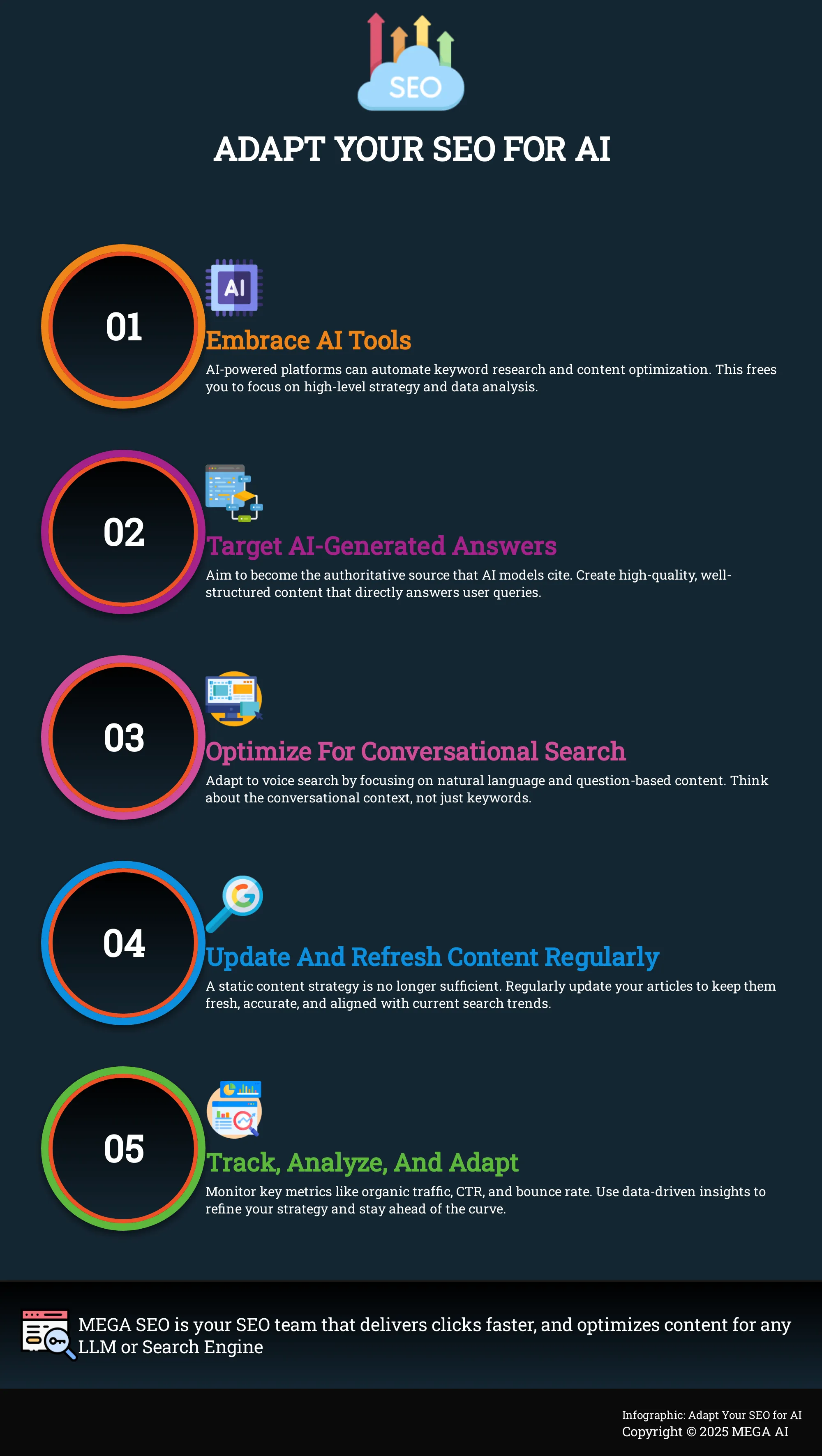
AI is no longer a future concept in search; it's the current reality. Search engines are integrating large language models to provide direct, summarized answers, changing the classic list of blue links. At the same time, platforms like ChatGPT are becoming go-to destinations for information, creating new arenas where you need to be visible. This shift means your SEO strategy must evolve beyond traditional keyword targeting.
The goal is now to become a trusted source that AI models cite. This requires a deeper understanding of how these algorithms work and a more comprehensive approach to content. An effective SEO strategy now involves creating content that is not only valuable to a human reader but is also structured clearly for an AI to understand and reference.
Optimize for voice and conversational search
The rise of AI directly connects to the growth of voice and conversational search. People are interacting with devices by asking questions in natural language, not just typing in fragmented keywords. Your content needs to reflect this change. Focus on answering the specific questions your audience is asking. Think about the full conversational context around a topic, not just the primary keyword.
For local businesses, this trend makes your Google Business Profile more critical than ever. AI assistants often pull directly from GBP listings to answer location-based queries like "Where can I find handmade pottery near me?". A well-optimized profile is a direct line into these conversational search results, making it a non-negotiable part of modern local SEO.
How to stay relevant as AI evolves
Staying relevant in an AI-driven landscape means being proactive and comprehensive. SEO is more complex now; you have to do multiple things well to win. A static content strategy is no longer enough. You need a system for continuously updating your existing articles to keep them fresh, accurate, and aligned with the latest search trends and user intent.
This means re-optimizing content after major algorithm updates and even tailoring it for different platforms, whether it's Google's AI Overviews or another large language model. Regularly analyzing performance and making data-driven adjustments is key. Using tools that can automate content maintenance helps you stay competitive without getting overwhelmed. You can book a demo to see how an AI-powered platform can manage these complexities for you.
Measure and Analyze Your SEO Performance
A strategy without measurement is just a set of guesses. To know if your efforts are paying off, you need to track your performance, understand the data, and use those insights to make smart adjustments. This process turns your SEO from a one-time task into a dynamic system that continuously improves. Let's walk through how to measure your success and use that information to refine your approach for even better results.
KPIs for multi-platform visibility
To effectively measure your SEO, you need to focus on key performance indicators (KPIs) that align with your business objectives. Start by tracking your organic traffic to see how many people are finding you through search. Monitor your keyword rankings to understand your visibility for important terms. Another critical metric is your click-through rate (CTR), which tells you how many people who see your site in search results actually click on it. A low CTR might mean your title or meta description isn't compelling enough. Also, keep an eye on your bounce rate; a high rate can indicate that your landing page isn't meeting the visitor's expectations. Together, these SEO metrics provide a clear story of what’s working and where you can improve.
Tools to track your progress
You don’t have to track your progress manually. Free tools like Google Analytics and Google Search Console are essential for any website owner, offering deep insights into your traffic, user behavior, and how Google sees your site. For a more integrated approach, platforms like MEGA AI build analytics directly into your workflow. Our SEO tools not only automate content creation and optimization but also help you monitor the impact on your performance. For example, our Maintenance Agent is designed to improve your content's CTR and can identify new content to add to existing articles, helping you track and act on performance data all in one place. This allows you to focus on the core metrics that tell the complete story: organic traffic, conversions, and traffic value.
Use data to adapt your strategy
The real power of data lies in its ability to inform your next move. Analyzing your performance metrics helps you identify what’s working so you can do more of it, and what isn’t so you can adjust. For instance, if you notice a blog post is starting to rank for unexpected keywords, you can update it with a new section that directly addresses that topic. This is one of the common SEO challenges—keeping content fresh and relevant. Platforms like MEGA AI can automate this process, re-optimizing content to capture new opportunities. This cycle of measuring, analyzing, and adapting is what turns a good SEO strategy into a great one that consistently drives growth.
Future-Proof Your SEO Strategy
The world of search is in constant motion. What works today might be outdated tomorrow. A successful SEO strategy isn't a "set it and forget it" plan; it's a living document that evolves with technology, search engine algorithms, and user behavior. Future-proofing your approach means building a resilient foundation that can adapt to these changes, ensuring your visibility and growth are sustainable for the long haul. It’s about moving from a reactive stance—scrambling after every update—to a proactive one where you’re prepared for what’s next.
This involves a commitment to quality, a willingness to adopt new tools, and a persistent curiosity. By focusing on these core areas, you can create a strategy that not only performs well now but is also built to withstand the inevitable shifts in the digital landscape.
Stay ahead of algorithm updates
Search engine algorithms are constantly being refined to deliver better results. Instead of fearing these updates, you can prepare for them by building a strong, user-focused foundation. Identifying and overcoming barriers to effective SEO is essential for any business looking to improve its online presence. Rather than chasing short-term wins, concentrate on creating high-quality, helpful content that genuinely serves your audience. This approach is more resilient to algorithm changes.
A great strategy is to regularly refresh and optimize existing content to keep it relevant and accurate. This signals to search engines that your site is a reliable source of information. By focusing on quality and user experience, you build a strategy that stands the test of time.
Embrace new tech and trends
The SEO landscape is filled with challenges, from growing competition to incorporating new technology. As technology evolves, so must your SEO strategies. Embracing new tools and methodologies can provide a significant competitive edge. AI, in particular, is no longer a futuristic concept but a practical tool that can transform your workflow.
AI-powered platforms can automate time-consuming tasks like keyword research and content optimization, freeing you up to focus on high-level strategy. These tools can also uncover insights that would be nearly impossible to find manually. By integrating AI-driven SEO into your process, you can work more efficiently and make smarter, data-backed decisions that keep you ahead of the curve.
Why you should always be learning in SEO
SEO is not a one-and-done activity; it's a continuous cycle of learning and adaptation. This is key to staying relevant in the ever-changing landscape of search. To truly understand what’s working, you need to establish clear metrics and track your performance over time. This data provides the insights you need to refine your approach and double down on successful tactics.
Cultivate a mindset of curiosity. Follow industry news, experiment with new strategies, and never assume you have it all figured out. The digital world moves quickly, and the most successful marketers are those who are committed to ongoing education. This dedication to learning ensures your strategy remains effective and continues to drive results.
Related Articles
- SEO Strategy Meaning: The Ultimate Guide (2023)
- Modern SEO: Adapting to Changing Search Behavior
- Master SERP Features: Essential 2024 SEO Strategies
- Google Business Profile Optimization: The Ultimate Guide
- SEO for Multiple Platforms: Everything You Should Know
Frequently Asked Questions
My business is small. Do I really need a multi-platform strategy? You don't need to be everywhere at once, but you do need to be somewhere besides your own website. Start by identifying one or two other platforms where your target audience spends their time. This could be YouTube, LinkedIn, or an industry-specific forum. Building a consistent and helpful presence on those key channels creates brand authority that supports your overall SEO efforts and helps you connect with customers in different ways.
What's the most important part of local SEO to focus on if I have limited time? Your Google Business Profile is your most valuable asset for local search. Before anything else, ensure your profile is completely filled out with accurate business information, high-quality photos, and your correct service areas. Actively encouraging and responding to customer reviews is the next most impactful step you can take to build trust with both Google and potential customers.
How can I tell if my content is actually meeting user intent? A great way to check is by analyzing the current top-ranking pages for your target search term. Notice the format of the content that Google is rewarding. Are they long-form guides, product comparison pages, or videos? This gives you a clear blueprint for the type of content that satisfies users for that query. After you publish, watch your user engagement metrics. If people are spending a good amount of time on your page, it’s a strong signal that you’ve hit the mark.
With AI providing direct answers in search, is traditional SEO still worth the effort? Yes, because those AI answers have to come from somewhere. The goal is to make your website the authoritative source that AI models cite. This requires a strong foundation in what we consider traditional SEO: creating high-quality, well-structured content and ensuring your site is technically sound. A strong SEO strategy makes your content more trustworthy and understandable for AI, increasing the chances it will be featured.
Technical SEO seems overwhelming. Where should I start? The best place to begin is with your website's mobile experience. Google primarily uses the mobile version of your site for indexing and ranking, so its performance is critical. Focus on making sure your site loads quickly on a phone, is easy to use on a small screen, and contains all the same important content as your desktop version. A solid mobile experience is the foundation for all other technical improvements.