Every successful Google Ads campaign is built on a strong foundation supported by three pillars: expected click-through rate, ad relevance, and landing page experience. Your Quality Score is simply Google's way of measuring how sturdy that foundation is. When all three components are strong, Google rewards you with better ad placements and lower costs. If one pillar is weak, the entire structure suffers. This article provides a blueprint for building and reinforcing that foundation. We will show you how to strengthen each pillar with practical steps for keyword targeting, ad copywriting, and landing page optimization, giving you a clear path to a higher score.
Key Takeaways
- Prioritize the Three Core Factors: Your Quality Score is a direct reflection of your expected click-through rate, ad relevance, and landing page experience. Focusing your efforts on these three areas provides the greatest impact on your ad costs and performance.
- Create a Seamless User Journey: Ensure your keywords, ad copy, and landing page content are tightly aligned. This strong connection signals high relevance to Google and reassures users they've found the right solution, which directly improves your score.
- Treat Quality Score as an Ongoing Process: A high score isn't a one-time achievement. Continuously monitor your campaign performance, A/B test your ad copy, and refine your keyword lists to adapt to changing user behavior and maintain cost-effective results.
What is Google Ads Quality Score?
If you're running Google Ads, you've likely come across the term "Quality Score." Think of it as Google's report card for your ads. It’s a diagnostic tool meant to give you a sense of how your ad quality compares to other advertisers, but it's not a key performance indicator. Still, understanding it is fundamental to running cost-effective campaigns. A strong score can significantly lower your advertising costs and improve your ad's visibility, making it a critical metric for businesses of all sizes, from large enterprises to small startups.
What is Quality Score and Why Does It Matter?
Quality Score is Google's rating of the overall quality and relevance of your ads, keywords, and landing pages, measured on a scale from 1 to 10. This score matters because it directly influences your ad rank and how much you pay per click (CPC). A higher Quality Score means Google sees your ad as more relevant and useful to searchers, rewarding you with better ad positions at a lower cost. For small businesses and startups, improving this score is one of the most effective ways to stretch an advertising budget. A better score can lead to a significant reduction in advertising spend while simultaneously improving your campaign's performance.
How Google Calculates Quality Score
Google determines your Quality Score by looking at three main components. While the exact formula is a secret, the core factors are well-known: expected click-through rate (CTR), ad relevance, and landing page experience. Expected CTR is Google's prediction of how often people will click your ad when it's shown. Ad relevance measures how closely your ad's message aligns with the keywords it targets. Finally, landing page experience assesses how useful and relevant your landing page is to someone who clicks your ad. Each of these components receives a rating of "Above average," "Average," or "Below average," which then informs your overall 1-10 score. Improving these three areas is the key to a better Google Ads Quality Score.
The Key Factors That Influence Your Quality Score
Google’s Quality Score isn’t a mysterious grade. It’s a practical tool that shows you the overall health of your ads, calculated by looking at three core components. Think of them as the pillars supporting your entire campaign. When you understand how Google grades your ads on these factors, you can make targeted improvements that lead to a higher score, lower costs, and better ad positions. Let's break down each of these key factors.
Expected Click-Through Rate (CTR)
Expected click-through rate (CTR) is Google's prediction of how often your ad will be clicked when it’s shown for a specific keyword. It’s a primary signal of how well your ad resonates with your audience. A higher CTR indicates that your ads are relevant to users, which is why your Quality Score is closely tied to your CTR. A high expected CTR tells Google that your ad is a helpful result for the search query. This is why crafting compelling ad copy that speaks directly to user needs is so critical for performance and achieving a better score.
Ad Relevance
Ad relevance measures how closely your ad’s message aligns with the keywords it targets. Google wants to see a clear, logical connection between what someone searches for and the solution your ad presents. High ad relevance means your ads are more likely to be clicked, which directly contributes to a better Quality Score. To achieve this, your ad groups should be tightly themed, with keywords and ad copy that mirror the user's search intent. When your ad feels like a direct answer to their question, you’re signaling strong relevance to both the user and to Google.
Landing Page Experience
The landing page experience covers everything that happens after the click. A great ad is only half the job; your landing page must deliver on the promise made in your ad copy. Google assesses whether your page is relevant, easy to use, and trustworthy. A well-optimized landing page that provides a good user experience can significantly improve your Quality Score. This includes having relevant content that matches the ad, fast page load times, and a clear, intuitive design, especially for mobile users. A seamless transition from ad to page signals a positive experience to Google.
Target Specific Keywords for Better Relevance
Your Quality Score is heavily influenced by how well your chosen keywords align with your ads and landing pages. Targeting broad, generic keywords might seem like a good way to get more eyes on your ads, but it often leads to low relevance, poor click-through rates, and wasted spend. The key is to focus on specificity. When your keywords precisely match the user's search query and intent, Google sees your ad as a helpful, relevant answer, which is a major step toward a higher Quality Score.
Conduct Thorough Keyword Research
Effective keyword research goes beyond just picking popular terms. To identify the right target keywords, you need to understand who your audience is and the language they use when searching for solutions. Think like your customer. Are they looking for information, comparing options, or ready to buy? This search intent dictates the kind of keywords you should target. Tools like MEGA AI’s automated keyword research can help you uncover long-tail keywords and specific phrases that signal high purchase intent, ensuring your ads connect with users who are most likely to convert.
Use Negative Keywords Effectively
Just as important as choosing what to target is choosing what not to target. Negative keywords prevent your ads from appearing in irrelevant searches, saving your budget for qualified clicks. For example, if you sell new software, you might add "free" and "tutorial" to your negative keyword list to filter out users who aren't looking to buy. By strategically implementing negative keywords, you refine your targeting to show ads only to people genuinely interested in your product. This improves your click-through rate and signals to Google that your ads are highly relevant to the audience you’re reaching.
Organize Keywords into Tightly Themed Ad Groups
Once you have your keywords, don't just dump them all into one ad group. Organizing them into small, tightly themed groups is essential for ad relevance. Each ad group should contain only closely related keywords, allowing you to write ad copy that speaks directly to those specific search terms. For instance, "organic dog food" and "natural dog kibble" would be in one group, while "dog grooming services" would be in another. This keyword grouping ensures a strong connection between the search query, your ad, and your landing page, which is exactly what Google looks for when assigning a Quality Score.
Craft High-Performance Ad Copy
Your ad copy is the bridge between a user's search query and your landing page. If it fails to capture attention, even the best keyword strategy will fall flat. Writing effective ad copy means speaking directly to your audience's needs while aligning with Google's best practices to improve your Quality Score.
Write Compelling Headlines and Descriptions
Your ad's headline and description are your first chance to make an impression. Compelling ad text is crucial; if your copy gets more clicks than your competitors, your cost per click can decrease. You should constantly test different headlines and descriptions to identify what resonates with your audience. Think about what makes your offer unique and highlight that benefit clearly. An AI-powered platform can help you generate and remix content to create hundreds of variations, simplifying the testing process to find the winning combination faster.
Incorporate Keywords in Your Ad Text
For your ad to be seen as relevant, it needs to reflect the user's search query. It's essential to incorporate your target keywords directly into your ad text. When your headlines and descriptions include the terms people are searching for, it signals to both the user and Google that your ad is a good match. This alignment is a key factor that can improve your Quality Score. Focus on choosing specific keywords that align with user intent and weave them naturally into your copy.
Use Strong Calls-to-Action (CTAs)
Every ad needs a clear purpose, and your call-to-action tells users exactly what to do next. A vague or missing CTA can leave potential customers confused. Instead of using the same generic ad text for all your keywords, you should tailor your CTAs to match the user's intent. For example, a user searching for "buy running shoes" should see a CTA like "Shop Now," while someone searching for "marketing automation software" might respond better to "Book a Demo." Being specific improves engagement.
A/B Test Your Ad Variations
You won't know what works best until you test it. A/B testing is running two or more versions of an ad to see which one performs better. By experimenting with different headlines, descriptions, and CTAs, you can gather data on what captures your audience's attention. This strategy is a powerful way to find which ads yield the highest click-through rates. With a tool like MEGA AI, you can automate ad variations and move budget around automatically to the top performers, ensuring your campaigns are always optimized.
Optimize Your Landing Pages for a Higher Quality Score
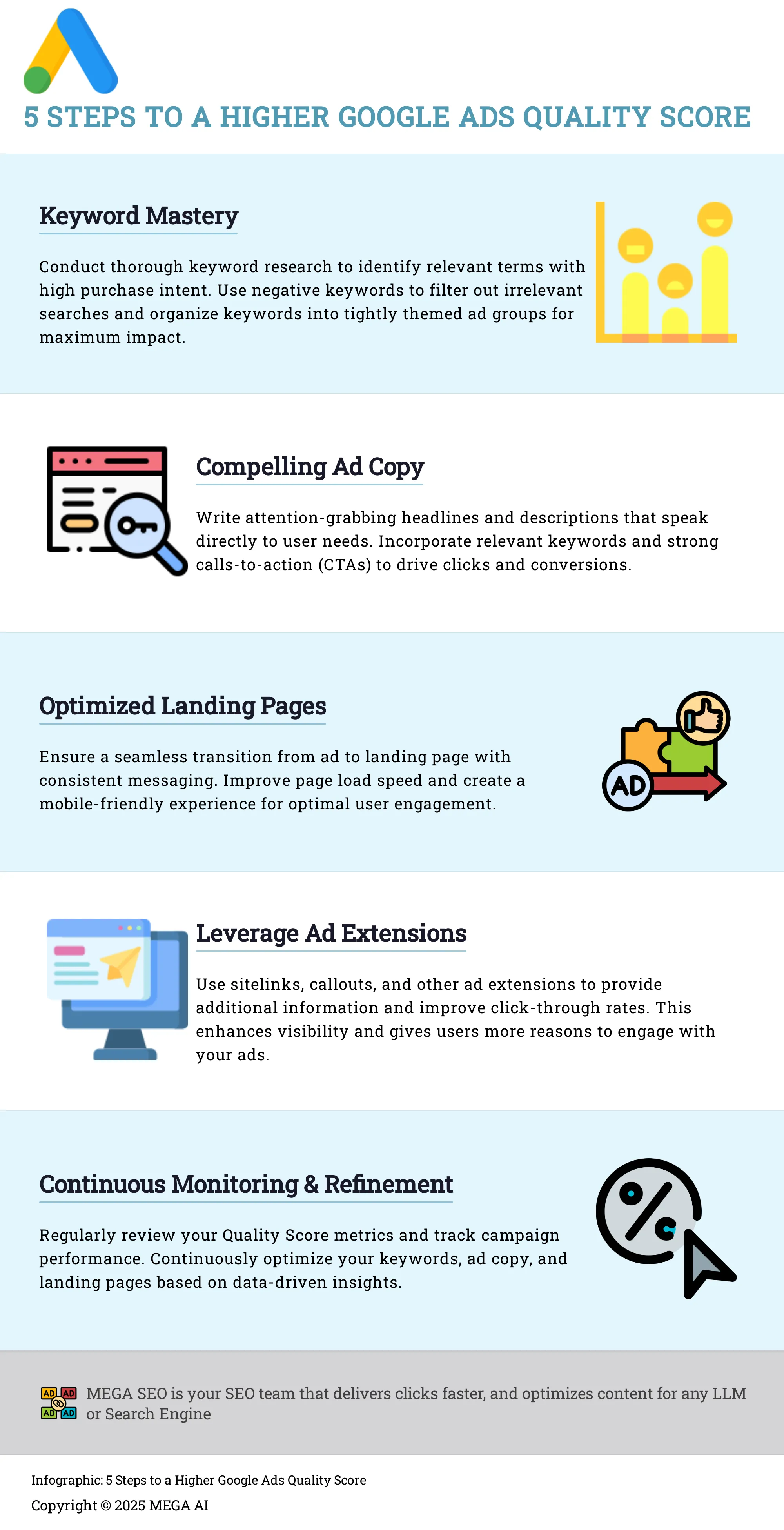
Your ad gets the click, but your landing page is where the action happens. A user’s journey doesn’t stop at the ad; it continues onto your site, and Google is watching. Your landing page experience is a critical component of your Quality Score. A page that is relevant, fast, and easy to use signals to Google that you’re delivering on the promise of your ad. Focusing on three key areas—ad-to-page consistency, load speed, and mobile design—can significantly improve your landing page experience and, in turn, your Quality Score.
Ensure Your Landing Page Matches Your Ad
When a user clicks your ad, they have a clear expectation. Your landing page must meet that expectation immediately. This is called message match, and it’s about creating a seamless transition from ad to page. If your ad headline says "2-Day Plant Delivery," your landing page should prominently feature that same offer. Use the same keywords and core message from your ad copy directly on your landing page. This consistency reassures visitors they’re in the right place, which can lower your bounce rate. A strong ad-to-page connection signals high relevance to Google, directly contributing to a better landing page experience score.
Improve Your Page Load Speed
Patience is not a virtue online. Even a one-second delay in page load time can cause users to leave. A slow page creates a poor user experience, and Google takes note. To improve your page speed, focus on technical optimizations like compressing image files, simplifying your website’s code, and using a content delivery network (CDN) to serve content faster. A quicker page not only keeps potential customers engaged but also demonstrates to Google that your site is well-maintained and user-friendly. You can use tools like Google's PageSpeed Insights to analyze your page and get specific recommendations for improvement.
Create a Better Mobile Experience
With the majority of searches happening on smartphones, your landing page must perform flawlessly on a small screen. A clunky mobile page with tiny text, hard-to-tap buttons, and complex forms will frustrate users and send your Quality Score downward. Your page should have a responsive design that automatically adjusts to fit any screen size. Think about the user’s context: they need information quickly and with minimal effort. Since Google uses mobile-first indexing, the mobile experience is not just an option; it’s the standard by which your page is judged. A clean, simple, and fast mobile page is essential for success.
Leverage Ad Extensions and Sitelinks
Think of ad extensions as a free way to make your ads bigger and more useful. They add extra information to your ad, like your phone number, location, or links to specific pages on your site. This extra detail makes your ad stand out and gives people more reasons to click. When your click-through rate (CTR) goes up, Google takes it as a positive signal that your ad is relevant. This helps improve your Quality Score, which can lead to better ad placements and a lower cost per click.
There are several types of ad extensions to choose from, including callouts (short, specific text snippets like "Free Shipping") and structured snippets (highlights of your products or services). Sitelinks are particularly powerful. They add extra links beneath your main ad, guiding users to important pages like your pricing, about us, or specific product pages. This not only improves the user experience by getting people where they want to go faster, but it also makes your ad physically larger on the results page, grabbing more attention.
To get the most out of ad extensions, you should use the ones that make the most sense for your business goals. If you want phone calls, use a call extension. If you want to showcase your product range, use Google Ads sitelinks for different categories. Always make sure the information is accurate and directly supports the ad's main message. Google recommends using at least three different extensions per campaign. Its system will then automatically test different combinations to show the ones most likely to perform well. Managing this process can be simplified with paid ads automation, which can help optimize your ad components for the best results.
Advanced Techniques to Improve Your Quality Score
Once you have the fundamentals down, you can move on to more advanced methods to fine-tune your campaigns. These techniques focus on using data and automation to make smarter decisions, which can lead to significant improvements in your Quality Score and a lower cost-per-click. By refining your targeting and leveraging automation, you can ensure your ads are not just seen, but seen by the right people at the right time.
Refine Keyword Lists Based on Performance
Continuously refining your keyword selection is essential for maintaining a high Quality Score. Go beyond initial research and analyze your performance data regularly. Identify keywords with low click-through rates or conversion rates and consider pausing them. Focus on keywords that are highly specific to your products and align closely with user search intent. This ensures your ads are shown to a more qualified audience that is actively looking for what you offer. The more relevant your keywords are to the user's query, the better your ad will perform, directly impacting your score.
Use Automated Bidding Strategies
Manually managing bids can be time-consuming and inefficient. Using Google’s automated bidding strategies allows you to optimize bids based on real-time performance data. Strategies like Target CPA or Maximize Conversions use machine learning to adjust your bids to achieve specific goals, which often leads to a better CTR and, consequently, a higher Quality Score. This approach helps you get more value from your budget. Platforms like MEGA AI take this a step further, letting you move budget around automatically across campaigns and platforms to ensure your ad spend is always placed where it will have the most impact.
Implement Audience Targeting and Remarketing
Ad relevance is a huge factor in your Quality Score, and one of the best ways to improve it is through precise targeting. Implementing audience targeting and remarketing allows you to show your ads to users who are already familiar with your brand or fit a specific demographic profile. For example, you can create a remarketing list to target users who have visited your website but didn't make a purchase. Showing these users a tailored ad increases the likelihood of a click because the ad is highly relevant to their previous behavior. This improved relevance and higher CTR signals to Google that your ad is valuable, helping to improve your score.
Monitor and Adjust Campaign Performance
Improving your Quality Score is an ongoing process, not a one-and-done task. Once you’ve implemented changes, you need to track your performance to see what’s working and identify new areas for improvement. A consistent monitoring and adjustment strategy ensures your campaigns remain efficient and cost-effective over time. This involves regularly checking key metrics, using tools to streamline the process, and committing to a cycle of continuous optimization. By staying on top of your performance, you can adapt to changes in the market and maintain a strong Quality Score.
Review Quality Score Metrics Regularly
After you make changes to your campaigns, it’s important to track how they affect your performance. Your Quality Score is closely tied to your click-through rate (CTR), so this is one of the first metrics you should watch. A rising CTR is a strong signal that your ads are resonating with your audience, which Google tends to reward with a better score. Log into your Google Ads account and monitor the Quality Score column for your keywords. Look for trends over time. Are your scores for key terms improving? If not, revisit your ad copy and keyword grouping to see where you can make further refinements. Regular check-ins help you catch issues before they significantly impact your budget.
Use Tools to Track and Improve Your Score
Manually tracking performance across dozens of ad groups and keywords can quickly become overwhelming. This is where tools can help you work more efficiently. Platforms designed for paid advertising can automate the process of monitoring your campaigns and identifying opportunities for improvement. For instance, an AI-powered tool can analyze your ad relevance and landing page experience at a scale that would be difficult to manage by hand. MEGA AI’s Paid Ads platform simplifies this by automatically tracking performance and suggesting data-backed optimizations, freeing you up to focus on strategy rather than getting lost in spreadsheets.
Create a Continuous Optimization Strategy
A high Quality Score is the result of a consistent, long-term strategy. Think of it as a cycle: you test new ad copy, measure the impact on your CTR, and adjust based on the results. A successful optimization strategy focuses on the three core pillars of Quality Score: expected CTR, ad relevance, and landing page experience. This means you should always be looking for ways to refine these areas. You could A/B test different calls-to-action, create new ad groups for niche keywords, or update your landing page content to better match user intent. By building a process for continuous improvement, you can maintain a high score and keep your ad costs low.
How to Maintain a High Quality Score
Keeping a high Quality Score isn't a one-time fix; it requires consistent attention and refinement. Think of it as regular upkeep for your ad campaigns. The goal is to stay proactive and continuously adjust your strategy based on performance data. This ongoing process ensures your ads remain effective and your costs stay as low as possible over the long term.
A great place to start is by regularly reviewing your keywords and ad copy. Periodically check your keyword list to make sure it still aligns with your business goals and, more importantly, with user search intent. Ad Relevance is a direct measure of how well your ad matches what a user is looking for, so this alignment is critical. As your products evolve or market trends shift, your keywords and ad text should adapt to stay current.
Your landing page and click-through rate also need regular check-ups. Your landing page should always deliver on the promise made in your ad, providing a seamless user experience. Keep an eye on page speed and mobile-friendliness to ensure visitors can easily find what they need. Your click-through rate (CTR) is a strong indicator of relevance, so monitoring this metric can give you an early warning if an ad is missing the mark. After making adjustments, it's important to track how those improvements affect your campaigns. This cycle of testing, monitoring, and optimizing is the foundation of a successful long-term strategy.
Related Articles
- How Google AI Helps Marketers Find New Customers
- Best Google Ads Management Tools for 2024
- Google Ads Automation: A 2024 Guide
- SEO vs. Google Ads: Which Is Better for Your Business?
- How to Deal With Declining Google Search Result Quality
Frequently Asked Questions
What is considered a good Quality Score? While the score is on a scale of 1 to 10, a score of 7 or higher is generally seen as strong. However, you shouldn't fixate on hitting a specific number. Instead, use the score as a diagnostic tool. If a keyword has a score of 4, look at its components—expected CTR, ad relevance, and landing page experience—to see which area is rated "Below average" and focus your efforts there. The goal is continuous improvement across all your keywords.
How long does it take to see improvements in my Quality Score? Changes to your Quality Score are not immediate. After you've optimized your ad copy, keywords, or landing page, it can take several days or even a couple of weeks for Google's system to gather enough performance data to reflect those improvements. The key is to be consistent with your optimizations and patient as the data updates.
Which of the three components of Quality Score should I focus on first? All three components are important, but a great place to start is with ad relevance and expected click-through rate. You have direct control over these by refining your keyword groups and writing more compelling ad copy. Improving the connection between a user's search and your ad can often lead to quicker wins. Once that's solid, you can turn your attention to making larger improvements to the landing page experience.
Can I just increase my bid to overcome a low Quality Score? You can, but it's an expensive and inefficient strategy. A low Quality Score means Google sees your ad as less relevant, so you'll have to pay a premium to get a good ad position. A competitor with a higher Quality Score could pay significantly less than you for the same or even a better spot. Improving your score is a more sustainable way to lower your costs and improve your ad rank over the long term.
How can I improve my landing page experience if I'm not a web developer? You don't need to be a technical expert to make meaningful improvements. Start by ensuring the headline and main message on your landing page directly match what your ad promises. Use clear, simple language and make sure your call-to-action is easy to find. You can also improve page speed by using online tools to compress your images before uploading them to your site. These small changes can make a big difference in the user experience.