Artificial intelligence is rapidly moving beyond the realm of futuristic concepts and into the practical toolkit of everyday business. For startups, small businesses, and digital marketing agencies, this shift presents a remarkable opportunity. It’s no longer just about understanding what AI can do; it’s about identifying how it can be strategically applied to create real value, streamline operations, and connect more effectively with customers. The power of AI to automate complex tasks, personalize experiences, and uncover data-driven insights is becoming increasingly accessible. This article explores several viable AI business models you can consider, focusing on how to leverage these technologies to build sustainable and impactful ventures in the current landscape.
Key Takeaways
- Use AI to reach underserved markets: Apply AI to solve specific challenges in overlooked markets, such as by creating fairer financial tools or personalized learning platforms, to make essential services more accessible.
- Streamline core business functions with AI: Help businesses improve everyday operations like customer support, content creation, design, and digital marketing by integrating practical AI solutions for greater efficiency.
- Build sustainable AI ventures through specialized, continuous support: Establish recurring revenue by offering ongoing AI services, such as agent management or custom consulting, particularly by focusing on niche markets requiring dedicated expertise.
What is an AI Business Model?
So, what exactly do we mean when we talk about an AI business model? At its core, an AI business model leverages artificial intelligence technologies to fundamentally change how a business creates value, streamlines its operations, and enhances customer experiences. Imagine it as a strategic framework where AI isn't just an add-on, but a central pillar. This could mean anything from AI-driven services that offer personalized recommendations to products that use sophisticated machine learning algorithms to solve very specific, often complex, problems for customers. The beauty of these models is that they're not just about showcasing cutting-edge technology; they're about the practical application of AI tools to address tangible, real-world challenges in ways that are both inventive and scalable.
The appetite for such models is definitely on the rise. Businesses of all sizes are increasingly recognizing the power of data and automation to improve efficiency, sharpen their decision-making processes, and gain a competitive edge. A well-designed AI business model is often characterized by its ability to scale rapidly – meaning it can handle growth and increased demand without a proportional explosion in operational costs. This scalability is a key factor that can lead to attractive profit margins, sometimes even when starting with a relatively modest initial capital investment. Beyond just optimizing what's already being done, these models are powerful engines for driving innovation and uncovering entirely new market opportunities. They empower entrepreneurs to tap into underserved niches and meet customer needs in novel and more effective ways. It’s really about identifying where AI can deliver significant impact and building a sustainable business around that.
Why Underserved Markets Need AI Solutions Now
It's clear that many communities and businesses haven't fully benefited from recent technological advancements. There's a noticeable gap between the cutting-edge AI tools being developed and practical, enterprise-ready solutions that can be deployed effectively and safely, especially at scale in these areas. This is where the real opportunity lies – creating AI solutions that are accessible and genuinely helpful.
Think about access to fair credit, for example. Many individuals and small businesses in underserved markets struggle to secure loans due to outdated or biased credit scoring models. AI offers a path to develop more equitable, data-driven credit scoring tools. This means lenders can reach more people and make fairer decisions, opening up economic opportunities for those previously excluded. Similarly, in education, AI-driven virtual tutoring can provide personalized support to students who might not have access to traditional resources, helping them improve their performance with customized learning paths.
Beyond individual services, AI can significantly streamline operations for businesses in these markets. Many small enterprises operate with limited resources, and AI can help automate processes, optimize inventory, and enhance customer service, allowing them to compete more effectively. The demand for AI solutions that address these specific challenges is growing, presenting a chance for entrepreneurs to build impactful businesses while making a real difference. For businesses like yours, looking to enhance your online presence with automated SEO and Paid Ads, AI offers a way to level the playing field.
1. Offer AI-Powered Customer Support
One of the most accessible and in-demand AI business models revolves around enhancing customer support. Think about it: nearly every business, from fledgling startups to established enterprises, needs to communicate with its customers. AI can significantly streamline this, offering 24/7 availability, instant responses to common queries, and a way to handle a large volume of interactions without a proportionally large team. This isn't just about cutting costs; it's about improving the customer experience, which is a huge differentiator. For businesses looking to implement AI solutions, providing services to set up, manage, and optimize AI-powered customer support systems can be a profitable venture.
The beauty of this model is its scalability and the recurring revenue potential. You could help businesses implement AI chatbots, train these bots on company-specific data, and then offer ongoing services to monitor performance and make improvements. As AI technology continues to advance, the capabilities of these support systems will only grow, creating more opportunities for specialized services. Many companies are discovering how AI can transform their customer interactions by providing more efficient and personalized support, leading to greater customer loyalty and operational efficiency. This approach allows businesses to focus on core activities while ensuring their customer service remains top-notch.
Balance Automation with Human Oversight
It's tempting to think of AI chatbots as a "set it and forget it" solution, but that's a common pitfall. As Neil Patel points out, "Most businesses believe that they can set it and forget it with their chatbots. But the customer experience and revenue eventually tanks when they do that." The reality is, while AI can handle a vast majority of routine inquiries, there will always be complex or sensitive situations where human intervention is crucial.
Your business can fill this gap by offering services that ensure a seamless handoff from AI to human agents when needed. This balanced approach ensures that customers don't get stuck in frustrating bot loops and that nuanced issues receive the empathetic handling they require. Providing this layer of human oversight and quality assurance can be a key part of your service offering, ensuring the AI support system genuinely enhances customer satisfaction.
Integrate Continuous Learning and Feedback
AI customer support tools are not static; they are designed to learn and improve over time. However, this learning process isn't entirely automatic. It requires ongoing human fine-tuning and the integration of data feedback. "Tools like ADA and Intercom are widely adopted, but still require human fine-tuning, data feedback, and upsell integration to work well," as highlighted in discussions on AI business models.
This necessity creates a valuable service opportunity. You can help businesses analyze interaction logs, identify areas where the AI is struggling, and use this data to refine its responses and understanding. Setting up robust feedback mechanisms, where customer ratings and agent input are used to train the AI, is essential. By offering expertise in continuous learning and optimization, you ensure the AI tool becomes increasingly effective and valuable to your clients.
Personalize Upsell and Cross-Sell Opportunities
Beyond just resolving issues, AI in customer support can be a proactive tool for revenue generation. By analyzing customer data and conversation context, AI can identify opportunities to offer personalized product recommendations or service upgrades. This turns customer support from a cost center into a profit center. The opportunity here is significant: "By offering chatbot setup, training, and upsell optimization, you can turn into a monthly retainer business for consultants and freelancers."
Your role could be to help businesses configure their AI support systems to intelligently identify these moments and present relevant offers in a natural, non-intrusive way. This involves understanding the client's product catalog, customer segments, and sales strategies. Training the AI to recognize buying signals and effectively suggest complementary products can add substantial value, making your services indispensable.
2. Provide AI Content Generation and Optimization
Content is the heart of any online presence, but consistently creating high-quality, engaging, and optimized material can feel like a huge task, especially if you're a startup or small business juggling many responsibilities. This is where an AI-powered business model centered on content generation and optimization can make a real difference. By using AI, you can offer services that help businesses produce better content more quickly and ensure it connects with the right people. This isn't just about automating word output; it's about offering a strategic content creation process that supports business objectives and speaks to audience needs.
Think about offering a service that helps your clients move past writer's block, scale their content for various platforms, and keep their existing articles and posts fresh and effective. AI tools can support every stage, from brainstorming initial topics and drafting first versions to refining the copy and tailoring it for specific channels. For businesses that find it challenging to maintain a blog, populate their social media feeds, or write compelling product descriptions, an AI-assisted content service can be incredibly valuable. You could structure this as a subscription, offer project-based work, or even act as a consultant, teaching clients how to use AI tools effectively themselves. The main idea is to position your service as a way to not just create content, but to create content that performs and helps grow their online visibility.
Generate Ideas and Content, Faster
One of the most noticeable benefits of AI in content creation is its speed. AI tools can help businesses "ideate, design, and optimize content across platforms," as digital marketing expert Neil Patel mentions, which significantly cuts down the time from initial concept to a published piece. Your business model could focus on helping clients generate blog post ideas, draft social media updates, or even outline video scripts.
While AI is excellent at execution, Patel also notes that "most AI content fails not because of execution, but because of weak concepts and no insight into platform trends." This is where your strategic input becomes crucial. You can guide the AI with thoughtful human direction, ensuring the content produced is not only quick to create but also insightful, relevant, and in tune with current trends and your client’s unique brand voice. This blend of AI efficiency and human strategy creates a truly compelling service.
Translate and Localize Content with AI
Reaching new markets is a significant growth opportunity, but language often presents a considerable challenge. AI provides an effective solution for translating and localizing content, making it understandable and relatable for a global audience. As AiEarnFlow points out, "AI can streamline operations," and this capability is particularly useful for the often complex and expensive task of content localization.
Your AI-powered service could assist businesses in adapting their website copy, marketing materials, and product information for various languages and cultural contexts. This involves more than just direct word-for-word translation; AI can help ensure the tone, style, and cultural nuances resonate appropriately with each target market. Offering efficient and accurate translation and localization can become a valuable revenue stream, especially for businesses aiming to expand internationally without the substantial costs typically associated with traditional translation services.
Refine Content and Optimize for SEO with AI
Creating great content is just the first step; making sure the right audience sees it is just as vital. AI can be instrumental in refining existing content and optimizing it for search engines. Neil Patel highlights that "AI-powered outreach and link building can be offered as a premium SEO service at a lower cost and a higher scale." This underscores the efficiency AI brings to SEO optimization.
Your business could offer services that use AI to analyze a client's existing content for SEO weaknesses, pinpoint areas for improvement, and even automate updates to enhance search rankings and click-through rates. For example, you could help clients identify new keywords to target, suggest better internal linking structures, or re-optimize older articles to align with current search engine algorithms or even emerging search platforms. This ensures a client’s content library continues to deliver value long after its initial publication, much like how MEGA AI's Maintenance Agent works to keep content performing at its best.
3. Deliver AI-Driven Design and Creative Solutions
The world of design is changing quickly, and AI is a big part of this shift. For businesses, especially startups and smaller companies, this creates new ways to offer creative services that many couldn't afford before. AI tools can help make great visuals and keep a brand looking consistent, often for less money and in less time. This isn't about AI taking over from people's creativity. Instead, it's about making human creativity even better, so you can provide top-notch design solutions more efficiently.
Create Cost-Efficient Designs for Everyone
One of the biggest ways AI is changing the creative world is by making good design easier to get and more affordable. As expert Neil Patel mentions, "AI-generated graphic design is a huge opportunity... Tools like Canva Magic Design can deliver stunning visuals if the prompts are detailed, iterative, and strategically guided." The thing is, many businesses don't have the extra time or the specific know-how to create effective prompts for these tools.
This opens up a new business idea: you can become an AI design strategist. You would help clients use AI tools to make creative assets that really convert, and do it faster and cheaper than traditional design shops. This kind of service is super helpful for businesses that need marketing materials, social media graphics, or website visuals but don't have a huge design budget. By guiding the AI with smart prompts and careful adjustments, you can produce professional-looking designs that perfectly fit what your clients need.
Maintain Brand Consistency at Scale
Having a consistent brand look is really important for people to recognize and trust your business. AI-powered design tools can be a huge help for businesses trying to keep that consistency across all their marketing efforts and materials. Squarespace points out that, "AI-powered design tools can help businesses maintain brand consistency... By leveraging AI, companies can automate the design process while ensuring that all visual elements align with their brand guidelines."
This automation saves a lot of time and money, especially when a business is growing and doing more marketing. Think about being able to quickly generate a whole set of social media graphics, ad creatives, and presentation slides that all perfectly match a client's brand colors, fonts, and overall style. Offering a service to set up and manage these AI-driven design systems can be very valuable. It makes sure that whether your client is launching a new paid ad campaign or updating their website, their brand identity stays strong and clear, making them look more professional.
4. Offer AI-Enhanced SEO and Digital Marketing
If you're looking to build a business that helps other companies grow their online presence, offering AI-enhanced SEO and digital marketing services is a smart move. Many businesses, especially startups and small to medium-sized enterprises, are eager to improve their visibility but may lack the large teams or budgets for traditional marketing efforts. This is where AI comes in, leveling the playing field. By harnessing AI, you can provide powerful, efficient, and data-backed marketing solutions that deliver real results. Think of it as giving your clients a significant competitive edge without straining their resources.
Services like MEGA AI's SEO platform are already showing how automation can transform complex tasks into manageable processes. You can build a business around implementing such tools or developing specialized AI-driven strategies for clients. This model allows you to offer high-value services, from pinpointing the right keywords to crafting compelling outreach campaigns, all made more effective with artificial intelligence. The key is to show clients how these advanced techniques can directly contribute to their growth, making sophisticated marketing accessible to them.
Automate Keyword Research and Analysis
One of the most time-consuming parts of SEO is keyword research. AI can dramatically speed this up. Instead of spending hours sifting through data, AI tools can quickly identify high-potential keywords, analyze what competitors are ranking for, and uncover content gaps your clients can fill. This means you can streamline operations and deliver comprehensive keyword strategies much faster. For your clients, this translates to quicker insights and the ability to target their audience more effectively. You can help them understand not just what keywords to target, but why, based on AI-driven analysis of search trends and user intent. This allows for a more strategic approach to content creation from the very beginning.
Develop Personalized Outreach Strategies
Generic outreach emails rarely get results. AI can help you craft highly personalized messages for link building, influencer collaborations, or sales prospecting. Imagine being able to generate tailored emails that resonate with each recipient, significantly increasing your chances of a positive response. For instance, you could use AI to analyze a prospect's recent articles or social media activity and then incorporate those specific details into your outreach. This level of personalization, as Neil Patel discusses, can improve response rates when you're trying to build valuable backlinks or partnerships for your clients. It’s about making each interaction feel genuine and relevant, which AI can help you achieve at scale, saving time while improving effectiveness.
Use Data-Driven Insights and Predictive Analytics
AI excels at processing vast amounts of data to uncover actionable insights and even predict future trends. In digital marketing, this means you can offer services that go beyond basic reporting. You can help clients understand customer behavior on a deeper level, optimize their ad spend for maximum ROI, and anticipate market shifts. For example, AI can analyze campaign performance in real-time, suggesting adjustments to improve results. This capability allows businesses to offer AI-powered outreach and link building as a premium service that's both cost-effective and scalable. By providing these data-driven insights, you empower your clients to make smarter, more informed marketing decisions, ultimately leading to better outcomes and a stronger market position.
5. Use AI for Financial Inclusion and Small Business Support
AI presents a remarkable opportunity to address long-standing challenges in financial inclusion and to provide robust support for small businesses. Many communities and small enterprises have historically faced barriers to accessing financial services and sophisticated business tools, often due to traditional systems that are rigid, costly, or require specialized expertise. AI can help change this by offering new ways to assess risk, personalize services, and automate complex processes, making them more accessible and affordable. This opens doors for entrepreneurs to build impactful, low-capital AI ventures focused on these vital sectors.
For entrepreneurs looking to make a real impact, developing AI solutions in this space can be incredibly rewarding. Think about tools that empower small business owners with insights previously available only to large corporations, or systems that help individuals build credit and access capital. This isn't just about complex algorithms; it's about creating user-friendly pathways to economic empowerment. You could develop AI-powered chatbots that offer financial literacy advice, or platforms that simplify loan applications for micro-enterprises. By focusing on these underserved markets, you can build a business that is both profitable and socially conscious, helping to foster economic growth and create a more equitable playing field. The key is to identify specific pain points and develop targeted AI solutions that are easy to integrate and deliver clear, measurable value from day one.
Improve Credit Scoring for Underserved Communities
Traditional credit scoring models often rely on limited data points, which can inadvertently exclude many creditworthy individuals, particularly in underserved communities. AI offers a path to fairer and more inclusive lending. By developing AI-powered credit scoring tools, entrepreneurs can help lenders evaluate risk more comprehensively. These tools can analyze a much broader range of data, including alternative data sources like utility payments or rental history, to build a more accurate picture of an applicant's financial reliability. This approach not only helps individuals gain access to credit they deserve but also enables lenders to tap into new, viable markets responsibly.
Offer Business Intelligence to Small Enterprises
Small businesses are the backbone of many economies, yet they often lack the resources for sophisticated business intelligence tools that larger companies use to make strategic decisions. AI can democratize access to these powerful insights. Entrepreneurs can create AI-driven platforms that help small enterprises streamline their operations through process automation, optimize inventory, or enhance customer service. Imagine an AI tool that provides a small retail shop with predictive analytics for stock management or helps a local service provider understand customer feedback more effectively. By offering affordable AI solutions for performance tracking and data-informed decision-making, you can empower small businesses to grow, improve productivity, and compete more effectively.
6. Apply AI in Education and Healthcare
AI is making significant inroads into sectors that touch all of our lives, particularly education and healthcare. These fields are ripe for innovation, and AI offers powerful tools to make services more accessible, personalized, and efficient. Imagine a world where every student learns at their own pace with tools tailored to their unique needs, or where quality healthcare advice is available regardless of your location. This isn't a far-off dream; AI is making it a reality. For entrepreneurs looking to make a real impact, developing AI solutions for education and healthcare can be incredibly rewarding, both socially and financially. The demand for smarter, more adaptive systems in both learning and patient care is growing rapidly.
By focusing on user-centric design and addressing specific pain points, businesses can create AI applications that truly resonate. The key is to identify specific challenges within these broad areas—like student engagement or diagnostic support—and apply AI to create targeted, effective solutions. This approach can lead to sustainable business models that genuinely improve people's well-being and future prospects, opening doors to markets eager for advancement. The shift towards data-driven decision-making in both sectors further underscores the potential for AI to streamline operations, enhance learning outcomes, and deliver more precise medical care.
Develop Personalized Learning and Tutoring Platforms
One of the most exciting applications of AI in education is the development of personalized learning experiences. Instead of a one-size-fits-all approach, AI can help create virtual tutoring solutions that adapt to individual student needs across various subjects and learning levels. As Prismetric notes, these platforms can help students "improve their performance with customized, data-driven support." This means AI can identify a student's strengths and weaknesses, then offer tailored content, exercises, and feedback to help them grasp concepts more effectively. For entrepreneurs, this means an opportunity to build tools that make learning more engaging and successful for everyone.
Build Telehealth Solutions for Remote Populations
AI is also revolutionizing healthcare access, especially for those in remote or underserved areas. AI-powered telehealth solutions can significantly extend the reach of medical services. Think about virtual consultations, intelligent symptom checkers that guide users, and personalized health recommendations delivered directly to a patient's device. According to AiEarnFlow, such platforms can "enhance access to healthcare services for remote populations...thereby improving patient outcomes and reducing healthcare costs." This creates a compelling business case for developing AI-driven telehealth tools that not only improve individual health but also contribute to a more equitable and efficient healthcare system overall.
7. Target Niche Markets with Specialized AI Services
While artificial intelligence offers transformative potential across many broad sectors, some of the most impactful and rewarding opportunities lie in developing AI solutions for specific, often underserved, niche markets. These specialized areas have unique requirements and challenges that general-purpose AI tools might not fully address. By focusing your efforts on a particular niche, you can cultivate deep expertise and create highly tailored, valuable solutions. This targeted approach often means facing less initial competition and can help you build strong, lasting relationships with your customers, leading to better product-market fit.
Identifying a promising niche involves careful observation and understanding specific community needs or gaps within an industry. You might explore market research reports to uncover underserved segments or simply pay close attention to recurring problems you see in specific communities or business types. Think about groups of people or sectors whose problems could be significantly eased with intelligent automation or data analysis. For instance, consider the specific daily challenges faced by distinct demographic groups or the operational hurdles unique to certain types of small businesses. Developing AI tools for these areas not only opens up new business avenues but also allows you to make a tangible difference. The following examples explore a couple of these specialized areas where AI can offer substantial benefits.
Provide AI for Elderly Care and Assistance
The global population is aging, and with this demographic shift comes an increasing need for innovative elderly care solutions. AI can play a significant role in enhancing the quality of life for seniors, offering them greater independence and support. Imagine AI-driven applications that gently remind individuals about medications, help monitor daily activity levels for safety, or even facilitate communication-for-health) with family and caregivers.
Beyond practical assistance, AI can also address issues like social isolation through conversational agents designed for companionship. Entrepreneurs can develop tools that provide personalized care routines or alert support networks to potential emergencies. By focusing on user-friendly interfaces and addressing real-world needs, AI businesses in this space can offer invaluable services to seniors and their families, tapping into a rapidly growing and socially impactful market.
Apply AI to Environmental Monitoring and Sustainability
Another area ripe for specialized AI solutions is environmental protection and sustainability. As concerns about climate change and resource depletion grow, there's a pressing need for technologies that can help us better understand and manage our environmental impact. AI excels at analyzing complex datasets, which is crucial for monitoring environmental conditions like pollution levels or deforestation rates.
Startups can create AI-powered systems to optimize energy consumption in buildings, improve waste management processes, or help agricultural businesses adopt more sustainable practices. These applications not only contribute to a healthier planet but also cater to an increasing consumer and regulatory demand for sustainability. Businesses that leverage AI for environmental good can find a strong market position while contributing to critical global efforts.
How to Create Recurring Revenue with Your AI Business
Many businesses are exploring AI, but the real win is building a model that brings in consistent income. Recurring revenue is the key to long-term stability and growth, allowing you to predict income and scale more effectively. Instead of focusing solely on one-off projects, consider how your AI expertise can provide continuous value. This could involve ongoing support, regular updates, or managed services that clients subscribe to. Think about it: AI isn't a "set it and forget it" technology. It evolves, data changes, and business needs shift. Companies using AI will require partners who can help them manage these changes, ensuring their AI solutions remain effective and aligned with their goals. This ongoing partnership is precisely where your opportunity for creating a sustainable, recurring revenue stream lies. The beauty of AI services is that they often require continuous monitoring, optimization, and updates, making them a natural fit for subscription or retainer models. As businesses integrate AI deeper into their core operations, they'll see the value in paying for consistent expertise rather than seeking ad-hoc help. By positioning yourself as an indispensable, long-term AI partner, you can build a resilient business. Let's explore a couple of specific ways you can structure your AI offerings to achieve this.
Offer AI Agent Creation and Management Services
AI agents are rapidly becoming more accessible, but many businesses still need expert help to customize and deploy them effectively. Platforms might offer templates, but tailoring an AI agent to specific business processes, especially those that directly impact revenue or customer interactions, requires a skilled hand. Most companies don't have an in-house team with the specialized knowledge to build and manage these agents properly. You can fill this gap by offering AI agent creation services. Better yet, extend this into a recurring revenue model by providing ongoing management, performance reviews, and updates for these agents, ensuring they continue to deliver value as business needs evolve.
Provide AI Consulting and Customization Services
Many businesses recognize the potential of AI but struggle with the practicalities of implementation. There's often a significant gap between experimental AI tools and the robust, enterprise-ready solutions needed for safe and effective deployment at scale. This is where AI consulting and customization services come in. Companies need guidance on integrating AI with their existing legacy systems, managing complex data extraction and transformation, and handling the challenges of AI adoption. By offering your specialized expertise, you can help businesses bridge this value gap, providing tailored solutions and ongoing support that translates into a steady, recurring income stream for you.
Ready to Build Your AI Business for 2025?
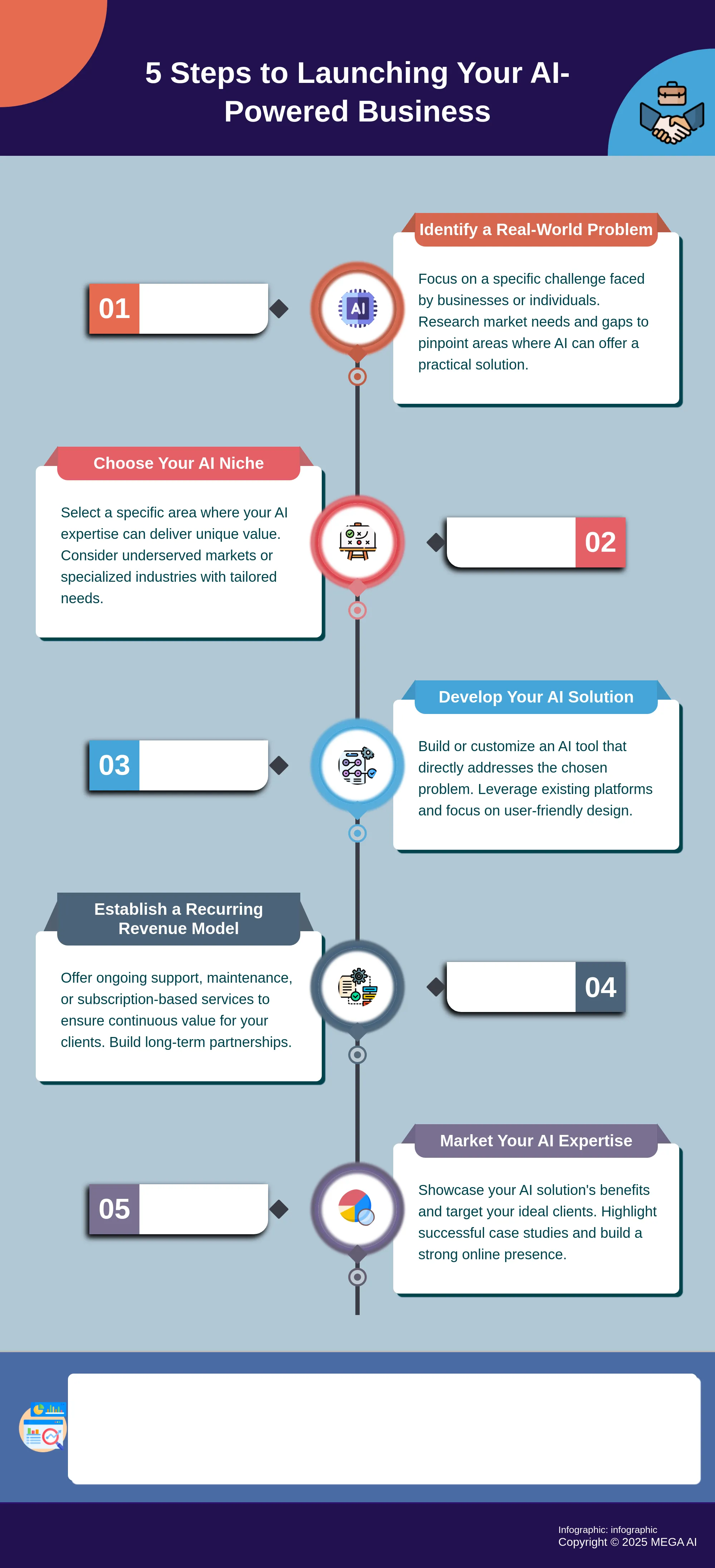
If you're considering launching an AI-driven business, 2025 presents a landscape ripe with potential. The key is to focus on how AI can address tangible needs and create genuine value for people and other businesses. For instance, entrepreneurs can develop AI-powered tools that assist lenders in making fairer credit decisions, thereby opening up financial services to previously underserved markets. This isn't just about new tech; it's about creating more equitable access. Similarly, the education sector is experiencing a significant demand for personalized learning experiences. AI-driven virtual tutoring solutions can cater to a wide array of subjects and learning levels, offering students customized, data-driven support to help them improve their performance.
Beyond these specific sectors, AI offers powerful avenues to enhance operational efficiency across various industries. Imagine how businesses can streamline their operations through automating repetitive processes, optimizing inventory management, or even enhancing customer service with intelligent assistants. These aren't just minor tweaks; they represent substantial improvements in how businesses function, freeing up valuable time and resources. The most impactful AI ventures will be those that skillfully combine powerful technological capabilities with practical solutions to real-world problems. While many experimental AI tools and frameworks are available, a clear opportunity exists for creating enterprise-ready solutions that businesses can deploy safely and effectively at scale. This gap highlights a prime area for innovation, inviting entrepreneurs to build the next wave of practical, impactful AI applications.
Related Articles
- Launch & Scale Your Online Business: An AI Guide
- AI Agents: Revolutionizing Business Operations
- AI Strategy: A Practical Guide for Your Business
- AI Content for SEO: Benefits, Risks & Best Practices
- Transforming Healthcare: The Impact of AI on Growth
Frequently Asked Questions
I'm interested in starting an AI business, but where do I even begin? A great starting point is to look for real-world problems that people or businesses are struggling with. Instead of getting caught up in the technology itself, think about where AI could genuinely make things easier, faster, or more effective. Once you identify a specific challenge, you can then explore how AI tools might offer a solution.
Do I need to be a coding genius to launch an AI-powered service? Not necessarily. Many AI business models involve using existing AI platforms and tools, then customizing them or offering services around them. Your strength could be in understanding a specific industry's needs, guiding the AI's application, or managing the client relationship, rather than building the AI from scratch.
How can I use AI to help underserved communities or niche markets specifically? The key is to first understand the unique challenges these groups face. For example, if a community lacks access to certain services, AI might help bridge that gap through automated support or personalized information. For niche markets, you can develop AI solutions tailored to their very specific operational needs, which broader tools might overlook.
What's a practical way to generate consistent income with an AI business, rather than just one-off projects? Think about offering ongoing services. This could be a subscription for access to an AI tool you've configured, a monthly retainer for managing and optimizing a client's AI systems, or providing continuous updates and support. The goal is to become an indispensable partner for your clients' AI needs.
The blog mentions AI for content and SEO. How does that work without making content sound robotic? AI is a powerful assistant for content creation and optimization, but human strategy and oversight are essential. You can use AI to generate ideas, draft initial versions, or analyze SEO data much faster. However, your expertise is needed to refine the concepts, ensure the brand voice is authentic, and make sure the content truly connects with the intended audience.