
The way customers find information is shifting from traditional search engines to conversational AI. This change presents a huge opportunity for small businesses. While larger companies may dominate keyword rankings, the new frontier of LLM search optimization levels the playing field. AI models prioritize expertise and genuinely helpful content over big budgets. By becoming the go-to authority in your specific niche, you can get your business recommended directly to customers who are ready to buy. This guide provides actionable strategies to help you build that authority and stand out in AI-powered search results.
Key Takeaways
- Aim to be the source, not just a search result: LLM optimization is about creating content so authoritative that AI tools cite your business directly, making you part of the answer instead of just another link.
- Own your niche with expert-level content: Compete with larger brands by focusing on a specific area of expertise. Create comprehensive guides that answer customer questions thoroughly, establishing your business as the go-to authority.
- Prioritize and improve your most valuable content first: Begin by auditing your key service or product pages. Update them to directly answer common customer questions in a clear, conversational tone to make them more useful for both people and AI.
What is LLM Search Optimization?
LLM Search Optimization, or LLMO, is the process of preparing your content to be featured in the answers generated by AI tools. For years, Search Engine Optimization (SEO) has been about getting your website to the top of a search results page. LLMO is the next step. Instead of just aiming for a top spot in a list of links, the goal is to have your brand, products, or services directly mentioned, cited, and recommended within the conversational responses from tools like ChatGPT, Google’s AI Overviews, and Perplexity.
Think of it this way: when a potential customer asks an AI a question like, “What’s the best local bakery for custom cakes?” LLMO is the work you do to make sure the AI’s answer includes your bakery. It’s about becoming a trusted source that these large language models rely on to form their responses. This shift is critical because it moves your business from being one of many options on a page to being part of the direct answer a user receives. For small businesses, this presents a new opportunity to build authority and connect with customers at the exact moment they’re looking for a solution. This new approach requires a focus on creating genuinely helpful, clear, and authoritative content that establishes your expertise in your specific field. By doing so, you're not just optimizing for a machine; you're building a library of information that proves your value to both AI and human users.
How LLMO Differs from Traditional SEO
While LLMO and traditional SEO share the goal of increasing online visibility, their methods are different. Traditional SEO focuses on ranking your website in a list of search results. You optimize for keywords, build backlinks, and manage technical site health to climb that list. LLMO, on the other hand, aims to make your content a credible source that an AI will use to construct its own answer.
This means the focus shifts from purely technical signals to demonstrating topical authority and trustworthiness. The goal isn't just to rank for a keyword, but to be the definitive answer for the topic that keyword represents. It’s less about winning a position and more about becoming part of the conversation.
The New Era of AI-Powered Search
For a long time, SEO was the primary way for brands to get found online. Now, generative AI is fundamentally changing how people find information. Instead of sifting through pages of search results, users are asking complex questions and getting instant, synthesized answers. This change in user behavior means businesses need to adapt their strategies to stay visible.
This isn't a trend on the horizon; it's happening now. As more people turn to AI-powered search for recommendations and information, your presence in those AI-generated results becomes essential. Optimizing for LLMs ensures your business can meet customers where they are, providing helpful information and building trust in this new, conversational search landscape.
Why LLM Optimization Matters for Your Small Business
Optimizing for large language models (LLMs) isn't just another marketing task to add to your list. It's a fundamental shift in how customers will find you. For a small business, this change presents a massive opportunity to connect with highly interested buyers in a more direct way. By understanding why this matters, you can position your business to be the go-to answer for the questions your future customers are asking AI.
How Customer Search Habits Are Changing
People are starting to use AI chatbots like ChatGPT as their first stop for recommendations, bypassing traditional search engines. Instead of just typing keywords, they're having conversations and asking detailed questions to find exactly what they need. Research shows that customer search habits are evolving quickly, with a growing number of consumers turning to AI for product and service suggestions. If your business isn't visible in these AI-generated answers, you're missing out on a valuable stream of potential customers who are ready to make a decision.
Why AI-Generated Traffic Converts Better
When a potential customer finds your business through an AI recommendation, they are often more qualified and ready to buy. Think about it: they've likely asked a very specific question, and the AI has matched your business as the ideal solution. This is different from someone who clicks on a search result among ten blue links. Because the AI has already done some of the vetting, the traffic that comes to your site is more targeted. If your content isn't ready for AI, you could be losing out on these high-intent visitors who are more likely to become paying customers.
Get Ahead with a Budget-Friendly Strategy
The good news is that LLM optimization doesn't require a massive advertising budget. It levels the playing field, allowing small businesses to compete with larger brands by focusing on quality and authority. The goal is to become a trusted source of information in your niche. By creating helpful, clear, and expert content that directly answers customer questions, your business can appear in various LLM-powered tools and features like Google's AI Overviews. Starting now gives you a significant advantage over competitors who are still focused only on traditional SEO tactics.
How Do LLMs Choose What Content to Show?
Think of a large language model as a diligent researcher. Instead of just giving you a list of links like a traditional search engine, it reads through countless sources to understand a topic deeply. Then, it synthesizes all that information into a single, comprehensive answer. To do this effectively, the AI needs to decide which sources are credible, authoritative, and helpful. It’s not just about matching keywords anymore; it’s about becoming a trusted source that an AI would want to cite.
LLMs look for signals that your business is a legitimate expert in its field. They analyze the quality and depth of your content, your reputation across the web, and what real people are saying about you. The goal is to provide the most accurate and reliable answer to a user's query. This means your content needs to be more than just optimized for a search algorithm; it needs to be genuinely valuable to a human reader. Platforms like MEGA AI are built to help you send these exact signals, using AI to create and maintain content that establishes your authority and gets you noticed in this new search landscape.
Establish Your Brand as an Authority
For an LLM to recommend your business, it needs to see a clear and consistent connection between your brand and your area of expertise. This is where the concept of E-E-A-T (Experience, Expertise, Authoritativeness, and Trustworthiness) comes into play. You need to show, not just tell, that you are an expert. Create content that provides well-researched insights and demonstrates a deep understanding of your industry. When an AI model sees that your brand is consistently associated with valuable information on a specific topic, it learns to trust you as a reliable source. This makes it much more likely that your business will be mentioned in an AI-generated answer.
Create High-Quality, Relevant Content
LLMs are designed to provide thorough answers, so they favor content that does the same. A short, 500-word blog post that only scratches the surface is less likely to be featured than a comprehensive, 2000-word guide that covers a topic from every angle. Your goal should be to create the single best resource for any given question your customer might have. Focus on crafting in-depth content that addresses user questions in natural, conversational language. When you provide detailed, well-structured information, you make it easy for an LLM to pull from your content to construct its own helpful response.
Use Customer Reviews and Community Content
An LLM’s research doesn’t stop at your website. It actively looks for real-world discussions on forums, social media, and review sites to understand what actual customers think about your brand. This user-generated content is a powerful signal of trustworthiness. Encourage your customers to leave reviews on platforms like Google, Yelp, or industry-specific sites. Participate in online communities where your target audience spends their time. When people are talking positively about your business online, it creates a trail of authentic content that AI models can find and use as evidence that you are a reputable choice.
Common LLMO Challenges for Small Businesses
Shifting your focus to LLM optimization can feel like learning a new language, especially when you're already juggling a dozen other tasks. Small businesses face a unique set of hurdles when it comes to adapting to this new landscape. You’re often working with smaller teams, tighter budgets, and less brand recognition than your larger competitors.
The good news is that LLM optimization isn’t just a game for big corporations. Understanding the common challenges is the first step to creating a strategy that works for your business. The main obstacles usually come down to creating enough high-quality content, standing out in a crowded field, and wrapping your head around how AI models actually "think." By tackling these challenges head-on, you can find opportunities to connect with customers in a whole new way.
Create Great Content with Limited Resources
As a small business owner, your time and resources are precious. The idea of creating a massive library of content can seem impossible. The goal of LLMO is to make your content easy for AI tools to find, understand, and use in their answers. This means the AI needs to see your brand as a reliable source of information.
While you may not be able to publish new articles every day, you can focus on quality and consistency. Creating a solid content strategy helps you prioritize what to write about. Instead of trying to cover everything, focus on the specific questions your customers are asking. A few well-researched, helpful articles that directly address customer pain points are far more valuable to an LLM than dozens of generic posts.
Compete Against Larger, More Established Brands
It’s tough to go up against household names that have huge marketing budgets and decades of brand recognition. Larger brands often have a strong backlink profile and are mentioned all over the web, which gives them an initial advantage with LLMs. However, this is where being a small business can actually be a strength.
LLMs are designed to find the best, most relevant information, and they value niche expertise. You can compete by becoming the go-to authority in your specific area. Instead of trying to be known for everything, focus on what you do best. A local bakery can become the authority on gluten-free baking in its city. By owning your niche, you provide the kind of specific, expert-level content that helps you build authority and get noticed.
Understand AI Logic vs. Traditional Search Rankings
One of the biggest mental shifts from SEO to LLMO is understanding that AI models don't "rank" websites in a list. Traditional SEO is focused on keywords, backlinks, and technical signals to climb a list of search results. LLMs, on the other hand, work by learning patterns from vast amounts of text to predict the next word in a sentence and generate a conversational response.
LLMs trust information that is consistent, well-explained, and frequently referenced across reliable sources. They aren't just looking for a keyword on a page; they're trying to understand concepts and relationships. Your goal is no longer just to rank number one but to have your brand and information become part of the AI's trusted knowledge base.
Actionable LLM Optimization Strategies
Optimizing for AI search might sound technical, but the core strategies are about creating helpful, authoritative content that serves your audience. It’s about proving you’re a trustworthy source of information in your field. By focusing on a few key areas, you can make your business more visible in AI-generated answers. These tactics will help you build a strong foundation for LLM optimization, whether you’re managing your content yourself or using an automated platform to handle the execution. Let’s look at five practical strategies you can start using.
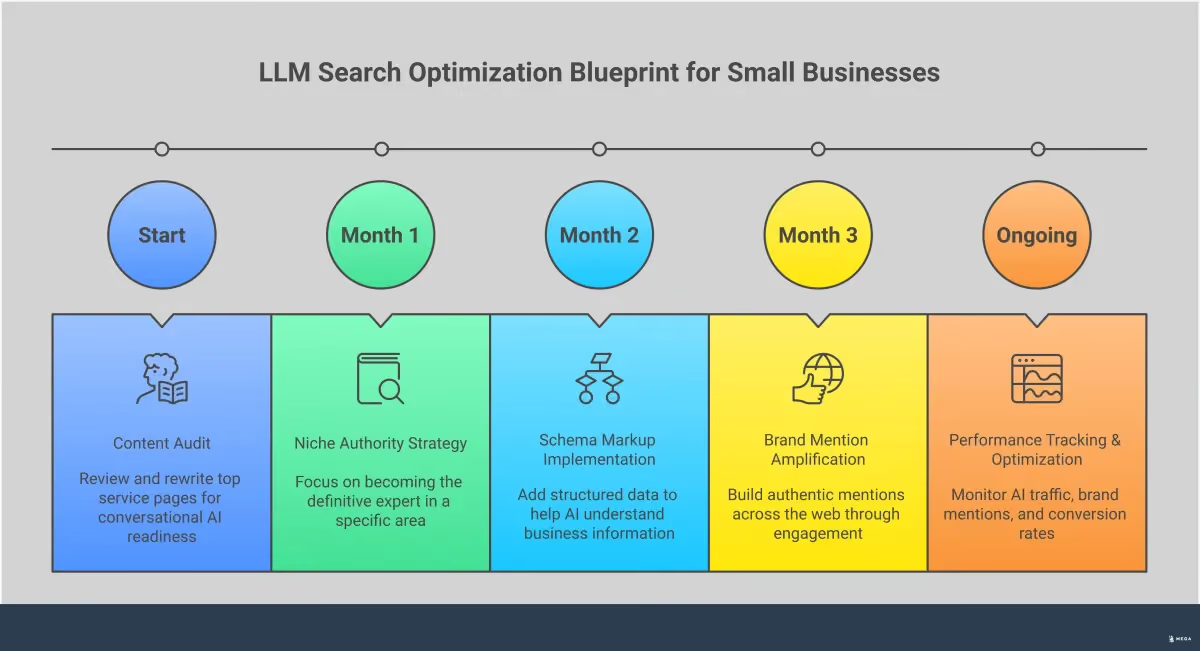
Create Content That Answers Questions
LLMs are designed to understand and answer questions in a conversational way. Your content should do the same. Think about the common problems and questions your customers have, and create content that directly addresses them. Instead of just describing your services, frame your articles, blog posts, and FAQ pages as clear answers. A great way to find these questions is by looking at the "People Also Ask" section on Google or browsing forums like Reddit and Quora. This gives you direct insight into the exact language your customers use when looking for solutions.
Optimize for Topics, Not Just Keywords
While keywords are still important, LLMs focus more on the overall topic and context of a page. This is known as semantic search. Instead of focusing on a single keyword, build your content around a central theme and include related concepts and subtopics. For example, if you’re a local coffee shop, don’t just write about "best coffee." Create content that covers related topics like "how to brew cold brew at home," "differences between light and dark roast," and "local coffee bean sourcing." This shows AI that you have deep expertise on the entire subject.
Build Authoritative Brand Mentions
LLMs learn about your brand’s authority from what others say about you online. Getting your business mentioned on reputable websites is a powerful signal. This doesn't have to mean a feature in a national publication. For a small business, this could be a mention in a local news blog, a feature on an industry-specific podcast, or a partnership with a non-competing local business. Every time a trusted source mentions your brand, it reinforces your credibility and makes it more likely that an LLM will cite you as a reliable source.
Focus on Your Niche
It’s difficult for a small business to be the top authority on a broad topic. Instead, focus on becoming the go-to expert in a specific niche. If you’re a marketing agency, you could specialize in "SEO for dentists" or "social media for local restaurants." By narrowing your focus, you can create highly specialized content that fully covers a topic. This makes it easier for AI models to identify you as the leading authority within that specific area, helping you stand out from competitors.
Encourage Customer Reviews and Content
Real-world discussions about your business are a goldmine for LLM optimization. AI models often pull information from customer reviews, online forums, and social media conversations to form their answers. Encourage your happy customers to leave reviews on platforms like Google, Yelp, and industry-specific sites. You can also foster community by creating a branded hashtag or engaging in relevant online groups where your customers spend their time. This user-generated content provides authentic, third-party validation that LLMs can use to recommend your business.
What Platforms Should You Optimize For?
Optimizing for LLMs isn't about targeting a single search engine. It's about making your brand visible across a new ecosystem of AI-powered tools where customers are looking for answers. While Google remains a giant, new platforms are quickly becoming go-to sources for information. A smart LLM optimization strategy ensures your business shows up wherever your customers are asking questions.
Think of it this way: traditional SEO focused on getting your website to the top of a list of links. LLM optimization focuses on getting your business mentioned directly in the AI-generated answer. This means your content needs to be a credible source for major AI platforms. The good news is that the work you do for one often helps you on others. Let's look at the key players you should have on your radar.
ChatGPT and OpenAI
ChatGPT has become a household name, and people use it for everything from writing emails to getting recommendations for local services. When a user asks a question, the AI scans its vast knowledge base to construct a helpful, conversational answer. The goal of LLM optimization is to ensure your business's information is part of that knowledge base and is seen as a credible source. When your brand gets featured or cited in a ChatGPT response, it acts as a powerful, trusted recommendation for potential customers looking for exactly what you offer.
Google's AI Overviews
Google is integrating AI directly into its search results with AI Overviews. These are the AI-generated summaries that appear at the top of the page for many search queries, answering the user's question directly. Unlike traditional search results that just provide a list of links, an AI Overview synthesizes information from multiple sources to create a single, comprehensive answer. Getting your content cited here positions your business as an authority right on the main search results page, giving you prime visibility before a user even starts scrolling through the blue links.
Perplexity and Other AI Search Engines
Beyond Google and ChatGPT, a new category of "answer engines" like Perplexity is emerging. These platforms are designed from the ground up to provide direct, cited answers to user questions rather than just a list of websites. They function as conversational search tools that are quickly gaining loyal users. Optimizing for these platforms means your content is ready for the next wave of search technology. A solid, human-first content strategy helps you gain traction across traditional search, AI Overviews, and these newer AI-powered tools, ensuring your business stays visible as search habits evolve.
How to Create Content for LLM Visibility
Creating content that gets noticed by AI search isn't about learning a new, secret language. It’s about focusing on what already works for human readers: clarity, relevance, and helpfulness. LLMs are designed to understand and process information the way people do. Your goal is to create content that is so clear and well-structured that an AI can confidently recommend it as the best answer to a user's question. Think of it as having a direct conversation with your customers through your content. When you write for people first, you’re also creating exactly what AI models are looking for.
Write in a Clear, Conversational Tone
The best way to connect with both your audience and AI models is to write like you speak. Avoid corporate jargon and overly complex sentences. Instead, use a conversational tone that is direct, friendly, and easy to understand. For example, instead of writing, “Our organization effectuates superior outcomes,” you could simply say, “We help you get great results.” This natural way of writing makes your content more accessible and relatable for your customers. Since LLMs learn from the vast amount of text on the internet, they are skilled at understanding and prioritizing content that sounds human and authentic.
Use Natural Language and Long-Tail Phrases
People rarely search using just one or two keywords. More often, they type or speak full questions into search engines. Your content should reflect this by incorporating natural language and long-tail phrases. For a local bakery, instead of just targeting “cakes,” you might create content that answers, “where to find the best custom birthday cakes in downtown.” This approach directly matches the specific intent of your potential customers. By focusing on these detailed phrases, you show LLMs that your content provides specific, valuable answers to real-world questions, increasing your chances of being featured in an AI-generated response.
Keep Your Brand Messaging Consistent
To be seen as a trustworthy source by an LLM, your business needs a consistent digital footprint. Your brand messaging—your unique voice, values, and expertise—should be uniform across your website, blog, social media profiles, and any other platforms where you appear. When an AI model consistently finds the same clear information about who you are and what you do, it builds a stronger, more authoritative signal. This tells the AI that you are a legitimate and knowledgeable entity in your niche, making it more likely to cite your business in its answers.
Format Your Content for Easy Reading
How your content looks is just as important as what it says. Proper formatting helps both humans and AI quickly scan and digest your information. Use clear headings and subheadings to break up your text into logical sections. Incorporate bullet points and numbered lists to highlight key information, and use bold text to emphasize important concepts. When you format your content for readability, you create a better user experience. This structure also provides clear signposts for AI crawlers, helping them understand the hierarchy and main points of your article more effectively.
Technical Steps for LLM Optimization
Beyond creating great content, a few technical adjustments can significantly improve how AI models understand and feature your website. Think of these steps as creating a clear, easy-to-read map for AI crawlers. By making your site’s structure and data more accessible, you help LLMs recognize your expertise and pull accurate information for their answers. These aren't complicated coding projects; they are straightforward updates that lay a strong foundation for your LLM optimization strategy. Getting these technical elements right ensures your hard work on content creation pays off and gets seen in the new landscape of AI-powered search. For small businesses, this is especially important. You're competing for attention, and making your website technically sound for AI is a low-cost way to gain an edge. It helps AI models trust your information, making them more likely to cite your business when answering a user's question about local services or niche products. This section will walk you through three key technical steps that make a real difference without requiring a deep technical background.
Use Schema Markup to Help AI Understand Your Site
Schema markup is a type of code you add to your website to help search engines and AI understand the meaning behind your content. It acts like a set of labels, clarifying that a string of numbers is a phone number, a specific text block is a customer review, or that your page is about a local business with a physical address. Using this structured data makes it much easier for an LLM to pull precise details from your site. For a local business, this could mean the AI accurately shares your hours, service area, or product prices in its response, directly answering a user's question with your information.
Structure Your Site for AI to Crawl
A well-organized website is crucial for both users and AI. When your site has a logical structure and clear navigation, AI crawlers can efficiently find and index all your important pages. This helps them build a comprehensive understanding of your expertise and what your business offers. An emerging practice is the creation of an llms.txt file, which works similarly to a robots.txt file. This file can give instructions to AI models about which content they can or cannot use for training. Adopting these LLM optimization strategies early can help prepare your site for the future of AI-driven search and content discovery.
Maintain and Update Your Content Regularly
LLMs are designed to provide the most current and reliable information available. A website with outdated statistics, old news, or broken links can be seen as less trustworthy. Regularly reviewing and refreshing your content signals to AI that your site is an active and authoritative source. This doesn’t mean you need to rewrite entire articles every month. Instead, focus on updating key pages with new examples, adding recent customer testimonials, or ensuring your service descriptions are accurate. This ongoing process of content maintenance is fundamental to building and preserving your brand’s credibility with both human readers and AI models.
How to Measure Your LLM Optimization Success
Measuring your success with LLM optimization looks a little different than tracking traditional SEO. Instead of focusing solely on where you rank on a search results page, the goal is to see how often and how favorably your brand appears within AI-generated answers. Think of it less like climbing a ladder and more like becoming a trusted source that an AI assistant would recommend to a friend. This shift means your key performance indicators (KPIs) will also change.
The key is to move your focus from keyword positions to brand presence and influence. Are LLMs citing your business as a solution? Are they mentioning your products when a user asks for recommendations? This requires a new set of metrics. You’ll need to track direct brand mentions, monitor referral traffic from AI platforms, and connect that activity to real business outcomes. By establishing a baseline now, you can see how your efforts are paying off and find gaps in your strategy before your competitors do. It's about understanding your visibility within these new conversational search environments and proving that visibility leads to growth.
Track Brand Mentions in AI Answers
One of the most direct ways to measure your LLMO efforts is to track how often your brand is mentioned in AI answers. When a user asks a question like, “What’s the best local coffee shop with free Wi-Fi?” or “Where can I find handmade leather goods?”, you want the AI to mention your business. These mentions are the new top-ranking positions.
While you can manually check this by asking different AI models questions related to your business, that isn’t a scalable approach. As research from industry experts points out, measuring LLM SEO is different, and you can't just look at keyword rankings. Specialized tools are emerging that can help track how often your brand appears in AI-generated responses, giving you a clearer picture of your visibility.
Monitor Traffic from AI-Powered Search
Beyond just being mentioned, you want to see if those mentions are driving people to your website. Keep a close eye on your website analytics to identify traffic coming from new or unusual referral sources. As AI search engines become more popular, you may start to see them appear in your traffic reports.
You can use a tool you already have, like Google Analytics 4, to track traffic coming from LLMs by setting up a custom report to watch for these new referrers. This data is crucial because it shows that users are not only seeing your brand in an AI response but are also compelled enough to click through to your site. This is a strong signal that your LLMO strategy is reaching high-intent customers.
Set Up Analytics to Track What Matters
Ultimately, the success of your LLM optimization strategy comes down to its impact on your bottom line. Tracking mentions and traffic is important, but you need to connect those metrics to the business goals that matter most, like sales, leads, and new customers.
Set up your analytics to measure the conversion rates of traffic coming from AI-powered search. Are these visitors signing up for your newsletter, booking appointments, or making purchases? By tracking these key business metrics, you can measure the real-world value of your LLMO efforts. This is where an end-to-end SEO service can help by connecting your content strategy directly to business growth, ensuring your efforts are always focused on driving tangible results.
How to Get Started with LLM Search Optimization
Shifting your focus from traditional SEO to LLM optimization doesn't require you to discard everything you’ve learned. Instead, it’s about adding a new layer to your strategy that focuses on conversational search. For a small business owner, the key is to start with small, manageable steps that build momentum over time. You don’t need to overhaul your entire website overnight.
The goal is to make your content a reliable source that AI models want to cite. This involves reviewing what you already have, identifying the most impactful changes you can make, and building your strategy piece by piece. By focusing on clear, helpful, and authoritative content, you align your website with what both human searchers and AI models are looking for. Our SEO agent is designed to handle this process, but you can lay a strong foundation on your own by following a few core principles. Let's walk through how you can begin.
Audit Your Content for LLM Readiness
Before creating new content, take stock of what you already have. An LLM readiness audit is simply a review of your existing pages to see how well they answer your customers' most common questions. Go through your main service pages and blog posts. Are they written in a clear, conversational tone? Do they provide direct answers to specific queries?
Focus on creating in-depth, informative content that addresses user needs comprehensively. For example, if you’re a local plumber, a page titled “Emergency Plumbing Services” should clearly answer questions like “What counts as a plumbing emergency?” and “How much does an emergency plumber cost?” This approach makes your content more valuable to readers and easier for AI to interpret as a helpful resource.
Prioritize Your Most Important Optimization Tasks
You can’t optimize everything at once, and you don’t have to. Start by identifying the pages that drive the most business or have the highest potential to attract customers. These might be your primary service pages, your top-performing blog posts, or pages targeting your most profitable customer segment.
Focusing your initial efforts here will help you see results faster without spreading yourself too thin. While traditional SEO focuses on ranking in a list of search results, LLM optimization aims to get your content featured as a credible source in AI-generated answers. By prioritizing your tasks, you can concentrate on making these key pages the best possible resource for a handful of important conversational queries first, then expand from there.
Build Your LLM Strategy One Step at a Time
LLM optimization is an evolving field, so a gradual approach is best. Start with one or two of your prioritized pages and focus on improving them for conversational search. You could rewrite a section to be more direct, add a Q&A section, or update the content with more current information.
Building your strategy incrementally allows you to make adjustments based on performance and emerging trends. Once you’ve optimized a page, monitor its performance. Are you seeing more traffic? Are you getting more qualified leads from it? Use these insights to refine your approach as you move on to other pages. This step-by-step process makes LLM optimization manageable and allows you to learn what works best for your specific business and audience. If you want to see how this can be automated, you can book a demo with our team.