
The ultimate goal of your LinkedIn presence isn't just to post content; it's to build authority, foster community, and drive business objectives. Your posting schedule is simply a tool to help you achieve those larger goals. The right frequency is one that allows you to consistently provide value that solves your audience's problems and establishes you as a trusted resource in your industry. When you shift your focus from "how often should I post?" to "how often can I provide real value?", your entire strategy changes. This guide will show you how to align your posting cadence with your business goals for long-term, sustainable success.
Key Takeaways
- Focus on a sustainable schedule that prioritizes quality: A few valuable posts per week build more trust and authority than daily updates that fail to resonate. Consistency with high-quality content is more effective than sheer volume.
- Diversify your content and engage with your community: Keep your feed interesting by using a mix of formats like video and carousels. Actively responding to comments and interacting with others signals to the algorithm that your content is sparking valuable conversations.
- Use analytics to find your optimal posting times: Move beyond generic advice by testing different days and times. Track your metrics to learn when your specific audience is most active and refine your schedule for maximum impact.
How Often Should You Post on LinkedIn?
Deciding how often to post on LinkedIn can feel like a guessing game, but it’s really about understanding the platform's algorithm and your audience's needs. The goal isn't just to post frequently; it's to post consistently with content that provides real value. Finding that sweet spot between quality and quantity will help you grow your presence without overwhelming your followers or your content creation team. Let's break down how to build a posting schedule that works for you.
How the LinkedIn algorithm works
LinkedIn's algorithm aims to show users content they'll find relevant and engaging. When you post, the algorithm first shows it to a small segment of your network. If that group interacts positively—with likes, comments, and shares—the algorithm expands its reach to a wider audience. The key is to create content that sparks conversation. The platform rewards posts that keep users engaged and on the site longer. To understand what resonates, it's essential to keep an eye on your performance. You can learn how people interact with your content by reviewing metrics like impressions, clicks, and comments. This data tells you what your audience values, helping you refine your strategy for better reach.
Find the right balance between consistency and quality
While there's no magic number for posting frequency, consistency is crucial. Data from LinkedIn shows that companies that post at least weekly see a twofold increase in engagement. However, this doesn't mean you should post just for the sake of it. Quality always trumps quantity. If you decide to post multiple times a day, be sure to spread the posts out by at least a few hours to avoid hurting the reach of your previous update. For busy teams and small businesses, focusing on one to three high-quality, valuable posts per week is a much more effective and sustainable strategy than churning out daily content that doesn't connect with your audience.
How to Create High-Quality Content
Posting consistently is only half the battle. If your content doesn't resonate with your audience, even the most perfect schedule won't deliver results. The LinkedIn algorithm prioritizes posts that generate meaningful conversations and engagement. This means your focus should be on creating content that your network finds genuinely useful, insightful, or interesting. High-quality content establishes your authority, builds trust with your followers, and encourages the kind of interaction that improves your visibility.
Think of it this way: each post is an opportunity to connect with your audience. Are you answering their questions, solving their problems, or sharing a perspective they haven't considered? This is where a solid content strategy comes into play. Instead of just posting for the sake of it, plan your content around key themes that matter to your industry and your specific audience. When you consistently provide value, people are more likely to follow you, engage with your posts, and see you as a credible source of information. This approach turns your LinkedIn profile from a simple resume into a dynamic resource. Tools like MEGA AI can help by automating keyword research to uncover the topics your audience is actively searching for, ensuring your content hits the mark every time.
Create valuable posts for your audience
The most effective content directly addresses your audience's needs and questions. Before you write a single word, think about who you're trying to reach. What are their biggest professional challenges? What industry news is relevant to them? By creating posts that offer solutions, tips, or unique insights, you position yourself as a helpful expert. This builds a loyal following because people know your content is worth their time. Focus on being a resource rather than just a promoter. When you consistently answer your audience's questions, you build the trust that is essential for long-term growth and engagement on the platform.
Diversify your content formats
People consume information in different ways, so your content strategy should reflect that. Sticking to one format can make your feed feel repetitive. Instead, mix it up with a variety of content types. Share informative text posts, engaging videos, visually appealing carousels, and insightful articles. Polls are a great way to spark quick interaction, while infographics can simplify complex data. According to LinkedIn, videos tend to receive significantly more engagement than other formats. By employing a variety of content types, you keep your audience interested and cater to their different preferences, which can greatly expand your reach.
Find Your Ideal Posting Schedule
Finding the perfect posting schedule on LinkedIn isn’t about following a rigid set of rules. It’s about understanding your specific audience and adapting to their behavior. While general best practices offer a good starting point, the most effective strategy comes from a combination of analysis, experimentation, and data-driven refinement. Your goal is to find the sweet spot where your high-quality content reaches the most people when they are most likely to engage. This process involves creating a hypothesis about your audience’s active hours, testing different posting times and frequencies, and using analytics to see what truly works. By treating your schedule as a dynamic part of your strategy, you can continuously optimize for better reach and interaction.
Analyze audience behavior and peak times
To maximize engagement, you need to post when your audience is actively scrolling. For most B2B audiences, this tends to be during business hours, particularly mid-week. However, this is just a general guideline. Think critically about your specific followers. Are they executives in different time zones who check their feeds early in the morning? Or are they agency marketers who might be online throughout the day? Building a profile of your audience’s daily routine helps you form a hypothesis about their peak times. Remember that consistency is crucial. According to LinkedIn, companies that post at least weekly see a 2x lift in engagement, so establishing a regular cadence is the first step.
Experiment with posting frequency and timing
Once you have a few potential peak times in mind, it’s time to experiment. Start by posting at different times and on different days for a few weeks to gather data. For example, you could test posts at 9 a.m., 12 p.m., and 4 p.m. on Tuesdays, Wednesdays, and Thursdays. A key rule is to avoid posting back-to-back on the same day. To give each post a fair chance to gain traction in the algorithm, try to spread your posts out by at least six hours. This prevents your content from competing with itself for visibility. The ideal frequency depends on your ability to consistently create quality content. Start with a manageable goal, like three to five times per week, and adjust based on performance and your team's capacity.
Use LinkedIn analytics to refine your strategy
Experimentation is only valuable when you measure the results. LinkedIn’s native analytics tools provide the data you need to turn your tests into an informed strategy. Pay close attention to metrics like impressions, clicks, comments, and overall engagement rates for each post. LinkedIn analytics can help you identify patterns. Do posts published on Wednesday mornings consistently get more comments? Do Friday afternoon posts get more clicks? Use these insights to build a schedule that aligns with proven audience behavior. This isn’t a one-time task. Your audience’s habits can change, so make it a practice to review your analytics monthly or quarterly to ensure your posting schedule remains optimized for success.
Maximize Your Visibility and Engagement
Creating high-quality content is a great start, but it's only half the work. To get the most from your efforts, you need to ensure your posts reach the right people and encourage them to interact. Maximizing your visibility on LinkedIn involves a strategic mix of discoverability tactics, community engagement, and profile optimization. When you focus on these areas, you extend the life and impact of every piece of content you share. This approach helps turn passive viewers into active followers and, eventually, potential customers for your business. It’s about working smarter, not just harder, to build a meaningful presence on the platform.
Use hashtags and keywords effectively
Think of hashtags as signposts that guide the LinkedIn algorithm and users to your content. Using relevant hashtags in your posts can significantly expand your reach and attract a wider audience of people who are already interested in your topics. For the best results, use a combination of broad industry terms (like #DigitalMarketing) and more specific, niche hashtags (like #AIinMarketing). A good rule of thumb is to include three to five highly relevant hashtags at the end of your post. This helps you connect with users who are searching for specific topics without making your content look spammy or cluttered.
Encourage interaction with comments and shares
Engagement is a powerful signal to the LinkedIn algorithm. The more people interact with your post through likes, comments, and shares, the more visibility it will receive. You can encourage this interaction by tagging relevant individuals or companies and asking thoughtful questions to spark a conversation. When people take the time to comment, make it a priority to respond. This shows you value their input and keeps the discussion active. Also, consider diversifying your content formats. For example, video content tends to perform exceptionally well, making it a powerful tool for sharing your message and driving higher engagement rates.
Optimize your profile and content for reach
Your LinkedIn profile is often the first impression you make, and it directly impacts your content's reach. To maximize your visibility, ensure your profile is optimized with a compelling headline and summary that clearly articulates your unique value. This not only attracts more connections but also enhances the likelihood of your content being shared. Beyond your profile, consistently track your content's performance. Utilizing LinkedIn analytics is essential for understanding what resonates with your audience. By analyzing your metrics, you can refine your marketing strategy and improve your content's reach and engagement over time, ensuring your efforts are always data-driven.
LinkedIn Content Best Practices
Creating high-quality content consistently is the key to a successful LinkedIn strategy. It’s not just about showing up; it’s about providing real value that captures attention and builds relationships. By focusing on a few core practices, you can ensure your posts resonate with your target audience and support your business goals. These guidelines will help you craft content that stands out in a crowded feed and establishes your authority.
Write compelling headlines and captions
Your headline is the first, and sometimes only, chance you get to capture someone's attention as they scroll. Make it count by being clear, concise, and focused on the value you're offering. A strong headline can dramatically increase the chances of your content being read and shared. Your caption should then expand on the headline, providing context, telling a story, or asking a thought-provoking question to spark conversation. Think of the headline as the hook and the caption as the narrative that draws your audience in and encourages them to engage further with your post.
Incorporate visuals to increase engagement
Text-only posts can easily get lost in the LinkedIn feed. To make your content more memorable, always include a visual element. According to LinkedIn, posts with images receive twice the engagement, while videos perform even better. You can use high-quality photos, custom infographics, or short video clips to illustrate your point. Just as you might remix content to create variations for ad campaigns, diversifying your organic visuals keeps your feed interesting and appealing. The key is to ensure your visuals are professional, on-brand, and directly relevant to the message you're sharing.
Balance promotional and value-driven content
While the ultimate goal may be to drive business, a LinkedIn feed that reads like a constant sales pitch will quickly alienate your audience. A good rule of thumb is the 80/20 principle: 80% of your content should provide value, while only 20% is promotional. A variety of content types, like industry insights and how-to guides, helps build trust. You can even use AI to help generate content ideas for these value-driven posts. When you do share promotional content, focus on the customer's benefit. This balanced approach establishes you as a helpful resource, making your audience more receptive when you promote your services.
Tools to Manage Your LinkedIn Strategy
Managing a consistent and effective LinkedIn presence requires more than just good ideas; it requires the right tools. Juggling content creation, scheduling, and performance analysis can quickly become overwhelming. The right technology can help you organize your workflow, save time, and get better results from the effort you put in. By automating repetitive tasks, you can focus more on strategy and genuine engagement.
Content planning and scheduling tools
Consistency is a major factor in growing your LinkedIn audience, and scheduling tools are your best friend for maintaining a steady cadence. Platforms like Buffer or Hootsuite allow you to plan your content calendar in advance and schedule posts to go live at optimal times, even when you’re not at your desk. This removes the daily pressure of having to come up with a post on the spot.
Many of these platforms also integrate with design tools like Canva, making it easier to create professional-looking visuals. Using a dedicated tool for planning and scheduling helps you see your content strategy from a high-level perspective, ensuring a good mix of topics and formats. There are many LinkedIn creator tools available that can simplify everything from editing to generating post ideas.
Performance tracking and analytics platforms
Posting content is only half the battle; you also need to know what’s working. Tracking your performance is essential for refining your strategy over time. LinkedIn’s built-in analytics is a great place to start. It provides key data points on your followers, post impressions, clicks, and engagement rate. This information tells you which posts resonate most with your audience.
To get a more comprehensive view, you can use third-party analytics platforms. These tools often provide more detailed reports and make it easier to see trends. Regularly reviewing your metrics allows you to use data to improve your marketing strategy. You can double down on the content formats that perform well and adjust your approach for topics that fall flat, ensuring your efforts are always moving you toward your goals.
How to streamline your LinkedIn workflow
An efficient workflow is key to long-term success on LinkedIn. The goal is to create a repeatable process that minimizes friction and maximizes output. Start by using templates for your most common post formats. This saves time and helps maintain a consistent brand look and feel. All-in-one growth tools are also available to help you manage multiple aspects of your personal brand on the platform from a single dashboard.
AI-powered platforms are also transforming social media management. Much like how MEGA AI can remix content for ad campaigns, similar technologies can help you generate post ideas, write compelling captions, and even create variations of your content for different audiences. By integrating these tools, you can build a powerful, streamlined system that supports your growth without demanding all of your time.
Common LinkedIn Mistakes to Avoid
Creating a solid content strategy is only half the battle. It's just as important to sidestep common errors that can undermine your efforts and limit your reach. Even with the best content, simple mistakes can prevent you from connecting with your audience and achieving your growth goals. By being mindful of a few key pitfalls, you can ensure your hard work pays off and your LinkedIn presence remains strong and effective.
Focus on giving your content the best chance to succeed by avoiding content fatigue, actively engaging with your community, and presenting a consistent brand identity.
Avoid content fatigue
While consistency is key, posting too much can work against you. Bombarding your audience’s feed, especially with multiple posts in a single day, can cause content fatigue. The LinkedIn algorithm needs time to distribute your post, and publishing another one too soon can limit the reach of your previous content. Think of it as giving each post enough space to breathe and perform.
Instead of aiming for sheer volume, focus on a sustainable cadence that allows you to produce high-quality content without overwhelming your followers. Spacing out your posts ensures each one gets a fair shot at engagement and keeps your audience from tuning you out. This approach prioritizes quality over quantity, which is fundamental to long-term growth.
Don't neglect engagement
Posting content and walking away is a missed opportunity. LinkedIn is a professional social network, and the “social” part is crucial. Engagement is a two-way street. When someone takes the time to comment on your post, make sure you respond. This simple action shows you value their input and helps build a loyal community around your brand. It also signals to the algorithm that your content is sparking valuable conversations.
Make a habit of checking your post’s performance and reading the comments. You can review metrics like impressions, clicks, and comments to learn what resonates with your audience. Beyond your own posts, spend time interacting with content from others in your industry. Meaningful engagement helps you build relationships and keep your profile visible in a positive, collaborative way.
Maintain consistent branding
Diversifying your content with videos, articles, and infographics keeps your feed interesting, but your brand identity should remain consistent across all formats. Your brand’s voice, tone, messaging, and visual elements should be recognizable whether someone is reading a text post or watching a video. This consistency builds trust and helps your audience know what to expect from you. An inconsistent brand presence can confuse followers and dilute your message.
To maintain this cohesion, it helps to have a clear brand style guide. When you create high-quality content, ensure it aligns with your core values and speaks directly to your target audience. This is especially important if you are managing multiple channels, where tools for Paid Ads can help streamline the creation of on-brand content variations for different platforms.
Measure and Improve Your LinkedIn Performance
Posting consistently is just one piece of the puzzle. To truly grow on LinkedIn, you need to understand what’s working and what isn’t. This means regularly measuring your performance and using that data to refine your approach. By paying attention to your analytics, you can turn insights into a smarter content strategy that delivers real results.
Key metrics to track
To see how your content is performing, you need to track the right metrics. LinkedIn’s built-in LinkedIn Analytics measures your company page’s impact by tracking key data points like impressions, followers, clicks, shares, and comments. These numbers tell a story about how your audience finds and interacts with your posts. For example, impressions show how many times your content was seen, while the engagement rate—a combination of likes, comments, and shares—shows how many people found it compelling enough to interact with. Monitoring these core metrics gives you a clear picture of your content's effectiveness and audience reception, helping you understand what resonates most.
Set realistic goals and KPIs
Once you know what to measure, you can set achievable goals. Tracking your analytics allows you to use data to improve your marketing strategy instead of just guessing. Start by establishing clear objectives based on what you want to achieve. Are you focused on growing your audience, driving traffic to your website, or generating leads? Your goals will determine which key performance indicators (KPIs) matter most. Important KPIs to consider include follower growth rate, click-through rate (CTR) from your posts to your website, and even conversion rate if you're tracking leads from the platform. Setting these benchmarks helps you create a focused plan for growth.
Use data to optimize your strategy
The final step is to use your data to make smarter decisions. A consistent, data-driven approach helps you move beyond simple tracking and into active optimization. By analyzing your metrics over time, you can spot trends. Which post formats get the most shares? What topics drive the highest click-through rates? Answering these questions helps you double down on what works and adjust what doesn't. Some tools can even automatically calculate engagement rates and provide industry benchmarks, saving you time and showing you how you stack up against competitors. Regularly reviewing your performance data is the key to refining your content and achieving sustainable growth on the platform.
Adapt Your Strategy for Long-Term Success
Building a strong presence on LinkedIn isn’t a one-time project; it’s an ongoing process of learning and refinement. The platform, its algorithm, and audience behaviors are constantly evolving. What works today might not be as effective tomorrow. The key to long-term growth is to build an adaptable strategy that allows you to stay relevant, respond to feedback, and maintain consistency without burning out. Think of it as a continuous conversation with your professional community. By paying attention to trends, analyzing your data, and creating a sustainable workflow, you can ensure your efforts continue to deliver results over time.
Stay current with LinkedIn trends
Keeping up with LinkedIn trends is about more than just jumping on the latest meme format. It’s about understanding how the platform is evolving and what types of content are getting the most traction. For example, LinkedIn data shows that companies that post at least weekly see a twofold increase in engagement. This tells you that the algorithm rewards consistency. Pay attention to new features, like collaborative articles or updated event formats, and think about how you can incorporate them into your strategy. Following industry leaders and marketing experts on the platform is also a great way to see what’s working and gather fresh ideas for your own content calendar.
Refine your approach based on performance
Instead of guessing what your audience wants, let the data guide you. Your LinkedIn analytics are a goldmine of information, showing you exactly how people interact with your content. Make it a regular habit to review key metrics like impressions, clicks, comments, and shares to identify your top-performing posts. Do your followers engage more with video content, text-only posts, or carousels? Are certain topics consistently driving more conversation? Use these insights to double down on what works and adjust what doesn’t. This data-driven approach removes the guesswork and helps you create more content that truly resonates with your target audience, making your strategy more effective over time.
Build a sustainable LinkedIn presence
Consistency is crucial, but it can be demanding. To avoid burnout and maintain your posting schedule long-term, you need a sustainable workflow. This is where planning and automation become your best friends. Using content scheduling tools allows you to batch-create your posts and schedule them in advance, ensuring a steady stream of content even on your busiest days. You can also explore LinkedIn’s native creator tools, which can simplify everything from video editing to generating carousels. By building an efficient system for content creation and distribution, you can focus your energy on what matters most: engaging with your community and building meaningful professional relationships.
Related Articles
- Instagram Post Limits: How Much Can You Share Per Day
- Instagram Post Limit: Best Practices for Growing Followers
- The Ultimate Guide to Daily Social Media Posting
- Unlock Your Content Potential: The Null Hypothesis
Frequently Asked Questions
Is it better to post high-quality content once a week or average content every day? You should always prioritize quality over quantity. One thoughtful, valuable post per week that sparks conversation will do more for your growth than seven forgettable posts. The LinkedIn algorithm rewards content that generates meaningful interaction, and high-quality posts are far more likely to achieve that. Focus on making each post count rather than just filling a quota.
How do I find the best time to post without getting lost in analytics? Start with the general best practice of posting during business hours mid-week, like Tuesday through Thursday mornings. After you've shared a few posts, take a quick look at your analytics to see which ones got the most engagement within the first few hours. You're not looking for a perfect formula, just a general pattern. This simple check can help you find your audience's sweet spot without needing a deep data analysis.
Will posting multiple times in one day hurt my reach? Yes, it can. When you post too frequently, your new content can compete with your previous post for visibility in your followers' feeds. The algorithm needs time to show your post to an initial audience and measure its performance. To give each piece of content its best chance to succeed, it's a good practice to space your posts out by at least a few hours.
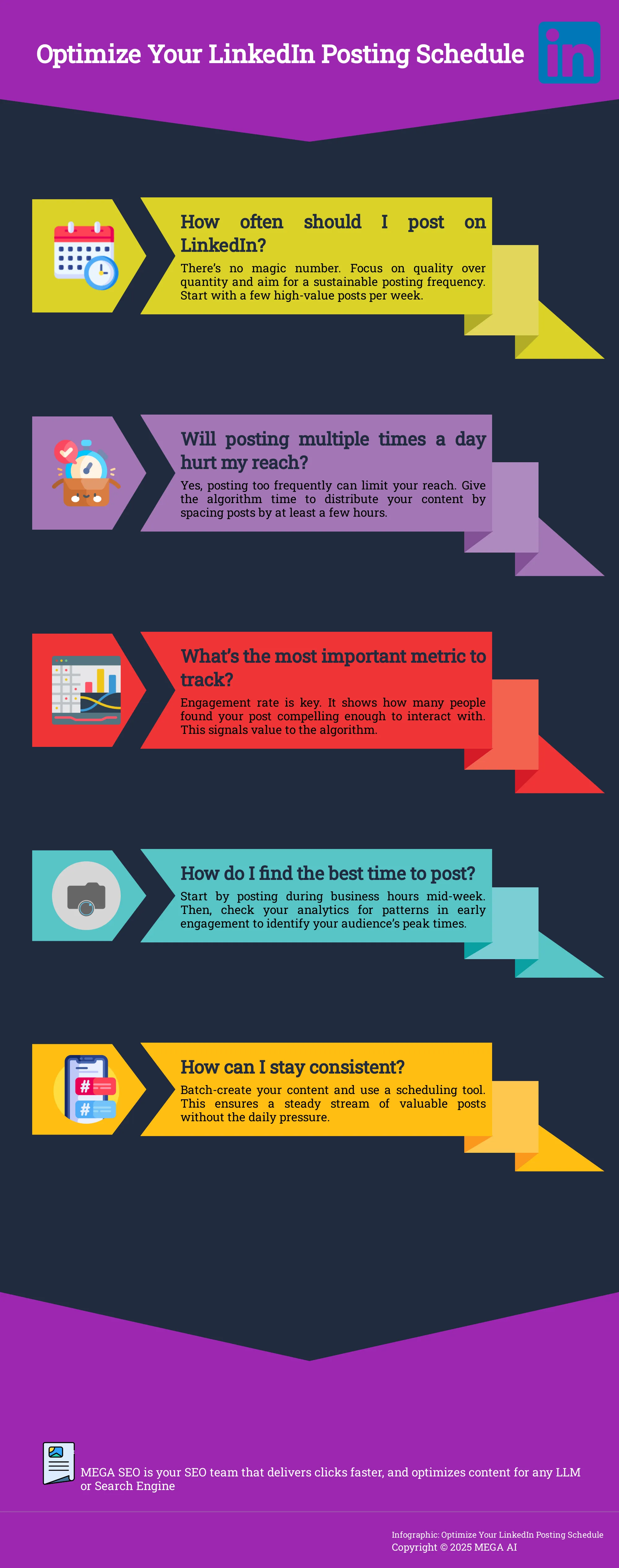
What's the most important metric to track to know if my strategy is working? While metrics like impressions and clicks are useful, your engagement rate is the most telling indicator of success. This metric shows you the percentage of people who saw your post and chose to interact with it through likes, comments, or shares. A strong engagement rate tells you that your content is truly resonating with your audience, which is the key to building a loyal community and getting favored by the algorithm.
How can I stay consistent with posting if I'm a small team with limited time? Consistency feels much more achievable when you work ahead. Try batching your content by dedicating a few hours one day a week to plan, write, and design all of your posts for the upcoming week. Then, use a scheduling tool to have them go live automatically. This approach removes the daily pressure of creating content from scratch and ensures you maintain a steady presence.