
Does your content calendar feel scattered? Are you trying to cover every topic in your industry, hoping something will stick? This "spray and pray" approach is a common trap that leaves marketing teams feeling burnt out and their content failing to make a real impact. It dilutes your message, confuses your audience, and makes building true authority nearly impossible. There is a simpler, more strategic way to operate. The Hedgehog Concept is a framework designed to bring sharp focus to your efforts. It helps you move away from being a generalist who is just okay at many things and become a specialist known for one thing, creating content that builds trust and drives measurable results.
Key Takeaways
- Find Your Niche by Pinpointing Your Core Focus: The Hedgehog Concept is about identifying the intersection of what you're passionate about, what you can be the best at, and what drives your business. This sharp focus allows you to build authority by creating deep, valuable content instead of covering a wide range of topics superficially.
- Apply Your Hedgehog Consistently Across All Channels: To build a strong brand identity, your core message must be consistent everywhere. Whether it's your blog, social media, or email marketing, every piece of content should reinforce your specific area of expertise and speak directly to your target audience.
- Continuously Measure and Refine Your Strategy: A successful hedgehog strategy isn't static; it evolves. Regularly analyze your performance against key business goals, identify which content drives revenue, and use that data to adapt to market changes and optimize your approach over time.
What is the Hedgehog Concept in Content Marketing?
The Hedgehog Concept comes from a simple parable about a fox and a hedgehog. The fox is clever and knows many things, constantly devising new strategies to catch the hedgehog. The hedgehog, in contrast, knows only one big thing: how to defend itself by rolling into a spiky ball. Every time the fox attacks, the hedgehog’s single, focused strategy wins.
In content marketing, this story highlights the power of focus over breadth. Many businesses operate like the fox, chasing every new trend, covering a wide range of topics, and trying to be everything to everyone. This approach often leads to content that is spread too thin and fails to build real authority. A hedgehog-focused business, however, identifies the one area where it can be the best in the world. It channels all its energy into owning that specific niche.
Finding your hedgehog means identifying the intersection of what you are passionate about, what you can be the best at, and what drives your business. It’s about drilling down to your core strength. Instead of trying to attract a million visitors with surface-level content, the goal is to create a content strategy that meaningfully reaches a hundred people who genuinely need your expertise. These are the people who will become loyal customers and brand advocates.
Once you find your hedgehog, your entire marketing plan becomes clearer. You know which topics to focus on, what keywords to target, and how to speak directly to your ideal audience. This sharp focus makes every piece of content more impactful and easier to optimize. With a clear direction, you can use SEO tools to dominate your niche, ensuring your expert content reaches the right people at the right time.
How to Find Your Content Hedgehog
Finding your content hedgehog requires looking inward at your strengths and outward at your market. It’s about discovering the intersection of three critical areas: what you are deeply passionate and knowledgeable about, what your audience genuinely needs, and what drives your business. When you find the sweet spot where these three circles overlap, you’ve found your hedgehog. This focused approach allows you to create content that is not only authentic and sustainable for you to produce but also valuable and compelling for your audience. It’s the difference between shouting into the void and having a meaningful conversation with people who are eager to listen.
This process isn't about chasing every trend or trying to cover every topic in your industry. It's a strategic choice to go deep instead of wide. By concentrating your efforts on a specific niche, you build authority and become the go-to resource for a dedicated community. This focus simplifies your content creation process, clarifies your messaging, and ultimately makes your marketing more effective. The following steps will guide you through this process of discovery, helping you pinpoint the unique value you can offer.
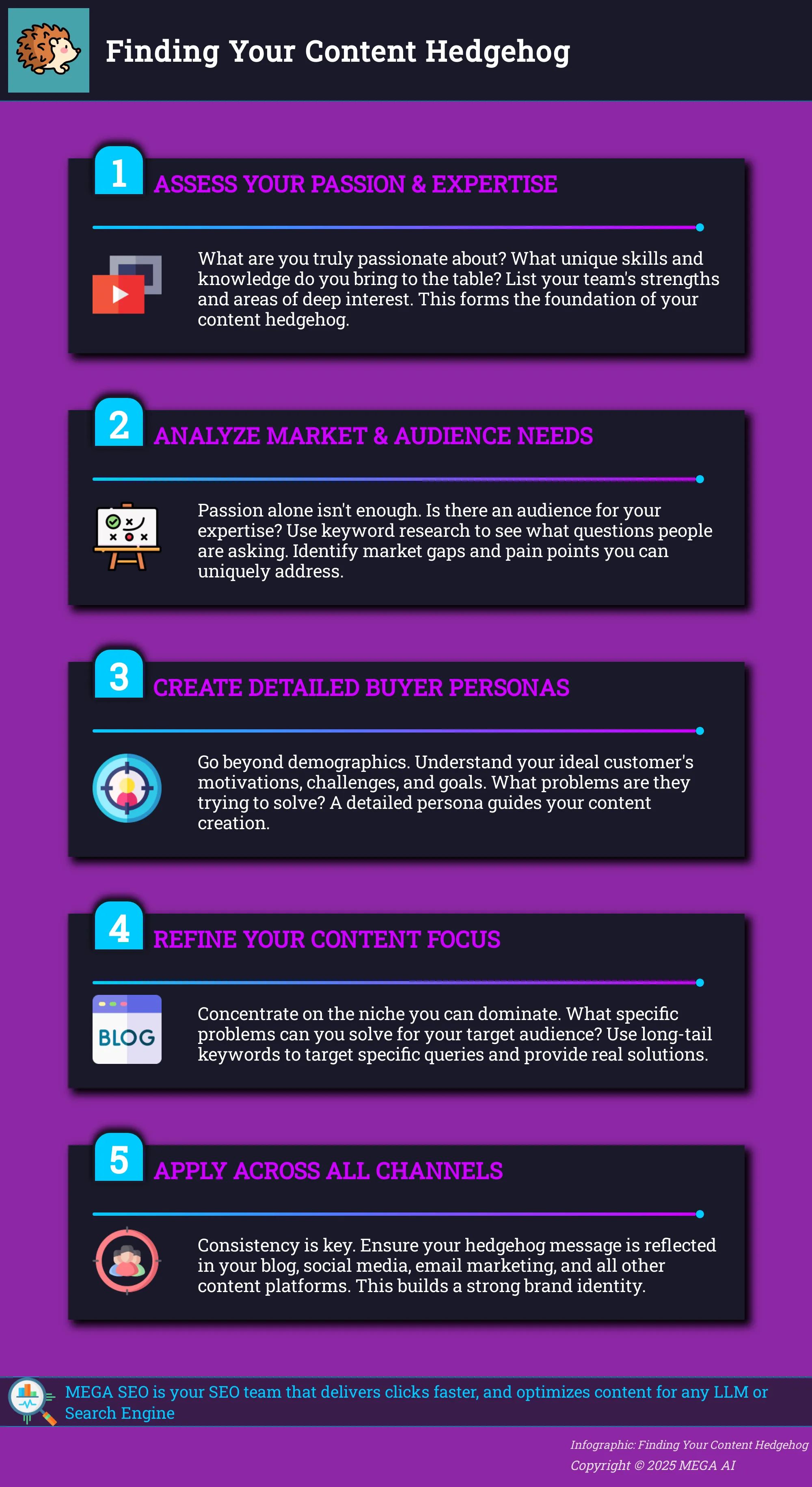
Assess Your Passion and Expertise
The first step is to identify what you and your team are uniquely good at. What topics could you talk about for hours? What knowledge do you possess that few others do? This isn’t about trying to be everything to everyone. Instead, focus on your core competencies. Authenticity is magnetic, and your content will be far more powerful if it comes from a place of genuine expertise and passion. It’s better to meaningfully connect with a hundred people who value your specific insights than to barely make an impression on a thousand. Start by listing your team's skills, professional experiences, and interests. This foundation ensures your content strategy is sustainable and that you can consistently produce high-quality, authoritative material.
Analyze Market and Audience Needs
Once you know your strengths, you need to find out if there’s an audience for them. It’s a common challenge; many marketers struggle to create content that truly resonates with their audience. Your passion is only one part of the equation; it must intersect with a real market demand. Use keyword research tools to see what questions people are asking related to your areas of expertise. Analyze competitor content to spot gaps you can fill. What problems are your potential customers trying to solve? Platforms with automated SEO features can simplify this discovery process, helping you identify high-demand topics where your expertise can provide a unique solution. The goal is to find the pain points that you are uniquely equipped to solve.
Create Detailed Buyer Personas
To truly understand your audience’s needs, you need to know who they are. Creating detailed buyer personas is essential. Using marketing personas can make your website and content significantly more effective because you’re targeting the right users. A strong persona goes beyond basic demographics like age and job title. It includes psychographics, which cover their goals, challenges, and motivations. What are their biggest professional pain points? What are they trying to achieve? Answering these questions helps you create a buyer persona that feels like a real person. This detailed profile will become your guide, ensuring every piece of content you create speaks directly to the people you want to reach.
Align Your Content with the Hedgehog Concept
Once you’ve identified your content hedgehog, the next step is to put it into action. Aligning your content strategy with this core concept ensures every piece you create is focused and effective. This isn't just about choosing the right topics; it's about refining your focus, tailoring your voice, and speaking directly to specific segments of your audience. This approach helps you build a library of resources that establishes your authority and resonates with the people you want to reach.
Refine Your Content Focus
It’s tempting to create content for everyone, but a broad approach often leads to shallow engagement. Instead, concentrate on the niche you can dominate. The goal is to meaningfully reach a hundred people who are genuinely interested in your expertise, rather than barely getting the attention of a thousand. This means zeroing in on the specific problems and questions your core audience has. Use automated keyword research tools to find long-tail keywords and specific queries that your ideal customers are searching for. This sharp focus ensures your content provides real solutions, making your brand the go-to resource within your specialized area.
Tailor Your Voice and Tone
Your voice is how you express your brand’s personality, and it should be consistent with your hedgehog. Are you a technical expert, a creative guide, or a data-driven analyst? Let that shine through. Authenticity is key, especially when building thought leadership. According to a LinkedIn study, many professionals feel that most thought leadership content lacks valuable insights. By sticking to what you know best, your content will naturally carry an authoritative and trustworthy tone. This helps you stand out from the noise and build a loyal following that values your unique perspective and expertise.
Segment Your Audience for Better Engagement
Even within your niche, your audience isn't a monolith. It consists of different groups with varying needs, pain points, and levels of knowledge. Segmenting your audience allows you to create targeted content that speaks directly to each group. For example, the content for a startup founder will differ from that for a marketing manager at a small business. Data shows that segmented campaigns perform better because they are more relevant. Use buyer personas to guide your content creation, ensuring each article, email, or social post is tailored to a specific segment for maximum impact.
Apply the Hedgehog Concept Across Your Content Channels
Once you’ve identified your hedgehog, the next step is to apply it consistently across every platform where you connect with your audience. This focused approach is what transforms your content from a scattered collection of ideas into a cohesive and powerful brand message. When every blog post, social media update, and email reinforces your core expertise, you become memorable. Your audience knows exactly what to expect from you and why they should listen. This is how you move from being just another voice to becoming a go-to resource in your industry.
This consistency also simplifies your content creation process. Instead of wondering what to post each day, you have a clear framework guiding your decisions, which saves time and mental energy. It ensures that you attract the right people—those who are genuinely interested in what you have to offer. Applying your hedgehog concept isn't about limiting your creativity; it's about channeling it effectively toward a specific goal. By doing so, you build a strong, recognizable brand identity that stands out in a crowded digital landscape. Let’s look at how you can implement this focused strategy across your key content channels to build momentum and drive results.
Blog Posts and Articles
Your blog is the perfect place to demonstrate the depth of your expertise. Instead of writing about a wide range of general topics, use your hedgehog concept to go deep on subjects within your niche. Every article should be a testament to what you do best. This starts with a clear understanding of your audience. Research shows that using marketing personas can make your content significantly more effective because you’re writing for a specific person with specific needs. When you focus your blog content on solving their unique problems, you not only attract high-quality traffic but also build a library of resources that establishes your authority in the field.
Social Media
On social media, it’s easy to get distracted by fleeting trends. The hedgehog concept keeps you grounded. Your social channels should be a direct reflection of your core message, providing consistent value to your followers. Focus on creating and sharing content that speaks directly to your niche. When you deliver exceptional content to a hungry audience, you meet their needs and encourage them to share your message with others who have similar interests. This approach helps you build a loyal community around your expertise rather than just accumulating passive followers. Every post, story, and video should reinforce what your brand stands for.
Email Marketing
Email marketing becomes much more powerful when guided by the hedgehog concept. Instead of sending generic blasts to your entire list, use your core focus to segment your audience. You can group subscribers based on their specific interests and behaviors related to your niche. This allows you to send highly targeted and relevant content that resonates on a personal level. In fact, segmented campaigns have been shown to achieve significantly higher open rates than non-segmented ones. By tailoring your messages, you show subscribers that you understand their needs, which builds trust and encourages them to take action.
Thought Leadership
True thought leadership is the ultimate outcome of the hedgehog concept. It’s not about having an opinion on everything; it’s about being the definitive source of knowledge in one specific area. With many professionals feeling that most thought leadership content provides little value, there's a clear opportunity to stand out by being focused. To do this, you must focus on what you know and commit to making it great. This aligns perfectly with Google’s E-A-T guidelines, which prioritize expertise, authoritativeness, and trust. By consistently producing high-quality, insightful content within your niche, you build a reputation as a trusted expert and the go-to resource in your field.
Use the Hedgehog Concept to Build Thought Leadership
Once you’ve defined your content hedgehog, you have a powerful framework for establishing yourself as a thought leader. True thought leadership isn’t about having an opinion on everything; it’s about offering deep, credible insights within a specific domain. By operating at the intersection of your passion, expertise, and economic drivers, you position your brand as a go-to resource for a dedicated audience. This focused approach is what separates genuine authorities from the general noise of the internet. It's about depth over breadth.
Instead of trying to be known for everything, the Hedgehog Concept encourages you to be known for one big thing. This clarity builds trust and authority over time. When your audience knows exactly what to expect from you—and that what you provide is consistently excellent—they are more likely to listen, engage, and see you as a credible guide. This is the foundation of effective thought leadership marketing. It shifts your content from simply informing to truly influencing your industry. By consistently delivering value within your niche, you create a reputation that attracts customers, partners, and talent to your business. This strategic focus ensures your efforts aren't diluted across too many topics, making each piece of content more impactful and memorable.
Identify Your Core Areas of Expertise
The first step in building thought leadership is to get brutally honest about what you know. As marketing expert Neil Patel advises, it's better to meaningfully reach a hundred people than to barely get through to a thousand. Instead of chasing a massive, generic audience, concentrate on the niche where you can be the best. This is the "what you can be the best in the world at" circle of the Hedgehog Concept. Define your area of expertise so narrowly that you can own the conversation. This focus allows you to go deeper than competitors, providing insights that a generalist could never uncover.
Create High-Quality, Insightful Content
With your expertise defined, the next step is to create content that proves it. According to a LinkedIn study, a majority of professionals feel that most thought leadership content provides little to no valuable insight. This is your opportunity to stand out. Focus on creating genuinely helpful, insightful content that goes beyond surface-level tips. Offer unique data, share a proprietary framework, or provide a perspective that challenges conventional wisdom. You can use MEGA AI's content generation features to handle the initial draft, freeing you up to infuse the article with your unique expertise and analysis, ensuring every piece is a valuable resource.
Engage with Your Community
Thought leadership is not a monologue; it's a dialogue. Building authority requires you to actively engage with the community you’re serving. When you deliver exceptional content, you encourage your audience to share it and discuss it. Make it a priority to respond to comments on your blog, answer questions on social media, and participate in relevant online forums. This two-way communication does more than just build relationships. It provides invaluable feedback, helps you understand your audience’s challenges more deeply, and solidifies your position as an approachable and trusted expert in your field.
How to Measure and Optimize Your Hedgehog Strategy
Once you’ve defined your Hedgehog Concept, the work isn’t over. A successful strategy requires continuous measurement and refinement to ensure it remains effective. Think of it as a feedback loop: you create focused content, measure its performance, and use that data to make your next move even smarter. This process helps you stay aligned with your core strengths while adapting to audience needs and market shifts.
Define Your Key Performance Indicators (KPIs)
To effectively measure your strategy, you must first define what success looks like. Key Performance Indicators (KPIs) are the specific metrics you’ll use to track progress toward your goals. Instead of tracking every metric available, focus on the ones that directly reflect the success of your Hedgehog strategy. These might include organic traffic from your target keywords, conversion rates on niche-specific landing pages, or customer engagement on your core content pieces.
By establishing clear KPIs, you create a benchmark for performance. For example, if your goal is to become the go-to resource for a specific topic, you would track keyword rankings and organic traffic for that topic cluster. Using SEO tools to monitor these metrics helps you see exactly how well your focused content is resonating with your intended audience.
Identify Revenue Drivers
While traffic and engagement are important, a truly effective Hedgehog strategy must also prove its economic value. It’s essential to understand which pieces of content are not just attracting visitors but are also driving revenue. Analyze your customer journey to see which blog posts, articles, or guides are most frequently consumed by users who eventually make a purchase or sign up for a demo.
This analysis helps you identify your content marketing revenue drivers and double down on what works. If you find that a series of articles on a specific problem consistently leads to demo requests, you know that topic is a powerful asset. This insight allows you to allocate resources more effectively, creating more content that directly supports your business’s bottom line.
Adjust Your Strategy Based on Data
Your market and audience are not static, so your content strategy shouldn’t be either. Regularly review your performance against your KPIs to see what’s working and what isn’t. This data-driven approach is fundamental to long-term success and helps you improve your content marketing strategy over time. If a certain content format is underperforming or audience interests begin to shift, you need to be ready to pivot.
This doesn’t mean abandoning your Hedgehog Concept. Instead, it’s about refining your execution within your niche. For instance, data might show that your audience prefers video tutorials over long-form articles. Or you might find that an existing article needs to be updated to maintain its rank after a search engine update. Tools like MEGA AI’s Maintenance Agent can automate these adjustments, ensuring your content stays fresh, relevant, and optimized for performance.
Common Challenges When Adopting the Hedgehog Concept
Adopting the Hedgehog Concept sounds straightforward, but it requires discipline. Many businesses find it challenging to stick to a single, focused idea when there are so many potential topics to cover. The path to becoming an authority in your niche is often paved with a few common hurdles. Understanding these challenges can help you stay the course and avoid the pitfalls that cause others to stray from their core focus. Let's look at three of the most frequent obstacles.
Resisting the Urge to Broaden Your Focus
It’s tempting to chase every trend or keyword. This fear of missing out can lead you to dilute your message by trying to be everything to everyone. While many businesses know that content creation is important, they often struggle by making their focus too wide. The real power comes from owning a specific niche. Instead of being a generalist who is just okay at many things, put your energy into the one thing that truly makes a difference for your audience. This commitment to a narrow focus is what builds deep expertise and makes your brand the go-to resource in its field.
Maintaining Consistency Over Time
Finding your hedgehog is the first step; sticking with it is the real test. It takes time to build momentum and see results from a focused content strategy. Many marketers give up too soon when they don't see immediate traffic spikes. Remember, you are much better off trying to meaningfully reach a hundred people than you are barely getting through to a thousand. Consistency in your niche builds trust and sets audience expectations. Tools that help with content automation can be a game-changer, allowing you to maintain a steady publishing cadence and keep your core content updated without burning out your team.
Balancing Specialization with Versatility
Being a specialist doesn't mean being rigid. The market changes, audience needs evolve, and new platforms emerge. The challenge is to adapt without abandoning your core hedgehog. True mastery involves knowing how to apply your specialized knowledge in new ways. This means staying informed and being willing to tweak your approach. For example, your core topic might stay the same, but you may need to re-optimize content for a new algorithm. A successful content marketing strategy is one that can evolve, expanding its impact while remaining firmly rooted in its area of expertise.
How to Evolve Your Hedgehog Concept
Your Hedgehog Concept is a powerful guide, but it isn't meant to be set in stone. Markets shift, audiences mature, and new technologies emerge. A successful content strategy requires you to evolve your focus over time, not by abandoning your core principles, but by refining and strengthening them. Evolving your Hedgehog Concept means staying sharp and relevant, ensuring your deep expertise continues to meet the needs of your audience.
This evolution isn't about chasing every new trend. Instead, it’s a strategic process of adapting to change, expanding your influence within your chosen niche, and using new tools to execute your strategy more effectively. By thoughtfully adjusting your approach, you can maintain your position as a trusted authority while continuing to grow your business and connect with your audience in meaningful ways.
Adapt to Market Changes
The digital landscape is always in motion. Customer preferences change, search engine algorithms are updated, and new competitors enter the market. Sticking rigidly to a strategy that no longer aligns with current realities is a recipe for stagnation. In fact, research shows that a massive 45% of marketing professionals say that they struggle to create content that resonates with their audience. This highlights a critical need to listen and adapt.
Regularly review your analytics, conduct customer surveys, and monitor industry trends to understand what your audience needs now. For example, if a major Google update occurs, your existing content may need re-optimization. Tools like MEGA AI’s Maintenance Agent can automatically update articles to align with new search standards, ensuring your SEO content remains effective and continues to drive results.
Expand Within Your Niche
Once you’ve established authority in your core area, you can begin to explore adjacent topics. The key is to expand logically, deepening your expertise rather than diluting it. As marketing expert Neil Patel says, "You are much better off focusing on trying to meaningfully reach a hundred people than you are trying to barely get through to a thousand." This principle should guide your expansion.
Think of it as building new rooms onto a solid foundation. If your Hedgehog Concept is "automated SEO for small businesses," a natural expansion could be "automated Paid Ads for small businesses." You’re still serving the same core audience and leveraging your reputation for automation, but you’re addressing a new, related pain point. This allows you to grow your reach without sacrificing the focus that made you successful.
Integrate New Technologies
Technology can be a powerful enabler for your Hedgehog strategy, helping you execute with greater precision and scale. As one report notes, "Integrating the right tools into your client’s content marketing strategy allows your agency to make smarter, data-backed decisions." This is especially true with the rise of artificial intelligence.
AI-powered platforms can handle time-consuming tasks like keyword research, content generation, and performance analysis, freeing you to focus on high-level strategy and creative thinking. By leveraging an end-to-end SEO automation platform, you can implement your Hedgehog Concept more consistently and efficiently. This allows you to double down on what you do best while using technology to handle the heavy lifting, ensuring your content remains sharp, relevant, and impactful.
Maximize ROI with a Hedgehog-Focused Strategy
A well-defined hedgehog strategy does more than just bring focus to your content; it directly impacts your return on investment. By concentrating your efforts on a specific niche, you stop wasting resources on content that doesn't resonate or convert. Instead, every piece of content you create works harder to attract the right audience, build authority, and drive tangible business results. This strategic focus is the key to turning your content marketing from a cost center into a predictable revenue generator.
Enhance Content Value and Shareability
When you consistently produce high-quality content within your niche, you build a reputation as the go-to expert. This specialized focus makes your content inherently more valuable to your target audience. As Neil Patel notes, "Delivering exceptional content to a hungry audience only helps them with their needs, encourages them to share it with others." People are more likely to trust and share information from a source they perceive as an authority. This organic sharing expands your reach without increasing your ad spend. To make your content even more valuable, include unique data, in-depth case studies, or actionable templates that your audience can't find anywhere else. This approach ensures your content not only attracts but also retains a loyal following.
Align Content with Business Goals
The hedgehog concept forces you to align your content strategy directly with your core business objectives. You’re no longer creating content just to fill a calendar; each article and post serves a purpose. This focus helps you build what Google values: expertise, authoritativeness, and trust (E-E-A-T). When you "focus on what you know and make it great," you naturally create content that supports your products and services. This alignment makes it easier to guide readers from a blog post to a product page or a demo request. Using a tool like MEGA AI's Maintenance Agent can help ensure this content stays optimized and continues to perform over time, consistently contributing to your bottom line.
Leverage Your Unique Market Position
Instead of trying to be everything to everyone, the hedgehog concept encourages you to dominate a specific niche. This strategy helps you carve out a unique and defensible position in the market. The idea is to "find your most profitable, well-developed, and researched product or service or idea and build on that." By doing so, you become a big fish in a small pond, making your brand more memorable and reducing direct competition. When a potential customer has a problem within your area of expertise, your brand is the first one they think of. This top-of-mind awareness is invaluable and can be built systematically through focused SEO efforts that reinforce your unique market position.
Related Articles
- Content Marketing for Startups: A Practical Guide
- Grow Your Startup with Effective Content Marketing Tips
- The Ultimate Guide to Content Marketing in 2024
- Specialized SEO Agency: Dominate Your Niche Market
- Ultimate Guide to Building Brand Authority for Marketers
Frequently Asked Questions
What is the difference between finding a niche and finding a hedgehog? Think of a niche as the specific topic you cover, like "project management software for startups." Your hedgehog is the unique intersection of what you are passionate about, what you can be the best at, and what drives your business within that niche. It’s your core philosophy and unique point of view that guides all your content, ensuring it’s not just about a topic, but about your specific, authoritative take on it.
How do I know if I've chosen the right hedgehog? The right hedgehog feels sustainable for you and valuable to your audience. You'll know you're on the right track when content creation feels more natural because it stems from genuine expertise. You will also see external validation through specific metrics, such as steady organic traffic from your target keywords, high engagement from a core audience, and a clear connection between your content and your business goals, like an increase in demo requests or sales.
Can my hedgehog concept change over time? Yes, and it should. A hedgehog isn't a rigid rule; it's a strategic guide. As your business grows, your audience matures, and the market shifts, your hedgehog should evolve too. This doesn't mean abandoning your core focus. It means expanding logically from your established foundation of authority into adjacent areas that still serve your core audience and align with your strengths.
I’m worried that focusing so narrowly will limit my audience. How do I balance specialization with growth? It’s a common concern, but true growth comes from depth, not breadth. By specializing, you become the go-to resource for a dedicated audience, which is far more valuable than being a minor player for a general one. Growth happens by deepening your expertise within that niche and exploring related topics, not by diluting your message. This focus builds a strong brand that attracts the right people, who are more likely to become loyal customers.
How does the Hedgehog Concept specifically help with SEO? This concept aligns perfectly with what search engines like Google want to see: expertise, authoritativeness, and trustworthiness. When you consistently create in-depth content around a central theme, you build topical authority. This makes it easier to rank for keywords related to your niche because you are signaling to search engines that you are a definitive source of information on that subject, which can improve your visibility and organic traffic.