
Those new AI-generated summaries in Google search results are hard to miss. They're also creating more "zero-click searches," where users find answers without ever visiting a website. For a small business, this change can feel unsettling. But visibility isn't about chasing every new trend. It’s about understanding the foundation. By learning how the core Google ranking systems operate, you can create content that not only ranks well but also gets featured in these new AI Overviews. This guide explains those foundational principles and shows you exactly how to apply them.
Key Takeaways
- Focus on answering questions, not just matching keywords: Google's systems are designed to understand the intent behind a search. The most effective strategy is to create content that provides the best, most comprehensive answer to what your audience is actually asking.
- Pair high-quality content with a healthy website: Your expertise and in-depth content demonstrate authority, but a fast, mobile-friendly, and well-structured site ensures both users and Google can access it. One can't succeed without the other.
- Build a durable strategy on core fundamentals: Instead of reacting to every algorithm update, concentrate on sustainable practices like optimizing your Google Business Profile, consistently publishing helpful content, and building genuine authority in your niche.
What Are Google's Ranking Systems?
It’s easy to think of "the Google algorithm" as a single, all-powerful program that decides who ranks first. The reality is much more complex. Instead of one algorithm, Google uses a whole suite of sophisticated systems, and each one has a very specific job. Think of it less like a single judge and more like a panel of specialists working together to deliver the best possible search results.
Before Google can find an answer, its systems first have to truly understand your question. Language-focused systems like RankBrain and Neural Matching work to decipher the meaning and intent behind your search terms, even if they’re vague or use conversational language. Once they understand the concept you’re looking for, other systems get to work finding web pages that are relevant to that concept.
But relevance is only part of the equation. Google also has systems dedicated to assessing the quality and trustworthiness of content. These systems look for signals of experience and expertise, while others, like SpamBrain, act as a frontline defense to filter out phishing sites and low-quality, auto-generated nonsense. An effective SEO plan doesn't just focus on keywords; it ensures your website sends the right quality signals to all of these interconnected systems.
Ranking Systems vs. Algorithm Updates
You’ll often hear SEO professionals talk about "algorithm updates," but it’s helpful to understand the difference between an update and a ranking system. Think of ranking systems as the core engines of your car—they are the fundamental, always-on technologies that power Google Search. An algorithm update, on the other hand, is like a tune-up or a software patch for one of those engines. It’s a change made to an existing system to improve its performance or adapt to new search behaviors. While updates can cause temporary shifts in rankings, your long-term strategy should focus on satisfying the core systems, not chasing every minor update.
The Evolution of Google's Algorithms: From Updates to Systems
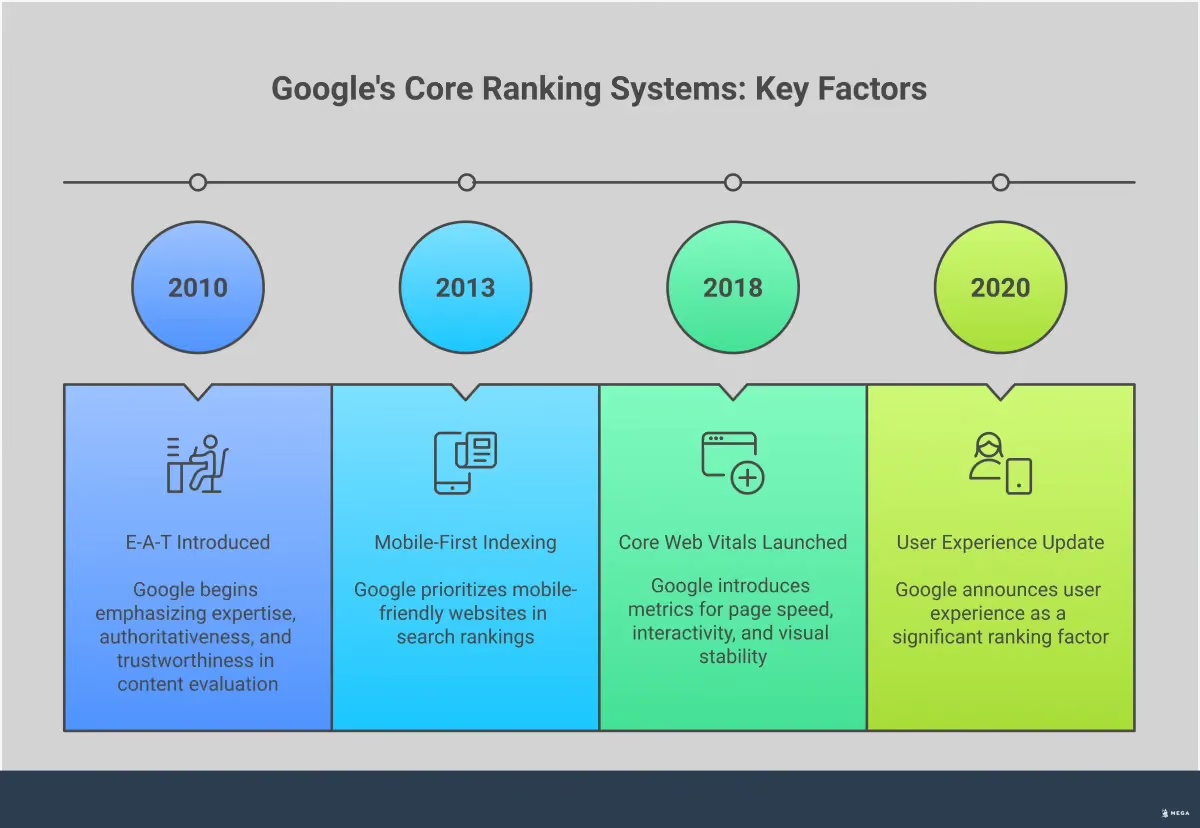
To understand what Google values today, it helps to look at its history. In the past, Google rolled out major, named updates that sent shockwaves through the SEO community. These updates, like Panda and Penguin, were designed to target specific types of low-quality results. Over time, the lessons learned from these events have been so deeply integrated into Google's core processes that they are no longer separate "updates" but foundational parts of the main ranking systems. This evolution shows a clear trend: Google has consistently moved toward rewarding sites that offer genuine value and a positive user experience.
For a small business, this history provides a roadmap for a durable SEO strategy. Instead of getting caught up in short-term tactics, you can focus on the principles these updates established. By creating high-quality content, building a reputable online presence, and focusing on your user's intent, you align your business with the fundamental goals of Google's search systems. This approach ensures your efforts will continue to pay off, regardless of future changes. Understanding the "why" behind these major shifts—Panda, Penguin, and Hummingbird—is key to building a website that stands the test of time.
Panda: The Fight Against Low-Quality Content
The Panda update first launched to address a growing problem of "content farms"—sites that produced huge volumes of low-quality articles designed purely to rank for specific keywords. Panda’s job was to lower the rank of sites with thin, duplicate, or unhelpful content and promote those with more substantial, valuable information. Today, Panda is no longer a periodic filter but a part of Google's core algorithm. The lesson from Panda is simple and timeless: create original, in-depth content that genuinely helps your audience. Your website should be a resource, not just a collection of keyword-stuffed pages.
Penguin: Penalizing Spammy Link Schemes
While Panda focused on content, the Penguin update targeted manipulative link-building practices. It was designed to devalue sites that tried to artificially inflate their authority by buying links or participating in spammy link networks. Like Panda, Penguin now operates in real-time as part of the core algorithm. This means that instead of waiting for the next "Penguin update," the system constantly evaluates the quality of the links pointing to your site. For your business, this reinforces the importance of earning links naturally by creating great content, building relationships, and being an active part of your community.
Hummingbird: Understanding Searcher Intent
Hummingbird was a complete overhaul of Google's main algorithm, shifting the focus from individual keywords to the meaning and intent behind a search query. It allowed Google to better understand conversational language and the context of a search. For example, instead of just matching the word "pizza," Hummingbird helps Google understand if you're looking for a recipe, a local restaurant, or delivery options. This update solidified the need for content that answers the questions your customers are actually asking, even if they don't use the exact keywords you're targeting.
Google's Framework for Organizing Search Results
Once Google's systems understand a query and find potentially relevant pages, how does it decide the final order? It uses a comprehensive framework that balances several factors to present the most helpful and reliable results. This isn't about a single score but a holistic assessment. Google’s own documentation simplifies this into three main categories: the meaning of the query, the quality of the content, and the context of the user. Understanding how these three pillars work together is crucial for creating content that not only gets seen but is also prioritized by Google's ranking systems.
Think of this framework as Google's final quality check before the results are displayed. It ensures that the top-ranking pages don't just match the words in a query but also provide a trustworthy, accessible, and relevant answer. For a small business, aligning your website and content with these principles is the most effective way to achieve sustainable visibility in search. It moves the focus from technical tricks to the core of what makes a business successful: offering real value and expertise to your customers. Tools like MEGA AI can help you maintain this alignment by automatically updating content to keep it fresh and relevant.
Meaning and Relevance
The first step in ranking is ensuring a page is truly relevant to the search query. Google’s systems go beyond simple keyword matching to analyze the topics and concepts on a page. It uses advanced language models to understand synonyms, related ideas, and the underlying intent of a search. For instance, if you search for "how to fix a leaky faucet," Google looks for pages that provide step-by-step instructions, lists of tools, and safety warnings—not just pages that repeat the phrase "leaky faucet." Your goal should be to create content that comprehensively covers a topic, anticipating and answering the user's next question.
Quality and Usability
Beyond relevance, Google prioritizes content that is trustworthy and provides a good user experience. Its systems look for signals of expertise, authoritativeness, and reliability. This means content should be well-researched, clearly written, and demonstrate real-world experience. At the same time, usability is critical. A page that is slow to load, difficult to read on a mobile device, or cluttered with intrusive ads is not a quality result. A technically sound website is the foundation upon which great content can shine, ensuring that both users and search engines can easily access your expertise.
Context and Settings
Finally, Google personalizes results based on the user's context. This includes factors like your geographic location, your past search history, and your search settings. This is especially important for local businesses. When someone searches for "coffee shop near me," Google uses their location to provide the most relevant, nearby options. This is why having a complete and optimized Google Business Profile is non-negotiable for any local business. It provides Google with the explicit context it needs to recommend your business to customers in your area at the exact moment they are looking for your services.
Breaking Down Google's Core Ranking Systems
To understand how Google ranks websites, it helps to know about the core systems working behind the scenes. These are not simple rules but sophisticated AI models that work together to understand language, intent, and quality. Think of them as a team of specialists, each with a specific job, all aiming to deliver the most relevant and reliable results for every search. Understanding these systems is the first step to creating a strategy that aligns with what Google values most.
RankBrain: Making Sense of Vague Searches
RankBrain is Google's machine learning system that helps the search engine understand the intent behind new or vague queries. It acts as a conceptual thinker, allowing Google to interpret complex search terms it has never seen before. For example, if someone searches for "what's the name of the coffee shop near the big park downtown," RankBrain helps connect that ambiguous phrase to a specific business. For your company, this means your content needs to do more than just target exact keywords. It should thoroughly answer the questions your potential customers are asking, even the oddly phrased ones. A comprehensive SEO approach focuses on creating content that covers a topic from all angles, satisfying the real intent behind these searches.
Neural Matching: Connecting Broader Concepts to Content
While RankBrain handles vague queries, neural matching helps Google connect the concepts behind a search to relevant content on web pages. For instance, if a user searches for "why does my food taste bland," neural matching can link them to pages about seasoning techniques, even if the word "bland" is not explicitly used. This system looks beyond keywords to understand the broader topic. This is why building topical authority is so important. When you create a cluster of content around a central theme, you show Google you are an expert. This makes it easier for a system like neural matching to recognize your site as a relevant resource for a wide range of related searches.
BERT: Grasping the Nuances of Human Language
BERT (Bidirectional Encoder Representations from Transformers) is designed to grasp the context of words in a search query. It excels at understanding the nuances of language, paying close attention to small but important words like "to" and "for." BERT can differentiate between a search for "math practice books for adults" and "math practice books for kids," a distinction older systems might have missed. This system reads sentences in their entirety to understand meaning, not just isolated keywords. For your content, this means writing naturally for a human audience is the best strategy. Clear, conversational language that directly addresses a user's query is what allows systems like BERT to understand and rank your content correctly.
SpamBrain: How Google Fights Spam
SpamBrain is Google's AI-driven system that identifies and demotes low-quality content designed to manipulate search rankings. It continuously learns and adapts to new spam techniques, ensuring that users receive high-quality, relevant results. This system targets tactics like keyword stuffing, cloaking (showing different content to users and search engines), and auto-generated gibberish. For small businesses, the lesson is clear: avoid shortcuts and focus on legitimate, ethical SEO practices. Following Google's spam policies and creating genuinely helpful content is the only sustainable path to success. It ensures your hard work is rewarded instead of being flagged as spam.
Other Important Ranking Systems
Beyond the core systems that interpret language and fight spam, Google uses a variety of other specialized systems to refine search results. These systems handle everything from evaluating the helpfulness of your content to ensuring a diverse set of websites appears on the first page. Each one plays a role in shaping the search results page, and understanding them can help you create a more resilient and effective SEO strategy. By aligning your content with these principles, you position your business to be seen as a valuable and trustworthy resource.
Helpful Content System: Prioritizing People-First Content
Google's Helpful Content System is a site-wide signal designed to reward content created for people, not just for search engine rankings. It looks for signals that your primary goal is to provide a satisfying experience and answer a user's question thoroughly. If a site is filled with content that seems designed only to attract search traffic without offering real value, this system can demote the entire site's visibility. For your business, this means focusing on creating genuinely useful articles, guides, and resources that address your customers' needs. Continuously updating your articles to add new information and improve clarity ensures they remain helpful over time.
Reviews System: Rewarding In-Depth Analysis
If your business involves reviewing products or services, you need to know about the Reviews System. This system is designed to promote reviews that offer deep analysis and original research, rather than just summarizing information from other sources. It rewards content written by experts or enthusiasts who have actually used the product or service. To align with this system, your reviews should go beyond the basics. Include your own photos or videos, discuss the pros and cons in detail, and explain how the product compares to others on the market. This shows both users and Google that your review is authentic and trustworthy.
Site Diversity System: Promoting Variety in Results
Have you ever noticed that you rarely see more than two results from the same website on the first page of Google? That’s the Site Diversity System at work. This system is designed to prevent a single domain from dominating the search results for a given query. For small and local businesses, this is great news. It means you have a real chance to compete for visibility against larger, more established brands. As long as you create high-quality, relevant content, this system helps ensure you have an opportunity to be seen by potential customers, leveling the playing field just a little.
Passage Ranking System: Finding Answers Within a Page
The Passage Ranking System uses AI to understand and rank individual sections, or "passages," of a web page. This means Google can pull a specific paragraph from a long article to directly answer a user's query, even if the rest of the article covers a broader topic. This is why structuring your content is so important. Use clear, descriptive headings (like H2s and H3s) to break your articles into logical sections. Each section can then be indexed and ranked on its own, giving your content more opportunities to appear in search results for a variety of specific, long-tail questions.
Deduplication and Original Content Systems
These two systems work together to prioritize unique content. The Deduplication System identifies when multiple pages contain very similar information and tries to show only the most relevant one. The Original Content System works to ensure that the original source of information, like an investigative news report, is ranked more prominently than sites that simply copy or rewrite it. The message for your business is simple: create original content. Avoid copying text from other websites. Instead, add your own unique perspective, data, or analysis to make your content a valuable, one-of-a-kind resource.
Exact Match Domain System
Years ago, some businesses tried to get a ranking advantage by using domain names that exactly matched a search term, like `cheap-plumbers-in-dallas.com`. The Exact Match Domain System was created to reduce the influence of these domains, ensuring they don't rank highly just because of their name. This system confirms that the quality of the content on a site is far more important than the keywords in its domain. For your business, it’s better to choose a memorable, brandable domain name and focus your energy on creating a great website with helpful content.
Systems for Safety, Crisis, and Information Reliability
Google's responsibility extends beyond just providing relevant answers; it also includes ensuring user safety and providing reliable information, especially during sensitive times. A dedicated set of ranking systems is in place to handle these critical situations. These systems are designed to surface authoritative information during a crisis, demote content from sites with a history of valid removal requests, and promote trustworthy sources across the board. Understanding these systems helps clarify Google's role as an information provider and reinforces the importance of ethical, responsible content creation for your own business.
Crisis Information Systems (SOS Alerts)
During a major crisis or natural disaster, Google activates its Crisis Information Systems. These systems are designed to display prominent SOS Alerts in search results, providing timely and authoritative information like emergency numbers, maps, and updates from official sources. While this system may not directly impact your day-to-day SEO, it’s a powerful example of how Google prioritizes information reliability in critical moments. For local businesses, being aware of this system is important, as it can affect what information your community sees during an emergency.
Removal-Based Demotion Systems
Google processes a large number of requests to remove content for reasons like copyright infringement or the exposure of sensitive personal information. The Removal-Based Demotion Systems take this into account. If a particular website has a high volume of valid removal requests filed against it, Google may use that as a signal of low quality and demote other content from that same site in search results. The lesson here is to operate ethically. Always use your own original content, or ensure you have the proper rights and permissions for any images, videos, or text you publish.
Reliable Information Systems and Content Advisories
In an era of widespread misinformation, Google uses its Reliable Information Systems to promote quality journalism and authoritative sources while lowering the rank of low-quality content. These systems are particularly important for topics that require a high degree of trust, such as health, finance, and news. For your business, this reinforces the need to build authority and trustworthiness. You can do this by demonstrating your expertise, citing credible sources, and being transparent about who you are. When you consistently provide accurate and helpful content, you send strong signals to Google that you are a reliable source in your field.
How Does Google Measure Content Quality?
Google’s main job is to give people the most helpful and reliable answers to their questions. To do this, its systems have become incredibly sophisticated at figuring out which content is genuinely high-quality and which is just trying to game the system. Think of it like this: if you ask a friend for a restaurant recommendation, you trust them because you know their experience and taste. Google tries to replicate that same level of trust at a massive scale.
This means that "quality" goes far beyond just good grammar or spelling. Google’s systems analyze a combination of signals to determine if your content is trustworthy, comprehensive, and provides a good experience for the user. This is why a huge part of modern SEO is about creating content that people actually want to read and share. It’s not about stuffing keywords into a page but about demonstrating your authority and providing real value. The following factors are some of the most important ways Google assesses the quality of your content.
E-E-A-T: Demonstrating Your Expertise and Trustworthiness
E-E-A-T stands for Experience, Expertise, Authoritativeness, and Trustworthiness. It’s a framework Google’s systems use to assess content, especially for topics that could impact someone’s health, safety, or finances. Essentially, Google wants to see that the person or business behind the content knows what they’re talking about from direct experience.
For a small business, you can demonstrate E-E-A-T by including author bios that highlight relevant experience, citing credible sources to back up your claims, and showcasing customer testimonials or reviews. Having a secure website (HTTPS) and clear contact information also builds a foundation of trustworthiness that both users and search engines appreciate. It’s about proving you’re a legitimate and knowledgeable source in your field.
Originality: Why Unique, In-Depth Content Ranks
Simply rewriting what your competitors have already said isn’t enough to stand out. Google’s systems are designed to reward content that brings something new to the table. This could be a unique perspective, original research, a detailed case study, or simply a more thorough and helpful guide than anyone else has published. The goal is to provide genuine value, not just to rank for a keyword.
Avoid the old-school tactic of creating thin pages stuffed with keywords. This kind of low-quality content is a common mistake that can hurt your rankings. Instead, focus on covering a topic in-depth. Answer the primary question, then anticipate and answer the follow-up questions your audience might have.
User Experience: Is Your Site Easy to Use?
Even the best content in the world won’t perform well if it’s on a website that’s frustrating to use. Google pays close attention to how users interact with your site. If people click on your page and immediately leave because it’s slow, confusing, or hard to read on their phone, that sends a strong signal that the page isn't helpful.
A positive user experience is a key part of content quality. This includes having a clean, well-structured layout with clear headings, short paragraphs, and bullet points to improve readability. It also means ensuring your site loads quickly and works seamlessly on mobile devices. These factors make your content more accessible and enjoyable for visitors, which is exactly what Google wants to see.
The Freshness Factor: Keeping Your Content Up to Date
For many search queries, the most relevant information is also the most recent. Google’s freshness systems help ensure that users get up-to-date answers, especially for topics that change over time, like news, trends, or product reviews. While not every piece of content needs to be updated weekly, it’s important that your information remains accurate and relevant.
Regularly reviewing your most important pages is a great practice. You can update statistics, replace broken links, or add new information to reflect the current landscape. This signals to Google that your content is actively maintained and reliable. In fact, fresh, relevant content is often favored in search rankings. Platforms like MEGA AI can even help automate this process by identifying and making updates to keep your articles competitive.
What Helps Your Content Rank Higher?
Understanding Google's complex ranking systems is one thing, but putting that knowledge into practice is what really matters. While there's no single magic formula for hitting the top spot, Google consistently rewards content that is helpful, reliable, and provides a great user experience. The core idea is simple: create content for people, not just for search engines. When you focus on giving users the best possible answer to their questions, you're aligning your strategy with what Google’s systems are designed to find and promote.
Think of it less as a checklist of technical tricks and more as a holistic approach to your online presence. It involves understanding what your audience is truly looking for, creating purposeful content that meets their needs, establishing your credibility as an expert, and presenting your information in a way that's easy for both users and Google to digest. Let's break down four of the most important elements that can help your content rank higher.
Give Searchers What They Want by Matching Search Intent
Before you write a single word, you need to understand the "why" behind a person's search. This is called search intent. As one expert puts it, "Before Google can even begin to find an answer, it has to truly understand your question... This is all about getting the intent, the context, and all the nuance behind what you type." If someone searches for "how to fix a leaky pipe," they want a step-by-step guide, not a sales page for a plumber. Conversely, a search for "emergency plumber near me" requires a direct link to a service page. Aligning your content format with the user's goal is the foundation of effective SEO.
Does Your Content Have a Clear Purpose?
Every piece of content on your site should have a clear and helpful purpose. Google's systems are designed to distinguish between content created to provide genuine value and content designed purely to manipulate search rankings. As one podcast explains, "Helpful content, well, it provides value. Spam is just there to manipulate the system." Your goal is to create pages that answer questions, solve problems, or guide users toward a solution. This means writing original, in-depth content that demonstrates you understand the topic and the user's needs. Thin, repetitive, or low-quality pages that don't serve a real purpose will likely be filtered out.
How to Build Topical Authority in Your Niche
Google wants to rank content from sources it trusts. One of the best ways to build that trust is by establishing topical authority—becoming the go-to resource for a specific subject. This involves creating a comprehensive library of content that covers a topic in depth. Another key component is earning backlinks from other reputable websites. Think of a link as a vote of confidence. A "vote from a big important trusted site counts for a whole lot more than a vote from some random unknown one." By consistently publishing expert content and earning credible backlinks, you signal to Google that you are an authority in your field.
How to Optimize for Featured Snippets and Rich Results
Ranking on page one is great, but standing out on page one is even better. Rich results are enhanced search listings that include extra visual information, like review stars, product prices, or event dates. Featured snippets are the answer boxes that appear at the very top of the results. Earning these placements can dramatically increase your visibility and click-through rate. This is often achieved by implementing structured data on your website, which helps Google better understand the context of your content. When users click on these enhanced results, it sends a positive signal that your page is a high-quality match for their query.
How Does User Behavior Affect Rankings?
Google’s main goal is to provide users with the most relevant and helpful results for their queries. To figure out what’s helpful, Google pays close attention to how people interact with the search results. These interactions, often called user behavior signals, act as a feedback loop. If users consistently click on a specific result and stay on that page, it tells Google that the page is a good match for that search.
While Google doesn't share the exact weight of these signals, the patterns are clear. Pages that satisfy users tend to rank better over time. This is why optimizing for user experience is just as important as optimizing for keywords. For instance, MEGA AI’s SEO agent can automatically update existing articles to improve their click-through rate, directly influencing one of the most important user signals.
Click-Through Rate (CTR): Does Your Title Earn the Click?
Click-through rate is the percentage of people who click your link after seeing it in the search results. Think of it as the first impression your page makes. A high CTR suggests that your page title and meta description are compelling and accurately reflect what the user is looking for. According to industry analysis, a higher click-through rate indicates to Google that a page is relevant to a user's query, which can positively influence its ranking. To improve your CTR, write clear, benefit-driven titles and descriptions that speak directly to your target audience’s needs and curiosity.
Dwell Time: Are Visitors Sticking Around to Read?
Dwell time measures how long a visitor stays on your page before returning to the search results. A long dwell time signals that your content is engaging and valuable. If someone clicks your link, skims the page, and immediately clicks back to Google (a behavior known as "pogo-sticking"), it tells the search engine your page wasn't a good fit. As experts note, dwell time is a critical indicator of content quality and relevance. To keep visitors on your page longer, make your content easy to read with clear headings, short paragraphs, and visuals. Most importantly, answer the user's question thoroughly.
Brand Signals: Are People Talking About You?
Brand signals are the online mentions, searches, and reviews related to your business. Google wants to rank content from real, authoritative entities, and these signals help establish your credibility. When people search for your brand name directly or leave reviews on your Google Business Profile, it shows that your business is a known quantity. These signals can significantly influence how your business is perceived in search results. For small and local businesses, building brand signals is crucial. You can start by encouraging customer reviews and seeking mentions in local publications to build your digital presence.
Technical SEO Factors That Influence Rankings
Think of your website as a house. Your content—the blog posts, product descriptions, and images—is the furniture and decor that makes it unique. But before you can decorate, you need a solid foundation and a logical floor plan. That’s technical SEO. It’s the behind-the-scenes work that ensures search engines like Google can easily find, crawl, and understand your website. Without a strong technical base, even the best content can get lost.
Google’s ranking systems need to be able to access your content efficiently. If your site is slow, hard to use on a phone, or structured like a maze, it creates a poor user experience, and Google takes note. For small businesses, getting these technical elements right is a huge step toward competing with larger players. It involves optimizing your site’s speed, ensuring it works on mobile devices, helping search engines understand your content with structured data, and creating a logical site structure with internal links. While it sounds complex, these are the foundational pieces that allow your quality content to shine and ultimately rank higher in search results. At MEGA AI, our SEO agent handles these technical fixes automatically, from fixing broken links to implementing lazy loading for improved speed.
Site Speed: How Core Web Vitals Affect Your Rank
How quickly your website loads is a critical ranking factor. No one likes to wait for a slow page, and Google knows it. A faster site provides a better user experience, which can lead to lower bounce rates and higher rankings. Google measures this experience using a set of metrics called Core Web Vitals. These metrics assess three key aspects of your site's performance: how fast the main content loads, how quickly the page becomes interactive, and how stable the layout is as it loads. You can check your site’s performance using Google’s PageSpeed Insights tool and find reports directly in your Google Search Console.
Mobile-First Indexing: Is Your Site Mobile-Friendly?
More than half of all web traffic comes from mobile devices, so Google now operates on a "mobile-first" basis. This means it primarily uses the mobile version of your website for indexing and ranking. If your site looks great on a desktop but is difficult to use on a smartphone, your rankings will likely suffer. A responsive design, which automatically adjusts to fit any screen size, is essential. For local businesses, this is especially important, as many customers will be searching for your services on their phones while they are out and about. Ensuring your mobile site is fast, easy to read, and fully functional is no longer optional.
Structured Data: Helping Google Understand Your Content
Structured data, often called schema markup, is a type of code you can add to your website to help search engines better understand your content. Think of it as creating labels for your information. You can tell Google that a string of numbers is a phone number, a block of text is a recipe, or that your business is a local restaurant with specific hours and a menu. Implementing structured data can help your pages appear as "rich results" in search—like star ratings, event listings, or product prices. These enhanced listings stand out on the search results page and can significantly improve your click-through rate.
Site Structure: Guiding Users with Internal Links
A logical site structure acts as a roadmap for both users and search engines. It organizes your content in a way that is intuitive and easy to follow. Internal links—links that point from one page on your site to another—are the pathways on that map. A strong internal linking strategy helps Google understand the relationship between your pages and establishes a hierarchy of importance. For example, using a "hub-and-spoke" model, where you link from a main topic page (the hub) to several related sub-pages (the spokes), shows Google that you have deep knowledge on a particular subject. This helps spread authority throughout your site and can improve rankings for all connected pages.
Backlinks and the Legacy of PageRank
Backlinks are links from other websites that point to your site, and they are a fundamental signal of authority for Google. The concept dates back to one of Google's foundational algorithms, PageRank. In simple terms, this system works by counting links as "votes" for a page's importance. If many websites link to one of your pages, Google sees that as a sign that your content is valuable and trustworthy. However, not all votes are equal. A link from a highly respected, authoritative site in your industry is far more powerful than a link from an unknown blog. This is why building topical authority and creating content worth linking to is so crucial for long-term SEO success.
Understanding Link Attributes: Nofollow, Sponsored, and UGC
As link-building strategies evolved, Google introduced link attributes to give webmasters more control and to help its systems understand the context of a link. The first of these was the nofollow attribute, which essentially tells Google not to count a link as a vote. This was created to combat spam, particularly in blog comments and forums. More recently, Google added two more specific attributes: `sponsored` for any link that is part of an advertisement or paid placement, and `ugc` for links within user-generated content. These tags provide transparency, helping Google differentiate between an earned editorial link and a paid one. For your business, understanding these attributes is important for managing your own site's outbound links and evaluating your backlink profile.
How Is AI Changing Search Rankings?
The fundamentals of SEO still apply, but the introduction of AI is shifting how search engines find and present information. Google's ranking systems are powered by a suite of sophisticated algorithms, and AI is the latest layer designed to enhance the search experience. For small businesses, this means adapting your strategy to not only rank in the blue links but also to be featured in new AI-driven formats.
What Are AI Overviews and Zero-Click Searches?
You’ve probably seen them already: AI-generated summaries that appear at the very top of the search results, aiming to answer your question directly. These are called AI Overviews. While helpful for users, they contribute to a rise in "zero-click searches," where a person gets their answer without ever clicking through to a website. This changes the goal of SEO. Instead of just aiming for the number one spot, you now need to create content that is so clear and authoritative that Google’s AI uses it as a source for these summaries. Optimizing for this new format is part of a practice called LLM Optimization, which focuses on making your content visible within AI-powered answers.
How to Optimize for an AI-Powered Search
To get your content featured in AI-powered search, you need to focus on clarity and authority. The best approach is to define relevant keywords, target user intent, create high-quality content, and build authority. Structure your articles to answer specific questions directly and concisely. Use clear headings, bullet points, and lists to make information easy for both users and AI to digest. Google continuously refines its algorithms to prioritize helpful, high-quality content, and AI Overviews are no exception. Think about the questions your customers are asking and create pages that provide the best, most straightforward answers to them. This approach aligns perfectly with what AI models look for when sourcing information.
Why Context Matters More Than Keywords
In the past, SEO often felt like a game of repeating the right keywords. That era is over. Thanks to systems like BERT, one of Google's key algorithms, the search engine can now understand context and nuance. It can differentiate meanings based on the surrounding words, which is crucial for delivering relevant search results. This means that understanding the context behind a search query is more important than simply focusing on keywords. Instead of stuffing a page with a single phrase, your content should cover a topic comprehensively. When you write naturally about a subject and address related subtopics, you signal to Google that you are an expert, making your content a better fit for complex queries.
The Role of Advanced AI like MUM
While systems like BERT focus on understanding the nuances of a single language, Google is already developing more powerful AI like the Multitask Unified Model, or MUM. Think of MUM as the next evolution in search intelligence. It's designed to understand information across different languages and formats, like text and images, to answer complex questions that don't have simple answers. For example, a user might ask, "I've hiked Mt. Adams, now what mountain should I hike next, and how should I prepare?" MUM can understand the comparison, infer the user's experience level, and synthesize information from multiple sources to provide a tailored recommendation. While Google has stated that MUM is not yet used for general ranking, it is applied to specific tasks, offering a glimpse into the future of search where AI can provide comprehensive, multi-step answers.
How Can Small Businesses Adapt to Google's Changes?
Keeping up with Google's algorithm changes can feel like a full-time job, especially when you're already busy running a business. The good news is that you don't need to react to every minor update. Instead, focusing on a few core principles will help you build a resilient online presence that can weather any changes Google throws your way. For small and local businesses, this means doubling down on what makes you unique: your connection to your community, your specific expertise, and the quality of your service.
By concentrating on these fundamental areas, you can create a sustainable SEO strategy that aligns with Google's long-term goals. This approach is less about chasing algorithms and more about building a strong foundation that serves your customers and, in turn, satisfies search engines.
Prioritize Local SEO and Your Google Business Profile
For businesses that serve a specific geographic area, local SEO is non-negotiable. Your Google Business Profile (GBP) is the cornerstone of your local SEO strategy, acting as a digital storefront directly on the search results page. Many business owners set it up once and forget it, which is a missed opportunity. Google rewards active profiles. Regularly updating your business hours, adding new photos, creating posts about offers or events, and responding to customer reviews sends strong signals that your business is active and engaged. This simple maintenance can significantly improve your visibility in local search results and on Google Maps, helping nearby customers find you when they need you most.
Creating High-Quality Content Without a Big Budget
You don't need a massive marketing budget to create content that ranks. In fact, producing original, high-quality content is one of the most effective ways for a small business to compete online. Instead of churning out generic articles, focus on answering the specific questions your customers are asking. Think about your unique expertise and create content that demonstrates it. Even with limited resources, you can improve your search rankings by focusing on SEO best practices. This means writing for humans first, targeting relevant keywords, and ensuring your content is helpful and easy to read. Platforms like MEGA AI can help by automating content generation and optimization, allowing you to produce great content without a dedicated team.
Build Authority by Publishing Content Consistently
Google aims to show users results from authoritative sources. To build authority in your niche, you need to consistently create good content that demonstrates your expertise. Start by defining your core keywords and understanding the user intent behind them. What is someone hoping to find when they search for that term? From there, you can develop a content plan that addresses those needs. A great way to organize this is with a hub-and-spoke model, where you have a main "hub" page about a broad topic and several "spoke" pages that dive into more specific sub-topics. This structure helps both users and search engines understand the depth of your knowledge on a subject.
How to Create a Google-Friendly SEO Strategy
Understanding Google’s ranking systems can feel overwhelming, but building a strategy that works with them doesn’t have to be. The key is to shift your focus from chasing algorithm updates to building a high-quality website that serves your audience. Google’s primary goal is to provide its users with the best possible answers to their questions. When you make that your goal too, your strategy naturally aligns with what the search engine rewards. This approach moves SEO from a purely technical exercise to a core part of your customer service.
For small and local businesses, this is great news. You don't need a massive marketing department to succeed. Instead, you can focus on what you do best: sharing your expertise and providing value to your customers. A successful SEO strategy is built on three core pillars: putting your audience first, balancing great content with a technically sound website, and monitoring your performance so you can adapt over time. By concentrating on these fundamentals, you create a sustainable approach that can weather algorithm changes and build long-term growth. It’s about playing the long game, building genuine authority, and earning your place in search results.
Always Put Your Audience First
At its core, Google’s algorithm is designed to measure user satisfaction. If people find your content helpful, Google takes that as a strong signal of quality. This means the most effective SEO strategy starts with a deep understanding of your audience. Before you write a single word, think about who you’re trying to reach. What problems are they trying to solve? What questions do they have? Your goal is to answer those questions more clearly and comprehensively than anyone else. This involves matching the user's search intent, whether they're looking for information, comparing products, or ready to make a purchase. When you prioritize creating a genuinely helpful experience, you’re building a foundation that Google’s systems are designed to favor.
How to Balance Technical SEO with Quality Content
A successful website needs both a strong foundation and compelling content. Technical SEO is the foundation—it ensures your site is fast, secure, and easy for Google to crawl and index. This includes things like site speed, mobile-friendliness, and a logical site structure. However, a perfect technical setup won't matter if your content is weak. High-quality, original content is what attracts and engages your audience. It’s how you demonstrate your expertise and build trust. For many small businesses, finding the time for both can be a challenge. This is where an AI-powered SEO platform can help by automating technical fixes and content updates, freeing you up to focus on sharing your unique knowledge.
Track Performance and Adapt to Google's Updates
SEO is not a one-time task; it’s an ongoing process of refinement. Tracking your performance is essential to understanding what works and where you can improve. Metrics like click-through rate, time on page, and conversion rates are all forms of user feedback that signal the value of your content. You can use tools like Google Search Console to monitor which keywords are driving traffic and identify pages that need improvement. Google’s algorithms are constantly evolving, but a strategy built on quality and user experience is durable. By regularly reviewing your data and staying focused on your audience’s needs, you can adapt to changes and continue to grow your online presence.