
Google's AI thinks a lot like we do. If you needed serious financial advice, you wouldn't trust a random blog post; you'd find a certified professional. The AI makes similar judgment calls online, constantly looking for signals of real-world expertise. This is your chance to build local business authority. You don't need a massive budget to win. You just need to provide tangible proof that you're an expert in your field. This guide will show you exactly what that proof looks like and how to build it.
Key Takeaways
- Prove Your Expertise Through Your Content: Show Google's AI you're a true expert by creating in-depth content that solves real customer problems. Back up your claims with data and ensure your website's technical foundation is solid to signal professionalism.
- Establish Credibility On and Off Your Website: Your authority isn't confined to your website. Secure it by earning backlinks from reputable sources, forming local business partnerships, and maintaining a consistent brand presence across all online platforms.
- Dominate a Niche to Compete with Larger Players: Small businesses can outperform larger competitors by becoming the definitive expert in a specific area. Focus on building deep knowledge in your niche or becoming the go-to resource for your local community to build credibility that big budgets can't buy.
What Is 'Authority' in Google's Eyes?
As search engines become more sophisticated, the old rules of SEO are changing. It's no longer enough to simply target the right keywords. Google's AI now prioritizes content from sources it deems authoritative and trustworthy. For small and local businesses, this shift presents a huge opportunity. You don't need a massive marketing budget to build authority; you just need to provide real-world proof that you're an expert in your field. Understanding what Google considers "proof" is the first step to making your business the go-to source in your niche.
Breaking Down Google's View on Authority
From Google's perspective, authority is about demonstrating that you know what you're talking about. The AI is designed to find signals of real-world expertise, much like a person would. Think of it this way: if you needed complex tax advice, would you trust a random blog post or a certified public accountant? Google is trying to make that same judgment call. It looks for evidence that your business has genuine experience and is a trusted entity in its industry. This is why Google’s quality guidelines emphasize experience, expertise, authoritativeness, and trustworthiness (E-E-A-T). It’s proof that you are who you say you are.
Why Credibility Is the New Keyword
In the past, SEO often felt like a game of keyword Tetris. Today, credibility is the foundation of a successful strategy. Simply stuffing your website with keywords won't convince Google's AI that you're a reliable source. Instead, you need to show your credentials. For a local business, this means creating content that addresses your community's specific needs and showcasing your licenses, certifications, or industry awards. Proving your credibility tells Google that your business is a legitimate, trustworthy resource, making your content more likely to rank. A consistent SEO strategy focuses on building these signals over time.
Why Does Google Prioritize Authoritative Content?
Google's primary goal has always been to provide the most relevant and trustworthy answers to user questions. With the rise of AI-driven search and generative overviews, this mission has become even more critical. The AI doesn't just want to find pages with the right keywords; it wants to find sources that have proven they know what they're talking about. It's looking for real-world proof of your expertise.
Think of it this way: if you needed financial advice, you wouldn't ask a random person on the street. You'd seek out a qualified professional. Google's AI is trained to do the same thing online. It prioritizes content from established authorities because that's the safest and most reliable way to satisfy a user's query. For small and local businesses, this means that building a reputation as a trusted expert in your niche is no longer just a good idea—it's a fundamental part of a modern SEO strategy.
How Trust Signals Impact Your Search Rank
Trust is the currency of the modern web. Google's AI is designed to identify which businesses have earned it. As marketing expert Neil Patel notes, "Average content from an authority outperforms great content from a nobody. Almost every time." This is because Google's systems are built to find signals that indicate your business is a legitimate, credible entity. It’s not enough to create great content; you have to prove you’re a reliable source for that information.
For a local business, this means becoming the go-to expert for your community. When you create content that addresses the specific needs and questions of your local customers, you build that niche authority. This is a core part of Google's quality guidelines, often referred to as E-E-A-T (Experience, Expertise, Authoritativeness, and Trustworthiness).
What User Behavior Tells Google About You
Google's AI mimics human bias. There's a famous psychology study where people were twice as likely to follow instructions from someone wearing a doctor's coat, even if they weren't a real doctor. The coat was a symbol of authority. Online, your brand and content serve as that doctor's coat. When users consistently choose your website in search results, spend time on your pages, and share your content, they are sending powerful signals to Google.
These user engagement signals tell the algorithm that people trust your brand. By consistently publishing helpful articles, guides, or videos about your field, you demonstrate your expertise and build a reputation that both users and search engines can rely on. Over time, this positive user behavior reinforces your site's authority, making it more likely that Google will recommend your content to others.
How Does Google Actually Measure Authority?
Google's AI doesn't just scan for keywords; it evaluates your website much like a person would assess someone's credibility. It looks for a combination of signals that, together, paint a picture of a trustworthy and knowledgeable source. Think of it as building a case for your expertise. The AI gathers evidence from three main areas: the technical quality of your site, the depth and usefulness of your content, and what other sources on the web say about you. Each piece of evidence helps Google determine if you are a genuine authority or just someone with a website.
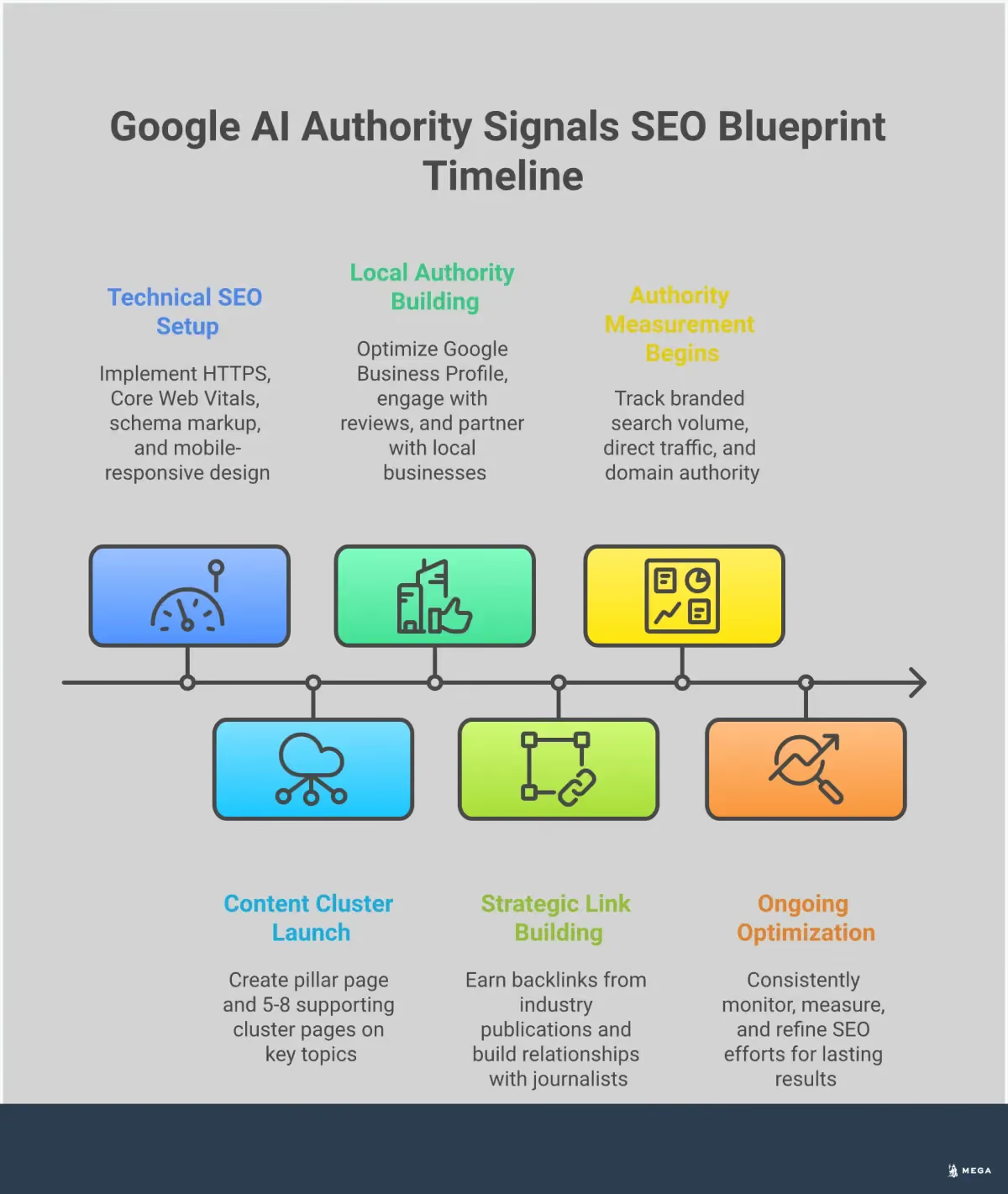
The Technical Signals That Build Authority
Your website's technical health is the first impression you make on Google. Just as you might trust someone more if they are well-dressed and professional, Google’s AI has a similar bias. It's been shown that people are more likely to trust someone in a doctor's coat, even if they aren't a real doctor. Your site's technical setup is its "doctor's coat." It signals professionalism and trustworthiness.
This includes having a secure site (HTTPS), fast page load times, and a mobile-friendly design. A clean, logical site structure also shows Google that you’ve put thought into the user experience. These aren't just minor details; they are foundational signals that tell Google you run a serious, credible operation. Getting these technical elements right is a critical first step in proving your authority.
Proving Your Expertise Through In-Depth Content
Once Google sees your site is technically sound, it looks at what you’re actually saying. This is where your expertise truly shines. To be seen as an authority, you need to create content that demonstrates a deep understanding of your niche. This means going beyond surface-level blog posts. You should aim to create in-depth guides that answer the real questions your customers are asking.
For local businesses, this is a huge opportunity. Creating content that specifically addresses your local community's needs and interests can make you the go-to authority in your area. Back up your claims with data, publish case studies that show your results, and prove that you know your stuff. This kind of helpful content shows Google that you are a valuable resource, not just another business trying to make a sale.
How Off-Page Signals Prove Your Authority
Finally, Google looks for outside validation. What do other people and businesses say about you? This external proof is like a letter of recommendation. It tells Google that others in your industry or community vouch for your credibility. This can come in many forms, from backlinks from reputable websites to mentions in local news outlets.
Showcasing professional credentials, licenses, or industry certifications on your site is another powerful signal, especially for service-based businesses. You can also build authority through local business partnerships. Collaborating with other respected local companies can create a network of trust that Google can see. When other authoritative sources link to you or mention you, it confirms to Google that you are a recognized expert in your field.
Actionable Ways to Prove Your Authority to Google
Google's AI looks for real-world proof that you know what you're talking about. It’s not enough to state you’re an expert on your website; you have to show it through your content and reputation across the web. Think of it as building a portfolio of evidence. Average content from an established authority often outperforms great content from an unknown source. The key is providing tangible signals that your business is a credible and trustworthy resource in its field.
Practical Ways to Showcase Your Expertise
The most direct way to prove your expertise is through the content you create. Develop in-depth guides that solve real problems for your customers. When you make a claim, back it up with data, original research, or case studies that show your methods in action. By consistently publishing helpful, well-researched content, you demonstrate a deep understanding of your industry. This isn't just about filling a blog; it's about creating a library of resources that establishes you as the go-to expert for your audience and for Google.
Why a Consistent Online Brand Matters
Your authority isn't just built on your website; it's the sum of your online presence. Maintaining a consistent brand voice, message, and information across all platforms is critical. This includes social media, your Google Business Profile, and other directories. For local businesses, this is especially important. Creating content that addresses the needs of your local community makes you the neighborhood authority. A consistent brand presence builds recognition and trust, signaling to Google that you are a legitimate business.
Using Third-Party Mentions to Build Credibility
What others say about you often carries more weight than what you say about yourself. Mentions from reputable websites act as third-party endorsements of your expertise. You can earn these by building relationships within your industry and community. Consider forming local business partnerships for cross-promotions, contributing guest articles, or getting featured in local news. Each external mention and backlink serves as a vote of confidence, telling Google that others recognize your authority. This external validation is one of the strongest signals you can send.
How to Build Technical Authority with SEO
Building authority isn't just about what you write; it's also about how your website is built and organized. Technical SEO provides the foundation that allows Google's AI to recognize and reward your expertise. When your site is technically sound, it signals that you are professional, credible, and serious about providing a good user experience. This goes beyond site speed and mobile-friendliness. It involves structuring your data, organizing your content, and implementing on-page elements in a way that clearly communicates your knowledge.
Think of it as building a house. Your content is the furniture and decor, but your technical SEO is the strong foundation and logical floor plan. Without it, everything feels unstable and confusing. A well-structured site makes it easy for search engines to crawl your pages, understand the relationships between them, and see the full scope of your expertise on a given topic. Managing these technical details is a continuous process, but it’s one of the most effective ways to prove your authority directly to search engines. MEGA AI's SEO agent handles these technical audits and fixes automatically, ensuring your foundation is always solid.
Using On-Page SEO to Signal Authority
The details on each page of your website send clear signals about your credibility. Start with clear, descriptive title tags and headers (H1s, H2s) that accurately reflect the page's content. This basic organization helps both users and search engines quickly grasp what your content is about. To further establish trust, include author bios that connect your content to real people with demonstrable expertise. Creating content that specifically addresses your local customers' needs and interests also makes your business the local authority. When you answer the exact questions your community is asking, you prove your relevance and value.
How to Use Schema Markup to Your Advantage
Schema markup, or structured data, is a vocabulary you add to your website's code to help search engines understand your content more deeply. It translates your content into a language that search engines can easily process, which can lead to enhanced search results known as rich snippets. For a local business, this is a powerful tool. You can use structured data to highlight your business hours, address, customer reviews, and services. Not using schema markup can lead to missed opportunities for enhancing your online presence and proving your authority directly within the search results.
Structuring Your Site to Showcase Expertise
A well-organized website demonstrates a deep command of your subject matter. To build topical authority, focus on creating well-organized content clusters. This involves creating a central "pillar" page that covers a broad topic and linking it to several "cluster" pages that go into detail on related subtopics. This structure shows search engines that you have comprehensive knowledge, not just a few scattered articles. Strong internal linking is what holds these clusters together, guiding both users and Google through your expertise and reinforcing the topical relevance of your pages.
How to Create Content That Builds Authority
Your website's content is the most direct way to prove your expertise to Google and potential customers. While technical SEO sets the stage, your articles, guides, and case studies are the performance. This is where you move beyond simply stating you're an expert and actually demonstrate it. Authoritative content answers the questions your audience is asking, solves their problems, and shows a deep understanding of your industry. It’s not about stuffing keywords into a page; it’s about providing genuine value that builds trust over time.
For many small businesses, consistently creating high-quality content is the biggest hurdle. It takes time and resources you might not have. The key is to be strategic. Instead of trying to write about everything, focus on creating content that methodically builds your reputation as a trusted source. This means planning your content around core themes, backing up your claims with real evidence, and becoming the go-to resource for your specific audience. MEGA AI's SEO agent can automate much of this process, from identifying topics to generating and updating articles, allowing you to build authority at scale. The following strategies show you how to create content that does exactly that.
Show Your Expertise with Topic Clusters
Instead of writing random articles, organize your content into topic clusters. This structure involves a main "pillar" page covering a broad topic and several "cluster" pages that explore related subtopics in greater detail. For example, a local bakery’s pillar page might be "A Guide to Sourdough Bread," with cluster pages on "How to Care for a Sourdough Starter" and "Best Flours for Sourdough." This approach demonstrates deep expertise and signals to search engines that you are a knowledgeable source. By creating well-organized content clusters, you show that your understanding of a subject is comprehensive, not just surface-level. This helps you build topical authority in your niche.
Why Original Research Makes You an Authority
One of the fastest ways to establish credibility is to create content with original data. This could be a survey of your customers, an analysis of your own business data, or a case study detailing a client's success. When you back up your claims with data, you provide concrete proof of your expertise. This not only builds trust with your audience but also makes your content highly linkable. Other sites are more likely to reference and link to original research, which sends powerful authority signals to Google. You don’t need a massive budget; even small-scale data collection can make your content stand out and position you as a primary source of information.
How to Become the Go-To Resource in Your Niche
Your ultimate content goal is to become the go-to resource for your audience. This happens when you consistently publish helpful, high-quality information that solves their specific problems. Think about the questions your customers ask every day and create content that answers them. By creating content that addresses your local customers' particular needs and interests, you establish your business as the local authority. This isn't just about selling; it's about educating and helping. When you become a reliable source of information, customers will trust you and turn to you first when they are ready to buy. This is how you build a loyal audience and a strong, authoritative brand over time.
Keeping Your Content Fresh and Relevant
Creating great content is just the beginning of the process. Over time, even the best articles can become outdated as your industry evolves, new data emerges, and customer questions change. Letting your content go stale is a missed opportunity to reinforce your expertise. Regularly revisiting and refreshing your articles shows both your audience and search engines that you are committed to providing accurate, current information. This continuous effort is what separates a simple blog from a truly authoritative resource. When you consistently provide up-to-date content, you reinforce your position as a reliable expert, which is a powerful signal to both users and Google that your business is a trusted leader.
Updating Articles to Maintain Rank and CTR
Even a top-ranking article can suffer from "content decay," where it gradually loses traffic and position as it becomes less relevant. Your competitors are constantly publishing newer content, and users naturally prefer the most current information available. Regularly updating your key articles is the best way to combat this. This doesn't always mean a complete rewrite. It can involve adding new sections to create a more in-depth guide, refreshing statistics, replacing outdated examples, or fixing broken links. These updates signal to Google that your content is still fresh and valuable, helping you maintain your hard-earned rank.
Updating your content also has a direct impact on your click-through rate (CTR). A "last updated" date displayed in search results can be a deciding factor for users choosing which link to click. An article updated recently appears more credible than one that's several years old. For busy small business owners, manually tracking and updating every piece of content is a significant challenge. This is where automation can help. MEGA AI's Maintenance Agent is designed to handle this, automatically identifying opportunities to improve CTR and suggesting new content to add to existing articles, ensuring they remain competitive and authoritative.
How to Build Local Business Authority and Compete with Big Brands
Competing with large corporations and their massive marketing budgets can feel like an uphill battle. They seem to dominate search results for every major keyword. However, as a small business, your strength lies in your focus and connection to your community. You don't need to outspend the big players; you need to outsmart them by building genuine authority.
Google's AI is designed to find the most trustworthy and expert sources, and that’s where you have an advantage. While large companies often create generic content for a broad audience, you can become the go-to expert for a specific niche, a trusted name in your local area, and a valued partner within your industry. By focusing on depth over breadth, you can build a level of credibility that big budgets can't buy. These next steps show you how to turn your size into your greatest asset for proving your authority.
Find and Dominate Your Niche
Instead of trying to be everything to everyone, concentrate on becoming the definitive expert in a specific area. This is how you build topical authority, which signals to Google that you have deep knowledge on a subject. Think about the most specific problems your customers face and create content that solves them in detail. If you're a plumber, don't just write about "plumbing services." Write about "how to choose the right tankless water heater for a historic home" or "common plumbing issues in split-level houses." This highly focused content attracts a qualified audience and demonstrates a level of expertise that generic articles can't match. Answering specific questions makes you the best resource, and Google’s AI rewards the best resource.
Actionable Steps for Building Local Authority
Your connection to the local community is a powerful asset that national chains can't replicate. Start by optimizing your online presence for local search. This means perfecting your Google Business Profile, gathering positive customer reviews, and ensuring your business is listed correctly in local directories. Beyond digital efforts, get involved in your community offline. Sponsoring a local sports team, participating in community events, or speaking at a local business group meeting builds real-world authority. These activities often lead to mentions in local news outlets and on community websites, creating powerful local SEO signals that prove your credibility to Google.
Grow Your Influence Through Strategic Partnerships
Collaborating with other non-competing businesses in your area is an effective way to build authority. Strategic partnerships allow you to tap into an established audience and gain a valuable endorsement. For example, a home painter could partner with a local real estate agent to co-author a guide on preparing a house for sale. A coffee shop could team up with a nearby bookstore for a joint loyalty program. These local business partnerships create opportunities for cross-promotion, leading to high-quality backlinks and brand mentions. When another respected business links to your website or mentions you as a trusted partner, it sends a strong signal to Google that your business is credible and authoritative.
Leveraging Government Resources to Build Real-World Authority
When you’re working to prove your credibility, some of the most powerful signals are also the most overlooked. Government agencies exist to support small businesses, and an affiliation with them provides a level of validation that is difficult to replicate. Think about it from the perspective of Google's AI: if a government body has vetted, funded, or certified your business, that’s a powerful, real-world indicator of trustworthiness. It’s like having the ultimate letter of recommendation. These resources are often free and designed specifically to help you succeed, making them an invaluable tool for building the kind of authority that gets noticed.
Tapping into these programs does more than just help your operations; it provides tangible proof of your legitimacy that you can showcase on your website and marketing materials. From federal support through the U.S. Small Business Administration to state-specific grants and local advisory services, these resources can help you build a foundation of credibility. By aligning your business with established government entities, you send a clear message that you are a serious, professional, and trustworthy player in your field. This is a strategic way to build authority that many of your competitors are likely ignoring.
The U.S. Small Business Administration (SBA) as a Key Partner
The U.S. Small Business Administration (SBA) is one of the best partners a small business can have. While many people associate the SBA with loans, its mission is much broader. The agency provides a wealth of resources to help entrepreneurs plan, launch, and grow their businesses. Engaging with the SBA provides more than just practical help; it offers a powerful stamp of approval. Being able to state that your business is SBA-certified or has participated in its programs is a significant trust signal. It shows that your business has met federal standards, which immediately adds a layer of credibility that both customers and search engines can recognize.
Accessing Funding Programs and Lender Match
Securing funding through an SBA program is a major vote of confidence in your business. When you receive an SBA-backed loan, it means your business plan has been thoroughly vetted and deemed viable by both a lender and a federal agency. This is a powerful authority signal you can highlight on your website. The SBA connects business owners with funding through programs like its Lender Match tool, which helps you find potential lenders. Even if you don't ultimately take a loan, going through the application process can help you refine your business plan and demonstrate that you are operating at a professional level.
Utilizing Business Guidance and Training
The SBA offers extensive free guidance and training on nearly every aspect of running a business. Their online learning platform and resource guides cover everything from writing a business plan to marketing and managing finances. Completing these training modules or using their frameworks shows a commitment to professional development and industry best practices. You can mention these certifications or the knowledge gained in your "About Us" page or in author bios for your blog content. This demonstrates to your audience and to Google that you are continuously working to sharpen your expertise and stay current in your field.
Finding Government Contracts and U.S.-Based Suppliers
Becoming a government contractor is one of the highest forms of authority you can achieve. The SBA provides comprehensive training and resources to help small businesses find and win contracts with federal agencies. If the government trusts you to provide goods or services, it sends an undeniable signal that your business is reliable and professional. You can proudly display your status as a government contractor on your website. Additionally, the SBA can help you connect with U.S.-based suppliers, which can be a strong selling point for customers who prioritize supporting the domestic economy and adds another layer of trust to your brand.
Tapping into State-Level Business Support
Beyond federal programs, your state government offers a wealth of resources tailored to your local economy. Most states have an office dedicated to helping small businesses succeed, similar to the SBA but with a local focus. For example, the California Office of the Small Business Advocate (CalOSBA) works to connect business owners with state-level programs, resources, and regulations. These state-level organizations are designed to help you navigate the local business landscape. A quick search for "[Your State] small business development center" or "office of small business" will likely lead you to your local equivalent.
Finding State-Specific Grants and Resources
State governments often provide grants and other financial incentives to support local businesses, especially those in key industries for the state's economy. Receiving a state grant is another powerful form of validation. It shows that your business aligns with the state's economic goals and has been recognized as a valuable contributor to the local community. These programs are often less competitive than national grants and are specifically designed for businesses like yours. Your state's small business office can help you identify and apply for these opportunities, giving you another credential to showcase your authority.
Connecting with Local Advisors and Centers
One of the most valuable resources state offices provide is access to local advisors. As CalOSBA notes, you can find advisors in centers across the state who offer one-on-one guidance. These mentors can help you refine your strategy, connect with other local leaders, and find opportunities for growth. Building a relationship with a local advisor does more than just provide you with good advice; it integrates you into the local business community. This can lead to local press, strategic partnerships, and speaking opportunities—all of which are powerful, real-world signals of your authority and expertise in your community.
How to Build Authority Off-Site
What you say about your business on your own website is important, but what others say about you is often more powerful. Google's AI understands this. It looks for external signals across the internet to verify that you are who you say you are—a credible, trustworthy expert in your field. Think of it as a digital background check. If reputable sources are pointing to you, it tells Google that your business is a legitimate and respected entity. This process of building credibility on other platforms is often called off-page SEO, and it’s a critical piece of the authority puzzle.
This isn’t just about getting your name out there; it’s about building a web of trust signals that Google can easily find and interpret. When other websites, industry leaders, and local organizations vouch for you, it strengthens your authority in a way that content on your own site simply can't. For small and local businesses, this is an opportunity to build a strong reputation within a specific community or niche, helping you compete with larger companies that may have bigger marketing budgets but lack your specialized focus. This external validation is what proves your expertise to both potential customers and search engines. The following strategies focus on building these essential off-site authority signals through consistent, genuine effort.
How to Build Links That Improve Credibility
Links from other websites to yours act like votes of confidence, but not all votes are equal. A single link from a well-respected industry publication or a local news site carries far more weight than a hundred links from low-quality directories. The goal is to earn links that enhance your credibility. You can achieve this by creating content that specifically addresses the needs of your local customers, making your business the go-to resource in your niche. When you produce valuable guides, original data, or helpful community resources, other sites will naturally want to reference and link to your work. MEGA's SEO agent is designed to help with this by identifying opportunities and acquiring high-quality backlinks that prove your authority.
Getting Industry Recognition and Citations
Authority isn't built through links alone. Mentions of your business name, address, and phone number—known as citations—in reputable online directories also count as proof. Gaining recognition from industry leaders and organizations can significantly improve your credibility. Think about local business awards, features in trade magazines, or certifications from professional bodies. Each mention serves as another piece of evidence that your business is established and respected. These forms of authority positioning help solidify your reputation online, making it easier for Google to recognize you as a leader in your field and a trusted local provider.
Why Your Professional Network Is an SEO Asset
Building real-world relationships with other professionals and businesses in your area is a powerful way to grow your authority online. Strategic partnerships and collaborations allow you to leverage the networks of others to enhance your own reputation. Consider co-hosting a local event, guest posting on a complementary business's blog, or participating in a local podcast. These activities not only put your brand in front of a new audience but also create valuable associations. These local business partnerships create a network of trust that signals to Google that you are an active and influential member of your community.
How to Measure and Track Your Authority
Building authority is an ongoing process that requires consistent effort. But how do you know if your work is paying off? You need to track your progress. Measuring your authority helps you understand what's working and where to focus your energy. It turns a vague goal like "become an expert" into a tangible process with clear indicators of success. By keeping an eye on the right signals, you can see how Google and your audience perceive your brand over time.
The Metrics That Really Matter for Authority
To track authority, look beyond simple keyword rankings. While important, they don't tell the whole story. Monitor your branded search volume—the number of people searching for your business name directly. An increase here is a strong signal that your brand recognition is growing. Also, watch your direct traffic in Google Analytics, as it suggests people are seeking you out intentionally. Another critical metric is the quality of your backlink profile. Earning links from reputable sites in your industry is a direct vote of confidence. These metrics show you're becoming a recognized and trusted resource.
Helpful Tools for Assessing Your Authority
You don't need a massive budget to measure your authority. Start with free tools like Google Search Console, which provides data on how your site performs, including which queries drive traffic and what sites link to you. For a deeper look at backlinks, tools like Ahrefs or Semrush offer domain authority scores. While these are third-party metrics, they provide a useful benchmark for your progress. Also consider new standards like Content Credentials, which help you transparently show your creation process. This fosters trust with your audience and signals authenticity, a key component of modern authority.
Common Pitfalls When Building Authority
Building genuine authority takes time. Don't expect to become the leading voice in your niche overnight. A common pitfall for small businesses is impatience or giving up too soon. Another mistake is neglecting local SEO. Creating content that addresses the needs of your local community is a powerful way to establish yourself as the go-to expert in your area. Also, avoid technical SEO mistakes like ignoring mobile responsiveness or slow site speed. These issues create a poor user experience, which tells Google your site isn't as authoritative as your content might suggest.