
Your SEO strategy should do more than just bring people to your website; it needs to contribute directly to your bottom line. While metrics like keyword rankings and organic traffic are useful, they don't tell the full story of your return on investment. The true measure of SEO success is goal completion—the specific, valuable actions users take on your site. Whether it's a new lead, a product sale, or a demo request, these are the outcomes that drive business growth. This article explains how to define, track, and optimize for goal completions, turning your SEO efforts into a predictable engine for revenue.
Key Takeaways
- Connect SEO to tangible business outcomes: Move beyond tracking traffic and rankings. Instead, measure goal completions—like form submissions or sales—to prove the direct financial impact of your SEO strategy.
- Optimize the entire user journey, not just the page: Guide visitors from search result to conversion by improving site speed, structuring content for scannability, and immediately addressing user intent. A positive experience is the clearest path to a completed goal.
- Use data to continuously refine your approach: Set up goal tracking in your analytics tools to understand user behavior. Analyze the paths people take on your site, identify where they drop off, and use A/B testing to make informed improvements that increase conversion rates.
What Is Goal Completion in SEO?
When you invest in SEO, your primary aim isn't just to see your website at the top of the search results. The real objective is to attract visitors who will take a specific, valuable action. This is where goal completion comes in. A goal completion is recorded when a user successfully performs a desired action on your website, like making a purchase or signing up for a newsletter. Think of it as the finish line for a particular user journey.
These actions, or goals, can vary widely depending on your business. For an ecommerce store, the ultimate goal is a purchase. For a B2B service provider, it might be a user filling out a contact form or booking a demo. Other common goals include downloading an ebook, creating an account, or even just spending a certain amount of time on a key page.
Essentially, goal completion is the metric that connects your SEO traffic to tangible business outcomes. While metrics like keyword rankings and organic traffic are important indicators of visibility, they don't tell the whole story. Goal completions show you whether your SEO strategy is attracting the right audience—people who are genuinely interested in what you offer—and effectively guiding them toward conversion. Tracking these completions is how you move from simply measuring traffic to measuring impact.
Why it matters for your strategy
Tracking goal completions is fundamental to understanding the true return on your SEO investment. Without it, you're essentially guessing whether your efforts are paying off. Measuring your SEO performance ensures your strategy is actually driving not just visibility and traffic, but meaningful conversions that contribute to your bottom line. It’s the difference between knowing people are visiting your store and knowing how many are actually buying something.
By focusing on goal completions, you can quantify the benefits of your SEO work. You can directly connect improved rankings and increased traffic to a rise in leads, sales, or sign-ups. This allows you to calculate the true financial impact of your strategy, making it easier to justify your budget and demonstrate value to stakeholders. It shifts the conversation from "we ranked for 10 new keywords" to "our SEO efforts generated 50 new qualified leads this month."
Common types of SEO goals
The most effective SEO goals are never set in a vacuum; they are always tied to the bigger picture of your company's overall objectives. Before you can define your SEO goals, you need to understand what your business is trying to achieve. Your digital marketing plan should support your business objectives, and your SEO plans should, in turn, support your marketing plan.
For example, if your company's main objective is to increase revenue by 20%, a corresponding SEO goal might be to increase organic sales by a specific amount. If the business wants to grow its customer base, your SEO goal could be to generate a certain number of new leads through your website's contact form each month. Other common goals include increasing newsletter subscribers, driving downloads of a white paper, or boosting free trial sign-ups.
How Goal Completion Influences Search Rankings
Search engines have one primary objective: to deliver the most relevant and helpful results for any given query. To figure out which pages are the most helpful, they look at how users interact with them. When a user lands on your page and quickly finds what they need, they’ve completed their goal. This positive experience is a powerful signal to search engines that your content is high-quality and relevant, which can directly influence your position in the search results. It’s a simple but crucial concept: a happy user often leads to higher rankings.
User satisfaction signals
Think of your website as the final destination for a searcher. Your job is to end the user's search journey as quickly and efficiently as possible. If a user clicks on your page and finds the answer to their question or the solution to their problem within seconds, they are satisfied. They don't need to hit the back button and try another result. This behavior sends a strong positive signal to search engines, indicating that your page successfully fulfilled the user's intent. Conversely, if a user lands on your page and quickly leaves, it suggests your content wasn't a good fit, which can harm your rankings over time.
Behavioral metrics search engines watch
Search engines don't just guess whether users are satisfied; they track specific behavioral metrics to measure it. These metrics are the data points that tell the story of the user's journey on your site. Goal completions, whether it's a purchase, a form submission, or just finding a piece of information, are a key part of measuring SEO effectiveness. Metrics like time on page, bounce rate, and conversion rates become important SEO KPIs that connect your marketing efforts directly to search performance. By tracking these numbers, you can quantify the impact of your strategy and understand exactly how well your content is meeting user needs.
Key Metrics to Track for Goal Completion
Measuring your SEO performance ensures your efforts are actually driving visibility, traffic, and conversions. To do that effectively, you need to track the right SEO KPIs. These metrics tell a story about how users interact with your site after they arrive from a search engine. They act as direct signals to Google about the quality and relevance of your content, influencing your ability to rank over the long term.
Think of these metrics as the vital signs of your SEO health. A low click-through rate might mean your titles aren't grabbing attention, while a high bounce rate could signal a disconnect between your content and user intent. By monitoring these numbers, you can diagnose issues in your user journey and make data-driven decisions to improve goal completion. Focusing on these five key metrics will help you connect your SEO efforts to tangible business outcomes and refine your strategy for better results.
Click-through rate (CTR)
Your click-through rate is the percentage of users who click your link on the search results page (SERP). It’s the first hurdle in the user journey—if no one clicks, no one can complete a goal on your site. A high CTR indicates that your page title and meta description are compelling and effectively match what the user is searching for.
A low CTR, on the other hand, is a red flag. It suggests your SERP snippet isn't resonating with your target audience. You may need to rewrite your titles to be more engaging or adjust your meta descriptions to better reflect your page's value. Continuously improving the CTR of your existing content is a powerful way to get more value from the rankings you already have.
Time on page and dwell time
Time on page measures how long a visitor stays on a single page, while dwell time tracks the duration between when a user clicks a search result and when they return to the SERP. Both metrics are strong indicators of user engagement. If people are spending significant time on your page, it signals to search engines that your content is valuable and satisfying their query.
Longer engagement times often correlate with a higher likelihood of goal completion. A user who reads your entire blog post is more likely to sign up for your newsletter or explore your product pages. By quantifying the benefits of your SEO efforts, you can calculate the true financial impact of your strategy.
Bounce rate and exit rate
A bounce occurs when a user lands on your website and leaves without taking any further action, like clicking a link or visiting another page. The bounce rate is the percentage of single-page sessions. The exit rate, meanwhile, is the percentage of visitors who leave your site from a specific page, even if they visited other pages before it.
A high bounce rate can indicate that your landing page isn't meeting user expectations. A goal completion is recorded when a user successfully completes a desired action, and a high bounce rate means that action is not happening. Analyzing these metrics helps you identify weak points in your conversion funnel where users are dropping off before they have a chance to complete a goal.
Pages per session
Pages per session is the average number of pages a user views during a single visit to your site. This metric provides insight into how engaging your website is as a whole. A high number suggests that visitors find your content interesting and are motivated to explore further, moving from one page to another.
This deeper exploration is a positive sign for goal completion. The more a user interacts with your site, the more familiar they become with your brand and offerings, increasing the likelihood they will convert. Tracking the growth of these traffic sources is a valuable way to measure SEO performance that’s often overlooked.
Conversion rate
Ultimately, the conversion rate is the most important metric for measuring goal completion. It’s the percentage of visitors who complete a desired action, whether that’s making a purchase, filling out a contact form, or subscribing to an email list. This metric directly ties your SEO activities to your business objectives.
All the other metrics—CTR, time on page, and bounce rate—are leading indicators that influence your conversion rate. Your SEO KPIs connect your marketing objectives to your SEO reporting and should feature prominently in your SEO plan. By focusing on improving conversions, you ensure your SEO strategy is not just driving traffic but also generating real, measurable value for your business.
Optimize Your Content Structure for Faster Goal Completion
How your content is organized on the page plays a huge role in whether a user sticks around to complete a goal. A messy, unstructured article makes it hard for readers to find what they need, often causing them to leave. On the other hand, a well-structured page guides them smoothly toward the information they’re looking for, which sends strong positive signals to search engines about your content’s quality and usefulness.
This isn’t just about making your page look nice. It’s about creating a functional, user-friendly experience that respects your reader’s time. When users can easily scan your content and find answers, they are more likely to convert, sign up, or take whatever action you’ve defined as your goal. Tools like MEGA AI’s content generator can help you build well-structured articles from the start, but you can also apply these principles to your existing content to improve its performance.
Use clear headings and subheadings
Think of headings and subheadings (H1, H2, H3, etc.) as a roadmap for your article. They break up long blocks of text, making your content feel less intimidating and much easier to read. A well-organized structure helps guide readers through your page, allowing them to quickly scan and locate the specific sections that answer their questions.
This is essential for keeping users engaged and reducing bounce rates. When someone can find what they need in seconds, they’re more likely to stay on your page longer. Clear headings also help search engines understand the hierarchy and main topics of your content, which can contribute to better rankings for relevant keywords.
Write concise paragraphs and use bullet points
Large walls of text are a major deterrent for online readers. To keep your audience engaged, keep your paragraphs short and to the point—aim for two to three sentences each. This creates more white space on the page, making the content easier to process, especially on mobile devices.
Using bullet points and numbered lists is another effective way to present information in a digestible format. This formatting draws the reader’s eye and allows them to grasp essential information quickly without having to read every single word. By making your content scannable, you help users achieve their goals faster, whether it’s learning a key fact or finding a specific product feature.
Add a table of contents and jump links
For longer articles or guides, a table of contents with jump links is a powerful tool for improving the user experience. It provides a high-level overview of the article at a glance and allows readers to navigate directly to the sections they find most relevant. This simple feature shows that you value your reader’s time and helps them complete their goals with minimal friction.
Implementing a table of contents can also enhance user experience and increase the time users spend on your site, as they can easily explore different sections of interest. As an added benefit, Google sometimes uses these jump links to create sitelinks in the search results, giving your page more visibility and attracting more qualified clicks.
Optimize for featured snippets
Featured snippets are the answer boxes that appear at the top of Google’s search results, often called "position zero." To increase your chances of appearing in them, you need to structure your content to answer specific questions directly and succinctly. Think about the common questions your audience might ask and provide clear, concise answers in your content.
Formatting your answers as a short paragraph, a numbered list, or a bulleted list can help you optimize for featured snippets. Winning a snippet not only drives significant traffic but also establishes your site as an authority on the topic. MEGA AI’s Maintenance Agent can help by identifying opportunities in your existing articles and re-optimizing them to capture these valuable positions.
Enhance the User Experience to Drive Goal Completion
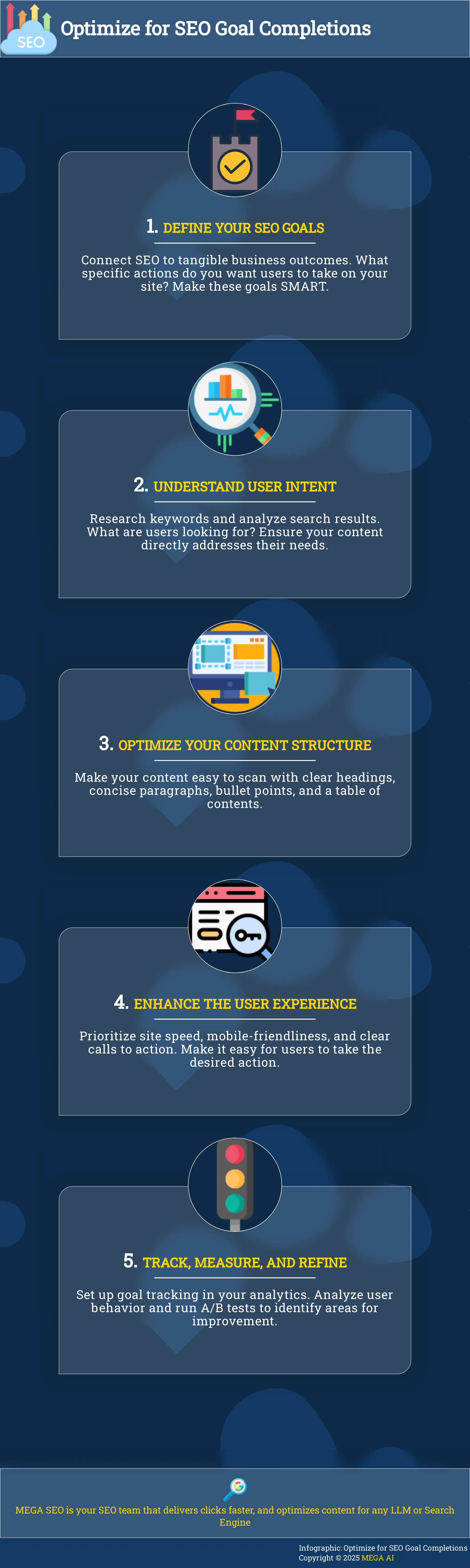
A positive user experience (UX) is the foundation of high goal completion rates. When your website is intuitive, fast, and easy to use, visitors can find what they need without friction. This seamless journey encourages them to stay longer, engage more deeply with your content, and ultimately take the action you want them to, whether that’s making a purchase, filling out a form, or subscribing to a newsletter. Think of it as clearing a path for your user directly to their destination.
Search engines like Google pay close attention to how users interact with your site. When users have a good experience, they send positive behavioral signals—like low bounce rates and high dwell times—that tell search engines your content is valuable and relevant. This is why focusing on UX is not just a design principle; it's a core component of a successful SEO strategy. By making your site a better place for people, you also make it more attractive to search engine algorithms, creating a cycle of improved visibility and higher goal completions.
Improve readability with visual elements
Large blocks of text can be intimidating and cause users to leave your page before they find their answer. To keep visitors engaged, you need to make your content easy to scan and digest. Incorporating visual elements is a great way to improve readability. Start by adding a "key takeaways" box near the top of your articles to give readers a quick summary of the main points.
You can also use infographics to present data, custom images to illustrate concepts, and embedded videos to offer a different way to consume the information. These elements break up the text, making the page more visually appealing and helping users process the content more efficiently. This approach keeps them on the page longer, signaling to search engines that your content is valuable and engaging.
Prioritize site speed and mobile-friendliness
In a world of short attention spans, speed is everything. If your page takes too long to load, users will likely hit the back button and choose a competitor's site instead. To optimize for goal completion, you must ensure your content answers the user's question as quickly as possible. This starts with a fast-loading website. You can use tools like Google's PageSpeed Insights to test your site's performance and get recommendations for improvement.
Equally important is mobile-friendliness. Since the majority of web traffic now comes from mobile devices, your site must provide a seamless experience on screens of all sizes. A responsive design ensures that text is readable, buttons are tappable, and users don't have to pinch and zoom to find what they need.
Address user intent immediately
When a user clicks on your link from a search results page, you have just a few seconds to convince them they're in the right place. Your content must immediately address the user intent behind their search query. The information presented "above the fold"—the part of the page visible without scrolling—is critical. Use this space to deliver a direct answer, present a clear value proposition, or confirm that your page contains the solution they are looking for.
Aligning your content directly with user intent builds instant trust and reduces the chance of a user bouncing. When visitors feel understood, they are more likely to continue down the page, engage with your content, and move closer to completing a goal. This alignment is a key part of any effective content strategy.
Measure and Analyze Goal Completions
Setting goals is the first step, but tracking your progress is what turns strategy into results. To understand if your SEO efforts are truly working, you need to dive into the data. This means setting up the right tracking, watching how users move through your site, and continuously testing your assumptions. By measuring goal completions, you can connect your SEO activities directly to business outcomes and make smarter decisions about where to focus your energy.
Set up goal tracking in analytics
Measuring your SEO performance ensures your efforts are actually driving visibility, traffic, and conversions. To do that effectively, you need to track the right SEO KPIs. Start by setting up goals in Google Analytics or your preferred analytics platform. You can define a goal as a specific user action, like submitting a contact form, signing up for a newsletter, or reaching a "thank you" page after a purchase. This setup allows you to see which pages and traffic sources are contributing most to your business objectives. Without it, you’re just looking at traffic numbers without understanding their actual value.
Analyze the user behavior flow
Once your tracking is in place, you can analyze the user behavior flow to see the paths people take on your site. Where do they come from, which pages do they visit, and where do they drop off before completing a goal? This analysis helps you spot friction points in the user journey. By quantifying the benefits of your SEO efforts in terms of metrics like increased traffic and conversions, you can calculate the true financial impact of your strategy. Tools like the Path Exploration report in GA4 are perfect for visualizing these journeys and identifying pages that need improvement.
Run A/B tests to optimize
Analysis leads to hypotheses, and hypotheses need to be tested. A/B testing is a powerful way to optimize your pages for better goal completion rates. You can test different headlines, calls-to-action, images, or even page layouts to see what resonates most with your audience. For example, does a button that says "Get Started" convert better than one that says "Sign Up"? Running these controlled experiments helps you make data-driven decisions instead of guessing. This process of continuous improvement is how you discover effective methods to measure SEO effectiveness and increase business growth, one test at a time.
Tools to Track Goal Completions
Once you’ve defined your goals, you need a reliable way to measure them. The right tools not only show you what’s working but also reveal where users are dropping off. This data is the foundation for making smart, effective changes to your SEO strategy.
Google Analytics and Search Console
For anyone getting started, Google’s free tools are non-negotiable. Google Analytics is your go-to for understanding what happens on your site. It gathers essential data on your website’s performance, showing you traffic sources and how users behave once they arrive. You can set up specific goals to track everything from newsletter sign-ups to product page views, giving you a clear picture of your conversion rates.
Google Search Console complements this by showing you what happens before the click. It provides critical data on your site's search performance, including which queries bring users to your site, your click-through rate (CTR), and your average ranking. Using both tools together gives you a complete view of the user journey, from search result to goal completion.
Specialized SEO and conversion tools
While Google's tools provide a fantastic foundation, specialized SEO reporting software can offer deeper insights and streamline your workflow. Platforms like Ahrefs and Semrush consolidate data, making it easier to monitor your progress over time, identify technical issues, and uncover new opportunities for growth. They help you keep a close eye on all your key performance indicators in one place.
Beyond just tracking, modern platforms are moving toward automation. For instance, MEGA AI’s SEO tools can analyze your performance data and automatically update content to improve metrics like CTR, closing the loop between analysis and action. This approach helps you not only measure your goals but also actively work toward achieving them more efficiently.
Align SEO Goals with Business Objectives
Your SEO strategy can't live on an island. For it to deliver real value, it needs to be directly connected to your company's bigger picture. Think about your main business objectives. Are you trying to increase overall revenue, expand into a new market, or establish your brand as an industry authority? Your SEO goals should be a direct reflection of these ambitions. If your company wants to launch in a new country, for example, your SEO strategy should focus on ranking for relevant keywords in that specific region. This ensures that every piece of content you create and every link you build serves a clear business purpose.
Great SEO goals start by looking at what the business needs to achieve. Your digital marketing plan is likely already designed to support these objectives, and your SEO efforts should fit right in. This alignment ensures that the traffic you generate is not just a number on a report but a stream of potential customers who are genuinely interested in what you offer. When your SEO work is tied to tangible business outcomes, it becomes much easier to demonstrate its value and secure the resources you need to succeed. It shifts the conversation from "we got more clicks" to "we generated more qualified leads for the sales team," making your contribution clear and undeniable.
Set SMART goals for your SEO strategy
To move from broad ambitions to a concrete plan, your goals need to be SMART: Specific, Measurable, Achievable, Relevant, and Time-bound. This framework turns a vague idea like "get more traffic" into an actionable target like "increase organic traffic to our product pages by 15% in the next quarter." To know if you've hit your mark, you have to monitor the right analytics.
Tracking progress is about more than just watching numbers go up. By carefully measuring your performance with the SEO KPIs that matter to your business, you get a clear picture of where you are and the value your strategy is delivering. This data-driven approach helps you make informed decisions, adjust your tactics when needed, and prove the impact of your work.
Integrate goal completion into your planning
A goal completion happens any time a user performs a desired action on your site, like signing up for a newsletter, downloading a guide, or making a purchase. These actions are the bridge between website traffic and business results. Integrating goal completions into your planning process is essential because it helps you quantify the financial impact of your SEO efforts. It’s how you prove that your strategy is doing more than just improving rankings; it’s actively contributing to the bottom line.
When you focus on goal completions, you start optimizing for user actions, not just keywords. This shift in perspective influences everything from your content structure to your site's user experience. By measuring SEO success through conversions, you can calculate the true return on your investment and make a stronger case for future SEO initiatives.
Strategies to Improve Goal Completion Rates
Knowing your goal completion metrics is one thing; improving them is another. If your numbers aren't where you want them to be, focus on a few core strategies. By refining your content, optimizing the user journey, and continuously testing your approach, you can create a smoother path from user arrival to goal completion.
Refine your content
To optimize your content for goal completion, ask yourself if it answers the user's question as quickly as possible. Modern users are impatient. If your page doesn't deliver value within seconds, they will likely return to the search results. Structure your articles with the most important information at the top, followed by supporting details. This approach, known as the inverted pyramid, respects the user's time and immediately addresses their intent. MEGA AI’s Maintenance Agent automates this by identifying ways to improve existing content, helping you refine articles to better match user queries and improve click-through rates.
Map and optimize the user journey
A goal completion rarely happens on a single page. It’s the result of a user moving through a series of steps. Map out the ideal path you want a user to take, from the landing page to the final conversion. Use your analytics to see where users are dropping off and identify points of friction. Does each page have a clear purpose and a logical next step? Measuring your performance ensures your efforts drive traffic and conversions. To do that effectively, you need to track the right SEO KPIs that show how users are interacting with your site at each stage of their journey.
Test and iterate continuously
An effective SEO strategy is never static. You should constantly test different elements of your pages to see what drives more goal completions. Run A/B tests on your headlines, calls-to-action, button colors, and page layouts. Small changes can often lead to significant improvements in conversion rates. By carefully measuring your SEO with metrics that matter to your business, you can understand what’s working and where to focus your efforts. Platforms like MEGA AI can support this process with SEO automation that re-optimizes content based on performance data, ensuring your pages are always working to meet your goals.
Related Articles
- Top 9 SEO Challenges & Solutions for 2024
- SEO Strategy Meaning: The Ultimate Guide (2023)
- How to Measure Goal Value in Google Analytics Easily
- How Improving Mobile User Experience Can Boost Your SEO Efforts - MEGA SEO | Blog
- Tracking SEO Performance: The Ultimate Guide (2024)
Frequently Asked Questions
My website gets a lot of traffic, but not many sales or leads. Where should I start? This is a common challenge that points to a disconnect between your audience and your content. The first step is to analyze the user journey. Use your analytics to see which pages have high traffic but also high exit rates. This helps you identify where people are losing interest. Also, review the search queries bringing users to your site. If your content doesn't directly address the intent behind those searches, visitors will leave without taking action.
What's the difference between bounce rate and exit rate, and which one matters more? A bounce is when someone visits a single page on your site and then leaves without interacting further. An exit rate is the percentage of visitors who leave your site from a specific page, regardless of how many other pages they viewed. A high bounce rate on a key landing page is often a red flag that your content isn't meeting expectations. A high exit rate, however, can be perfectly normal on pages like a "thank you" page after a purchase or a contact confirmation page.
How do I choose the right goals to track for my specific business? The best goals are always tied to your core business objectives. Start by asking what your company wants to achieve—is it more revenue, a larger customer base, or greater brand authority? Then, work backward to identify the website actions that support those objectives. For an ecommerce site, the primary goal is a completed purchase. For a B2B company, it might be a demo request or a white paper download.
Can improving my page's structure really impact my business goals? Absolutely. A well-structured page with clear headings, short paragraphs, and a table of contents does more than just look good. It helps users find the information they need quickly and with less effort. This positive experience builds trust and keeps them on your site longer, making them significantly more likely to take the next step, whether that's signing up for your newsletter or making a purchase.
Besides Google Analytics, what's the next step for tracking and improving goal completions? Google Analytics is excellent for telling you what is happening on your site, like which pages have high conversion rates. The next step is to use tools that help you understand why and then automate improvements. Platforms like MEGA AI can analyze your performance data and then automatically update your content to improve metrics like click-through rate, directly connecting your analysis to action and helping you achieve your goals more efficiently.