
In the past, SEO was like stuffing a resume with keywords. You just listed your skills over and over. Today, that's not enough. Entity SEO is like adding the projects, results, and recommendations that prove you have those skills. It builds a complete picture, showing the relationships between your expertise, your products, and your industry. This approach moves beyond simple labels to establish context and credibility. It helps an entity search understand your business's full story, making search engines more confident in recommending you to users.
Key Takeaways
- Prioritize topics over keywords: Modern search engines understand context. Build authority by creating interconnected content that thoroughly covers a subject, showing you're an expert on the entire topic, not just a single search term.
- Translate your content for search engines: Use structured data to explicitly label the key information on your pages. This removes guesswork for search engines, helping them understand your content's context and improving your chances for rich results.
- Establish your brand as a trusted entity: Authority is built on high-quality content and credible online associations. Focus on creating genuinely helpful information and managing your brand's reputation to send strong trust signals to search engines.
What is a Business Entity Search?
Before you can build a brand and grow your online presence, you need to register a business. A business entity search is your first step in this official process. Think of it as a background check for companies, allowing you to look up the public records of businesses registered with the state. Whether you're vetting a potential partner, researching a competitor, or getting ready to launch your own venture, this search is a fundamental tool. It helps you verify a company's legal standing, find out who is behind it, and ensure you're making informed decisions from the very beginning.
The Primary Definition: Looking Up Official Business Records
At its core, a business entity search is the process of accessing official state records for a specific company. As the California Secretary of State explains, this search "allows individuals to look up official records related to businesses, including their registration status, ownership details, and compliance with state regulations." This isn't just about finding a website or a phone number; it's about accessing the legal paperwork filed with the government. You can see if a business is in "good standing," identify its registered agent for legal notices, and review its official filing history. It’s the definitive way to confirm that a business is legitimate and operating correctly within a particular state.
How to Search for a Business Entity on Government Portals
Nearly every state offers a free, searchable online database of registered businesses, typically hosted on the Secretary of State's website. These portals are designed to make public records accessible and usually provide a few different ways to find the information you need. While the exact interface varies from state to state, the search methods are generally consistent. Knowing the different ways you can search will help you find what you're looking for quickly, even if you only have partial information about the company you're researching. Let's look at the most common search options you'll encounter.
Searching by Business Name
The most straightforward method is to search by the business's legal name. According to the Louisiana Secretary of State, you can search by the business's full name, which they refer to as the "Entity Name." This is perfect when you know the exact name of the company you're looking for. Keep in mind that you may need to be precise. If a simple search doesn't yield results, try including legal suffixes like "LLC," "Inc.," or "Corporation" in your query. Some systems are very specific, and getting the name exactly right is key to finding the correct record.
Searching by Identification Number
When a business registers with the state, it's assigned a unique identification number. This might be called a "Charter Number," "Entity ID," or "Trade Registration Number." Searching by this number is the most accurate way to locate a specific business, as it eliminates any confusion that might arise from companies with similar names. If you have this number from an invoice, contract, or other official document, using it for your search will take you directly to the record for that one specific entity, saving you time and ensuring you've found the right company.
Searching by an Associated Person's Name
What if you don't know the business name but you know who runs it? Many state portals allow you to search by the name of a person associated with the business, such as an "Officer Name" or "Agent Name." This feature is incredibly useful for due diligence. For example, you could use it to see what other companies a potential business partner is involved with. It provides another layer of transparency, helping you build a more complete picture of the individuals and organizations you plan to work with before you commit to a partnership.
Common Goals for a Business Entity Search
People perform business entity searches for two primary reasons: to gather intelligence on an existing company or to clear the path for a new one. For established businesses, it's a tool for competitive analysis and risk management. For aspiring entrepreneurs, it's a mandatory step in the formation process. Both goals rely on the same public databases, but the intent behind the search shapes what information is most valuable. Understanding these common goals helps clarify why these public records are such an important resource for the entire business community and the first step in building a lasting enterprise.
Finding Information on Existing Businesses
One of the main uses of a business entity search is to find information on companies that are already operating. As the New Jersey Department of Revenue and Enterprise Services points out, this allows you to "find existing businesses by their name, keywords, or a special ID number." You might do this to verify that a potential supplier is a legitimate, registered company before signing a contract. Or you could use it to research a competitor, confirming their legal name and registered agent. This kind of basic due diligence can protect you from fraud and help you make smarter business decisions.
Checking for Business Name Availability
If you're starting a new business, the entity search is your best friend. Before you can choose a business name and register it, you must ensure it's not already in use. State portals often have a specific tool to "Search for Available Names" for this exact purpose. This is a critical step. Attempting to register a name that's already taken will result in your filing being rejected. More importantly, using a name that's too similar to an existing one can lead to legal trouble down the road. The entity search is the official way to confirm your name is unique and available for registration.
Resources Provided by Government Business Agencies
The Secretary of State's website is much more than just a search portal; it's a comprehensive resource center for business owners. Beyond the search function, these sites are designed to guide you through various administrative and compliance tasks. For instance, the California Secretary of State's site notes that it provides "forms, examples of documents, and information about fees." This is typical for most states. You can find downloadable PDF forms for creating an LLC or corporation, detailed fee schedules for different filings, and instructions to ensure you're completing the paperwork correctly. Before you hire expensive help, it's always worth exploring these official resources first.
What is Entity SEO?
Entity SEO is a way of optimizing your content so search engines understand it as a collection of related concepts, not just a string of keywords. Think of it as moving beyond what you say to what you mean. Instead of just matching the words in a search query, search engines like Google now try to understand the people, places, things, and ideas behind those words. They want to grasp the context and the relationships between them to deliver more accurate and comprehensive results.
This approach is all about building a web of interconnected information on your site. When you do this effectively, you're not just ranking for a single keyword; you're establishing your authority on a whole topic. You're helping search engines see you as a reliable source of information about a specific subject. This is a fundamental shift from old-school SEO tactics. By focusing on entities, you create content that better answers complex questions and satisfies user intent, which is exactly what modern search algorithms are designed to reward.
What Are Entities in Search?
In the world of search, an entity is any well-defined thing or concept that can be uniquely identified. It’s not just a word; it’s the real-world object or idea that the word represents. An entity can be a person (like a company’s CEO), a place (like your business address), an organization (your company itself), a product, or even an abstract concept (like “digital marketing”).
Search engines use these entities to build a massive, interconnected database of knowledge called a Knowledge Graph. This helps them understand, for example, that “San Diego” is a place, and it’s related to other entities like “California,” “beaches,” and “apartments for rent.” Optimizing for entities means making it clear what your content is about in these terms.
Entities vs. Keywords: What's the Difference?
The main difference between entities and keywords is that keywords are the words people type into a search bar, while entities are the concepts those words represent. A keyword is a label; an entity is the thing itself. For example, “best coffee shops in Brooklyn” is a keyword phrase. The individual coffee shops, the neighborhood of Brooklyn, and the concept of “coffee” are all entities.
Traditional SEO focused heavily on including the right keywords. Entity SEO goes a step further by focusing on building context around the core concepts. It’s about showing the relationships between different entities. You’re not just mentioning an apartment complex; you’re connecting it to the city it’s in, the amenities it offers, and the type of lifestyle it provides, creating a richer, more meaningful picture for search engines.
How AI Recognizes Entities
Artificial intelligence, particularly a field called Natural Language Processing (NLP), is how search engines identify entities within your content. AI algorithms read your text much like a human would, analyzing the words to understand context, sentiment, and the relationships between different concepts. This is how a search engine can tell whether a page mentioning "Apple" is about the tech company or the fruit. It looks at other entities mentioned nearby, like "iPhone" and "Tim Cook" or "pie" and "orchard."
AI-powered SEO platforms can help you optimize your content for this process. By analyzing your text, tools like MEGA AI SEO can identify the key entities and suggest ways to strengthen their context, ensuring search engines clearly understand what your content is about.
Structured Data: The Foundation of Entity SEO
Structured data is a standardized format for providing information about a page and classifying its content. Think of it as a cheat sheet for search engines. By adding a specific type of code, like Schema.org markup, to your website, you can explicitly label the entities on your page. You can tell Google, "This string of text is the author's name," "This number is the product's price," or "This is a recipe for chocolate chip cookies."
This process makes the information on your page easily digestible for search engines. Instead of having to process the entire page to figure out what it’s about, they can quickly understand the key entities and their relationships. This can also help your pages qualify for rich results in search, like star ratings, event details, or FAQ dropdowns.
Why Modern Search Thinks in Concepts, Not Keywords
Search engines have become incredibly sophisticated. They no longer just scan for keywords on a page; they now understand context, relationships, and user intent on a much deeper level. This evolution is largely driven by advancements in artificial intelligence, which has fundamentally changed how information is organized, understood, and presented to users. For marketers and business owners, this means the old playbook for SEO is no longer enough to stay competitive. To succeed, you need to understand how search works today and adapt your strategy to meet the expectations of both modern search engines and the people using them.
This shift requires a more holistic approach. Instead of focusing narrowly on individual keywords, the goal is to build authority around entire topics. It’s about creating content that provides real, comprehensive value and answers the questions your audience is asking, sometimes before they even ask them. The following sections break down the key changes in modern search, from the move toward entities to the critical importance of user intent. Understanding these concepts is the first step toward building an SEO strategy that is resilient, effective, and ready for the future of search.
Why Search Engines Shifted from Keywords to Entities
In the past, SEO was a game of keywords. Today, it’s about entities. An entity is any well-defined thing or concept, like a person, place, organization, or idea. While a keyword is just a string of text, an entity has context and relationships. For example, a search engine doesn’t just see the keyword "Leonardo da Vinci"; it understands the entity as a Renaissance artist and inventor connected to other entities like the "Mona Lisa," "Italy," and "painting." This shift allows search engines to grasp the true meaning behind a query and deliver more accurate, relevant results. For your content, this means you should focus on covering topics comprehensively, establishing clear connections between related concepts and building a rich, contextual foundation for your subject matter.
How AI Influences Search Behavior
Artificial intelligence is the engine driving modern search, powering features like generative answers and more conversational search experiences. This directly impacts how users find information. People are asking more complex, long-form questions and expect direct, accurate answers right on the results page. The integration of AI means that simply ranking for a keyword is less important than being the source of truth for an answer that an AI might use. Traditional SEO methods need to be paired with an understanding of how AI is changing search. Your content must be structured clearly and authoritatively to be easily understood and utilized by these intelligent systems, ensuring you remain visible in this new landscape.
How Entity Search Improves the User Experience
As search becomes smarter, user expectations rise. People want personalized, intuitive, and fast results. AI helps deliver this by understanding user history, location, and other signals to provide the most relevant information. This heightened focus on user experience extends directly to your website. Search engines favor sites that are easy to use, load quickly, and provide a positive, seamless experience on any device. Factors like clear navigation, mobile-friendliness, and fast page speeds are no longer just design best practices; they are critical signals that tell search engines your site provides a quality experience worthy of a high ranking. A great user experience is a core component of modern SEO.
Why Search Intent Is More Important Than Ever
Understanding why someone is searching is more important than ever. Are they looking to buy something, find specific information, or compare their options? This is known as search intent, and it's a primary signal for search engines. AI has made search engines much better at deciphering this intent from the language a user types. Creating content that aligns with the specific needs behind a query is essential for ranking. If someone searches for "best running shoes," they likely want reviews and comparisons, not the history of footwear. Aligning your content with user intent ensures you provide genuine value, which leads to better rankings and more satisfied visitors.
The Building Blocks of an Entity SEO Strategy
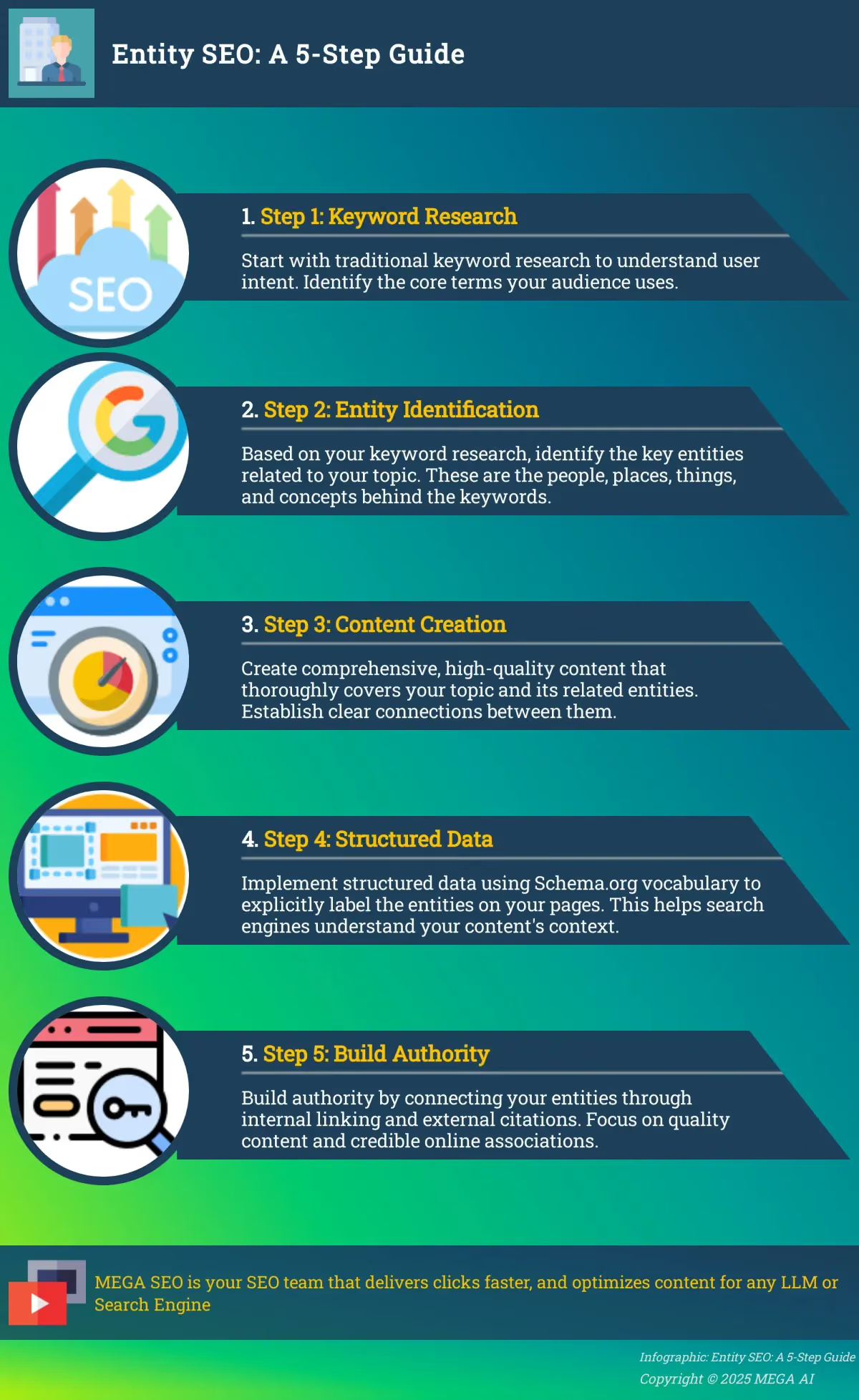
To effectively use entity SEO, you first need to understand its building blocks. It’s not just about one single tactic; it’s about how several components work together to create a clear, authoritative picture for search engines. Think of it as building a detailed profile for your brand, products, and expertise online. By focusing on these core areas, you can help search engines understand not just what your content says, but what it’s about in a much deeper, more connected way. This approach moves beyond simple keywords to establish your authority in your specific niche.
How Knowledge Graphs Connect Everything
At the heart of entity SEO is the concept of a knowledge graph, which is how search engines map out the relationships between different things. An entity can be a person, a place, an organization, or even an idea. For example, an entity could be your company, a specific product you sell, or the author who writes your blog posts. Your goal is to help search engines understand the connections between these entities. When you mention "apartments to rent in San Diego," you're referencing multiple entities—the concept of "apartments," the action "to rent," and the place "San Diego"—and showing how they relate to one another.
Defining an Entity's Properties and Attributes
Every entity has unique properties and attributes that define it. This is the information that adds context and detail, helping search engines understand the entity completely. For instance, the entity "San Diego" has attributes like its location (California), its population, and its famous attractions. The goal is to tie together all the relevant information about the entities you work with daily. By clearly defining these attributes, you help search engines understand the relationships that exist between different data points, creating a richer, more accurate picture of what your content and your business are all about. This clarity is what allows them to serve your content for more relevant, specific queries.
How to Structure Your Content for Entity Search
How you organize your content on the page plays a big role in entity SEO. Your content structure should logically connect different entities and their attributes. This helps both users and search engines follow the narrative you're creating. The technical side of this is using structured data, which makes your content easily digestible for crawlers. Instead of forcing a search engine to process an entire page to figure out its meaning, structured data presents the key information upfront. This tells the search engine exactly what the page is about and how its core entities relate to other concepts across the web, making its job much simpler.
How to Send the Right Authority and Trust Signals
Search engines want to recommend content from sources they trust. Entity SEO helps you build that trust by establishing clear signals of authority. This goes back to the idea of E-E-A-T (Experience, Expertise, Authoritativeness, and Trustworthiness). For example, if the authors writing your content are established experts in your industry with a history of creating valuable content, that's a powerful signal. Having well-versed authors who are recognized leaders in their field helps establish your entire website as an authoritative entity. Consistently providing accurate, well-researched information reinforces this and builds the trust needed to rank well.
How to Implement Structured Data
Structured data, often implemented using Schema.org vocabulary, is the code that translates your content into a language search engines can easily understand. It’s how you explicitly define the entities on your page and their relationships. One expert described it as taking a complex novel and distilling it down to a kindergarten reading level for a crawler. You can use schema markup to identify everything from your business's address and phone number to the author of an article or the ratings on a product. This removes ambiguity and ensures search engines see your content exactly as you intend, which is a critical step in any entity-based strategy.
How to Build Your Entity Authority
Building entity authority means showing search engines that you are a credible and trustworthy expert on a specific topic. It’s about moving beyond individual keywords and creating a web of high-quality, interconnected information that clearly defines who you are and what you know. When search engines can confidently identify your brand as an authority, they are more likely to feature your content prominently in search results, including in knowledge panels and other rich snippets. The following steps will help you create a strong foundation for your entity and establish your expertise in your niche.
Creating Entity-Rich Content
To build authority, your content needs to be comprehensive. This means naturally including relevant entities—like specific people, organizations, locations, and concepts—within your articles. For example, if you’re writing about social media marketing, you would mention platforms like Instagram and TikTok, influential marketers like Neil Patel, and concepts like "engagement rate." This practice helps search engines understand the depth and context of your content. Using a tool for automated keyword research can help you identify these related entities and ensure your content covers a topic thoroughly, making it more valuable to your readers.
Building Connections Between Your Entities
Simply listing entities isn’t enough; you need to show how they connect. Your goal is to help search engines understand the relationships between the different data points on your site and across the web. You can do this by creating a logical site structure with strong internal linking between related pieces of content. For instance, an article about "content marketing" should link to your articles on "SEO," "email marketing," and "social media." Using structured data also helps explicitly define these relationships, building a clear knowledge graph for your website and solidifying your topical authority.
How to Optimize for Content Quality and Relevance
Ultimately, entity authority is built on a foundation of high-quality content that serves the user. Content created solely to rank, without providing real value, will not succeed in the long run. Your focus should be on creating well-researched, helpful, and engaging articles that answer your audience's questions. While AI-powered content generation can help you scale your efforts, it should be used to enhance human expertise, not replace it. Prioritizing quality builds trust with your audience and sends strong positive signals to search engines about your credibility.
Managing Your Brand's Entity Associations
The company you keep online matters. Search engines evaluate your authority based on the other entities your brand is associated with. Actively manage these associations by seeking guest post opportunities on reputable websites, earning mentions in industry publications, and collaborating with other experts in your field. It’s also important to manage your own brand entity by ensuring your business name, address, and phone number are consistent across all online directories. Claiming and optimizing your Google Business Profile is a critical first step in controlling how your brand entity appears in search.
When and How to Prune Your Content
Not all content serves your brand forever. Old, outdated, or low-performing pages can dilute your website's overall authority and confuse search engines about your core expertise. A content pruning strategy involves regularly conducting a content audit to identify these underperforming assets. From there, you can decide whether to update and republish them, consolidate multiple weak articles into one strong one, or remove them entirely. This process focuses your site’s authority on your best content, sending clearer signals to search engines about what topics you are an expert on.
Optimizing Your Site for AI-Powered Search
Optimizing for AI-powered search engines means shifting your focus from simple keyword matching to creating a rich, contextual experience for users. AI doesn't just read words; it understands concepts, relationships, and intent. To align with this, your strategy should prioritize creating high-quality, human-centric content that is technically sound and structured in a way that machines can easily interpret. This involves using natural language, understanding the meaning behind search queries, and building a website structure that supports AI crawlers. By focusing on these areas, you can create content that satisfies both users and the advanced algorithms that power modern search.
Understanding Natural Language Processing (NLP)
Natural Language Processing (NLP) is how machines learn to read, understand, and interpret human language. For SEO, this means search engines can grasp the nuance and context of your content far beyond individual keywords. To optimize for NLP, write conversationally, just as you would speak to a person. Use clear sentence structures and organize your content logically to answer user questions directly. AI marketing uses NLP capabilities to analyze data and gain customer insights, so creating content that is easy for AI to process gives you a significant advantage. Think less about keyword density and more about covering a topic thoroughly and naturally.
What Is Semantic Search?
Semantic search is all about understanding the intent and contextual meaning behind a search query. Instead of just matching keywords, search engines now analyze the relationships between words and concepts to deliver more accurate results. This is why a search for "best places to eat near me" shows restaurants, not just pages with those exact words. To optimize for semantic search, create comprehensive content that explores a topic from multiple angles. Use synonyms and related terms to build a strong contextual foundation. Remember, content written for bots won't win in the long run. Your goal is to create the best possible resource for a human reader, which in turn makes it the best resource for an intelligent search engine.
Optimizing for Voice Search: What You Need to Know
Voice search queries are typically longer and more conversational than typed ones. People often ask full questions, like "What are the main components of entity SEO?" instead of just typing "entity SEO components." To capture this traffic, focus on long-tail keywords that mirror natural speech patterns. Use structured data, especially FAQ schema, to provide clear, concise answers that AI assistants can pull directly for voice responses. Since most voice searches happen on mobile devices, ensuring your site is mobile-friendly with fast load times is critical. AI's ability to process conversational language makes it a game-changer for marketers who adapt to these new search behaviors.
How Personalization Affects Entity Search Results
AI search engines deliver highly personalized results based on a user's location, search history, and past behavior. While you can't control these factors directly, you can create content that appeals to different segments of your audience. Develop detailed user personas and craft content that addresses their specific questions and pain points. By creating a variety of content that serves different intents—informational, transactional, or navigational—you increase the chances that your pages will be seen as the most relevant result for a specific user's personalized query. This focus on hyper-personalization helps you connect with users on a deeper level and improves engagement.
How to Build an AI-Ready Technical SEO Foundation
A strong technical foundation is essential for AI search engines to crawl, understand, and index your content effectively. Start with a logical site architecture that is easy for both users and crawlers to follow. Ensure your website is mobile-friendly and loads quickly, as these are key ranking factors. Implementing structured data (schema markup) is one of the most direct ways to communicate with search engines, providing explicit context about your content. A clean, well-structured site allows AI-powered SEO tools to work more effectively, helping you create campaigns, improve conversions, and enhance the overall customer experience.
Common Myths About Entity SEO
As entity-based search becomes more central to SEO, a few misconceptions have started to pop up. It’s easy to get confused about what still matters and what’s changed. Let’s clear the air and look at some of the most common myths about entity SEO so you can build a strategy based on facts, not fiction. Understanding these distinctions will help you focus your efforts on what truly drives results in modern search.
Myth: Traditional SEO Is Dead
A common myth is that entity SEO replaces traditional SEO practices. The truth is, it builds on them. Foundational SEO principles like creating high-quality content, building a solid backlink profile, and ensuring a good user experience are more important than ever. While AI can automate many tasks, it doesn't replace the need for human strategy and expertise. Think of entity SEO as an evolution. It refines our approach, but the core goal remains the same: providing the best possible answer to a user's query. Your SEO strategy should integrate both, using entity optimization to enhance the solid foundation you've already built.
Myth: AI Will Make SEO Obsolete
Another misconception is that AI's role in search is just a passing trend. In reality, AI has fundamentally changed how search engines work. AI’s ability to process massive amounts of data allows search engines to understand context and intent on a much deeper level. This isn't just about matching keywords; it's about understanding relationships between concepts. For marketers, AI in marketing provides powerful tools to analyze campaign data in near real-time, offering insights that were previously impossible to get. Ignoring AI's impact means falling behind as search engines become more sophisticated and personalized.
Common Myths About Content for Entity Search
Many people believe that AI-generated content is automatically low-quality or spammy. This is one of the biggest myths holding marketers back. The quality of AI-generated content depends entirely on the tool and the person using it. When used correctly, AI can help you create well-researched, entity-rich content at scale. The key is to provide clear direction, edit the output, and ensure it aligns with your brand voice and user intent. AI is a powerful assistant that can handle the heavy lifting of research and drafting, freeing you up to focus on strategy and creativity.
Debunking Technical Myths About Entity SEO
Some marketers think that because AI is so advanced, technical details like structured data are no longer necessary. This couldn't be further from the truth. AI-powered search engines rely heavily on structured data to understand the entities on your website and the relationships between them. Schema markup gives search engines a clear, organized roadmap of your content, making it easier for them to index and rank it accurately. A strong technical SEO foundation is the bedrock of any successful entity SEO strategy. It provides the clear signals that AI crawlers need to make sense of your site.
The Best Tools and Resources for Entity SEO
Putting entity SEO into practice doesn't have to be an abstract exercise. A number of tools and resources can make the process more concrete, helping you identify, structure, and analyze entities for your content. From implementing schema to leveraging AI, these tools provide the support you need to build a modern, effective SEO strategy. Think of them as your toolkit for communicating more clearly with search engines and, ultimately, with your audience.
Tools to Help You Understand Knowledge Graphs
To work with knowledge graphs, you first need to understand what information they already contain. Structured data is the language you use to feed information into these graphs, but you can also peek at what’s already there. Tools like Google's Knowledge Graph Search API allow you to see the data Google has on specific entities. This provides a valuable baseline, showing you what information you might need to clarify or expand upon. Exploring public knowledge bases like Wikidata can also reveal how entities are categorized and connected, offering a blueprint for your own content structure.
Top Resources for Implementing Schema Markup
Once you identify the key entities for your content, you need to communicate them clearly to search engines. This is done through schema markup. You are essentially adding a layer of code that explicitly defines the people, places, and things on your page. The official Schema.org website is the definitive resource for finding the correct vocabulary for any type of content. To ensure your code is correct before it goes live, you can use Google’s Rich Results Test. This step makes your content easily digestible, so search engines don’t have to guess what your page is about.
Platforms for Analyzing Your Entities
To succeed with entity SEO, you need to think more intricately about the language you use. Entity analysis platforms help you do just that. Tools that use Natural Language Processing (NLP) can scan your content to identify the main entities, their relationships, and even the sentiment associated with them. This analysis helps you confirm that your content is properly aligned with your target entities. You can also use these platforms to analyze top-ranking competitor pages, revealing which related entities they emphasize and giving you a roadmap for creating more comprehensive content.
AI-Powered Platforms to Support Your SEO
Manually managing entities, schema, and content optimization can quickly become overwhelming. This is where AI-powered SEO platforms can make a significant difference by identifying actionable insights and automating tedious tasks. For instance, an end-to-end platform like MEGA AI can handle automated entity research, generate the correct structured data, and even update existing articles to include new, relevant entities as search trends evolve. This approach ensures your content remains current and authoritative without constant manual work, freeing you up to focus on your broader strategy.
Automating Entity Optimization with MEGA AI
Keeping up with entity optimization by hand is a huge task, especially for a small business. You have to research entities, write schema code, and constantly update your content to stay relevant. This is where an end-to-end platform can be a lifesaver. MEGA AI, for example, automates this entire process. It handles the initial research to find relevant entities for your topics and can automatically generate the right structured data for your pages. Even better, its Maintenance Agent product can update existing content by identifying new entities to add as search trends change, ensuring your articles stay fresh and authoritative without you having to lift a finger.
Measuring and Adapting Your Entity SEO Strategy
Entity SEO isn't a one-and-done task. It’s a continuous process of building authority and making sure search engines understand who you are and what you offer. To know if your efforts are paying off, you need to track the right metrics and be ready to adjust your approach. Measuring success goes beyond traditional keyword rankings; it’s about observing how search engines perceive and present your brand as a distinct entity. By monitoring your visibility and analyzing performance, you can refine your strategy to build a stronger, more authoritative online presence.
How to Track Your Entity's Visibility in Search
Tracking entity visibility means measuring how well search engines understand your brand and its connections. When you use structured data correctly, you make it easy for search engines to digest information about your entity without having to process the entire page. A good sign of success is seeing your brand appear in rich results, like featured snippets or "People also ask" sections, for topics related to your expertise. You can use rank tracking tools that monitor these SERP features to see how often your entity is being surfaced. This shows that Google not only recognizes your brand but also trusts it as a relevant source of information for users.
Keeping an Eye on Your Knowledge Panel
Your brand’s Knowledge Panel is one of the most visible indicators of a successful entity SEO strategy. It’s the information box that appears on the right side of search results, summarizing key details about your business. You should regularly check your Knowledge Panel to ensure all the information is accurate and complete. Is your logo correct? Are your social profiles linked? As Google learns more about your entity, you may see new information added to the panel. This is a clear sign that your efforts to build connections and provide clear signals are working, solidifying your brand’s identity in the Knowledge Graph.
How to Align Your Content with Search Intent
A strong entity strategy ensures your content answers the specific questions your audience is asking. It’s not enough for search engines to know who you are; they need to see you as the answer to a user's problem. To measure this, review the search queries that bring users to your site in Google Search Console. Are they aligned with the topics you want to be known for? If you sell handmade pottery, you want to attract queries like "durable ceramic dinnerware" not just "pottery." Creating content that directly addresses user search intent reinforces your authority and tells search engines exactly what you’re about.
Analyzing Your Performance Data for Insights
Ultimately, your entity SEO efforts should translate into tangible business results. Go beyond rankings and look at performance data like click-through rates (CTR), user engagement, and conversions. When search engines understand your entity, they can show your content to a more qualified audience, which should lead to higher-quality traffic. AI-powered tools can help you automate the analysis of this data, identifying which pages are performing well and which need updates. For example, MEGA AI’s SEO Maintenance Agent can identify opportunities to improve the CTR of your existing content, ensuring it continues to perform well long after it's published.
How to Adapt Your Strategy for Better Results
The data you collect will show you what’s working and what isn’t, allowing you to adapt your strategy. Entity SEO requires flexibility. If you notice that content on a specific topic is consistently building your entity’s authority and driving traffic, double down on that area. Create more content to establish yourself as the go-to expert before expanding to other topics. Conversely, if certain pages aren't performing or are misaligned with your core entity, consider updating or pruning them. A successful long-term strategy involves continuously refining your focus based on performance, ensuring your efforts are always directed where they’ll have the most impact.
What's Next for Entity SEO?
The world of search is constantly changing, driven by advancements in artificial intelligence and a deeper understanding of user intent. For marketers, staying ahead means looking at where search is going, not just where it is. Entity SEO is central to this future, as search engines become more sophisticated at understanding the real world. The focus will continue to shift from strings of text to interconnected concepts, making a strong entity-based strategy more important than ever. As AI evolves, so will the methods for establishing your brand as a credible and authoritative entity in your niche.
How New AI Technologies Will Shape Search
New AI technologies are fundamentally changing how marketing works. The process of AI marketing uses capabilities like machine learning and natural language processing to analyze data and automate key decisions. For entity SEO, this means AI can understand the context of your content with incredible accuracy. Generative AI, for example, can create hyper-personalized marketing materials and distill insights from customer data almost instantly. This allows you to build out your knowledge graph more efficiently, creating content that clearly defines your entity and its relationship to other concepts. By using these tools, you can ensure your brand's information is structured in a way that modern search engines can easily interpret and trust.
Recognizing Patterns in Search Engine Evolution
As search technology evolves, a clear pattern is the move toward more intelligent, context-aware systems. AI's ability to process and analyze massive volumes of data is a game-changer for digital marketers. Instead of just matching keywords, search engines now strive to understand the meaning and relationships behind a query. This is where entity SEO shines. The future of search is less about finding pages with the right words and more about providing direct answers and comprehensive solutions. This shift means your content needs to be built around entities, establishing your authority on specific topics and demonstrating how your expertise connects to the broader questions your audience is asking.
How to Prepare for Future Changes
Preparing for the future of search means embracing automation and AI-driven strategies. Marketers can now use AI to create content, craft campaigns, and improve the customer experience more effectively. Using generative AI for content creation, for instance, allows you to produce high-quality, relevant articles and social media posts in a fraction of the time. This frees you up to focus on higher-level strategy, like identifying new entity relationships to build or analyzing performance data. Platforms like MEGA AI can automate your SEO efforts, from keyword research to content updates, ensuring your strategy remains agile and effective as search algorithms continue to change.
Strategic Considerations for a Future-Proof SEO Plan
Looking ahead, your strategy should focus on building a comprehensive and interconnected digital presence. AI technologies can help improve your customer relationship management by automating tasks like data preparation and analysis. By using AI-powered tools, you can also assess unstructured data from sources like customer reviews and social media comments. This provides deep insights into customer preferences and how your brand is perceived online. These signals are crucial for entity SEO, as they help search engines understand your authority and trustworthiness. Your goal is to create a consistent and positive brand entity across all platforms, which in turn strengthens your visibility in search results.