
Are you constantly busy but not making the progress you want? Many entrepreneurs get trapped doing everything themselves, from marketing to accounting. This approach leads to burnout and stalls growth. The key to breaking this cycle is understanding the real value of your time. That’s where your Effective Hourly Rate (EHR) comes in. This simple calculation reveals exactly how much profit you generate for every hour you work. Knowing this number helps you strategically delegate, automate, and focus on the tasks that truly drive your business forward.
Key Takeaways
- Calculate your EHR to find the true value of your time: This metric—your total profit divided by all hours worked—is a clear benchmark that helps you make more strategic decisions about your business.
- Protect your rate by offloading low-value work: Identify any task that can be done for less than your EHR. Then, your only options are to delegate, automate, or eliminate it to free up your focus for high-impact activities.
- Use your EHR as a filter for new investments: Before buying a tool or hiring help, compare its cost to your hourly rate. If the investment saves you time for less than your EHR, it's a smart decision that supports your growth.
What Is Your Effective Hourly Rate (EHR)?
As a business owner, you're likely tracking dozens of metrics, from revenue and profit margins to customer acquisition costs. But there's one number that often gets overlooked, and it might be the most important one for your personal and professional growth: your Effective Hourly Rate (EHR). Simply put, EHR is a measure of how much profit your business generates for every hour you personally work. It cuts through the noise of gross revenue and tells you the true value of your time, creating a clear ratio of profit versus the hours you invest.
Understanding your EHR is more than just a vanity metric. It’s a powerful diagnostic tool that helps you make smarter decisions about where to invest your energy, when to delegate, and which projects are actually worth your effort. When you know what your time is worth, you can start treating it like your most valuable asset. This single metric can reshape how you approach your daily tasks, your pricing strategy, and your long-term business goals, putting you on a more direct path to sustainable growth and helping you achieve your financial objectives more quickly.
The EHR Formula Explained
Calculating your EHR doesn't require a complex spreadsheet. At its core, the formula is straightforward: divide your total earnings by the total number of hours you worked to achieve them. For a simple starting point, you can calculate your rate by taking your annual business profit and dividing it by the hours you work in a year. For example, if your business profits $100,000 and you work a standard 2,000 hours per year (40 hours/week for 50 weeks), your EHR is $50. This simple calculation gives you a baseline to measure against and improve upon. It's the first step in understanding where your time truly goes.
EHR Benchmarks to Consider
Once you have your EHR, it’s helpful to put that number into context. Your rate doesn’t exist in a vacuum, and comparing it to industry benchmarks can reveal important insights about your business. These reference points help you understand if your pricing is competitive, if your processes are efficient, and if your financial goals are realistic. Looking at external data gives you a clearer picture of where you stand and what you should be aiming for. It transforms your EHR from a simple number into a strategic tool for growth.
The Average Freelancer Rate
A great starting point for comparison is the average rate for other independent professionals. According to Harvest, the average freelancer made $48 per hour in 2024. How does your EHR stack up? If it’s lower, it might be a sign that you need to raise your prices or find ways to work more efficiently. Consider the time you spend on non-billable tasks that are essential but time-consuming. Automating tasks like keyword research and content optimization can free up dozens of hours, allowing you to focus on high-value work that increases your EHR. This benchmark isn't a rule, but a tool to help you evaluate your time's value accurately.
The Value of Employee Benefits
When you're self-employed, your profit needs to cover more than just a salary. It has to replace the benefits a traditional employer would provide, like health insurance, retirement contributions, and paid time off. In 2020, these benefits added about 31% to a person's total pay. This means if you're aiming for an income equivalent to a $100,000 salaried position, you actually need to earn around $131,000 to have the same financial security. Factoring this into your EHR goal ensures you’re building a truly sustainable business that supports your life, not just your bottom line. It’s a critical piece of context when you assess your overall compensation.
Why Your EHR Matters More Than Your Salary
A traditional salary can be misleading for an entrepreneur. A six-figure income might seem impressive, but if it requires you to work 80 hours a week, your actual hourly rate is much lower than you think. Unlike a salary, your EHR provides a more honest view of your financial performance because it directly connects your income to your time investment. It measures the average revenue generated per hour of your work, not just the total amount you take home. Knowing this number helps you identify which activities generate the most value, allowing you to focus your efforts and make strategic decisions that protect your most finite resource: your time.
How to Calculate Your True Effective Hourly Rate
Calculating your Effective Hourly Rate isn't complicated, but it does require an honest look at your business finances and your time. The goal is to get a clear, realistic number that you can use to make smarter decisions. Think of it as a financial check-up for your most valuable asset: your time. By breaking it down into simple steps, you can find your EHR and start using it to guide your strategy. Let's walk through the process together.
Tally Your Total Earnings
First, you need a clear picture of what your business is actually earning. For the most accurate EHR, you should use your net profit—the money left over after all business expenses are paid. However, if you're just starting out, using gross revenue is a fine starting point. The key is to calculate your effective hourly rate by taking your yearly income and dividing it by the hours you work each year. Whether you use profit or revenue, pick a specific time frame, like the last quarter or the last 12 months, and stick with it for a consistent measurement. This ensures you're comparing apples to apples as you track your progress over time.
Count All Your Work Hours (Even the Hidden Ones)
This is where most entrepreneurs get tripped up. It’s easy to count the hours you spend with clients or creating products, but what about the rest? You need to include every hour you dedicate to the business. This means tracking time spent on administrative tasks, answering emails, marketing, networking, and even the time you spend planning or strategizing after dinner. Your EHR is a ratio of the profit a business makes versus the hours the business owner works. To get an accurate baseline, try tracking your time meticulously for one full week. You might be surprised where your hours are really going.
See the EHR Formula in Action
Once you have your two numbers—total earnings and total hours—the formula is simple:
EHR = Total Annual Profit / Total Annual Hours Worked
For example, if your business made $80,000 in profit last year and you worked 2,500 hours (about 50 hours per week), your calculation would be:
$80,000 / 2,500 hours = $32 per hour
Your EHR is $32. For a quick estimate, you can also divide your gross revenue by 2,000, which represents a standard 40-hour work week for 50 weeks a year. While less precise, this shortcut can give you a fast snapshot of where you stand.
An Illustrative Example
To make this concept concrete, let’s consider an entrepreneur named Sarah who runs a local consulting business. Over the past year, her business generated a total profit of $80,000. Like many small business owners, Sarah wears multiple hats and works long hours. After tracking her time for a few weeks, she realized she was working about 2,500 hours annually. This wasn't just client work; it included everything from updating her website and managing social media to bookkeeping and following up on invoices. By accounting for every single hour, she can get a true measure of her time's value and start making more informed decisions about her workload.
With her profit and hours tallied, Sarah can calculate her EHR: $80,000 divided by 2,500 hours equals $32 per hour. This number becomes her new decision-making filter. Any task that costs less than $32 per hour to outsource is a prime candidate for delegation. For instance, instead of spending hours trying to keep up with search engine changes, she can automate her content optimization for a fraction of that cost. This frees her up to focus on high-value activities like networking, developing new services, and nurturing client relationships. The goal is to delegate effectively, not just offload work, so she can invest her energy where it matters most.
An Advanced Formula for Agencies
For agencies managing multiple clients, the basic EHR formula needs an adjustment to provide more granular insights. This advanced version, sometimes called the Average Billable Rate, helps you determine the true profitability of each client or service. You calculate it by dividing your earned revenue (minus any write-offs) by the total hours spent on a client. This includes all time—billable and non-billable—to reveal what you’re actually earning per hour. Once you calculate this for each client, you can spot the outliers and make strategic decisions. For example, if you find that manual SEO tasks are dragging down your EHR, automating that work can drastically reduce your hours and make those accounts more profitable. This data empowers you to renegotiate rates, focus on high-value clients, and streamline your service delivery for better overall financial health.
Common Mistakes When Calculating Your EHR
Calculating your Effective Hourly Rate seems straightforward, but it's easy to get a number that looks good on paper yet feels completely disconnected from reality. Many business owners end up with an inflated EHR because they only account for the obvious inputs—the money that comes in and the hours they think they work. This miscalculation isn't just a math error. It can lead you to make poor decisions about pricing, hiring, and where you invest your time, all based on a flawed understanding of your own value.
The problem is that the true cost of running a business isn't just in your expenses; it's also in the unseen hours you pour into it. To get an accurate EHR, you have to be brutally honest about every minute you spend on the business, not just the time spent on client-facing or revenue-generating work. When you don't, you might continue doing low-value tasks yourself, thinking you're saving money, when in reality, your time would be better spent elsewhere. Getting this number right is the first step toward making strategic changes that actually improve your profitability and work-life balance. Let's look at the three most common traps entrepreneurs fall into when calculating their EHR.
How Hidden Hours Skew Your Calculation
The biggest mistake entrepreneurs make is underestimating their total hours worked. We often track the 9-to-5 block but forget the "hidden hours"—the time spent checking emails on a Sunday night, thinking through a client problem during dinner, or spending 30 minutes on a "quick" social media update. These small pockets of time add up significantly.
Your EHR is a simple ratio of profit to hours. If you underestimate the hours, your rate becomes artificially high. This creates a false sense of efficiency and can mask burnout. To get a true picture, you need to track your time diligently for at least a week. You might be surprised to find your 40-hour workweek is closer to 60, which drastically changes your real hourly rate.
The Cost of Mixing Personal and Business Time
For founders, the line between personal and business time is often blurry. When your office is your home and your phone is always on, it’s difficult to separate work from life. This constant blending makes it nearly impossible to accurately calculate your EHR. If you’re taking business calls during family time or drafting proposals after the kids are in bed, are those hours being counted?
To calculate your effective hourly rate, you need a clear idea of the hours you actually work each year. When work bleeds into every part of your day, you lose track of the denominator in your EHR equation. The key is to set clearer boundaries. By defining specific work blocks, you not only protect your personal time but also create a more accurate dataset for understanding your business's financial health.
Accounting for Unpaid Tasks and Admin Work
Another common oversight is failing to account for all the non-billable work required to run a business. Tasks like sending invoices, managing bookkeeping, updating your website, and planning your marketing strategy are essential, but they don't directly generate revenue. Many entrepreneurs only count the hours spent on client projects, which paints a misleadingly rosy picture of their profitability.
Every hour spent on administrative or operational work is part of your total time investment. Ignoring these tasks means you're not seeing the true cost of your revenue-generating activities. This is where automation becomes critical. By using tools to handle repetitive but necessary functions, like AI-powered SEO, you can reduce your non-billable hours and dedicate more time to high-value work that directly increases your EHR.
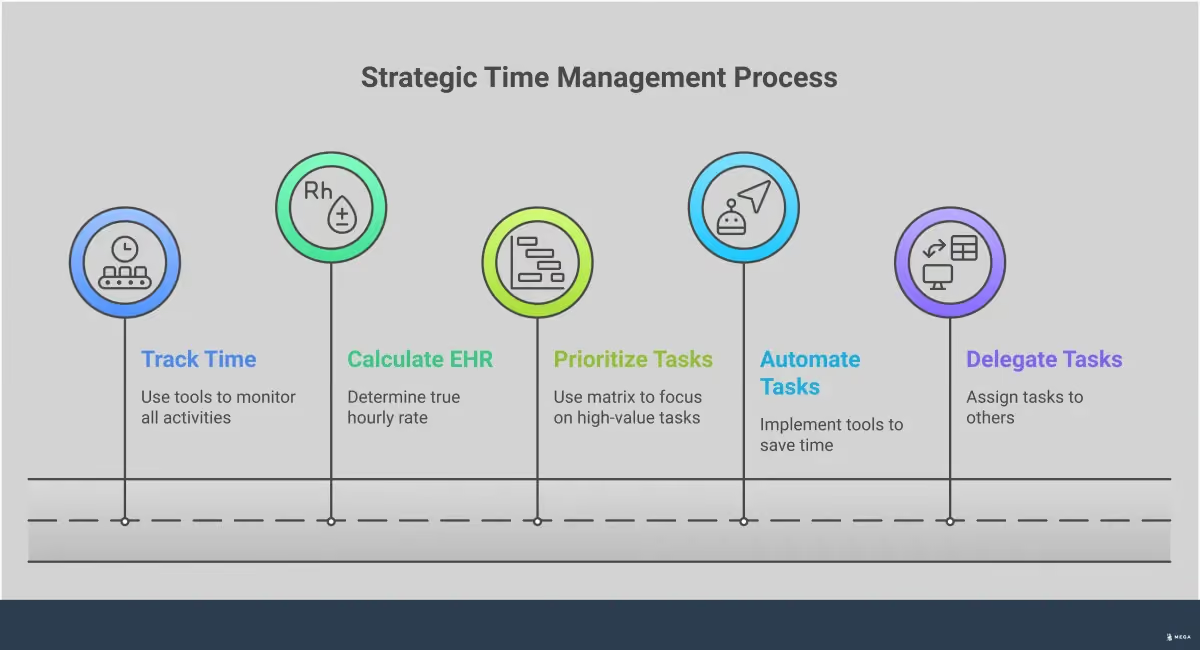
Factors That Lower Your Effective Hourly Rate
Once you have your baseline EHR, you can start to identify the silent profit killers that drag it down. These are the tasks and habits that consume your time without adding proportional value to your bottom line. Recognizing them is the first step toward plugging the leaks in your schedule and reclaiming your most valuable resource. Many of these factors are a necessary part of running a business, but if left unchecked, they can slowly erode your profitability and lead to burnout. Let's look at the most common culprits that lower your Effective Hourly Rate.
Project Scope Creep
Scope creep is the slow expansion of a project beyond its original goals, often through small, seemingly harmless requests. When a client asks for "just one more revision" or an "extra little feature," it might feel easier to agree than to push back. However, every unbilled hour you spend accommodating these requests directly lowers your EHR for that project. When a project takes more time than originally estimated, your EHR decreases. If a project was estimated to take 20 hours but ends up taking 30 for the same price, you've just cut your hourly earnings by a third. To protect your rate, it's crucial to define project boundaries clearly from the start and have a process for handling change requests that includes adjusting the budget and timeline.
Specific Unpaid Tasks
Beyond client work, a significant portion of your time is likely spent on essential but non-billable activities. As a service professional, you spend a lot of time on tasks you don't directly bill clients for. These are the operational tasks that keep your business running, from marketing and sales to bookkeeping and professional development. While you can't eliminate this work entirely, it's important to recognize that every hour spent on these tasks is an hour you're not earning direct revenue. Understanding where this time goes is critical because it highlights opportunities for automation and delegation. By minimizing the time you spend on unpaid work, you can dedicate more of your schedule to the activities that actually generate profit.
Marketing and Sales
Attracting new business is vital, but marketing and sales activities are a notorious time sink. This includes everything from writing blog posts and updating your website to managing social media accounts and answering questions from potential clients. While these efforts are an investment in future growth, they don't pay the bills today. The hours you spend on marketing are part of your total time investment, which dilutes your EHR. This is why many small business owners turn to automation. Using tools for AI-powered SEO and content generation can handle these repetitive but necessary functions, freeing you to focus on billable client work and high-level strategy.
Administrative Work
Every business comes with a mountain of administrative work. Sending invoices, chasing payments, managing your books, scheduling appointments, and organizing files are all necessary tasks that don't directly generate revenue. It's easy to spend hours each week just keeping the lights on. While these activities feel productive, every hour spent on administrative or operational work is part of your total time investment. Ignoring these tasks means you're not seeing the true cost of your revenue-generating activities. To protect your EHR, it's essential to streamline these processes as much as possible with efficient systems and administrative tools that can automate your workflow.
Professional Development
Staying current in your field is non-negotiable. Investing time in learning new skills, taking courses, or attending industry webinars allows you to offer better services and potentially charge higher rates in the future. However, these hours are unpaid and directly lower your current EHR. Think of professional development as a strategic investment rather than a direct expense. The key is to be intentional about it. Set aside a specific, limited amount of time for learning each month. This ensures you continue to grow without letting "research" become a form of procrastination that eats away at your profitable working hours.
Overtime and Benefits for Salaried Employees
If you pay yourself a fixed salary, it's easy to fall into the trap of thinking your hourly rate is set. You might calculate your pay based on a 40-hour workweek, but are you actually working 40 hours? For many entrepreneurs, the reality is closer to 50, 60, or even more. When you work overtime without adjusting your compensation, you are effectively lowering your own wage. For salaried workers, it's important to divide your annual salary by the *actual* hours worked annually, not just the standard 2,080 hours. This simple adjustment often reveals a much lower EHR than expected and underscores the importance of tracking all your time, not just the hours you think you *should* be working.
How to Identify and Prioritize High-Value Tasks
Once you know your Effective Hourly Rate, the next step is to protect it. This means focusing your time and energy on activities that meet or exceed that rate. The challenge is that your to-do list is likely a mix of high-impact projects and low-value busywork. Without a system to tell them apart, it’s easy to spend the day on tasks that keep you occupied but don’t move your business forward.
Prioritizing isn’t about working harder; it’s about applying your effort more strategically. By identifying which tasks generate the most value, you can ensure your most limited resource—your time—is invested in work that truly matters. The goal is to shift from a reactive mindset, where you tackle whatever is in front of you, to a proactive one, where you intentionally choose tasks that align with your most important goals. Here are a few practical frameworks to help you sort through the noise and focus on what counts.
Use a Value vs. Effort Matrix to Evaluate Tasks
A simple yet powerful way to organize your to-do list is with a value vs. effort matrix. This tool helps you visualize where your tasks fall on two scales: the value they bring to your business and the effort required to complete them. Draw a simple four-quadrant grid and start plotting your tasks. You’ll find they generally fall into one of four categories. By categorizing tasks this way, you can see what truly matters and what can be delegated or eliminated. This approach helps you focus on activities that yield the highest returns, making your time management more effective.
Use the RICE Method to Prioritize Projects
For more complex decisions, especially when comparing different projects, the RICE method provides a structured scoring system. RICE stands for Reach, Impact, Confidence, and Effort. This framework forces you to think critically about who a project affects (Reach), how much it will benefit them (Impact), how sure you are about your estimates (Confidence), and the resources it will consume (Effort). You can then use these factors to create a score that helps you compare opportunities more objectively. Using prioritization methods like RICE allows for a clear assessment of which projects will deliver the most value relative to the work required.
Categorize Tasks by Their Real Value
Ultimately, effective prioritization comes down to a mindset shift. It’s about learning to distinguish between being busy and being productive. Answering emails as they arrive might feel productive, but does it contribute more to your bottom line than developing a new marketing campaign or calling a high-potential lead? Focusing your energy on high-value tasks instead of endless busywork is the key to getting out from under a mountain of work. Regularly ask yourself, "Is this task worth my EHR?" If the answer is no, it’s a strong signal that the task should be delegated, automated, or dropped altogether.
How to Analyze Your EHR for Growth Opportunities
Knowing your Effective Hourly Rate is like having a compass. It tells you your current position, but its real power is in guiding where you go next. A single, business-wide EHR is a great starting point, but it’s an average. It smooths over the peaks and valleys of your daily operations. The most successful entrepreneurs learn to look deeper, breaking down their EHR to see which clients, services, and activities are driving growth and which are holding them back. This analysis isn't about finding fault; it's about finding opportunities. By dissecting your EHR, you can make data-driven decisions to optimize your business, focus your energy, and build a more profitable and sustainable company.
Calculate Your Average Charge Rate and Billable Hours
Before you can dig deeper, you need a solid benchmark. This is your overall EHR, calculated using the simple formula we discussed: total profit divided by total hours worked. This number represents the average value of every hour you invest in your business. Think of it as your baseline. Calculating your EHR doesn't require a complex spreadsheet. At its core, the formula is straightforward: divide your total earnings by the total number of hours you worked to achieve them. Once you have this number, you can start comparing specific activities against it to see how they stack up. Is that new service you launched performing above or below your average? Is your biggest client actually your most profitable on an hourly basis? This baseline is the foundation for all future analysis.
Compare Averages Across Business Segments
With your baseline EHR established, it's time to move from a wide-angle view to a close-up. Averages can be deceiving, and the real story of your business is in the details. By segmenting your EHR, you can pinpoint exactly where your time yields the highest returns. This involves calculating your EHR for different parts of your business, such as individual clients or specific service lines. This process illuminates the hidden financial dynamics of your operations, showing you which areas are true profit centers and which might be costing you more time than they're worth. It’s a crucial step in moving from simply working hard to working smart.
Analyze by Client
Not all clients are created equal, and some are more profitable for your business than others. To figure this out, track the hours you spend on each client and the revenue they generate over a specific period. Then, calculate a unique EHR for each one. You will quickly look for 'outliers': the clients who are far above or below your average EHR. For high-EHR clients, your goal is to understand what makes them so profitable and find more clients like them. For low-EHR clients, it’s time to make a decision. Can you renegotiate their rate, make your process more efficient, or is it time to part ways?
Analyze by Service Type
Just as you analyzed your clients, you should do the same for your services. Which offerings provide the best return on your time? Calculate the EHR for each service you provide by tracking the hours and profit associated with it. You might discover that a service you thought was a bestseller is actually a low-margin time sink. For example, if you offer manual SEO services, the high number of hours required might result in a low EHR. This is where you can get strategic. Can you streamline the service, raise the price, or use technology to reduce the time investment? This analysis helps you refine your offerings to focus on what’s most profitable.
Identify and Act on Outliers
Once you’ve analyzed your EHR by client and service, you’ll have a clear list of outliers. These are the data points that are much higher or lower than your average, and they are your biggest opportunities for growth. The high-EHR outliers are your blueprint for success; they show you what’s working so you can do more of it. The low-EHR outliers are your call to action. These are the tasks and projects that are draining your resources. For each one, you have three choices: fix it, delegate it, or eliminate it. For time-intensive but necessary tasks like SEO and content updates, automation is a powerful fourth option. Platforms like MEGA AI can handle these functions automatically, drastically cutting your hours and transforming a low-EHR service into a profitable one.
What to Do with Tasks That Fall Below Your EHR
Once you’ve calculated your EHR and identified which tasks fall below that rate, you face a critical decision: what do you do with them? Holding on to low-value work is a common trap for entrepreneurs, but it keeps you from focusing on the strategic activities that actually grow your business. The goal is to systematically remove these tasks from your plate so you can reinvest your time where it matters most. This process comes down to three key actions: delegating, eliminating, and understanding the true cost of your choices.
To Delegate or Eliminate? How to Decide
Low-value tasks can feel like a necessary part of running a business, but they don't all have to be your responsibility. The first step is to determine if a task is essential. If it is, the next question is whether you are the only person who can do it. For recurring work like updating website content or managing ad campaigns, the answer is almost always no. You can delegate them to others or eliminate them by hiring a freelancer, using an AI-powered tool, or training a team member. If a task isn't essential—like a report no one reads—simply stop doing it.
The Long-Term Gains of a High-Value Focus
Freeing yourself from low-EHR work isn't just about saving a few hours each week. It's about fundamentally shifting your focus toward activities that create compounding returns. Prioritizing high-impact tasks allows you to dedicate your best energy to strategic planning, building key relationships, and developing new products. Over time, this consistent focus on what truly matters leads to accelerated growth, better decision-making, and a higher overall EHR. Each hour you reinvest in high-value work builds on the last, creating momentum that is impossible to achieve when you're bogged down in administrative details.
Don't Ignore Opportunity Costs
Every time you choose to do one task, you are also choosing not to do something else. That trade-off is the opportunity cost. When you spend an afternoon on administrative work that falls below your EHR, the real cost isn't just your time; it's the high-value client call you could have made or the growth strategy you could have developed instead. Understanding opportunity cost is crucial for making smart decisions about your time. By delegating or automating tasks that are below your EHR, you aren't just buying back time. You are actively choosing to invest in higher-return activities that will increase your EHR and move your business forward.
How to Use Your EHR to Make Smarter Investments
Once you know your Effective Hourly Rate, it becomes more than just a number; it’s a powerful decision-making tool. Your EHR acts as a benchmark for every financial choice you make in your business, from buying software to hiring help. By comparing the cost of an investment to the value of the time it saves or the revenue it generates, you can move from making gut decisions to making strategic investments that systematically increase your rate and your business’s profitability. This framework helps you identify which expenses are true investments and which are simply costs.
Use Your EHR to Evaluate Software and Tools
Every tool you consider buying should be measured against your EHR. Think about a potential software subscription not in terms of its monthly fee, but in the hours it saves you. If a tool costs $100 per month and saves you five hours of work, you've effectively paid $20 per hour for that time. If your EHR is $75, that's a clear win. This is especially true for automation platforms that handle complex, time-consuming functions. For example, an AI-powered SEO agent can manage keyword research, content creation, and technical fixes, saving dozens of hours you would otherwise spend on tedious tasks or learning complex skills.
Make Hiring Decisions That Pay for Themselves
Your EHR is the clearest indicator of when it's time to delegate. Any task that can be completed by someone else for less than your EHR should be taken off your plate. This applies to hiring freelancers, part-time help, or even full-time employees. As a business owner, your goal is to be as leveraged as possible, focusing your hours on the highest-value activities that only you can do. By offloading work that falls below your EHR, you free yourself up to work on the business, not just in it. This strategic delegation is fundamental to scaling your operations and your income.
Does Your Marketing Pay Off? Calculate the ROI
Marketing is an investment, and its return should be measured by its impact on your bottom line and, by extension, your EHR. When evaluating a marketing platform or service, look beyond the initial cost and focus on the potential return on investment (ROI). A successful marketing initiative should generate more revenue without proportionally increasing your work hours, which directly increases your EHR. Platforms with transparent pricing make this calculation straightforward. You can weigh the monthly cost against the new business it brings in, ensuring your marketing spend is actively working to make your time more valuable.
Are You Making These EHR Mistakes?
Calculating your EHR is a great first step, but protecting it is an ongoing challenge. Many common entrepreneurial habits can quietly drain its value without you even noticing. When you’re focused on building a business from the ground up, it’s easy to fall into traps that feel productive but ultimately limit your earning potential. Recognizing these patterns is the key to breaking them and building a more profitable, sustainable business where your time is spent on what truly matters.
Stop Undervaluing Your Time
As a founder, it’s easy to adopt a mindset where you do everything yourself to save money. But this often leads to a critical mistake: undervaluing your own time. When you spend hours on a $20 task instead of focusing on a $200 task, you’re effectively paying yourself less. This common undervaluation can result in poor planning and inefficient workflows, as you get bogged down in administrative or technical work that doesn’t align with your core strengths. To counter this, assign a real, non-negotiable value to your hour. Use your target EHR as a filter to decide if a task is worth your personal attention or if it should be delegated or automated.
The Trap of Too Many Low-Paying Projects
When you’re starting out, the pressure to build a portfolio and generate cash flow can lead you to accept any project that comes your way. While this can provide initial momentum, a schedule filled with low-paying projects becomes a trap. It leaves no room for higher-value opportunities that could significantly increase your EHR. Being busy isn’t the same as being profitable. This practice spreads your resources thin and prevents you from focusing on the clients and projects that will truly move your business forward. Be selective and have the confidence to pursue work that meets your target rate. It’s better to have fewer, high-quality clients than a roster of low-margin ones.
Don't Ignore the Cost of a Learning Curve
The do-it-yourself spirit is a hallmark of entrepreneurship, but it has its limits. Every new skill, from bookkeeping to digital marketing, comes with a steep learning curve. The hours you spend becoming a novice at a non-essential task are hours you’re not spending in your zone of genius. For example, spending 30 hours trying to master the technical side of SEO is time you could have spent closing two new clients. The opportunity cost is immense. Be strategic about the skills you choose to develop. If a task isn't central to your unique value proposition, consider outsourcing it to an expert or using a specialized tool. Your EHR will thank you.
Can Marketing Automation Increase Your EHR?
Once you know your Effective Hourly Rate, you can start making strategic decisions about where to invest your time and money. Marketing automation is one of the most direct ways to influence your EHR because it tackles both sides of the equation: it reduces the hours you spend on low-value tasks and improves the quality of your output, which helps increase your earnings.
Instead of spending hours on keyword research, writing blog posts, or managing ad campaigns, you can offload these responsibilities to an automated system. This frees you up to focus on the high-value work that only you can do, like building client relationships, developing new products, or refining your business strategy. Think of it less as a software expense and more as an investment in buying back your most valuable asset: your time.
Save Time with AI-Powered SEO and Paid Ads
Effective SEO and paid advertising campaigns require constant attention. From keyword research and content creation to technical audits and budget management, these tasks can easily consume dozens of hours each month. This is precisely the kind of repetitive, time-intensive work that lowers your EHR. Marketing automation platforms handle these tasks for you. For example, an AI-powered SEO agent can generate articles, fix technical issues, and build a backlink strategy without your direct involvement.
Similarly, an automated system can optimize ad campaigns for better targeting and cost savings, managing bids and testing creatives around the clock. By handing these functions over to an AI agent, you reclaim valuable hours that you can redirect toward activities that generate more revenue, directly increasing your EHR.
How Better Quality Work Scales Your Impact
Beyond saving time, marketing automation also improves the quality and scale of your efforts. An AI system can analyze billions of data points to identify patterns and opportunities that a human would likely miss. This leads to more precise audience targeting, more relevant messaging, and ultimately, higher conversion rates. The result is that every dollar and hour you invest in marketing produces a greater return.
For instance, AI can uncover previously overlooked customer segments, opening up new avenues for growth that you might not have discovered otherwise. This improvement in quality means your marketing isn't just running on its own; it's running more effectively. This scales your impact far beyond what you could achieve manually, increasing the "total earnings" part of your EHR calculation.
How to Calculate the True ROI of Marketing Automation
To see the true return on investment of automation, you need to look beyond the monthly subscription fee. The real calculation involves quantifying the value of your reclaimed time and the increased revenue from more effective campaigns. Start by estimating the hours you currently spend on marketing tasks each month and multiply that by your target EHR. This number represents the value of the time you get back.
Next, look at the performance improvements. AI-powered marketing automation has transformed e-commerce strategies by creating more efficient campaigns. When you see higher traffic, more leads, or increased sales, that additional revenue is a direct return from the platform's higher-quality output. By combining the value of your saved time with the new revenue generated, you get a clear picture of how automation is a powerful lever for increasing your EHR.
Proven Strategies to Increase Your Effective Hourly Rate
Once you have a clear picture of your current EHR, you can start making strategic moves to improve it. Increasing your effective hourly rate isn't about working longer hours; it's about making the hours you do work more valuable. It comes down to a combination of earning more for your time, spending less time on low-value work, and focusing your energy where it matters most. The following strategies are proven ways to do just that, helping you build a more profitable and sustainable business.
Raise Your Prices Without Losing Clients
Calculating your price based on your EHR helps you set a rate that reflects the true value of your time and expertise. If your current EHR is lower than you’d like, it might be a sign that your prices are too low. Raising your rates can feel intimidating, but clients who value your results will understand. The key is to clearly communicate the value you deliver. Focus on the outcomes you provide, not just the hours you put in. When you can demonstrate exceptional value, you can justify premium pricing without alienating your best clients.
Streamline Your Processes for Better Efficiency
Your EHR is a direct ratio of profit to hours worked. To increase it, you can either increase your profit or decrease your hours. Streamlining your internal processes is one of the most effective ways to tackle the second part of that equation. By creating standard operating procedures (SOPs), using templates for repeatable tasks, and adopting automation, you reduce the time spent on administrative and low-value work. This frees you up to focus on the activities that actually grow your business. A more efficient business allows you to serve clients better and make more strategic decisions.
The Impact of Small Improvements
You don’t need to overhaul your entire business to see a meaningful change in your EHR. Small, consistent improvements in your daily operations can compound over time, freeing up hours you can reinvest in high-value work. Start by creating standard operating procedures (SOPs) and using templates for repeatable tasks like client proposals or email responses. Adopting automation is another powerful lever. By using tools to automate time-consuming but necessary functions like marketing or administrative work, you systematically reduce the hours spent on activities that fall below your EHR, making your business more efficient and profitable.
Rethink Your Pricing with Alternative Strategies
If your EHR is consistently lower than your target, it may be time to look beyond hourly billing. While simple, charging by the hour can limit your earning potential to the number of hours in a day and often fails to capture the true value of your expertise. Alternative models, such as project-based fees or value-based pricing, shift the focus from your time to the results you deliver. Calculating your price based on your EHR helps you set a rate that reflects the true value of your time and expertise, but pricing based on the outcome you create for a client allows you to share in the success you help them achieve.
This shift in pricing fundamentally changes the client relationship for the better. Instead of being seen as a clock-punching vendor, you become a strategic partner invested in their success. It moves the conversation away from "how many hours will this take?" to "what is the best way to achieve this outcome?". This alignment of goals can lead to more collaborative and trusting partnerships. Adopting a value-based pricing model also forces you to get crystal clear on the tangible results you provide, which in turn makes your marketing and sales efforts more effective.
Offer Service Packages
One of the most effective ways to move away from hourly billing is to offer service packages. Instead of itemizing every task, you can bundle your services into tiered offerings with clear deliverables and a flat fee. This approach ensures you get paid for everything you do, including the often-unbilled time spent on emails, prep work, and strategy calls. By offering packages that include extra support, you ensure you are compensated for your full contribution. This model provides clients with transparent, predictable pricing, which simplifies their buying decision, while also making your revenue more consistent and protecting your EHR from the hidden costs of client management.
Prioritize High-Impact Activities
Many entrepreneurs fall into the trap of being busy rather than productive. To increase your EHR, you must learn to distinguish between the two. Prioritizing high-impact tasks means concentrating your efforts on the activities that yield the greatest results for your business. This could be sales, product development, or high-level strategy. Getting bogged down in low-value busywork is a quick way to lower your EHR. By identifying and focusing your energy on what truly moves the needle, you make every hour you work more valuable and impactful.