
The immediate benefits of AI, like saving time and money, are clear. But the real, long-term advantage lies in your data. Every campaign you run and every piece of content you publish generates insights for an AI system to learn from. This is why early AI adoption is so critical. It starts this learning cycle sooner, creating a compounding advantage that becomes nearly impossible for competitors to catch. This isn't just about having more data. It's about building a proprietary intelligence engine that continuously refines your strategy and widens your competitive lead.
Key Takeaways
- Automate marketing to move faster than competitors: AI agents handle the repetitive work of SEO and paid ads, freeing your team to focus on growth and giving you a critical head start in the market.
- Achieve agency-level results on a predictable budget: Replace expensive and unpredictable agency fees with a subscription-based AI platform that delivers sophisticated marketing execution at a fraction of the cost.
- Maintain strategic oversight while automating tasks: Choose AI tools with built-in approval workflows. This hybrid approach allows you to benefit from automation's speed while ensuring every action aligns with your business goals.
What Is Early AI Adoption and Why Should You Care?
Adopting AI isn't about chasing the latest tech trend. It's a strategic move that redefines how your business operates, competes, and grows. For small and local businesses, early AI adoption means leveling the playing field, allowing you to achieve results that were once only possible for large corporations with huge teams and budgets. It’s about automating the repetitive, time-consuming tasks that bog you down so you can focus on what truly matters—serving your customers and scaling your operations.
Think of it this way: AI-powered automation can increase productivity by up to 40%. That’s not a small improvement. It’s the equivalent of adding a highly efficient team member who works 24/7 on keyword research, content creation, and ad optimization without ever needing a coffee break. By integrating AI into your marketing, you’re not just saving time; you’re building a more resilient business. AI helps you address challenges like labor shortages and rising operational costs by handling complex work autonomously. This shift allows you to move faster, make smarter, data-driven decisions, and secure a lasting competitive advantage in your market.
A Brief History of AI in Business
Artificial intelligence is what experts call a "General Purpose Technology," which is a fancy way of saying it can be used in many different ways across almost every industry. Think about how the internet or electricity changed the world—they weren't just for one specific task; they became the foundation for countless new innovations. AI is having a similar impact. According to research from Wharton, its versatility allows it to transform various jobs and business functions, from marketing to operations. Companies that recognized this early and began integrating AI are already seeing significant returns, not just in efficiency but in revenue growth and employee happiness.
The Shift from AI Curiosity to ROI
The conversation around AI in business has changed dramatically. Just a short while ago, leaders were curious; now, they're committed. The number of business leaders who use generative AI weekly nearly doubled in the last year alone. This rapid adoption shows that the focus has moved from simply understanding AI to actively using it to generate a return on investment (ROI). And that return isn't just financial. Companies leading in AI adoption also have higher employee satisfaction and retention. The biggest challenge for many businesses is overcoming old routines, but the data is clear: the rewards for making the switch are too significant to ignore.
Why Moving Faster Than Your Competitors Matters
In business, timing can be everything. When a new technology emerges that fundamentally changes how work gets done, being an early adopter is a strategic move. Artificial intelligence is that technology. For small and local businesses, AI isn't a futuristic concept reserved for large corporations; it's a practical tool that levels the playing field, allowing you to operate with the speed and efficiency of a much larger team.
Adopting AI early means you start learning and adapting before the market becomes saturated with AI-driven competitors. It allows you to build a foundation of data, refine your processes, and establish a lead that others will have to work hard to catch. While your competitors are still figuring out their strategy, you can be executing yours, capturing customer attention, and solidifying your market position. The window of opportunity to gain this first-mover advantage is open now, but it won't stay open forever.
The Growing Gap Between AI Leaders and Followers
A clear difference is emerging between businesses that actively integrate AI and those that wait on the sidelines. Organizations that use AI early, often called "AI leaders," view the technology as a core part of their strategy for growth and efficiency. On the other hand, "AI followers" tend to see it as less important or something to consider later. This creates a widening competitive gap that goes beyond just technology. It reflects a fundamental difference in mindset. AI leaders are building momentum by continuously learning from their data and refining their operations, making it increasingly difficult for followers to catch up.
The Impact on Revenue and Employee Retention
This growing divide has a direct effect on the bottom line. A recent study found that 70% of AI leaders expect AI to increase their company's income in the next year, compared to just 19% of AI followers. The impact also extends to team stability. The same study showed that 68% of employees at AI-leading companies plan to stay in their jobs, while only 48% at follower companies say the same. When AI platforms automate repetitive work like keyword research and ad management, it frees your team to focus on more strategic and fulfilling tasks. This not only improves productivity but also creates a more engaging work environment, which is key to retaining valuable employees.
What's the Real Cost of Waiting?
The decision to wait on AI adoption isn't a neutral one. While it might feel safer to see how things play out, the reality is that standing still means falling behind. If you're not using AI, your competitors will likely outproduce you and operate more efficiently. The cost of waiting is measured in lost opportunities, higher operational expenses, and shrinking market share.
Companies that delay AI adoption often find themselves in a difficult game of catch-up, struggling with outdated processes while their forward-thinking peers have already optimized their workflows. This isn't just a hypothetical risk. Businesses that are slow to embrace new technology often face higher costs and lose ground to those who moved first. The real cost of waiting is the competitive edge you give away.
Gain a First-Mover Advantage with AI
Acting now gives your business a significant head start. Early AI adoption allows you to innovate faster, streamline your operations, and set new standards in your industry. For small businesses, this is a powerful way to compete. By implementing AI tools strategically, you can achieve measurable competitive advantages that were once out of reach.
Consider the impact on productivity. AI-powered automation can increase output by up to 40%, a massive gain for any business. With autonomous tools like MEGA AI's SEO and Paid Ads agents, you can execute complex marketing campaigns at a speed that manual processes simply can't match. Securing this first-mover advantage means building a more resilient, efficient, and competitive business for the future.
How Can AI Reshape Your Business Operations?
Adopting AI is more than just adding another tool to your tech stack. It’s about fundamentally changing how your business operates. Instead of spending hours on manual, repetitive marketing tasks, you can delegate them to an intelligent system that works around the clock. This shift frees you and your team to focus on what truly matters: strategy, customer relationships, and big-picture growth. AI agents can handle the day-to-day execution, learn from performance data, and scale your efforts across every platform you use.
Automate Manual Work and Focus on Strategy
Many small business owners find themselves bogged down by the daily grind of marketing—writing ad copy, researching keywords, or updating website content. AI transforms this dynamic by introducing autonomous execution. Instead of you manually performing each task, an AI agent can develop a strategy and carry out the necessary steps independently. This is a significant step up from simple automation tools. As the U.S. Chamber of Commerce notes, AI can automate tasks and create marketing content, allowing your team to focus on higher-value work. This means less time spent on tedious execution and more time dedicated to strategic planning and innovation.
Let AI Learn and Optimize for You
One of the most powerful aspects of AI is its ability to learn and improve over time. Unlike a static marketing plan, an AI-driven strategy adapts based on real-world performance data. For example, MEGA AI’s systems are trained on hundreds of millions of data points, allowing them to identify patterns and optimization opportunities that a human might miss. This continuous learning loop means your campaigns get smarter and more effective with each passing day. According to the Bipartisan Policy Center, over 80% of small business owners using AI have seen its value in improving systems and increasing efficiencies, leading to a significant competitive edge.
Integrate AI to Scale Your Operations
For a small business, managing a presence across multiple platforms can be overwhelming. AI solves this by integrating with your existing tools and scaling your efforts seamlessly. An AI agent can connect to your CMS to publish SEO content, link to your ad accounts to manage campaigns on Google and Meta, and ensure your messaging is consistent everywhere. This centralized approach breaks down operational silos and makes scaling feel effortless. With AI handling the cross-platform execution, your team can redirect resources toward new investments and growth opportunities, confident that your marketing foundation is solid and scalable.
What Are the Financial Benefits of Adopting AI Early?
Adopting AI is more than a tech upgrade; it's a strategic financial move. For small businesses and startups where every dollar is scrutinized, integrating AI early can directly impact your bottom line. It fundamentally changes how you allocate resources, measure performance, and plan for growth, turning marketing from a cost center into a predictable revenue driver. The primary financial benefits come from reducing overhead, increasing your team's output without adding headcount, and stabilizing your monthly expenses. This allows you to plan with confidence and reinvest savings back into your business. Instead of wrestling with unpredictable agency fees or the hidden costs of manual work, AI offers a clear path to measurable ROI. It automates the repetitive tasks that drain your budget and empowers your team to focus on high-value activities. By leveraging AI, you can achieve a level of marketing sophistication that was once only available to large corporations, all while maintaining strict control over your spending. This shift not only saves money in the short term but also builds a more resilient and scalable financial foundation for the future.
Get Agency-Level Results Without the Agency Price Tag
Hiring a marketing agency is a significant expense, often running into tens of thousands of dollars per month. AI platforms offer a powerful alternative, delivering sophisticated marketing execution without the high price tag. For example, MEGA AI provides the equivalent of a $20,000/month agency service for a fraction of the cost. This makes high-level SEO and paid advertising accessible to businesses that previously couldn't afford it. You get access to data-driven strategies and automated campaigns that drive real growth, allowing you to compete with larger players on a more level field.
Streamline Operations and Cut Costs
AI-powered automation can increase productivity by handling time-consuming tasks like keyword research, content creation, and ad optimization. This frees up your team to focus on strategic initiatives that require a human touch, such as building customer relationships or developing new products. With over 80% of small business owners seeing value from AI in their operations, the impact is clear. By automating repetitive marketing work, you reduce the hours needed to run campaigns, which translates directly into lower labor costs and a more efficient, focused team.
Create a More Predictable Budget
One of the biggest challenges for small businesses is managing fluctuating costs. Marketing agencies and freelancers often come with variable fees that make budgeting difficult. AI platforms typically operate on a subscription model, giving you a fixed, predictable monthly expense. This stability helps you manage cash flow and address economic challenges like inflation more effectively. Knowing exactly what your marketing execution will cost each month allows for better financial planning and frees up capital to reinvest in other critical areas of your business, from inventory to product development.
Why Data Gives Early AI Adopters a Long-Term Advantage
One of the most significant, long-term benefits of adopting AI early is the data advantage. Every interaction, campaign, and customer query becomes a data point that your AI systems can learn from. This creates a powerful feedback loop: the more you use AI, the more data it gathers, and the smarter it becomes at serving your specific business needs. Over time, this builds a competitive moat based on proprietary insights that your competitors cannot replicate.
While starting with a powerful AI model is crucial—MEGA AI’s platform is built on proprietary models trained on over 450 million Google Search data points and one billion advertising data points—the real magic happens when that technology starts learning from your unique business environment. Early adopters begin this learning process sooner, allowing their AI to refine its understanding of their customers, market, and operations. This creates a cycle of continuous improvement that widens the gap between you and the competition with each passing day. This isn't just about having more data; it's about having smarter data that translates directly into better business decisions, more effective marketing campaigns, and a deeper understanding of what your customers truly want. The longer you wait, the more ground you cede to competitors who are already building this intelligent foundation.
Turn Your Business Data into Actionable Insights
Early AI adoption gives you the ability to uncover valuable patterns hidden within your own business data. For example, a small e-commerce retailer can use an AI-powered engine to learn which product recommendations are most effective for different customer segments. By using AI for tasks like SEO optimization and content generation, businesses can dramatically increase their production capacity while tailoring their output to what the data shows is working.
This is how MEGA AI’s agents operate. Lindsay, our SEO agent, doesn’t just write articles; she analyzes their performance and learns which topics and keywords drive the most qualified traffic for you. Erle, our Paid Ads agent, tests hundreds of creative variations to find the messaging that resonates most with your audience, continuously refining its approach based on real-world results.
Build a Smarter AI with Compounding Data
The improvements from AI aren't just incremental; they're compounding. As your AI model processes more of your data, its performance gets better at an accelerating rate. This creates a snowball effect where your operational efficiency and marketing effectiveness grow exponentially over time. Research shows that AI-powered automation can increase productivity by up to 40%, giving small businesses a significant competitive edge.
This is why waiting to adopt AI is so risky. While you stand still, early adopters are building smarter, more efficient systems. The performance gap widens daily, making it increasingly difficult to catch up. As small businesses continue to leverage AI and see these benefits, the pressure to adapt will only grow. Starting now ensures you benefit from this compounding growth rather than trying to overcome it later.
What Are the Common Challenges of AI Adoption?
Adopting any new technology comes with a learning curve, and AI is no different. While the competitive advantages are clear, it’s practical to anticipate the hurdles you might encounter. Understanding these potential challenges helps you create a smarter implementation strategy and choose the right tools for your business. Most issues fall into three main categories: resource limitations, technical complexity, and security concerns.
Successfully addressing these areas is key to a smooth transition. The goal isn’t to avoid challenges entirely but to be prepared for them. By knowing what to expect, you can select AI solutions designed to minimize these very issues, especially for small businesses where time and resources are at a premium. Let’s look at each of these challenges more closely.
Limited Budgets and Technical Expertise
Many businesses struggle with the initial steps of AI adoption because they lack the necessary in-house expertise. Developing effective AI solutions often runs into roadblocks like poor data quality issues, a shortage of available tech talent, and the general complexity of integrating new tools. For a small business, hiring a data scientist or an AI specialist is usually not feasible. This talent gap can make it feel like powerful AI tools are reserved for large corporations with deep pockets, leaving smaller players to figure things out on their own.
Managing Complex Integrations and Team Buy-In
Getting a new AI system to work with your existing software can be a significant technical challenge. To be effective, businesses often need to create hybrid models that connect their current systems with new AI infrastructure. This process can be complicated and time-consuming. Beyond the technical aspect, there’s also the human element. Teams get used to their established workflows, and introducing a new, automated way of doing things can be met with hesitation. Overcoming this resistance from teams is crucial for any new technology to be adopted successfully.
Addressing Data Privacy and Security Concerns
AI systems often need access to sensitive information to do their job well, from customer data to financial performance metrics. This naturally brings up valid concerns about data privacy and security. Handing over access to your company’s core data requires a high level of trust in the AI provider and their security measures. Many organizations find it difficult to build a culture that embraces innovation while also managing these critical data privacy and security risks. Ensuring your data and your customers’ data are protected is a foundational step that can’t be overlooked.
Organizational Resistance and Adjustment Costs
It’s human nature to stick with what’s familiar. Many businesses operate on established routines, and the idea of introducing a new system can be met with the classic "but this is how we've always done it" mindset. This resistance isn't just about being stubborn; it's rooted in the real costs of change. Transitioning to AI requires an investment of both time and money. You have to consider the resources needed to train your team, the potential for temporary disruptions as workflows are adjusted, and the financial cost of the new technology itself. As researchers from MIT Sloan point out, companies often stick to old routines, which makes it hard to adopt new technology. This is why choosing an AI platform designed for simplicity and ease of use is so important. The right tool minimizes these adjustment costs by integrating smoothly into your business, not by forcing you to rebuild it from the ground up.
Concerns About AI Reliability and Overreach
The headlines around AI can be confusing, swinging from promises of a business revolution to warnings about uncontrollable technology. This leaves many business owners with two valid concerns: "Will it actually work?" and "Will I lose control?" On one hand, there's the fear that AI will make mistakes or produce low-quality work that you'll have to fix. Research from Wharton suggests that while useful, generative AI isn't seen as a tool that can transform all parts of a business just yet. On the other hand, there's the fear of AI overreach—that an automated system might make decisions that don't align with your brand or strategy. The best way to address both issues is to choose AI tools that keep you in the driver's seat. Look for platforms that offer approval workflows, allowing you to review and sign off on AI-generated content and campaigns before they go live. This hybrid approach gives you the speed of automation without sacrificing strategic control.
How to Overcome Common AI Adoption Hurdles
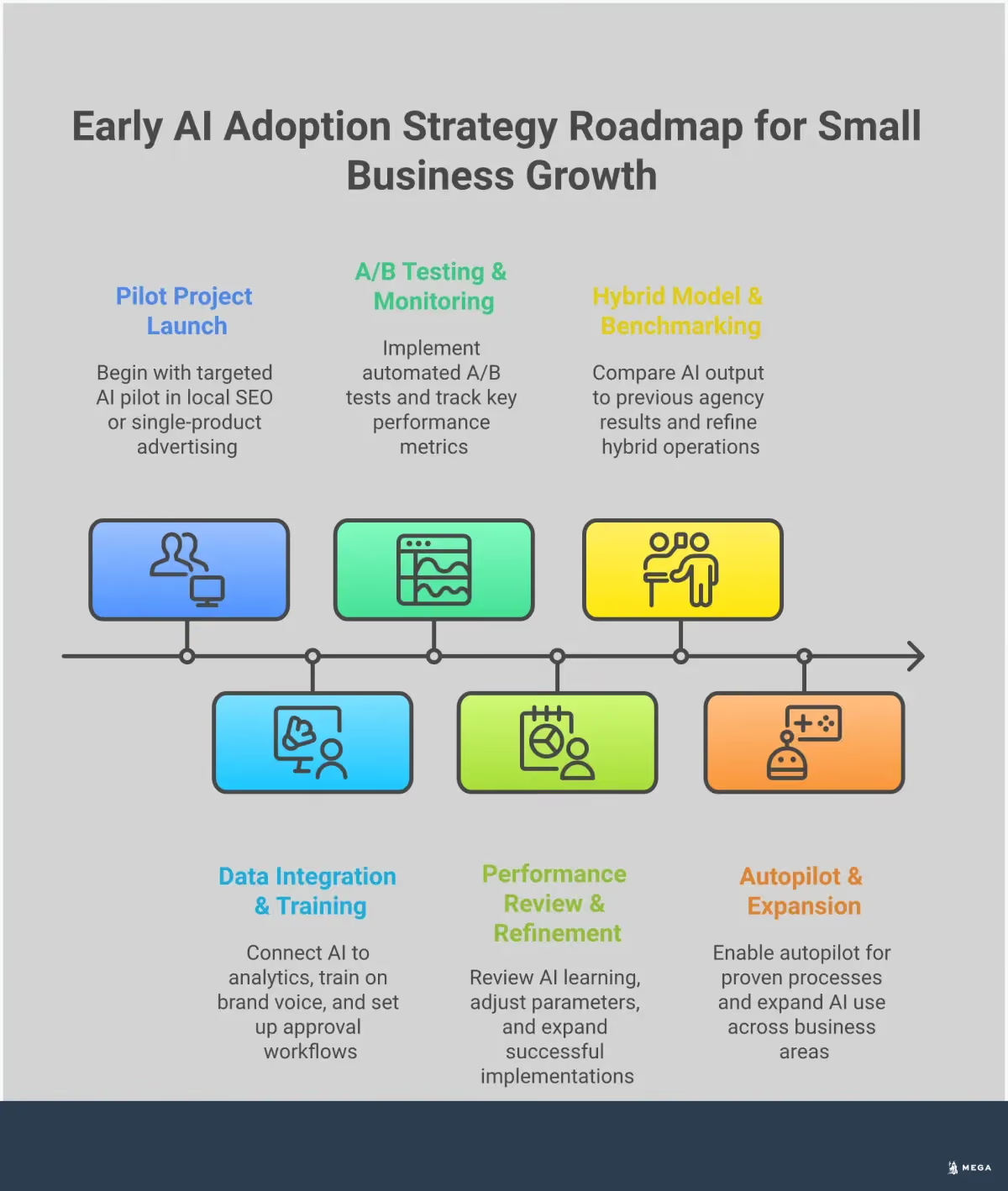
Adopting new technology often comes with a learning curve, and AI is no exception. Concerns about budget, technical skills, and team buy-in are valid. However, these hurdles are not roadblocks. With a strategic approach, you can integrate AI smoothly and start seeing the benefits without disrupting your entire operation. The key is to start smart, choose the right tools, and bring your team along with you.
Start Small with a Pilot Project
You don’t need to overhaul your entire business strategy overnight. Instead, identify one specific, high-impact area where AI can make a difference. For example, a small e-commerce business could begin by using an AI tool to optimize product descriptions for a single category or run a targeted ad campaign for one new product. This pilot project approach allows you to test the technology in a controlled environment, measure the results, and build a case for wider adoption. It minimizes risk and gives your team a chance to learn without feeling overwhelmed by a massive, company-wide change.
Choose AI Solutions That Are Easy to Use
The best AI tool is one your team will actually use. You shouldn't need a data science degree to get results. Look for platforms that prioritize ease of use with intuitive dashboards and clear workflows. Solutions that offer autonomous agents, like MEGA AI’s SEO and Paid Ads agents, handle the technical complexity behind the scenes. This allows you to focus on your business goals, not on wrestling with complicated software. When you select user-friendly AI solutions, you lower the barrier to entry and empower your team to get started right away.
Invest in Training to Build Your Team’s Confidence
Resistance to new technology often stems from a fear of the unknown. Address this head-on by investing in training and establishing clear guidelines. This doesn’t mean everyone needs to become an expert in prompt engineering. Instead, focus on practical training that shows your team how the tool works and how it will make their jobs easier. It's crucial to define approved use cases and review processes to address any concerns about data or quality control. By setting clear boundaries and providing support, you can avoid common AI adoption challenges and build the confidence your team needs to embrace the change.
How to Build Trust Between Your Team and AI
Adopting new technology often feels like a leap of faith, especially when it involves automation. Handing over important marketing tasks to an AI agent might seem like you’re giving up control. However, the goal of AI isn't to replace your team's strategic input but to handle the repetitive, time-consuming work so your team can focus on the bigger picture. Building trust starts with choosing tools that are designed for collaboration between humans and AI.
The most effective AI platforms operate on a principle of transparency and partnership. They aren't black boxes that make decisions without your input. Instead, they provide clear insights into their strategy and give you the final say. For example, MEGA AI’s agents don't just execute tasks blindly. They develop a strategy for your SEO or paid ads, and you can choose how involved you want to be. This hybrid model, combining autonomous execution with human oversight, is key to building confidence. It ensures the AI aligns with your business goals while freeing up your team from the manual grind.
Keep Your Team in Control of Automation
A true partnership with AI means you never have to give up the driver's seat. While AI can improve efficiency, it's crucial to maintain oversight to ensure every action aligns with your strategic goals. The best platforms are built with this in mind, offering features that let you review and approve work before it goes live. For instance, you can have AI-generated articles saved as drafts in your CMS, giving your team a chance to edit and approve them. This approach ensures quality and brand consistency while still benefiting from the speed of automation. This level of control over AI implementations helps your team feel confident in the technology because they understand how decisions are made and have the final word.
Implement Approval Workflows for Key Decisions
Approval workflows are a practical way to manage AI-driven tasks and build trust within your team. By integrating a review step, you ensure that AI-generated content or campaign changes are vetted by a human before they impact your business. This is especially important when you're just starting out. You can begin with a hands-on approach, reviewing every action the AI takes. As your team sees the quality and consistency of the AI's work, you can gradually move toward more autonomy. Platforms like MEGA AI allow you to turn "Autopilot" on or off, giving you the flexibility to choose your level of involvement. This ability to integrate approval processes allows you to maintain strategic oversight while empowering your team to embrace automation securely.
Which Businesses Benefit Most from Early AI Adoption?
While any business can find value in AI, certain types are uniquely positioned to see a significant return by adopting it early. These are typically organizations where resources like time, budget, and specialized staff are at a premium. For them, AI isn't just a helpful tool; it's a fundamental shift that levels the playing field and makes sustainable growth possible.
Autonomous platforms like MEGA AI are designed for these exact scenarios, providing the power of an expert marketing team without the associated overhead. By handling the complex, time-consuming work of SEO and paid ads, AI agents free up business owners and small teams to focus on what they do best: running their business.
Why Startups and Small Teams See Big Returns
Startups operate on a simple formula: achieve maximum growth with minimal resources. This is where AI offers a distinct advantage. You no longer need a massive budget or a dedicated marketing department to compete. Instead of manually researching keywords or tweaking ad campaigns, an AI agent can execute these tasks autonomously, acting as a force multiplier for a small team.
Early AI adoption gives these businesses a strong competitive edge, helping them innovate and scale faster. By using AI for content generation, SEO optimization, and campaign management, startups can dramatically increase their output and reach. This allows them to build a strong online presence and generate leads while the founding team focuses on product development and customer relationships.
How Local Businesses and SMBs Can Compete
For local businesses and SMBs, the biggest challenge is often juggling daily operations with the need to attract new customers. AI-powered automation can increase productivity significantly, giving these businesses a way to grow without burning out. A recent survey found that 82% of small business owners saw enhanced operational efficiency after implementing AI.
Tools like MEGA AI’s autonomous agents handle the persistent work of marketing. They can optimize your website for local search terms, manage your Google Ads to attract nearby customers, and update your content to keep it relevant. This frees you from the marketing grind and allows you to focus on serving your clients. By empowering small businesses to automate complex tasks, AI makes it possible to achieve steady growth under any market condition.
AI Adoption Trends by Company Size and Industry
The data on AI adoption reveals a clear trend: larger companies are currently leading the way. Research from MIT shows that while over 60% of companies with more than 10,000 employees use AI, adoption varies widely by industry. For example, sectors like manufacturing and information services are moving faster than retail and construction, where only about 4% of companies have integrated AI. For a small business, these figures highlight a significant opportunity. The slower pace in certain industries creates a window to gain a first-mover advantage. As AI becomes more accessible, it levels the playing field, allowing smaller businesses to implement powerful tools and compete effectively, regardless of their size or industry.
Your First Steps in Adopting AI
Getting started with AI doesn’t require a data science degree or a massive budget. The key is to focus on practical tools that solve real business problems. For most small businesses, that means finding solutions that save time, reduce costs, and drive growth. Instead of getting caught up in the hype, think about your biggest operational bottlenecks. Are you spending too much time on marketing tasks? Are you struggling to compete with larger companies online?
Your AI journey should begin with a clear goal. Maybe you want to automate your content creation to rank higher on Google, or perhaps you need to optimize your ad spend without hiring an expensive agency. By defining the problem first, you can look for AI-powered tools designed to execute specific functions, moving you from manual effort to automated results.
Identify the AI Features You Actually Need
When evaluating AI tools, focus on the features that will make the biggest impact on your daily operations. Early AI adoption gives businesses a strong competitive edge, but only if the technology aligns with your goals. Look for platforms that offer end-to-end automation for critical functions like SEO or paid advertising. For example, an AI agent that can handle everything from keyword research and content generation to technical optimization saves you from juggling multiple tools. Prioritize solutions that not only provide insights but also execute the work, freeing you up to focus on running your business.
How to Plan Your AI Budget and Timeline
For many small businesses, cost is a significant barrier to adopting new technology. However, it’s more helpful to view AI as an investment rather than an expense. The right tools can help you address challenges like inflation and labor shortages by improving efficiency and driving revenue. Start by setting a realistic budget. Look for platforms with transparent, subscription-based pricing that fits within your monthly operational costs. This model provides predictable spending, unlike the variable retainers of traditional agencies. A good AI partner should deliver measurable value that far outweighs its cost, making it a strategic investment in your company’s growth.