
You’ve heard the mantra “content is king” so many times it’s become an absolute truth. While it’s not wrong, it is dangerously incomplete. Believing that simply creating the best article is enough to win is why so many marketers experience Difficulty ranking with good content. The reality is that content is just one member of the royal court. Authority is the queen, technical SEO is the castle guard, and user experience is the loyal advisor. Without the support of the entire court, even the most powerful king can’t rule the search results. This article moves beyond the simple mantra to give you the complete picture of what it takes to compete for tough keywords.
Key Takeaways
- Prioritize keywords you can actually win: While high-quality content is essential, it can't overcome high keyword difficulty on its own. Focus on attainable keywords to build your site's authority before you take on more competitive terms.
- Build a strong foundation for your content: To compete for difficult keywords, your website needs more than just great articles. A complete strategy includes earning quality backlinks, organizing content into topic clusters, and maintaining solid technical SEO to signal authority to search engines.
- Outsmart the competition with a targeted approach: Instead of writing one-off articles, focus on a repeatable process. Identify specific long-tail keywords, create content that is more comprehensive than what's currently ranking, and regularly update your articles to maintain their edge.
What Are Keyword Difficulty and Content Quality?
When you're building an SEO strategy, two terms you'll hear constantly are "keyword difficulty" and "content quality." Understanding the difference—and the relationship—between them is the first step toward ranking for terms that matter to your business. Think of it this way: keyword difficulty tells you how crowded the playing field is, while content quality determines how well you can play the game.
Keyword difficulty is an SEO metric that estimates how hard it is to rank on the first page of Google for a specific search term. It’s a measure of competition. A high difficulty score suggests you’ll be up against websites with strong domain authority, a lot of high-quality backlinks, and well-established content. It’s like trying to open a coffee shop on a street already lined with popular, established cafés. You can find this metric in most SEO tools, and it helps you gauge the effort required to see results.
Content quality, on the other hand, is about how well your page satisfies a user's search. High-quality content is comprehensive, accurate, easy to read, and directly addresses the search intent behind the keyword. It’s not just about writing a long article; it’s about creating the best possible resource for someone searching that term. While keyword difficulty is a measure of external competition, content quality is something you have direct control over. The two are linked because you need exceptional content to even have a chance at ranking for a difficult keyword. But as we'll see, even the best content can struggle to rank if the competition is too fierce.
Why Great Content Isn't Enough to Rank
You’ve probably heard the phrase “content is king” a thousand times. While high-quality content is absolutely essential for SEO, it’s only one piece of a much larger puzzle. Publishing a brilliant article on a website with low authority is like performing a masterpiece in an empty theater. Without an audience or a strong reputation, even the best performance goes unnoticed. Search engines consider many factors when deciding which page deserves the top spot, and your content’s quality is just the beginning of the evaluation.
Search engines aim to deliver the most authoritative and trustworthy results. This means they look beyond the words on the page to assess your website's overall credibility. Factors like your site's domain authority, the quality and quantity of your backlink profile, and the level of competition for your target keyword all play a significant role. If you’re a new website targeting a keyword dominated by established industry giants, your content will struggle to rank, no matter how well-written it is.
This is why a comprehensive approach is so important. Success in SEO requires more than just being a great writer; it requires being a great strategist. You need to analyze the competitive landscape, build your site’s authority over time, and ensure your technical SEO is sound. Real-world SEO case studies consistently show that success comes from a combination of tactics, including content optimization, link building, and technical improvements. Your content needs this strategic foundation to compete effectively and earn the visibility it deserves.
How to Create Content That Competes for Difficult Keywords
When you're up against established players for high-difficulty keywords, simply writing "good content" won't cut it. You need to create content that is demonstrably better, more comprehensive, and more helpful than what’s already ranking. This means moving beyond basic on-page SEO and adopting a more strategic approach to content creation. It’s about building an asset that not only answers a user's query but also provides an exceptional experience. Let's walk through the key tactics that will help your content stand out and start climbing the search results, even in the most competitive landscapes.
Conduct Comprehensive Research
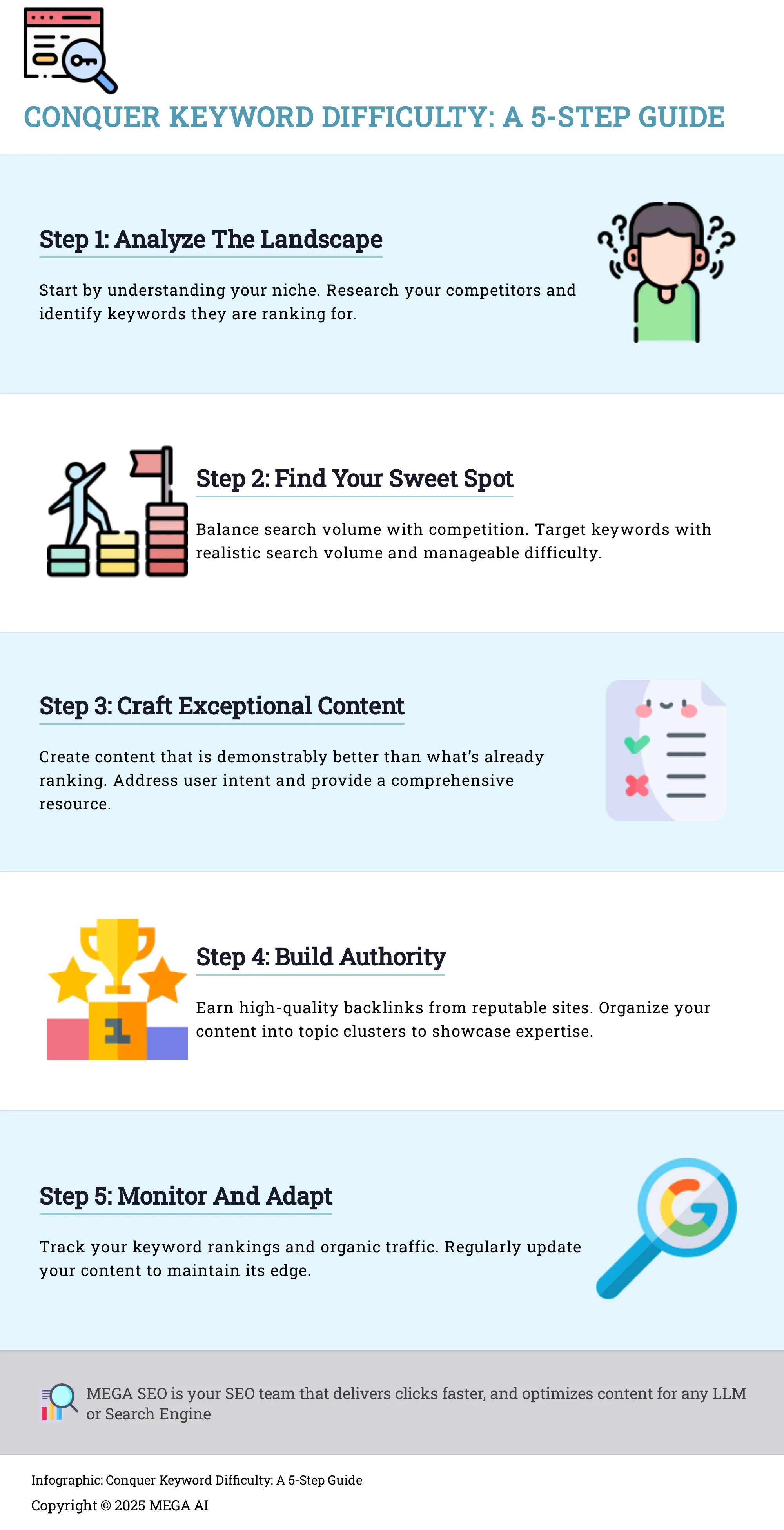
Before you write a single word, you need to understand the competitive landscape. Analyzing the top-ranking pages for your target keyword is essential. Look at their structure, the subtopics they cover, their word count, and the questions they answer. Reviewing SEO case studies is a great way to see what strategies yield real results for others. This deep analysis helps you identify content gaps you can fill and opportunities to cover the topic more thoroughly. MEGA AI’s SEO tools can automate much of this research, identifying what your competitors are doing right so you can create a content brief that aims to be the best resource on the web for that query.
Optimize for User Intent and Search Context
Ranking for difficult keywords requires a deep understanding of why someone is searching for that term. Are they looking for information, trying to buy something, or comparing options? Your content must directly match this user intent. For example, a query like "how to start a blog" requires a step-by-step informational guide, while "best web hosting" calls for a comparison article with clear recommendations. Aligning your content with the user’s goal is critical for success. A strategic review of how a website improves its search engine rankings often reveals a sharp focus on satisfying search intent.
Add Multimedia and Interactive Elements
A wall of text is intimidating and can lead to high bounce rates. To keep users engaged, break up your content with relevant multimedia. This includes high-quality images, infographics, charts, and embedded videos. These elements make your content more visually appealing and easier to digest, which can increase the time users spend on your page. As part of a holistic content strategy, you can optimize old content by adding new multimedia elements to make it more competitive. Interactive elements like quizzes or calculators can also significantly improve user engagement, signaling to search engines that your page provides a valuable experience.
Use Strategic Internal and External Links
A smart linking strategy is a non-negotiable part of competing for difficult keywords. Internal links help search engines discover your content and understand the structure of your website, passing authority between your pages and establishing topic clusters. Linking out to credible, authoritative sources can also build trust and add context to your content. A well-executed linking strategy is a common thread in marketing tactics that result in significant traffic growth. With MEGA AI, you can automate your internal linking to ensure your content is well-connected, helping to distribute page authority across your site and support your most important pages.
How to Find the Right Keywords in Competitive Niches
Entering a competitive niche doesn't mean you can't find your footing. The key is to be strategic with your keyword selection instead of chasing the most popular terms right away. By focusing on the right opportunities, you can build momentum and carve out a space for your brand. Here’s how to approach keyword research when the competition is stiff.
Identify Attainable Keywords
A smart approach, especially for newer sites, is to focus on attainable keywords. These are terms with lower competition scores but still have a decent search volume. Targeting these keywords helps you build authority over time, which can eventually help you rank for more difficult terms. By securing rankings for less competitive phrases first, you establish a foundation of credibility with search engines. MEGA AI's automated keyword research tools can simplify this process by identifying terms with a manageable keyword difficulty score.
Balance Search Volume with Competition
SEO success is about finding the right balance between search volume and achievability. A keyword with tens of thousands of monthly searches is attractive, but if the top results are all major industry players, your chances of ranking are slim. Instead, look for terms where the search volume is realistic for your site's current authority. It's better to capture traffic for a keyword with 500 monthly searches than to get zero from a keyword with 50,000. The goal is to find that sweet spot where you can realistically compete and attract relevant visitors. This balance is crucial for a sustainable SEO strategy.
Use Long-Tail Keywords to Your Advantage
Long-tail keywords are longer, more specific phrases users search for when they are closer to making a decision. For example, instead of “coffee maker,” a long-tail keyword might be “drip coffee maker with thermal carafe.” These phrases are often less competitive and attract more qualified traffic. Because the searcher's intent is so specific, the content you create can be highly targeted, leading to better engagement. Building your strategy around these terms is an effective way to find your audience in a crowded market. You can create specialized SEO content that directly answers these detailed queries.
Go Beyond Content to Overcome High Keyword Difficulty
Creating amazing content is your ticket to the game, but it doesn't guarantee a win for tough keywords. To truly compete, you need to look beyond the words on the page. Your website's authority, content structure, and technical health all send powerful signals to search engines. Think of your content as the star player; it still needs a strong team and a smart game plan to succeed. Let's break down the key areas that will give you a competitive edge.
Build Domain Authority and Backlinks
Your website’s domain authority is its reputation in the eyes of search engines. A strong reputation signals trustworthiness, making it easier for your content to rank. While many factors contribute, high-quality backlinks remain a significant piece of the puzzle. These are links to your site from other reputable, relevant websites. It’s not about quantity; a single link from an industry-leading site is more valuable than dozens from low-quality directories. Building these links takes time, but it’s a direct investment in your site’s long-term ranking potential.
Create Topic Clusters and Content Hubs
Instead of writing one-off articles, organize your content into topic clusters. This strategy involves a central 'pillar' page on a broad topic, surrounded by 'cluster' pages on specific subtopics. Each cluster page links back to the pillar, creating an interconnected web of content that demonstrates your deep expertise. This structure also creates a better user experience by making it easy for visitors to find related information and fully answer their questions. A well-organized content hub can become a go-to resource, attracting more traffic and links over time. You can plan and generate the articles needed to build these hubs efficiently.
Apply Technical SEO Best Practices
Technical SEO ensures your website's foundation is solid, making it easy for search engines to crawl and index your content. If search engines can't access your pages, even the best content won't rank. Key elements include optimizing for site speed, ensuring it's mobile-friendly, and using a clean URL structure. These technical aspects are crucial for search engine rankings, especially against strong competition. A technically sound website also provides a better user experience, which can lead to lower bounce rates and more time on site. Automating technical SEO improvements can save time and prevent common errors from holding your content back.
Common Mistakes When Targeting Difficult Keywords
Even the most well-crafted content can fail to rank if you fall into a few common traps. Targeting competitive keywords requires a near-perfect execution of your entire SEO strategy. It’s not just about writing a great article; it’s about making sure every piece of the puzzle fits perfectly. Let's walk through some of the most frequent missteps that can hold your content back from reaching its potential on the search engine results page (SERP). Avoiding these mistakes will give your content the fighting chance it needs in a crowded space.
Forgetting On-Page SEO Fundamentals
It’s easy to get so focused on creating amazing content that you overlook the foundational elements of on-page SEO. But without them, your content is like a brilliant store with no sign on the door. Many factors influence keyword difficulty, including the quality of competing content, backlink profiles, and a site's overall domain authority. You need to ensure your page title, meta description, headers, and URL are all optimized for your target keyword. These signals help search engines understand what your page is about and confirm its relevance to a user's query, making them non-negotiable for competitive terms.
Ignoring the User Experience
You can write the most comprehensive article on a topic, but if it doesn’t match what the user is actually looking for, it won’t rank. Understanding search intent is crucial. Does the user want an informational guide, a product comparison, or a quick definition? If your keyword is "best running shoes," a user likely wants a list-based review article, not a history of footwear. A poor user experience—like slow page speed, confusing navigation, or a wall of text with no images—will also send users bouncing back to the search results, signaling to Google that your page isn't the best answer.
Not Updating and Refreshing Your Content
Hitting "publish" is the beginning, not the end. One of the biggest mistakes is treating content as a one-and-done task. Over time, information becomes outdated, competitors publish better content, and search engine algorithms evolve. Regularly optimizing old content by adding new information, updating statistics, and incorporating new keywords is essential for maintaining and improving your rank. This practice shows search engines that your content is still relevant and valuable. Automating this process with tools like MEGA AI's Maintenance Agent ensures your articles stay fresh and competitive without constant manual effort.
Tools for Keyword Analysis and Content Optimization
Manually assessing every factor that contributes to ranking difficulty is a massive undertaking. You need tools to do the heavy lifting, giving you the data to make strategic decisions. The right software can show you which keywords are worth targeting and what it will take to rank for them, moving you from guesswork to a clear plan of action.
A good keyword analysis tool will look at multiple factors, including the number of competing websites, backlink quality, and domain authority to calculate a keyword difficulty score. This helps you find attainable keywords, especially if your site is newer. But data is just the start. You also need a way to turn those insights into high-quality content that directly addresses user intent.
This is where an end-to-end platform becomes so valuable. MEGA AI’s SEO tools automate the entire process, from keyword research to content optimization. Our platform identifies keywords with the right balance of search volume and competition, so you can focus on topics you can actually rank for. Once you have your keywords, MEGA AI helps you create and maintain content designed to compete. Our Maintenance Agent identifies opportunities to improve existing articles by adding new sections or optimizing for a better click-through rate (CTR). It ensures your content doesn't just start strong but stays relevant over time. By combining keyword analysis with automated content optimization, you can build authority and compete even in crowded niches. See how it works by booking a demo.
How to Measure Success: Track Rankings and Performance
Once you’ve published your content and implemented your strategy, your work isn’t over. The next step is to measure performance to see what’s working and where you need to adjust. Without tracking, you’re essentially guessing whether your efforts are making a difference. To get a clear picture of your success, focus on a few key performance indicators (KPIs) that tell the full story of your content's journey from search result to customer action.
Start by regularly monitoring your keyword rankings. This is the most direct way to see if your SEO strategy is effective. When you see your pages climbing the search engine results pages (SERPs) for your target keywords, it’s a strong signal that your content is resonating with search engines and meeting user intent. While rankings can fluctuate, a consistent upward trend shows you’re on the right path.
Beyond rankings, you need to analyze your organic traffic. A high rank is great, but it’s only valuable if it brings people to your site. An increase in organic visitors indicates that your title tags and meta descriptions are compelling enough to earn clicks. This metric helps you understand if you’re not just ranking, but also attracting the right audience. Ultimately, the goal is to turn those visitors into customers. Tracking conversion rates—whether that’s a sale, a demo request, or a newsletter signup—shows the true business impact of your SEO work. An integrated tool like MEGA AI's SEO platform can automate this tracking, helping you monitor performance and identify which articles need updates to improve their click-through and conversion rates.
How to Adapt Your SEO Strategy Over Time
An effective SEO strategy is not a one-time setup; it’s a continuous process of refinement. Search engine algorithms change, competitors adjust their tactics, and user search habits evolve. What helped you rank six months ago might not be as effective today. To stay competitive, you need to build adaptation directly into your workflow. This means regularly reviewing your performance and being ready to make changes based on what the data tells you.
Start by scheduling periodic check-ins on your analytics. Look at which pages are gaining traffic and which are losing it. Are your click-through rates for top keywords holding steady, or are they declining? These metrics are your first clues that a shift might be needed. Beyond your own data, you can find valuable insights by studying how other businesses have succeeded. A deep dive into SEO case studies can reveal new tactics and highlight challenges you might face, offering a blueprint for your own adjustments.
Adapting isn't just about reacting to problems. It's also about proactively maintaining your existing content. An article that performed well last year might need a refresh with new information, updated statistics, or better multimedia to keep its edge. Tools designed for SEO maintenance can automate this process by identifying opportunities to improve CTR and add new, relevant content to existing articles. By treating your SEO strategy as a living document, you can make informed adjustments that keep your content relevant and your rankings strong over the long term.
Related Articles
- Advanced Keyword Research Techniques for Content SEO: Driving Targeted Traffic to Your Blog - MEGA SEO | Blog
- Mastering SEO: The Importance of Content Quality and Relevance for Startup Success - MEGA SEO | Blog
- Mastering Keyword Difficulty: Boost Your SEO in 2024
- Unconventional SEO Tactics That Actually Work: Surprising Strategies for Boosting Your Rankings - MEGA SEO | Blog
- Content Optimization Tools: Your Key to SEO Success
Frequently Asked Questions
What's more important: low keyword difficulty or high-quality content? Think of them as two sides of the same coin. You need both to succeed. Targeting a low-difficulty keyword is a smart starting point, but you still need high-quality content to actually win that top spot. Conversely, even the best content in the world will struggle to rank if the keyword difficulty is too high for your website's current authority. The best strategy is to find keywords with manageable difficulty and then create the absolute best content for that search query.
Why isn't my high-quality content ranking for a competitive keyword? This is a common frustration, and it usually comes down to authority. Search engines consider more than just the words on your page. They look at your website's overall reputation, which is heavily influenced by your backlink profile and technical health. If the top-ranking pages are from established websites with strong domain authority and many high-quality backlinks, your content needs a similar level of off-page credibility to compete, regardless of how well-written it is.
Should I even bother targeting high-difficulty keywords if my site is new? It's best to approach it strategically. Instead of targeting the most competitive head terms right away, focus on long-tail keywords first. These are more specific, lower-competition phrases that can help you build initial traffic and authority. As you start ranking for these attainable keywords, your site's reputation will grow, which will eventually position you to compete for the more difficult terms in your niche.
How can I tell if a keyword is realistically attainable for my website? Start by looking at the keyword difficulty score in an SEO tool, but don't stop there. You also need to analyze the search engine results page yourself. Look at the websites that are currently ranking. Are they major industry leaders and household names, or are they smaller blogs and businesses similar to yours? If you see sites with a similar level of authority to your own, it's a good sign that the keyword is within reach.
Besides writing better content, what is the most important thing I can do to compete for difficult keywords? Focus on building your website's overall authority. The most direct way to do this is by earning high-quality backlinks from other reputable sites in your field. You should also ensure your technical SEO is flawless so search engines can easily crawl and understand your site. Organizing your articles into topic clusters is another powerful way to demonstrate your expertise and build authority on a specific subject over time.