
Your RetailTech solution might be groundbreaking, designed to solve real problems for businesses. But if your message isn't cutting through the noise, even the best technology can go unnoticed. In a crowded digital space, generic content simply doesn't make an impact. To truly connect with startups, digital marketers, and small businesses seeking to enhance their online presence, your approach needs to be different. Creating content for RetailTech effectively means building genuine connections, understanding customer pain points, and showing how your offerings provide tangible value. This article explores strategies to move beyond simple product descriptions, helping you craft engaging narratives, interactive experiences, and trustworthy testimonials that resonate deeply and encourage action.
Key Takeaways
- Connect Through Varied Content: Develop a range of content, from interactive demos to in-depth reports, that directly addresses your audience's challenges and clearly demonstrates the value of your RetailTech solutions.
- Personalize and Optimize for Reach: Use customer insights to tailor your content effectively and implement smart SEO practices to ensure your RetailTech expertise reaches and resonates with the right audience.
- Leverage Tools and Measure for Growth: Choose appropriate tools to streamline your content efforts and consistently track key metrics to refine your approach, proving the impact of your RetailTech content.
What Content Drives RetailTech Engagement?
When we talk about RetailTech, it's easy to get caught up in the exciting features and complex algorithms. But to truly connect with your audience—whether they're busy startup founders or marketing teams at small businesses—your content needs to do more than just list specifications. It needs to resonate. The most effective RetailTech content strategies focus on understanding customer pain points and demonstrating how your solutions can genuinely make their lives easier and their businesses more successful. This means creating a variety of content that speaks to different stages of their journey and addresses their unique questions.
Some content will aim to grab their attention and spark curiosity, perhaps by highlighting a common industry challenge. Other pieces will provide deeper insights, build confidence, and clearly illustrate the return on investment. Think of it as building a relationship; you wouldn't just talk about yourself all the time, right? You'd listen, share valuable information, and show them you understand their world. By diversifying your content approach, you can effectively guide potential customers from initial awareness to making an informed purchase decision, and even turn them into loyal advocates for your brand. The key is to provide value at every touchpoint, making complex technology feel accessible and directly relevant to their specific needs and goals. This approach not only educates but also actively involves your audience, fostering a sense of connection that is crucial for long-term engagement and loyalty in the competitive RetailTech space.
Show Products: Demos and Tutorials
Seeing is believing, especially with technology. Product demos and tutorials are fantastic for showing exactly how your RetailTech solution works and the benefits it offers. Instead of just telling people your platform is user-friendly, a quick video walkthrough can demonstrate its ease of use in real-time. These can range from short, feature-specific clips to more comprehensive guides on getting started or tackling a specific task. Think about common questions your sales team receives or tricky steps in a process – these are perfect topics for a tutorial. Clear, concise, and visually engaging demos help demystify your technology, making it feel more approachable and less intimidating for potential users, ultimately helping them visualize how it fits into their own operations.
Engage Users: Quizzes and Configurators
Who doesn't love a bit of interaction? Quizzes and configurators are excellent tools for actively engaging your audience. A well-designed quiz can help potential customers self-identify their needs or challenges, guiding them towards the most relevant solutions your RetailTech offers. For instance, a quiz titled "Is Your Current Inventory System Holding You Back?" could lead users to discover specific features. Configurators, on the other hand, allow users to customize a virtual product or service setup, giving them a tangible sense of how your solution can be tailored to their specific requirements. This type of interactive content, as noted by Influencer Marketing Hub, makes the discovery process fun and personalized, increasing the time users spend with your brand.
Educate Your Audience: Whitepapers and Reports
Sometimes, your audience is looking for more than just product information; they're seeking expertise and deeper understanding. This is where whitepapers and industry reports shine. By publishing insightful content on trends, challenges, and solutions within the RetailTech space, you position your brand as a knowledgeable leader. These pieces can explore complex topics, present original research, or offer strategic advice that helps your audience make better business decisions. While they require more investment to create, well-crafted whitepapers and reports can be powerful lead generation tools and significantly enhance your company's credibility, showing you understand the broader industry landscape beyond your own offerings. This aligns with the idea that educational content helps customers make informed decisions.
Build Trust: Reviews and Testimonials
In the world of B2B, trust is paramount. Before committing to a new RetailTech solution, businesses want assurance that it delivers on its promises. This is where customer reviews and testimonials become invaluable. Hearing directly from other businesses—especially those in similar industries or facing similar challenges—about their positive experiences can significantly influence purchasing decisions. Consider showcasing detailed case studies that highlight specific problems, how your solution addressed them, and the measurable results achieved. Authentic video testimonials can be particularly compelling. By letting your satisfied customers do the talking, you build credibility and reduce perceived risk for prospective clients, making them feel more confident in choosing your platform.
Use Customer Data for Personalized RetailTech Content
In the competitive landscape of RetailTech, generic content simply doesn't cut it anymore. If you want to truly connect with your audience and drive meaningful engagement, personalization isn't just a nice-to-have; it's essential. Your customers have come to expect experiences that are tailored to their specific needs and preferences, and they're less likely to engage with content that feels impersonal or irrelevant. The great news is that the customer data you're already collecting can be a goldmine for crafting these highly personalized content experiences. When you understand who your customers are, what they’ve purchased, and how they interact with your brand across various touchpoints, you gain the power to create content that resonates on a deeper level. This means delivering information that answers their precise questions, addresses their specific pain points, and effectively guides them through their unique buying journey. Such a targeted approach not only leads to higher customer satisfaction and loyalty but can also significantly improve your conversion rates and overall marketing ROI. By leveraging customer data, you can move beyond broad, one-size-fits-all messaging and start delivering content that feels individually crafted for each user, making your brand stand out and fostering stronger relationships.
Implement Customer Data Platforms (CDPs)
Think of a Customer Data Platform (CDP) as your central hub for all customer information. In today's retail environment, data flows in from everywhere—your website, app, in-store systems, social media, and support channels. A CDP works to unify these fragmented data streams, creating a single, comprehensive profile for each customer. This unified view is incredibly valuable. It allows you to see the complete customer journey, understand their behaviors across different channels, and even predict their needs more accurately. For RetailTech businesses, this means you can tailor product demos, tutorials, or promotional offers with precision, ensuring every interaction is relevant and timely based on a deep understanding of individual customer profiles.
Segment Your Audience for Targeted Messages
Once you have a clear, unified view of your customers, the next logical step is audience segmentation. It’s unlikely that all your customers share the exact same interests or needs, so sending a blanket message to everyone often results in low engagement. Segmentation involves dividing your larger audience into smaller, distinct groups based on shared characteristics. These could be demographic details like age or location, psychographic insights such as lifestyle or interests, their purchase history, or behavioral data like website activity. By segmenting, you can create personalized shopping experiences and adjust your content to speak directly to the specific preferences of each group, making your marketing efforts far more effective.
Use Purchase History for Product Recommendations
A customer's purchase history is a powerful indicator of their needs and preferences. Knowing what someone has bought in the past provides strong clues about what they might be interested in next. You can use this information to offer highly relevant product recommendations, whether through personalized emails, on-site suggestions, or in-app messages. For example, if a customer recently purchased a specific RetailTech hardware solution, you could follow up with content showcasing compatible software or advanced user guides for that product. It's important that your digital and physical retail operations work together seamlessly to ensure this data is consistently used, preventing disjointed experiences that can undermine your personalization efforts.
Apply Behavioral Data to Content Topics
Beyond purchase history, how customers interact with your brand online offers a wealth of actionable insights. This behavioral data includes actions like the pages they visit on your website, the features they use within your app, articles they read on your blog, or the links they click in your emails. Analyzing these behaviors helps you understand current interests, identify problems they're trying to solve, and pinpoint areas where they might need more support. With this knowledge, you can create content that directly addresses their active concerns. For instance, if many users are visiting a support page for a particular feature, developing an in-depth tutorial or a best-practices blog post for that feature would be a timely and valuable response. This data-driven approach to content ensures your efforts are relevant and genuinely helpful.
Ensure Data Privacy and Compliance
Leveraging customer data for personalization is incredibly effective, but it carries a significant responsibility: protecting customer privacy. Today's consumers are more aware than ever about how their data is collected and used, and they rightly expect transparency and control. It's absolutely crucial to be clear about what data you collect, your methods for using it, and the measures you take to protect it. Adhering to data privacy regulations such as GDPR and CCPA is non-negotiable. Implementing robust data risk management practices and ensuring your systems are secure will help you meet customer privacy expectations while still delivering valuable personalized experiences. Building trust through ethical data handling is fundamental to fostering long-term customer relationships and maintaining a strong brand reputation in the RetailTech space.
Optimize RetailTech Content for Search and Social
Creating truly valuable RetailTech content is a significant first step, and I'm sure you're putting a lot of effort into making it insightful. But even the most brilliant content can get lost in the digital noise if people can't find it. That's where optimizing your work for search engines and social media platforms becomes so important. Think of it as building clear pathways so your ideal audience – those startups, small businesses, and digital marketers you want to reach – can easily discover your solutions.
This isn't just about ticking boxes for algorithms; it's about connecting meaningfully with people who are actively looking for what your RetailTech offers. When your content is optimized, it shows up when they search for answers, and it grabs their attention when they're scrolling through their social feeds. This increased visibility directly translates to more relevant website traffic, better quality leads, and ultimately, a stronger chance of converting interest into action. We're talking about making your content work harder for you, ensuring it reaches the right eyes and ears. In the following sections, we'll walk through practical steps you can take to make this happen, from smart keyword use to crafting posts that people genuinely want to share.
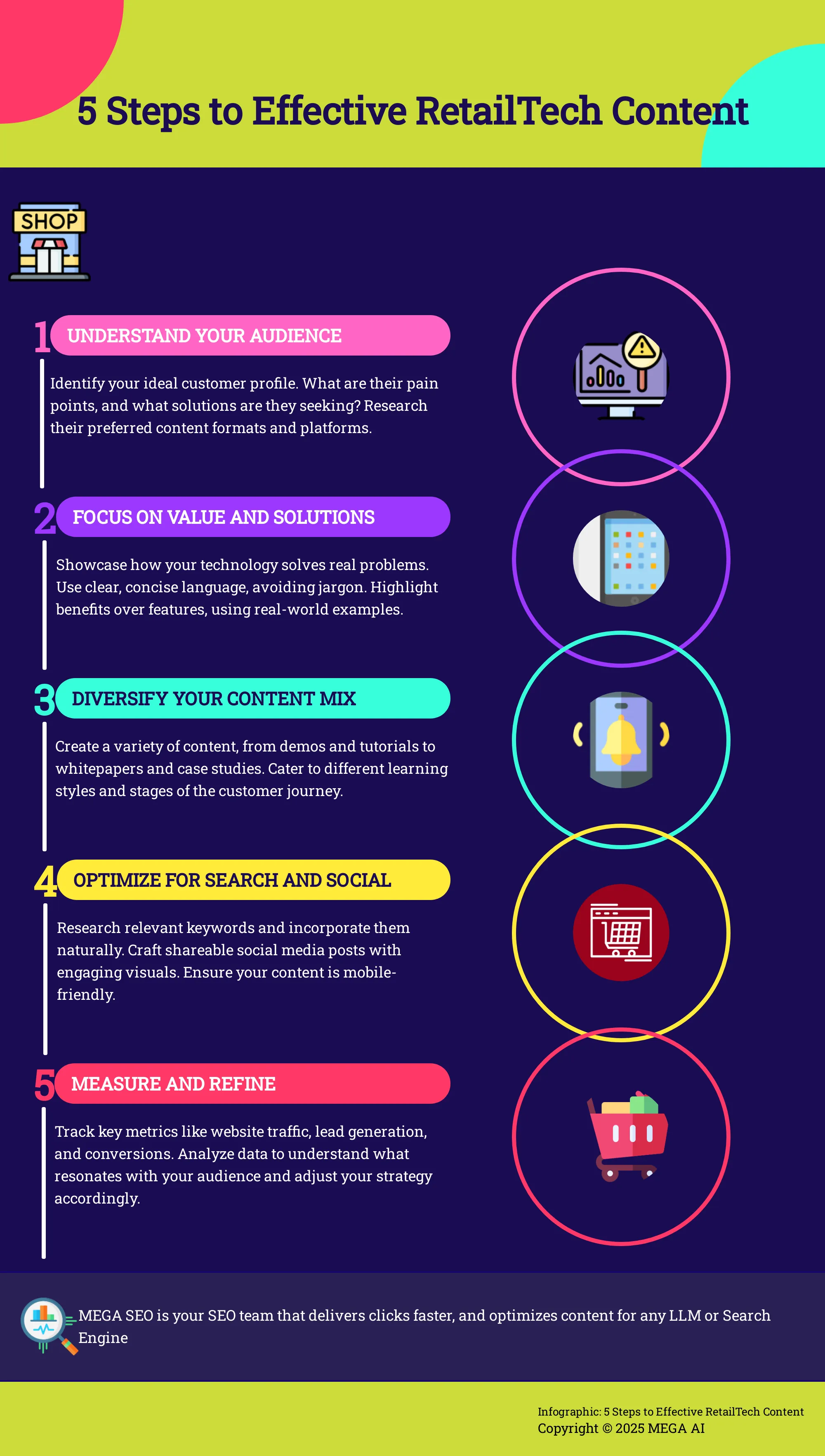
Research and Implement Keywords for RetailTech
Keywords are essentially the language your customers use when they're looking for solutions online. For your RetailTech content to show up in their search results, you first need to understand these specific terms. This means diving into keyword research to pinpoint the phrases related to your products, your niche, and the challenges your technology addresses. Using tools that offer automated keyword research can make this discovery phase much more efficient.
Once you've identified your core keywords, the next step is to weave them naturally into your product descriptions, blog posts, and website pages. As the team at Strider SEO aptly puts it, this strategic incorporation helps search engines understand your content's relevance, improving your chances of attracting the right customers. It’s a foundational piece for driving targeted traffic.
Craft Shareable Social Media Content
Social media isn't just a broadcast channel; it's a place for conversation and connection. For RetailTech companies, this means creating content that not only showcases your products but also encourages interaction. Your aim here is to craft posts that people find interesting enough to share with their own networks. As ContentStudio advises, "focus on creating engaging content...engaging with your audience through regular posts and promotions."
Visuals play a huge role here. Think about how compelling a short video demonstration or a customer success story can be. We Are Amnet highlights that "video has become one of the most engaging content formats." Platforms like Instagram and TikTok are perfect for this. And if you're looking to expand your reach, remember that well-planned Paid Ads can amplify your best-performing social content to a highly targeted audience.
Optimize RetailTech Content for Mobile
It's a mobile-first world, and a large chunk of your audience is likely viewing your RetailTech content on their smartphones or tablets. If your website and content aren't easy to use on these smaller screens, you could be losing potential customers before they even get a chance to see what you offer. Mobile optimization is more than just aesthetics; it's about providing a smooth and efficient user experience.
As the experts at Bloomhouse Marketing state, "Optimizing your site’s speed, ensuring mobile-friendliness, and using structured data are critical." This means your pages should load quickly, text should be readable without pinching and zooming, and buttons should be easy to tap. Making your content mobile-friendly doesn't just keep users happy; it also helps your search engine rankings, as platforms like Google prioritize sites that offer a good mobile experience.
Develop Voice Search Optimization Strategies
The way people search is evolving, and voice search is a growing part of that shift. Think about how you ask your smart speaker a question – it's usually more conversational than a typed search query. Optimizing your RetailTech content for voice search means anticipating these natural language questions.
To do this well, you need a solid understanding of your customers' needs and how they might phrase their queries verbally. SAP Emarsys points out that "By unifying fragmented data streams, brands can predict customer needs." This insight is invaluable. You can then structure some of your content, like FAQs or blog sections, to directly answer these potential voice questions clearly and concisely. Using natural, conversational language in your content will also align well with how people speak their searches.
What Tools Do You Need for RetailTech Content?
Creating compelling RetailTech content requires more than just good ideas; you need the right set of tools to bring those ideas to life efficiently and effectively. Think of these tools as your support system, helping you manage workflows, enhance your creative output, and understand how your content performs. From crafting engaging product descriptions and immersive visuals to distributing your message across various channels and analyzing its impact, a well-chosen toolkit can significantly simplify your content creation process.
Whether you're a startup looking to make your mark, a small business aiming to grow, or a digital marketing agency serving RetailTech clients, having access to appropriate software can make a substantial difference. These tools can help you automate repetitive tasks, gain deeper insights into your audience, and ultimately, create content that resonates and converts. Let's explore some essential categories of tools that can support your RetailTech content strategy.
Content Management Systems (CMS)
A Content Management System is the backbone of your digital content operations. It's where you’ll create, manage, and modify your website content without needing to dive deep into code. For RetailTech, a robust CMS allows you to publish everything from blog posts detailing new technologies to product pages with intricate specifications. To truly make the most of content marketing, you'll want a system that helps you produce high-quality, original material, optimize it for search engines, and easily update it as your offerings evolve. A good CMS streamlines these processes, letting you focus on the quality and relevance of your information.
Social Media Scheduling and Analytics Platforms
In the RetailTech space, engaging with your audience on social media is key. Social media scheduling and analytics platforms are designed to make this much more manageable. These tools allow you to plan and schedule your posts in advance across multiple platforms, ensuring a consistent presence. More than just scheduling, they provide valuable analytics to understand what content resonates with your audience, helping you promote products and drive sales effectively. This data-driven approach means you can refine your social strategy over time, focusing your efforts on what truly captures attention and encourages interaction.
Email Marketing Tools
Email remains a powerful channel for nurturing leads and communicating directly with your audience in RetailTech. Email marketing tools help you build and manage your subscriber lists, segment your audience for targeted messaging, and design professional-looking email campaigns. Retailers can use customer data gathered through various touchpoints to personalize these communications, sending relevant updates, product information, or special offers. By automating parts of your email marketing, you can maintain regular contact with your audience, guiding them through their decision-making process with timely and pertinent information.
AI Content Personalization Tools
Artificial intelligence is increasingly playing a role in tailoring content experiences. AI content personalization tools analyze vast amounts of user data—like browsing behavior, purchase history, and preferences—to deliver content that feels uniquely relevant to each individual. For RetailTech, this means you can dynamically adjust website content, product recommendations, or even marketing messages. By unifying data streams, these tools help predict customer needs and personalize at scale, making each interaction more meaningful and increasing the likelihood of engagement and conversion.
Augmented Reality (AR) Product Visualization Software
Augmented Reality is transforming how customers interact with products online, especially in RetailTech. AR product visualization software allows potential buyers to see how a product, like a new piece of retail hardware or a store layout, would look in their own environment. This immersive experience helps bridge the gap between online browsing and in-person evaluation. By offering such interactive visualizations, you can significantly enhance customer experiences and provide a deeper understanding of your products, which can be a powerful factor in purchasing decisions.
Top RetailTech Content Tools:
Here are a few standout tools that can be particularly useful for creating and managing your RetailTech content:
MEGA AI
MEGA AI offers an end-to-end platform that uses artificial intelligence to simplify and automate SEO and paid advertising efforts. For RetailTech content, this means automated keyword research, content generation, and optimization of existing articles to improve ranking and click-through rates. Its ability to handle tasks from content creation to ad campaign management makes it a comprehensive solution for businesses looking to enhance their online presence efficiently.
Shopify
While primarily known as an e-commerce platform, Shopify also provides robust tools and features for content marketing. RetailTech businesses, especially those selling directly, can use Shopify to create blogs, landing pages, and product descriptions that engage audiences and drive sales. Its integrated nature means your content and commerce efforts can work seamlessly together, providing a comprehensive strategy for using content marketing.
Hootsuite
Hootsuite is a widely used social media management platform that helps you schedule posts, monitor conversations, and analyze your social media performance across various networks. For RetailTech companies, this tool can streamline the process of engaging with industry professionals, potential clients, and partners. It enables businesses to enhance brand visibility and drive website traffic through targeted social media activities.
Mailchimp
Mailchimp is a popular email marketing and automation platform that enables businesses to create targeted email campaigns. Its strength lies in customer segmentation, allowing RetailTech marketers to send personalized messages based on user behavior and preferences. This is crucial for nurturing leads, maintaining customer relationships, and turning broad audiences into focused groups for more relevant content.
Canva
Canva has made graphic design accessible to everyone. For RetailTech content, you can use Canva to quickly create professional-looking visuals for your blog posts, social media updates, presentations, and marketing materials. Its user-friendly interface and vast library of templates help you produce engaging content, which is essential for driving traffic, even without extensive design experience.
Adobe Creative Suite
For those needing more advanced design capabilities, the Adobe Creative Suite (including Photoshop, Illustrator, and InDesign) offers a powerful set of tools. These applications are industry standards for creating high-quality graphics, videos, and layouts. They ensure your RetailTech content has a polished and professional appearance, which is critical for effectively showcasing sophisticated technology offerings and optimizing user experience.
Measure Your RetailTech Content Impact
Creating compelling RetailTech content is a significant first step, but understanding its actual performance is where the real strategic advantage lies. In the dynamic world of retail technology, where innovations emerge rapidly and customer expectations continuously evolve, simply producing content isn't enough. You need to know if it's hitting the mark, resonating with your target audience—be it startups exploring new solutions or established businesses looking to optimize—and contributing to your overall business objectives. Measuring your content's impact allows you to move beyond assumptions and base your decisions on concrete data. This process is vital for refining your strategy, proving the value of your content marketing efforts, and ultimately, building stronger connections with your audience.
When you systematically measure impact, you gain clarity on what works and what doesn't. Are your deep-dive whitepapers on AI in supply chain management truly engaging CTOs, or are shorter case studies more effective? Do your interactive product demos lead to more qualified leads than your webinars? Answering these questions with data empowers you to allocate resources more effectively and tailor your messaging for maximum relevance. This is particularly important in RetailTech, where the solutions can be complex and the sales cycles long. Effective measurement helps you demonstrate how content supports lead generation, nurtures prospects through the funnel, and even aids in customer retention. Platforms like MEGA AI can further help by automating aspects of content optimization and SEO, but the foundational understanding of your content's performance comes from diligent measurement. This section will guide you through defining the right metrics, setting up tracking, interpreting the data you collect, and calculating the return on your content investment.
Define Key Performance Indicators (KPIs) for RetailTech Content
To accurately assess your RetailTech content, you need clear Key Performance Indicators. These aren't just numbers; they are specific, measurable targets tied directly to your business goals. For instance, you might track demo requests from a blog post, downloads of a whitepaper, or the conversion rate of users who interact with a new product configurator. Effective customer segmentation allows you to tailor content, and your KPIs should reflect how well this content engages those specific groups. Begin by defining what success means for each content piece and align these with your broader marketing objectives.
Set Up Tracking and Analytics
With your KPIs defined, the next step is to implement solid tracking and analytics. This involves using tools like Google Analytics to monitor website activity and user behavior, and potentially integrating data from your CRM. For RetailTech, it's important to map the customer journey from their first content interaction to a key action, like scheduling a consultation. Properly configured analytics are essential to capture the data needed for your KPIs, showing exactly how your content contributes to your business outcomes and where improvements can be made to enhance performance.
Interpret Data to Refine Your Content
Collecting data is only half the battle; the real power comes from interpretation. Analyze your analytics to see which RetailTech topics truly connect with your audience, what content formats lead to the most interaction, and where users might be losing interest. This understanding allows you to make informed, data-driven decisions about your future content, making your efforts more efficient. If articles on AI in logistics perform well, for example, that’s a strong indicator to develop more content in that area. Regularly review your data to spot trends and continuously improve your strategy.
Calculate Content Marketing ROI
Finally, you’ll want to understand the return on investment (ROI) from your RetailTech content efforts. Calculating content marketing ROI means comparing the revenue generated or costs saved due to your content against what you spent to create and promote it. While directly attributing sales can sometimes be tricky in RetailTech, especially with longer B2B sales cycles, tracking generated leads, reductions in customer acquisition cost, or improvements in customer retention influenced by your content are valuable metrics. Unifying customer data across platforms can significantly help in assessing content's financial contribution and justifying your marketing spend.
Overcome Common RetailTech Content Challenges
Creating compelling content in the RetailTech space comes with its own set of hurdles. From explaining complex technologies simply to keeping pace with rapid industry changes, it's important to have strategies in place. By addressing these common issues head-on, you can ensure your content resonates with your audience and achieves your marketing goals. Let's look at how to tackle some of the most frequent challenges you might encounter and how you can effectively manage them.
Balance Technical Details with Readability
One of the trickiest parts of RetailTech content is explaining sophisticated technology without overwhelming your audience. You want to showcase your expertise, but if your message is buried in jargon, it won't connect. The key is to truly understand your audience and what they need to know. Focus on the benefits and solutions your technology provides, rather than just the features. Use clear, concise language, and when technical terms are necessary, explain them simply. Analogies and real-world examples can also make complex ideas much more digestible and engaging for your readers, helping them see the practical value.
Keep Up with Evolving Technology
The RetailTech landscape is constantly shifting, with new innovations emerging all the time. This rapid evolution means your content needs to be current and reflect the latest trends. To stay ahead, dedicate time to continuous learning. Follow industry publications, attend webinars, and monitor what competitors and thought leaders are discussing. This proactive approach allows you to adapt your content marketing strategies quickly, ensuring your information is always relevant and valuable to an audience looking for up-to-date insights and solutions in this dynamic field.
Address Privacy Concerns in Content Marketing
Personalization is powerful in RetailTech, but it relies on customer data, bringing privacy to the forefront. Customers are increasingly aware of how their data is used and expect transparency and control. Your content marketing must acknowledge and respect these concerns. Clearly communicate your data usage policies and highlight the steps you take to protect customer information. Building trust is paramount, and by implementing robust data risk management, you can show your audience that you value their privacy as much as they do, fostering stronger, more loyal relationships.
Scale Content Production, Maintain Quality
Meeting the demand for fresh, engaging content can feel like a constant race, especially for growing businesses. The challenge is to increase your output without letting quality slip. Start by creating a solid content calendar and explore ways to repurpose existing assets into new formats. Consider leveraging user-generated content, which can add authenticity and reduce your creation burden. Tools and efficient workflows are also vital. For instance, platforms like MEGA AI can help automate aspects of content creation and optimization, allowing you to produce more high-quality material consistently. Remember, consistent posting of valuable content is key to keeping your audience engaged and your brand top-of-mind.
What Future Trends Will Shape RetailTech Content?
The RetailTech landscape is always moving, and so are the ways we connect with customers through content. Staying ahead means understanding the trends that are shaping how shoppers discover, engage with, and purchase products. These aren't just fleeting fads; they represent fundamental shifts in consumer expectations and technological capabilities. From the intelligence of AI in crafting personalized messages to the immersive allure of virtual try-ons, the future of RetailTech content is about creating more meaningful, efficient, and engaging customer journeys. Let's look at some key trends that will define how you create compelling content.
AI and Machine Learning in Content Creation
Artificial intelligence is no longer just a concept for the future; it's actively reshaping how we create and personalize content in the RetailTech space. Think about anticipating your customers' desires, sometimes even before they fully recognize them. That's the kind of insight AI can bring, as it's poised to transform the customer experience and deliver greater results.
This isn't solely about automation; it's about fostering smarter, more intuitive connections. By unifying fragmented data streams, brands can predict customer needs and personalize at scale. Platforms offering AI-driven content generation are becoming vital, helping you produce relevant material that truly resonates with individual shoppers.
Immersive Technologies for Product Showcasing
Helping customers truly understand your product online can be a significant hurdle, but immersive technologies are changing this landscape. We're progressing beyond static images to more dynamic and interactive experiences that capture attention and provide deeper insight.
"Video has become one of the most engaging content formats on social media," and its appeal is clear. It allows you to demonstrate products in action and tell compelling brand stories. Taking this a step further, "immersive technologies like AR and VR can enhance the shopping experience" by enabling customers to visualize items in their own homes or even "try on" products virtually. This not only makes shopping more enjoyable but also helps reduce uncertainty and build purchase confidence.
Sustainability and Ethical Consumerism Content
Today's consumers are more aware than ever about the origins of their products and the broader impact of their purchasing decisions. This significant shift means that content focusing on sustainability and ethical practices is no longer just a thoughtful addition; it's becoming a core expectation.
"Brands are increasingly focusing on sustainability and ethical practices to meet consumer demand for responsible products." Your content provides the perfect avenue to share your brand's commitment to these values, whether through narratives about your supply chain or your involvement in community initiatives. Authentically integrating these themes can build profound trust. As experts highlight, "sustainability integration and enhanced customer experience are critical areas where strategic internal transformation can yield tangible outcomes."
Omnichannel Content Strategies
Your customers interact with your brand across numerous touchpoints – your website, social media, email, and physical stores. An omnichannel content strategy ensures a consistent and seamless experience, helping you engage effectively regardless of how they connect with you.
The goal is to make every interaction feel connected and personalized. With this approach, "retailers can create personalized shopping experiences and even anticipate customer wants." This relies on understanding customer data. Tools that help manage content across platforms, like MEGA AI's Paid Ads solutions, are key to mastering this and improving profitability.
Related Articles
- Unlocking Writing Startups: Players and Growth Prospects
- Grow Your Startup with Effective Content Marketing Tips
- Top 10 Digital Marketing Tools for Lead Generation
- AI Outreach: The Ultimate Guide to Personalization
- Content Optimization - MEGA SEO | Blog
Frequently Asked Questions
I'm just starting to create content for my RetailTech business. What's a good first step to make sure it connects with people? A great starting point is to clearly show how your technology solves real problems for your audience. Consider creating straightforward product demos or tutorials. These allow potential customers to see the practical benefits of your solution in action, making complex technology feel more accessible and directly relevant to their needs.
Using customer data for personalized content seems powerful, but how do I handle privacy concerns responsibly? It's essential to be transparent with your audience about how you collect and use their data. Always prioritize clear communication, give customers control over their information, and ensure you comply with all relevant privacy regulations. The goal is to use data to provide genuine value and helpful experiences, which builds trust.
My RetailTech content isn't getting seen by many people. What are one or two simple things I can focus on to improve its visibility? Two effective areas to concentrate on are understanding the search terms your audience uses and making your content shareable. Research the keywords potential customers might type into search engines when looking for solutions like yours and incorporate them naturally. Also, create content, perhaps with engaging visuals or unique insights, that people will find interesting enough to pass along on social media.
With so many content tools available, which type offers the most impact for a RetailTech company just starting out or on a tight budget? For a foundational setup, a reliable Content Management System (CMS) is crucial. This will help you efficiently publish and manage all the content on your website. Beyond that, an email marketing tool can be very effective for directly communicating with and nurturing potential leads, allowing you to send targeted information to interested individuals.
How can I tell if the time and money I'm spending on RetailTech content are actually paying off? You can determine your content's effectiveness by first defining clear, measurable goals for each piece. This could be tracking demo requests generated from a specific blog post or counting downloads of an informational whitepaper. Use web analytics to monitor these specific actions and observe how your content contributes to generating leads or influencing sales over time.