
The world of education technology moves quickly, and standing out requires more than just a clever app or platform. The real differentiator often lies in the quality and effectiveness of the learning materials themselves. Creating content for EdTech is a specialized skill, blending pedagogical principles with engaging design and smart technology. It’s about transforming information into experiences that genuinely help learners grasp new concepts and achieve their goals. For startups and businesses in this space, compelling content isn't just a nice-to-have; it's fundamental to attracting users, demonstrating value, and building a reputation for educational excellence. This guide explores the essential strategies for developing EdTech content that truly connects and delivers results.
Key Takeaways
- Focus on Your Learners: Get to know your audience's specific needs and how they learn best, then create clear, accessible, and engaging content that truly connects with them.
- Choose Formats Wisely: Select the right content types—like videos or interactive guides—and adjust the complexity to fit different educational stages, making sure your message is well received.
- Improve with Data: Build in ways to assess learning and gather feedback, then use this information to see what’s working, personalize the experience, and keep making your content better.
What is EdTech Content and Why is it Important?
Understanding EdTech content is key to creating impactful educational experiences. It's more than digital textbooks; it's about using technology to make learning accessible, engaging, and effective. For businesses in or supporting the education sector, quality EdTech content is essential for growth and authority. Let's explore what EdTech content involves and its significant role in modern education.
What is EdTech Content?
At its core, "EdTech," or education technology, refers to any technology or software used within an educational context. This broad umbrella covers everything from comprehensive online learning platforms to specialized applications and games designed to help students learn, such as interactive modules or video tutorials.
The content created for these technologies is EdTech content. Its primary purpose is to facilitate and enhance the learning process, making complex subjects easier to grasp or providing new ways to practice skills. The goal is to use technology for richer, more dynamic educational experiences.
How EdTech Influences Modern Education
A key way EdTech influences modern education is through personalization. Technology enables learning experiences to adapt to a student's individual pace and skill level. Many EdTech tools use algorithms to adjust material difficulty; if a student excels, they see advanced concepts sooner, while those struggling get more support.
This ability to tailor the educational journey creates a more effective learning environment. Students avoid boredom from easy material or frustration from overly difficult concepts, progressing at a suitable pace. This leads to deeper understanding and confidence, highlighting how EdTech reshapes education.
Advantages for Learners and Educational Institutions
High-quality content is fundamental for EdTech companies. It boosts brand visibility, builds trust with users (learners, parents, institutions), and improves search engine optimization (SEO), helping audiences find you. Compelling EdTech content drives sales and differentiates offerings.
Content marketing is also key for establishing relationships with customers and influencing purchase decisions. Learners gain access to engaging, tailored materials and flexible learning. Institutions benefit from efficient teaching tools, student progress data, and broader reach.
What Makes EdTech Content Effective?
Effective EdTech content does more than just share information; it crafts learning experiences that are clear, purposeful, engaging, and reliable. When these key elements come together, your content can truly make a difference in a learner's journey. Let's explore what sets impactful EdTech content apart.
Ensure Clarity and Accessibility
Learners grasp material best when it's easy to understand. Focus on clarity by using straightforward language and organizing content logically. Break down complex ideas into smaller, digestible pieces, and explain any jargon. Visual cues like headings and bullet points also help guide learners.
Beyond clarity, ensure your content is accessible to everyone. This means designing inclusively with practical steps like video captions, alt text for images, and keyboard-only navigation. Making your content truly accessible creates equal learning opportunities and shows you value every user's experience.
Align with Curriculum and Learning Goals
Effective EdTech content always has a clear purpose. Start by defining specific learning objectives: what should learners know or do after using your material? These objectives will guide your content creation.
Then, ensure your content directly supports these objectives and aligns with relevant curriculum standards. This makes your material educationally sound and helps learners achieve required outcomes. When content directly addresses learning goals and audience needs, it becomes a powerful educational tool, not just a collection of facts.
Foster Interactivity and Engagement
Active involvement helps learners absorb information. Make your content a two-way street by adding interactive elements like quizzes with immediate feedback, drag-and-drop activities, or simple polls. Simulations can also allow learners to apply concepts safely.
Using a mix of content formats keeps things engaging and appeals to different learning styles. Videos can demonstrate processes, while infographics summarize key points. The aim is an environment where learners actively participate and apply knowledge, making learning more memorable and effective.
Meet Educational Standards
Trust is fundamental in education, so your EdTech content must be reliable. Ensure all information is accurate, current, and based on sound educational practices. Always double-check facts and cite credible sources to build authority.
Meeting educational standards also means committing to quality and improvement. Be open to feedback from users and use it to refine your materials. Regularly review content for relevance and effectiveness. This commitment builds credibility and provides learners with dependable resources for their academic and professional development.
Know Your EdTech Audience
Creating EdTech content that truly connects starts with a deep understanding of who you're trying to reach. It’s not just about what you want to teach, but about who is learning and how they learn best. Taking the time to get to know your audience will make every piece of content more impactful, whether you're developing educational tools or marketing them.
Identify Your Target Audience
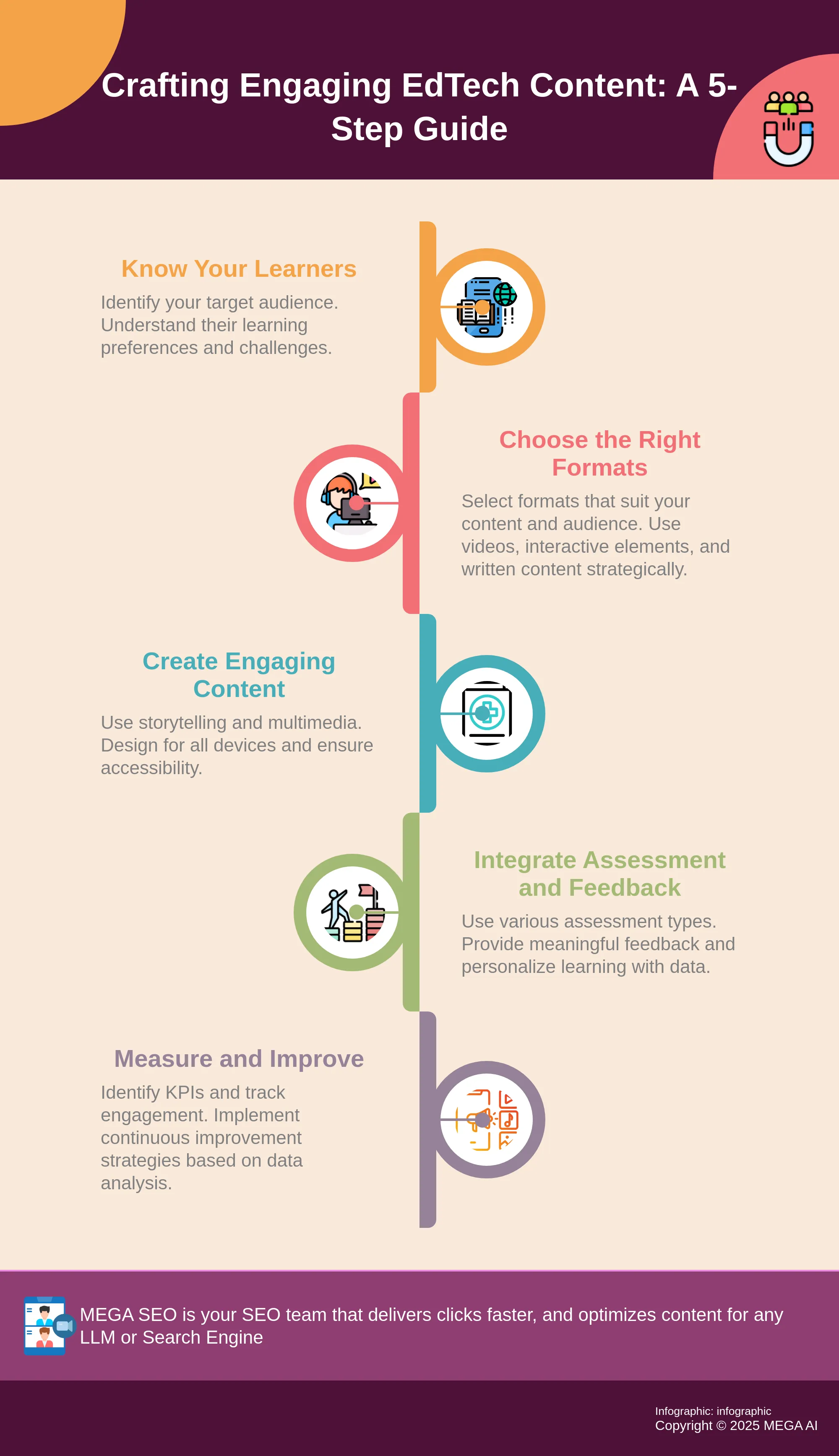
Before you create any EdTech material, it's essential to pinpoint exactly who you're speaking to. Are they K-12 students, higher education learners, or professionals seeking new skills? Each group has distinct needs, motivations, and existing knowledge. Success in EdTech content marketing often depends on understanding these needs at every stage of their learning journey. Consider creating detailed learner personas. Think about their age, educational background, tech-savviness, and what they hope to achieve. This clarity will guide your content's tone, complexity, and subject matter, ensuring it truly resonates with the specific challenges and goals of your audience.
Analyze Learning Preferences
Once you know who your audience is, the next step is to understand how they prefer to learn. Some learners might thrive with video tutorials, while others prefer interactive simulations or concise written guides. Successful EdTech companies often use various content formats, and by analyzing the preferred learning styles of your audience, you can create content that engages them more effectively. Look at data from existing content if you have it, or consider simple surveys to ask your audience directly. Offering a variety of content types, like blog posts, videos, podcasts, and infographics, can help you cater to diverse learning styles and make your educational materials more accessible.
Address Their Learning Challenges
Effective EdTech content doesn't just present information; it solves problems. What are the specific hurdles your audience faces in their learning process? Perhaps they struggle with complex concepts, lack motivation, or need more practical examples. High-quality content should address customer pain points and offer solutions that resonate with their specific learning challenges. Frame your materials as solutions, showing learners how your content can help them overcome obstacles and achieve their educational goals. When your content provides clear, actionable answers to their challenges, it builds trust and positions you as a valuable educational resource.
Choose the Right EdTech Content Formats
Picking the right way to present your EdTech material is more than just a finishing touch; it’s a fundamental part of making sure your message hits home and your learners truly benefit. The format you choose can dramatically influence how well students engage with the content, how easily they understand complex topics, and ultimately, how much they retain. Think of it like choosing the right tool for a job – you wouldn’t use a hammer to saw wood. Similarly, a dense academic paper might not be the best fit for a quick overview of a practical skill, where a short video could shine.
Understanding your audience, a topic we’ve touched on before, plays a huge role here. Are they visual learners who thrive on diagrams and videos? Do they prefer to listen to content on the go? Or are they readers who like to dive deep into text? Answering these questions will guide your format decisions. Moreover, the nature of the content itself often dictates the best approach. For instance, demonstrating a software feature is almost always clearer with a screen recording, while exploring a nuanced historical event might be well-suited to an in-depth article or a podcast discussion. A thoughtful content strategy considers these variables to maximize impact.
Don't feel pressured to stick to just one format. In fact, a blended approach often works best. Offering information in multiple ways caters to diverse learning preferences and can reinforce understanding. For example, a core concept might be introduced in a blog post, elaborated upon in a video, and then summarized in an infographic. This variety not only keeps things interesting but also provides multiple entry points for learners to connect with the material. As you explore the different formats, consider how each can contribute to a richer, more effective learning experience for your audience. The goal is to make learning accessible, engaging, and impactful.
Use Video for Learning Materials
Video is a powerhouse in the content world, and for good reason. Many businesses, around 85% in fact, use video in their marketing, and it's just as effective, if not more so, for educational purposes. Videos can bring complex subjects to life, demonstrate processes step-by-step, and offer a more personal connection through visual and auditory cues.
Consider creating explainer videos for difficult concepts, tutorials for software or practical skills, or even interviews with experts to provide different perspectives. The visual nature of video helps with retention and can make learning feel more dynamic and less like a chore. It’s an excellent way to capture attention and deliver information in a digestible way.
Create Interactive Simulations and Games
To truly make learning stick, getting your audience actively involved is key. Interactive content like simulations and games transforms learners from passive recipients to active participants. This approach aligns with the idea that content should be compelling and offer solutions to user challenges by allowing them to apply knowledge in a safe, controlled environment.
Simulations can replicate real-world scenarios, allowing learners to practice decision-making and see the consequences of their actions without real-world risks. Gamification elements, such as points, badges, and leaderboards, can further motivate learners and make the educational experience more enjoyable. This hands-on approach fosters critical thinking and problem-solving skills, leading to deeper understanding and better retention of the material.
Develop Podcasts and Audio Content
Don't underestimate the power of audio. Podcasts and other audio content offer incredible flexibility, allowing learners to absorb information while commuting, exercising, or doing chores. This format is particularly effective for reaching younger audiences, with data showing that 50% of American podcast listeners fall between the ages of 12 and 34.
You can use podcasts to share interviews with thought leaders, tell engaging stories related to your subject matter, or provide audio summaries of lessons. Audio content is also a great accessibility feature for those who prefer auditory learning or have visual impairments. It’s a convenient way to deliver valuable insights and keep your audience connected to your educational material, even when they're on the move.
Design Infographics and Visual Aids
In a world saturated with information, visuals can cut through the noise and make complex data much easier to understand. Infographics, charts, and diagrams condense information into a visually appealing and digestible format. It's quite telling that blogs incorporating visuals see significantly more engagement than those that are purely text-based.
Use infographics to summarize key concepts, present statistics in an engaging way, or illustrate processes. Well-designed visual aids can break up long blocks of text, making your content more approachable and improving learner comprehension. They cater to visual learners and can make even the most data-heavy topics more engaging and memorable. Think of them as powerful storytelling tools that use images and concise text.
Write Blogs and In-Depth Articles
While newer formats are exciting, traditional written content like blogs and in-depth articles still holds immense value in EdTech. A well-crafted blog filled with valuable content can attract a substantial audience, establishing your authority and providing a go-to resource for learners. This format is ideal for exploring topics in detail, offering comprehensive explanations, and providing a space for nuanced discussions.
Blogs are excellent for SEO, helping learners find your content through search engines. You can use articles to share case studies, research findings, detailed guides, or thought leadership pieces. For learners who prefer to read and absorb information at their own pace, or who need a reference to come back to, well-structured written content is indispensable.
Create Engaging EdTech Content: Best Practices
Creating EdTech content that genuinely captivates and educates requires more than just presenting information. It’s about crafting experiences that resonate with learners and support their educational journey. By focusing on a few key best practices, you can significantly improve how your audience interacts with and benefits from your materials. These strategies help ensure your content is not only informative but also memorable and effective, leading to better learning outcomes and a stronger connection with your users.
Use Storytelling Techniques
One of the most powerful ways to make your EdTech content stick is by weaving in storytelling. Humans are naturally drawn to narratives; they help us connect emotionally and make abstract concepts more concrete and relatable. Instead of simply listing facts or instructions, try framing your lessons within a story. This could involve creating characters, scenarios, or case studies that learners can follow. For example, a complex science topic could be explained through the journey of a fictional student discovering it. As ProSalesConnection notes, "Storytelling can be an effective way to engage your audience and convey your message in a relatable manner." This approach not only makes learning more enjoyable but also aids in retention, as information embedded in a compelling narrative is often easier to recall.
Incorporate Multimedia Elements
To cater to diverse learning preferences and keep your audience engaged, it's essential to incorporate a variety of multimedia elements. Text alone can sometimes feel monotonous, but when combined with visuals, audio, and interactive components, your content becomes much more dynamic. Consider using videos to demonstrate processes, infographics to summarize key data, podcasts for on-the-go learning, or interactive quizzes to reinforce concepts. According to ProSalesConnection, "using multimedia and interactive elements can significantly boost engagement." By offering information in multiple formats, you not only appeal to different learning styles but also make complex topics more digestible and interesting. Explore tools that can help you create various media types to enrich your educational offerings.
Design for All Devices
In our multi-device world, learners access educational content on everything from desktop computers to tablets and smartphones. Therefore, ensuring your EdTech content is responsive and provides a seamless experience across all screen sizes is crucial. A clunky or difficult-to-use interface on a mobile device can quickly lead to frustration and disengagement. Prioritize a mobile-first design approach where appropriate, ensuring that text is readable, navigation is intuitive, and interactive elements are easily tappable on smaller screens. As ThinkOrion suggests, it's important to "ensure accessibility across devices." This practice ensures that your valuable content is accessible and user-friendly, no matter how or where your audience chooses to learn.
Ensure Accessibility for Every Learner
Creating truly effective EdTech content means making it accessible to everyone, including learners with disabilities. This isn't just a matter of compliance; it's about inclusive design that benefits all users. Simple measures like providing alt text for images, offering closed captions and transcripts for videos, ensuring keyboard navigability, and using color-contrast effectively can make a significant difference. As ProSalesConnection points out, this "not only broadens your audience but also aligns with best practices in educational content creation." By committing to web accessibility standards, you create a more equitable learning environment and ensure that your valuable educational resources can reach and empower the widest possible audience.
Tailor Content to Different Educational Levels
Effective EdTech content isn't a one-size-fits-all solution; it requires a thoughtful approach that considers the unique characteristics of learners at various stages. Learners bring distinct needs, established learning preferences, and different motivations depending on whether they're in elementary school, pursuing a university degree, or seeking professional advancement. Recognizing these differences is fundamental to creating resources that genuinely connect, deliver value, and ultimately achieve educational goals. Think about it: the way a kindergartener engages with new information is vastly different from how a postgraduate student critically analyzes complex theories, or how a mid-career professional seeks immediately applicable skills.
Tailoring your approach will significantly influence engagement and learning outcomes. This means looking beyond the core subject matter to carefully consider how it's presented. The language you use must be appropriate for the audience's comprehension level, and the interactive elements you include should align with their learning styles and technological comfort. For instance, gamification and colorful visuals might be perfect for younger learners, while in-depth case studies, peer-reviewed articles, and opportunities for collaborative projects might better suit higher education students and professionals. By understanding the specific context of each educational level—their cognitive abilities, their prior knowledge, and their learning environment—you can develop content that not only educates but also inspires and empowers. For businesses operating in the EdTech space, this targeted approach is crucial. It can help you refine your content strategy to more effectively reach and serve your intended audience segments, ensuring your message resonates, your educational tools are utilized to their full potential, and your overall impact is maximized. This careful consideration ensures your efforts aren't just seen, but are truly effective in fostering learning.
Develop K-12 Content Strategies
When creating content for the K-12 market, it’s helpful to think about two primary audiences: the students themselves and their educators. Teachers are often searching for resources that seamlessly align with established curriculum standards, are straightforward to integrate into their existing lesson plans, and genuinely help their students grasp new concepts. Students, on the other hand, need content that is captivating, appropriate for their age and developmental stage, and makes the learning process enjoyable. Your strategy should therefore involve developing materials that successfully appeal to both groups. This could mean creating interactive games that reinforce key learning concepts for students, paired with comprehensive guides, assessment tools, and professional development resources for teachers.
Plan Higher Education Approaches
For the higher education sector, content strategies need to cater to students who are typically more self-directed in their learning and are often exploring complex subjects in considerable depth. These learners are generally looking for credible, well-researched information that supports critical thinking and provides clear pathways for further academic exploration. It's important to consider the diverse needs within higher education, from undergraduates seeking foundational knowledge in their chosen fields to postgraduate students conducting specialized research. A strong approach involves clearly defining your target student personas within this bracket, understanding their specific academic goals, learning preferences, and the challenges they might face. Content formats such as in-depth articles, peer-reviewed journals, detailed case studies, and access to extensive research databases can be particularly effective in meeting their needs.
Create for Adult Learning and Professional Growth
Adult learners and professionals seeking growth are often driven by very specific career goals or the immediate desire to acquire new, practical skills they can apply in their work. Content designed for this audience must be highly relevant to their professional lives, immediately applicable to real-world scenarios, and demonstrate a clear return on their time investment. They typically value flexibility due to work and personal commitments, so formats like on-demand video courses, interactive webinars, and concise, actionable guides tend to work very well. High-quality, authoritative content is essential to build trust and establish your EdTech solution as a valuable, go-to resource for ongoing professional development. Focus on showcasing expertise and providing clear, structured pathways for learners to achieve their objectives.
Integrate Assessment and Feedback
Creating engaging EdTech content is a significant first step, but its true value shines when you understand how learners interact with it and how it helps them progress. This is where integrating thoughtful assessment and constructive feedback becomes essential. It’s not just about testing knowledge; it’s about creating a responsive learning environment that actively supports growth. When you effectively weave assessment and feedback into your EdTech offerings, you transform static information into a dynamic, interactive experience. Imagine a continuous cycle: learners engage with your material, their understanding is assessed in meaningful ways, they receive clear, actionable guidance through feedback, and this entire process not only shapes their individual learning journey but also provides you with invaluable insights. For businesses, startups, and digital agencies developing or utilizing EdTech, this loop is fundamental. It allows you to demonstrate the efficacy of your educational tools, directly improve learner outcomes, and ensure your content remains relevant and impactful. By understanding where learners excel and where they struggle, you can identify content gaps, refine instructional strategies, and ultimately create more effective learning experiences. Let's explore how to build this vital feedback mechanism into your EdTech content strategy, making learning more effective and your content more powerful.
Explore Assessment Types in EdTech
In the EdTech space, assessments go beyond traditional tests. They serve as key tools to understand how a learner is progressing and to help shape their educational path. As Investopedia points out, a core strength of EdTech is its ability to "tailor learning to each student's pace and skill level," often using algorithms to adjust material difficulty based on performance. This adaptive learning is frequently driven by various assessments. Think about incorporating a variety: diagnostic assessments at the start can help you gauge existing knowledge. Formative assessments, like short quizzes or interactive activities embedded within modules, allow for ongoing monitoring of understanding. Finally, summative assessments, such as final projects or comprehensive exams, evaluate overall learning. The goal is to select assessment types that directly support your learning objectives and yield clear, usable data.
Provide Meaningful Feedback
Feedback acts as the crucial link between an assessment and a learner's improvement. For feedback to truly make a difference, it must extend beyond a simple 'correct' or 'incorrect.' It should be specific, constructive, and delivered in a timely manner, clearly guiding learners on their next steps. Consider how your EdTech platform can offer solutions or direct learners to helpful resources when they encounter difficulties. For example, if a learner struggles with a particular concept, your feedback mechanism could suggest they review a specific video lesson, read a related article, or engage with an interactive exercise that approaches the topic from another angle. This method doesn't just address misunderstandings; it also encourages learners to actively manage their learning process by giving them clear, actionable guidance.
Use Data to Personalize Learning
The information you collect from assessments is incredibly useful for creating tailored learning experiences. As ProSalesConnection aptly notes, "Measuring content effectiveness is vital... Use this data to improve your strategy." Within EdTech, this involves closely observing how learners engage with both assessments and the content itself. This helps you pinpoint what's resonating and where learners might be facing difficulties. With this insight, you can effectively personalize learning paths, perhaps by recommending additional resources for those needing more support or introducing more advanced material to learners who grasp concepts quickly. Consistently analyzing this performance data allows you to enhance individual learning journeys and also improve the overall design and impact of your EdTech content, leading to better engagement and outcomes.
Measure Your EdTech Content's Effectiveness
Creating fantastic EdTech content is a great first step, but how do you know if it's truly hitting the mark? Measuring its effectiveness is key to understanding what resonates with your audience and where you can make improvements. Think of it as getting a report card for your content – it shows you what you’re acing and where you might need a little extra study. This isn't about judgment; it's about growth and ensuring your efforts are making the biggest impact possible. When you understand what works, you can create more of it, leading to better learning experiences and more successful educational outcomes. This insight also helps you allocate your resources more efficiently, focusing on strategies that deliver real results.
By regularly checking in on how your content is performing, you can refine your approach, better serve your learners, and ultimately achieve your educational goals. It’s a continuous cycle of creating, measuring, and improving that keeps your content fresh, relevant, and effective. This iterative process helps you stay aligned with your audience's needs and the ever-changing educational landscape. It ensures that your content doesn't just exist, but actively contributes to learning and engagement. Let's look at how you can do this systematically to get the best results from your valuable content.
Identify Key Performance Indicators (KPIs) for EdTech
To understand how your EdTech content is doing, you first need to decide what success looks like. This is where Key Performance Indicators, or KPIs, come in. These are specific, measurable values that show you how effectively you're achieving your main objectives. For EdTech content, some common KPIs include website traffic (how many people are visiting your content), bounce rates (how many visitors leave quickly), and time on page (how long they stick around).
You'll also want to look at social media engagement, such as likes, shares, and comments, which indicate how your content is being received and spread. Conversion rates are also crucial; for example, tracking how many users download a resource or sign up for a course after interacting with your content. Monitoring these metrics gives you concrete data to see what's working well and what might need a rethink, helping you fine-tune your content strategy.
Use Analytics to Track Engagement and Outcomes
Once you've identified your KPIs, the next step is to use analytics tools to track them. Regularly diving into this data is so important for understanding how your audience is interacting with your content. Are they watching your videos all the way through? Are they completing your interactive quizzes? Analytics can answer these questions and provide insights into user behavior, showing you the pathways learners take.
This information helps you see which pieces of content are most engaging and which ones might be causing users to drop off. For instance, if you notice a high bounce rate on a particular article, it might indicate that the content isn't meeting user expectations or that the page is difficult to use. By analyzing this data, you can make informed decisions to optimize your content performance. Platforms like MEGA AI can also assist in tracking how your SEO efforts contribute to these engagement metrics, giving you a fuller picture.
Implement Continuous Improvement Strategies
Measuring content effectiveness isn't a one-time task; it's an ongoing process. The data and analytics you gather are your roadmap for continuous improvement. Use these insights to make adjustments to your content strategy as needed. Perhaps you find that video content gets significantly more engagement than blog posts, prompting you to invest more in video production. Or maybe analytics show that learners struggle with a particular concept, indicating a need to simplify or reframe that section.
Remember, content marketing, especially in EdTech, is a long-term strategy that requires consistent effort and high-quality material. The digital landscape and audience preferences are always evolving, so your strategy needs to adapt too. Tools like MEGA AI’s Maintenance Agent can even help by identifying areas in your existing articles that could be expanded or re-optimized to improve their ranking and relevance, ensuring your content stays current.
Overcome EdTech Content Creation Challenges
Creating impactful EdTech content comes with its unique set of hurdles. From integrating new tools thoughtfully to ensuring student data is handled with care, there's a lot to consider. Let's look at some common challenges and how you can approach them effectively.
Balance Technology with Traditional Methods
It's easy to get excited about the latest technological advancements, but the most effective EdTech strategies often find a sweet spot between innovation and proven educational practices. The goal isn't to replace traditional methods entirely, but to enhance them. As ProSales Connection highlights, "[h]igh-quality content is crucial for EdTech companies," and this content needs to be diverse, compelling, and genuinely helpful. Think about how technology can support, not supplant, established teaching techniques. For instance, AI tools can assist in generating diverse content formats, from interactive quiz outlines to video scripts, helping you create that varied and engaging material that addresses student pain points without losing the human touch essential for learning.
Address Data Privacy and Security
Data privacy is a significant concern in the digital world, and it's especially critical in education. As Investopedia points out, "Some worry that EdTech might replace teachers or lead to too much data collection on students." These concerns are valid and must be addressed head-on. Building trust with educators, students, and parents means being transparent about how data is collected, used, and protected. EdTech companies should prioritize robust security measures and clearly communicate their data policies. While technology offers incredible opportunities for personalized learning, it must be implemented ethically, ensuring that student information is always handled responsibly and with the utmost care.
Adapt to New Technologies and Trends
The EdTech landscape is constantly changing, with new tools and teaching methodologies emerging all the time. Staying current requires a commitment to ongoing learning and adaptation. Content marketing in EdTech, as Think Orion notes, "is a long-term strategy that requires consistent effort and high-quality content." This means not only creating fresh material but also revisiting and updating existing content to keep it relevant. Understanding your audience and measuring content effectiveness are key. AI-powered platforms can help by identifying new content opportunities or even refreshing articles to align with current search trends and educational standards, ensuring your resources continue to meet the evolving needs of learners.
Related Articles
- Boost SEO with Knowledge-Based Trust & Factual Content
- Does Blackboard Detect AI-Generated Content? Explained
- Answer Key Generator: The Ultimate Guide (2024)
- My SEO Course's Unexpected Life After Launch
- The Ultimate Guide to Content Marketing in 2024
Frequently Asked Questions
I'm new to creating EdTech content. Where should I even begin? Start by clearly defining who your learners are and what you want them to achieve. Understanding their age, existing knowledge, and learning goals will guide every decision you make, from the topics you cover to the language you use. This foundational step ensures your content is relevant and purposeful from the get-go.
My learners seem bored. How can I make my EdTech content more interactive without complex tools? You don't need fancy technology to boost engagement. Try incorporating simple storytelling to make concepts more relatable. You can also add quick quizzes with immediate feedback, pose thought-provoking questions, or encourage learners to apply concepts to real-world scenarios they suggest. Even breaking up text with relevant images or short audio clips can make a big difference.
There are so many content formats. How do I choose the right ones for my EdTech material? Think about what you're trying to teach and who your audience is. If you're demonstrating a process, a short video or a series of clear screenshots might be best. For complex theories, an in-depth article combined with a summary infographic could work well. Consider your audience's learning preferences too; offering a mix of formats often caters to the widest range of learners.
How can I tell if my EdTech content is actually effective and not just 'out there'? Look at how learners are interacting with your content. Are they completing activities or spending a good amount of time on specific pages? Simple feedback forms or short surveys can also provide direct insights. Setting clear learning objectives beforehand allows you to create small assessments or check-ins to see if those objectives are being met.
What's one key thing to remember to make EdTech content truly accessible for everyone? Always design with inclusivity in mind from the start. This means simple things like adding descriptive text to your images (alt text), providing captions or transcripts for videos, and ensuring your content can be navigated using just a keyboard. Making your content accessible benefits everyone and ensures no learner is left behind.