
Search engines like Google deploy crawlers, or bots, to explore the vast expanse of the internet, discovering and indexing web pages. These crawlers operate with a "crawl budget"—a finite amount of resources they allocate to any given website. If your site is difficult for them to navigate, they might exhaust this budget before reaching all your crucial content. This is why crawl efficiency is so vital. It ensures that search engine bots can use their time on your site effectively, focusing on your most important pages. When you make your site easy for them, you're essentially helping them do their job better, which in turn helps you. The benefits of crawl efficiency enhancement for increased page views? become clear as your key content gets indexed faster and ranks higher.
Key Takeaways
- Steer Crawlers to Your Best Content: Use tools like
robots.txtand XML sitemaps to point search engines directly to your most important pages, making sure their crawl time is well spent. - Build a Crawler-Friendly Foundation: Improve your site's technical aspects, such as its structure, internal linking, and page speed, to help search engines explore your content without a hitch.
- Keep an Eye on Crawl Performance: Regularly check how search engines interact with your site using tools like Google Search Console, and make adjustments to fix issues and maintain smooth access.
What is Crawl Efficiency and How Does It Affect Website Performance?
Understanding how search engines find your website is key to improving your online presence. A big part of this is "crawl efficiency." While it might sound technical, it’s a straightforward idea that greatly affects your site's search performance. When search engines can easily navigate your site, they can better index your valuable content, which is crucial for reaching your audience. Let's look at what crawl efficiency means, how search engines operate, and why it’s so important for your website's visibility.
Define Crawl Efficiency
Crawl efficiency describes how well search engine bots, like Googlebot, can navigate your website to find and index its pages. Think of your website as a library; crawl efficiency is how easily the librarian (the search bot) finds each book (your web pages). A clear site structure helps these bots access important content quickly, avoiding duplicate or low-value pages. The goal is to ensure the search engine's limited resources, or "crawl budget," are spent on indexing the content you want users to see.
How Do Search Engine Crawlers Work?
Search engine crawlers, also known as spiders or bots, explore the internet. Their main job is to browse websites, following links from one page to another to discover new and updated content. When a crawler visits a page, it reads the information and notes any links for future visits. Large websites have a "crawl budget"—the amount of resources a bot will spend crawling that site. If your site is difficult to navigate, the crawler might use its budget before reaching your key content, delaying its indexing.
Connect Crawl Efficiency to Website Visibility
How does this affect your website's appearance in search results? The link is direct. Good crawl efficiency means search engine bots can find and index your important pages faster and more thoroughly. Your latest blog post or new product page is more likely to be processed and appear in search results sooner. A well-configured robots.txt file helps search engines avoid wasting crawl budget on less critical URLs, focusing attention on valuable content. Better crawl efficiency means more key pages get indexed, which is vital for improved rankings and visibility.
How Does Crawl Efficiency Relate to Search Engine Success?
Think of crawl efficiency as how easily search engines, like Google, can explore and understand your website. When your site is efficient for crawlers, they can quickly find your valuable content, which is a cornerstone of good SEO. This efficiency isn't just a technical detail; it directly impacts how visible your site becomes in search results, ultimately influencing how many people find and visit your pages. If search engines struggle to crawl your site, important pages might get overlooked, or updates might take longer to be reflected, hindering your overall search performance.
Its Influence on Indexing and Ranking
When search engines can crawl your website efficiently, they can discover and index your important pages more quickly. Indexing is like adding a book to a library's catalog; if your page isn't indexed, it simply won't appear in search results. A good crawl budget, which is essentially the number of pages Googlebot will crawl on your site within a certain timeframe, means search engines can process your content faster.
This speed and thoroughness in crawling and indexing directly contribute to better rankings. When search engines can easily access and understand your content, they are more likely to consider it relevant and authoritative for user queries. Making your site easy to crawl is a fundamental step in helping your content achieve the visibility it deserves.
Optimize Your Crawl Budget Allocation
Optimizing your crawl budget allocation means guiding search engine crawlers to spend their limited resources on your most important pages. You don’t want Googlebot wasting time on low-value URLs, duplicate content, or sections of your site that aren't meant for public eyes. The primary tool for this is your robots.txt file.
By carefully crafting your robots.txt file, you can instruct crawlers which pages to crawl and which to ignore. This strategic direction ensures that your key content gets the attention it needs. Well-configured sites avoid squandering their crawl budget, allowing search engines to focus on the pages that truly matter for your business, leading to more effective indexing and, ultimately, better search performance.
Its Effects on Page Indexing Speed and Frequency
Improved crawl efficiency has a noticeable impact on how quickly your new or updated content gets indexed. When search engines can navigate your site smoothly, they're more likely to pick up on changes, such as a newly published blog post or an updated product page, often within hours rather than days. This is particularly beneficial for time-sensitive content where quick visibility is key.
Furthermore, a well-organized website, which is inherently easier to crawl, also tends to offer a better user experience. When search engines can efficiently process your site structure and content, perhaps guided by an updated sitemap, it often means users can also navigate your site with ease. This alignment between search engine accessibility and user-friendliness is a hallmark of a well-optimized website.
What Key Factors Affect Crawl Efficiency?
Several key website elements affect how easily search engine crawlers access your content. Getting these right is fundamental to improving site visibility and page views. Let's examine what truly makes a difference.
Site Structure and Navigation
Your website's structure acts as its blueprint. A clear, logical layout with intuitive navigation helps search engine bots efficiently find and crawl your important pages. When well-organized, crawlers easily move between pages, understanding content hierarchy. A case study on crawl efficiency found "Optimized configuration dramatically improves crawl efficiency... Small business sites with well-crafted robots.txt files avoided wasting Google’s crawl budget on duplicate or low-value URLs." Clean architecture ensures search engines focus resources on your most vital content, not on deciphering a confusing setup.
Internal Linking Strategies
Internal links are crucial pathways connecting your content, guiding both users and search engine crawlers. An effective internal linking strategy distributes link equity and significantly improves how crawlers discover and index your pages. By linking relevant articles, you signal content importance to search engines. Tools like MEGA AI can assist in developing robust internal linking structures. While robots.txt files tell crawlers where not to go, strong internal linking actively guides them towards your valuable content, making efficient use of the crawl budget.
Page Load Speed and Server Response Times
Page load speed critically impacts user experience and crawl efficiency. Search crawlers operate with a limited crawl budget per site. Slow pages or lagging server responses mean crawlers might not access all your content. Google Developers state, "You can improve crawl efficiency by optimizing page speed, using HTTP status codes strategically, hiding unnecessary pages, and monitoring for overcrawling to help Googlebot prioritize your valuable content." Faster load times allow more content processing, improving indexing.
Content Quality and Relevance
High-quality, relevant content is foundational to SEO and also influences crawl efficiency. Search engines aim to deliver the best information. If your site consistently offers valuable, original content, crawlers are more inclined to visit frequently and explore deeply. Thin or duplicate content can deplete your crawl budget. Prioritizing important pages with your best material is key. As noted for crawl budget management, "Large websites should optimize crawl budget by prioritizing important pages." Regularly updated content, perhaps maintained with MEGA AI's tools for content optimization, signals ongoing value to search engines.
What Strategies Enhance Crawl Efficiency?
Improving how search engine bots explore your website is a smart move for better online presence. When crawlers can efficiently access and understand your content, it paves the way for improved indexing and, ultimately, more people seeing your pages. Think of it as organizing a library so the librarian—the crawler, in this case—can easily find and categorize every book, which are your web pages. If the library is messy or paths are blocked, some books might never get found.
Several key strategies can help you achieve this, making your site more inviting and accessible to search engines. By implementing these, you help search engines understand what your site is about and which pages are most important. This focused approach ensures that the crawlers' limited time is spent on your best content. Let's look at some practical steps you can take to make your website a place search engine bots love to visit and understand.
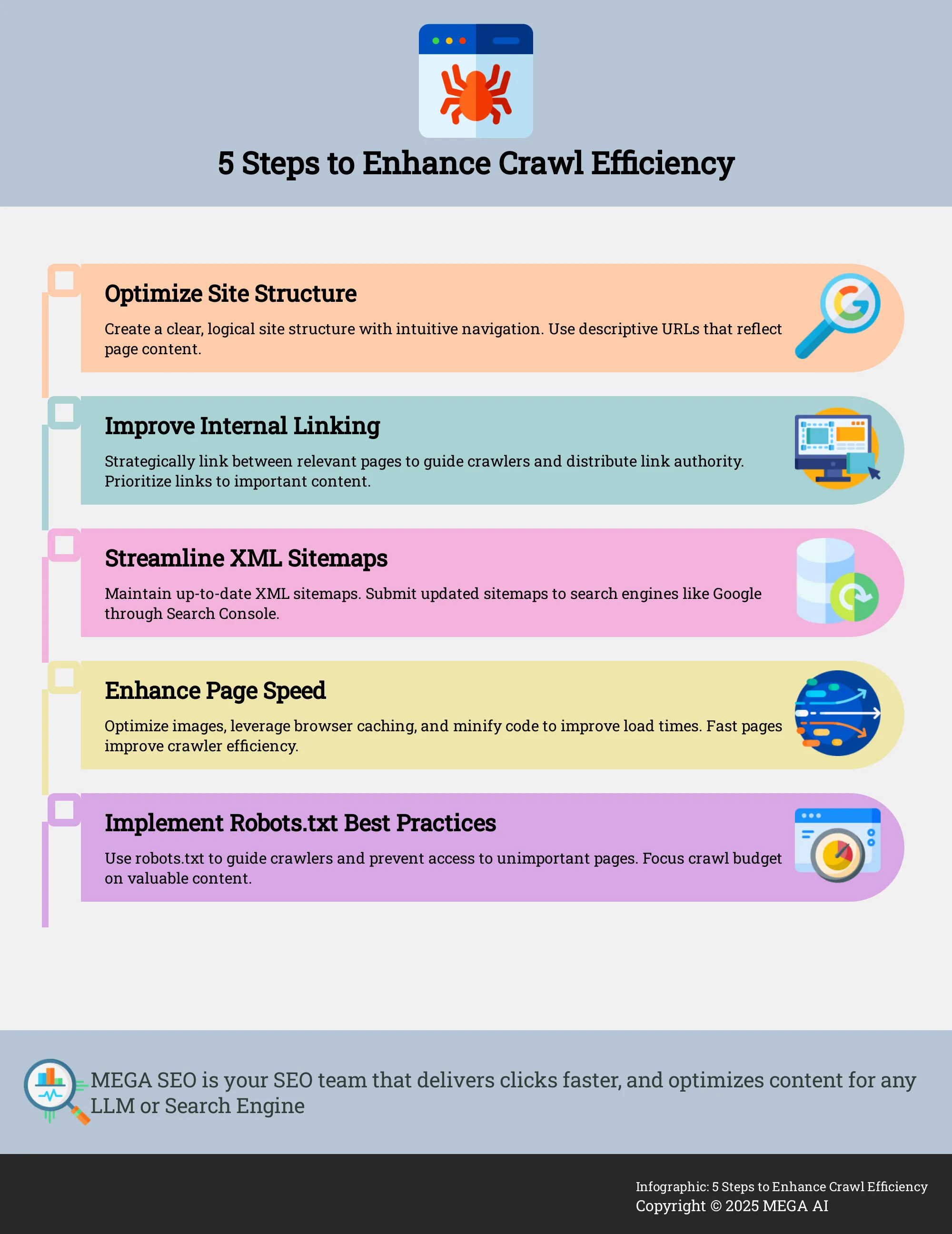
Optimize Your Site Architecture
A well-organized website is fundamental for good crawl efficiency. Imagine trying to find a specific item in a cluttered store versus one with clear aisles and signage; search engine bots experience a similar challenge. A logical site structure with intuitive navigation helps bots move through your site smoothly. Use descriptive URLs that give both users and crawlers an idea of the page's content before they even click.
Aim for a relatively flat site architecture. This means users and bots can reach any page in just a few clicks from the homepage. This approach prevents important content from being buried too deep within your site, ensuring it gets discovered and indexed more readily by search engines.
Improve Your Internal Linking
Your internal linking strategy acts like a well-drawn map for search engine crawlers, guiding them to all the important content on your site. When you link strategically between your pages, you show search engines the relationships between different pieces of content and help distribute link authority across your site. Make sure your most important pages receive plenty of internal links from other relevant pages.
It's also a good practice to link from your more established, high-authority pages to newer or less-popular pages that you want crawlers to find and index. This helps ensure that all your valuable content gets the attention it deserves from search engines, rather than just a few top-level pages, and can help surface content that might otherwise be overlooked.
Streamline Your XML Sitemaps
An XML sitemap is essentially a list of all the important pages on your website that you want search engines to crawl and index. Keeping your XML sitemaps current is a straightforward yet effective way to support crawl efficiency. When you add new content or update existing pages, your sitemap should reflect these changes promptly.
Submitting an updated sitemap to search engines like Google, typically through their Search Console, signals them to come and crawl these new or modified URLs. This practice helps search engines discover your content faster and ensures they are crawling the most relevant versions of your pages. This is especially important for larger websites or sites that update content frequently, as it keeps search engines informed of your latest offerings.
Enhance Page Speed and Performance
How quickly your pages load directly impacts how efficiently search engine bots can crawl your site. Bots have a limited amount of time they can spend crawling any single website, often referred to as the crawl budget. If your pages load slowly, bots will be able to crawl fewer pages within that allocated time, potentially missing important content.
Improving your site's speed and overall performance can significantly aid crawl efficiency. Focus on technical aspects like optimizing images to reduce file sizes, leveraging browser caching so repeat visitors load pages faster, minifying code (CSS, JavaScript, HTML) to remove unnecessary characters, and ensuring your server response times are quick. A faster website not only helps with crawling but also greatly improves the user experience.
Implement Robots.txt Best Practices
The robots.txt file is a powerful tool for guiding search engine crawlers. It's a simple text file placed in your site's root directory that tells bots which parts of your website they should or shouldn't access. Using a robots.txt file effectively can prevent crawlers from wasting their limited time and resources on unimportant or duplicate pages.
For example, you can disallow access to admin areas, internal search results pages, or staging environments that don't need to be in search results. By doing this, you direct the crawl budget towards your valuable, user-facing content that you want indexed. This not only improves crawl efficiency but also helps in prioritizing your most important pages for search engine attention, ensuring they are crawled and indexed more promptly.
How Better Crawling Leads to More Page Views
When search engine bots can easily find and understand your website's content, it sets off a positive chain reaction. Think of it like a well-organized library: if the librarian can quickly locate and categorize every book, they can more effectively recommend those books to interested readers. Similarly, efficient crawling allows search engines to accurately index your pages. This improved indexing means your content is far more likely to appear in relevant search results, which directly boosts your site's visibility.
This increased visibility is key because it means more people will discover your website when they're searching for information or products you offer. And when more people find your site through search, you naturally see an increase in page views. It’s a direct line from how well search engines can explore your site to how many eyes land on your content. By ensuring search bots don't get lost or waste their valuable time on unimportant pages, you're essentially paving the way for your most important content to be discovered by a wider audience. This process is fundamental to growing your organic traffic and, ultimately, achieving more page views. In the sections below, we'll explore exactly how this connection works and why it's so crucial for your website's success.
Efficient Crawling Improves Indexing
Efficient crawling is the bedrock of good indexing. When search engine crawlers can move through your website smoothly, without hitting roadblocks or getting sidetracked by low-value pages, they can do their job much better. A well-optimized site, perhaps using a carefully crafted robots.txt file, guides these crawlers to your most important content. This focused crawling ensures that the crawler’s limited time and resources—often called a crawl budget—are spent on pages you actually want indexed.
If crawlers waste their budget on duplicate content, broken links, or unimportant sections of your site, your key pages might be overlooked or indexed less frequently. This means new content or updates might take longer to appear in search results. By optimizing for crawl efficiency, you ensure that a higher percentage of the crawler's requests fetch valuable content, leading to more comprehensive and timely indexing of your website. This thorough indexing is the first critical step to getting your pages seen.
Its Impact on Search Engine Rankings and Visibility
Once your important pages are efficiently crawled and indexed, your website's potential to rank well in search results significantly improves. Search engines aim to provide users with the most relevant and high-quality results. If they can easily find and understand your content, they are more likely to consider it a good match for user queries. A well-managed crawl budget means that search engines can discover new content and updates on your site faster, keeping your listings fresh and relevant.
Conversely, if your crawl budget is squandered on non-essential pages, search engines might miss your crucial content, which can negatively affect your site's ranking. When search engines can efficiently access and index the breadth of your valuable content, those pages have a better chance of appearing for relevant searches. This increased visibility in search engine results pages (SERPs) is a direct outcome of efficient crawling and is essential for attracting organic traffic.
How Enhanced Crawl Efficiency Drives Organic Traffic
The connection between enhanced crawl efficiency and increased organic traffic is straightforward. When search engines can effectively crawl and index your site, your pages are more likely to rank higher for relevant keywords. Higher rankings mean greater visibility in search results, and greater visibility naturally leads to more clicks and, consequently, more organic traffic to your website. Think of it as ensuring your store is easy for customers to find on a busy street; the easier it is to locate, the more foot traffic you'll get.
Technical SEO enhancements that improve crawl efficiency, like optimizing site structure or improving page speed, directly contribute to better search visibility. By making it easier for search engines to access and understand your content, you're essentially improving your website's discoverability. This improved discoverability ensures that when users search for topics you cover, your pages are among the top results they see, leading to a steady flow of organic visitors and more page views.
What Tools and Techniques Monitor and Improve Crawl Efficiency?
Keeping a close watch on how search engines interact with your website is fundamental to improving your site's crawl efficiency, and ultimately, its performance in search results. You don't need to operate in the dark; a variety of tools and techniques are available to provide clear, actionable insights into this process. By understanding what these tools offer and how to interpret the data, you can move from guesswork to strategic optimization. Monitoring crawl efficiency helps you identify bottlenecks that might be preventing search engines from discovering all your valuable content. It allows you to see if your crawl budget is being spent wisely on important pages or wasted on irrelevant ones.
Effective monitoring reveals patterns in how search engine bots, like Googlebot, access your site, highlighting which sections are frequently crawled and which might be overlooked. It also uncovers errors, such as broken links or server issues, that could hinder crawling. With this knowledge, you can make targeted improvements to your site’s structure, technical setup, and content strategy. The goal is to make it as easy as possible for search engines to find, understand, and index your pages. This proactive approach ensures that your optimization efforts translate into better visibility and more organic traffic. The following sections will explore specific tools and metrics that empower you to take control of your site's crawlability.
Leverage Google Search Console Insights
Google Search Console is an indispensable free tool that provides direct insights from Google itself. One of its most valuable features for understanding crawl behavior is the Crawl Stats report. This report details how many pages Google crawls on your site daily, offering a clear view of your site's interaction with Googlebot and helping you gauge your crawl budget. By analyzing this data, you can spot trends, such as unexpected increases or decreases in crawl activity, and identify potential issues that might be affecting how Google accesses your content. These insights enable you to make informed decisions to optimize your site’s structure and content, ensuring your most important pages are efficiently discovered and indexed.
Use Log File Analysis and Crawl Simulation Tools
For a more granular view of search engine bot activity, analyzing your server's log files is incredibly useful. These files record every request made to your server, including those from search engine crawlers. This allows you to see exactly which pages bots are visiting, how frequently, and if they encounter any errors. While diving into raw log files can be complex, specialized tools can simplify this process. For instance, Oncrawl's log analyser is designed to help detect relevant log changes and understand crawl rates effectively. Additionally, crawl simulation tools can mimic how search engines explore your site, helping you proactively identify issues like broken links or inefficient redirect chains before they impact your live site and search performance.
Key Metrics to Track and Interpret
Beyond the general overview provided by tools like Google Search Console, focusing on specific metrics can offer deeper insights into your crawl efficiency. Key metrics include the crawl rate (the number of pages crawled per second) and the total number of pages crawled over a specific period. It's also important to compare the number of pages submitted in your XML sitemap against the number of pages actually indexed by search engines; a significant discrepancy here can signal crawling or indexing problems. Effectively managing your URL inventory is crucial. You should guide Googlebot to your most important pages while using your robots.txt file to prevent access to low-value or duplicate content areas. As various case studies demonstrate, a well-configured robots.txt file can significantly improve crawl efficiency by ensuring the crawl budget is spent on valuable content.
How to Overcome Common Crawl Efficiency Challenges
Even with the best intentions, your website might encounter a few obstacles that reduce how effectively search engines can crawl it. Imagine a delivery driver trying to locate an address; confusing road signs or unexpected dead ends will certainly slow them down. In the same way, specific website characteristics can make it more difficult for search engine bots to access, process, and understand your content. Identifying these common hurdles is the crucial first step toward creating a smoother path for crawlers, which helps them efficiently find and index your valuable pages. When crawlers face these difficulties, they might miss some of your important content, or they could expend their limited crawl budget on less critical areas of your site. This inefficiency can directly impact your site's visibility in search results, potentially leading to fewer page views and missed opportunities. These challenges aren't insurmountable; often, they stem from common website practices that you can rectify with targeted actions once identified. Understanding and addressing these issues proactively is key to maintaining a healthy, well-indexed website that performs well in search. Let's examine some frequent challenges and discuss practical ways you can overcome them, ensuring search engines can easily navigate and appreciate what your site offers.
Address Duplicate Content Issues
Duplicate content is a common culprit when it comes to wasted crawl budget. This happens when identical or very similar content appears on multiple URLs. Search engines then have to figure out which version is the "main" one, and they might spend time crawling pages that won't even make it into the search results. For small businesses, it's particularly important to guide crawlers effectively. As one case study on crawl efficiency found, "Small business sites with well-crafted robots.txt files avoided wasting Google’s crawl budget on duplicate or low-value URLs." To tackle this, start by identifying any duplicate content on your site. You can then use canonical tags (rel="canonical") to tell search engines which URL is the preferred version you want indexed. If multiple pages serve the same purpose, consider consolidating them or using 301 redirects to point crawlers and users to the primary page. Carefully configuring your robots.txt file can also prevent crawlers from accessing URLs that generate duplicate content.
Manage Low-Quality Pages and Broken Links
Low-quality pages and broken links are like potholes for search engine crawlers. Pages with thin content, auto-generated text, or those that offer little value to users can dilute the overall quality signals of your site and waste crawl resources. Broken links, or 404 errors, lead crawlers to dead ends, which is frustrating for both bots and users. Google suggests that you can improve crawl efficiency by "optimizing page speed, using HTTP status codes strategically, hiding unnecessary pages, and monitoring for overcrawling to help Googlebot prioritize your valuable content." Regularly conduct content audits to identify these underperforming pages. You might decide to improve them, consolidate them, or remove them (using a 301 redirect if they have backlinks). Use tools like Google Search Console to find and fix broken links. For pages you don't want indexed, like internal search results, use the noindex meta tag. This helps search engines focus on your important content.
Optimize JavaScript and AJAX Usage
Modern websites often use JavaScript and AJAX for dynamic experiences. While search engines are better at rendering JavaScript, complex setups can still challenge crawlers. If content loads heavily via JavaScript post-initial load, or navigation relies solely on it without HTML fallbacks, crawlers might miss content or links, leading to incomplete indexing. A thorough technical SEO audit is often "essential to identify and resolve crawl inefficiencies and errors," especially JavaScript-related ones. Consider server-side rendering (SSR) or dynamic rendering, providing crawlers with fully rendered HTML. Ensure you implement important links as standard <a href="..."> tags for easy discovery. Regularly testing how search engines view your pages with tools like Google's Mobile-Friendly Test can help you fix JavaScript crawling issues.
How to Implement a Crawl Efficiency Optimization Strategy
Improving your website's crawl efficiency is a strategic process, not a one-time fix. By systematically auditing, benchmarking, and monitoring, you ensure search engines effectively discover and index your valuable content. This structured approach helps maximize your crawl budget and supports your SEO goals. Let's walk through the key steps to implement a robust crawl efficiency optimization strategy. This process helps identify improvements and maintain optimal performance, ensuring your content gets the visibility it deserves.
Conduct a Comprehensive Crawl Efficiency Audit
Your first step to refine crawl efficiency is understanding your current standing. Conduct a thorough technical SEO audit to pinpoint inefficiencies or errors hindering search engine crawlers. Pay close attention to your robots.txt file. An optimized configuration is crucial; a well-crafted robots.txt prevents search engines from wasting crawl budget on duplicate content or low-value pages. Identifying these issues early creates a clear roadmap for improvements. Many businesses find this initial audit uncovers quick wins for how search engines interact with their site.
Set Benchmarks and Prioritize Optimization Efforts
With your audit complete, use the data to set clear benchmarks and prioritize optimization. Analyze crawl data, review your XML sitemap, and assess your current crawl rate. This information guides robots.txt file tuning to better manage your crawl budget. Effective URL inventory management is key here. Actively direct Googlebot to important pages while blocking irrelevant ones. This prioritization ensures crawlers spend resources on content vital for your visibility and ranking.
Develop Ongoing Monitoring and Adjustment Strategies
Crawl efficiency requires ongoing attention. To maintain optimal performance, develop strategies for continuous monitoring and adjustments. Regularly check crawl stats in tools like Google Search Console and consider log file analysis for deeper insights into search engine interactions. Some platforms offer tools that significantly improve efficiency in detecting changes in crawl patterns. A healthy crawl budget means faster indexing of important pages. Adapt your strategy based on performance data, site updates, or search engine algorithm changes. This continuous improvement is vital for long-term SEO success.
What's the Future of Crawl Efficiency in SEO?
Understanding where crawl efficiency is headed can give you a real edge. Search engines are always getting smarter, and how they find and process your website's content is continually evolving. Staying informed about these changes helps you adapt your strategies to ensure your most important pages get the attention they deserve, leading to better visibility and, ultimately, more page views.
Emerging Trends in Search Engine Crawling
One of the key trends we're seeing is an even greater emphasis on efficient crawl budget management. Search engines have finite resources, so they prefer not to waste time on unimportant or duplicate pages. Think of it like this: you want to give clear directions so they can find your best stuff quickly. For instance, a well-structured robots.txt file acts as a guide, telling search engine bots which parts of your site to crawl and which to ignore. Studies have shown that sites with optimized configurations prevent crawl budget from being wasted on low-value URLs, meaning more of the crawler's attention goes to your valuable content. This direct approach ensures that your key pages are discovered and indexed more effectively.
Prepare for Evolving Crawl Efficiency Best Practices
So, how can you get ready for these evolving practices? It starts with a proactive approach to your site’s technical health. You can significantly improve how search engines crawl your site by focusing on core areas. Optimizing page speed is crucial; faster pages are easier for bots to process. Using HTTP status codes strategically, like 301s for redirects or 404s for missing pages, guides crawlers correctly. Also, hide unnecessary pages using noindex tags or robots.txt to ensure the crawl budget focuses on content that matters.
Regularly monitoring for overcrawling helps Googlebot prioritize valuable content. A comprehensive technical SEO audit is invaluable for pinpointing inefficiencies. For businesses looking to streamline this, platforms like MEGA AI offer SEO tools that automate many technical improvements and content optimizations, keeping your site aligned with best practices.
How to Maximize the Benefits of Enhanced Crawl Efficiency
Getting search engines to crawl your site efficiently is a significant step. But to truly reap the rewards, you need to understand its long-term effects and how it fits into your overall SEO picture. This ensures your efforts translate into sustained growth and better online visibility, helping you make the most of every visit from a search engine bot.
Its Long-Term Impact on Website Growth and Success
Improving how search engines explore your website isn't just a quick technical fix; it's a genuine investment in your site's future. When your site’s configuration is well-tuned, it significantly improves crawl efficiency, meaning search engine bots, like Googlebot, don’t expend their limited resources on unimportant or duplicate pages. Instead, they can dedicate their time to discovering and indexing your valuable content.
Over time, this focused crawling ensures that more of your important pages are indexed and stand a better chance to rank for relevant searches. Consistent discovery of your quality content builds a stronger foundation for organic traffic growth. Think of it as ensuring your best products are always visible on the most accessible shelves in a store – easier for customers, or in this case, search engines, to find and appreciate. This sustained attention helps solidify your site's presence and authority in search results.
Balance Crawl Efficiency with Other SEO Priorities
While optimizing for crawl efficiency is crucial, it’s important to remember it’s one component of a larger SEO puzzle. Effective SEO strategies require a holistic view. The clearer your site communicates its structure and important content, the better crawlers can understand it. This involves integrating crawl data, your XML sitemap, and desired crawl rate to fine-tune your robots.txt file effectively, ensuring search engines prioritize your most valuable content.
A perfectly crawled site still needs high-quality content, a positive user experience, relevant keywords, and authoritative backlinks to perform well in search results. For instance, ensuring your technical SEO is sound allows crawlers easy access, but compelling content is what will ultimately engage users and earn rankings. Balancing these elements ensures that when search engines efficiently find your pages, those pages are also valuable and satisfying for your audience, leading to better engagement and conversion.
Related Articles
- Boost Your SEO Strategy: Mastering Crawlability Tips
- Boost SEO Crawlability: The Ultimate Guide
- How to Optimize Your Crawl Budget for Better Indexing
- Top 5 Website Indexing Tools for SEO Pros
- Unlocking the Secrets of Technical SEO: Enhancing Site Structure for Better Crawlability - MEGA SEO | Blog
Frequently Asked Questions
What's the simplest way to think about crawl efficiency? Think of crawl efficiency as making it super easy for search engine bots, like Googlebot, to explore your website. If your site is well-organized and loads quickly, these bots can find and understand your important pages without getting stuck or wasting time on less critical stuff. This helps your content get noticed and listed in search results faster.
Why is my robots.txt file so important for crawl efficiency? Your robots.txt file is like a set of instructions for search engine crawlers. It tells them which parts of your website they should visit and which areas they should skip. By guiding crawlers away from unimportant pages, like admin logins or duplicate content, you help them focus their limited time—their crawl budget—on your valuable content that you actually want people to find.
If I improve my site speed, will that automatically make it easier to crawl? Yes, improving your site speed definitely helps. Search engine bots have a limited amount of time to spend on your site. If your pages load quickly, they can visit and process more pages during their visit. This means more of your content can be discovered and indexed efficiently, which is a big plus for your visibility.
How does having a clear site structure help with crawl efficiency? A clear site structure, with logical navigation and well-organized categories, acts like a good map for search engine crawlers. It helps them understand how your content is related and makes it easier for them to move from one page to another. When bots can easily find their way around, they can discover all your important pages more effectively.
What’s one common mistake that hurts crawl efficiency for small business websites? A frequent issue is having duplicate content across different URLs without telling search engines which version is the main one. This can confuse crawlers and make them waste time indexing multiple versions of the same page. Using canonical tags or clear robots.txt directives helps guide them to the content you want prioritized.