
Search engines like Google work tirelessly to understand and categorize the vast amount of information online. To help them see your website in the best possible light, you need to speak their language – and a key part of that language is structure. A clear content hierarchy acts as your translator, clearly communicating what your site is about and which pages hold the most important information. This organization is fundamental for SEO. If crawlers can easily navigate and understand your content, your site stands a much better chance of ranking well. We're going to look into the benefits of content hierarchy establishment for improved crawlability? and how this can make a real difference to your online visibility.
Key Takeaways
- Focus on Logical Organization: Structure your website content clearly so visitors can navigate with ease and search engines can effectively process and rank your pages.
- Use Foundational Building Blocks: Create a strong hierarchy with proper heading usage (H1-H6), strategic internal linking, and a straightforward, mobile-responsive site design.
- Maintain and Adapt Your Hierarchy: Regularly review your content structure through audits and user feedback, making adjustments to meet evolving search engine standards and audience preferences for sustained SEO success.
What is Content Hierarchy and Why Does It Matter for SEO?
Think of your website like a well-organized book. Just as a book has chapters, headings, and subheadings to guide you through its contents, your website needs a clear structure so visitors and search engines can easily find what they're looking for. This organization is what we call content hierarchy. It’s a fundamental piece of a strong SEO strategy because it directly influences how easily users can navigate your site and how effectively search engines can understand and rank your pages. When your content is logically arranged, it not only helps users have a better experience but also makes it much simpler for search engines like Google to process your information. This means your valuable content has a better chance of being seen by the right audience.
Getting your content hierarchy right can significantly impact how well your site performs in search results. It’s about making sure your most important information is prominent and that related topics are grouped together in a way that makes sense. This clarity helps search engines crawl your site more efficiently, understand the relationships between different pieces of content, and ultimately, determine your site's relevance for specific search queries. A well-planned hierarchy acts as a roadmap for both your users and for search engine bots, guiding them to the most important destinations on your site.
Understanding Content Hierarchy
Content hierarchy is essentially the way you arrange information on your website, ensuring that the most important content is the easiest to find and understand. As the team at Bynder puts it, "Content hierarchy is arranging website information so the most important stuff is easiest to see." This usually means placing your key messages and core topics prominently, often near the top of a page or in easily accessible sections of your site. This organization isn't just for aesthetics; it directly influences how users interact with your site and how search engines perceive its value.
A well-defined content hierarchy is vital for effective search engine optimization because it impacts how search engines crawl and index your website. If search engines can easily understand the structure and relative importance of your content, they are more likely to rank it favorably. This structured approach helps signal to search engines what your site is about and which pages are most critical, forming a cornerstone of your SEO efforts.
How Content Hierarchy Affects Site Structure and Crawlability
Your content hierarchy directly shapes your website's overall structure, which in turn affects how easily search engine bots can crawl and index your pages. When your content is organized logically, with clear relationships between main topics and subtopics, search engines can more efficiently discover and understand all the content you offer. According to Linkbot, "Effective content structure and heading hierarchy are crucial for enhancing Google's crawlability and indexing efficiency." This means a clear hierarchy helps Google find and process your pages faster.
Google actually recommends a hierarchical website structure to improve SEO. This involves organizing your content in layers, moving from broad, general topics down to more specific ones. This kind of structure doesn't just benefit search engines; it also makes it easier for your human visitors to find what they need, leading to a better user experience. When both users and search engines can easily make sense of your site, your chances of ranking higher improve.
What Makes a Content Hierarchy Effective?
An effective content hierarchy does more than just arrange your information neatly; it acts as a clear, intuitive guide for both your website visitors and search engine crawlers. When you establish a strong hierarchy, you significantly improve how easily your content can be found, understood, and ultimately, valued. Think of it as creating a detailed map for a large library – it helps everyone locate exactly what they're looking for without getting lost. This structured approach is fundamental because it directly impacts user experience. Visitors who can easily find information are more likely to stay on your site, engage with your content, and convert.
Furthermore, a logical content hierarchy is essential for search engine optimization. Search engines like Google rely on this structure to understand the relationships between different pages and the overall themes of your website. A clear hierarchy helps crawlers index your site more efficiently, which can lead to better search rankings and increased organic traffic. It’s about making your content accessible and digestible for machines as well as humans. Several key elements contribute to this effectiveness, from the strategic use of headings and smart internal linking to clear site architecture and mobile-responsive design. Each component plays a vital role in building a robust and user-friendly online presence.
Using Headings (H1, H2, H3, etc.)
Headings are fundamental to a strong content hierarchy. Your H1 tag should clearly state the main topic of your page, acting as its primary title. Subsequent headings, like H2s and H3s, then break down the content into digestible subtopics, creating an organized and scannable structure. This isn't merely for aesthetics; these tags are essential for SEO. They provide a clear roadmap for search engines, helping them understand the main points and the organization of your content. A well-defined heading structure also allows users to quickly find the specific information they need, improving readability and keeping them engaged with your page.
Smart Internal Linking
Smart internal linking is another vital piece of an effective content hierarchy. When you strategically connect related pages within your own website, you help search engines discover more of your content and grasp the relationships between different pieces of information. This practice also plays a role in distributing "link equity" or ranking power throughout your site. For your visitors, thoughtful internal links offer a seamless way to explore relevant topics further, enriching their experience and encouraging them to spend more time engaging with your material. Always aim to use descriptive anchor text for these links, as this provides valuable context for both users and search engines.
Clear URLs and Site Architecture
The overall structure of your website, often called site architecture, should be logical and easy for users to follow, and your URLs should mirror this clarity. A common and effective approach is to build a pyramid-like structure: your homepage sits at the top, followed by main category pages, then subcategories, and finally, individual content or product pages. This type of organized system acts like a clear filing cabinet for your website, making it simple for users to understand their location and find what they need. Search engines also favor well-defined site architecture and concise, keyword-relevant URLs because this helps them crawl and index your content more effectively.
Designing for Mobile
In our current digital environment, a large amount of web traffic originates from mobile devices. Consequently, an effective content hierarchy must be supported by a mobile-friendly design. This means your website needs to adapt smoothly to various screen sizes, ensuring that text is easy to read, buttons are simple to tap, and overall site interaction is straightforward on smartphones and tablets. A responsive design is crucial here, as it automatically adjusts your site’s layout to fit the user's device. Google considers mobile-friendliness a significant ranking factor, so providing a positive mobile experience is vital for both user satisfaction and your SEO results.
How to Build a Strong Content Hierarchy
Building a strong content hierarchy is like creating a clear roadmap for your website. It guides both your visitors and search engines, making your site much easier to understand and use. When your content is well-organized, it not only improves the user experience but can also give your SEO a significant lift. Let's walk through some practical steps to construct a hierarchy that truly works for you.
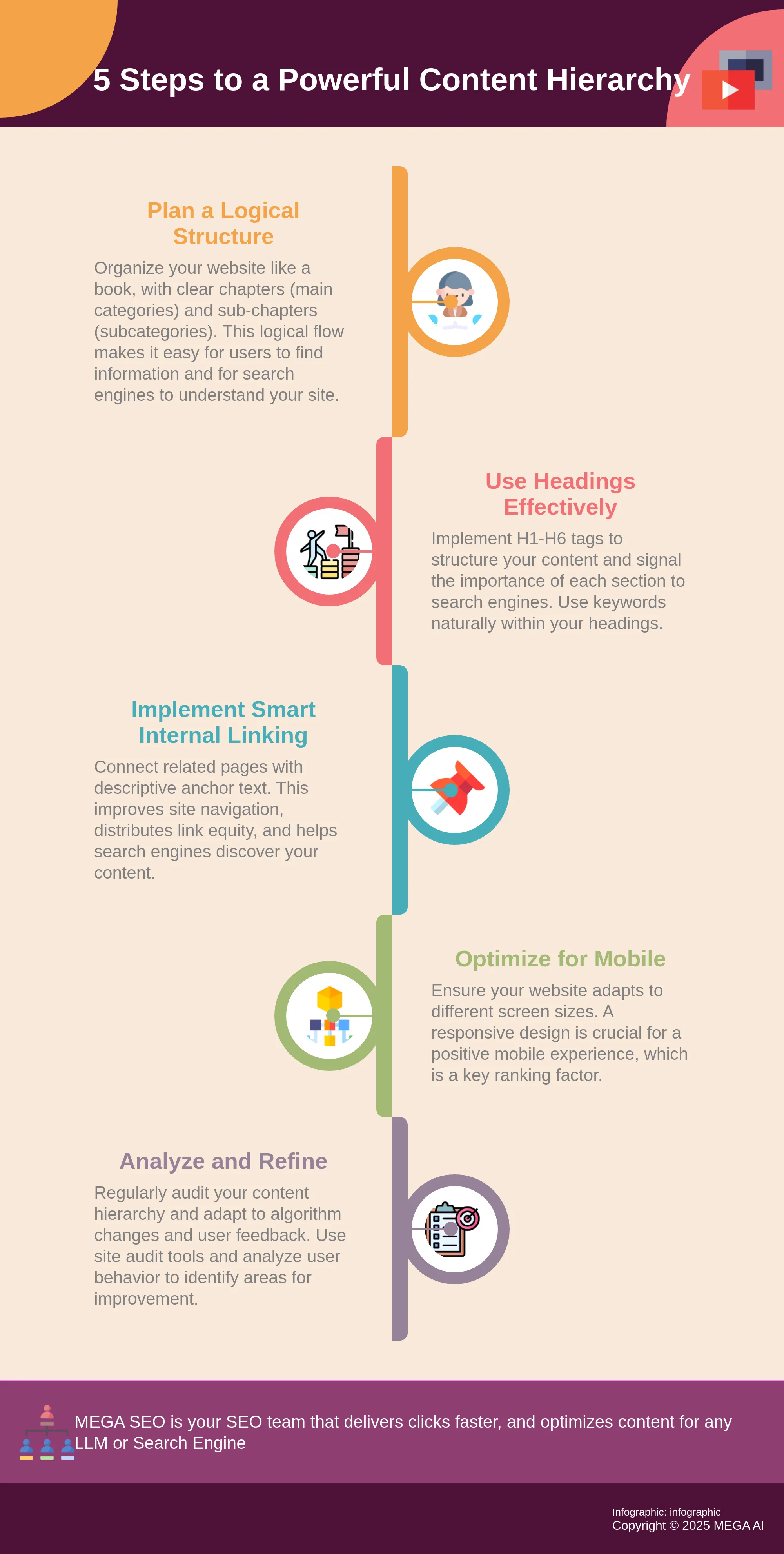
Create a Logical Information Flow
Think of your website as a well-organized library. You want your visitors to easily find the information they're looking for, moving smoothly from general categories to more specific topics. A well-thought-out hierarchical structure helps both search engines like Google and your website visitors understand and navigate your website more effectively. This logical flow ensures that users aren't overwhelmed and can intuitively find what they need. This naturally improves their overall experience and encourages them to stay longer, exploring more of what you offer.
Use Clear and Relevant Headings
Headings, such as H1s, H2s, and H3s, do more than just break up text visually; they are fundamental for both SEO and readability. They create a clear structure on each page, signaling to Google and your readers what content is most important. As the folks at Linkbot point out, these headings form a hierarchy that clarifies the main points of your page. So, make sure your headings accurately describe the content that follows. It's also a good practice to use your keywords naturally within them to help both users and search engines quickly grasp the topic of each section.
Link Internally with Purpose
Internal links are the pathways that connect your content, effectively guiding users and search engines through your site. When you thoughtfully link related articles and pages, you help distribute page authority and make it easier for search engines to discover all your valuable content. This practice is crucial for SEO because it helps establish context and relevance between different pieces of information on your site. A strong internal linking strategy not only strengthens your site's overall SEO performance but also keeps users engaged by offering them relevant next steps and further reading opportunities.
Optimize for Users and Search Engines
Ultimately, the goal is to create a website that serves both your audience and search engine crawlers effectively. Improving your website's structure and using headings correctly is a straightforward yet powerful way to enhance your search engine rankings and the user experience. When users find your site easy to use and the content valuable, search engines often take that as a positive signal, which can lead to better visibility. Tools like MEGA AI's SEO features can also assist in refining your content structure, ensuring it meets best practices for both your human visitors and search algorithms, making this optimization process smoother.
How Content Hierarchy Improves Crawlability
Think of your website as a well-organized library. When a librarian (or in this case, a search engine crawler) enters, they can quickly understand what topics are covered and where to find specific information if the sections are clearly labeled and books are logically arranged. A strong content hierarchy does exactly this for your website, making it significantly easier for search engines like Google to understand and index your content. This isn't just about tidiness; it's a fundamental aspect of technical SEO that directly impacts how search engines perceive and rank your site.
When search engine bots crawl your website, they follow links and analyze the structure to determine the relationship between different pieces of content. A clear hierarchy, established through proper use of headings, internal links, and site architecture, provides a roadmap for these crawlers. It helps them identify your most important pages, understand the topical relevance of your content, and efficiently discover new or updated material. Without this clarity, crawlers might struggle to find all your valuable content, or they might misunderstand its importance, which can hinder your site's ability to rank well. Essentially, a logical content hierarchy streamlines the crawling process, ensuring that search engines can effectively access and interpret the information you're providing. This efficiency is crucial for getting your content seen by the right audience. Our SEO tools at MEGA AI can help you analyze and optimize your site's structure to ensure it's crawler-friendly.
Better Search Rankings and Visibility
A clear content hierarchy is a cornerstone for achieving better search rankings and increasing your website's visibility. As research from Linkbot points out, "Google's search engine robots ('crawlers') rely heavily on how a website is organized to understand its content. A well-structured site is easier for them to understand, leading to better search rankings." When your site is well-structured, it's much easier for these crawlers to interpret the information on your pages. This improved understanding allows search engines to more accurately match your content with relevant user queries.
Think of it this way: if your most important ideas are clearly signposted with H1 tags, and supporting concepts are neatly arranged under H2s and H3s, search engines can quickly grasp the main topics and subtopics of each page. This clarity helps them determine the relevance of your page to specific searches, which can lead to higher placement in search results. Ultimately, a site that is easy for search engines to understand is more likely to be ranked favorably, making your content more visible to potential customers.
More Organic Traffic and Engagement
A logical content hierarchy, particularly when implemented using content clusters, plays a significant role in attracting more organic traffic and keeping visitors engaged. Content clusters, which involve a central "pillar" page linked to several related "cluster" pages, help search engines understand your website's authority on a particular topic. As Content Whale aptly notes, "Content clusters help search engines understand your website better, leading to higher rankings. This is because they organize content logically and show the relationship between different pages."
When search engines recognize your site as a comprehensive resource on a subject, they are more likely to rank your pages higher for relevant keywords. This increased visibility naturally leads to more organic traffic. Furthermore, a well-organized site makes it easier for users to find related information, encouraging them to explore more of your content. This deeper engagement signals to search engines that your site provides value, which can further support your SEO efforts.
Faster Content Indexing
A well-defined content hierarchy not only helps search engines understand your content but also speeds up the process of getting your pages indexed. Indexing is how search engines add your web pages to their vast database, making them eligible to appear in search results. A hierarchical structure, as Now Media Group highlights, "helps both search engines (like Google) and website visitors understand and navigate your website more easily."
When crawlers can efficiently move through your site, following a clear path from main categories to subcategories and individual pages, they can discover and process your content more quickly. This is especially important for new content or updates to existing pages. If your site structure is confusing or lacks clear pathways, crawlers might take longer to find and index your pages, or they might miss some altogether. A logical hierarchy ensures that your valuable content gets into Google's index faster, allowing it to start ranking and attracting visitors sooner.
Improved User Experience
Beyond the technical benefits for search engines, a strong content hierarchy significantly improves the user experience on your website. When visitors land on a page, they want to find information quickly and easily. A well-structured website with clear headings, logical navigation, and a sensible flow makes it simple for people to read and understand your content. As Linkbot's research indicates, "A well-structured website with clear headings is easier for people to read and navigate. This leads to people spending more time on your site and leaving positive signals for Google's search algorithms."
This ease of use leads to a more positive experience for your visitors. They are more likely to stay on your site longer, explore multiple pages, and find what they're looking for. These positive user engagement signals, such as lower bounce rates and increased time on site, are important indicators for Google's search algorithms. When users have a good experience, it suggests to search engines that your site is valuable and relevant, which can indirectly contribute to better rankings.
How Does Content Hierarchy Support Your SEO?
A well-thought-out content hierarchy does more than just make your website look organized; it’s a powerful tool for your search engine optimization (SEO) efforts. Think of it as the blueprint for your website's content, guiding both users and search engine crawlers to understand what your site is about and which pieces of information are most important. When search engines can easily understand your content's structure and relevance, they are more likely to rank it favorably. This means your carefully crafted articles and pages have a better chance of appearing in front of the right audience when they search for topics you cover.
A strong content hierarchy directly impacts how search engines like Google perceive your site's authority and expertise on specific subjects. By logically organizing your content, you're essentially telling search engines, "Hey, I know a lot about this topic, and here’s how all my information connects." This clarity helps them index your content more effectively and match it to relevant search queries. Furthermore, a good hierarchy improves user experience, encouraging visitors to stay longer and explore more of your site—signals that search engines value. At MEGA AI, we've seen firsthand how structuring content effectively can significantly improve SEO performance for businesses of all sizes. It’s a foundational element that supports all other SEO activities, from keyword optimization to link building.
Optimize Keywords Within Your Hierarchy
Your content hierarchy provides a natural framework for strategic keyword placement. Headings, from H1 down to H6, aren't just for visual appeal; they signal the importance and subject of the content that follows. As one source aptly puts it, "Headings aren't just for making web pages look nice; they're essential for SEO. They create a hierarchy that shows Google (and readers) what's most important on the page." By incorporating your primary and secondary keywords into these headings in a natural, reader-friendly way, you clearly communicate the topic of each section to search engines. This helps them understand the relevance of your page to specific search queries, making it easier for your target audience to find you.
Make Content Easier to Find and More Relevant
When your content is well-organized with a clear hierarchy, it becomes much simpler for visitors to navigate your website and find the information they need. This improved user experience is a big win for SEO. People are more likely to spend more time on your site, explore multiple pages, and engage with your content when it's easy to understand and follow. These positive user behaviors, like lower bounce rates and longer dwell times, send strong signals to search engines that your site provides value. As experts note, "A well-structured website with clear headings is easier for people to read and navigate. This leads to people spending more time on your site and leaving positive signals for Google's search algorithms," ultimately contributing to better search rankings.
Strengthen Your Internal Linking
A solid content hierarchy naturally supports a robust internal linking strategy. When your content is organized into logical categories and subcategories, you can easily create meaningful links between related pieces of content. These internal links act as pathways, guiding both users and search engine crawlers through your site. This helps search engines discover new content and understand the relationships between different pages, which is "crucial for SEO." Furthermore, using content clusters, where a central "pillar" page links to related "cluster" pages, reinforces your site's authority on specific topics. This interconnectedness "help[s] search engines understand your website better, leading to higher rankings" because it clearly demonstrates the depth and breadth of your expertise.
Common Content Hierarchy Mistakes to Avoid
Building a solid content hierarchy is a fantastic step, but it's easy to stumble along the way. Knowing the common pitfalls can help you sidestep them and keep your website structure strong and effective for both users and search engines. Let's look at a few frequent missteps and how you can steer clear of them. Getting these right will make your content more accessible and improve its chances of ranking well.
Don't Skip Heading Levels or Overcomplicate
Think of headings—like H1, H2, and H3—as the structural outline of your page. As research points out, "Headings (, , , etc.) aren't just for making web pages look nice; they're essential for SEO. They create a hierarchy that shows Google (and readers) what's most important on the page." A common mistake is skipping these levels, for instance, jumping from an H1 directly to an H3. This can confuse search engine crawlers and make your content harder for users to scan. Always use HTML heading elements in logical, sequential order.
Similarly, try not to overcomplicate your heading structure. While detail is good, an excessively nested hierarchy with too many H4s, H5s, and H6s for minor points can make the content feel dense. Aim for a clear, logical flow that guides the reader smoothly.
Balance SEO with User Experience
It's tempting to focus solely on SEO elements, like keyword placement in headings, but this shouldn't come at the expense of the user experience. A well-structured page with clear, logical headings is naturally easier for people to read and understand. When users can easily find what they're looking for, they're more likely to stay on your site longer. As studies show, "This leads to people spending more time on your site and leaving positive signals for Google's search algorithms."
Your content hierarchy should serve your audience first. If it makes sense to a human reader, it will likely make sense to search engine algorithms too. Strive for clarity and readability in your headings and overall page layout. Remember, Google's search algorithms are increasingly sophisticated and prioritize content that genuinely serves user needs.
Solve Mobile Optimization Challenges
With a significant portion of web traffic coming from mobile devices, ensuring your content hierarchy works flawlessly on smaller screens is crucial. A structure that looks great on a desktop might become cumbersome on a phone. For instance, long headings or deeply nested navigation can be tricky on mobile. Your website needs to adapt gracefully, and a "responsive design automatically adjusts to different screen sizes," which is key.
Think of your site structure like a pyramid: "Homepage, then main categories, then subcategories, then individual pages." This clear path should be easily navigable on any device. Regularly test your site's mobile usability and pay attention to how your headings and content flow appear on different screen sizes. Simple, clear navigation is a cornerstone of good mobile optimization.
How to Analyze Your Content Hierarchy
Understanding how well your current content hierarchy is performing is key to making smart improvements. It’s not just about setting it up and forgetting it; you need to regularly check in to see what’s working and what needs a little tweaking. Think of it like a health check-up for your website's structure, ensuring everything is functioning smoothly beneath the surface. By looking at specific tools and user behaviors, you can get a clear picture of how effectively your hierarchy is guiding both search engines and your visitors. This analysis helps you pinpoint areas where users might be getting lost, where content isn't resonating, or where search engines are struggling to understand your content's importance and relationships. Ultimately, a strong analysis leads to better user engagement and improved search visibility.
Fortunately, there are straightforward ways to get this insight. You don’t need to be a technical wizard to understand the basics. We’ll look at how site audit tools can give you a technical overview and how analyzing user behavior can tell you the human side of the story. Both perspectives are crucial for a well-rounded understanding. With these insights, you can make informed decisions to refine your hierarchy, ensuring it supports your SEO goals and provides a great experience for your audience. Platforms like MEGA AI can also simplify much of this analysis, especially when it comes to technical SEO and content optimization.
Use Site Audit and Crawl Analysis Tools
Site audit and crawl analysis tools are your best friends when it comes to getting a technical snapshot of your content hierarchy. These tools act like a detective, scanning your website to find clues about its structure and accessibility. They can highlight crawlability errors, which are issues that prevent search engines from properly accessing and indexing your content. If search engines can't crawl your pages efficiently, those pages won't rank, no matter how great the content is.
Many SEO platforms offer these auditing features. For instance, Ahrefs’ Site Audit includes a "Health Score" that quickly shows you the proportion of your site’s internal URLs that are free of technical SEO errors. A lower score might indicate problems with your hierarchy, like broken internal links or pages that are too many clicks deep from the homepage. Regularly running these audits helps you catch and fix issues that could be undermining your SEO efforts, ensuring your carefully structured content is actually discoverable.
Analyze User Behavior for Optimization
While technical tools tell you how search engines see your site, analyzing user behavior tells you how actual people interact with it. Metrics like dwell time and average time on page offer valuable insights into whether your content hierarchy is intuitive and engaging. For example, analyzing dwell time can help you understand if your content truly addresses what users are searching for. If users land on a page and quickly leave, it might mean the content wasn't what they expected, or they couldn't easily find the next logical step.
The average time on page is another useful indicator. If users spend a good amount of time on a page, it suggests the content is relevant. A well-structured hierarchy encourages users to explore further, which naturally increases their time on site. If these metrics are low, your hierarchy might not be guiding users effectively.
How to Maintain and Evolve Your Content Hierarchy
Creating a solid content hierarchy isn't a one-time task; it's an ongoing commitment. To keep your structure effective and working hard for your SEO, you'll need to revisit and refine it regularly. Think of it like tending a garden—consistent care ensures it continues to flourish. This involves periodically checking its health, adapting to new conditions, and measuring how well it's performing to support your online goals.
Conduct Regular Content Audits
A key part of maintaining your content hierarchy is performing regular content audits. This means taking a close look at your existing structure to ensure it’s still logical and effective. A well-structured website is fundamental for both user experience and search engine optimization. During an audit, pay special attention to your headings (H1s, H2s, H3s, etc.).
You'll want to review your website's headings to confirm they are used correctly, follow a logical sequence, and accurately describe the content they introduce. This simple check can uncover areas for improvement that significantly impact how search engines understand your pages. Set a schedule for these audits—perhaps quarterly or bi-annually—to catch outdated information or broken links, keeping your site organized.
Adapt to Algorithm Changes and User Needs
The digital landscape is always changing. Search engine algorithms get updated, and what your audience is searching for can shift over time. Your content hierarchy needs to be flexible enough to adapt to these changes. Keeping your hierarchy aligned with both user experience and the technical demands of search engines is crucial for maintaining visibility and rankings. This means staying informed about major algorithm updates and understanding how they might affect your site.
Equally important is listening to your users. Are they finding what they need? Is your content answering their questions effectively? A positive user experience is a significant factor in SEO, and building topic authority around what your users care about is essential for long-term success. If you notice user behavior patterns changing, be prepared to adjust your content organization.
Measure Success with KPIs and Engagement
To understand if your content hierarchy is truly working, you need to track its performance. Key performance indicators (KPIs) and user engagement metrics offer valuable insights. Keep an eye on metrics like organic traffic, bounce rate, and conversion rates for pages within your hierarchy. Analyzing dwell time on your pages, for instance, can reveal whether your content effectively addresses what users are looking for.
Technical SEO metrics are also important. For example, crawlability errors can indicate that search engines are having trouble accessing parts of your site, potentially due to a confusing hierarchy. Regularly monitoring these KPIs will help you identify what’s working well and what needs adjustment, allowing you to continuously refine your strategy for optimal results.
Does Content Hierarchy Differ by Website Type?
The fundamental goal of content hierarchy—making information accessible and logical—is universal. However, the way you achieve this can look quite different depending on what your website is trying to do. Think about it: the journey a customer takes on an e-commerce site to find and purchase a product is very different from the path a reader follows on a blog to consume information, or how a potential client explores a service-based website to understand offerings and build trust. Each type of site has unique user expectations and business objectives. This means the emphasis on certain types of content, the structure of navigation, and even the way you organize internal links will need to be adapted.
A rigid, one-size-fits-all approach simply won’t cut it if you’re aiming for optimal user experience and search engine performance. For instance, an e-commerce site might prioritize clear categorization and filtering options, while a blog might focus on chronological or topic-based organization. Service sites often benefit from a structure that guides users through a solutions-focused journey. Recognizing these distinctions allows you to build a more effective and targeted content structure, ultimately leading to better engagement and conversion rates. MEGA AI's SEO platform can assist in tailoring these structures by providing insights into how users interact with different types of content on your site.
E-commerce vs. Blogs vs. Service Sites
For e-commerce sites, a clear, hierarchical structure is absolutely vital. Think product categories, subcategories, and individual product pages, all logically connected to make it easy for shoppers to find what they need and for search engines to understand your offerings. This is essential for both user experience and SEO success. Blogs, on the other hand, thrive on well-structured posts. Using headings (H1, H2, H3) correctly not only improves SEO performance but also makes your content more readable and accessible. For service-based websites, the content hierarchy should guide potential clients smoothly, showcasing expertise and solutions. This alignment of user experience with search engine requirements leads to better visibility and higher rankings.
Tailor Strategies for Your Industry
Beyond the general type of website, your specific industry also plays a significant role in how you should structure your content. What works for a local bakery's website might not be the best approach for a B2B software company. The key is to understand your audience's search intent and information needs within your particular niche. Improving your website's structure and using headings correctly is a simple yet powerful way to improve your search engine rankings and user experience. This means tailoring your keyword strategy, the depth of your content, and how you build topic authority to match what’s standard and expected in your field. A well-thought-out, industry-specific hierarchy makes your site more intuitive for users and more authoritative in the eyes of search engines.
Related Articles
- Guide to Header Tags for Better On-Page SEO Structure
- Master Technical SEO: A Comprehensive Guide for Success
- Content Optimization - MEGA SEO | Blog
- Learn How to Structure Your Website to Improve Search Engine Crawlability and Indexing: Advanced Technical SEO Techniques - MEGA SEO | Blog
- Internal Links: Boost Crawling & Indexing for SEO
Frequently Asked Questions
What's the main goal of having a good content hierarchy? The primary purpose of a solid content hierarchy is to make your website easy to understand for both your visitors and search engines. It organizes your information logically, so people can find what they need without confusion, and search engines can efficiently grasp what your site is about and how different pieces of content relate to each other.
How do headings like H1 and H2 tags actually improve my website? Headings are more than just a way to style your text; they create a clear outline for each page. Your H1 tag should be the main title, telling everyone the page's core topic. Subsequent headings like H2s and H3s break down that topic into smaller, digestible sections. This structure makes your content easier for people to read and scan, and it also signals the importance and organization of your information to search engines.
Is content hierarchy only important for large websites with lots of pages? Not at all. While it's certainly crucial for large sites, a good content hierarchy benefits websites of any size. Even if you have just a few pages, organizing them logically helps users navigate more easily and allows search engines to understand your site's focus from the get-go. It sets a strong foundation for future growth.
Can I just organize my content once and then forget about it? It's best to think of your content hierarchy as something that might need adjustments over time. As your website grows, you add new content, or even as search engine best practices evolve, you'll want to revisit your structure. Regularly reviewing and tweaking your hierarchy ensures it continues to serve your audience and your SEO goals effectively.
Beyond helping with search engines, how does a good content hierarchy benefit my actual visitors? A clear content hierarchy significantly improves the experience for people visiting your site. When information is well-organized and easy to find, visitors are less likely to get frustrated or leave. They can navigate intuitively, understand your content more easily, and are often encouraged to explore more of what you offer, leading to a more positive interaction with your brand.