
For startups and small businesses, every piece of content needs to contribute to building a strong online presence and demonstrating expertise. A scattered approach to publishing can dilute your message and make it harder to be seen as an authority in your niche. Implementing a clear content hierarchy provides the solution, offering a structured way to present your knowledge. We're going to explore exactly what are the benefits of content hierarchy establishment for improved site authority? By understanding how to organize your information effectively, from pillar pages to cluster content, you can significantly enhance your site's credibility and search visibility.
Key Takeaways
- Organize for Authority: Structure your website content logically to clearly demonstrate your expertise, making it easier for both visitors and search engines to recognize your site as a go-to resource.
- Connect Content with Pillars and Clusters: Create comprehensive pillar pages for broad topics and link them to detailed cluster articles on specific subtopics, effectively showcasing your in-depth knowledge.
- Refine for Better User Experience and SEO: Regularly review and adjust your content hierarchy to ensure it helps users find information easily and improves how search engines understand and rank your site.
What is Content Hierarchy and Why Does it Matter for Site Authority?
Think of content hierarchy as the way you organize all the information on your website. It’s about structuring your pages and posts so that both your visitors and search engines can easily find their way around and understand how different pieces of content relate to each other. A well-thought-out content hierarchy acts like a clear map, guiding users to the information they're looking for and helping search engines efficiently crawl and index your site. This careful organization is really important for creating a good user experience, which often means people will spend more time on your site, find what they need without frustration, and view your site more favorably.
Now, why is this structure so crucial for building your site's authority? When your content is arranged logically, perhaps using what's known as a "silo structure" or by creating "topic clusters," you're essentially showcasing your expertise and the depth of your knowledge on specific subjects. By strategically grouping related articles and pages around central themes, your website can clearly demonstrate its authority in those particular areas. This structured approach doesn't just help your SEO by making your site easier for search engines to understand; it also makes a big difference in how users engage with your site. When visitors can easily find related information and follow a clear path through your content, they're more likely to see your website as a trustworthy and valuable resource in your field, which directly contributes to its perceived authority.
Understand Effective Content Hierarchy
To really get a handle on building site authority, it’s helpful to understand the building blocks of an effective content hierarchy. Think of it like constructing a well-organized library where every book is easy to find and its relationship to other books is clear. This structure isn't just about looking neat; it's a fundamental part of how search engines perceive your expertise and how users find the information they need. When your content is logically arranged, it signals to search engines like Google that you have a deep understanding of your subject matter. This, in turn, can significantly influence your website's authority and search rankings. A clear hierarchy makes your site more intuitive for visitors, guiding them seamlessly from broad topics to more specific details, which encourages them to stay longer and explore more of what you offer. It’s a strategic approach to content organization that pays dividends in both user satisfaction and SEO performance. For startups and small businesses, establishing this authority early on is crucial for standing out in a crowded digital space. A well-defined hierarchy demonstrates professionalism and a commitment to providing valuable, well-structured information, which builds trust with your audience and with search algorithms. Essentially, a well-thought-out content hierarchy forms the backbone of a strong online presence, making your expertise visible and accessible, and helping you establish a credible voice in your field.
Pillar Pages: Your Content Strategy's Foundation
At the heart of your content strategy should be your pillar pages. A content pillar is a comprehensive, in-depth piece of content that serves as the foundation for multiple subtopics. It’s structured to improve SEO, user engagement, and overall content organization. Think of it as the main textbook for a major subject you want your business to be known for. These pages cover a core topic broadly, providing a complete overview. For instance, HubSpot found that implementing a topic cluster strategy, which relies on these strong pillar foundations, resulted in a remarkable 55% increase in organic traffic. Your goal with a pillar page is to create that definitive, go-to resource that thoroughly addresses a user's initial broad interest in a topic.
Cluster Content: Support and Expand Your Pillars
Supporting your pillar pages are pieces of cluster content. These are more specific articles or pages, each focusing on a distinct subtopic related to your main pillar theme. As Cybertek Marketing highlights, content clusters have become a powerful strategy for building topical authority because they organize related topics into a cohesive structure, rather than just creating standalone pieces. Each cluster article delves into a particular question or aspect of the broader pillar topic in greater detail. This approach, as Inner Spark Creative points out, creates an interconnected network that satisfies both search engines and user intent by offering comprehensive coverage around a central theme.
Linking Structure: Weave Your Content Web
The magic that ties your pillar pages and cluster content together is a smart internal linking structure. This means your pillar page should link out to each of your relevant cluster pages, and importantly, each cluster page should link back to the main pillar page. This creates a tightly woven web of content. By strategically grouping related content this way, websites can effectively demonstrate their authority on specific subjects, thereby improving their visibility. These internal links also act as signposts, guiding your visitors to other relevant information. As Diggity Marketing notes, adding these links is a great way to direct users towards important pages and gives Google a much better understanding of how your website is structured.
How Content Hierarchy Builds Website Authority
A clear content hierarchy does more than keep your website tidy; it’s a powerful way to build authority. When search engines and users easily understand your site's focus and find information, your credibility grows. This structured approach directly impacts how your expertise is perceived and how your content performs. Let's explore how a solid content hierarchy establishes your website as a trusted source.
Show Your Topical Expertise and Depth
Think of your website as a library. If books on a specific subject are scattered randomly, it's hard to see the library's depth on that topic. But, if they're neatly organized, the library's expertise is clear. Content hierarchy does this for your website. By grouping related content into topic clusters around a central pillar page, you clearly demonstrate your authority on specific subjects. This strategic organization signals to search engines your comprehensive knowledge, making your site more visible and relevant. It shows you offer real depth, not just surface-level information.
Strengthen Your Internal Linking Structure
A strong content hierarchy naturally creates a robust internal linking structure. Your pillar page is the main hub, with cluster content linking back to it and often to each other when relevant. This forms an interconnected web of information. For users, this means easy exploration of related topics. For search engines, these internal links clarify content relationships and distribute link equity. Tools that assist with SEO optimization, like those from MEGA AI, can simplify building these crucial links. This structure, with pillar and cluster pages, creates a network that satisfies both search engines and user intent.
Improve Crawlability and Indexing
Imagine finding an item in a messy room versus an organized one. Search engine crawlers face a similar challenge with websites. A logical content hierarchy acts as a clear map, making it easier for them to discover, understand, and index your pages. With a well-organized site, bots efficiently move through your content, ensuring more pages are found and indexed. This improved crawlability is fundamental for SEO; if search engines can't easily find your content, it won't rank. A topic cluster strategy with a hierarchical structure can significantly increase organic traffic and leads.
Improve User Experience with Content Hierarchy
A well-thought-out content hierarchy does more than just please search engines; it fundamentally shapes how visitors experience your website. When users can easily find what they're looking for and understand the relationships between different pieces of content, they're more likely to stay longer, engage more deeply, and view your site as a valuable resource. This positive user experience is a cornerstone of building lasting authority and achieving your online goals. Let's look at how a strong content hierarchy directly benefits your audience.
Simplify Site Navigation and Information Discovery
Imagine walking into a library where books are randomly scattered on shelves. Frustrating, right? Your website is similar. A clear content hierarchy acts like a well-organized shelving system, making it simple for users to find the information they need. When you organize content into logical categories and subcategories, users can intuitively understand where to go. For instance, a fitness website might categorize content into "Beginner Workouts," "Advanced Training," and "Nutrition Tips." This structure helps users quickly pinpoint relevant sections, improving their overall experience and reducing the chances they'll leave out of confusion.
Increase Engagement and Lower Bounce Rates
When users find your site easy to use and understand, they're more likely to stick around. A logical content hierarchy, particularly through the use of content clusters, guides visitors from one relevant piece of content to another. This interconnectedness encourages exploration. If someone reads a blog post about "basic SEO techniques," a clear hierarchy might lead them to related articles on "keyword research for beginners" or "on-page optimization essentials." This cohesive structure keeps them engaged, consuming more of your content, which naturally helps to lower your bounce rates.
Create a Logical Content Flow for Readers
A strong content hierarchy creates a natural pathway for your readers, guiding them through topics in a way that makes sense. This logical flow helps users build their understanding progressively, especially for complex subjects. For example, a pillar page on "Digital Marketing" could link to cluster content covering "SEO," "PPC Advertising," and "Social Media Marketing." This allows a reader to start with a broad overview and then explore specific areas of interest in more detail. This structured approach not only educates your audience effectively but also positions your website as a comprehensive resource, which can contribute to increased organic traffic as users find more value.
Gain SEO Advantages with Smart Content Hierarchy
A well-thought-out content hierarchy isn't just about keeping your website tidy; it's a powerful tool for improving your search engine optimization (SEO). When search engines can easily understand what your site is about and how your content is related, they're more likely to rank it favorably. This organized approach helps you strategically target keywords, makes your content more visible in search results, and even positions you for those valuable featured snippets. For businesses looking to enhance their online presence, understanding these SEO advantages is a key step toward growth.
Target Keywords Effectively Across Content Levels
A smart content hierarchy allows you to be very intentional with your keyword strategy. Think of your pillar pages as targeting broader, high-volume keywords that define a main topic. Then, your cluster content can dive deeper, targeting more specific, long-tail keywords related to that pillar. This layered approach ensures comprehensive coverage of a topic. As Quick Creator notes, "The silo structure plays a crucial role in organizing content into distinct themes or topics, creating a clear hierarchy that enhances the site's visibility and relevance." This organization helps search engines understand the depth of your expertise on a subject and prevents your own pages from competing against each other for the same keywords, a common issue known as keyword cannibalization.
Increase Visibility in Search Results
When you structure your content into clusters around central pillar pages, you're essentially building a strong case for your website's authority on those topics. Instead of having scattered articles, you create a connected web of information that thoroughly covers a subject area. Cybertek Marketing highlights this by stating, "Content clusters have emerged as a powerful strategy for building topical authority and improving website authority." This comprehensive approach signals to search engines that your site is a reliable source. As a result, you're likely to see improved rankings not just for your primary keywords, but for a wide array of related search queries, significantly broadening your reach in search results.
Optimize for Featured Snippets and Rich Results
Well-organized content is much more likely to be chosen for featured snippets and other rich results in search engine results pages (SERPs). These snippets often appear at the top of the page, providing direct answers to user queries. By structuring your content with clear headings, bullet points, numbered lists, and concise explanations, especially within your cluster pages, you make it easier for search engines to pull out this information. Inner Spark Creative points out, "By structuring your content around comprehensive pillar pages and supporting cluster pages, you create an interconnected network that satisfies search engines and user intent alike." Tools like MEGA AI's Maintenance Agent can further help by identifying opportunities within your existing articles to refine content for better click-through rates and snippet eligibility.
Implement a Strong Content Hierarchy: Best Practices
Building a strong content hierarchy isn't just about organizing your website; it's about laying a clear path for both search engines and your audience. When you get this right, you make your content more discoverable and your expertise undeniable. Let's walk through some best practices to help you implement a content hierarchy that truly works for your site.
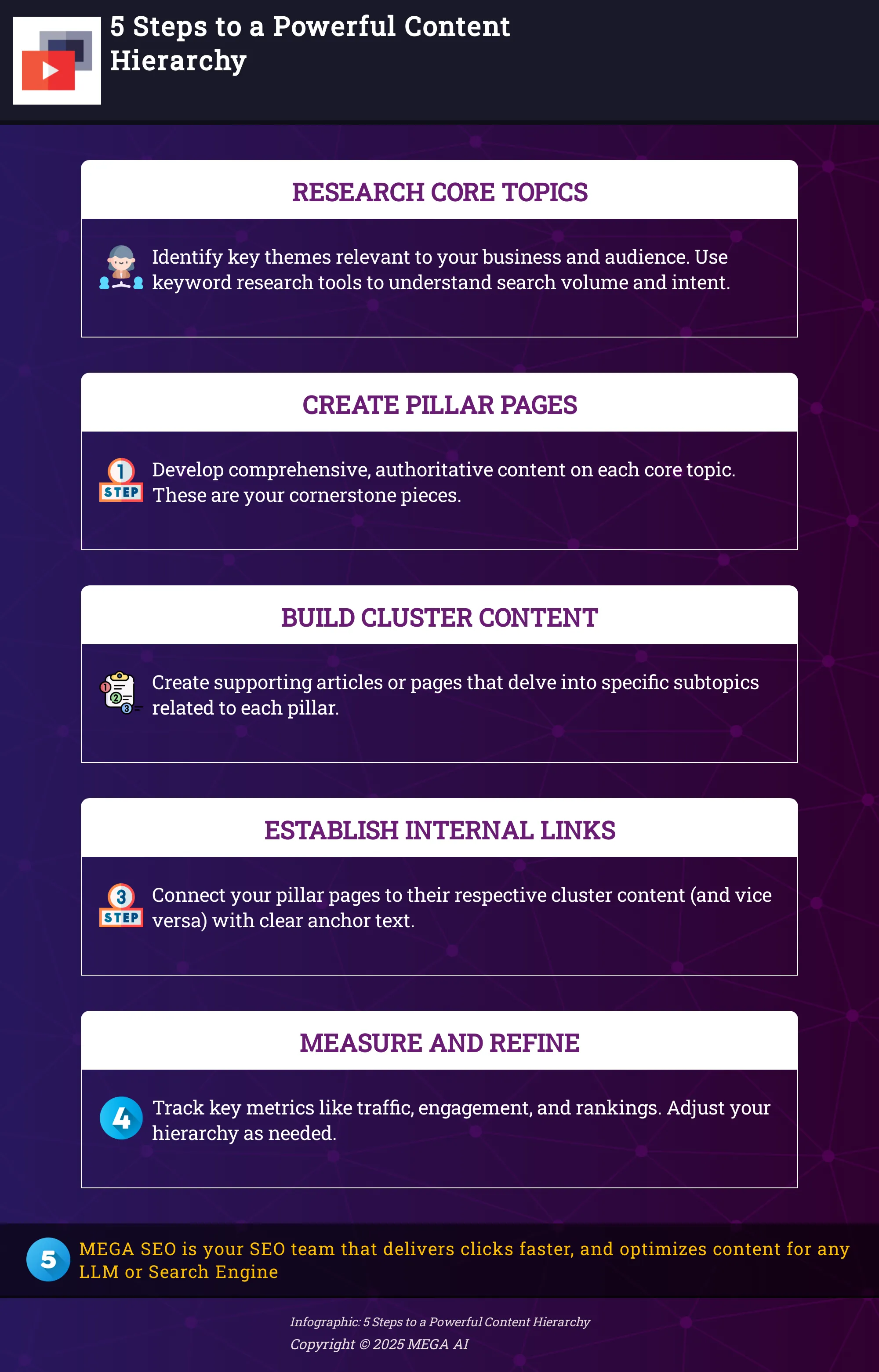
Conduct Comprehensive Topic Research
Before you write a single word, thorough topic research is essential. This initial step helps you understand what your audience is searching for and how different concepts relate to each other. Think of it like drawing a map for your content. You'll want to identify broad themes that can serve as your main categories. As Quick Creator notes, "The silo structure plays a crucial role in organizing content into distinct themes or topics, creating a clear hierarchy that enhances the site's visibility and relevance."
This research phase is where you uncover the core topics your audience cares about, allowing you to plan content that directly addresses their needs and search intent. Tools offering automated keyword research can significantly streamline this process, helping you pinpoint valuable themes and the specific terms people are using.
Craft Authoritative Pillar Content
Once you've identified your core topics, the next step is to create pillar content for each. A pillar page is a comprehensive resource covering a broad topic in depth. According to Done With You, "A content pillar is a comprehensive, in-depth piece of content that serves as the foundation for multiple subtopics. It is structured to improve SEO, user engagement, and content organization." Your pillar page should be the go-to guide on that subject, offering substantial value to your readers.
Aim for thoroughness, covering all key aspects of the topic. This isn't just a long blog post; it's a central hub that will link out to more specific articles. Using AI-powered content generation tools can help you outline and draft these extensive pieces efficiently, ensuring they are well-structured and informative.
Develop Relevant and Diverse Cluster Content
With your authoritative pillar pages in place, it's time to build out your cluster content. These are more specific articles or pieces of content that explore subtopics related to your pillar page in greater detail. This approach allows you to build topical authority comprehensively. Cybertek Marketing highlights that, "Instead of creating standalone pieces of content, content clusters take a more comprehensive approach by organizing related topics into a cohesive structure."
Each piece of cluster content should delve into a particular niche aspect of the main pillar topic. This strategy helps you cover a subject thoroughly without overwhelming the reader in a single article. Consider various formats for your cluster content, like blog posts, FAQs, or case studies, to keep your audience engaged and cater to different preferences for information consumption.
Optimize Internal Linking for Maximum Impact
Internal linking is the glue that holds your content hierarchy together, creating a cohesive web of information. It’s crucial to link your cluster content back to the relevant pillar page and, where appropriate, link pillar pages to other related pillars or important cluster pieces. Inner Spark Creative puts it well: "By structuring your content around comprehensive pillar pages and supporting cluster pages, you create an interconnected network that satisfies search engines and user intent alike."
Use descriptive anchor text for your internal links to provide context for both users and search engines. A well-planned internal linking strategy not only distributes link equity throughout your site but also guides users to related content, keeping them engaged longer. Platforms that assist with automated internal linking can help ensure this network is robust and effective.
Measure and Refine Your Content Hierarchy
Creating a solid content hierarchy isn't a one-time task. To truly reap the benefits for your site authority and SEO, you need to regularly measure its performance and make adjustments. Think of it as tending a garden; consistent care helps it flourish. This ongoing process ensures your structure remains effective and continues to support your goals. Let's look at how you can keep your content hierarchy in top shape.
Key Performance Metrics to Track
To understand if your content hierarchy is working effectively, you'll want to keep an eye on several key performance metrics. Start by tracking your website's overall traffic and how users engage with your content; metrics like time on page and bounce rate can offer insights here. Pay close attention to your keyword rankings for the terms your pillar and cluster pages are targeting. Are they improving or holding steady?
Another important metric is your site's Domain Authority (DA) or a similar authority score. While not a direct ranking factor for Google, monitoring DA can give you a general sense of how your SEO efforts, including your content structure, are perceived in terms of authority. Also, monitor the number and quality of backlinks pointing to your pillar and cluster pages, as these are strong indicators of authority.
Tools to Analyze and Improve Content Structure
Several tools can help you analyze how well your content structure is performing and identify areas for improvement. Google Analytics and Google Search Console are indispensable starting points. Google Analytics provides data on user behavior, traffic sources, and content performance, while Search Console offers insights into how Google crawls and indexes your site, keyword performance, and any technical issues.
Beyond these, consider using comprehensive SEO platforms. Many SEO tools offer features for backlink analysis, keyword tracking, and content optimization suggestions, which can be invaluable for refining your hierarchy. For instance, MEGA AI's SEO capabilities can help automate keyword research and identify opportunities to strengthen your content clusters, ensuring your structure is always working efficiently. These tools can help you see which pages are performing well and which might need more support or better internal linking.
Strategies for Iterative Improvement
Continuous improvement is key to a successful content hierarchy. One important strategy is to regularly audit your content. Keep your content fresh and up-to-date; this might involve updating statistics, adding new information, or refreshing examples. This is particularly crucial for your pillar pages, which should always represent the most comprehensive resource on a topic. MEGA AI's Maintenance Agent, for example, can help identify net new content to add to existing articles, helping to optimize content and improve its ranking.
Another vital step is to create in-depth, comprehensive pages covering your main topics. If you find gaps in your cluster content, develop new pieces to fill them. Also, regularly audit your website for low-quality or spammy backlinks and take steps to disavow them if necessary, as these can harm your site's authority. Consistently applying these strategies will help your content hierarchy evolve and strengthen over time.
Overcome Content Hierarchy Challenges
Developing a strong content hierarchy is key for your site's authority and SEO, though it can present some challenges. The good news is these are quite manageable with the right plan. Think of it like setting up a well-organized filing system; it takes effort upfront, but the long-term clarity and efficiency are worth it.
You might find yourself wondering where to begin, or how to improve an existing structure that feels a bit tangled. Staying current with the fast-moving digital landscape is another common point to consider. We'll explore practical ways to handle these common issues, making sure your content organization truly works for you. A well-thought-out strategy can turn these potential roadblocks into opportunities to refine your site and connect more effectively with your readers. For those looking to streamline this, MEGA AI's SEO platform offers automated assistance to build and maintain an effective hierarchy.
Balance Structure with Content Quality
While focusing on pillar pages, topic clusters, and internal links is important for a solid hierarchy, the quality of your actual content must remain a top priority. Think of structure as the framework of a house, but quality content is what makes it a home. A neatly organized website with unhelpful or poorly written content won't hold visitor interest or perform well in search. As Quick Creator notes, "The silo structure plays a crucial role in organizing content into distinct themes or topics, creating a clear hierarchy that enhances the site's visibility and relevance." However, each article or page within that structure must also offer real value.
Aim for a balance where strong organization supports engaging, useful information. Every piece of content, from blog entries to service pages, needs to be thoroughly researched, clearly written, and genuinely helpful to your readers. Avoid compromising depth or clarity just to fit a rigid structural mold. Instead, allow your high-quality content to guide and refine your hierarchy. If creating excellent content consistently while managing structure feels challenging, AI-powered content generation tools can offer valuable support.
Adapt to Algorithm Updates and Audience Needs
The online environment, particularly SEO, changes frequently. Search engine algorithms are refined, and strategies that were effective previously might need adjustment. Your audience's requirements, search habits, and preferences can also change. A content hierarchy that isn't flexible can become less effective over time, impacting your site's visibility. It's important to create a structure that is both stable and adaptable.
As Inner Spark Creative points out, "By implementing topic clusters and strategically grouping related content, websites can effectively demonstrate their authority on specific subjects, thereby improving their SEO." This approach allows you to add or adjust content within your clusters as new trends emerge or as you gain deeper insights into your audience. Regularly check your site analytics, perform keyword research, and observe competitor strategies. Be ready to update your pillar pages and cluster content so they stay current and meet the changing expectations of search engines and your visitors. Services like MEGA AI's Maintenance Agent can update existing articles to keep them optimized after algorithm shifts.
Maintain Consistency Across Your Content
Maintaining consistency is vital for an effective content hierarchy, yet it's an area where issues often arise. Even with a solid plan, inconsistent execution can lead to user confusion and lessen your SEO impact. As one Medium article on content hierarchy for SEO notes, common mistakes include "using a single H1 for multiple topics, overloading pages with too much text without breaks, & failing to use subheadings." Another common pitfall is providing "Too Much Information," essentially writing a novel instead of a focused blog post or landing page.
To prevent these issues, set up clear guidelines for how you create content. This means consistent application of heading tags (H1, H2, H3), maintaining a steady brand voice, and ensuring a logical structure within each article or page. Apply your internal linking strategy uniformly, making sure cluster content links appropriately to pillar pages and other related pieces. Regular site audits can help you find and fix any inconsistencies. This careful approach improves user experience and helps search engines better understand your site, which supports your overall authority.
Future-Proof Your Content Hierarchy Strategy
Building a solid content hierarchy is a fantastic start, but the digital landscape is always shifting. To keep your site authoritative and performing well in search results long-term, your strategy needs to be adaptable. Think of it as tending a garden; it requires ongoing care and adjustments to flourish. This means regularly revisiting your structure, embracing new ways to present information, and always keeping an eye on what search engines and your audience are looking for. A proactive approach ensures your content continues to meet user needs and search engine standards effectively.
Evolve Your Structure for Long-Term Authority
Your initial content structure, perhaps using content silos or topic clusters, provides a strong foundation. However, as your business grows, new trends emerge, or your understanding of your audience deepens, this structure may need to evolve. Don't hesitate to reassess your pillar pages and content clusters periodically. You might find that new, major themes your business now covers warrant a new pillar. Or perhaps an existing cluster needs expansion or even division into more specific sub-topics to better reflect its depth. Regularly auditing and refining your content organization ensures it accurately represents your expertise and maintains its relevance, which is crucial for long-term site authority.
Integrate New Content Formats and Technologies
The way people consume information is constantly changing, so your content formats should adapt as well. While blog posts are a staple, consider how videos, podcasts, infographics, or interactive quizzes could enhance your pillar and cluster content. These varied formats can cater to different learning styles and preferences, making your expertise more accessible and engaging. As new technologies emerge, explore how they can support your content strategy. For instance, AI-powered tools can assist in generating diverse content pieces or repurposing existing material into new formats, helping you efficiently expand your reach. The key is to align these new formats with user intent and ensure they seamlessly fit within your established content hierarchy, further strengthening your site's authority.
Stay Ahead of Search Engine and User Expectations
Search engines continually refine their algorithms to better understand content and satisfy user queries. At the same time, user expectations for information delivery are also rising; they want accurate, comprehensive answers, quickly. To stay ahead, you need to be proactive. This involves keeping up with SEO best practices and understanding shifts in how users search for information related to your niche. By strategically grouping related content into topic clusters, you clearly signal your site's authority on specific subjects. Regularly analyzing your content's performance and user engagement metrics will provide insights into whether you're meeting these evolving expectations, allowing you to make timely adjustments and maintain your competitive edge.
Related Articles
- SEO Without Backlinks: Rank Higher in 2024
- Master Technical SEO: A Comprehensive Guide for Success
- Content Clusters: Publish Now or Wait for SEO Success?
- Using Internal Links to Improve Site Structure and Boost SEO
- Site Navigation Benefits: Lower Your Bounce Rate
Frequently Asked Questions
My website's content is currently all over the place. What's a good first step to create a content hierarchy? A great way to begin is by identifying the main themes or core areas of expertise your business focuses on. Don't feel pressured to reorganize everything at once. Select one central topic that could serve as a pillar, and then brainstorm a few more specific, related subtopics that could support it. This initial mapping can provide a much clearer path forward.
How often do I really need to revisit my content hierarchy once it's set up? It's helpful to think of your content hierarchy as a dynamic part of your website, not something you set and forget. A review once or twice a year is a good general guideline. You’ll also want to reassess it whenever you're planning a major content initiative, or if you notice significant changes in your industry or what your audience is looking for.
Is creating a content hierarchy too complicated for a small team or a solo entrepreneur? Not at all. While the term might sound technical, the fundamental idea is to organize your information in a way that makes sense. You can certainly start small. Focus on structuring one key area of your business first. Even a simple hierarchy with a couple of well-defined pillar topics and their supporting articles can make a noticeable impact. Consistency is more important than trying to achieve a perfect, complex structure right away.
Pillar pages sound like a lot of work. Are they truly necessary for every website? Pillar pages are indeed very effective for demonstrating your authority on subjects central to your business. They do require a good amount of effort, but they serve as strong foundations for your content. If developing extensive pillar pages seems like too much to begin with, you can start by identifying your most comprehensive existing content pieces and begin structuring related, more specific articles around them. The core principle of having central, authoritative content to anchor your topics is what truly matters.
How does content hierarchy actually help my site show up better in search results? A clear content hierarchy significantly helps search engines understand your website's main subjects and the depth of your knowledge in those areas. When your content is logically arranged with central pillar pages and connected cluster articles, search engines can more easily see the relationships between your pages. This allows them to recognize your site as a thorough resource, which can improve your visibility for relevant search queries.