
Trying to understand AI pricing can feel like decoding a secret language. You're hit with terms like "tokens" and "context windows," making it hard to know what you're actually paying for. This is especially true when comparing the complex models of OpenAI Codex and Anthropic Claude. This guide translates the jargon for you. We'll explain in simple terms how each service charges, what a "token" really means for your budget, and how efficiency can lower your costs. You'll get the clarity you need to choose the right AI price model and make a confident financial decision.
Key Takeaways
- Match the pricing model to your budget: Choose Codex for predictable subscription costs ideal for stable budgeting, or select Claude for a flexible pay-as-you-go model that adapts to fluctuating project needs.
- Prioritize token efficiency to lower your bill: An AI model that uses fewer tokens to complete a task is more cost-effective in the long run, as small savings on each task add up significantly over time.
- Assess the total value, not just the price tag: The right tool saves you time and improves your workflow, so factor in the quality of the AI's output and how it integrates with your team to find the most cost-effective solution overall.
Why AI Pricing is Different from Traditional Software
If you've ever bought software, you're probably used to a simple subscription or a one-time fee. The company sells you the product, and whether you use it once or a thousand times, their cost doesn't really change. AI is a completely different ballgame. Unlike traditional software where adding another user is practically free for the company, every single time you use an AI tool, it costs the provider real money. This is because each query, command, or content generation task requires a significant amount of computing power from power-hungry servers. This fundamental difference is why AI pricing models can seem so complex and varied.
This cost-per-use reality directly shapes the financial structure of AI companies. While a typical Software-as-a-Service (SaaS) company might enjoy gross margins of 80-90%, AI companies often operate with much thinner margins, typically in the 50-60% range. They have to pay for the infrastructure every time their product delivers value, which means they must price their services carefully to cover these ongoing operational costs. Understanding this helps explain why you see pricing based on usage, tokens, or credits instead of a simple flat fee. It’s a direct reflection of the resources your request consumes.
The Inherent Cost of Every Use
Think of it like electricity. When you flip a switch, you use power and the utility company incurs a cost to generate and deliver it. AI works similarly. Every time you ask an AI to write an email, analyze data, or create an image, you're "flipping a switch" that activates powerful processors. This consumption of computing power is a direct, measurable expense for the AI provider. This is why, unlike a subscription to a service like Netflix where your viewing habits don't increase their per-user cost, your usage of an AI tool is directly tied to the company's bottom line. This model ensures that the price you pay is aligned with the resources you actually use.
Impact on Profit Margins and Company Budgets
The lower profit margins for AI companies have a ripple effect on how they package and sell their products. Because every use has a cost, offering unlimited, flat-rate plans is risky and often unsustainable. Instead, companies develop tiered or usage-based pricing to ensure their revenue scales with their costs. For you, the customer, this means you need to budget for AI tools differently. Instead of a predictable monthly expense, your costs might fluctuate based on your activity. It becomes crucial to not just find a tool that works, but one whose pricing model aligns with your usage patterns and budget, ensuring you get value without unexpected bills.
Common AI Pricing Strategies
Because of the unique cost structure of AI, companies have developed several pricing strategies to balance their expenses with customer value. You'll often see models that are very different from the standard software subscriptions you're used to. Some focus on the results you get, while others are based on how much of the service you consume. Many companies even blend different approaches to create a hybrid model that fits their specific product. Getting familiar with these common strategies will help you better evaluate which AI tools are the right financial fit for your business and avoid any surprises when the bill arrives.
Value-Based and Performance-Based Pricing
Two of the most logical approaches are value-based and performance-based pricing. With value-based pricing, the cost is tied to the tangible value the AI provides your business, not just the raw computing power it uses. For example, an AI that saves your sales team 10 hours a week would be priced based on the value of that saved time. Performance-based pricing takes this a step further, linking the cost directly to the results. You might pay based on the number of leads the AI generates or the percentage of customer service tickets it successfully resolves. This model directly aligns your costs with your ROI.
Freemium Models
The freemium model is a popular entry point for many AI tools. Companies offer a basic version of their product for free, giving you a chance to experience its core functionality without any commitment. This free tier is usually limited by usage caps, feature availability, or processing power. The goal is to let you see the tool's value firsthand. Once you become reliant on it or need more advanced capabilities—like higher usage limits, team collaboration features, or premium support—you are prompted to upgrade to a paid plan. This strategy is effective for building a large user base and converting the most engaged users into paying customers.
License Fee and Hybrid Models
A license fee is a more traditional approach where customers pay a recurring fee, often monthly or annually, for access to the AI software. This provides predictable revenue for the company and a fixed cost for the user, though it may still come with usage limits to control operational expenses. More commonly, you'll encounter hybrid models, which combine elements from different strategies. A company might charge a base subscription fee (license) that includes a certain number of credits (usage-based), with the option to purchase more if needed. This approach offers both predictability and flexibility, making it a popular choice for many AI providers.
Understanding Emerging AI Business Models
As AI technology becomes more sophisticated, the ways we interact with it are evolving, leading to new business models that go beyond simple tools. We're moving from software that you operate to AI systems that collaborate with you or even work independently on your behalf. These emerging models—copilots, agents, and AI-enabled services—are changing how work gets done. They are priced not just as software, but as active contributors to your business outcomes. Understanding these models is key to seeing where the industry is headed and how you can leverage these advanced systems for growth.
Copilots: Your AI Assistant
The "copilot" model frames AI as a collaborative partner rather than just a passive tool. Think of it as an expert assistant working alongside you, offering suggestions, automating parts of your workflow, and helping you complete tasks faster and more effectively. For example, a coding copilot might suggest lines of code as you type, while a marketing copilot could help you draft social media posts. Because these tools act like a productive team member, their pricing often reflects the value of the outcomes they help deliver. You're not just paying for software; you're investing in a digital teammate that enhances your capabilities.
Agents: Autonomous Task Completion
AI agents take the concept of a copilot a step further. Instead of just assisting you, an agent is designed to complete entire tasks autonomously from start to finish. You delegate a goal—like "find the best deals on flights to New York" or "resolve all customer support tickets under this category"—and the agent handles the entire workflow on its own. These systems are often priced based on the results they achieve or the costs they save your business. For instance, an agent that handles customer service might be priced per resolved ticket. This model represents a significant shift, turning AI into a true digital workforce.
How MEGA AI Uses Agents for SEO and Paid Ads
At MEGA AI, we build our platform around the power of autonomous agents to simplify complex marketing tasks for small businesses. Our Maintenance Agent for SEO doesn't just give you suggestions; it actively works on your website's content. It identifies articles with declining click-through rates and automatically rewrites titles and meta descriptions to improve them. It also finds content gaps and adds new, relevant information to existing posts to help them rank higher. Similarly, our agent for Paid Ads can automatically reallocate your budget to the best-performing campaigns and remix your creative assets to prevent ad fatigue, all without requiring manual intervention.
AI-Enabled Services: A Human and AI Partnership
The AI-enabled services model combines the speed and efficiency of artificial intelligence with the nuance and expertise of human oversight. In this model, AI performs the bulk of the heavy lifting—like analyzing massive datasets or generating initial drafts—while human experts handle the final review, strategy, and quality assurance. This partnership allows companies to deliver high-quality services faster and at a lower cost than traditional, human-only approaches. For customers, it offers the best of both worlds: the scale and power of AI, backed by the assurance of human judgment and accountability.
How Do OpenAI Codex and Anthropic Claude Price Their AI?
When you're looking at AI tools like OpenAI's Codex and Anthropic's Claude, their pricing models can seem complicated. The truth is, one isn't always cheaper than the other. The best choice depends entirely on how your business will use the tool. Understanding their different approaches to pricing is the first step to making a smart decision that fits your budget.
OpenAI Codex often comes with a more predictable cost structure. For many users, access is bundled into existing subscriptions like ChatGPT Plus. This is great for small businesses that need a fixed, reliable monthly expense for budgeting. If you anticipate heavy and consistent use, this model prevents surprise bills. OpenAI has also made Codex widely accessible, so you can get started without dealing with long waitlists.
Anthropic Claude, on the other hand, typically uses a more flexible, usage-based model. This means your costs scale up or down depending on how much you use it. For businesses with fluctuating or project-based needs, this can be very cost-effective. However, it's important to monitor your usage, as heavy users might find their monthly costs exceeding $200. This pay-as-you-go approach ensures you only pay for what you need, but it requires a bit more management.
A key factor that influences cost is token efficiency. Think of tokens as the small pieces of words that AI models process. A more efficient model can perform a task using fewer tokens, which directly impacts your bill in a usage-based system. At a large scale, a model with better token efficiency can save you money on every task you run. In short, Codex offers budget predictability, while Claude provides cost flexibility. Your ideal choice depends on whether you value a fixed monthly cost or a variable one that mirrors your activity.
How Much Does OpenAI Codex Cost?
Understanding the cost of any new tool is a critical step for a small business. When it comes to powerful AI like OpenAI Codex, the pricing isn't a simple flat fee. Instead, it's based on how much you actually use the service, which can be both flexible and a little confusing at first. The model is designed to scale with your needs, whether you're just experimenting with a few tasks or integrating AI deeply into your operations.
The core of Codex's pricing revolves around "tokens," which are essentially pieces of words. Think of it as paying for the raw materials the AI uses to generate code or text. This approach allows you to control costs by managing your usage directly. For businesses that need consistent, predictable marketing outcomes without tracking tokens, a service like MEGA AI's SEO or Paid Ads agents can be a simpler alternative, offering a fixed monthly cost for a fully managed service. But if you're building your own tools, getting familiar with the token system is key.
What is Token-Based Pricing?
OpenAI Codex uses a pay-as-you-go model centered on tokens. A token can be a character, a word, or part of a word, and every request you send to the AI, plus the response it generates, consumes a certain number of them. This structure offers great flexibility, as you only pay for what you use. It's a cost-effective way to get started without committing to a hefty subscription. One analysis highlighted that this model gives you more value for your money, noting that Codex offers higher usage limits at a lower cost. This makes it an attractive option for developers and businesses looking to experiment with AI-powered coding without a large initial investment.
Finding Savings with Usage Tiers and Volume Discounts
For those with more consistent needs, OpenAI offers different tiers that can make Codex even more affordable. For example, a user on a Plus plan found that the usage limits were significantly higher than a standard cloud plan, making it about five times cheaper for the same amount of work. This is great news for small businesses that start to rely more heavily on the tool. As your usage grows, you can move into tiers that provide more tokens for your money, effectively giving you a volume discount. This scalability ensures that the tool can grow with your business, supporting you from initial projects to more complex, ongoing development tasks.
What to Know About Price Changes and Reductions
The world of AI is constantly changing, and that includes pricing. OpenAI has a history of adjusting its pricing structure, often making its models more accessible over time. These changes can include lower per-token costs or new subscription plans that offer better value. It’s a good practice to stay informed about these updates, as they can directly impact your budget. You can find a complete guide to GPT 5.3 Codex pricing that explains the different subscription plans and API costs. Keeping an eye on these trends can help you plan your expenses and take advantage of cost reductions as they happen.
What Are Anthropic Claude's Pricing Options?
Anthropic Claude approaches pricing with a focus on providing options for different scales of use, from individual developers to large enterprises. Unlike a purely pay-as-you-go model, Claude often uses a tiered subscription system that bundles access to its models with specific features and usage limits. This structure is designed to give users predictable monthly costs while aligning the available power with their needs. For businesses, this means you can choose a plan that matches your current project demands without worrying about unexpected bills.
The tiers are generally separated by factors like which AI model you can access, the number of requests you can make per minute, and the size of the context window you can use. Anthropic offers a family of models, including the fast and affordable Haiku, the balanced Sonnet, and the highly intelligent Opus. This range allows you to start with a cost-effective plan for initial development and scale up to a more robust tier as your application grows and requires more sophisticated capabilities. Understanding these options helps you make a strategic choice that supports your business goals without overspending on features you don't need yet.
Subscription or Pay-Per-Use: Which is Right for You?
Anthropic offers a mix of subscription plans and pay-per-use API access, giving you flexibility in how you manage costs. The subscription plans, like Claude Pro, are great for individuals or small teams who need consistent access for tasks like content generation or analysis. For more intensive use, higher-tier plans can exceed $200 per month, providing access to the most powerful models and higher usage limits. On the other hand, the pay-per-use API pricing is geared toward developers and businesses building applications on top of Claude. This is ideal for products with variable user traffic, as your costs scale directly with usage.
What Features Do You Get at Each Price Point?
The features you get with Claude are directly tied to the pricing tier you select. Think of it this way: lower-cost tiers give you access to solid, reliable models for general tasks, while premium tiers give you the equivalent of a specialist. The higher-priced plans often unlock access to Claude's most advanced models, which are better at handling complex reasoning and specialized tasks. As one analysis puts it, the premium version acts like a "senior developer who takes the time to understand your codebase." This means you're not just paying for more tokens; you're paying for higher quality output and code that's easier to maintain.
A Look at Enterprise and API Pricing Plans
For large-scale operations, enterprise and API pricing is where the details really matter. When your team is running thousands of tasks or building a customer-facing product, small differences in efficiency add up quickly. Claude's models are known for their large context windows and strong performance, which can translate into cost savings at scale. Efficient models process tasks using fewer tokens, which directly lowers your API bill. For example, a significant difference in token efficiency can have a major financial impact when you're processing a high volume of requests. Enterprise plans also typically include dedicated support and security features designed for corporate environments.
Codex vs. Claude: A Head-to-Head Cost Comparison
When you’re choosing an AI tool, the features are only half the story. The other half is the pricing model, which determines how much you’ll actually spend. Both Codex and Claude are powerful, but their cost structures are different. Understanding these differences helps you find the right fit for your budget and workflow, ensuring you get the performance you need without unexpected bills.
For small businesses, predictable costs are key. While one tool might seem cheaper per task, another could offer better long-term value through a flat-rate subscription. It’s a classic debate: pay-as-you-go flexibility versus subscription stability. Let’s break down how each model works in practice so you can make an informed decision.
How Do Per-Token Costs Stack Up?
Most AI models, including Codex and Claude, use a token-based system to measure usage. A token is a piece of a word, so a few sentences can add up to dozens of tokens. While the cost per token is tiny, these charges accumulate quickly. The real difference often comes down to efficiency. As one analysis notes, "The 3x token efficiency difference between Codex and Claude adds up fast at scale, especially when your team is generating hundreds of PRs weekly."
This means one model might use significantly fewer tokens to complete the same task, making it more cost-effective over time. For a small business, this efficiency is critical. It directly impacts your monthly bill and the overall return on investment for your AI tools. When evaluating options, look beyond the price per token and consider how efficiently each model processes your specific tasks.
Beyond Codex and Claude: The Broader AI Model Market
While Codex and Claude are major players, the AI landscape is filled with a diverse range of models, each with its own strengths. Looking beyond the big names can help you find a tool that’s perfectly suited to your specific business needs and budget. Some models are built for raw intelligence, others for lightning-fast speed, and some are designed to be incredibly affordable. Understanding these differences is key to making a smart investment. This overview will help you see what else is out there, comparing models across the four areas that matter most to a small business: intelligence, performance, cost, and memory.
Comparing Intelligence: The Smartest Models
When a task requires deep reasoning or a sophisticated understanding of complex topics, you need one of the "smartest" models available. These AI are best for generating high-quality, nuanced content, like in-depth blog posts, technical documentation, or strategic business plans. According to recent analysis, models like Claude Opus and Gemini Pro Preview lead the pack in intelligence. This means they are better at grasping context, following intricate instructions, and producing output that requires less editing. For a small business, using a highly intelligent model can save you significant time on tasks that demand a high degree of accuracy and quality from the start.
Comparing Performance: The Fastest and Most Responsive Models
Performance isn't just about intelligence; it's also about speed. In the AI world, speed is measured in two ways: how quickly the model starts responding and how fast it generates content. A model like Gemini Flash-Lite is incredibly quick to begin its response, which is perfect for real-time applications like customer service chatbots. On the other hand, a model like Mercury 2 excels at generating a high volume of tokens per second, making it ideal for creating long-form content quickly. Choosing the right model depends on your priority. Do you need immediate interaction or rapid content creation? Answering that question will point you to the best-performing tool for the job.
Comparing Cost: The Most Affordable Models
For many small businesses, the bottom line is the deciding factor. If you need to perform a high volume of simple tasks, choosing a more affordable AI model can save you a lot of money. Models like Qwen and Gemma are incredibly cost-effective, charging just a few cents for every million tokens processed. This makes them a great choice for tasks like summarizing text, generating social media captions, or categorizing data. For more complex, ongoing needs like SEO and content optimization, an integrated platform like MEGA AI can offer more predictable value by bundling these services into a single subscription, removing the need to track per-token costs across different tools.
Comparing Memory: Models with the Largest Context Windows
An AI model's "context window" is like its short-term memory. A larger window means the AI can remember and process more information from your conversation or the documents you provide. This is crucial for tasks that require a deep understanding of extensive material. For example, if you need to analyze a long report, summarize a book, or have a detailed, multi-turn conversation, a model with a large context window is essential. Models such as Llama 4 Scout and Grok 4.1 Fast lead in this area, capable of recalling millions of tokens. This allows them to maintain context and provide more relevant, accurate responses over a longer interaction.
Is a Monthly Subscription Worth It?
Predictability is a major advantage of a monthly subscription. For businesses that need to manage a consistent budget, a flat fee is much easier to plan for than a variable, usage-based bill. This is a key differentiator between Codex and Claude. According to one report, "For heavy use, Codex is more predictable since it’s included in ChatGPT subscriptions, while Claude Code can scale to $200/month for power users."
This structure provides peace of mind, allowing your team to use the tool as needed without worrying about racking up high costs. Platforms that offer clear, subscription-based pricing simplify financial planning. You know exactly what you're paying each month for a defined set of capabilities, which is an ideal model for startups and SMBs focused on sustainable growth.
How Token Efficiency Can Save You Money
Ultimately, the choice between AI tools isn't just about which one is "smarter." Both Codex and Claude are built on advanced models capable of complex tasks. The smarter financial decision often comes down to which tool provides the most value for your specific needs. Token efficiency is a direct path to savings because it means you pay less for the same amount of work.
Well-designed pricing tiers aim to lower the barrier to entry while capturing value as usage grows. For a small business, this means you can start with a cost-effective plan and scale as your needs evolve. By focusing on the cost-per-task rather than just the cost-per-token, you can better project your long-term expenses and ensure your AI budget is spent wisely.
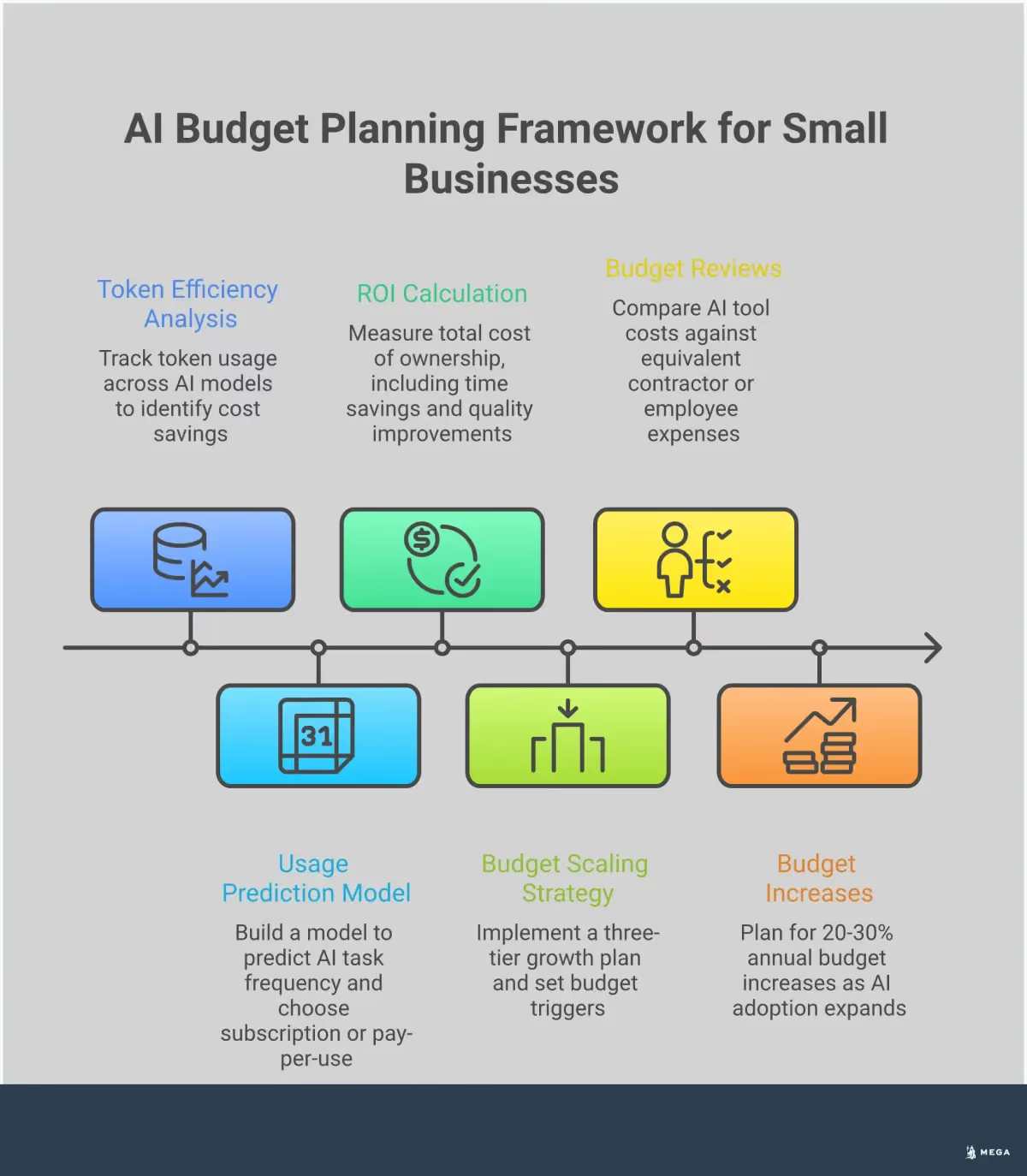
Which AI Price Model Works for Small Businesses?
Choosing the right AI tool when you're running a small business often comes down to balancing power with price. Both Codex and Claude offer compelling features, but their pricing models cater to different needs and budgets. For a startup or a local business, the decision isn't just about which tool is cheaper per token. It's about which one provides the most value and predictability, allowing you to grow without facing unexpected costs. The best model for you will depend on your team's technical skills, your project volume, and how you plan to scale.
A pay-as-you-go model might seem attractive for its low entry barrier, but costs can quickly add up. On the other hand, a subscription can offer predictability but might include features you don't need. Let's break down how to think about these options so you can find the right fit for your business.
How to Budget for AI as a Startup or SMB
For startups and small businesses, predictable monthly expenses are crucial. The ideal AI pricing model is one that allows you to start small and scale your costs as your revenue grows. Token-based, pay-as-you-go plans are excellent for getting started because they require minimal upfront investment. You only pay for what you use, which is perfect for experimenting or for businesses with inconsistent demand.
However, as your usage becomes more regular, relying solely on a usage-based model can make budgeting difficult. This is where tiered pricing models shine. A good structure offers pricing tiers that reduce initial adoption barriers while letting you move to a higher plan as your needs expand. This approach provides a clear path for growth and helps you forecast expenses more accurately than a purely consumption-based plan.
Matching Features to Your Budget
When comparing pricing, it’s easy to focus on the cost per token, but the real value lies in the features you get for your money. A slightly more expensive model might save you hours of work, making it the more cost-effective choice in the long run. For example, some users find that Claude Code acts like a senior developer by producing code that is cleaner and easier to maintain. This higher-quality output means your team spends less time debugging and more time building.
As a small business, you need to evaluate what you get at each price point. Does a higher tier give you access to a more powerful model, better integrations, or higher rate limits? Consider the total cost of ownership, which includes the time your team spends working with the tool. A cheaper tool that generates more work is no bargain.
How to Optimize Your Usage and Cut Costs
Regardless of which model you choose, actively managing your usage is key to keeping costs down. One of the most important factors is token efficiency. A model with high token efficiency can perform a task using fewer tokens, which directly translates to lower costs on a pay-per-use plan. The reported 3x token efficiency difference between some models can lead to significant savings, especially as your workload increases.
Because no single metric perfectly captures AI value, many providers are moving toward hybrid pricing models. These might combine a base subscription fee with usage-based charges, offering a balance of predictability and flexibility. For core business functions like marketing, many small businesses prefer the simplicity of a flat-rate service. An all-inclusive SEO agent, for example, removes the need to count tokens and provides a clear, predictable monthly cost for achieving your growth goals.
Why a Mid-Tier Plan Could Be a Game-Changer
For many small businesses, the jump from a free AI plan to a premium one is a huge leap. Current pricing often forces a choice between limited access and a high monthly cost, with some premium tiers exceeding $200 per month. This gap creates a significant barrier for businesses ready to scale but unable to justify the price tag. A well-designed mid-tier plan could solve this problem by making powerful AI tools more accessible and creating a logical growth path for users.
What a $50 Subscription Gets You
A hypothetical $50 subscription could be the perfect middle ground. This price point is low enough to reduce the adoption barrier for freelancers and small businesses, yet it provides more generous usage limits than a free tier. By offering pricing tiers that ease users into the ecosystem, AI providers can build sustainable business models. This approach aligns with modern hybrid pricing models, which evolve with the customer. A mid-tier plan is a crucial stepping stone, giving users confidence to invest in a tool that can scale with them.
Bridging the Gap Between Basic and Premium Plans
Tiered pricing is a proven strategy, and OpenAI already "offers tiered pricing with different levels of access and support." However, the model's effectiveness depends on the space between tiers. If the gap between a basic and premium plan is too wide, customers get stuck. They may have outgrown the entry-level offering but find the next step financially out of reach. A mid-tier plan closes this gap, creating a smooth upgrade path. It allows a business to gradually increase its investment as its reliance on the AI tool grows, fostering loyalty and reducing churn.
Will More Competition Lead to Lower AI Prices?
The intense rivalry in the AI space is great news for consumers. As major players compete for market share, they must innovate on pricing and accessibility. The current competitive environment directly influences pricing strategies. As AI models become more powerful and their capabilities overlap, user experience becomes the key differentiator. One expert suggests that "as models become more capable and more similar, the strength of the consumer product becomes the main basis for differentiation." This pressure will likely lead to more diverse pricing, including the affordable mid-tier plans that small businesses need.
Future-Proofing Your AI Investment: The ROI Challenge
Thinking about the long-term cost of AI means looking past the monthly bill. The real challenge is figuring out your return on investment when the biggest benefits, like saving time or creating better work, are tough to measure in dollars. Instead of getting stuck on the price tag, it's better to evaluate the tool's total value. An AI that saves your team hours every week is a better investment than a cheaper option that ends up creating more headaches. Focusing on the cost-per-task, not just the cost-per-token, helps you project your long-term expenses more accurately. This shift in thinking lets you see the true financial impact and pick a solution that will actually help your business grow.
What Features Drive the Price Difference?
When you compare the costs of AI tools like Codex and Claude, it’s easy to focus only on the price per token. But the real story is in the features and the philosophy behind each platform. The price you pay is directly tied to how each tool is designed to work, the quality of its output, and how easily it fits into your team’s process. One model might be built for quick, functional code generation, while another is designed to act more like a collaborative partner, guiding you toward a better long-term solution.
Understanding these core differences is key to seeing the true value. It’s not just about which tool is cheaper on paper, but which one will save you the most time and effort in the long run. Factors like code maintainability, raw performance, and the overall developer experience play a huge role in the total cost of ownership. Just as our SEO agent handles complex optimization tasks autonomously, the right coding assistant should simplify your workflow, not just add another tool to your stack. Let’s look at the key features that shape the pricing of these two powerful AI models.
Factoring in the Cost of Long-Term Code Maintenance
Think of it this way: one tool might give you a quick answer, while another helps you build something that will last. Claude is often described as acting like a senior developer who helps produce code that’s meant to be maintained long-term. It’s designed to understand the context of your codebase and generate cleaner, more readable code. This approach can reduce technical debt and save your team countless hours on debugging and updates down the road. While this feature isn’t a line item on a pricing sheet, its value is immense for businesses that are building products they need to support and scale over time.
Does Price Affect Speed and Accuracy?
Performance is a critical factor that directly impacts your costs. A faster, more accurate model can complete tasks in fewer attempts, which means you use fewer tokens and spend less time prompting and correcting. For businesses with consistent needs, Codex’s inclusion in a subscription offers predictable monthly costs. In contrast, Claude’s pricing can scale for power users, which provides flexibility but may lead to higher bills for heavy use. The right choice depends on your workload. Do you need a steady, predictable tool for daily tasks, or a high-performance model for occasional, intensive projects?
How Integration and Developer Experience Impact Cost
How an AI tool fits into your existing workflow is just as important as what it can do. Claude is built for an interactive, “developer-in-the-loop” experience, positioning itself as a constant collaborator you work with side-by-side. On the other hand, OpenAI provides multiple ways to access Codex, including web interfaces, command-line tools, and IDE extensions. This multi-interface approach offers greater flexibility, allowing developers to integrate the tool in a way that feels most natural to them. A seamless integration saves time and reduces friction, making your team more efficient.
Strategic Considerations When Choosing an AI Price Model
Choosing an AI tool is more than just comparing features; it's a strategic financial decision. The price tag doesn't always tell the whole story. Unlike traditional software where you pay a flat fee for access, AI pricing is often tied directly to usage. This is because every time you ask an AI to perform a task, it costs the provider real money in computing power. This fundamental difference is why you see so many different pricing models, from pay-per-token to complex subscription tiers. For a small business, this means you need to think less like you're buying a license and more like you're hiring a specialist for a specific job.
The key is to look past the initial cost and evaluate the total value a tool brings to your business. A cheaper tool that requires more of your time or produces lower-quality results isn't a bargain. The right model should align with your workflow, budget, and growth plans. It should feel like a smart investment that saves you time and delivers measurable results, not just another monthly expense. Understanding the logic behind these pricing structures will help you see the bigger picture and choose a partner that truly supports your business goals.
Understanding the Charge Metric
AI pricing is different from regular software because of its underlying costs. With traditional Software-as-a-Service (SaaS), adding another user to the platform costs the company next to nothing. That’s why so many offer simple, per-seat pricing. AI is different. Every single query, from generating a line of code to writing an email, requires significant computing power, which has a direct cost. This is why AI companies often have lower profit margins than SaaS companies and need to structure their pricing around consumption. This model ensures that the price you pay is linked to the resources you actually use, which can be both fair and flexible.
Consumption-Based vs. Outcome-Based Metrics
Most AI tools you'll encounter use a consumption-based model. You pay for what you use, typically measured in "tokens" or API calls. This is the approach used by foundational models like Codex and Claude. It’s flexible and great for getting started, but it can be hard to predict your monthly costs. A more modern approach is outcome-based pricing, where you pay for the value the AI delivers, not just for access to the tool. For example, instead of paying per keyword researched, you pay for the result: improved search engine ranking. This model aligns the provider's success with your own, ensuring you're paying for tangible business outcomes.
Focusing on "Hard ROI"
When you're evaluating an AI tool, focus on its ability to deliver a "hard ROI," which means clear, measurable results. Many tools promise "soft ROI" benefits like better insights or improved creativity, which are nice but difficult to connect to your bottom line. Hard ROI is different. It’s the stuff you can track, like a 20% increase in website traffic, a 15% reduction in ad spend, or saving ten hours of manual work each week. Products that deliver these kinds of concrete results can more easily justify their price because the value is obvious. As a small business owner, always ask how a tool will directly impact your key metrics.
How to Test and Validate a Price Point
In the rapidly evolving AI market, pricing is still finding its footing. This means you, as the customer, have a role in deciding what's fair. The best way to validate a price point is to test the tool's value for yourself. Take advantage of free trials or low-cost introductory tiers to see if the tool delivers on its promises. Does it save you time? Does it produce high-quality work? Does it solve a real problem for your business? If a tool provides immediate and undeniable value during the trial period, its price is likely justified. If the results are underwhelming, then even a low price might be too high for the return on investment.
How to Get the Most from Your AI Budget
Choosing an AI tool isn't just about comparing monthly fees or per-token rates. The real value comes from finding the right balance between what you pay and what you get. For a small business, every dollar counts, so you need an AI partner that not only fits your budget today but also supports your growth tomorrow. This means looking deeper at how each tool performs on the tasks that matter most to you, how its costs change as your usage increases, and what the long-term financial picture looks like. By thinking through these factors, you can make a smart investment that delivers a real return.
How to Analyze Your Cost-Per-Task
A lower price per token doesn't always mean a lower cost to get a job done. The quality and completeness of the AI's output are just as important. Think about it this way: if one tool gives you a perfect result on the first try, while another requires multiple attempts and manual edits, the "cheaper" option might actually cost you more in time and resources. For example, some users find that Claude Code functions like a senior developer, producing code that’s built for long-term maintenance. In contrast, OpenAI’s Codex is accessible through multiple interfaces, including web agents and IDE extensions, which might fit different workflows. Your goal is to find the tool that completes your specific tasks most efficiently, minimizing the need for rework.
Scaling Your AI Use Without Breaking the Bank
Your AI needs will likely change as your business expands. A pricing model that works for you now might become a bottleneck later. It's important to consider how each platform handles increased usage. For heavy use, Codex can offer more predictable costs since it’s often included in ChatGPT subscriptions. Claude, on the other hand, has a pay-as-you-go model that can scale up for power users. For many small businesses, a predictable, flat-fee structure is the easiest to manage. Platforms like MEGA AI offer a fixed monthly cost for a dedicated SEO agent, removing the guesswork and allowing you to budget with confidence as you grow.
How to Project Your Long-Term AI Costs
When you're planning for the future, small details in pricing can have a big impact. One key factor is token efficiency. If one model can understand your request and generate a response using fewer tokens, it will be more cost-effective over time. Some analyses suggest a significant token efficiency difference between Codex and Claude, which can add up quickly at scale. This is especially true if your team is running hundreds of tasks every week. Looking at these kinds of technical details helps you project your long-term expenses and avoid surprises down the road. A little research now ensures your AI tool remains a valuable asset, not a financial drain.
How to Choose the Right AI Tool for Your Business
Selecting the right AI tool feels a lot like hiring a new team member. You're not just looking at the cost; you're evaluating their skills, how they'll fit into your workflow, and their potential to help your business grow. The choice between a tool like OpenAI Codex and Anthropic Claude isn't just about comparing token prices. It’s about understanding what kind of support you need. Do you need a generalist assistant you can direct on specific tasks, or do you need a specialized expert who can manage an entire function of your business?
For small businesses, the right tool can be a game-changer, automating tasks that once consumed countless hours. But the wrong one can become another complex system to manage. The key is to look beyond the feature list and consider the total value. Think about the time you'll save, the new opportunities you can pursue, and the expertise you gain. An autonomous system like MEGA AI, for example, acts as a dedicated SEO or Paid Ads agent, handling strategy and execution from start to finish. This is different from a tool that requires your constant input. As you weigh your options, focus on finding a solution that aligns with your specific goals, budget, and long-term vision.
Start by Evaluating Your Needs and Usage
Before you compare pricing tables, take a moment to map out exactly what you need an AI tool to do. Are you looking for a coding assistant to help your developers with specific, well-defined tasks? Or do you need a strategic partner to manage a whole area of your business, like marketing? Some tools, like Codex, offer multiple interfaces for hands-on use, while others are designed to function more like a senior team member who understands your goals and works autonomously.
Consider your team’s capacity. Do you have the time and expertise to manage a tool, provide prompts, and review the output? Or would you benefit more from an AI agent that plans and executes campaigns for you? Your answer will guide you toward the right type of solution and prevent you from paying for features you won't use.
How to Plan Your AI Budget and Calculate ROI
AI pricing models can be tricky. A low per-token cost might seem appealing, but costs can quickly add up with heavy use, as seen with models where token efficiency varies. A fixed monthly subscription offers predictability, which is crucial for startups and small businesses managing a tight budget. When you review pricing, think less about the monthly fee and more about the return on investment (ROI).
Calculate the value of your time and the potential revenue a tool can generate. If an AI agent can deliver the results of a full-time employee or an expensive agency for a fraction of the cost, its value becomes clear. A predictable monthly fee for an autonomous agent can be a much smarter investment than a pay-as-you-go model that’s difficult to forecast, especially when you start to scale your operations.
Making an AI Choice That Lasts
The AI landscape is evolving rapidly. The tool that’s best today might be outdated tomorrow. When choosing a solution, consider the provider’s commitment to innovation and how their platform will scale with your business. A good AI partner invests in continuous improvement, ensuring you always have access to the most effective technology.
Look for pricing models that support growth rather than penalize it. As SaaS pricing evolves, many providers are aligning costs with consumption, which can be beneficial if your usage is variable. Ultimately, you want a tool that can grow with you, adapting to your changing needs without forcing you into a cost-prohibitive tier. This long-term perspective ensures your investment continues to pay off for years to come.
A Different Angle: How AI Itself Can Set Prices
So far, we've talked about how AI companies price their own tools. But what about using AI to set prices for your products or services? This isn't science fiction; it's a strategy called dynamic pricing, and it's becoming more common for businesses of all sizes. Instead of setting a price and hoping it’s right, AI can analyze market conditions in real time to find the sweet spot that attracts customers while maximizing your revenue. It’s a proactive approach that turns pricing from a static decision into a responsive, intelligent part of your business strategy.
How AI Pricing Algorithms Work
AI pricing algorithms work by analyzing huge amounts of data to determine the optimal price for a product at any given moment. These systems look at factors like competitor pricing, customer demand, sales history, inventory levels, and even external events like holidays or weather patterns. The AI builds a model to understand how these variables affect what a customer is willing to pay. It then continuously learns from new data, adjusting prices automatically to stay competitive and relevant. This process allows a business to adapt its pricing strategy far more quickly and accurately than a human team ever could, responding instantly to shifts in the market.
The Benefits of AI-Powered Pricing
Using AI for pricing offers some significant advantages, especially for small businesses trying to compete in a crowded market. The most obvious benefit is the potential to increase revenue by ensuring your prices are always optimized. It also helps you stay competitive without having to manually track what every other business is doing. AI-powered pricing can reduce the risk of human error, like setting a price too low and leaving money on the table or setting it too high and driving customers away. Over time, the data collected by the AI can also provide deep insights into customer behavior, helping you understand purchasing patterns and make smarter decisions across your entire business.