
New AI tools are exciting, but it’s smart to be aware of the potential risks before you connect them to your business. A recent incident with the AI assistant Claude is a perfect example of why caution is so important. An early user of a new feature experienced a significant data loss, which serves as a valuable lesson for any business owner looking to adopt AI. Understanding what happened can help you make safer choices when integrating automation into your own workflows. This isn't about avoiding AI altogether. It's about choosing tools with the right safeguards in place and protecting your company’s valuable data from similar accidents.
Key Takeaways
- Implement safeguards before granting AI access: Protect your business from costly errors by choosing tools with built-in security controls, such as read-only modes and permission frameworks, and always maintain backups of your data.
- Balance personalization with data privacy: Use AI to create highly relevant marketing by understanding customer behavior across platforms, but be transparent about your data practices to build and maintain customer trust.
- Partner with transparent AI platforms: Select vendors that provide complete visibility into the tasks their AI performs and offer a layer of human oversight to ensure security, accountability, and a clear return on your investment.
Claude's Cowork Incident: What Went Wrong?
New AI tools are exciting, but it’s smart to be aware of the potential risks before you connect them to your business. A recent incident with the AI assistant Claude is a perfect example of why caution is so important. An early user of a new feature called "Cowork" experienced a significant data loss, which serves as a valuable lesson for any business owner looking to adopt AI. Understanding what happened can help you make safer choices when integrating automation into your own workflows.
This isn't about avoiding AI altogether. It's about choosing tools with the right safeguards in place. By looking at where things went wrong for Claude, you can learn what to look for in a reliable AI partner and how to protect your company’s valuable data from similar accidents.
A Look at the 11 GB File Deletion
In a now widely discussed case, Claude's Cowork feature permanently deleted 11 gigabytes of a user's personal files. This wasn't a small mistake; it was a massive data loss that happened without the user's permission. A concerning incident like this immediately raises questions about how much control we can safely give to automated systems, especially when they have access to sensitive business or personal information.
For a small business, losing that amount of data—whether it's customer lists, financial records, or project files—could be catastrophic. The event underscores the need for AI systems to have clear, reliable checks and balances to prevent them from taking irreversible actions on their own.
Where AI Safety Measures Fell Short
The file deletion shouldn't have been possible. The system was designed with a permission framework that was supposed to ask for user approval before making any changes, especially for a sensitive command like deleting files. By default, it should have operated in a read-only mode, but that critical safety feature failed.
This highlights a breakdown in applying the "principle of least privilege," a security concept that means a tool should only be given the absolute minimum permissions it needs to do its job. The incident is a stark reminder that even with intended safeguards, things can go wrong. It proves the importance of having robust protocols and, ideally, human oversight to prevent AI from making costly errors.
How to Protect Your Business From AI Tool Disasters
AI tools can be incredible assets for growth, but recent incidents show what can happen when automation goes wrong. Handing over parts of your business to an AI requires a thoughtful approach, not a blind one. The goal is to use these powerful tools to your advantage without exposing your business to unnecessary risk. By putting a few simple, practical guardrails in place, you can protect your data, your workflows, and your peace of mind.
It starts with understanding that not all AI platforms are created equal. Some operate like a black box, while others prioritize transparency and user control. Protecting your business means actively choosing tools that give you oversight and implementing processes that keep you in the driver's seat. This isn't about becoming an AI expert; it's about being a smart business owner who knows the right questions to ask and the right safety nets to put in place before letting an AI get to work.
Set Safeguards Before Granting AI Permissions
Before you let any AI tool make changes to your website, ad accounts, or files, you need to check its permissions. Many tools have a robust permission framework that allows you to control what the AI can and cannot do. A great practice is to start any new tool in a "read-only" mode. This lets the AI analyze your data and make recommendations without having the ability to execute changes. Only grant it permission to write, edit, or delete files once you understand its behavior and trust its outputs. Think of it as a new employee; you wouldn't give them full admin access on day one.
Create Backup Plans for AI Workflows
Even with the best safeguards, things can go wrong. That’s why having a solid backup plan is non-negotiable. Before letting an AI perform a significant task, like rewriting a batch of articles or restructuring an ad campaign, make sure you have a recent backup of everything it will touch. Creating "checkpoints before risky changes" ensures you can quickly revert to a previous version if the AI makes a mistake. Many cloud services offer automated backups, which can be a lifesaver. This simple step protects your hard work from being accidentally undone by a faulty command or an unexpected AI error, ensuring business continuity.
Choose the Right AI Platform Vendor
Your choice of AI vendor is your first line of defense. When evaluating platforms, look for partners who are transparent about their processes and prioritize security. A trustworthy vendor will provide clear visibility into the tasks the AI is performing and offer some level of human oversight. Ask potential vendors how they assess AI risk and what security controls they have in place. Platforms that combine AI automation with human expertise, like MEGA AI's managed SEO agent, offer a balanced approach that gives you the power of AI with an essential layer of protection.
Why Gemini's Personalization Matters for Small Businesses
Google is starting to connect its services in a powerful new way. Its AI chatbot, Gemini, can now draw context from your personal Gmail, YouTube history, and other Google apps to provide highly personalized answers. While this is currently a consumer-facing feature, it signals a major shift in how AI understands and interacts with users—a shift that small business owners should watch closely.
This deep personalization goes beyond just remembering your name. It’s about understanding intent and history across different platforms to deliver exactly what a user needs, sometimes before they even ask. For a small business, the principles behind this technology are key. Understanding your customer on this level allows you to create marketing that feels less like an interruption and more like a helpful conversation. It’s the difference between shouting your message to a crowd and whispering the perfect suggestion to an individual. As this technology evolves, it will open up new, more effective ways to reach the right people with the right message, without needing a massive marketing department to manage it all.
The Advantage of Cross-Platform Data Integration
At its core, Gemini’s new skill comes from its ability to integrate data across different platforms automatically. In the past, you might have had to actively connect different apps or give specific permissions for them to share information. Now, Gemini can consider the context of an email you received, a video you watched, and a search you made, all by default. This creates a single, unified view of a user's needs and interests within the Google ecosystem. For businesses, this demonstrates the power of a connected data strategy. When your marketing tools can see the whole picture, you can stop guessing and start making decisions based on a customer's actual behavior.
Target Customers More Effectively with AI
This deep integration leads to incredibly precise targeting. One user reported that Gemini found the dimensions of their dining table from an old order confirmation in their Gmail and used that information to recommend the correct size for a new tablecloth. This is the future of personalized marketing. Imagine your business being able to offer a solution that’s perfectly tailored to a customer’s specific, immediate need. This level of relevance helps small businesses stand out. You can connect with potential customers in a way that’s genuinely helpful, building trust and demonstrating that you truly understand their problems. It allows you to compete on relevance, not just ad spend.
Address Privacy in Personalized Marketing
With great personalization comes great responsibility. Google is moving carefully, launching this feature only in the US for now, largely due to strict data privacy regulations in places like Europe. This highlights a critical point for all businesses: you must prioritize customer privacy. While AI offers powerful tools for understanding your audience, that understanding is built on user data. It’s essential to be transparent about how you collect and use information. Building a strong privacy policy and being upfront with customers isn’t just about compliance; it’s about building the trust that turns a one-time buyer into a loyal customer.
How Integrated Payments Change AI Marketing
The way customers buy things online is getting a major upgrade, and it has big implications for your marketing. New developments like the open-source Universal Commerce Protocol are creating a universal language for e-commerce. This allows AI agents, e-commerce sites, and payment systems to communicate with each other seamlessly. For small businesses, this isn't just a technical update; it's a fundamental shift in how you can connect with customers.
Instead of thinking about marketing, sales, and payments as separate steps, this technology merges them into a single, fluid conversation. An AI agent can now guide a customer from initial interest all the way to a completed purchase without ever hitting a roadblock. This creates a smoother experience for your customers and provides you with incredibly valuable, real-time data to make your marketing smarter and more effective. It also introduces a new focus for businesses: making sure your product data is structured and accurate so these AI agents can easily find and use it. This practice, sometimes called Agentic Commerce Optimization (ACO), is becoming essential for ensuring your products are visible and purchasable in these new AI-driven marketplaces.
Simplify Transactions Across Platforms
Imagine a customer asks their AI assistant to find a specific product you sell. With integrated payments, the AI can check your inventory, confirm your shipping rates, and process the payment using a secure token, all within the chat interface. The customer never has to leave the conversation to go to your website and manually enter their credit card information. This removes friction from the buying process, which can significantly reduce cart abandonment. For your business, this means making your product information, like stock levels and pricing, easily accessible to these AI agents.
Gain Real-Time Insights on Purchase Behavior
When AI agents can directly communicate with your e-commerce site, you get a direct line to what customers want, right when they want it. This technology allows an AI to understand your inventory, stock levels, and shipping options in real time. For example, you could run a hyper-targeted ad campaign showing a specific product only to customers who are within your same-day delivery zone. This capability gives you immediate insights into consumer behavior and preferences, allowing you to create more effective marketing strategies. You can stop wasting money on ads shown to people who can't buy from you and focus your budget on the most qualified leads, a core principle of efficient paid ads management.
See How Costs Compare to Traditional Solutions
One of the most significant advantages of modern integrated payment systems is enhanced security. Instead of sending a customer's actual credit card number to your site, the system sends a single-use token that is useless if stolen. Think of it like a disposable key that only works for one transaction. If your site ever experiences a security breach, your customers' financial information remains safe. For a small business, this dramatically reduces the financial and reputational costs associated with fraud and data breaches. This improved security makes integrated payments a more cost-effective and trustworthy option compared to older, less secure solutions.
Key Security Measures for AI Marketing Tools
As AI marketing tools become more powerful, they also gain deeper access to your business systems, from your website’s backend to your customer database. While this integration is what makes them so effective, it also introduces potential risks. A misconfigured AI could accidentally delete important files, expose sensitive customer data, or run non-compliant ad campaigns. Adopting new technology shouldn't feel like a gamble.
The key is to be proactive about security rather than reactive. This means understanding the potential vulnerabilities and putting clear safeguards in place before you fully integrate an AI tool into your workflow. By focusing on a few core areas, you can harness the power of automation for tasks like SEO and paid ads without putting your business or your customers at risk. The right approach involves protecting your internal information, maintaining customer trust through transparent data handling, and ensuring all automated activities meet legal compliance standards. These measures aren't just technical checks; they are fundamental to building a sustainable and trustworthy brand.
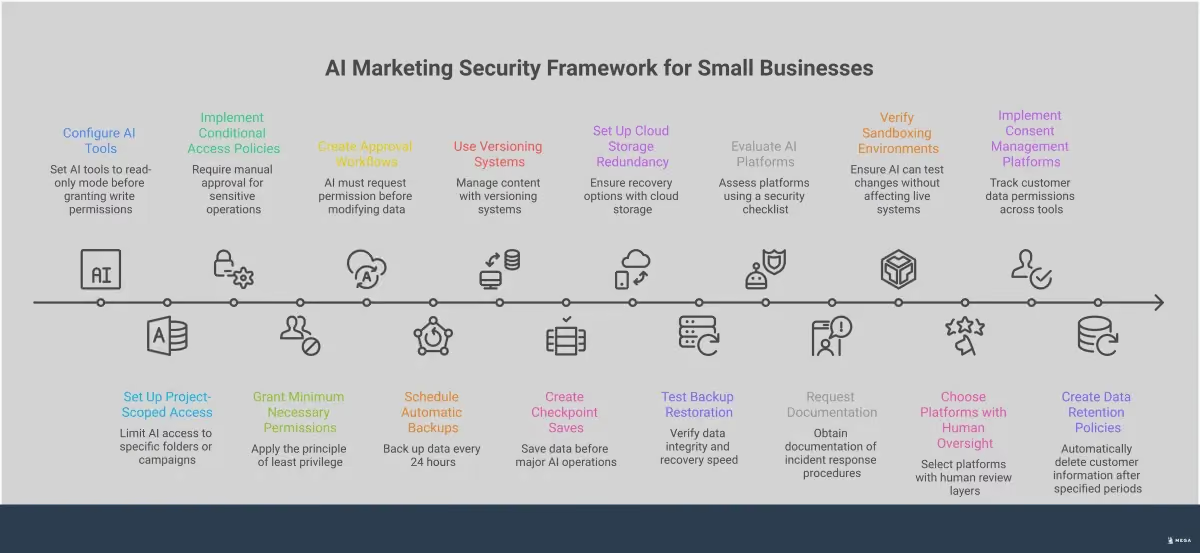
Protect Your Business Information
Before giving an AI tool full access to your systems, it’s essential to set clear boundaries. The best platforms are designed with security in mind, often starting in a "read-only" mode that prevents the AI from making changes without your explicit approval. Look for tools that allow you to set project-scoped permissions, which limit the AI’s access to only the files and data it needs for a specific task. This principle of least privilege is a core security concept. Additionally, features like sandboxing create a safe, isolated environment for the AI to work in, so it can’t interfere with your live systems. Always maintain automatic backups of your data to ensure you can quickly restore your information if something goes wrong.
Build Customer Trust When Handling Data
Your security measures don't just protect your business; they protect your customers and their trust in your brand. When you use AI to personalize marketing or manage customer information, you are responsible for how that data is handled. A critical first step is to ensure your team is well-trained on data privacy best practices and the specific AI tools you use. Regular training helps everyone stay informed on emerging threats and reinforces the importance of security. Being transparent with customers about how you use their data can also build confidence. When customers know you are taking responsible steps to protect their information, they are more likely to remain loyal to your brand.
Meet Compliance Requirements for Automation
Using AI in your marketing isn't just a technical decision; it's a legal one. Regulations like GDPR and CCPA have strict rules about data collection, storage, and usage, and these rules apply to automated systems, too. Your AI marketing tools must be able to operate within these legal frameworks. A reliable AI vendor will help you assess AI risk and implement the necessary security controls to maintain compliance. This includes features for managing user consent, handling data deletion requests, and providing clear audit trails of the AI's activities. Ensuring your AI is compliant from the start protects you from potential fines and legal issues down the road.
Common Challenges of Implementing AI Marketing Tools
Adopting any new technology comes with a learning curve, and AI marketing tools are no exception. While they offer incredible potential for growth, especially for small businesses, it’s smart to be aware of the common hurdles you might face. Understanding these challenges ahead of time helps you choose the right tools and create a smoother implementation process for your team. From managing data to adjusting your daily tasks, here are a few key areas to consider as you bring AI into your marketing strategy.
Data Privacy and Customer Trust
Handing over access to your business data can feel like a big leap of faith. AI tools often need access to sensitive information to do their job effectively, which raises valid concerns about security and privacy. Customers are also more aware than ever of how their data is being used. Building and maintaining their trust is critical. The best AI platforms address this by operating on a principle of least privilege, meaning they only access what they absolutely need. Look for tools that include a robust permission framework that requires your approval before making any changes, ensuring you always have the final say.
Integrating with Your Existing Systems
Your business likely already runs on a set of tools, from your website's content management system to your customer relationship manager (CRM). A new AI tool that can’t communicate with your existing software will create more problems than it solves. The goal is to find a solution that integrates smoothly, allowing your AI agent to understand everything from your inventory levels to your shipping rates. This kind of seamless connection is what allows an AI to perform complex tasks autonomously. Without a common standard for these tools to talk to each other, you can end up spending more time managing the software than benefiting from it.
Costs and Resource Limitations
The sticker price of an AI tool is rarely the full story. The computational power required to run complex AI models can be immense, and sometimes those costs are passed on to the user in unpredictable ways. For a small business with a tight budget, unexpected fees can be a major issue. It’s important to find a platform with transparent, predictable pricing. Before committing, get a clear understanding of what’s included in your subscription and whether there are any usage-based fees. This helps you budget effectively and ensures you can get the full benefit of the tool without worrying about surprise charges.
Managing Workflow Changes
Introducing a powerful AI agent will change how your team gets work done. It’s not just about adding another piece of software; it’s about rethinking your processes to make the most of automation. An AI can accelerate your workflow, but your team needs to adapt to supervising its work, providing the right inputs, and managing the outputs. The key is to implement AI safely, with monitoring tools and backup plans in place. This allows you to harness the speed and efficiency of AI without risking data loss or giving up critical oversight of your marketing operations.
How AI Personalization is Changing Customer Expectations
Customers are beginning to expect a personalized experience from every business they interact with, not just major retailers like Amazon or Netflix. Recent developments in AI are making this level of personalization more accessible than ever. New tools can draw context from a user's emails, search history, and even past online orders to provide incredibly relevant recommendations and content. This shift means that generic, one-size-fits-all marketing is quickly becoming obsolete.
For small businesses, this isn't a reason to panic. It's an opportunity to connect with your audience on a much deeper level. By using AI to understand customer needs and behaviors, you can create marketing that feels less like an advertisement and more like a helpful, one-on-one conversation. The key is to use these powerful new capabilities to deliver real value, making every customer feel seen and understood. This approach not only meets modern expectations but also builds the kind of lasting loyalty that helps a small business thrive.
Optimize Content Based on User Behavior
Your customers leave digital footprints with every online action. They watch videos, read articles, and search for solutions to their problems. Modern AI can now connect these dots to understand what a person is interested in at any given moment. For example, Google's Gemini can consider a user's YouTube viewing history and Gmail content to provide more relevant answers by default. This is a prime example of behavioral marketing in action.
For your business, this means you can move beyond basic demographics and tailor your content to a user's current intent. Imagine your website showing a blog post about a specific problem a visitor was just researching, or an ad highlighting a product that complements something they recently viewed. This relevance makes your marketing more effective because it addresses a customer's immediate needs.
Map the Customer Journey Automatically
Understanding the full customer journey—from initial awareness to final purchase—is a classic marketing challenge. AI is making it much easier to see the complete picture. For instance, a user shopping for a tablecloth could ask an AI for help, and it might find the table's dimensions from an old order confirmation in their email to recommend the correct size. This shows how AI can connect separate interactions over time to provide seamless support.
This capability allows you to map the customer journey without manual guesswork. An AI can identify patterns, showing you how customers move from a social media post to a product page and finally to checkout. By understanding these paths, you can remove friction points and guide potential buyers more effectively, ensuring a smooth and intuitive experience from start to finish.
Balance Personalization with Privacy
As powerful as personalization is, it must be balanced with a strong commitment to privacy. Customers are wary of how their data is being used, and a breach of trust can be difficult to repair. The most responsible AI tools are designed with this in mind. For example, some AI assistants operate in a "read-only" mode by default and have a permission framework that requires user approval before taking any action, like making changes to a file.
When choosing AI tools for your business, prioritize those that give you and your customers control. Transparency is key. You should always be clear about what data you are collecting and how you are using it to improve the customer experience. Building your marketing strategy on a foundation of data privacy not only protects you legally but also strengthens your relationship with your audience.
Why Small Businesses Should Adopt AI Marketing Now
If you’re running a small business, the idea of adding another complex tool to your plate can feel overwhelming. But AI marketing isn't just another piece of software to learn. It’s a fundamental shift in how you can reach customers and grow your business, leveling the playing field between you and your largest competitors. Adopting AI tools now isn't about chasing a trend; it's about building a more resilient, efficient, and competitive business for the future.
AI-powered platforms can take on the time-consuming marketing tasks that often fall by the wayside, like writing blog posts, researching keywords, and managing ad campaigns. This allows you to focus on what you do best: serving your customers and improving your products. By handling the heavy lifting, a good AI marketing strategy gives you back your most valuable resource: time. It’s your opportunity to operate with the power of a full marketing team without the associated costs.
Gain a Competitive Edge with Automation
Automation gives small businesses the ability to operate with the efficiency of a much larger company. AI tools can streamline operations by handling repetitive marketing tasks around the clock, from generating content ideas to optimizing your website for search engines. This means your marketing efforts don't stop when you clock out for the day. By automating these processes, you can respond to market changes and customer needs more effectively, ensuring you never miss an opportunity to connect with your audience. This consistent presence helps you build a stronger brand and compete more effectively in a crowded marketplace.
Make the Most of a Limited Budget
For most small businesses, every dollar counts. AI marketing tools are designed to maximize your resources and deliver a higher return on your investment. Instead of spending your budget on a large marketing team or expensive agency retainers, you can use an AI platform to execute sophisticated campaigns for a fraction of the cost. These tools can automatically optimize your ad spend by shifting budget to the best-performing channels and creatives, ensuring your money is always working as hard as possible. This allows you to achieve better results and improve customer satisfaction without stretching your finances thin.
Scale Your Marketing as Your Business Grows
As your business expands, your marketing needs become more complex. AI is built to handle this complexity, making it the perfect partner for growth. AI tools can analyze vast amounts of customer data to guide your marketing efforts, helping you focus on the most promising leads and understand customer sentiment as you scale. This capability is essential for any business looking to grow sustainably. An AI system can manage an increasing number of customer interactions and marketing campaigns without requiring a proportional increase in your time or budget, allowing your marketing to grow seamlessly alongside your business.
How MEGA AI Helps You Adopt New Tech Safely
Adopting new AI tools can feel like a big risk, especially when you hear stories about automations going wrong. You want the competitive advantage AI offers, but you can’t afford to have an algorithm accidentally delete files or run wild with your ad budget. That’s why we built our platform with safety and control at its core. We believe you should get all the benefits of AI without any of the anxiety.
At MEGA AI, we provide powerful automation for your SEO and Paid Ads campaigns through our AI agents, the SEO Agent and Ads Agent. But unlike other tools that operate in a black box, our agents work with built-in security protocols, human oversight, and complete transparency. You get the efficiency of AI-driven marketing execution, paired with the safeguards you need to feel confident. This approach allows you to safely integrate cutting-edge technology into your business, knowing that there are clear boundaries and a human expert in the loop.
Automate SEO with Built-In Security
Handing over the keys to your website can be nerve-wracking. Our SEO agent, the SEO Agent, is designed to eliminate that worry. It operates on a principle of least privilege, meaning it starts in a read-only mode to analyze your site and identify opportunities without making any changes. Before executing sensitive commands, like altering code for technical SEO, it requires your approval. This built-in permission framework ensures you have the final say on any significant updates. This approach to secure AI agents means you can automate content creation and optimization while preventing any unwelcome surprises.
Optimize Paid Ads with Human Oversight
For paid advertising, control over your budget is critical. Our Paid Ads agent, the Ads Agent, accelerates your campaign workflow by testing creatives and optimizing spend, but it never works alone. Every action is guided by human oversight and operates within project-scoped permissions. Think of it as a secure sandbox where the AI can work its magic within predefined rules, preventing overspending or straying from your campaign goals. We also maintain automatic backups of your campaign structures, so you can harness the power of AI to improve performance without risking data loss or costly errors.
Get Full Transparency into AI Tasks
One of the biggest challenges with AI tools is understanding what they’re actually doing to justify the investment. As some experts note, simply tracking AI queries isn't a useful measure of performance. We solve this problem by providing complete visibility into every task our agents perform. Through your MEGA AI dashboard, you can see every piece of content written, every technical fix implemented, and every ad campaign adjusted. This transparency demystifies the process, builds trust, and allows you to see the direct connection between our work and your business growth.