
Using AI for content creation and SEO analysis offers incredible speed, but it also raises valid concerns about maintaining content quality and brand authenticity. An advanced ChatGPT prompt strategy directly addresses these challenges. It’s about guiding the AI to produce outputs that are not only SEO-friendly but also accurate, original, and aligned with your unique brand voice. This article delves into techniques for overcoming AI's potential biases, ensuring your content remains distinct, and staying current with the evolving AI and SEO landscape. Learn how to leverage AI's power responsibly, enhancing your SEO without sacrificing the quality and authenticity your audience trusts.
Key Takeaways
- Refine Your ChatGPT Prompts for Stronger SEO Insights: Move beyond simple queries by providing detailed context and iterating on your questions to uncover more actionable SEO intelligence.
- Improve Content by Analyzing Quality and Intent with AI: Use ChatGPT to assess your articles against Google's guidelines and competitor content, ensuring your information effectively answers user questions.
- Translate AI Insights into SEO Actions and Refine Your Strategy: Implement ChatGPT's recommendations by updating content and creating new material, then monitor your SEO performance and adjust your prompts, always balancing AI suggestions with your own expertise.
What is an Advanced ChatGPT Prompt Strategy for SEO?
An advanced ChatGPT prompt strategy for SEO moves beyond asking simple questions like "give me keywords for organic dog food." Instead, it involves a more thoughtful and structured approach to interacting with the AI to get truly valuable insights for your search engine optimization efforts. Think of it less like a vending machine where you input a query and get a fixed output, and more like a brainstorming partner that you guide and refine.
At its core, an advanced strategy means crafting highly specific and context-rich prompts. This might involve utilizing the capabilities of more advanced AI models and spending time perfecting your prompt text to align with specific SEO principles or guidelines. It’s about telling ChatGPT not just what you want, but how you want it analyzed or generated, and why it’s important from an SEO perspective. This precision helps the AI understand the nuances of your request, leading to more targeted and useful responses.
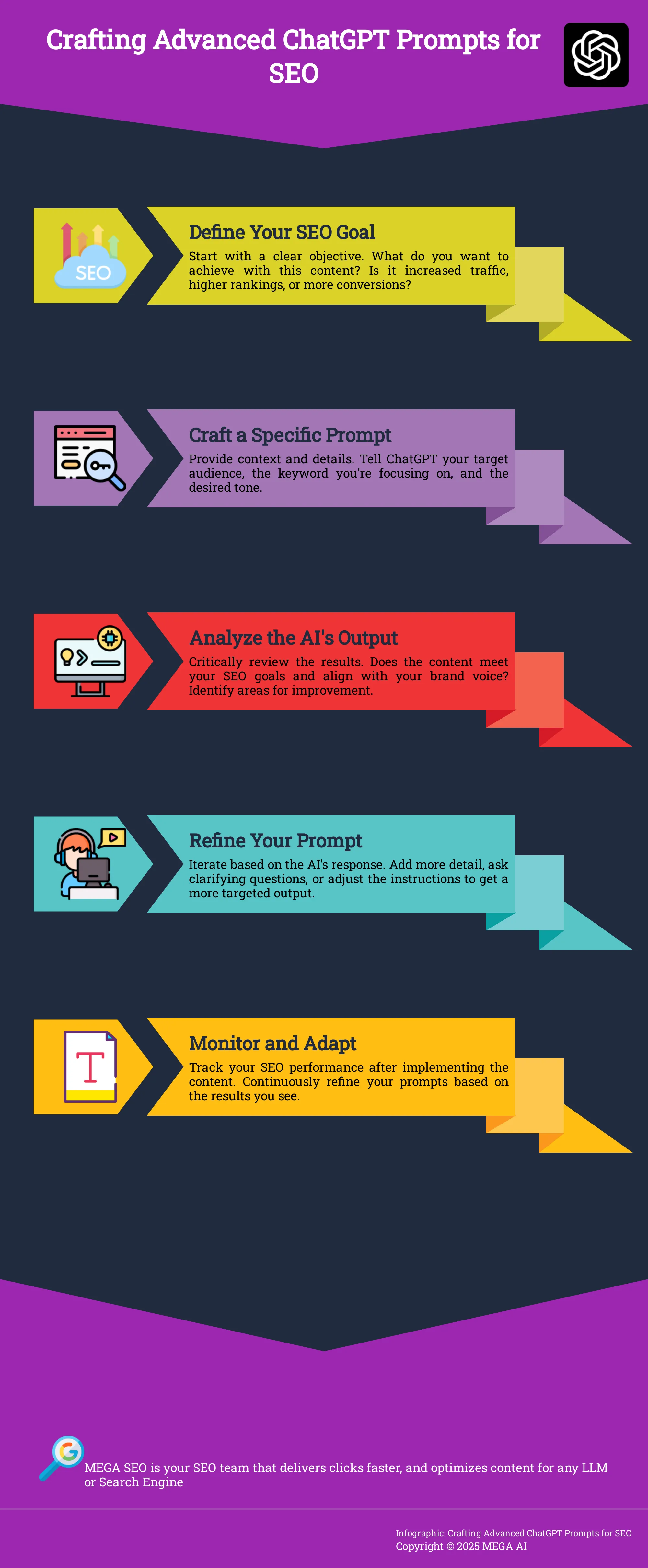
Furthermore, an advanced strategy is iterative. You don't just send one prompt and call it a day. It's about a continuous cycle of prompting, reviewing the AI's output, and then refining your subsequent prompts to dig deeper or clarify instructions. This co-writing approach, where you treat ChatGPT as an assistant rather than an autopilot, allows you to guide the AI toward producing drafts and analyses that you can then further refine and fact-check. Ultimately, it’s about using prompts to steer ChatGPT towards generating actionable insights that genuinely help improve your content and SEO performance.
What are Google's Quality Rater Guidelines (and Why They Matter)?
You might have heard about Google's Quality Rater Guidelines, and they're quite important in the world of SEO. Essentially, these guidelines are a detailed handbook Google provides to its team of human search quality evaluators. These aren't algorithms; they're real people who assess the quality of search results for various queries. Think of them as providing a crucial human perspective that helps Google refine its automated systems and ensure search results are genuinely useful. So, why should this document, primarily for Google's internal teams, matter to you and your business? Because these guidelines offer a transparent look into exactly what Google values as a high-quality, relevant, and helpful search result.
Understanding and applying these principles to your website and content can significantly influence how well your pages perform. When your content aligns with what these raters are trained to look for, you're setting yourself up for better search engine rankings. But it's more than just rankings; it's about creating content that truly serves your audience, builds trust, and establishes your authority. These guidelines provide a clear roadmap to achieving that, helping you focus your efforts on what truly makes a difference in Google's eyes and, more importantly, in your users' experience. Consistently creating content with these standards in mind is a sustainable way to improve your online presence.
Key Aspects of the Quality Rater Guidelines
The Quality Rater Guidelines direct evaluators to examine several core components when they look at a webpage. A major focus is on the depth and comprehensiveness of the content. They ask: Is this information superficial, or does it thoroughly explore the topic, answering potential follow-up questions a user might have? They also carefully scrutinize the credibility of the source. This involves looking at who created the content, their qualifications, and the reputation of the website itself.
Another critical factor is how well the content satisfies the user's likely intent behind their search query. Evaluators are trained to prioritize content quality above almost all else, considering if the information is accurate, clearly written, and provides substantial value. The overall user experience on the page, including its design, ease of use, mobile-friendliness, and general trustworthiness, also plays a significant role in their assessment.
Understanding E-A-T: Expertise, Authoritativeness, and Trustworthiness
A cornerstone of the Quality Rater Guidelines is the concept of E-A-T, which stands for Expertise, Authoritativeness, and Trustworthiness. While E-A-T itself isn't a direct, measurable ranking factor like page speed, it's a critical framework Google's human raters use to assess the overall quality of content. This is especially true for topics that can significantly impact a person's health, happiness, safety, or financial stability—often referred to as "Your Money or Your Life" (YMYL) pages.
Expertise refers to the demonstrated skill and knowledge of the content creator on the specific topic. Authoritativeness is about the overall reputation of the creator, the content itself, and the website as a recognized leader or go-to source in its field. Trustworthiness relates to the legitimacy, transparency, accuracy, and security of the content and the website. Google wants to surface results from sources that users can confidently depend on, and demonstrating strong E-A-T helps build that essential user trust.
Incorporate Guidelines into Your SEO Strategy
To effectively weave the insights from the Quality Rater Guidelines into your SEO efforts, your primary focus should be on creating genuinely high-quality, informative content that directly addresses what your audience is searching for. Always start by considering the user's intent: What problem are they trying to solve, or what question are they hoping to answer with their search? Your content should aim to provide a clear, comprehensive, and satisfying solution.
Regularly review and update your existing content to ensure it remains accurate, relevant, and continues to meet current E-A-T standards. This isn't a one-time task but an ongoing commitment. This might involve adding new information, updating statistics, refreshing examples, or improving clarity. Leveraging tools that assist with content generation and analysis can help you identify areas for improvement based on these quality principles. By consistently aiming to meet these guidelines, you're not just optimizing for search engines; you're building a better, more valuable experience for your users.
Use ChatGPT for In-Depth SEO Analysis
ChatGPT can be a fantastic partner for digging deep into your SEO performance, going far beyond simple keyword lists. When you guide it with smart prompts, it can help you understand content quality, dissect what your competitors are doing right, and uncover hidden opportunities to improve your rankings. Let's look at how you can use it to get some really insightful analysis.
Craft Effective Prompts for Content Evaluation
To get the most out of ChatGPT for evaluating your content, you need to give it clear instructions. Think of it as briefing an expert. For example, you can tell ChatGPT to act as an SEO specialist familiar with Google's Quality Rater Guidelines. This helps the AI assess your content based on criteria Google itself uses for quality and relevance. The more specific your prompt, the better ChatGPT can understand what you need and provide a useful evaluation of your content's strengths and weaknesses, helping you refine your approach.
Analyze Competitor Content: Structure and Depth
Understanding what your competitors are doing well is a big part of SEO. You can use ChatGPT to help with this by asking it to compare your articles with top-ranking competitor pieces. Prompt it to look at things like the depth of information, the level of detail, and how well each article seems to demonstrate expertise. A key area to focus on is user intent – how well does the content actually answer the searcher's underlying question? This kind of analysis can show you where your competitors shine and where you have a chance to do even better with your own content strategy.
Pinpoint Content Gaps and Opportunities
Once ChatGPT has helped you compare your content to your competitors, the next step is to find specific ways to improve. Ask it to create a list of actionable recommendations for your articles. This list should stem from the comparative analysis, highlighting areas where your competitors might have an edge or where they've missed something you can capitalize on. This process is great for identifying content gaps and finding clear opportunities to make your content more comprehensive, helpful, and ultimately, rank higher in search results.
Generate Actionable SEO Insights with ChatGPT
Once you're comfortable with crafting effective prompts, ChatGPT can become a powerful ally in dissecting SEO performance and uncovering opportunities. It’s about moving beyond basic keyword research and truly understanding the landscape your content lives in. This means using AI to get specific, actionable feedback that can guide your content strategy.
Assess Content Quality and User Intent Fulfillment
To create content that ranks well and resonates, you need to know how well it meets user needs. Understanding user intent is key. Guide ChatGPT to evaluate if your articles truly answer user questions and satisfy their search reasons. For instance, by providing ChatGPT with principles from Google's Quality Rater Guidelines, it can assess if content effectively addresses queries and offers a helpful experience. This ensures your content is genuinely valuable, not just keyword-optimized.
This assessment can highlight where your content might fall short—perhaps it's not deep enough or misses the "how-to" users seek. AI offers a structured way to find these gaps before making granular improvements.
Prioritize Content Improvements Strategically
Knowing where to improve is one step; prioritizing is next. ChatGPT can analyze your content against competitors. Prompt it to compare your article with top-ranking ones for a list of actionable enhancements. This method helps you focus your efforts for maximum impact.
Imagine getting specifics like: "Competitor A has a case study, Competitor B offers a template." This feedback is invaluable, moving you beyond guesswork to make targeted updates where your content is less thorough. This strategic approach ensures your optimization time is well spent.
Develop a Data-Driven Content Enhancement Strategy
Effective content strategies are dynamic and data-responsive. A data-driven approach means tracking SEO metrics and using AI insights for your next steps. By monitoring key performance indicators like traffic and rankings, you can make informed decisions to refine your content.
For instance, if a page has high impressions but low click-through, ChatGPT can help brainstorm better titles. If an article ranks but has a high bounce rate, AI can analyze if it matches search intent. Platforms like MEGA AI simplify this with tools like the Maintenance Agent, which identifies chances to add new sections or re-optimize content based on performance and search changes. This continuous loop of analysis, action, and measurement is vital for SEO success.
Put ChatGPT's SEO Recommendations into Action
Once you've used ChatGPT to analyze your content and your competitors, the next step is to translate those insights into tangible improvements for your website. This is where the real work begins, but it's also where you'll see the most significant impact on your SEO performance. It’s about taking the data and suggestions and turning them into a concrete plan.
Think of ChatGPT as your research assistant; it provides valuable information, but you, or an advanced platform, need to implement the strategy. This involves refreshing older content, creating new pieces based on identified gaps, and ensuring everything you publish contributes to your site's overall authority on key topics. For businesses looking to streamline this process, tools like MEGA AI can automate SEO tasks, from content updates to new article generation, making it easier to act on these AI-driven recommendations. This allows you to focus on strategy while the system handles much of the execution, ensuring your SEO efforts are both effective and efficient.
Refresh Existing Content for Better Performance
One of the quickest ways to see SEO gains is by improving the content you already have. ChatGPT can be a great starting point here. For instance, it can assist in analyzing your existing articles and help generate actionable insights. You can even use it to quickly summarize Google Analytics data to pinpoint valuable insights and areas that need a bit more attention. This might mean identifying pages with high impressions but low click-through rates, or articles that have started to lose ranking for important keywords.
After receiving an initial response from ChatGPT, continually refine your prompts. This ensures the plan is not too generic and includes deeper analysis or particular recommendations tailored to your specific needs. For example, instead of just asking "How can I improve this blog post?", try "Analyze this blog post [link] for outdated information and suggest three ways to improve its E-A-T for the keyword 'X', providing specific examples." Platforms like MEGA AI take this further with features like the Maintenance Agent, which can automatically update content to improve CTR and overall rank.
Create New, Targeted Content from AI Insights
Beyond updating what's already there, ChatGPT can help you identify opportunities for entirely new content. By analyzing competitor strategies and your own site's performance, you can uncover topics your audience is searching for that you haven't yet covered. You can implement specific ChatGPT prompts to evaluate traffic, engagement, and potential ROI to make informed decisions about what to create next. This proactive approach ensures your content calendar is always filled with relevant, high-potential topics.
Ask ChatGPT to summarize key insights from your data, such as notable increases or decreases in traffic around certain themes. This can highlight emerging trends or areas where your current content isn't meeting user demand. For instance, if you notice a competitor ranking well for a long-tail keyword related to your niche, you can ask ChatGPT to help outline a comprehensive article targeting that specific query. MEGA AI’s content generation capabilities can then help you produce this new, targeted content efficiently, ensuring it's optimized from the start.
Optimize for Semantic SEO and Build Topical Authority
To truly establish your website as a go-to resource, focus on semantic SEO and building topical authority. This means creating comprehensive content that thoroughly covers a subject and its related subtopics. Using ChatGPT for SEO is most effective when you treat it as a co-writer, not an autopilot. It can generate drafts, but these will need your expertise for refining, fact-checking, and optimizing to meet high SEO standards and align with your brand voice.
The more you write on a given topic and completely cover all the subtopics in a niche, the more search engines like Google will recognize you as a topical authority in that category. Use ChatGPT to brainstorm related keywords, outline content clusters, and ensure your articles answer all potential user questions. This approach not only helps individual pages rank but also strengthens your site's overall authority, making it easier for all your content to perform well and attract consistent organic traffic.
Enhance Content Quality and User Experience with AI
Artificial intelligence, particularly tools like ChatGPT, offers powerful ways to refine your content beyond initial drafts. When you thoughtfully guide these tools, you can improve article quality and the reader experience. This means treating AI as a collaborator to help analyze, expand, and polish your work.
Add Meaningful Depth and Detail to Your Articles
AI generates text quickly, but initial drafts can lack the specific details your audience needs. The first output might be general, as AI assembles readable content using sophisticated predictive text, which can sometimes be confidently incorrect. Your role is to guide the AI further. Refine your prompts, ask for deeper analysis, or request specific examples. For instance, if a section feels too surface-level, prompt it with, "Expand on this point by providing three distinct examples and explaining the implications of each."
This iterative process helps transform generic content into something valuable. Platforms like MEGA AI can also assist by identifying sections in your existing content that would benefit from additional information, helping you continuously enrich your articles.
Address User Intent More Effectively
Content resonates when it addresses what your audience seeks. AI can be a great partner here. Instead of just generating text, use AI to analyze if your content answers user questions and solves their problems. Think of AI as a co-writer that helps you align your content with user needs, not an autopilot.
Prompt an AI to review an article from a user's perspective. Ask: "If a user searches for 'X,' does this article fully address their needs? What questions remain?" This refines your content to be more targeted. Tools offering content optimization, like MEGA AI's Maintenance Agent, work to ensure your articles effectively meet user intent, crucial for SEO success.
Incorporate Relevant Examples and Data
Strong content often includes credible examples and data. AI can streamline finding and integrating this support. Instead of hours sifting reports, ask AI for relevant data points or case studies. For example, prompt, "Find three recent statistics about X trend" or "Provide a brief case study for Y concept." AI helps you quickly sift through data for valuable insights.
Once you have this information, AI can help weave it naturally into your narrative. This makes your content more persuasive and enhances its authority. Using data to support your claims can significantly improve how users perceive your content. Many AI-powered SEO tools can also help analyze which data makes your content more compelling.
Use ChatGPT for Effective Competitor Analysis
Understanding what your competitors are doing well is a fundamental part of building a successful SEO strategy. It helps you see where the bar is set and find opportunities to outperform them. Think of it as reconnaissance for your content – knowing the terrain before you advance. ChatGPT can be a powerful ally in this process, helping you dissect competitor strategies and uncover insights much faster than manual analysis alone. Instead of spending hours sifting through search results and competitor websites, you can direct ChatGPT to do the heavy lifting. By using targeted prompts, you can get a clearer picture of the competitive landscape and identify actionable steps to improve your own SEO performance. This isn't about simply copying what others do; it's about learning from their successes and failures to inform your unique approach. With the right prompts, ChatGPT can help you look at competitor content with a critical eye, making it easier to spot patterns, strengths, and weaknesses. This means you can move from simply observing competitors to strategically responding to their efforts, all with a more efficient workflow, freeing up your time for other critical SEO tasks.
Compare Your Content Against Top-Performing Articles
One of the first steps in competitor analysis is to see how your content stacks up against those already ranking at the top of search results. ChatGPT can assist in analyzing top-performing articles and generating actionable insights. For instance, you can use ChatGPT to quickly summarize Google's search quality evaluator guidelines. Then, you can prompt it to compare your content with these guidelines and with the key elements found in top-performing articles within your niche. This can highlight areas where your content might be falling short, whether it's in terms of comprehensiveness, clarity, or addressing user intent. This approach gives you a structured way to evaluate your existing pages and plan improvements.
Identify Your Unique Selling Points and Differentiators
While it's important to see what successful competitors are doing, it's equally crucial to understand what makes your content and your brand unique. Using ChatGPT for SEO is most effective when you treat it as a co-writer, not an autopilot. It can generate drafts and ideas, but these require your expertise to refine, fact-check, and optimize to meet SEO standards. This collaborative process can help you identify unique selling points and differentiators in your content. Ask ChatGPT to analyze your content alongside a competitor's, specifically prompting it to highlight differences in perspective, depth, or the unique value you offer. This can help you lean into your strengths and carve out a distinct space in the search results.
Adapt Successful Strategies for Your Niche
Once you have a good understanding of what your competitors are doing and how your content compares, the next step is to adapt successful strategies for your own niche. You can implement specific ChatGPT prompts to evaluate competitor approaches to traffic generation, user engagement, and how they might be measuring their return on investment. By analyzing successful strategies from competitors, you can adapt these insights to fit your specific audience and improve your content performance. For example, if competitors are successfully using a particular content format or addressing a specific subtopic you've overlooked, ChatGPT can help you brainstorm ways to incorporate similar, yet unique, approaches into your own content plan. This allows you to make informed decisions rather than guessing what might work.
Integrate ChatGPT into Your SEO Workflow
Adding ChatGPT to your daily SEO tasks is much like welcoming a skilled new assistant to your team. The real value comes when you view it as a partner that helps you work smarter, not as a substitute for your own strategic insights. When you thoughtfully incorporate ChatGPT into your established workflows, you'll find it can help you discover fresh perspectives, accelerate routine tasks, and ultimately build more effective SEO strategies. This isn't about completely changing how you operate; it's about enriching your current methods with the analytical power and content generation capabilities of AI.
Consider the everyday components of your SEO responsibilities: sifting through performance data, generating new content topics, or even creating initial drafts for articles. ChatGPT can significantly streamline these activities, giving you more time and mental space to concentrate on overarching strategy and creative development. The aim is to establish a collaborative system where AI complements your skills, making your entire SEO process more productive and impactful. For instance, platforms like MEGA AI are built to support this kind of synergy, providing tools that automate and clarify intricate SEO functions, allowing you to leverage AI without needing deep technical expertise yourself.
Combine ChatGPT with Other SEO Tools
ChatGPT performs best when it complements your existing set of SEO tools. While it’s remarkably adaptable, it doesn’t replace the specialized functions of other platforms. You’ll continue to use your preferred analytics tools for concrete data on site performance and keyword research software for accurate search volumes and competitor insights. ChatGPT then steps in to help you interpret this information. For example, you can use ChatGPT to summarize detailed performance reports or extract key takeaways from numerical data, helping you convert raw information into clear actions.
Think of ChatGPT as a collaborative partner—more like a co-writer or research assistant than a fully autonomous system. It can produce initial drafts or brainstorm ideas, but these suggestions always require your professional judgment for fine-tuning, verification, and optimization to align with SEO best practices. After conducting keyword research with a dedicated tool, for instance, you might ask ChatGPT to generate potential blog titles or outline an article based on those keywords. This teamwork allows you to benefit from AI's efficiency while ensuring your strategy and quality standards remain high.
Create a Sustainable, AI-Enhanced SEO Process
To get the most from ChatGPT, integrate it into your SEO activities regularly, rather than just occasionally. This involves establishing a consistent, repeatable workflow. Begin by pinpointing routine tasks where ChatGPT can provide significant help, like drafting meta descriptions, brainstorming ideas for content clusters, or creating initial versions of outreach emails. Building a collection of effective prompts for these common tasks will streamline your work and help maintain consistent quality in the outputs.
A sustainable AI-enhanced process also includes using AI to help you monitor SEO performance and adjust your strategy accordingly. For instance, you can input traffic and engagement metrics into ChatGPT and request an analysis of trends, potential problems, or opportunities for growth. This enables you to make better-informed choices about where to direct your attention, such as refreshing content that isn’t performing well or expanding on successful topics. This methodical approach allows for ongoing improvement of your SEO strategy, guided by AI-generated insights.
Balance AI Insights with Human Expertise
Although ChatGPT provides impressive analytical power, your expert oversight is crucial. AI can sift through extensive data and spot patterns, but it doesn't possess the subtle understanding, critical reasoning, or ethical considerations that a human professional offers. It's wise to learn how to avoid common pitfalls such as providing unclear prompts or not recognizing the AI's natural limitations. Always review the suggestions and content from ChatGPT with a critical eye.
Keep in mind that AI-generated material can sometimes present information with false confidence or may not capture your brand’s unique voice and style. Your responsibility is to direct the AI, polish its suggestions, and confirm that the end result meets your strategic objectives and quality benchmarks. Tasks like verifying facts, editing for clarity and brand consistency, and making ultimate strategic choices depend on your irreplaceable expertise. This careful balance ensures that AI supports and improves your SEO work, rather than controlling it.
Overcome Challenges and Ensure Content Authenticity
Using AI tools like ChatGPT for your SEO and competitor analysis can bring some fantastic efficiencies, but it's wise to approach them with a clear understanding of their potential downsides. Like any powerful tool, AI has its quirks and limitations. The real skill lies in recognizing these challenges upfront and having solid strategies to manage them. This way, you can truly leverage the advantages AI offers while making sure your content stays authentic, accurate, and perfectly aligned with your brand. It’s all about integrating these tools thoughtfully to work smarter and maintain the high quality your audience and search engines value. When you understand these nuances, you can confidently weave AI into your SEO practices.
Address AI's Potential Biases and Limitations
It's important to remember that AI, including ChatGPT, isn't perfect. These models learn from incredibly large datasets, which can sometimes include outdated information, inherent biases, or even factual errors. As the team at BlackBean Marketing aptly puts it, "ChatGPT content is always confidently written and often incorrect — a dangerous combination." This means you can't simply take what the AI produces at face value. A critical eye and thorough fact-checking are essential steps before any AI-assisted content goes live.
Think of AI as a highly capable assistant that still requires your expertise for guidance and final approval. To achieve the best outcomes, you'll want to combine the speed of ChatGPT with human expertise to craft content that is not only optimized for search but also genuinely connects with your readers and upholds your standards for accuracy. This human oversight is the key to transforming raw AI output into polished, trustworthy content.
Maintain Your Originality and Brand Voice
Your brand has a distinct voice and personality; it's what helps you connect with your audience and stand apart from the competition. When you use AI to help brainstorm ideas or draft content, it's crucial that the final product truly reflects your established style. If you rely too heavily on generic AI output, your content might sound impersonal or lose that unique spark that defines your brand.
The advice from Public Media Solution is spot on: "After receiving an initial response from ChatGPT, continually refine your prompts to ensure the output aligns with your brand voice and messaging." This could mean feeding the AI examples of your best content, clearly defining the tone you're aiming for, or patiently tweaking your prompts until the suggestions feel authentic. While ChatGPT is a remarkable tool for streamlining content creation, it's important to use it effectively to ensure your brand's unique identity shines through. Always take the time to edit and personalize AI-generated material.
Stay Current with AI and SEO Developments
The fields of artificial intelligence and search engine optimization are incredibly dynamic. New AI models are developed, search engine algorithms receive updates, and best practices shift. What works well today might need adjustment tomorrow. Because of this constant change, a commitment to ongoing learning and adaptation is a vital part of successfully using AI in your SEO strategy. This involves keeping up with industry news, trying out new AI features, and regularly reviewing your own performance data.
Monitoring your SEO performance is key to understanding how well your AI-assisted strategies are working and to making smart, data-backed decisions. You can even implement specific ChatGPT prompts to help assess metrics like website traffic, user engagement, and return on investment. By staying informed and maintaining a flexible approach, you can ensure your methods remain effective and that you continue to get the best results from these evolving tools.
Measure and Refine Your ChatGPT-Driven SEO Strategy
Once you've started using ChatGPT to inform your SEO efforts, the work doesn't stop there. Like any effective strategy, it requires ongoing measurement and adjustment. Think of it as a feedback loop: you implement, you measure, you refine, and then you repeat. This iterative process is key to making sure your AI-assisted SEO truly delivers results and helps you achieve your online visibility goals. By consistently evaluating your performance and making smart tweaks, you can harness the full potential of AI in your SEO workflow.
Key Performance Indicators to Track
To understand how your ChatGPT-driven SEO strategy is performing, you need to keep a close eye on relevant Key Performance Indicators (KPIs). These metrics will tell you what's working and where you might need to make changes. Focus on core SEO metrics such as organic traffic, keyword rankings, click-through rates (CTR), conversion rates, bounce rate, and average session duration.
You can even use ChatGPT to help analyze these numbers. For instance, you might ask it to summarize key trends in your traffic data or to offer potential explanations for a sudden drop in engagement on certain pages. Regularly monitoring your SEO performance is essential for making informed, data-driven decisions and continuously improving your approach. This ensures you're not just implementing tactics but are actively steering your strategy toward success.
Adapt Your Approach Based on Results
The data you collect from your KPIs isn't just for show; it's your roadmap for improvement. If certain content pieces aren't performing as expected, or if your target keywords aren't gaining traction, it's time to adapt. ChatGPT can be a valuable partner in this phase as well. For example, if you notice a high bounce rate on a page where you used AI-generated content, you can ask ChatGPT to help you analyze the content for potential issues or suggest ways to make it more engaging.
With ChatGPT's assistance, you can efficiently sift through traffic data to uncover valuable insights and pinpoint areas that need attention. This allows you to be agile, making timely adjustments to your content or keyword strategy based on real-world performance rather than guesswork. This responsive approach helps keep your SEO efforts effective and aligned with user behavior.
Continuously Improve Your ChatGPT Prompts
The quality of the insights and content you get from ChatGPT is directly tied to the quality of your prompts. As you become more familiar with using ChatGPT for SEO, make it a practice to continuously refine your prompts. If an initial response isn't quite what you need, don't be afraid to tweak your prompt, add more context, or ask for a different perspective.
Think of prompt engineering as an ongoing skill you're developing. After receiving an initial response, you can refine your prompts to request deeper analysis or more specific recommendations. For instance, instead of just asking for "keywords for X topic," you might ask for "long-tail keywords for X topic targeting users in the consideration stage of the buyer's journey, with a focus on informational intent." This kind of specificity will yield much more useful results and make ChatGPT a more powerful tool in your SEO arsenal.
Related Articles
- Transform Your Copywriting with AI-Powered ChatGPT Prompts
- ChatGPT for SEO: A Startup's Guide to Content Optimization
- Google Review Algorithm: A 2024 Guide for Businesses
- How to Use ChatGPT Undetected: Tips & Tricks
- ChatGPT for Business Growth: A Practical Guide
Frequently Asked Questions
What's the main difference between a basic ChatGPT prompt for SEO and an 'advanced' one? A basic prompt might just ask for something simple, like a list of keywords. An advanced strategy involves giving ChatGPT much more specific direction and context. You're guiding the AI by explaining your SEO goals, who your audience is, and even the particular SEO principles you want it to focus on. It’s also more of an ongoing conversation; you review what the AI produces and then adjust your next prompt to get a more refined and useful response.
How can I use ChatGPT to help me align my content with Google's E-A-T principles? You can instruct ChatGPT to analyze your content through the lens of Expertise, Authoritativeness, and Trustworthiness. Provide your article and ask it to pinpoint areas where E-A-T could be strengthened, perhaps by suggesting where to add more evidence of expertise or where claims need better support. While ChatGPT can offer valuable suggestions, your own judgment is key to ensure the changes genuinely enhance your content's E-A-T.
My brand has a unique voice. How can I use ChatGPT for SEO without losing that? This is a common and important concern. The best approach is to view ChatGPT as an assistant or a starting point, rather than the final author. You can help it understand your style by providing examples of your existing content that reflect your brand voice. Crucially, always take the time to thoroughly edit and rewrite any AI-generated text to ensure it truly sounds like you and fits your brand’s personality.
When using ChatGPT for competitor analysis, what's the best way to get truly useful insights instead of just a summary? To get beyond a simple summary of a competitor's article, prompt ChatGPT to perform a more detailed comparison. You can ask it to look at specific elements such as the article's structure, the depth of information it offers, how effectively it seems to address user intent, or the kinds of examples it uses. These detailed observations can then help you identify specific opportunities where your own content can provide something more thorough or a distinct perspective.
If I'm using ChatGPT for SEO tasks, how important is my own SEO knowledge? Your SEO knowledge remains absolutely vital. ChatGPT is a powerful tool that can assist with executing tasks and generating ideas, but it doesn't replace the need for a strong understanding of SEO fundamentals. You need that expertise to create effective prompts, critically assess the AI's output, spot potential inaccuracies, and develop a sound overall strategy. Think of AI as a tool that amplifies your existing skills, not a replacement for them.