
The goal of any SEO effort is to connect with your target audience effectively and drive meaningful traffic to your site. Achieving this means understanding user needs, creating valuable content, and ensuring your website is technically sound. ChatGPT can assist you in many of these areas, acting as a powerful research and content generation aid. This piece will guide you through practical ways to integrate ChatGPT into your SEO strategy, from optimizing your site structure and meta tags to developing content that resonates with both local search queries and voice search users. We'll focus on how this AI can help you create and refine content at scale, ultimately supporting your efforts to improve your Google rankings.
Key Takeaways
- Establish Clear SEO Direction with AI: Use AI to translate your broader business aims into specific, actionable SEO goals and to identify key content areas and keyword opportunities, setting a solid groundwork for your efforts.
- Refine On-Page Elements and User Experience: Let AI assist you in improving your website's structure, meta tags, and headers, and in addressing technical SEO aspects, which contributes to a better experience for visitors and clearer signals for search engines.
- Maintain Momentum with AI-Powered Content and Analysis: Employ AI to brainstorm engaging content ideas, optimize your existing articles for improved performance, and interpret SEO data to make informed adjustments, ensuring your strategy remains dynamic and effective.
How ChatGPT Helps Your SEO
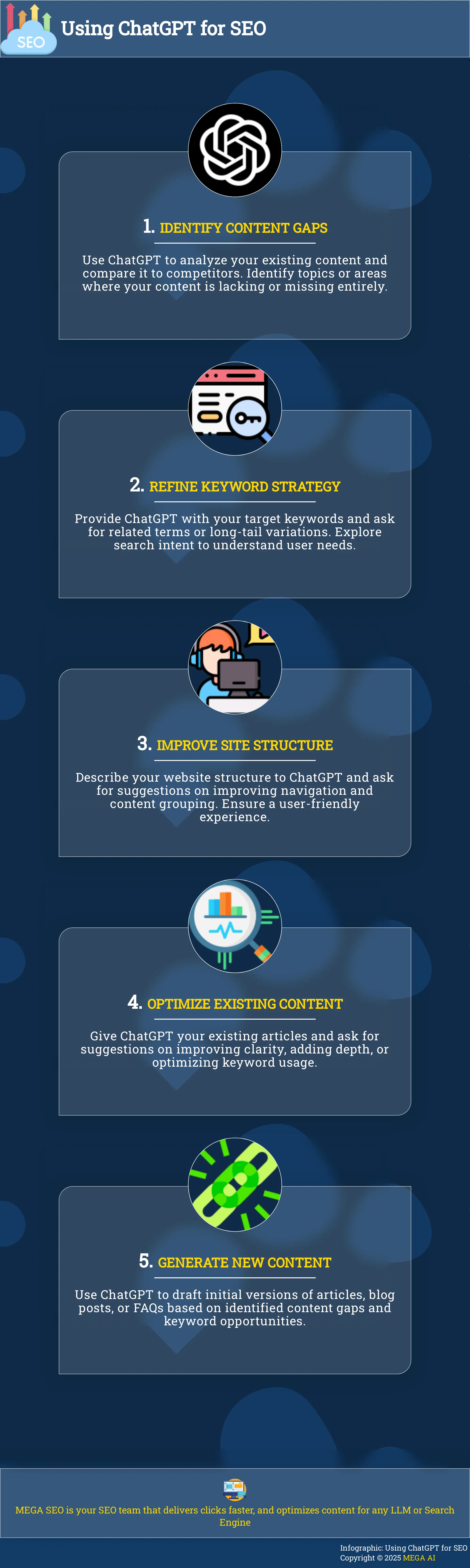
ChatGPT can be a genuinely helpful partner in your SEO efforts, offering fresh perspectives to tackle common challenges and uncover new opportunities. Think of it as a versatile assistant that can speed up various tasks, freeing you up to focus on overarching strategy and refinement. One of its most significant contributions lies in shaping your content strategy. For example, ChatGPT can assist you in performing a thorough content gap analysis. By analyzing existing content landscapes, it helps you pinpoint topics your competitors are covering that you might be missing, or identify underserved areas within your niche. This allows you to create targeted content that directly addresses what your audience is searching for and fills those important information voids.
Beyond just finding gaps, ChatGPT is also quite adept at keyword research. It can help you brainstorm a comprehensive list of potential keywords and even dive deeper into understanding the nuances of search intent. This means you can gather valuable insights more quickly, ensuring your content is precisely aligned with user needs. Furthermore, its capabilities extend to helping you draft initial outlines, meta descriptions, title tags, and even generate ideas for linkable assets. For those looking to understand complex SEO concepts or even generate basic structured data markup, ChatGPT can serve as a useful starting point, simplifying technical aspects and making them more accessible. By integrating ChatGPT into your workflow, you can make your SEO processes more efficient and ultimately more effective.
Define SEO Goals with AI
Setting clear goals is the first step to any successful SEO strategy. Without them, you're essentially working without a map, hoping to stumble upon success. The good news is that AI, and tools like ChatGPT, can be incredibly helpful in this foundational stage. Instead of relying on guesswork or past assumptions, AI can help you process vast amounts of data—market trends, competitor performance, and audience behavior—to define objectives that are not only ambitious but also genuinely achievable and directly tied to your business's overall success. Think of AI as your strategic partner, one that helps you see both the bigger picture and the specific, actionable steps needed to get there. This means moving beyond surface-level metrics like just ranking for a keyword, and instead focusing on SEO goals that genuinely contribute to tangible growth. This could be increasing qualified leads, driving more sales through organic channels, or establishing your brand as a recognized authority in your specific niche. For businesses, especially startups and small enterprises aiming to make a real impact, using AI to sharpen your SEO focus can make a significant difference in how effectively you connect with your target audience and achieve your core business objectives. This intelligent approach ensures your efforts are precisely targeted and your valuable resources are well spent from the outset.
Align Strategies with Business Objectives
Your SEO goals shouldn't exist in a silo; they need to be tightly woven into your company's overall mission. Each SEO objective should directly support the broader purpose: to reach more prospective users through organic search and guide them towards becoming customers. To choose your SEO goals effectively, start with your company's big-picture objectives. Your digital marketing plan likely supports these aims, and your SEO strategy should align perfectly.
AI can assist in translating these overarching business aims into specific, measurable SEO targets. For example, if your business goal is to boost sales for a new service, AI can identify high-intent keywords, analyze competitor tactics, and suggest relevant content. This helps you set a concrete SEO goal, like "Increase organic leads for X service by 20% in Q3 by ranking for Y keyword group." This ensures your SEO efforts directly contribute to core business outcomes.
Find Industry-Specific Opportunities
Every industry has its unique characteristics—customer language, competitive dynamics, and specific challenges. A generic SEO approach often falls short because what works for one sector may not apply to another. Understanding the importance of industry-specific SEO means diving into the nuances that make your field distinct.
AI tools can be powerful for uncovering these specific opportunities. They help analyze trends, understand the competitive landscape, and identify constraints like strict regulatory standards in certain fields. For instance, AI can sift through industry reports and competitor content to highlight underserved topics or emerging keywords unique to your area. This allows you to tailor your content and keyword strategy precisely, ensuring you connect effectively with your target audience by addressing their specific needs.
Optimize Keywords and Content Strategy
A solid keyword and content strategy is the foundation of any strong SEO effort. It’s all about figuring out what your audience is searching for and then creating genuinely helpful content that answers their questions. This crucial first step sets the direction for everything else you do in SEO. AI tools, especially something like ChatGPT, can really streamline this. Think of it as a super-smart research assistant that helps you find keyword opportunities, get a clearer picture of what users really want, and spot those content gaps you might have missed. This way, you can build a more focused and effective content plan that connects with your audience and performs well in search, ultimately driving more qualified traffic to your site.
Using AI in your strategy helps you go beyond just basic keyword lists. You can develop a much deeper understanding of the search landscape. This isn't just about knowing what terms people use, but why they're searching for those things, and how you can best provide the information they need. This deeper insight is key for crafting content that not only gets seen but also keeps people engaged and encourages them to take the next step. For businesses looking to make their mark, like startups or small businesses, using AI to refine content strategy can be a game-changer, saving time and improving results by automating parts of the research and analysis process.
Generate Comprehensive Keyword Lists
Putting together a complete list of keywords can feel like a mountain to climb, but ChatGPT can make it much more manageable. While your usual keyword research tools are still important, ChatGPT is a fantastic addition to your toolkit. As the team at Bluehost mentions, "By using ChatGPT for SEO, you can identify the related keywords and gain valuable insights quickly." You can ask it to brainstorm keywords around your main topics, find those specific long-tail phrases, or even group keywords by what the user is trying to do. For example, try prompting ChatGPT with, "Generate long-tail keywords for 'eco-friendly packaging solutions for small businesses'" to get more targeted ideas.
Analyze Search Intent and Relevance
Understanding search intent – the actual reason behind someone's search query – is so important for creating content that users find useful and that search engines rank well. ChatGPT can be a real help here. It can assist you in breaking down keywords to figure out if a user is looking for information, ready to make a purchase, or trying to find a particular website. HubSpot notes that, "ChatGPT can help you run a thorough content gap analysis... it can assist in understanding user intent and tailoring content to meet those needs." For instance, you could give ChatGPT a keyword and ask it to explain the likely intent, or even suggest the best content formats for that intent, ensuring your content truly hits the mark.
Find Content Gaps and Opportunities
Identifying content gaps means finding those topics your audience is interested in that you haven't covered yet, or areas where your current content could be significantly improved. ChatGPT can make this discovery process much smoother. You can use it to compare your content with what competitors are doing or check it against your target keyword list to see where you might be falling short. As AIPRM highlights, you can "Identify content gaps based on the analysis conducted using ChatGPT and other data sources, pinpoint the gaps in your existing content and identify areas where you can provide new and valuable information." Furthermore, by leveraging AI, you can effectively analyze these gaps and, as Team GPT suggests, "create content that fills these 'gaps' and rank on top of Google." This helps you focus your efforts on creating new content or updating existing pieces that will make the biggest difference.
Improve User Experience and On-Page SEO
Creating a positive user experience and strong on-page SEO go hand in hand. When visitors find your website easy to use and your content valuable, search engines tend to reward you. ChatGPT can be a helpful assistant in refining these aspects, offering a fresh perspective on your site and highlighting areas for improvement you might not have spotted. Think of it as a tool that can process information and suggest changes to make your website more appealing to both users and search engine crawlers.
A site that offers a good experience keeps people engaged longer, which can lower bounce rates and signal to search engines that your content is high quality. This often translates to better rankings and more organic traffic. Let's explore how ChatGPT can specifically assist with enhancing user experience and on-page SEO.
Improve Site Structure and Navigation
A clear and intuitive website structure is essential. If users struggle to find what they need, they’re likely to leave. As Tribulant notes, "User testing isn't just a strategy; it's a fundamental necessity in perfecting your website design to ensure an optimal user experience." While ChatGPT doesn't replace human user testing, it can help you brainstorm and refine your site’s architecture.
You can describe your current site layout to ChatGPT and ask for suggestions on how to logically group your content or simplify your navigation menu. For example, you could ask it to propose a more user-friendly hierarchy for your blog categories or product pages. This AI-driven analysis can help you organize information effectively, guiding visitors smoothly through your site.
Optimize Meta Tags and Headers
Meta tags, like titles and descriptions, and header tags (H1-H6) are vital for both SEO and user engagement. They give search engines context about your page content and offer users a quick idea of what to expect. Writing compelling, keyword-rich tags can take time, but ChatGPT can help streamline this. You can provide your page content or a list of target keywords and ask it to generate several options for meta titles, descriptions, and headers.
It's important to remember that, as Slider Revolution points out, "Enhancing user experience on a website isn't just a single action—it's a series of deliberate strategies and ongoing adjustments." This means your meta tags and headers should be regularly reviewed. ChatGPT can help you rephrase existing tags to improve clarity or click-through rates, ensuring they remain effective and support your on-page SEO efforts.
Use AI for Technical SEO
Technical SEO might seem complex, but it's crucial for ensuring your site is crawlable, indexable, and technically sound for users. ChatGPT can assist with several technical SEO tasks. For instance, the HubSpot Blog mentions, "ChatGPT can help you run a thorough content gap analysis... it can assist in identifying and adjusting areas of poor color contrast to meet accessibility standards." This highlights its utility beyond just creating text.
You can also use ChatGPT to help generate structured data markup, like Schema.org, which helps search engines better understand your content. For continuous optimization, tools like MEGA AI’s Maintenance Agent can automatically identify where existing articles need updates to improve rankings or even re-optimize content for different platforms or after search engine algorithm changes, keeping your technical SEO robust.
Develop a Strong Link-Building Strategy
Building a strong backlink profile is a key part of effective SEO. It shows search engines that your content is valuable and authoritative. While this can take time, ChatGPT can be a great assistant in making your link-building efforts more efficient. From finding hidden opportunities to brainstorming content that naturally attracts links, AI helps you work smarter. Platforms like MEGA AI can further support this by helping to automate content creation and optimization, which are key parts of an effective link-building strategy.
Find High-Value Link Opportunities
One of the first steps in link building is knowing where to look. ChatGPT can help you identify potential sources for high-quality backlinks. You can prompt it to list websites in your niche that accept guest posts or find blogs that often link to specific types of content, like original research or comprehensive guides. Think about asking ChatGPT to identify high-performing content types in your industry; these often include original data, in-depth tutorials, tool comparisons, expert roundups, and detailed case studies. A smart approach is to look for content gaps where existing articles might lack depth. This gives you a chance to provide superior value and earn a link, focusing your outreach effectively.
Create Linkable Content Ideas
Content that naturally attracts backlinks is invaluable. Instead of just writing standard blog posts, you can use ChatGPT to brainstorm ideas for "linkable assets." These are pieces of content so useful, informative, or unique that other websites will want to reference and link to them. Consider asking ChatGPT for ideas like interactive tools, compelling infographics, ultimate guides, or original survey data relevant to your audience. By focusing on creating content that truly serves and educates your target audience, you not only attract backlinks but also build a stronger, more authoritative online presence. The goal is to make your content a go-to resource that others are eager to share.
Analyze Competitor Backlinks
Understanding where your competitors get their links can provide a roadmap for your own strategy. While ChatGPT can't directly crawl websites for backlink data (you'd use dedicated SEO tools for that), it can be very helpful in the analysis phase. You can feed it information about content pieces that have earned your competitors many links and ask it to identify common themes, content structures, or potential angles for improvement. This is where techniques like the Skyscraper Technique come into play—finding great content and making something even better. ChatGPT can help you brainstorm how to add more value, update information, or present it in a more engaging way to attract those quality backlinks.
Create and Optimize Content with ChatGPT
ChatGPT offers some impressive ways to help you create new content and refine what you already have. When you approach content with an SEO mindset, this AI tool can become a great partner in developing materials that connect with both search engines and your audience. Let's look at how you can use ChatGPT to generate, optimize, and adapt your content effectively.
Generate SEO-Friendly Content at Scale
One of the most effective uses of ChatGPT for SEO is its ability to help you produce relevant content efficiently. You can leverage ChatGPT to analyze content gaps by seeing what your competitors are covering and what questions your audience is asking. Once you identify these opportunities, ChatGPT can assist in drafting initial versions of articles, blog posts, or FAQs designed to fill these gaps. For instance, if your analysis shows a lack of comprehensive guides on a specific topic in your niche, you can prompt ChatGPT to outline and then write a foundational piece. This method helps you consistently publish fresh, targeted content that addresses user needs and search engine priorities.
Optimize Existing Content for Better Performance
Your existing content library is a valuable resource for SEO improvements, and ChatGPT can help you polish these assets. By providing your current articles to ChatGPT, you can get suggestions for enhancing clarity, adding depth, or improving keyword use naturally. It can help you pinpoint gaps within your existing content where new, valuable information could be added to make the piece more comprehensive and authoritative. For example, you might ask ChatGPT to review a blog post and suggest sections that could be expanded or updated with recent statistics. This is similar to how MEGA AI's Maintenance Agent works to identify areas for adding new content to existing articles, aiming to improve rankings and click-through rates.
Adapt Content for Various Platforms
Content isn't one-size-fits-all; what works for a detailed blog post might not be suitable for a social media update or a different search platform. ChatGPT can be very helpful in repurposing your core content for various channels. You can ask it to summarize a long article into key bullet points for an email newsletter, or rephrase a technical explanation into simpler terms for a broader audience. This adaptability is key for enhancing user experience across different touchpoints. Platforms like MEGA AI further simplify this by enabling content re-optimization for any search engine or platform, ensuring your message is effective wherever your audience finds it. This ongoing adjustment helps maintain relevance and engagement.
Use AI for Local SEO and Voice Search
Reaching customers in your neighborhood and those searching by voice requires a specific approach. AI, including tools like ChatGPT, can help you refine your strategies for local SEO and the growing trend of voice search, making your business more discoverable to these valuable audiences. Let's look at how you can put AI to work.
Optimize for Local Search Queries
If your business serves a specific geographic area, appearing in local search results is crucial. SEO challenges for service companies often include high competition and the need for local optimization. Effective local SEO strategies should focus on optimizing for local search queries to improve visibility. You can use ChatGPT to brainstorm location-specific keywords, like "best pizza in Brooklyn" or "emergency plumber near me." It can also help you generate ideas for blog posts or service page content that incorporates these local terms naturally, making your offerings more relevant to nearby customers. Think about asking ChatGPT to draft descriptions for your services that highlight your connection to the local community.
Adapt Content for Voice Search
The way people search is changing, with voice assistants becoming increasingly popular. Voice search optimization requires a different approach, focusing on natural language and conversational queries. Users tend to ask full questions, so your content should provide direct and succinct answers. ChatGPT is excellent for this. You can feed it existing content and ask it to rephrase sections into a question-and-answer format. Or, prompt it to generate FAQs relevant to your products or services, using conversational language that mirrors how someone would actually speak their search query. This makes your content more likely to be featured in voice search results.
Enhance Local Business Listings
Your online business listings, especially your Google Business Profile, are vital for local SEO. To improve local SEO, ensure that your business listings are complete and accurate across all platforms. This includes maintaining consistent NAP (Name, Address, Phone Number) information and utilizing local keywords in your business descriptions. ChatGPT can help you write compelling, keyword-rich descriptions for these listings. You can also use it to generate responses to customer reviews or draft answers for the Q&A section of your profile, ensuring you’re actively engaging with your local audience and providing helpful information. Consistent and optimized listings build trust and improve your local search ranking.
Measure SEO Success and Adapt Strategies
Launching your SEO strategy is just the beginning. To truly succeed, you need to consistently measure your performance and be ready to adjust your approach. This is where AI, and tools like ChatGPT, can become incredibly valuable. By helping you understand complex data and identify areas for improvement, AI empowers you to make smarter, data-driven decisions that keep your SEO efforts on track and effective. Think of it as having an analytical assistant who can quickly process information and offer insights, allowing you to focus on strategic adjustments.
This ongoing cycle of analysis and adaptation is fundamental to improving your search rankings and achieving your business objectives. With the right tools, you can turn raw data into actionable steps, ensuring your SEO efforts continuously evolve and deliver better results.
Interpret SEO Metrics with AI
Understanding how your website is performing can feel like deciphering a complex code. AI tools can simplify this. For instance, ChatGPT can assist you in conducting a thorough content gap analysis. You can provide it with your website's performance data, and it can help highlight areas that need attention or improvement. This means you spend less time crunching numbers and more time understanding what they mean for your strategy.
Imagine you have a report from Google Analytics. Instead of just looking at traffic numbers, you can ask an AI tool to help you identify trends, understand user behavior patterns related to specific content pieces, or even summarize key takeaways from dense data sets. This allows you to get a clearer picture of your SEO strengths and weaknesses without getting bogged down in the raw data.
Adjust Strategies Based on Performance Data
Once you have a clearer understanding of your SEO metrics, the next step is to act on that information. AI can be a powerful ally here. You can leverage ChatGPT to analyze performance data and pinpoint content that isn't meeting expectations or to identify new opportunities. For example, if a set of keywords isn't driving the desired traffic, AI can help you understand why and suggest alternative approaches or content angles.
This proactive approach means your SEO strategy doesn't become static. If certain articles are underperforming, AI can help identify if it's due to a content gap that needs filling or if the existing content needs re-optimization. Platforms like MEGA AI take this further with features like the Maintenance Agent, which can automatically identify net new content to add to existing articles, helping to optimize content and improve its ranking based on ongoing performance analysis. This ensures your content stays relevant and competitive.
Track and Improve KPIs
Key Performance Indicators (KPIs) are the milestones that tell you if your SEO efforts are heading in the right direction. AI can help you not only track these KPIs but also find ways to improve them. By using ChatGPT for SEO, you can identify related keywords and gain valuable insights quickly, which can directly contribute to tracking and improving your KPIs. For example, if your goal is to increase organic traffic by a certain percentage, AI can help analyze which content pieces are contributing most effectively and where there are opportunities for growth.
This continuous loop of tracking, analyzing, and refining is crucial for long-term SEO success. AI can help you set more realistic KPIs based on industry benchmarks and your current performance. It can also assist in brainstorming strategies to address underperforming metrics. For instance, if your click-through rates are low, ChatGPT could help you generate more compelling meta descriptions or title tags, directly impacting that specific KPI and ultimately your site's visibility.
Best Ways to Use ChatGPT in Your SEO Workflow
ChatGPT can be an incredible asset in your SEO toolkit, but like any powerful tool, knowing how to use it effectively makes all the difference. It’s about understanding its strengths and where human insight remains irreplaceable. Think of it as a brilliant assistant who can speed up processes and offer fresh perspectives, allowing you to focus on strategy and refinement. By integrating ChatGPT thoughtfully, you can streamline many aspects of your SEO, from keyword research to content creation, making your overall workflow more efficient.
The key is to approach AI as a partner. It can handle much of the groundwork, but your expertise guides the process, ensuring the final output aligns perfectly with your goals and your audience's needs. This collaborative approach helps you get the most out of AI tools while maintaining high quality and strategic direction in your SEO efforts.
Handle Limitations and Potential Pitfalls
While ChatGPT is fantastic for brainstorming and drafting, remember it doesn't understand your brand's unique voice or your specific audience's nuanced needs without explicit guidance. The information it provides, while often comprehensive, can be generic or may not be entirely up-to-date, so always cross-reference critical data. For instance, while ChatGPT can assist in generating content ideas and performing analyses, it is essential to incorporate human expertise to ensure the content truly resonates.
ChatGPT can also be a great starting point for tasks like content gap analysis. It can analyze existing content and identify areas where you can provide new and valuable information. However, its insights should be validated and expanded upon with your own industry knowledge and competitor research. Platforms like MEGA AI's SEO suite are designed to work alongside your expertise, offering specialized AI capabilities that refine these processes and help you manage these potential pitfalls effectively.
Balance AI Assistance with Human Expertise
The most effective SEO strategies combine AI's analytical power with the critical thinking and creativity of human experts. AI, including ChatGPT, can process vast amounts of data, identify patterns, and automate repetitive tasks, freeing you for higher-level strategic work. Your role becomes guiding the AI, refining its outputs, and ensuring content aligns with your brand’s objectives and provides genuine value to your audience.
For example, while AI can suggest website structure improvements, human oversight is crucial for an optimal user experience. As experts point out, user testing isn't just a strategy; it's a fundamental necessity. Similarly, AI can analyze Google Analytics data, but your expertise translates those numbers into actionable insights and helps implement direct user feedback to genuinely enhance the user journey. This synergy ensures your SEO efforts are data-driven and human-centered.
How ChatGPT Can Improve Your Google Rankings
Improving your Google rankings is a common goal, and ChatGPT can be a surprisingly helpful partner in this effort. Think of it as an assistant that can speed up several important SEO tasks, giving you more time to focus on strategy. One of its strong suits is helping you perform a content gap analysis. By comparing your website's content to that of your top competitors, ChatGPT can point out topics or specific areas where your current content is thin or missing entirely. This allows you to create new, targeted content that directly addresses what your audience is searching for but not finding on your site.
Beyond just finding gaps, ChatGPT can assist with refining your keyword strategy. You can provide it with your primary business goals, your industry, and the keywords you're currently targeting. It can then help you analyze your pages for SEO effectiveness or suggest related keywords you might have overlooked. This targeted approach helps ensure your content is truly optimized for what your potential customers are typing into Google. Once you have these insights, you can even use ChatGPT to help create content that fills those identified gaps, aiming for high-quality, relevant material that attracts organic traffic.
It doesn't stop at content and keywords. ChatGPT can also offer suggestions for improving user experience, which is a significant factor in SEO. For instance, it can help identify areas on your website with poor color contrast, making your site more accessible. While tools like MEGA AI's Maintenance Agent can automate updates to improve CTR and optimize existing articles, understanding these foundational elements with ChatGPT's help can provide a more holistic view. Better user experience often means visitors stay on your site longer, signaling to Google that your content is valuable and potentially improving your rankings over time.
Related Articles
- ChatGPT for SEO: A Startup's Guide to Content Optimization
- The Role of Artificial Intelligence in SEO: Transforming Search Engine Optimization - MEGA SEO | Blog
- Long-Tail vs Short-Tail Keywords: Optimizing Your SEO Content Strategy - MEGA SEO | Blog
- Optimizing Content to Match User Search Intent and Improve Engagement Metrics: Advanced On-Page SEO Techniques - MEGA SEO | Blog
- Link Building Strategies: The Ultimate Guide (2024)
Frequently Asked Questions
How can ChatGPT really help with my SEO if I'm not a technical expert? Think of ChatGPT as a helpful brainstorming partner and a research assistant. It can simplify complex SEO ideas and help you with tasks like finding keywords your audience uses or coming up with topics for your blog. You don't need to be a tech wizard; you can ask it questions in plain language to get ideas for improving your website's content and structure.
Is content created by ChatGPT good enough to rank on Google? ChatGPT can definitely help you draft content quickly, but it's best used as a starting point. The content it generates often needs your unique insights, brand voice, and factual verification to truly shine and meet your audience's specific needs. Human oversight is key to ensure the content is high-quality, accurate, and provides real value, which are all important for ranking well.
Can ChatGPT replace my existing SEO tools for things like keyword research? ChatGPT is a great addition to your SEO toolkit, but it doesn't entirely replace specialized SEO tools. It's excellent for brainstorming keyword ideas, understanding search intent, and exploring related topics. However, dedicated SEO tools often provide more detailed data, competitor backlink analysis, and rank tracking features that ChatGPT doesn't offer directly. Use them together for the best results.
What's the most practical way to start using ChatGPT for my website's SEO today? A great first step is to use ChatGPT to analyze your existing content. You could ask it to identify potential content gaps by comparing your topics to what competitors cover, or ask for suggestions on how to improve the clarity and keyword focus of a specific blog post. This gives you actionable insights you can implement right away.
How do I make sure I'm using ChatGPT effectively and not just creating generic content? The key is to be specific with your prompts and always add your own expertise. Instead of asking for "SEO content," ask ChatGPT to help you "generate an outline for a blog post about sustainable gardening tips for urban dwellers, focusing on container gardening and composting." Then, take that outline and infuse it with your unique experiences, brand voice, and any specific data or examples relevant to your audience. Always review and refine what it produces.