
Many startups and small businesses believe Content Delivery Networks are complex, expensive tools reserved for massive global brands like Amazon or Netflix. This is one of the biggest myths holding businesses back from a major performance improvement. The reality is that CDNs are more accessible and affordable than ever, offering plans that are perfect for growing companies. You don't need a billion-dollar brand to benefit from faster load times, better security, and improved reliability. A CDN is a practical tool that levels the playing field, allowing your business to provide a fast, professional user experience to every visitor, no matter where they are.
Key Takeaways
- Deliver a Faster Experience and Support SEO: A CDN reduces the physical distance between your content and your users by caching it on a global network of servers. This faster load time is a key factor for search engine rankings and keeps visitors from bouncing.
- Add a Critical Layer of Security: A CDN is a frontline defense for your website, not just a speed tool. It helps protect your site from DDoS attacks, manages SSL/TLS encryption, and can filter malicious traffic with a Web Application Firewall (WAF).
- Choose and Configure Your CDN Thoughtfully: To see real performance gains, select a provider with servers in your key geographic markets. Take the time to configure caching rules and security settings, and regularly monitor performance to get the best return on your investment.
What Is a Content Delivery Network (CDN)?
Think of your website as a single, central kitchen. When someone wants to view your site, they place an order, and that order has to travel all the way to your kitchen (your web server) and back. If your visitor is across the country or on the other side of the world, that's a long trip. The result is slower loading times, which can frustrate users and hurt your search rankings.
A Content Delivery Network, or CDN, solves this problem by setting up a network of smaller, distributed kitchens all over the globe. A CDN is a group of servers strategically placed in different geographic locations. These servers store copies, or a "cache," of your website's static content—things like images, stylesheets (CSS), and JavaScript files that don't change often. When a visitor from London accesses your site hosted in San Francisco, the CDN delivers the content from a server in or near London instead of making the request travel across the Atlantic. This dramatically reduces the physical distance data has to travel, making your website load much faster for everyone, everywhere. Faster load times are a critical factor for a good user experience and a key part of any successful SEO strategy.
How a CDN Works
The magic of a CDN lies in its ability to reduce latency, which is the delay that happens from the moment you request information to the moment it appears on your screen. When a user visits your website, the CDN automatically identifies their geographic location and routes their request to the nearest server in its network, known as an edge server. This server then delivers the cached content.
Because the edge server is so much closer to the user than your website's main "origin" server, the data arrives almost instantly. This process not only speeds up your site but also reduces the strain on your origin server, since it doesn't have to handle every single request. This improved efficiency means a better, more consistent user experience for your audience.
Common CDN Myths
Many small businesses assume CDNs are complex, expensive, and only necessary for massive global brands like Amazon or Netflix. This is one of the biggest myths holding people back. While enterprise-level CDNs can be costly, many providers offer affordable and even free plans that are perfect for startups and small businesses. You don't need a billion-dollar brand to benefit from faster load times.
Another common misconception is that CDNs only handle simple content caching. In reality, modern CDNs are powerful tools that offer much more. They provide significant security benefits, like protection from DDoS attacks, manage SSL certificates, and can even optimize your content on the fly. Debunking these myths reveals that a CDN is an accessible and multifaceted tool for improving any website's performance and security.
How a CDN Improves Website Performance
A content delivery network enhances your website's performance by tackling the single biggest obstacle to speed: physical distance. By distributing your site's content across a global network of servers, a CDN brings your data closer to your visitors. This simple change has a ripple effect, leading to faster page loads, a more consistent experience for users everywhere, better reliability, and the ability to manage sudden increases in traffic without your site crashing. These improvements are critical for keeping visitors engaged and supporting your SEO efforts.
Faster Load Times
The primary benefit of a CDN is a significant reduction in latency. Latency is the time it takes for data to travel from your website's origin server to a user's browser. The farther away the user is, the higher the latency and the slower the load time. A CDN solves this by caching, or storing, copies of your website's content on multiple servers in various geographic locations.
When a visitor accesses your site, the CDN automatically directs their request to the nearest server. This shortens the data's travel distance, which in turn reduces latency and makes your pages load much faster. Since page speed is a confirmed ranking factor for search engines, faster load times can directly contribute to better search visibility and a lower bounce rate.
A Better Experience for Global Users
If your business serves an international audience, a CDN is essential for providing a consistent user experience. Without one, a user in London accessing a site hosted on a server in San Francisco will experience much slower performance than a user in Los Angeles. This delay can frustrate international visitors and make them less likely to convert.
A CDN creates a more equitable experience by serving as a system of distributed servers that deliver content based on the user's location. Whether your visitor is in Tokyo, Berlin, or São Paulo, they receive your website's content from a nearby server. This ensures that all users, regardless of where they are, get the fast and responsive experience they expect.
Improved Reliability and Uptime
A CDN adds a layer of redundancy to your hosting setup, which improves your website's overall reliability. Because your content is duplicated across many different servers, your site is better protected against server outages. If your main origin server goes down for maintenance or experiences a technical issue, the CDN can often continue to serve the cached version of your site from its edge servers.
This failover capability minimizes downtime and ensures your website remains accessible to visitors. For any business, uptime is crucial for maintaining customer trust and avoiding lost revenue. The distributed nature of a CDN means there is no single point of failure, improving website performance and keeping your site online even when problems arise.
Handle Traffic Spikes with Ease
Sudden surges in traffic, whether from a viral social media post, a successful marketing campaign, or a seasonal sale, can overwhelm a single origin server and cause your website to slow down or crash entirely. A CDN helps you manage these spikes by distributing the load across its entire network.
Instead of all requests hitting one server, the traffic is balanced among multiple servers around the world. This distribution prevents any single server from becoming a bottleneck, ensuring your site remains fast and responsive even under heavy load. This is especially valuable when running large-scale paid ad campaigns designed to drive a high volume of visitors to your site in a short period. By caching content across its network, a CDN provides the scalability needed to handle success.
The Core Components of a CDN
A CDN's ability to speed up your website comes from a few key technologies working in concert. Understanding these components helps you see how a CDN delivers a faster, more reliable experience for your users. It’s not just one thing, but a system of servers and software designed for efficient content delivery.
Origin Servers vs. Edge Servers
Your website’s files live on a single origin server, the primary source for all your content. Without a CDN, a user’s browser fetches everything from that origin, which could be thousands of miles away. A CDN introduces edge servers, a network of servers distributed globally. The CDN copies your content from the origin and stores it on these edge servers. When a user visits your site, they connect to the closest edge server. This reduces the physical distance data travels and cuts down on load times, delivering a faster experience.
Caching Strategies
Caching is the process of storing copies of your files on a CDN’s edge servers. When a user requests a page, the nearest edge server pulls the files from your origin server and saves a copy. For every subsequent user in that region, the content is delivered directly from the edge server’s cache, which is much faster than going back to the origin. You can manage this with cache-control headers, which tell the CDN how long to store a file before checking for an update. This ensures users get fresh content without sacrificing speed.
Load Balancing
High traffic can overwhelm a single server, causing your site to slow down or crash. CDNs prevent this with automatic load balancing. By distributing user requests across its network of edge servers, a CDN ensures no single server gets overloaded. If one server experiences high traffic or goes offline, the system instantly reroutes new requests to another healthy server. This distribution of traffic handles sudden spikes from a marketing campaign or viral post and improves your site’s overall reliability, keeping it accessible for all users.
Content Optimization
Modern CDNs also optimize files for better performance. This can happen automatically as content passes through the edge servers. Common optimizations include minification, which strips unnecessary code from HTML, CSS, and JavaScript files to make them smaller. CDNs can also perform image optimization by compressing images to reduce their file size without a visible loss in quality. These adjustments decrease the amount of data a user needs to download, which directly contributes to faster page load speeds and a better user experience.
What Kind of Content Do CDNs Handle?
A common misconception is that CDNs only handle simple files like images. While that’s a core function, modern CDNs are built to manage a wide variety of content types, ensuring your entire site is fast and responsive. Let's look at the main categories of content a CDN can accelerate.
Static Content
Static content includes any file on your website that stays the same for every visitor. Think of things like your company logo, product images, CSS files that define your site’s design, and JavaScript files that add interactive elements. A CDN is brilliant at handling this type of content. It stores copies of these files on its edge servers around the world. When someone visits your site, the CDN delivers these assets from the server closest to them, which significantly cuts down on load time. This is the most fundamental way a CDN improves website speed and is a must-have for any image-heavy site, like an ecommerce store or a portfolio.
Dynamic Content
Dynamic content is the opposite of static—it changes based on user-specific factors like login status, location, or past behavior. Examples include a personalized greeting, a shopping cart, or a real-time stock ticker. Since this content is unique to each user, it can't be cached in the same way. However, modern CDNs use advanced techniques for dynamic content acceleration. They optimize the network path between the user and your origin server, reducing the round-trip time for data. This ensures that even personalized, un-cacheable parts of your website load quickly, providing a seamless experience for every visitor and keeping them engaged.
Streaming Media
If your site features video or audio, a CDN is non-negotiable. Streaming media, like on-demand video tutorials, podcasts, or live events, requires a stable, high-bandwidth connection to prevent frustrating buffering. CDNs are built for this challenge. They distribute large media files across their global network, allowing users to stream content from a nearby edge server instead of your origin server. Many CDNs also support adaptive bitrate streaming, which automatically adjusts the video quality based on the viewer’s internet speed. This process ensures a smooth, high-quality playback experience, which is critical for keeping your audience watching and engaged with your content.
How a CDN Strengthens Your Security
While most people associate CDNs with speed, they also play a critical role in your website's security strategy. A CDN acts as a protective shield between your origin server and incoming traffic, filtering out threats before they can reach your site. This setup provides multiple layers of defense that can protect your business from data breaches, downtime, and loss of customer trust. By handling traffic distribution and offering specialized security features, a CDN hardens your website against common cyberattacks. Let's look at three key ways a CDN can improve your security posture.
DDoS Protection
A CDN is one of your best defenses against Distributed Denial of Service (DDoS) attacks. These attacks happen when a malicious actor floods your server with so much traffic that it becomes overwhelmed and crashes, making your site unavailable to real customers. CDNs are built to handle massive amounts of traffic by design. They distribute incoming requests across a vast network of edge servers around the globe. This means that instead of one server taking the full force of an attack, the malicious traffic is absorbed and spread out across the entire network. This distribution prevents your origin server from being overloaded and ensures your website stays online and accessible to legitimate users, even during an attack.
SSL/TLS Certificate Management
Ensuring your website's connection is encrypted is fundamental for security and user trust. This is handled by SSL/TLS certificates, which enable the secure HTTPS protocol. However, managing these certificates can be a hassle, as they need to be regularly renewed. A CDN can simplify SSL/TLS certificate management by automating the entire process. Many CDN providers offer automated certificate provisioning and renewal, so you don't have to worry about a certificate expiring and leaving your site vulnerable. This ensures that all data exchanged between your users and your website remains encrypted and private, which is essential for protecting sensitive information and maintaining your customers' confidence in your brand.
Web Application Firewall (WAF)
Many CDNs include a Web Application Firewall (WAF) as part of their security package. Think of a WAF as a specialized filter that sits between your website and the internet, inspecting all incoming HTTP traffic for malicious patterns. It's designed to protect your site from common application-layer attacks that target vulnerabilities in your code, such as SQL injection and cross-site scripting (XSS). By identifying and blocking these threats before they reach your origin server, a WAF provides a critical layer of defense that standard firewalls don't. This helps safeguard your application, prevent data theft, and ensure the integrity of your website without you needing to become a cybersecurity expert.
The Impact of CDNs on SEO
A content delivery network does more than just speed up your website; it directly influences your search engine optimization (SEO) efforts. Think of it as the foundation upon which your entire content strategy is built. While tools like MEGA AI’s SEO suite help you research keywords and generate high-ranking articles, a CDN ensures that content is delivered quickly and efficiently to every user, no matter where they are. Search engines like Google prioritize websites that offer a great user experience, and a CDN helps you check several important boxes. It improves page speed, supports a mobile-friendly experience, and encourages positive user behavior—all of which are signals that can improve your rankings.
By reducing the physical distance between your content and your visitors, a CDN lays the groundwork for your SEO strategy to succeed. This technical enhancement works hand-in-hand with your on-page and off-page SEO. For example, a fast-loading page is more likely to be crawled and indexed by search engine bots. A better user experience leads to more social shares and backlinks, which are powerful ranking factors. Essentially, a CDN removes technical barriers that could otherwise hold your content back, making sure your hard work on creating valuable content gets seen and appreciated by both users and search engines. It’s a critical piece of the technical SEO puzzle that supports all your other marketing activities.
Page Speed and Search Rankings
Page speed isn't just a nice-to-have; it's a confirmed ranking factor for Google. When your site loads quickly, it provides a better experience, and search engines reward you for it. The opposite is also true: a slow site can be a dealbreaker for visitors. Research highlights the critical importance of page speed, showing that 53% of mobile visitors will leave a page if it takes longer than three seconds to load. A CDN tackles this problem head-on by serving your website’s content from a server that's geographically closer to the user. This reduction in latency means faster load times, which helps keep visitors on your site and sends positive signals to search engines.
Support for Mobile-First Indexing
Google now primarily uses the mobile version of a website for ranking and indexing, a practice known as mobile-first indexing. This means your mobile site's performance is more important than ever. Mobile users often deal with less reliable internet connections, making speed and stability even more critical. A CDN is a huge asset here. By delivering content from nearby edge servers, it ensures your mobile site loads quickly and reliably for users on the go. This enhanced performance helps you meet the demands of mobile-first indexing, providing a seamless experience that keeps both users and search engines happy.
Better User Engagement Metrics
User engagement metrics—like bounce rate, time on page, and pages per session—give search engines clues about your site's quality and relevance. While not direct ranking factors, they paint a picture of the user experience you provide. A slow, clunky website leads to high bounce rates and short visit times, signaling to Google that users aren't finding what they need. A CDN improves these metrics by creating a smoother, faster experience. When pages load instantly, visitors are more likely to stick around, explore more content, and engage with your site. This focus on enhancing experience with CDNs is key, as it indirectly supports your SEO goals by showing search engines that users value your content.
How to Choose and Implement a CDN
Once you’ve decided a CDN is right for your website, the next step is choosing a provider and getting it set up. This process involves more than just picking the most popular option. The best CDN for your business depends on your specific audience, technical setup, and budget. A thoughtful approach ensures you get the performance gains you’re looking for without overcomplicating your workflow or overspending. Let's walk through the key steps to select and implement a CDN that truly works for you.
Select the Right Provider
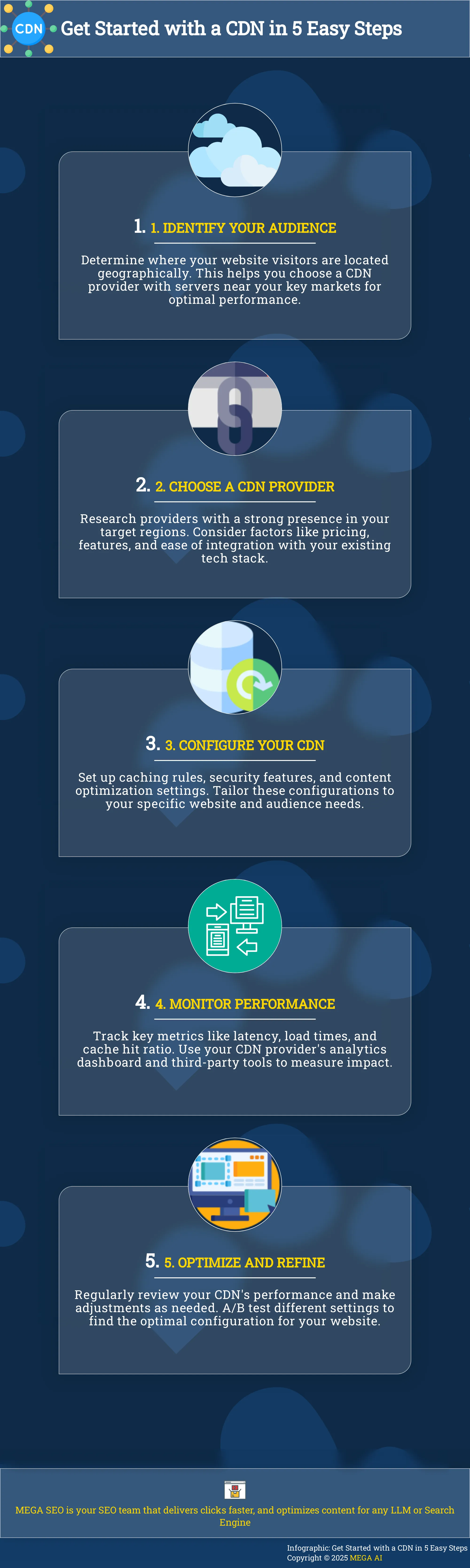
Your first task is to find a provider that aligns with your audience. If most of your customers are in Europe, a CDN with a dense network of servers there will deliver content much faster than one primarily focused on North America. Before you start comparing features, list your top geographic markets. Use this list to research providers and see which ones have a strong global infrastructure in the places that matter most to your business. Also, consider their customer support and the user-friendliness of their dashboard, as you'll be interacting with it to manage your settings.
Integrate with Your Tech Stack
A CDN should feel like a natural extension of your website, not a clunky add-on. Before you sign up, confirm that the provider integrates smoothly with your existing technology. Most reputable CDNs offer simple plugins or extensions for popular content management systems (CMS) like WordPress, Shopify, or Magento. Check the provider’s documentation or support forums for guides on connecting it to your platform. A seamless CDN integration saves you from technical headaches down the road and ensures that the service can work effectively with your site’s structure from day one.
Configure Your Settings
Implementing a CDN isn't a "set it and forget it" task. To get the most out of the service, you’ll need to configure its settings. This includes setting up caching rules to tell the CDN how long it should store copies of your files, like images and CSS. You can also configure security features and decide which content should be served by the CDN and which should come directly from your origin server. While default settings are a good start, taking the time to learn about and adjust these caching policies is what truly maximizes your site's speed and efficiency.
Analyze Costs and ROI
CDN services come with a wide range of price tags, from free plans with basic features to costly enterprise packages. It's important to understand the different pricing models available, such as pay-as-you-go based on bandwidth usage or a fixed monthly fee. Don't just look at the price; consider the return on investment (ROI). A faster website can lead to better user engagement, lower bounce rates, and higher conversion rates, all of which contribute to your bottom line. Weigh the cost of the CDN against the potential revenue and SEO benefits to make a financially sound decision for your business.
Common CDN Implementation Challenges
While a CDN offers significant benefits for performance and security, the implementation process isn't always a simple plug-and-play affair. Being aware of the potential hurdles can help you plan your strategy, choose the right provider, and set realistic expectations for the setup process. Here are a few common challenges you might encounter when integrating a CDN.
Cost
For startups and small businesses, budget is always a key consideration. CDN pricing can be complex, often based on bandwidth consumption, the number of geographic regions you need, and access to advanced features like security or image optimization. This variable model can make it difficult to predict monthly expenses, especially if your site experiences sudden traffic spikes. While many providers offer free or low-cost introductory tiers, it's important to understand the limitations and what it will cost to scale your plan as your business grows. Carefully evaluating different pricing structures is essential to find a solution that fits your budget without compromising on necessary features.
Technical Complexity
Setting up a CDN involves more than just flipping a switch. Proper integration requires technical know-how, including modifying your website’s DNS settings to direct traffic through the CDN. You’ll also need to configure caching rules to tell the CDN which assets to store and for how long. An incorrect setup can lead to your site not updating correctly or serving stale content to users. The growing complexity of modern web applications means that ensuring a seamless integration with your specific tech stack can sometimes require troubleshooting and a deeper technical understanding.
Performance Bottlenecks
Ironically, a poorly configured CDN can sometimes create performance issues instead of solving them. A performance bottleneck occurs when one part of the system slows down the entire process. For example, if your CDN’s caching rules are too aggressive, users might not see updated content. If the provider has limited points of presence in a region where you have many users, those visitors won't experience the full speed benefits. Identifying and fixing these issues requires you to monitor performance closely and fine-tune your settings, ensuring the CDN is actually optimizing content delivery as intended.
Security and Integrity
A CDN adds a powerful security layer, but it also introduces another element into your infrastructure that must be managed correctly. Since the CDN sits between your users and your origin server, any vulnerability in the CDN itself could potentially be exploited. Misconfigurations, such as improper SSL/TLS certificate setup or a poorly defined Web Application Firewall (WAF) policy, can leave your site exposed. It's crucial to choose a reputable provider and to take the time to properly configure all security features to protect both your website and your users' data.
How to Measure CDN Performance
Once your CDN is active, the next step is to track its impact. Measuring performance isn't just about checking a box; it’s about understanding how well the CDN is serving your users and where you can make adjustments. A well-optimized CDN directly influences website speed, reliability, and the overall user experience, which are all critical factors for keeping visitors on your site and encouraging them to convert. By regularly monitoring a few key areas, you can ensure you’re getting the most value from your investment and delivering the best possible experience to your audience.
Key Performance Metrics to Monitor
To get a clear picture of your CDN's effectiveness, focus on a few core metrics. Latency, or the time it takes for data to travel from a server to a user's browser, is one of the most important. The primary goal of a CDN is to reduce latency by serving content from a nearby edge server. You should also track load times for key pages to see the real-world improvement for your visitors. Other important metrics include cache hit ratio (the percentage of requests served from the CDN's cache) and uptime, which measures the reliability of the service. A high cache hit ratio and near-perfect uptime mean your CDN is working efficiently.
Tools for Monitoring Performance
You don’t need to be a data scientist to monitor your CDN. Most providers offer built-in analytics dashboards that make it easy to track performance. These platforms typically provide detailed performance reports on metrics like bandwidth usage, cache hit ratio, and request distribution by geographic location. You can see where your traffic is coming from and how effectively the CDN is serving those users. For a more comprehensive view, you can use these native tools alongside third-party website performance tools like Google PageSpeed Insights or GTmetrix to measure load times and get actionable recommendations for improvement from an external perspective.
A/B Testing and Fine-Tuning
Monitoring gives you the data, but the real value comes from using that data to fine-tune your setup. Don't be afraid to experiment with your CDN's settings. You can A/B test different caching rules or content optimization features to see what yields the best results for your specific site and audience. For example, you might adjust how long certain assets are cached to find the right balance between freshness and speed. This process of continuous optimization is key to maximizing user engagement and ensuring your website remains fast and reliable as it grows. Think of it as an ongoing conversation with your data, always looking for small tweaks that lead to a better experience.
What's Next for CDN Technology?
Content delivery networks are not a set-it-and-forget-it technology. As the internet evolves, so do the tools we use to make it faster, safer, and more reliable. The future of CDNs is being shaped by the demand for instant, personalized, and secure digital experiences. Providers are moving beyond simple content caching and are developing more intelligent networks that can anticipate user needs and adapt to changing conditions in real time. Three key trends are leading this charge: edge computing, artificial intelligence, and deeper integration with new web technologies. These advancements are transforming CDNs from a simple delivery service into a critical component of the application infrastructure, directly impacting everything from user experience to business operations. Understanding these trends can help you make more informed decisions about your own website's performance strategy.
Edge Computing
Edge computing represents a significant evolution for CDNs, moving beyond just storing content closer to users. It involves bringing actual computation and application logic to the network's edge. Instead of a user's request having to travel all the way back to an origin server for processing, an edge server can handle it directly. This dramatically reduces latency for dynamic, interactive web applications. CDNs have always played a pivotal role in improving website performance by minimizing the physical distance data travels. Edge computing is the next logical step, enabling faster, more personalized experiences by running code right where your users are.
AI-Powered Optimization
Artificial intelligence is making CDNs smarter and more efficient. By using machine learning algorithms, CDNs can now analyze traffic patterns in real time to predict which content will be requested and proactively cache it at the right edge locations. This predictive caching means users get faster load times because the content is already waiting for them. AI also helps with load balancing by intelligently routing traffic to avoid congestion and potential outages. This focus on leveraging emerging technologies is key to modern performance. Just as AI can automate and refine your SEO strategy, it can also fine-tune content delivery for maximum speed and reliability.
New Web Technology Integrations
The digital landscape is in a constant state of flux, with new protocols and standards emerging to meet modern demands. The future of CDNs depends on their ability to integrate seamlessly with these new technologies, such as HTTP/3 and QUIC, which are designed to make web connections faster and more reliable. As businesses adopt more complex digital strategies, the growing complexity of content delivery requires CDNs to be more adaptable than ever. A forward-thinking CDN provider will stay current with these changes, ensuring your site remains compatible and performant as the internet continues to evolve.
Related Articles
- Ultimate Image Optimization Guide 2024: Top Techniques to Supercharge Load Times & SEO
- Boost Rankings: Fix Your Website’s SEO Problems Now
- How Core Web Vitals Affect SEO: Facts vs. Fiction
- SEO Impact of Web Core Vitals: Real-World Success Stories
- JavaScript SEO Audit: A Comprehensive Guide
Frequently Asked Questions
Is a CDN really necessary if my business is small or local? Even if your audience is concentrated in one city or country, a CDN can still provide significant benefits. It improves your site's reliability by distributing traffic during unexpected surges and adds a crucial layer of security against common attacks. Faster load times and better security are important for user trust and SEO, regardless of your business's size or geographic reach.
How is a CDN different from my website hosting? Your web hosting is where your website's original files permanently live on a single origin server. A CDN, on the other hand, doesn't host your site. Instead, it creates a network of servers that store copies of your content. It works with your hosting provider to deliver those copies from a server closer to your visitor, which speeds up the experience.
If a CDN caches my site, how will my visitors see my latest updates? This is a common and valid concern. CDNs are designed to be cleared or "purged" when you make changes. Most CDN providers offer a simple way to clear the cache through their dashboard, and many CMS plugins can do this automatically whenever you publish a new post or update a page. This ensures your visitors always see the most current version of your site without sacrificing speed.
Can a CDN help with more than just website speed? Absolutely. While faster load times are the most well-known benefit, a modern CDN is a multi-purpose tool. It strengthens your website's security by protecting against DDoS attacks and managing SSL certificates. It also improves reliability by balancing traffic loads, which prevents your site from crashing during busy periods and ensures better uptime.
What's the first step I should take to get started with a CDN? The best first step is to identify where most of your website visitors are located. This will help you choose a provider with a strong network in those specific regions. Once you have a shortlist, you can check for integrations with your current website platform, like WordPress or Shopify, to ensure the setup process will be straightforward.