
Bounce rate and crawlability are two of the most important, yet often misunderstood, concepts in SEO. Bounce rate measures human behavior—it’s the percentage of visitors who leave your site after viewing only one page. Crawlability, on the other hand, is about machine behavior—how effectively search engine bots can navigate and index your content. While they seem separate, they are deeply connected. The actions of your human visitors send powerful signals to search engine algorithms. A pattern of users leaving immediately can suggest your site isn't a quality result, which can influence how often bots decide to crawl it. So, what are the benefits of bounce rate reduction for improved crawlability? This guide will show you how improving the user experience can directly lead to better indexing and visibility.
Key Takeaways
- Focus on what bounce rate signals: A high bounce rate isn't always a problem, but it often indicates a mismatch between your content and a visitor's expectations. Understanding the context of each page is essential to interpreting this metric correctly.
- Prioritize a crawlable site structure: Search engines cannot rank content they can't find. A logical site with fast load times and a solid internal linking strategy is the non-negotiable foundation for your SEO efforts.
- A better user experience encourages better crawling: When visitors stay on your site longer and view more pages, it sends positive signals to search engines. This can encourage them to crawl your site more frequently and deeply, helping them discover and index more of your content.
What is Bounce Rate and Why Does It Matter?
Before we get into the technical side of SEO, it’s important to understand a core metric that reflects how users interact with your website: bounce rate. Think of it as a first impression. A visitor lands on your page, and they either stick around to explore or leave immediately. That immediate departure is a "bounce."
A high bounce rate can be a red flag, suggesting a disconnect between what a user expected and what your page delivered. It often means fewer sign-ups, sales, or other desired actions. Understanding this metric is the first step toward creating a better user experience that search engines will reward.
How to Define and Measure Bounce Rate
A bounce rate is the percentage of visitors who land on one of your web pages and leave without clicking on anything or visiting another page on your site. To put it simply, they came, they saw one page, and they left. You can calculate bounce rate by dividing the number of single-page visits by the total number of visits to that page.
It’s easy to confuse bounce rate with exit rate, but they measure different things. Bounce rate only counts visitors who leave after viewing a single page. The exit rate measures the percentage of visitors who leave from a specific page, regardless of how many other pages they viewed during their session.
How Bounce Rate Affects User Experience and Site Performance
Your bounce rate is a direct reflection of your user experience. A high bounce rate often signals that visitors aren't finding what they're looking for. The issue could be slow page load times, a confusing layout, or content that doesn't match their search query. This mismatch between visitor expectation and your content can be a major problem.
Search engines pay close attention to these user engagement metrics. While bounce rate isn't a direct ranking factor, it's a strong indicator of content quality and relevance. If users consistently leave your page quickly, search engines may interpret this as a sign of a poor user experience, which can correlate with lower rankings over time.
How Bounce Rate and SEO Are Connected
While bounce rate isn't a direct ranking factor that Google's algorithm uses, it’s a critical diagnostic metric that reflects user satisfaction. Think of it this way: search engines want to deliver the best possible results for any given query. If users consistently click on your page from the search results and leave immediately without interacting, it sends a strong signal that your content isn't fulfilling their needs. This behavior, sometimes called 'pogo-sticking,' tells the search engine that your page was a poor match for the user's intent.
Over time, this pattern of user behavior can indirectly affect your search rankings. Pages with lower bounce rates tend to have higher engagement, which tells search engines that visitors find the content valuable. This positive feedback loop can contribute to better visibility in search results, making bounce rate an important metric to monitor and improve for your overall SEO strategy. It's less about the single number and more about what that number represents: the quality of the user's experience. A low bounce rate suggests you've successfully matched your content to user intent, which is the core of good SEO.
How Search Engines View Bounce Rate
Search engines are focused on user satisfaction. They use a variety of user engagement metrics, including time on site and pages per session, to determine if your content provides real value. A high bounce rate often suggests that your page didn't meet the visitor's expectations or failed to answer their question effectively. When someone clicks your link from the search results and immediately hits the back button, it sends a signal that your page wasn't the right match for that query. A pattern of these quick exits can correlate with lower rankings, as search engines will favor pages that better satisfy user intent.
Why Bounce Rate Is a Key Quality Signal
Think of your bounce rate as an honest piece of feedback on your content's quality and relevance. A consistently high bounce rate can point to underlying issues. It might mean your page loads too slowly, the design is confusing, or the content simply doesn't align with what the user was searching for. When search engines detect a pattern of users quickly leaving your site, they can interpret it as a sign of a poor user experience. Optimizing your site to lower your bounce rate does more than just keep visitors around. It directly improves content relevance and user experience, sending positive quality signals to search engine algorithms and strengthening your site's performance.
What is Crawlability and Why is it Important for SEO?
Crawlability is a term for how easily a search engine, like Google, can explore your website's content. Think of a search engine bot as a librarian tasked with cataloging every page on your site. If the doors are locked (like with a "noindex" tag) or the aisles are blocked by broken links, the librarian can't access your content to add it to the library—which, in this case, is Google's index. If your page isn't in the index, it simply won't appear in search results, no matter how amazing your content is. This makes crawlability the absolute foundation of search engine optimization.
But it’s not just about whether search engines can access your site; it’s also about how efficiently they can do it. A clean site structure, a logical internal linking system, and a fast-loading website all help search engine bots move through your pages smoothly. This efficiency ensures they can discover new content and revisit existing pages to see what’s changed without getting stuck or missing important information. Maintaining a crawlable site is a continuous process of clearing the path for search engines. A solid technical SEO foundation removes these roadblocks, allowing bots to find, understand, and ultimately rank the content you work so hard to create.
How Crawlability Affects Your Search Rankings
Once a search engine can crawl your pages, it starts looking for clues about your content's quality. It doesn't just take your word for it; it observes how real users interact with your site. Search engines pay close attention to engagement metrics like how long visitors stay on your page and whether they leave immediately—also known as a bounce. A high bounce rate can signal that your content didn't match what the user was looking for.
This is where crawlability and rankings intersect with user experience. If your page loads slowly or is difficult to use, visitors are more likely to leave. Search engines interpret these negative signals as a sign of low quality, which can lead to lower rankings. Essentially, making your site easy for bots to crawl is the first step. The second is ensuring that when humans arrive, they find a valuable and accessible experience that encourages them to stick around.
How Does Bounce Rate Affect Crawlability?
While search engines like Google haven't said that bounce rate is a direct ranking factor, the relationship between bounce rate and crawlability is all about user signals. Think of it this way: search engines want to serve up the best possible results. If users consistently land on your page and leave immediately, it sends a message that your content might not be what they were looking for. This can indirectly influence how search engines perceive your site's quality and, consequently, how often they decide to crawl it.
The Indirect Link: User Signals and Crawl Budget
Search engines have a "crawl budget," which is the amount of resources they allocate to crawling a website. They prefer to spend this budget on high-quality, valuable pages. A high bounce rate can be a red flag that your page isn't delivering a great user experience or that the content doesn't match what the user expected to find. Search engines use engagement metrics like time on site and pages per session to figure out if your content is providing real value. If users aren't sticking around, search engines may interpret this as a low-quality signal, potentially reducing how frequently they crawl that page or your site as a whole.
How Positive User Engagement Influences Search Engines
On the flip side, positive user engagement sends all the right signals. When a visitor lands on your site and stays to explore multiple pages, it tells search engines that you're offering relevant, high-quality content. Factors like fast-loading pages and a smart internal linking structure encourage this behavior. Slow pages can frustrate users and lead to high bounce rates, which search engines see as an indicator of a poor user experience. By keeping users engaged, you not only lower your bounce rate but also encourage search engine bots to crawl your site more deeply. This helps them discover more of your content and understand how different pages on your site relate to one another, which is great for your overall SEO.
The Benefits of a Lower Bounce Rate for Crawlability
When you successfully lower your bounce rate, you’re not just improving a single metric. You’re setting off a chain reaction of positive effects that directly benefit your site's crawlability and overall SEO health. A lower bounce rate tells search engines that visitors find your content valuable and your site easy to use. This encourages them to crawl your site more deeply and frequently, leading to better indexing and visibility in search results. Think of it as building trust with both your users and with search engines like Google. When visitors stay longer and explore more of your site, it signals that you are a credible authority, which is a cornerstone of a successful SEO strategy.
Better User Engagement and More Time on Site
A low bounce rate is a clear sign of strong user engagement. When a visitor lands on your page and stays, it indicates that your content meets their expectations and answers their query. This increased time on site is a powerful signal to search engines. A high bounce rate can suggest a "content mismatch with visitor expectations," which often correlates with lower search rankings. By keeping users engaged, you demonstrate the quality and relevance of your page, which is a fundamental aspect of good SEO performance.
More Page Views and Deeper Site Exploration
When a visitor doesn't bounce, they often proceed to view other pages on your site. This deeper exploration increases your average page views per session, another key engagement metric. By guiding users to other relevant content, you keep them on your site longer and expose them to more of what you have to offer. This behavior helps search engines understand the relationships between your pages and recognize your site as a comprehensive resource on a given topic. A user who explores multiple pages is a strong indicator of a positive experience.
A Stronger Internal Linking Structure
A low bounce rate is often the result of a thoughtful internal linking strategy. When you provide clear, relevant links to other pages on your site, you give visitors a reason to continue their journey instead of leaving. This practice is not only great for user experience but is also critical for SEO. An effective internal linking structure helps search engine crawlers discover more of your content, passing authority between pages and improving your site’s overall visibility. Tools like MEGA AI can even automate your internal linking to ensure your site is optimized for both users and crawlers.
Send Positive Signals to Search Engines
Search engines pay close attention to user behavior to assess content quality. Metrics like time on site, pages per session, and bounce rate are all part of this evaluation. When users consistently engage with your site, it sends strong, positive signals to algorithms that your content provides real value. These engagement metrics act as a vote of confidence from your audience, reinforcing that your page deserves its spot in the search results. Over time, these positive signals can contribute to improved and more stable rankings.
Help Search Engines Discover Your Content
A site that keeps users engaged is also a site that’s easier for search engines to crawl. When visitors click through your internal links, they essentially create pathways for crawlers to follow, helping them discover pages that might otherwise be hard to find. This improved content discovery ensures that more of your site gets indexed and has a chance to rank. Optimizing your site to lower the bounce rate enhances the user experience and sends positive signals to Google’s algorithms, ultimately benefiting your entire digital marketing performance.
Strategies to Lower Bounce Rate and Improve Crawlability
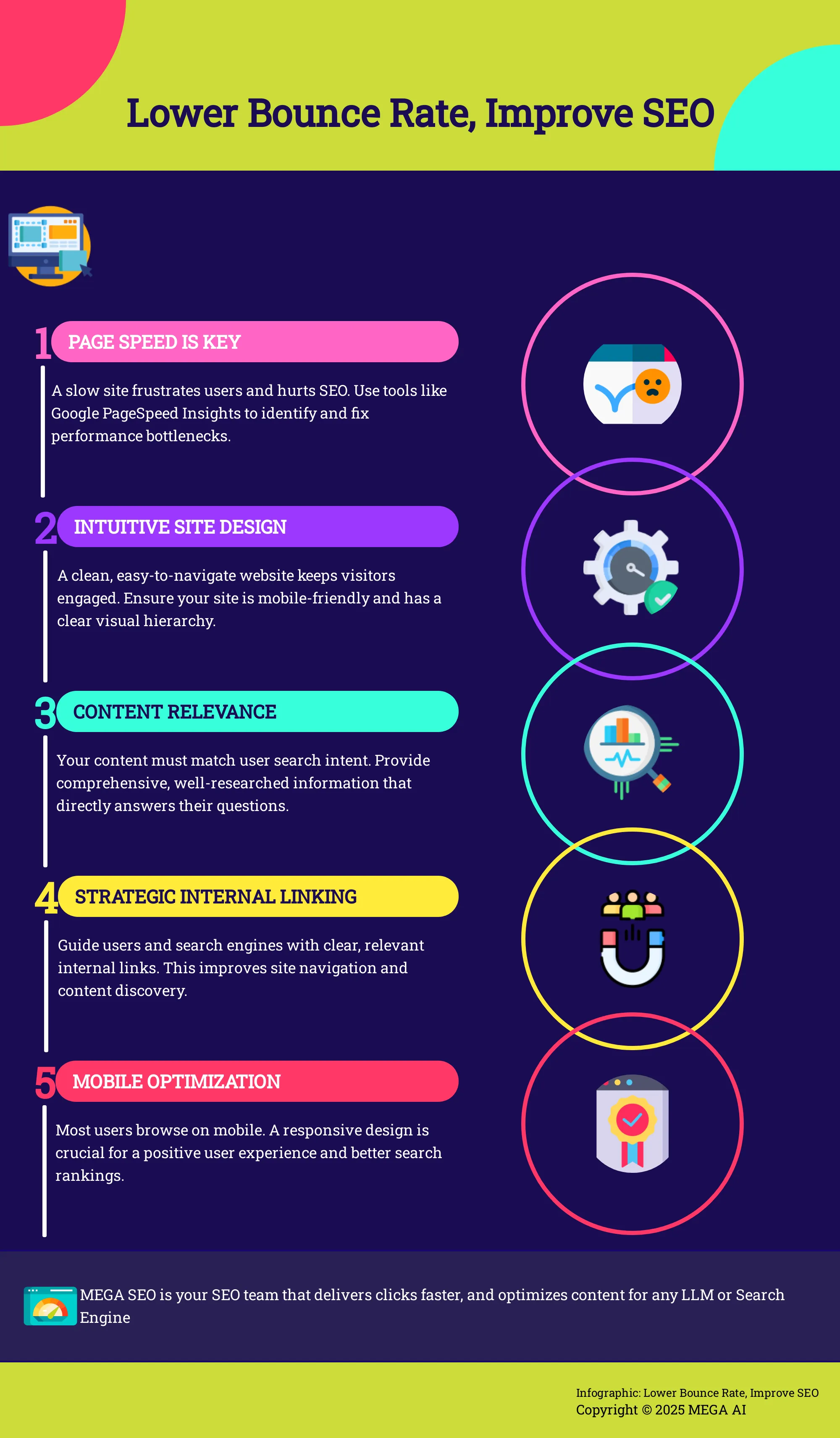
Improve Your Page Load Speed
Users expect instant results. If your page takes too long to load, they won't wait around. In fact, even a two-second delay can cause your bounce rate to spike significantly. Slow speeds frustrate visitors and signal to search engines that your site offers a poor user experience. You can use tools like Google's PageSpeed Insights to check your site's performance. Addressing technical issues like image compression, browser caching, and minimizing code can make a huge difference. Automating these technical SEO fixes ensures your site stays fast and efficient, keeping both users and search engines happy.
Refine Your Website Design and Usability
Your website's design is the first impression you make. A cluttered, confusing, or outdated layout can make visitors leave before they even read your content. Focus on creating a clean, intuitive user experience. Your navigation should be logical, making it easy for people to find what they're looking for. Use readable fonts, ample white space, and a clear visual hierarchy to guide the user's eye. A well-designed site not only looks professional but also makes your website easier to use, encouraging visitors to stay and explore. This improved engagement tells search engines that your site is a valuable resource.
Create High-Quality, Relevant Content
Your content must deliver on the promise made in your title and meta description. When a user clicks through from a search result, they have a specific question or need in mind. If your page doesn't meet their search intent, they will immediately bounce back to the search results. Ensure your content is well-researched, comprehensive, and directly addresses the topic. Regularly updating existing articles to keep them fresh and relevant also plays a key role. Using an SEO platform can help you generate high-quality content and automatically update existing posts to improve their performance and click-through rate.
Optimize Your Site Navigation and Internal Links
Think of internal links as pathways that guide visitors deeper into your website. When you link to other relevant pages on your site, you encourage users to continue exploring. This not only increases their time on site but also helps them discover more of your valuable content. A strong internal linking strategy is also critical for crawlability. It helps search engines understand the structure of your site and the relationships between different pieces of content. By making it easy for users and crawlers to move through your site, you reduce bounce rate and improve how effectively your pages are indexed.
Make Sure Your Site is Mobile-Friendly
A significant portion of your audience is likely visiting your site from a smartphone or tablet. If your website isn't optimized for these devices, you're providing a frustrating experience that will send your bounce rate soaring. A mobile-friendly design means your site is easy to read and navigate on a smaller screen without pinching or zooming. Google uses mobile-friendliness as a key ranking signal, so a non-responsive site hurts both your user experience and your SEO. Ensuring your site works well on all devices is no longer optional; it's a fundamental requirement for keeping visitors engaged and ranking well in search results.
How to Measure the Impact of Your Efforts
After you’ve put in the work to improve your site, you need a way to see if your changes are actually making a difference. Tracking your progress helps you understand what’s working and where you might need to adjust your strategy. It turns guesswork into a clear, data-driven process.
Key Metrics to Track
Start by focusing on a few core numbers that tell the story of how users interact with your site. A high bounce rate can be a red flag, often signaling that your content doesn't match what visitors were looking for. But don't stop there. Search engines look at a variety of engagement metrics to judge your content's value, including time on site and pages per session.
Look at how visitors move through your site. Are they clicking on other pages or leaving after viewing just one? An effective internal linking strategy encourages users to explore more of your content, keeping them on your site longer and sending positive signals to search engines.
Tools for Tracking Progress
You don’t need a massive budget to track these metrics. Several free and powerful tools can give you the insights you need. The most essential is Google Analytics, which provides detailed data on bounce rates, page views, and user behavior. It’s the standard for understanding how people find and interact with your website.
For a deeper look into user behavior, consider using heatmaps and session recordings. Heatmaps show you where users click, while session recordings replay their entire visit. These tools help you spot usability issues you might otherwise miss. Finally, since site speed is a major factor in bounce rate, use performance monitoring tools like Google PageSpeed Insights to ensure your pages load quickly for every visitor.
Common Myths About Bounce Rate and Crawlability
Myth: A High Bounce Rate Always Hurts Your SEO
It’s easy to see a high bounce rate and assume the worst for your SEO. After all, if people are leaving your page without clicking anything, it must be bad, right? Not necessarily. While a high number can indicate issues like slow load times or irrelevant content, it’s not a universal sign of failure. Think about a blog post that perfectly answers a specific question. A visitor might land on the page, find the exact answer they need, and leave completely satisfied. In this case, the page did its job perfectly, even though it resulted in a bounce. Search engines understand this context and don't automatically penalize a page just for a high number. So, before you panic, take a step back and consider the page's purpose.
Fact: Context is Everything for Bounce Rate
The key to understanding your bounce rate is to look at the context. A "good" or "bad" number depends entirely on the page's goal. For example, a high bounce rate on your homepage is likely a problem, as you want visitors to explore your site further. But for a landing page with a single call to action, like signing up for a newsletter, a user might sign up and leave, which counts as a bounce but is actually a conversion. The same goes for contact pages where a user might just be looking for a phone number. Understanding these nuances is critical for making smart decisions about your site's performance and user engagement strategies. Analyze each page's purpose before judging its bounce rate.
Create Your Bounce Rate Reduction Plan
Putting everything you’ve learned into practice requires a structured approach. A clear plan helps you make targeted changes and measure their impact effectively. Here’s how to build a plan that works for your site.
Set Clear and Realistic Goals
Your first step is to define what success looks like. A high bounce rate often points to a poor user experience or a mismatch between your content and what a visitor expects. Search engines use engagement metrics like time on site and pages per session to figure out if your content is valuable. Start by analyzing your current bounce rate to set a baseline. Then, set a specific, achievable goal. For example, aim to lower the bounce rate on your top five landing pages by 10% over the next quarter. This gives you a clear target to work toward and makes it easier to measure your progress.
Build a Step-by-Step Action Plan
With your goals in place, outline the specific actions you’ll take. Reducing bounce rate usually involves landing page optimization, so start there. Look at your highest-bounce pages and identify potential issues like slow load times, confusing layouts, or weak calls to action. Another critical step is to improve your internal linking structure. Effective internal linking guides users to other relevant content on your site, keeping them engaged and encouraging them to explore further. Tools like MEGA AI’s SEO platform can automate this process, ensuring your content is interconnected in a way that helps both users and search engines.
Monitor, Adjust, and Repeat
Lowering your bounce rate is an ongoing process, not a one-time fix. You need to continuously track your performance, make adjustments, and repeat the cycle. Use tools like Google Analytics to get valuable insights into bounce rates, page views, and user behavior. By analyzing this data, you can make informed decisions about what’s working and what isn’t. For instance, examining the relationship between bounce rate and exit rate can help you find problems with your site design or content quality. As you gather data, refine your action plan and test new strategies. This iterative approach ensures your site is always improving.
Related Articles
- Site Navigation Benefits: Lower Your Bounce Rate
- Time in SEO: A Comprehensive Guide for 2024
- Increase SEO Dwell Time: The Ultimate Guide (2023)
- Deep Linking SEO: A Complete Guide for 2024
- Boost Your SEO Strategy: Mastering Crawlability Tips
Frequently Asked Questions
What is considered a "good" bounce rate? There isn't a single number that works for every website. A good bounce rate really depends on the purpose of the page. For example, a blog post that answers a specific question might naturally have a higher bounce rate because a visitor gets their answer and leaves satisfied. However, your homepage or a key service page should have a much lower rate, as their goal is to encourage exploration. The key is to analyze the context of each page rather than aiming for a universal benchmark.
If my bounce rate is high on a specific page, what's the first thing I should check? Start by looking at two primary factors: page load speed and content relevance. A slow-loading page is one of the fastest ways to lose a visitor's attention. After that, review the content itself. Ask yourself if the information on the page directly matches what a user would expect to find based on your page title and meta description. A mismatch between expectation and reality is a common reason for a quick exit.
Does fixing my bounce rate automatically improve my site's crawlability? It's more of an indirect relationship. Lowering your bounce rate improves user engagement, which sends positive signals to search engines. When search engines see that users are staying on your site and interacting with your content, they may interpret your site as being higher quality. This can encourage them to dedicate more resources to crawling your site more frequently and deeply over time.
Can a page have a high bounce rate and still be successful? Yes, absolutely. Think about a contact page or a simple FAQ page. A user might land on it, find the phone number or the specific answer they need, and then leave. In that scenario, the page perfectly fulfilled its purpose, even though the visit resulted in a bounce. This is why it's so important to understand the goal of each page before judging its performance based on this single metric.
Besides bounce rate, what other engagement metrics should I watch? While bounce rate is a useful diagnostic tool, it doesn't tell the whole story. You should also pay close attention to metrics like "average time on page" and "pages per session." Time on page shows how long visitors are actually spending with your content, while pages per session indicates if they are exploring other parts of your site. Looking at these metrics together gives you a much more complete picture of user satisfaction.