
You've launched your website, crafted what you believe is great content, and now you're waiting for the traffic to roll in. But sometimes, the needle doesn't move as much as you'd hoped. Often, the conversation quickly turns to backlinks as the missing piece. While links are important, jumping straight to link acquisition without a solid on-page SEO strategy is like trying to decorate a house before the walls are even built. We'll explore why getting your on-page elements right—from content quality to technical soundness—is the critical first step for sustainable search visibility and how to assess when backlinks truly become necessary for your growth.
Key Takeaways
- Focus on a Strong On-Page SEO Foundation: Direct your efforts towards high-quality content, a seamless user experience, and solid technical health, as these internal factors are crucial for ranking well.
- Assess Your Backlink Needs with Competitive Insight: Before pursuing backlinks, analyze the top-ranking pages for your keywords; if they aren't heavily reliant on links, your strong on-page work can often be enough.
- Continuously Refine Your Strategy with Performance Data: Regularly use analytics to track how your on-page optimizations and any acquired backlinks are impacting your rankings, making informed adjustments to improve results.
What is On-Page SEO and How Does It Affect Your Rankings?
On-page SEO, sometimes called on-site SEO, is all about optimizing the actual content and HTML source code of your individual web pages. The goal? To help these pages rank higher in search engine results and attract more of the right organic traffic. It’s a foundational piece of your overall SEO strategy, ensuring each page clearly communicates its purpose and value to both search engines and your visitors before you even think about more complex tactics like acquiring backlinks.
Key Elements of On-Page Optimization
So, what exactly do you need to look at when you're working on your on-page SEO? It involves several key components on your actual web pages. This includes crafting clear and concise meta tags, like your page titles and descriptions that appear in search results. You'll also want to ensure your URL structures are logical and user-friendly, making them easy to understand at a glance. Using headings (H1-H6) properly to structure your content is also important, as it helps break up text and highlight key sections. Don't forget about optimizing your images with descriptive alt text, which aids accessibility and can help your images rank in image searches. It's wise to avoid common missteps such as keyword stuffing and ignoring how your site performs on mobile devices, as these can frustrate users and confuse search engines.
How On-Page SEO Impacts Search Visibility
The effort you put into on-page SEO directly influences how search engines perceive and rank your content. If your on-page elements are poorly managed, it can lead to a subpar user experience, and that often results in lower search rankings. Search algorithms are designed to deliver the best, most relevant content to users. Therefore, pages with thin or low-quality content are unlikely to perform well. By focusing on clear, well-structured, and valuable material, perhaps with assistance from AI content generation tools, along with technical soundness, you signal to search engines that your page is a good answer. This, in turn, can significantly improve your chances of appearing higher in search results for your target keywords.
Backlinks: When Do You Really Need Them?
So, you've been diligently working on your website, focusing on creating fantastic content and making sure your on-page SEO is in top shape. That's a great foundation. But then the question of backlinks often pops up. Are they always a must-have? The straightforward answer is: it really depends. If you've truly perfected your on-page elements and you're still not seeing the ranking progress you're aiming for, especially when the pages you're competing against have a clear backlink advantage, then yes, it's probably time to consider building some. The first step, though, is to get a clear picture of the competitive field you're playing in.
Analyze SERPs: Do You Need Backlinks?
Before you consider acquiring backlinks, it's essential to examine the Search Engine Results Pages (SERPs) for your target keywords. You can't effectively target a keyword without first understanding what's already performing well. Type your keyword into Google and carefully look at the top-ranking results. What do their backlink profiles show? SEO tools can help you see the number of backlinks and the domain authority of these leading pages.
Pay close attention to the quality and type of backlinks your competitors have. Are these links from reputable, relevant websites, or do they seem lower-quality? As Olga Zarr SEO suggests, you should also assess if these are backlinks you could realistically replicate through quality content and outreach. This analysis will reveal if backlinks are a significant ranking factor for your specific keywords. If top pages have few quality backlinks, your on-page efforts might be sufficient.
When Backlinks Are Crucial for Competitive Keywords
Let's consider highly competitive keywords – those broad, high-volume terms many businesses target. For keywords like "AI content generation" or "automated ad campaigns," backlinks are almost always a critical part of the ranking strategy. The SERPs for such terms are typically dominated by websites with strong authority, largely built through robust, high-quality backlink profiles.
If you're aiming for these challenging terms and have already perfected your on-page SEO, then building backlinks becomes an essential next step. Without them, it's very difficult to signal to search engines that your content is authoritative enough to rank alongside established websites that have invested in acquiring valuable links. In these scenarios, backlinks aren't just helpful; they are fundamental for gaining meaningful visibility.
Quick Test: Assess Your Backlink Needs
Before you spend valuable time and resources chasing backlinks, it’s a good idea to first determine if they’re truly what your website needs most right now. Often, the desire for more backlinks can overshadow foundational on-page SEO issues or opportunities that, if addressed, could yield significant results on their own. Think of it like preparing a garden; you wouldn't focus on attracting pollinators before ensuring the soil is fertile and your plants are healthy.
This quick assessment will help you clarify where your efforts should be concentrated. By first looking inward at your current on-page SEO and then outward at your competitors' backlink profiles, you can make a more strategic decision. It’s all about working smarter to improve your site's visibility and performance in search engine results. Let's walk through how you can get a clearer picture of your website's immediate needs.
Evaluate Your Current On-Page SEO
Your on-page SEO is the absolute foundation of how well your website can perform in search results. As SEO expert Olga Zarr wisely points out, "Actually, 80% of your work is on-page. And backlinks are like the last thing you want to do... It is not always backlinks. It is very often on on-page." This highlights a crucial point: before you even think about acquiring external links, your own website needs to be in top shape. Take a thorough look at your content quality, how well you've implemented keyword strategies, your site's structure, internal linking, and the overall user experience. Are your pages loading quickly? Is your content genuinely helpful and well-targeted to your audience?
Many ranking improvements can come from simply refining these on-page elements. For instance, ensuring your content remains fresh and relevant is key, and some platforms can even help automate article updates to maintain or improve click-through rates. Addressing technical SEO issues, like ensuring search engines can easily crawl and understand your site, is also a critical first step.
Compare Your Site to Competitor Backlinks
Once you have a solid understanding of your on-page SEO status, the next step is to see how you measure up against your direct competitors, specifically concerning their backlink profiles. If the top-ranking pages for your target keywords have very few backlinks, you might find that you can compete effectively primarily through strong on-page optimization and high-quality content. As Olga Zarr notes in her analysis, for some keywords, "you don't need backlinks to start competing... Probably you can do it without backlinks or with just a few."
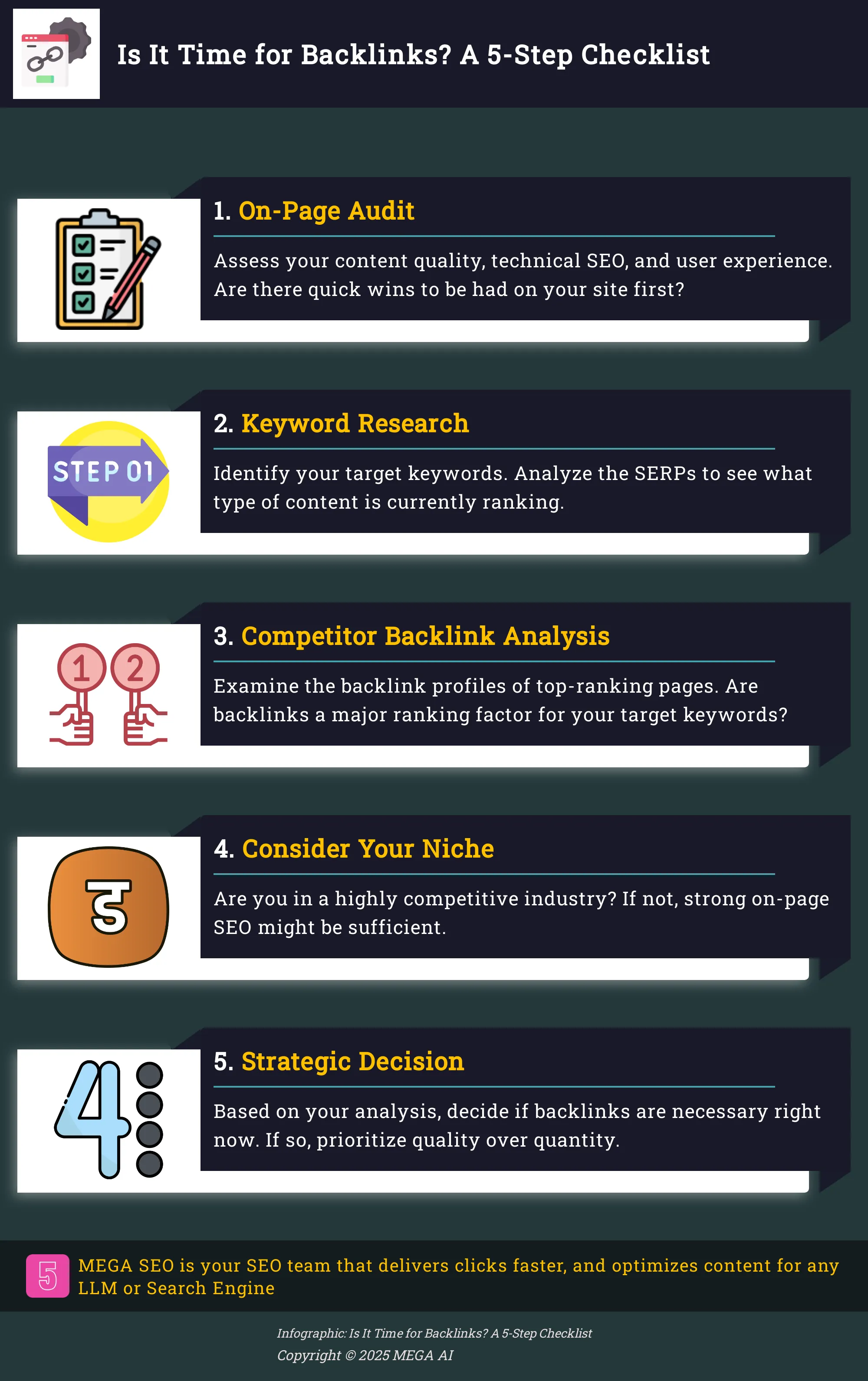
However, if your research reveals that the leading competitors for your desired keywords boast a significant number of high-quality backlinks, then building your own backlink profile will likely be a necessary part of your strategy. You can use various SEO tools to analyze competitor backlinks and identify where they are getting their links from. This comparative analysis will help you understand if investing in backlinks is "more justified in that specific case," guiding your resource allocation for link-building efforts.
Improve Rankings with On-Page SEO (Even Without Many Backlinks)
It's a common thought that you need a massive number of backlinks to see your website climb the search engine rankings. While backlinks certainly have their place, a well-executed on-page SEO strategy can make a substantial difference, often more than many realize. Think of your website as your home. Before you widely advertise it and tell everyone how wonderful it is (which is akin to building backlinks), you first want to ensure everything inside is organized, appealing, and easy for visitors to find their way around. That's precisely what directly on your website to improve how search engines see it and how users experience it.
Many businesses, particularly startups and smaller companies, can achieve notable ranking improvements by first concentrating on these on-page factors. This approach gives you direct control, allowing you to influence how search engines interpret your content's quality and relevance. By focusing on what you can manage on your own site, you build a strong foundation. This solid base then makes any future efforts to acquire backlinks even more impactful. Let's explore how you can refine your on-page SEO to achieve tangible results.
Optimize for Content Quality and Relevance
The foundation of strong on-page SEO is your content. Search engines strive to provide users with the most relevant, high-quality answers to their search queries. As SEO expert Olga Zarr explains, "Actually, 80% of your work is on-page." This underscores the importance of creating content that not only targets specific keywords but also deeply addresses the user's intent. Is the searcher looking for information, a product to buy, or a comparison of options? Your content needs to clearly satisfy that underlying need.
Concentrate on producing material that is comprehensive, well-written, and offers a unique perspective. This goes beyond simply inserting keywords; it’s about delivering genuine value. Regularly updating your existing content to maintain its freshness and accuracy also signals to search engines that your site is a dependable information source. While tools can assist with automated content creation, human oversight remains vital to ensure true quality and relevance.
Implement Effective Keyword Strategies
You cannot effectively optimize your content without understanding the terms your audience uses in their searches. This is where thorough keyword research becomes essential. It’s not sufficient to merely guess which keywords might be effective; you need data-backed insights. To echo Olga Zarr, "Without checking what's ranking, and doing like a normal search for that keyword... you cannot target a keyword." This means you should examine the search results for your desired terms to understand the competitive environment and the type of content that currently performs well.
Identify primary and secondary keywords, including longer, more specific phrases (long-tail keywords), that align with your content and your audience's search patterns. Integrate these keywords naturally into your page titles, headings, meta descriptions, and the main body of your text in a way that is user-friendly. The objective is to clearly communicate your page's topic to both users and search engines.
Address Technical SEO for Better Crawlability
Even the most outstanding content will struggle to rank if search engines cannot efficiently find, crawl, and index it. Technical SEO ensures your website is structured in a way that is accessible and understandable to search engine bots. This encompasses various elements, from how quickly your pages load to how well your site functions on mobile devices. According to Techfee, it's wise to "Use tools like Google Search Console, Screaming Frog, or Semrush to find issues, then fix crawl errors, improve speed, optimize mobile usability, and clean up broken links."
Regularly auditing your site for technical problems is a key practice. Pay attention to your site's architecture, ensure you have a clear XML sitemap submitted to search engines, and use your robots.txt file effectively to guide web crawlers. Improving page load times and ensuring your site is responsive across all devices are also critical components of technical SEO that directly influence user experience and, by extension, your rankings. Many platforms now offer services that include technical SEO improvements.
Enhance User Experience and Site Structure
Search engines are placing increasing importance on user experience (UX) signals when determining website rankings. A website that is confusing to use or provides a frustrating experience is unlikely to rank well, irrespective of its content quality or the number of backlinks it has. As SEO.com points out, "Common pitfalls like keyword stuffing and ignoring mobile optimization not only frustrate users but also confuse search engines." A clear, intuitive site structure helps both users and search engine crawlers easily find information.
Focus on creating logical navigation, using readable fonts, and maintaining a clean, uncluttered design. Ensure your internal linking strategy effectively guides users to other relevant content on your site, which can keep them engaged for longer periods. Mobile optimization is no longer a secondary concern; your site must perform seamlessly on smartphones and tablets. By fostering a positive user experience, you encourage visitors to stay longer, interact more with your content, and return in the future—all positive signals that search engines take into account.
Essential Tools for Your SEO Analysis
To really understand how your website is performing and where you can make improvements, having the right set of tools is key. SEO analysis isn't just about guesswork; it's about using data to make informed decisions. The good news is there are many tools available that can help you dissect every aspect of your SEO, from how your content is structured to the technical health of your site. These tools can automate tasks, provide deep insights, and help you identify opportunities you might otherwise miss, making the entire process more manageable.
Think of these tools as your SEO assistants. They can help you understand your audience better, see what your competitors are doing, and track your progress over time. For small businesses and startups, leveraging these tools means you can compete more effectively, even if you don't have a massive marketing team. They simplify complex data into actionable steps, making it easier to refine your strategy and see real results. Whether you're looking to improve your on-page elements, find the best keywords, or ensure your site is technically sound, there’s a tool out there to help you get the job done efficiently. Platforms like MEGA AI offer end-to-end SEO services designed to simplify these processes, making advanced analysis accessible for businesses of all sizes.
Tools for On-Page SEO Audits & Optimization
When it comes to on-page SEO, you want tools that can give you a clear picture of what’s working and what needs attention on your actual web pages. These tools often cover a wide range, from checking your keyword usage and analyzing your content's readability to performing technical audits and monitoring how your pages perform in search results. For small businesses, SEO tools are particularly helpful because they can automate many on-page optimization tasks and help you optimize your content effectively. Platforms like MEGA AI can also assist by automating content updates and optimizing existing articles to improve their performance.
Resources for Keyword Research & SERP Analysis
Understanding what terms your audience is searching for is fundamental to SEO. Keyword research tools help you identify these terms, gauge their search volume, and understand how competitive they are. SERP (Search Engine Results Page) analysis tools then let you see who is ranking for these keywords and why. Some tools, like Ubersuggest, are known for being user-friendly and are a solid choice if you're focused on keyword research and want to monitor your website's performance against competitors. MEGA AI also offers automated keyword research to simplify this process, helping you find the right terms to target.
Tools for Technical SEO Checks
Technical SEO forms the foundation of your website's ability to be crawled and indexed by search engines. Tools designed for technical SEO checks help you identify issues like broken links, slow page speed, mobile-friendliness problems, or incorrect schema markup. You can run a comprehensive site audit using tools like Google Search Console, Ahrefs, or Semrush to find technical, content, and other on-page issues that might be holding your site back. Addressing these technical aspects is crucial for improving your site’s overall search visibility. MEGA AI also supports your efforts by offering technical SEO improvements as part of its services.
Avoid These Common On-Page SEO Mistakes
Getting your on-page SEO right is fundamental to how search engines, and your audience, find and understand your content. While it might seem straightforward, there are a few common missteps that can hinder your progress. By being aware of these pitfalls, you can ensure your efforts are effective and contribute positively to your site's visibility. Let's look at some key areas where things can go awry and how you can sidestep these issues for better results.
Steer Clear of Keyword Stuffing and Over-Optimization
One of the most tempting, yet detrimental, mistakes is keyword stuffing. This practice involves excessively loading your content with keywords in an attempt to rank higher. However, as experts at seo.com point out, "Keyword stuffing not only frustrates users but also confuses search engines, leading to poor rankings." Instead of trying to game the system, your focus should be on creating high-quality content that naturally incorporates your target keywords. Think about your reader first. What information are they looking for? How can you provide the best, most comprehensive answer? When your content is genuinely valuable and well-written, keywords will fit in organically, making for a much better user experience and more favorable search engine assessment.
Optimize Meta Tags and Descriptions Effectively
Your meta tags, specifically your title tags and meta descriptions, are like the welcome mat for your webpages in search results. They are often the first impression a potential visitor gets, so it's important to make them count. Ahrefs highlights that, "Meta tags and descriptions are crucial for SEO. Ensure they are unique, relevant, and accurately describe the content of your pages." This means each page should have its own distinct title and description that clearly tells both search engines and users what the page is about. Well-crafted metas not only help search engines understand your content but also significantly improve click-through rates from the search results page. MEGA AI's Maintenance Agent can even help refine these elements to improve the clickthrough rate (CTR) of your existing content.
Prioritize Mobile-Friendliness and Page Speed
We live in a mobile-first world, and your website needs to reflect that. Ensuring your website is mobile-friendly isn't just a nice-to-have; it's essential. As Techfee notes, "With the increasing use of mobile devices, ensuring your website is mobile-friendly is essential." Alongside mobile responsiveness, page speed is a critical factor. Slow-loading pages are a major turn-off for users, leading to high bounce rates, and search engines like Google take this into account for rankings. Prioritizing a fast-loading and seamlessly responsive experience across all devices will keep your visitors happy and signal to search engines that your site offers a quality user experience. Regularly test your site's speed and mobile usability to catch and fix any issues promptly.
Finding the Right Mix: On-Page SEO and Strategic Backlinks
Achieving strong search engine rankings involves more than a single tactic; it’s about creating a balanced approach between your website's own content and structure, and how other websites refer to yours. Think of your on-page SEO as the recipe and quality of ingredients for a fantastic cake. Backlinks, then, are like respected food critics raving about it. Both elements are important, but you need a well-made cake before anyone significant will talk about it. For startups and small businesses, understanding this interplay is key to using your time and budget wisely. You want to direct your efforts where they will yield the most significant results, especially when you're working with limited resources. The aim is to develop a comprehensive strategy where excellent on-page SEO prepares the ground for high-quality backlinks to enhance your visibility. This method helps you build a lasting online presence that both search engines and your audience will value.
Start with a Strong On-Page Foundation
Before you spend much time considering backlinks, your main attention should be on your on-page SEO. It's often said that about 80% of your SEO work happens directly on your site. This means making sure your website content is high-quality, directly relevant to your target audience, and correctly optimized for the keywords you aim to rank for. This includes well-thought-out title tags, meta descriptions, header tags, and ensuring your site’s structure is logical and straightforward for search engines to crawl. If your on-page components aren't solid, even the most impressive backlinks won't provide much lift. It’s like constructing a tall building on unstable ground. Taking the time to properly optimize your content and address technical aspects first will set you up for better success.
Integrate Backlinks Naturally and Effectively
Once your on-page SEO is in good order, you can begin to think about backlinks. However, it’s important to approach this strategically. You should carefully consider whether you truly need backlinks, especially through paid methods. In many instances, particularly for less competitive industries or keywords, robust on-page SEO might be sufficient to start making headway. When you do decide to pursue backlinks, concentrate on earning them organically through high-quality content that other sites find genuinely valuable and want to reference. This could involve writing guest posts for reputable sites, creating easily shareable infographics, or publishing original research. The crucial part is ensuring these links come from relevant and authoritative sources, as this signals to search engines that your content is trustworthy and offers real value.
Build a Diverse, High-Quality Link Profile
When it comes to backlinks, quality consistently outweighs quantity. A few high-quality links from authoritative websites within your industry will benefit your SEO far more than hundreds of low-quality links from unrelated sites. Your goal should be to build a diverse link profile, which means acquiring links from various types of reputable sources. You might even find that some top-ranking pages for your target keywords don't possess an enormous number of backlinks, which further underscores the impact of strong on-page optimization. It's important to avoid common SEO mistakes such as pursuing irrelevant links. Instead, channel your energy into creating excellent content and using effective SEO tools to identify genuine opportunities for acquiring valuable backlinks that genuinely complement your on-page efforts.
Adapt Your SEO Strategy for Different Scenarios
Your SEO strategy isn't a static blueprint; it needs to flex and change based on the specific challenges and opportunities you encounter. What works in one situation might not be the best approach in another, especially when deciding how to balance your on-page efforts with off-page tactics like link building. Understanding these nuances helps you make smarter decisions to improve your search rankings. Let's explore how to adjust your approach for a few common scenarios.
Adjust for Competitive Keyword Landscapes
When you're targeting keywords where the competition is particularly tough, it’s wise to see what the top-ranking pages are doing. Specifically, look at their backlink profiles. If the pages dominating the search results for your desired terms have a significant number of high-quality backlinks, that’s a strong indicator that you’ll likely need to build backlinks as part of your strategy. In these competitive arenas, search engines often view a robust backlink profile as a sign of authority and trustworthiness, meaning your excellent on-page SEO might need that extra off-page support to truly contend.
Address Niche-Specific SEO Needs
While backlinks are often crucial in highly competitive spaces, for many businesses, particularly those in less crowded niches, the bulk of your SEO energy should be channeled into perfecting your on-page elements. A practical guideline is to dedicate about 80% of your efforts to what’s happening directly on your website. This includes creating valuable content, optimizing titles and meta descriptions, ensuring your site is easy to use, and employing keywords thoughtfully. Once you’ve thoroughly polished these aspects and still find yourself up against sites with strong backlink numbers, then it’s a good time to consider a backlink strategy.
Differentiate Local vs. Global SEO Approaches
Whether your audience is around the corner or across the globe, some core SEO principles always hold true. Avoiding common on-page errors is fundamental for both local and international reach. Issues like missing meta tags, poorly structured URLs, keyword cannibalization (where your own pages compete against each other for the same terms), incorrect use of heading tags, and unoptimized images can all negatively affect your performance. Making sure these foundational elements are correctly implemented will strengthen your SEO efforts overall. For local SEO, you'll add location-specific tactics, but these on-page best practices are the bedrock of your visibility.
Measure and Refine Your SEO Performance
Once you've put in the work to optimize your on-page elements and strategically consider backlinks, your SEO journey isn't over. Think of it like tending a garden; it needs consistent attention to flourish. Measuring your performance and refining your approach based on data is key to long-term success. This means regularly checking in on how your website is doing in search results and making adjustments as needed. It’s about understanding what’s working, what’s not, and why.
This continuous loop of measuring, analyzing, and tweaking is what separates stagnant sites from those that consistently climb the rankings and attract more organic traffic. Don't be afraid to experiment and learn from the results. With the right tools and a clear understanding of what to look for, you can make informed decisions that significantly improve your site's visibility and effectiveness. Platforms like MEGA AI can also automate much of this ongoing optimization, helping you stay ahead and maintain your competitive edge.
Track Key On-Page Optimization Metrics
To understand how well your on-page SEO efforts are paying off, you need to keep an eye on specific metrics. These numbers tell a story about your website's health and how search engines perceive it. Start by using tools like Google Search Console; it’s a free resource directly from Google that provides invaluable insights into how your site performs in Google Search. Look for crawl errors, which can prevent Google from properly indexing your pages.
Pay attention to your site's loading speed and mobile usability, as these are crucial ranking factors. Broken links can also harm user experience and SEO, so regularly scan your site for those and fix them promptly. Monitoring these metrics helps you identify and address issues before they significantly impact your rankings, ensuring your site remains accessible and user-friendly for everyone.
Evaluate Backlink Impact on Rankings
While a strong on-page foundation is paramount, if you do have backlinks, it's important to understand their actual impact. Not all backlinks are created equal. Some can genuinely help your authority, while others might offer little benefit or, in worst-case scenarios, even harm your site if they're from low-quality or spammy sources.
Instead of just counting the number of backlinks, focus on their quality and relevance. Are they coming from reputable websites in your industry? Do they drive actual referral traffic? It's often more beneficial to have a few high-quality, relevant backlinks than hundreds of low-value ones. As Olga Zarr wisely points out, you should think very deeply before acquiring backlinks, as strong on-page SEO is usually what your site truly needs to perform well.
Use Analytics for Continuous Improvement
Your website analytics are a goldmine of information for refining your SEO strategy. Tools like Google Analytics, alongside SEO platforms such as Ahrefs or Semrush, allow you to conduct thorough site audits. These audits can help you detect technical SEO problems, content gaps, and further on-page optimization opportunities. Look at which pages are performing well, which ones aren't, and try to understand the reasons.
Are users bouncing quickly from certain pages? This might indicate an issue with content relevance or user experience. Which keywords are driving traffic? Are there related keywords you could target? Regularly analyzing this data allows you to make informed decisions, continuously improve your content, and adapt your strategy to better meet user needs and search engine expectations. This iterative process is fundamental to sustained SEO success, and tools like MEGA AI's Maintenance Agent can help by identifying new content opportunities and re-optimizing existing articles.
Prepare Your SEO for the Future
The world of SEO is always evolving, and what works today might not be as effective tomorrow. To stay ahead and maintain your search rankings, it’s smart to adopt a forward-thinking approach. This means not just reacting to changes, but anticipating them and building a resilient SEO strategy that can adapt. Let's look at a few key areas to focus on to make sure your SEO efforts are ready for what’s next.
Keep Up with Search Engine Algorithm Changes
Search engines, like Google, are always tweaking how they rank websites. Keeping up with these shifts is really key. You can follow industry news or the official blogs from search engines to get a handle on what’s changing. It’s also important to steer clear of old tactics that don’t work anymore. As SEO.com rightly notes, "SEO mistakes can seriously derail your website's chances of ranking well in search results. Common pitfalls like keyword stuffing and ignoring mobile optimization not only frustrate users but also confuse search engines." When algorithms change, you’ll likely need to adjust your content, technical setup, or how you approach links. Platforms like MEGA AI offer SEO solutions that can help your content stay effective as these requirements change.
Prioritize User Experience and Valuable Content
At the end of the day, search engines want to make their users happy. That’s why focusing on user experience (UX) and creating truly valuable content is so crucial. Ask yourself: Can people easily find what they need on my site? Do my pages load fast? Does my content actually solve their problems or answer their questions? Semrush puts it well: "Search algorithms are designed to deliver the best content to users. So naturally, low-quality content is unlikely to rank well." Make it a goal to produce thorough, well-organized, and interesting content that genuinely helps your audience. Checking your content regularly and making UX improvements shows search engines your site is a trustworthy spot, which can help your rankings.
Embrace New SEO Trends and Technologies
New trends and tech, especially AI, are always changing the SEO game. Using tools that tap into artificial intelligence can help you automate some of the heavy lifting, get smarter insights, and build better strategies. Techfee offers solid advice: "Use tools like Google Search Console, Screaming Frog, or Semrush to find issues, then fix crawl errors, improve speed, optimize mobile usability, and clean up broken links." And it doesn’t stop there. Think about how AI-powered platforms, such as MEGA AI, can support you with tasks like automated keyword research or fine-tuning your content. Being open to these new tools and approaches is a great way to keep your SEO sharp.
Related Articles
- Optimizing On-Page Elements for Improved SEO Rankings - MEGA SEO | Blog
- Master On-Page SEO: Boost Rankings with Key Techniques
- On-Page SEO: The Ultimate Guide to Ranking Higher
- The Enduring Power of Backlinks: Why They Matter for SEO Success in 2024 - MEGA SEO | Blog
- Boost Your Rankings: The Ultimate On-Page SEO Guide
Frequently Asked Questions
When should I focus on on-page SEO versus building backlinks? Think of on-page SEO as the groundwork for your website. It's best to get this solid first. This means ensuring your content is high-quality, your keywords are well-integrated, and your site is technically sound. Once these elements are in good shape, and if you're still not seeing the desired rankings, especially in competitive areas, then it's a good time to consider a backlink strategy.
How can I tell if my on-page SEO is strong enough before I worry about backlinks? A good starting point is to thoroughly review your website's content quality, keyword implementation, site structure, and overall user experience. Are your pages loading quickly and are they easy to use on mobile devices? If you've addressed these areas and your content genuinely serves your audience, you've built a strong on-page foundation. Many ranking improvements can come from these refinements alone.
What's one common on-page SEO mistake that can really hurt my rankings? A frequent issue is keyword stuffing, which means unnaturally forcing too many keywords into your content. This practice can make your content difficult to read for users and can also be penalized by search engines. Your aim should be to create valuable, reader-friendly content where keywords fit naturally.
Is it possible to rank well with just good on-page SEO, or will I always need backlinks? You can often achieve significant ranking improvements with strong on-page SEO, especially if your website is in a less competitive niche. Many sites perform well by focusing on high-quality content and a great user experience. Backlinks become more critical when you're targeting highly competitive keywords where top-ranking sites have substantial backlink profiles.
What’s a quick way to see if backlinks are essential for a keyword I’m targeting? A practical step is to search for your target keyword and look at the top-ranking pages. Use an SEO tool to examine their backlink profiles. If these leading pages have very few quality backlinks, your own strong on-page efforts might be enough to compete. If they have many strong backlinks, then building links will likely be necessary for you as well.