
For many startups and small businesses, time is the most precious resource. SEO tasks like internal linking, while important for visibility and user engagement, often get sidelined due to their time-intensive nature. Automating parts of this process can free you up to focus on other critical areas of your business. AI tools, including ChatGPT, are now capable of assisting with identifying and suggesting internal links, transforming a manual chore into a more manageable task. We're going to look at practical ways you can use AI to build a more effective internal linking structure, saving you time and improving your site's performance.
Key Takeaways
- Build a Strong Linking Foundation: Recognize that smart internal and external linking creates a clear roadmap for search engines and makes it easier for visitors to find what they need on your site.
- Leverage AI for Speed, Guide with Strategy: Use tools like ChatGPT to efficiently identify potential internal links, but always use your expertise to confirm each link adds real value and fits naturally within your content.
- Maintain High-Quality, Relevant Links: Consistently create links that enhance the reader's journey, regularly update your linking as your content grows, and ensure your approach supports your site's overall authority and trustworthiness.
SEO Linking: What It Is and Why It Matters for Your Site
Understanding how links work is key to improving your website's visibility and user engagement. SEO linking isn't just a technical task; it's about creating connections that guide search engines and users to your valuable content. A thoughtful linking strategy can significantly influence how your site performs in search and how visitors interact with your pages. Let's explore the basics of SEO linking and why it's important for your online presence.
What Exactly Is SEO Linking?
SEO linking is about creating connections between web pages. Think of these as pathways. For search engines like Google, these pathways help them discover, understand, and rank your content. For your visitors, links make it easier to navigate your site and find what they need. It’s not just about having links, but having the right links in the right places. This includes internal links (within your site) and external links (from other sites to yours), both working to show search engines your content is valuable.
Internal vs. External Links: Know the Difference
It's helpful to distinguish between internal and external links. Internal links connect pages within your own website—like a link from a blog post to your services page. A strong internal linking strategy helps search engines explore your site efficiently and distributes ranking power. It also keeps visitors engaged by guiding them to related content.
External links involve other websites. These can be outbound (linking from your site to another) or inbound (another site linking to yours). Inbound links, or backlinks, are particularly valuable as they act like recommendations, signaling to search engines your content's authority.
How Links Impact Your Rankings and Visitor Experience
Links significantly influence your website's search engine ranking. When Google's crawlers find your site, they follow links to discover pages and understand their relationships. Pages with quality internal and inbound links often rank higher, as these links signal importance. If your content isn't well-linked, search engines may struggle to find and index it, impacting your visibility.
Beyond rankings, links directly affect visitor experience. Clear linking helps users move through your site, find answers, and discover more content. This positive experience can lead to lower bounce rates and more time on site—positive signals for search engines. Efficiently managing these connections, especially as your site grows, is key for both SEO and user satisfaction.
Chat GPT in SEO: How It Helps Automate Your Linking
If you're looking for ways to make your SEO linking more efficient, AI tools like ChatGPT present some really interesting options. Linking is a vital part of good SEO, but let's be honest, it can take up a lot of time. We'll explore how ChatGPT can assist, especially in automating parts of your linking strategy, which can make your workflow smoother and your website perform better. Understanding its capabilities will help you see how it can complement your current SEO efforts, much like the SEO automation tools we develop at MEGA AI.
A Quick Look at Chat GPT's Capabilities
At its heart, ChatGPT is a sophisticated language model designed to understand and generate text that sounds human. For SEO tasks, one of its most useful features is its ability to sift through large volumes of content and spot relevant connections. For example, you can feed ChatGPT your website's content or even a sitemap, and it can help identify areas for internal links by finding pertinent keywords or phrases within your pages. Imagine it as a very quick assistant that scans your material and suggests where links could naturally be placed, saving you considerable manual effort. This ability is key to automating certain aspects of your linking work.
Using AI to Enhance SEO, Especially Your Linking Strategy
So, how does this text-processing skill translate into a more effective linking strategy? A strong internal linking structure is incredibly important; it helps search engines discover and index your content more thoroughly, which can give you a competitive advantage. AI, including tools like ChatGPT, can significantly simplify this. Instead of manually combing through pages to find linking opportunities, you can use AI to analyze your content and suggest relevant internal links almost instantly. It’s like having a system that automatically draws connections between related pieces of your content, creating a more cohesive and search-engine-friendly website. This automation allows you to scale your internal linking efforts much more effectively.
Why Internal Linking is Key for Your SEO Success
Internal linking might not always grab the headlines like keyword research or backlink building, but it's a foundational element of a strong SEO strategy. Think of internal links as the intricate network of roads within your website. They are the connections that weave your content together, guiding both users and search engines, and they ultimately play a significant role in how well your site performs in search results. When you approach internal linking with a clear plan, it can truly set your website apart from the competition. Many businesses focus heavily on acquiring external links, sometimes overlooking the power they already hold within their own domain.
A well-crafted internal linking strategy offers a distinct advantage, primarily by helping search engine crawlers efficiently understand and index your website's content. This improved crawlability means search engines can discover new or updated pages faster. Beyond the technical benefits for search engines, thoughtful internal linking significantly enhances how users move through your site and engage with your content. It makes your website feel more intuitive, welcoming, and ultimately, more useful. These internal connections are fundamental to your site’s architecture and its ability to retain visitors. Let's explore exactly how these connections within your own website contribute to your overall SEO success.
Build Site Structure and Authority with Internal Links
One of the primary roles of internal linking is to establish a clear site structure and hierarchy. When you strategically link your pages together, you're essentially drawing a map for search engines like Google. This map helps them understand which pages are most important, how different pieces of content relate to each other, and the overall topical relevance of your site. This clarity allows search engines to process your site more effectively, ensuring all your valuable content gets discovered and indexed.
Beyond just structure, internal links are crucial for distributing page authority, often referred to as "link equity," throughout your site. Important pages, like your homepage or key service pages, typically accumulate more authority from external links. By linking from these authoritative pages to other relevant content, you pass some of that strength along, helping those linked pages perform better in search. This internal distribution of authority ensures that your entire website benefits, not just a few select pages, creating a stronger overall presence.
Improve User Navigation and Engagement with Internal Links
Internal links are incredibly important for a variety of reasons, and perhaps the simplest reason is user movement. As the Link Whisperer guide points out, "All of those links in your header, your sidebar, and your footer are internal links." These are the pathways that help your visitors move around your site. Good internal linking makes it easy for users to find related articles, explore topics more deeply, or move logically from one piece of information to the next, creating a seamless journey.
When users can easily find what they're looking for and discover more relevant content, they're likely to stay on your site longer. This increased engagement—longer session durations, more pages per visit, and lower bounce rates—sends positive signals to search engines, indicating that your site provides a valuable user experience. While tools like ChatGPT can help automate finding relevant link opportunities, as Repeat Digital notes, "adding internal links shouldn't ever be too long a process," the core goal remains to enhance how users interact with your content and find value in what you offer.
Automate Your Internal Links with Chat GPT: A How-To
Internal linking is a fundamental part of a strong SEO foundation. When done well, it helps search engines understand your site’s structure and spreads link equity. Yet, manually finding and placing these links can consume a lot of time, especially if your website has a substantial amount of content. This is where Chat GPT can step in as a helpful assistant. By learning how to prompt and guide this AI tool, you can automate a significant portion of your internal linking process. This frees you up to concentrate on other vital areas of your SEO work. The approach here is systematic: ensure the AI's suggestions align with your content goals and genuinely improve the user experience. Let’s explore how you can effectively use Chat GPT to build out your internal linking structure.
How Chat GPT Generates Contextual Links
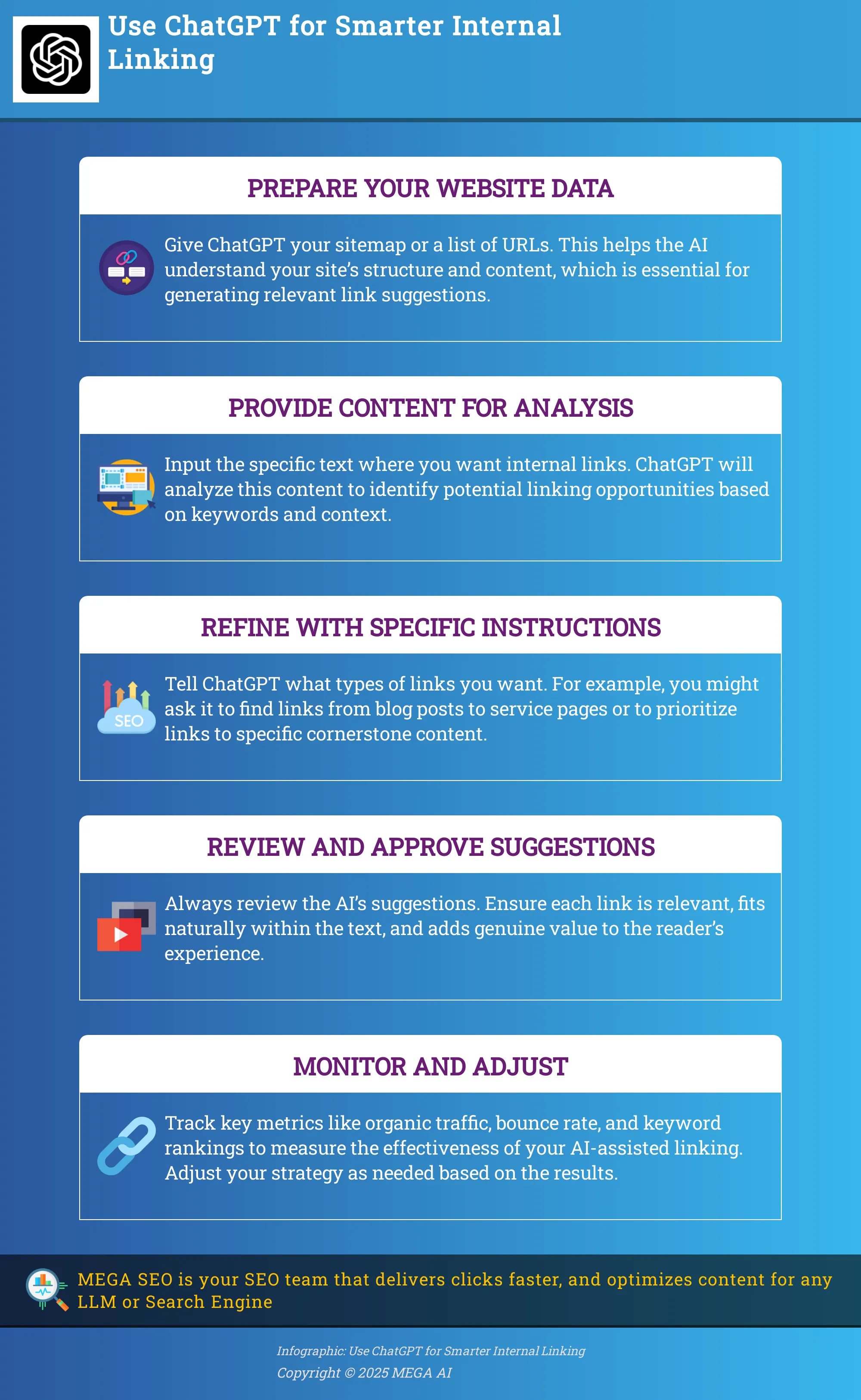
Chat GPT’s capacity to suggest contextual internal links comes from its sophisticated understanding of language. You can start by giving the AI information about your website. As Repeat Digital suggests, a practical first step is to "Input your site links or sitemap to ChatGPT." This provides the AI with an initial map of your site's layout and content. After this, you can provide the specific piece of content where you want to add internal links.
Chat GPT then examines this content, identifying phrases or keywords that semantically connect to other pages on your site. It essentially looks for places where a link to another relevant article would offer more value or context for the reader. The more detailed the information you give about your site, such as the content from key pages, the better Chat GPT becomes at pinpointing truly relevant linking opportunities. This process helps search engines discover relationships between different pieces of your content.
Ensure Contextual Relevance in AI-Generated Links
While Chat GPT is a powerful tool, it’s important to remember that its outputs are suggestions. The real effectiveness comes when AI assistance is paired with your own judgment. AI Tools Explorer mentions that a custom GPT can "analyze the content, pulling in relevant internal links like a magnet collecting iron filings." However, you are the final decision-maker on whether a suggested link truly fits the context and enhances the reader's journey.
Before you implement any link Chat GPT suggests, ask yourself: Does this link feel natural in this spot? Does it genuinely provide more information or a logical next step for someone reading this section? The goal is to create a smooth experience, where internal links guide users to more relevant information, not just to insert links for the sake of SEO. This attention to user experience is vital for both search engines and your audience. Always review and refine the AI's output to make sure each link adds real value.
Tailor AI-Generated Links to Your Content
To get the best results from Chat GPT for internal linking, you need to direct its efforts clearly. Instead of just asking for "internal links," be specific about what you want to achieve. For example, you might instruct Chat GPT to find linking opportunities from your blog posts to your main service pages, or to help connect articles within a particular content cluster. This specificity helps the AI focus its analysis and provide more targeted, useful suggestions. A well-thought-out internal linking strategy can be a distinct advantage, enabling search engines to "navigate and index website content efficiently," as noted by Seer Interactive.
You can also "teach" Chat GPT about your priority pages. If you have cornerstone content or new product pages you want to build authority for, instruct the AI to look for relevant anchor text and contexts in other articles where links to these priority pages would be appropriate. By giving clear instructions and refining your prompts over time, you can customize Chat GPT’s output to align perfectly with your site’s specific content strategy and SEO goals, similar to how MEGA AI's Maintenance Agent can re-optimize existing content for better performance.
Smart SEO Linking with Chat GPT: Best Practices to Follow
Using ChatGPT to assist with your internal linking can be a significant time-saver, but it's not a set-it-and-forget-it solution. To truly benefit your site’s SEO and visitor experience, you need to guide the AI with smart strategies. Think of ChatGPT as an efficient assistant; it handles the groundwork, while you provide the direction and ensure quality. By focusing on relevance, quality, and a natural fit for your links, you combine AI's speed with essential human insight.
Choose Effective Anchor Text and Place Links Naturally
Anchor text, the clickable words in a hyperlink, offers vital context to both users and search engines about the linked page's content. When using ChatGPT, guide it to select anchor text that is descriptive and directly relevant to the destination page. For example, instead of generic phrases like "learn more," aim for anchor text that naturally incorporates keywords. You can even input your site links or sitemap to help ChatGPT identify appropriate words for anchors.
The goal is for these links to feel like an organic part of the sentence, providing genuine value rather than appearing forced. If a link seems out of place, it can detract from the user experience, which is counterproductive to your SEO efforts.
Focus on Link Quality and Smart Quantity
When it comes to internal links, quality consistently outweighs quantity. A few strategically placed, highly relevant internal links are far more beneficial than a page cluttered with numerous, less pertinent ones. A well-thought-out internal linking strategy helps search engine crawlers understand your site's structure and the relationships between your content pieces. This, in turn, can improve how efficiently search engines index your site and also enhance user navigation.
While ChatGPT can suggest potential linking opportunities, your oversight is crucial to confirm their quality. Consider if a link genuinely aids the reader or if the destination page is authoritative. Avoid overlinking, as too many links can dilute SEO value and overwhelm users. Strive for a balance that serves both SEO objectives and reader needs.
Keep Your Links Fresh: Regular Updates and Maintenance
Your website content evolves, and your internal linking strategy should reflect these changes. Regularly reviewing and maintaining your links is essential. This involves checking for broken links, ensuring existing links still point to the most relevant pages, and identifying new opportunities to link to your latest content. ChatGPT can assist in this ongoing process by providing link suggestions and keyword relevance analysis as your site grows.
For instance, if you publish a new comprehensive guide, use AI to help find older, related articles where a link to this new resource would be valuable. Tools like MEGA AI’s Maintenance Agent can also help identify where existing articles can be updated with new links or content, ensuring your linking structure remains robust and effective.
Measure Your Automated Linking Success: Key Metrics and Tools
Once you've set up your automated linking with a tool like Chat GPT, the next step is to see how it's performing. You want to know if these new links are actually helping your site. Keeping an eye on specific numbers and using the right tools will give you a clear picture of your success and show you where you might need to make adjustments. This isn't just about seeing numbers go up; it's about understanding how your automated efforts are contributing to your overall SEO goals and improving the experience for your visitors.
Track These Key Metrics (And the Tools to Use)
To really understand the impact of your automated linking, you'll want to focus on a few important metrics. Start with organic traffic – are more people finding your site through search engines? Also, look at your bounce rate; a lower bounce rate can indicate that visitors are finding your internal links helpful and exploring more of your content. Average session duration is another key metric, as longer sessions can mean users are engaged with the pathways you've created. Tools like Google Analytics are excellent for tracking these user behavior metrics.
Beyond user behavior, monitor your keyword rankings and your site's backlink profile. An increase in rankings for target keywords can be a direct result of a stronger internal linking structure. Platforms such as Ahrefs or Moz offer robust features to check your keyword positions and analyze your site's authority, giving you a comprehensive view of how your automated linking is working.
See How Automated Links Affect Engagement and Rankings
A well-executed internal linking strategy can significantly influence your search engine rankings. For instance, businesses often report substantial increases in keyword rankings after implementing solid internal linking. This shows just how powerful connecting your content effectively can be. When search engines can easily crawl and understand the relationships between your pages, they are more likely to rank your content favorably.
It's also crucial to monitor how users interact with these automated links. Pay attention to click-through rates (CTRs) on your internal links. A healthy CTR suggests that the links are relevant and enticing to your audience, encouraging them to explore more of your site. This engagement not only improves user experience but also signals to search engines that your content is valuable. If you're looking to improve CTR for existing content, MEGA AI's Maintenance Agent can help identify opportunities and re-optimize articles.
Add Chat GPT to Your SEO Strategy for Better Linking
Integrating ChatGPT into your SEO linking strategy can feel like adding a superpower to your toolkit. It’s about working smarter, not just harder, to build those crucial connections within your website. When you combine the analytical power of AI with your strategic insights, you can create a linking structure that truly supports your SEO goals. This means helping search engines better understand your content and guiding your visitors to the information they need most. Think of ChatGPT as an assistant that can rapidly identify opportunities, but you’re still the director, ensuring every link serves a clear purpose and enhances the overall quality of your site. Platforms like MEGA AI are designed to streamline these SEO processes, making advanced strategies more accessible for businesses of all sizes. By thoughtfully applying AI, you can refine how you approach both internal and external linking, ultimately making your site more discoverable and user-friendly.
Your Action Plan for Implementing Automated Linking
Ready to put ChatGPT to work on your linking strategy? Start by defining clear objectives. What do you want your internal linking to achieve? Perhaps it's to distribute link equity to important pages or to improve how users move through your site. A strong internal linking structure is a significant advantage, as it helps search engine crawlers efficiently discover and index your content, while also making your site easier for visitors to use.
Begin by identifying your cornerstone content—those high-value pages you want to rank. Then, use ChatGPT to scan your existing articles for relevant phrases or keywords that can serve as anchor text linking back to these core pages. You can provide ChatGPT with a list of your key pages and ask it to suggest internal linking opportunities from other related content on your site. This systematic approach ensures you’re building a logical and helpful site architecture.
Blend AI Efficiency with Essential Human Oversight
While ChatGPT offers incredible efficiency for identifying potential links, human oversight remains essential. AI is a powerful tool, but it doesn’t understand nuance or user intent quite like you do. Your role is to ensure that every link suggestion is genuinely helpful and natural. Remember, the foundation of good SEO is producing quality content that is unique, valuable, and engaging for your audience. Links should always support this primary goal, not detract from it.
Review the links suggested by AI for contextual relevance and natural placement. Does the anchor text make sense? Does the linked page offer real value to someone reading the current piece? Also, keep in mind that AI models perform best with focused tasks. Instead of asking for all links at once, break down the process. For instance, focus on linking to one pillar page at a time. This blend of AI speed and human strategy is where the real improvements happen.
Teach Chat GPT Your Specific Content Requirements
To get the best results from ChatGPT for internal linking, you need to guide it effectively. Think of it as training your AI assistant. Provide ChatGPT with specific information about your website and content. You can input your sitemap or a list of your site’s URLs to give the AI a comprehensive understanding of your content landscape. The more context it has, the more relevant its suggestions will be.
You can also create custom instructions or prompts. For example, if you want to build links to a new product page, you can instruct ChatGPT to find mentions of related features or problems your product solves in existing blog posts. By clearly defining the types of links you’re looking for and the pages you want to prioritize, you can "teach" ChatGPT to pull in relevant internal links much more effectively. This targeted approach, perhaps facilitated by tools like those offered by MEGA AI, allows you to book a demo and see how such customization can refine your automated linking efforts.
AI-Powered Linking: Challenges and Smart Considerations
Using AI for your SEO linking strategy is a smart move, but it's not quite a set-it-and-forget-it solution. Like any powerful tool, it comes with its own set of challenges and things you'll want to keep in mind. Thinking through these aspects will help you make the most of AI while avoiding common pitfalls. It’s about working smarter, not just faster, and ensuring your AI-assisted efforts truly support your SEO goals. Let’s look at a couple of key areas where a thoughtful approach makes all the difference.
Understand AI's Limitations and the Need for Human Review
AI tools like ChatGPT are incredibly advanced and can produce text that feels very human. However, it's important to remember they are still artificial intelligence with certain inherent limitations. When you're integrating AI into something as crucial as your website's linking structure, which directly impacts your SEO, recognizing these boundaries is key. For instance, while AI can suggest links, it might not always grasp the subtle nuances of your content strategy or the specific intent behind each page.
Think of AI as a highly efficient assistant. It can handle a lot of the heavy lifting, but it performs best when given clear, focused tasks; ChatGPT limitations show it's best with a single objective. Complex SEO strategies often involve multiple objectives, and this is where human oversight becomes invaluable. You'll want to review AI's suggestions to ensure they align perfectly with your goals and that no technical barriers or misunderstandings creep in. This human touch ensures the final linking structure is not just algorithmically sound but also strategically smart.
Keep Pace with Search Engine Algorithm Updates
The world of SEO is always on the move, with search engine algorithms constantly being refined. What worked yesterday might not be as effective tomorrow. This is where AI can be a real game-changer. AI models can process vast amounts of data, including real-time information about algorithm shifts, helping your site stay optimized. For internal linking, this means AI can help speed up the development of strategies that adapt to these changes, potentially by as much as 47% according to some case studies.
A well-crafted internal linking strategy is a significant advantage. It helps search engine crawlers efficiently navigate and index your website's content, which is fundamental for visibility. Beyond that, it improves how users move through your site and engage with your content. By using AI to help manage and update your linking strategy, you're better positioned to maintain this edge, ensuring your site structure remains effective even as search engine priorities evolve. The key is to use AI's analytical power while still understanding the core principles of good SEO.
Align Automated Links with Google's E-A-T Guidelines
Google's E-A-T guidelines—which stand for Experience, Expertise, Authoritativeness, and Trustworthiness—are a core part of how it evaluates your website's content quality. Smart linking practices, especially when enhanced with AI, play a significant role in demonstrating these qualities. By strategically placing internal and external links, you can effectively strengthen your site's E-A-T signals, which is great news for both your users and your search engine performance. Platforms like MEGA AI can help you automate your SEO efforts, including building a strong linking profile.
How Smart Linking Builds E-A-T (Experience, Expertise, Authority, Trust)
Thoughtful linking directly contributes to building a strong E-A-T profile for your website. When you cite sources and link to other authoritative external websites, you're showing that your content is well-researched and based on credible information. This helps establish your expertise and builds trustworthiness with your audience, letting them know you value accuracy.
Internally, a solid linking strategy helps search engine crawlers understand your site's structure and how your content pieces relate to each other. This not only allows search engines to index your website content more efficiently but also improves the user experience by guiding visitors to other relevant and helpful information on your site. A well-organized site that's easy for users to explore naturally builds authority and trust.
Use AI-Assisted Linking to Strengthen Your E-A-T
AI tools, including ChatGPT, can be incredibly useful for putting these E-A-T-enhancing linking strategies into practice. Instead of spending a lot of time manually finding good linking opportunities across your site, AI can significantly speed up the development of your internal linking plan. These tools can process large amounts of content quickly, suggesting relevant internal links that help create a cohesive and informative experience for your users.
This AI-driven approach allows you to consistently add links that improve your site’s SEO and the overall user journey. By using AI to suggest or even help create content with strategic links already incorporated, you can more effectively tie your content cosmos together. This reinforces your site's authority and trustworthiness by making it simpler for users to find related, valuable information, all while keeping your content well-optimized and engaging.
What's Next? The Future of AI in SEO Linking
The world of SEO is always evolving, and AI is playing a bigger part in how we approach tasks like linking. It's exciting to see how these technologies are shaping the future and what we can expect next. Staying informed helps you keep your strategies fresh and effective.
What's New: Trends and Potential AI Advancements in Linking
A well-crafted internal linking strategy can give you a real edge, helping search engines better understand your site and making it easier for users to find what they need. AI tools, including some helpful plugins for ChatGPT-4, are making these strategies even more effective. Imagine the time you could save; for example, using GPT models can significantly accelerate how you develop your internal linking plan. These models are also adept at processing real-time information, which means your site can stay optimized as search engine algorithms evolve. This capability makes AI a strong partner in aiming for better rankings and a smoother user journey.
Get Ready for the Future of SEO and AI Linking
So, how can you prepare for what’s on the horizon? You can begin by using tools like ChatGPT for specific internal linking tasks. This might involve getting suggestions for links, analyzing keyword relevance, or even getting ideas for anchor text. For those looking to scale their efforts, it's even possible to implement automated internal linking with scripts. While AI offers incredible advancements, it's also wise to remember its limitations. AI-generated text is impressive, but it's still powered by algorithms and might encounter technical challenges when integrated with complex systems. This is where platforms like MEGA AI come in, designed to simplify these advanced SEO processes and make sophisticated linking strategies more accessible for everyone.
Related Articles
- Using Internal Links to Improve Site Structure and Boost SEO: Content Optimization Strategies - MEGA SEO | Blog
- Mastering the Art of SEO-Friendly Content: Best Practices for Internal and External Linking - MEGA SEO | Blog
- Link Building Strategies: The Ultimate Guide (2024)
- 7 Best SEO Automation Tools to Boost Your Workflow
- The Role of Artificial Intelligence in SEO: Transforming Search Engine Optimization - MEGA SEO | Blog
Frequently Asked Questions
I'm just starting with SEO. What's the most important thing to remember about website links? Think of links as pathways. For search engines, they help discover and understand your content, which influences your ranking. For your visitors, good links make it easy to find what they need on your site, improving their experience. So, it's about creating clear, helpful connections.
Using ChatGPT for internal linking sounds great, but how much work do I still need to do myself? ChatGPT is a fantastic assistant for finding potential linking opportunities much faster than you could manually. However, your expertise is still crucial. You'll want to review its suggestions to ensure each link is truly relevant, makes sense in context, and genuinely helps your reader. AI handles the legwork; you provide the strategic oversight.
How can I ensure the links ChatGPT suggests actually make sense for my readers and aren't just random? The key is to guide ChatGPT with clear instructions and then carefully review its output. Provide it with information about your site's structure and your content goals. When you review, ask yourself if the link feels natural and if it leads to a page that offers real value or a logical next step for someone reading that specific piece of content.
What's a simple way to check if my AI-assisted linking efforts are actually working? You can look at a few key indicators. Notice if more people are finding your site through search (organic traffic). Also, check if visitors are spending more time on your site or viewing more pages per session. These can suggest your internal links are helping them explore your content more deeply. Tools like Google Analytics can help you track these changes.
Is it better to have lots of internal links or just a few really good ones when using AI to help? Quality definitely wins over quantity here. A few well-placed, highly relevant internal links are much more effective than a page crowded with links that don't add much value. Your goal is to guide users and search engines logically, so focus on creating connections that genuinely enhance understanding and navigation.