
Setting clear expectations is fundamental to a positive user experience on any website. When a visitor clicks a link, they have an idea of what they'll find on the next page. If that expectation isn't met, they're likely to hit the back button, contributing to a higher bounce rate. This is precisely why anchor text optimization is so vital. The words you choose for your links act as a promise to your users. Getting this promise right means visitors are more likely to find relevant information and continue exploring. Understanding the full benefits of anchor text optimization for reduced bounce rate? can transform how users interact with your site, leading to longer visits and more successful outcomes.
Key Takeaways
- Guide Visitors Accurately: Use anchor text that clearly tells people what they'll find on the next page; this builds trust and encourages them to explore your site rather than leave.
- Strengthen Site Structure for Users and Search Engines: Make your anchor text a reliable map for both visitors exploring your content and search engines understanding how your pages connect, improving navigation and discoverability.
- Write Links for Humans First: Choose words for your anchor text that are descriptive and sound natural within your sentences, varying your choices to keep your linking strategy effective and user-friendly.
What is Anchor Text and Why Does It Matter?
Understanding anchor text is fundamental to improving your website's performance. It’s a small detail that carries significant weight in how both users and search engines perceive your content. When used thoughtfully, anchor text can make your site more intuitive and help your pages rank higher in search results. Many businesses, especially startups and small enterprises, can benefit greatly by paying closer attention to this aspect of their SEO strategy.
Define Anchor Text and Its Function in Hyperlinks
Anchor text is the visible, clickable text in a hyperlink. When you see words on a webpage that are a different color, often underlined, and clicking them takes you to another page, you're looking at anchor text. Think of it as a brief, descriptive label for the link's destination. For users, it sets expectations about what they'll find if they click. For search engines, anchor text provides crucial context, helping them understand what the linked page is about and how it relates to the current page. This simple component of a link plays a vital role in website navigation and information architecture, guiding both human visitors and search engine crawlers effectively.
How Anchor Text Affects SEO and User Experience
Effective anchor text significantly influences both your search engine optimization (SEO) and the overall user experience on your site. From an SEO perspective, clear and relevant anchor text helps search engines accurately index your content, which can lead to improved rankings for your target keywords. When search engines can easily determine the topic of a linked page, they are more likely to see it as a valuable resource.
For your website visitors, well-crafted anchor text makes site navigation more intuitive. Instead of vague phrases like "click here," descriptive anchor text tells users exactly what to expect, making it easier for them to find the information they need. This clarity reduces frustration and can encourage users to spend more time engaging with your content, ultimately contributing to a positive experience and potentially better conversion rates. A thoughtful mix of anchor text types, such as exact match, partial match, and branded terms, generally works best.
What Are Bounce Rates and How Do They Impact Your Site?
Understanding bounce rates is a key part of figuring out how well your website is performing. Think of it as a measure of your site's first impression. When someone lands on your page, do they stick around, or do they leave quickly? A high bounce rate might mean visitors aren't finding what they need, or perhaps the page isn't engaging enough. This can affect not only your user experience but also how search engines view your site's relevance. If you're aiming to improve your site's effectiveness, getting a handle on bounce rates is a great place to start. Let's look closer at what a bounce actually is and why keeping an eye on this metric is so important for your site's health and visibility.
Define a "Bounce"
So, what exactly is a "bounce"? In simple terms, a bounce occurs when a visitor lands on one of your webpages and then leaves without interacting further with your site. This means they didn't click on any internal links to explore other pages, fill out a form, leave a comment, or make a purchase. They essentially "bounced" off your site after viewing just that single page. Imagine someone walking into a shop, glancing around for a second, and then immediately walking out without touching anything or speaking to anyone. That quick entry and exit is similar to a website bounce. Understanding this concept of a single-page session with no interaction is fundamental to analyzing how engaging your site truly is for new visitors.
Why High Bounce Rates Can Hurt Your Site
A high bounce rate can be a clear signal that something isn't quite right, and it can have a few negative effects on your site. Primarily, it often suggests that visitors aren't finding what they expected or wanted when they arrived on your page. This mismatch between user expectation and your page's content can tell search engines that your material might not be the most relevant or valuable for certain search queries. Consequently, this can negatively impact your site's SEO performance, potentially leading to lower rankings over time. When users quickly leave, it indicates that your content may not be compelling enough to hold their attention, which can diminish your site's overall visibility and authority in search results.
How Optimizing Anchor Text Reduces Bounce Rates
Optimizing your anchor text is more than just a small search engine optimization detail; it’s a key factor in how users interact with your website. When you use anchor text thoughtfully, it can directly help lower your bounce rates. Think of anchor text as the initial introduction to a new page – it sets the stage and user expectations. If this introduction is clear and accurate, visitors are much more likely to stay and explore your content. This section will show you how specific strategies for anchor text optimization can encourage visitors to remain on your site longer, leading to a better overall user experience and stronger site performance.
Set Clear User Expectations
One of the most effective ways optimized anchor text helps reduce bounce rates is by clearly setting user expectations before they even click a link. When a visitor encounters a hyperlink, the anchor text should provide an accurate and concise description of what they will find on the destination page. If the text is ambiguous, such as a generic "click here," or if it's misleading, users might click through only to discover that the content isn't relevant to their needs. This kind of mismatch between expectation and reality is a common reason for a user to leave a page immediately, contributing to a higher bounce rate.
Well-chosen anchor text, however, functions as a trustworthy guide. It helps people find information on your site with greater ease. When users land on a page that delivers precisely what the anchor text promised, their confidence in your site grows. This positive initial experience makes them more inclined to engage with the content further, rather than quickly returning to search results or the previous page. Such clarity is fundamental to creating a positive user journey.
Improve Site Navigation and Content Discovery
Thoughtfully crafted anchor text significantly enhances how users move through your website and discover additional content. Consider your internal links as pathways within your site; the anchor text on these links acts as the directional signs. If these signs are descriptive and directly relevant to the linked page, users can effortlessly transition from one piece of related content to another. This smooth and logical progression encourages them to explore more of what your site has to offer, which naturally reduces the chances of them bouncing.
When anchor text provides clear navigation, visitors are far less likely to feel disoriented or frustrated. Instead of encountering a dead end or landing on a page that doesn’t meet their needs, they can follow an intuitive path through your information. This not only keeps them engaged on your site for longer periods but also assists them in finding valuable content they might not have located otherwise, making their visit more fruitful and satisfying.
Increase User Engagement and Time on Site
Ultimately, clear and relevant anchor text is a direct contributor to increased user engagement and the amount of time visitors spend on your site. When users click a link and the destination page perfectly aligns with the expectations set by the anchor text, they are significantly more likely to interact with the content—be it reading an article, watching a video, or taking another intended action. This type of active engagement is the direct opposite of a bounce. As research suggests, avoiding vague phrases and using descriptive anchor text improves user experience, which in turn helps to reduce bounce rates.
This positive interaction, cultivated by accurate and compelling anchor text, means users are finding the value they were seeking. They are more likely to perceive your site as a useful resource and will be encouraged to explore further. Each relevant page they visit, guided by well-optimized anchor text, reinforces their decision to stay, thereby extending their session duration and signaling to search engines that your website offers a high-quality, user-friendly experience.
Discover the SEO Benefits of Optimizing Anchor Text
Optimizing your anchor text is a key part of a strong SEO strategy, impacting how search engines and users see your content. Thoughtful anchor text clarifies your subject matter and can improve your ranking for important keywords. It acts as a signpost, guiding visitors and crawlers, making your site more accessible. Let's explore how refining your anchor text brings tangible SEO benefits.
Improve Content Relevance and Context
Well-crafted anchor text helps search engines understand your linked pages' topics. Using descriptive words in links gives search engines clear clues about your content, helping them accurately index pages and potentially leading to higher rankings for relevant searches.
For visitors, clear anchor text is equally important. It shows what to expect from a link, simplifying their search for information. This direct navigation improves user experience, reducing confusion. When users can easily understand where a link leads, they are more likely to engage and explore your site.
Strengthen Your Internal Linking Structure
Your internal linking structure acts as your website's roadmap, with anchor text defining the routes. Specific, relevant anchor text for internal links creates clear pathways between related content. This helps users discover information and allows search engines to crawl your site efficiently, understanding page relationships.
A smart approach uses varied anchor text types. Mixing partial-match keywords, branded terms, and natural generic phrases makes your linking profile appear more organic. This thoughtful variation, focused on user understanding, builds a healthier internal linking strategy. Tools that automate internal linking can also ensure consistent anchor text optimization.
Improve Keyword Targeting and Ranking Potential
Anchor text powerfully signals keyword relevance to search engines. Linking with anchor text including a target keyword reinforces that page's topic connection. Consistent, relevant anchor text across many links can significantly improve your ranking potential for those keywords.
Using the right words is key; avoid vague phrases like "click here," which offer no context. While exact-match anchor text is useful, a natural mix of partial-match keywords, branded terms, and descriptive phrases often works best. This balanced approach helps search engines understand your content's themes without appearing manipulative, supporting your ranking efforts for key terms.
Optimize Anchor Text: Best Practices for Success
Getting your anchor text right is a key part of a strong online strategy, and it’s simpler than you might think. It’s not about trying to trick search engines with keywords, but rather about creating a clear and helpful path for your website visitors. When you optimize anchor text thoughtfully, you’re essentially giving users a better roadmap to navigate your site. This clarity helps them find what they're looking for quickly, making them more likely to stay and explore, which in turn can significantly reduce how often people leave your site prematurely. Think of well-crafted anchor text as friendly signposts that guide users smoothly from one piece of relevant content to another. This approach not only improves user experience but also helps search engines understand the context and relevance of your pages. Let’s walk through some practical ways to make your anchor text more effective.
Use Descriptive and Relevant Text
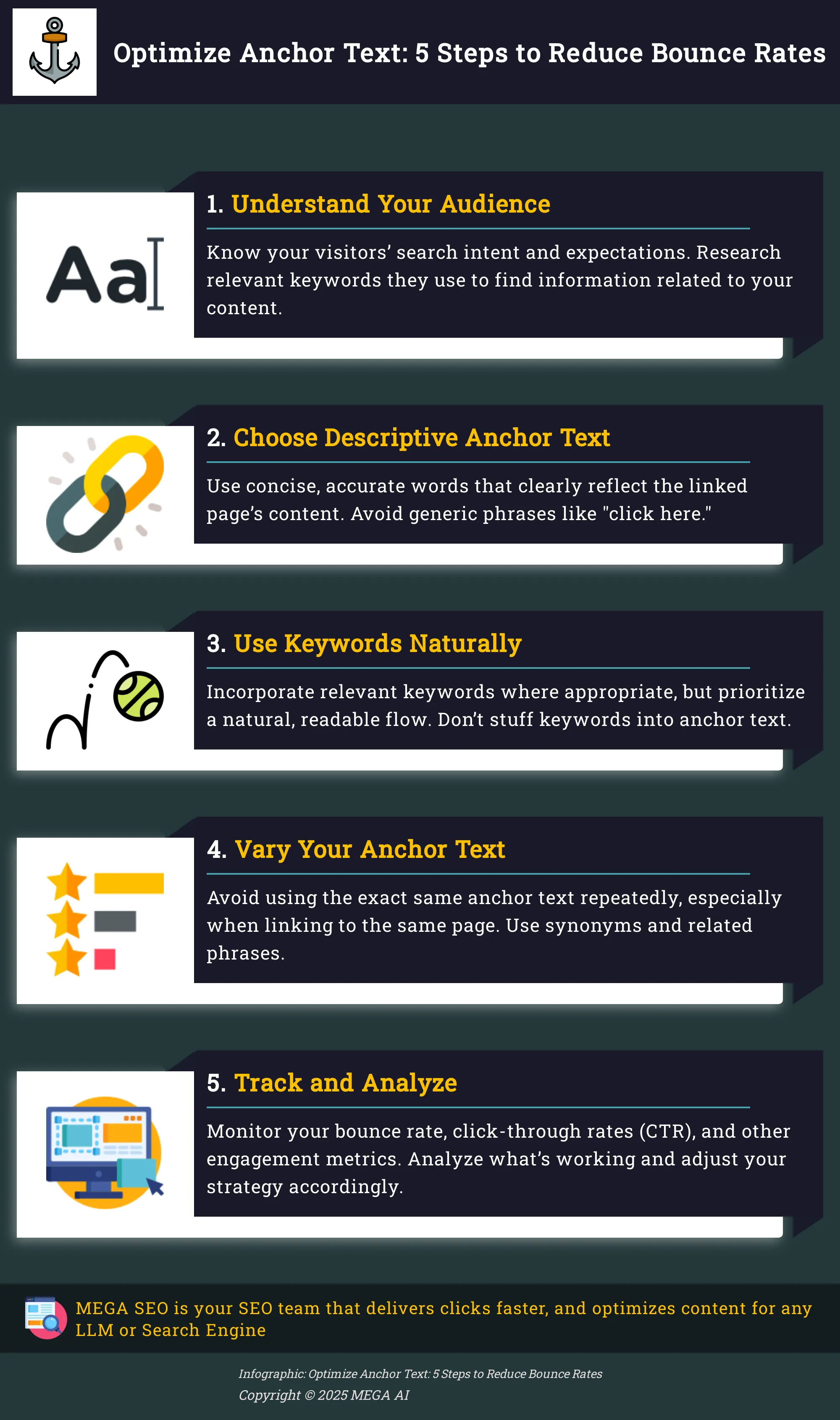
The words you choose for your anchor text make a big difference. Your goal should be to use text that accurately and clearly describes the content of the page you're linking to. Instead of relying on generic phrases like "click here" or "learn more," try something more specific. For example, if you're linking to a page about your SEO services, an anchor like "discover our automated SEO solutions" is much more informative. Good anchor text helps search engines understand your website and its structure, which can contribute to better visibility. More importantly, it provides a much clearer expectation for your visitors, making it easier for them to find the information they need and encouraging them to continue exploring your site.
Balance Keywords with Natural Language
Including relevant keywords in your anchor text can be beneficial for SEO, but it’s essential to do this in a way that sounds natural and fits seamlessly within your content. If your anchor text feels forced or stuffed with keywords, it can be jarring for readers and might even be viewed negatively by search engines. The key is to balance keywords and natural language effectively. For instance, if you're linking to an article about improving ad performance, an anchor like "strategies to improve ad campaign performance" reads more naturally than just "ad performance keywords." Always prioritize the reader's experience; if the anchor text makes sense in the sentence and clearly indicates the link's destination, you're on the right path.
Avoid Over-Optimization Pitfalls
While it might seem like a good idea to use your primary target keyword for every internal link pointing to a particular page, this approach can backfire. Consistently using the exact same anchor text, especially if it's keyword-heavy, is considered over-optimization. Search engines may interpret this as an attempt to manipulate rankings, which can ultimately harm your website's performance in search results. A better strategy is to vary your anchor text. Use synonyms, long-tail keyword variations, or descriptive phrases that still accurately reflect the content of the linked page. This method appears more organic to both users and search engines and helps you steer clear of potential penalties.
Adapt Anchor Text for Different Content Types
A one-size-fits-all approach to anchor text rarely works best. The most effective anchor text often depends on the specific context, the type of content you're linking from, and the destination page. For example, the anchor text for a call-to-action button encouraging a demo might be different from the anchor text used within a detailed blog post linking to a related resource. Similarly, linking to a product description page might call for a different style of anchor text than linking to an informational guide. Always keep the user in mind and consider what phrasing would be most helpful and intuitive for them in that particular situation. Using a variety of thoughtfully chosen anchor text types generally leads to better results for both user engagement and your SEO efforts.
How to Measure Anchor Text's Impact on Bounce Rates
Understanding if your anchor text strategy is actually working to reduce bounce rates requires a bit of detective work. It’s not enough to just change your anchor text; you need to measure its effects. By tracking the right numbers and using the appropriate tools, you can see exactly how your anchor text choices influence user behavior and, ultimately, how well your pages retain visitors. This data-driven approach will help you refine your strategy for even better results.
Identify Key Metrics to Track
To truly gauge the effectiveness of your anchor text in keeping visitors on your site, you'll want to focus on a few key metrics. Naturally, bounce rate is at the top of this list; a decrease here often signals that your anchor text is setting clearer expectations. Beyond that, keep an eye on click-through rates (CTR) for your internal links. A higher CTR can indicate that your anchor text is compelling and relevant.
Also, consider user engagement metrics like pages per session and average session duration. If users are visiting more pages and spending more time on your site after clicking an internal link, your anchor text is likely doing a good job guiding them to valuable content. Finally, while not a direct measure of bounce rate, conversion rates on pages linked via optimized anchor text can also provide insights into whether users are finding what they need and taking desired actions.
Use Tools to Analyze Anchor Text Performance
Several tools can help you dig into how your anchor text is performing. Google Analytics is indispensable for tracking bounce rates, pages per session, and average session duration for specific pages. You can segment your audience or look at behavior flows to see how users move through your site after clicking certain links. Google Search Console is another valuable asset, offering insights into the queries users type to find your pages and which internal links they click most often.
For more in-depth analysis, tools like SEMrush can provide comprehensive SEO metrics, including backlink analysis which often involves looking at anchor text from external sites. When analyzing, remember the goal is to ensure your anchor text accurately reflects the content of the linked page. As Neil Patel suggests, analyzing the anchor text and content of various traffic sources helps you understand visitor expectations better, which is key to reducing bounce rates and improving overall site performance.
Integrate Anchor Text Optimization into Your SEO Strategy
Optimizing your anchor text isn't a standalone task; it's a piece of your larger SEO puzzle that works best when connected with your other efforts. When you thoughtfully integrate anchor text optimization, you create a more cohesive and effective strategy that benefits both users and search engines. This means looking at how your links fit into your content, your site's technical setup, and what your user data is telling you.
Align with Content Marketing Efforts
Your anchor text and content marketing should go hand-in-hand. Think of anchor text as the bridge connecting different pieces of your valuable content. When you create a blog post or guide, the internal links you include should use anchor text that accurately reflects the destination page's topic. This alignment is crucial because properly optimized anchor text helps search engines understand your content's relevance and significantly improves the user experience. Clear, descriptive anchor text guides visitors to related information easily, encouraging them to explore more of your site. This keeps them engaged and signals to search engines that your site offers comprehensive information. As you plan your content, also plan how your internal links will support your topics.
Coordinate with Technical SEO Improvements
Anchor text optimization plays a supportive role in your technical SEO. While technical SEO covers site speed and crawlability, your anchor text helps search engines map your site's structure and understand content hierarchy. Good anchor text helps search engines understand your website's pages and their relationships, which can lead to better indexing and rankings. For instance, consistently using relevant keywords in anchor text for internal links to a pillar page reinforces that page's authority on the topic. This coordination ensures visitors and search engine crawlers can efficiently find information. When your technical SEO makes your site easy to crawl, well-optimized anchor text provides clear pathways for search engines to assess your content.
Use User Behavior Data for Optimization
To truly refine your anchor text strategy, turn to your user behavior data. Analytics offer insights into how visitors interact with your links. By examining metrics like click-through rates (CTR) on internal links, page bounce rates, and conversion rates from specific link clicks, you can understand what resonates with your audience. If an anchor text has a low CTR, it might not be compelling or clearly indicate the linked page's value. You can also analyze the anchor text and content of non-search traffic sources, like referral links, to see what language draws visitors and what they expect. This information helps you choose anchor text that better aligns with user intent, potentially reducing bounce rates. Regularly reviewing this data allows for informed adjustments.
Explore Advanced Anchor Text Optimization Techniques
Once you've got a handle on the fundamentals of anchor text, you can start to explore more sophisticated approaches. These strategies move beyond simple keyword matching, focusing instead on building a more intelligent and user-friendly linking structure within your site. When you think more deeply about the why and how behind your links, you can significantly improve the user journey, send clearer signals to search engines, and see even better reductions in your bounce rates. These advanced methods often require a closer look at user intent and the evolving ways people find content online.
Implement Contextual Linking Strategies
Contextual linking means ensuring your anchor text fits seamlessly within the surrounding content, offering clear clues about where a click will lead. When you use descriptive anchor text, you make it much easier for people to find the information they need, which is a cornerstone of a positive user experience. This clarity is just as vital as signaling relevance to search engines. Well-chosen anchor text helps search engines better understand your website's content, potentially leading to improved rankings. More directly impacting bounce rates, it guides users effectively. If someone clicks a link expecting specific information and lands on something unexpected or confusing, they're likely to leave. Clear, contextual links set accurate expectations, keeping visitors engaged and encouraging them to explore your site further.
Optimize for Voice Search and AI-Driven Content Discovery
The way people search for information is constantly evolving. With the growing use of voice assistants and more advanced AI, search queries are becoming more conversational and focused on user intent. This shift means your anchor text strategy should adapt too. Future trends point towards adapting for voice search and leveraging AI to refine anchor text choices. Consider how someone might verbally ask a question and think about using longer, more natural phrases for your anchor text where it makes sense. Modern search engines increasingly prioritize the overall user experience, making older tactics designed to simply game algorithms less effective. By focusing on clear, user-centric anchor text that aligns with how AI discovers and interprets content, you make your site more accessible and engaging, which naturally helps to lower bounce rates.
Avoid These Common Anchor Text Optimization Mistakes
Optimizing anchor text is a smart move for guiding users and search engines, but it's important to do it right. Some common missteps can actually hinder your SEO and annoy your visitors. Let's look at a few frequent mistakes so you can avoid them and ensure your linking strategy truly supports your audience and your site's performance.
Steer Clear of Over-Optimization and Keyword Stuffing
It’s tempting to pack anchor text with exact match keywords for quick ranking wins. However, this over-optimization often backfires. As Interact Marketing notes, "Over-optimization hurts your SEO: Repeating the exact same anchor text many times is bad. Search engines see this as trying to trick them, and it can lower your website's ranking." You might even face penalties. Search engines understand context, so avoid unnaturally forcing keywords. Instead, craft anchor text that reads smoothly. Vary your phrasing with synonyms or descriptive terms to show your content is authentic, not an attempt to game the system.
Don't Use Generic or Irrelevant Anchor Text
Links like 'click here' or 'learn more' are common, but these generic phrases offer little value. They don't tell users or search engines much about the linked page's content. Valve + Meter explains, "Using vague phrases like 'click here' or 'read more' would be less effective than using descriptive keywords that accurately describe the linked page's content." Clear anchor text helps users decide if a link is relevant. Similarly, irrelevant anchor text—where link text doesn't match the destination—can confuse visitors and increase bounce rates. Always ensure your anchor text accurately reflects the destination; this helps search engines understand your content.
Prioritize the Mobile User Experience
With much web browsing on mobile devices, optimizing this experience is vital, including your anchor text. As Bliss Drive advises, "Keep your anchor text concise and easy to understand, especially for mobile users." On smaller screens, links must be easily tappable and their destination clear. Lengthy anchor text can be hard to read and tap, frustrating users. Consider how your links appear on a smartphone—are they distinct and well-spaced? Concise, descriptive anchor text helps mobile users quickly grasp where a link leads. This focus on mobile usability can reduce bounce rates and improve engagement, signaling a positive mobile experience to search engines.
Implement Anchor Text Optimization for Your Website Type
Optimizing your anchor text isn't a one-size-fits-all task. The best approach depends on the type of website you run and what you want your visitors to achieve. Whether you're selling products, sharing information, or offering services, tailoring your anchor text strategy can significantly improve how users interact with your site and help keep those bounce rates down.
Your internal linking and the anchor text you use should reflect the different expectations of your visitors, guiding each user smoothly to their next step. By understanding the nuances of your specific website type, you can make your anchor text work much harder for you. This creates a more intuitive experience that encourages visitors to stick around. Let's look at how to approach this for different kinds of websites.
Optimize E-commerce Sites and Product Pages
For e-commerce sites, clarity is essential. When a potential customer lands on your site, they're often looking for specific products or categories. Your anchor text for internal links needs to be crystal clear, guiding them effortlessly. Properly optimized anchor text can improve your site's search engine rankings and enhance user experience. This is particularly important for e-commerce sites where clear navigation and relevant links can help drive targeted organic traffic and keep users engaged on the site.
Instead of generic phrases like "click here," use descriptive anchor text that tells the user exactly where they're going. For example, if you're linking from a homepage feature to a new shoe collection, use anchor text like "Shop New Spring Sneakers" rather than just "New Arrivals." This specificity helps users find what they want faster, reducing frustration and the likelihood they'll bounce.
Optimize Content-Heavy Websites and Blogs
If your website is rich with articles, guides, or blog posts, your anchor text plays a crucial role in helping users discover more of your valuable content. Good anchor text helps search engines understand your website better, leading to higher rankings. It also improves how easily people can find information on your site, which is crucial for content-heavy websites and blogs.
When linking between articles, use anchor text that accurately reflects the topic of the linked page. For instance, if you're referencing a detailed guide on a specific strategy within a broader overview, the anchor text should clearly state that strategy, like "our complete guide to keyword research." Using descriptive and relevant anchor text helps users understand where a link will take them, making navigation easier and more intuitive. This leads to less confusion and more engagement with your website, encouraging them to delve deeper into your expertise.
Optimize Service-Based Business Websites
For service-based businesses, building trust and guiding potential clients towards a consultation or inquiry is often the primary goal. Clear and descriptive anchor text helps users navigate your website easily. This is just as important as pleasing search engines, especially for service-based business websites where user experience can directly impact conversion rates. Your anchor text should clearly communicate the value or action behind the link.
Instead of vague calls to action, be specific. For example, use "Explore Our Digital Marketing Services" or "Request a Free Quote" rather than generic terms. Using a variety of anchor text types and keeping the user in mind will lead to the best results, particularly for service-based businesses that rely on user engagement to drive inquiries and conversions. Make it easy for visitors to understand what services you offer and how to take the next step.
Related Articles
- Anchor Text: A Simple Guide for Startups
- Anchor Text Guide: Best Practices for SEO (2024)
- How to Avoid Keyword Stuffing: A 2024 SEO Guide
- Title Attribute SEO: Best Practices for 2024
- Contextual Relevance: Boosting Site Authority in 2024
Frequently Asked Questions
I'm new to all this. What's the one anchor text mistake I absolutely need to avoid? The most common misstep is using vague or generic phrases like "click here" or "read more." Your anchor text should always give a clear and concise idea of what the linked page is about. This helps visitors understand where they're going and why it's relevant to them, which is much more effective.
How can I tell if my current anchor text is actually working to keep visitors on my site? You can look at your website analytics. Pay attention to the bounce rates of pages that receive a lot of traffic from internal links. If pages linked with clear, descriptive anchor text have lower bounce rates and users go on to visit more pages, that's a good sign. You can also observe user flow reports to see the paths visitors take after clicking specific links.
Should I use the exact same anchor text every time I link to a specific page, or is it better to mix it up? It's generally better to vary your anchor text while keeping it relevant to the linked page. Using the exact same keyword-heavy anchor text repeatedly can look unnatural to search engines. A mix of descriptive phrases, partial keyword matches, and even branded terms creates a more organic linking profile and still provides clear context for users.
What about links that are images, not text? How does anchor text work for those? That's an excellent point. For images that function as links, the "alt text" (alternative text) you provide for the image serves a similar purpose to anchor text. It describes the image and, by extension, gives context to the link for search engines and for users who might have images turned off or use screen readers. So, make sure your alt text is descriptive.
If I update my anchor text, how quickly might I see changes in my bounce rate or search rankings? Changes from anchor text optimization aren't usually instantaneous. Search engines need time to recrawl your pages and process the new information. You might start seeing shifts in user behavior, like lower bounce rates on certain pages, relatively soon if the changes improve clarity. Effects on search rankings can take longer and depend on various factors, including how frequently your site is crawled and the overall competitiveness of your keywords.