
If you’re a startup or small business, you know that competing with larger companies in search results can feel like an uphill battle. Traditional SEO requires a level of time and specialized knowledge that many small teams simply don't have. This is where the conversation about AI driven SEO vs traditional SEO becomes particularly important. AI-powered tools are leveling the playing field, automating complex tasks like keyword research, content optimization, and technical monitoring. This allows smaller players to implement sophisticated strategies without needing a large, dedicated SEO team. It’s about using technology to scale your efforts and focus on running your business.
Key Takeaways
- Adopt a Hybrid SEO Model: The most effective strategies don't pit AI against traditional methods—they integrate them. Use AI for its speed and scale in data analysis and automation, freeing up your team to focus on high-level strategy, creativity, and brand building.
- Use AI for Execution, Humans for Strategy: Let AI handle the heavy lifting of keyword research, technical audits, and content optimization. This allows you to apply human insight to what truly matters—defining your brand voice, understanding customer intent, and building real relationships.
- Guide Your AI with a Human Touch: AI is a powerful tool, but it needs direction. Human oversight is crucial for steering clear of generic content, ensuring your brand's unique voice is present, and aligning your SEO activities with your specific business goals.
AI SEO vs. Traditional SEO: What's the Difference?
Think of the core difference between AI SEO and traditional SEO as the distinction between manual craftsmanship and automated production. Both aim to create a high-quality result, but their methods, speed, and scale are fundamentally different. Traditional SEO is the classic, hands-on approach where marketers rely on their expertise, intuition, and manual effort to improve search rankings. This involves manually researching keywords, writing and updating content, building relationships for links, and conducting technical site audits. This method gives marketers direct control over content relevancy and brand voice, ensuring every decision is deliberate.
AI SEO, on the other hand, uses machine learning and automation to perform these tasks with greater speed and at a much larger scale. Instead of a person manually analyzing a handful of competitors, an AI can process data from thousands of top-ranking pages in seconds to identify winning patterns. It can automatically optimize content for search algorithms, find technical issues across a massive website, and discover keyword opportunities a human might miss. This approach offers incredible efficiency, allowing a small team to manage an enterprise-level SEO strategy. Platforms like MEGA AI use this power to automate everything from keyword research to content updates, making advanced SEO accessible to everyone. The goal isn't to replace the strategist but to equip them with tools that handle the heavy lifting.
From Manual Tweaks to AI Automation: The SEO Journey
Search engine optimization has always been a hands-on discipline. For years, success depended on manual effort and deep expertise. Traditional SEO involves meticulous keyword research, technical site audits, and the slow, steady process of building high-quality links. These methods give marketers direct control over their site’s structure and content, ensuring every change is deliberate and aligned with brand strategy. This foundational approach required a significant investment of time and resources, with specialists manually adjusting every element to appeal to search engines and users.
The introduction of AI marked a significant shift in this process. AI tools began by automating the most repetitive and time-consuming tasks, offering a new level of efficiency and scale. Instead of spending hours sifting through keyword data, marketers could get instant suggestions. AI could analyze a webpage and automatically optimize its content, helping to improve page rankings without constant human input. This automation freed up marketing teams to focus less on the granular tasks and more on the bigger picture.
Today, AI’s role in SEO has expanded far beyond simple automation. Modern platforms can analyze vast datasets to predict future search trends, identify content gaps, and even update existing articles to improve performance. This journey from manual tweaks to intelligent automation allows businesses to scale their SEO efforts in ways that were previously impossible. However, this evolution doesn’t make traditional methods obsolete. Instead, it highlights the ongoing need for human oversight, creativity, and strategic direction to guide the technology effectively.
What Can AI SEO Do for You?
AI-powered SEO tools handle the heavy lifting across several key areas of search optimization. Instead of spending hours on manual tasks, you can use AI to get faster, more accurate results. This frees you up to focus on the bigger picture of your marketing strategy. From finding the right keywords to fixing technical errors, AI can act as a powerful assistant for your SEO efforts.
Automate Keyword Research
Finding the right keywords is the foundation of any SEO strategy, but the manual process can be tedious. AI tools change the game by sifting through massive amounts of search data in seconds to identify high-potential keywords, uncover long-tail opportunities, and analyze competitor strategies. This data-driven approach means you’re making informed decisions based on real-time insights, not just guessing what your audience is searching for.
Generate and Optimize Content
Creating content that both search engines and humans love is a constant challenge. AI helps on two fronts: generation and optimization. It can produce first drafts of articles or meta tags to get you started. More importantly, AI can analyze your existing content and suggest improvements. Tools like MEGA AI's SEO platform can identify content gaps, re-optimize articles for better click-through rates, and ensure your pages are aligned with top-ranking content.
Improve Technical SEO
A website with technical problems won’t get very far in search results. Technical SEO can feel overwhelming, but AI simplifies it. AI-driven tools continuously crawl your site to find issues like broken links, slow page speeds, and mobile-friendliness problems. By proactively catching these errors, AI helps you maintain a healthy website and provide a smooth user experience, which is a major factor in search rankings.
Predict Trends and Analyze Performance
Beyond just executing tasks, AI offers a strategic advantage by helping you see what's next. By analyzing vast datasets, AI can spot emerging search trends before they become mainstream, giving you a head start on creating relevant content. It can also dig into your performance data to show you which strategies are working. This predictive capability allows you to make timely adjustments and build a forward-thinking SEO strategy that adapts to market changes.
The Core of Traditional SEO
Before we look at how AI is changing the game, it’s important to understand the foundations of search engine optimization. Traditional SEO is the collection of tried-and-true strategies that marketers have used for years to improve a website's visibility. It’s a hands-on approach that gives you direct control over how your site is perceived by search engines and users. This manual process involves everything from keyword research and content creation to technical audits and link building, giving you full control over your content's relevancy and site structure.
These foundational practices are built on three key pillars. Each one requires a deliberate, manual effort to execute correctly. While tools have always existed to help with these tasks, the strategy and implementation have historically been human-driven. Understanding these core components is essential because they form the strategic bedrock upon which all modern SEO, including AI-powered approaches, is built. Without a solid grasp of these fundamentals, it's difficult to appreciate how AI can streamline workflows or where human oversight is still critical. Think of it as learning the rules of the road before getting behind the wheel of a self-driving car.
Optimize On-Page Elements
On-page optimization is the practice of fine-tuning the individual pages of your website to rank higher in search results. This involves manually adjusting elements like your page titles, headings, meta descriptions, and body copy to align with your target keywords. Traditional methods give you full control over your content's relevancy and your site's structure. It’s a meticulous process of ensuring every page clearly signals its topic and value to search engines. This hands-on work helps you build a solid foundation for your pages, making them more understandable to search crawlers and more useful to your audience.
Build High-Quality Links
In the world of SEO, links from other reputable websites act as endorsements. Earning these backlinks is a cornerstone of traditional SEO, as it helps build your site's authority and trust with search engines. This process is far from automatic; it involves manual outreach, building relationships with other site owners, and creating content so valuable that people naturally want to link to it. This effort helps you establish a strong "digital credit score," demonstrating your expertise in your field. A thoughtful, manual approach to building high-quality links remains one of the most effective ways to improve your rankings.
Create and Market Your Content
Content is the heart of any successful SEO strategy. The traditional approach centers on manually creating and marketing high-quality content that serves your audience's needs. This involves researching what your audience cares about, writing informative articles, and designing engaging visuals. Traditional SEO often requires manual adjustments to content to keep it fresh and aligned with search engine algorithms. After publishing, you manually promote your content across different channels to attract visitors and earn links. This cycle of creating and distributing valuable information is what helps you attract and retain an audience, establishing your brand as a credible authority.
Why Use AI for Your SEO Strategy?
Integrating AI into your SEO doesn't mean you have to abandon everything you know about traditional methods. Think of it as adding a powerful set of tools to your kit that helps you work smarter, not just harder. AI excels at processing huge amounts of data, identifying patterns that a human might miss, and automating the repetitive tasks that can eat up your day. This shift allows you to focus your energy on big-picture thinking, creative content development, and building genuine relationships—the parts of SEO that truly require a human touch.
By letting AI handle the heavy lifting of data analysis and routine optimization, you can make more strategic decisions and achieve better results. For small businesses and startups, this means you can compete with larger companies without needing a massive team. For digital marketing agencies, it means you can deliver more value to your clients by focusing on high-impact strategies instead of getting bogged down in manual execution. The goal isn't to replace the strategist but to empower them. When you combine the analytical power of AI with human creativity and intuition, you create a much more effective and resilient SEO strategy that can adapt to the ever-changing digital environment.
Scale Your Efforts Efficiently
Traditional SEO can be a slow, manual process. Optimizing a single page, finding internal linking opportunities, and updating old content all take significant time. AI tools offer a way to handle these tasks with greater efficiency, allowing you to manage larger volumes of data and optimize multiple pages at once. Instead of spending hours on one article, you can use an AI SEO platform to analyze and improve your entire site's content library. This approach scales your impact without scaling your workload, freeing you to concentrate on the creative and strategic tasks that drive real growth.
Make Data-Driven Decisions
Guesswork has no place in a modern SEO strategy. AI helps you move from intuition to insight by analyzing complex data sets that would be impossible for a human to sift through manually. AI can analyze a page’s content and automatically suggest optimizations based on what’s currently ranking, helping you make informed, data-driven decisions. This means choosing keywords based on performance data, structuring content based on proven formats, and building a strategy grounded in what the data says will work, not just what you think might work. It brings a new level of precision to your work.
Personalize Content at Scale
Delivering the right message to the right person is key to connecting with your audience. AI-driven content tools allow for more tailored user experiences by using predictive insights to understand user intent. This enables you to create personalized content at a scale that would be difficult to achieve with traditional methods. Instead of a one-size-fits-all blog post, you can generate variations of content that speak to different audience segments. This level of customization helps you build a stronger connection with visitors and guide them more effectively through their journey.
Adapt in Real Time
The digital landscape changes constantly. Search engine algorithms are updated, new competitors emerge, and user search behavior evolves. AI helps you stay agile by identifying the best-performing keywords and predicting future search trends. This allows you to adapt your content strategies in real time to maintain a competitive edge. For example, a tool like MEGA AI’s Maintenance Agent can automatically identify when an article's click-through rate is dropping and suggest updates to refresh its performance. This ensures your content remains relevant and effective long after it's published.
Understanding the Limits of AI in SEO
AI tools are incredibly powerful for automating tasks and analyzing data, but they aren't a complete replacement for a human SEO professional. To build a truly effective strategy, you need to understand where AI excels and where it falls short. Relying too heavily on automation without human oversight can lead to generic content and missed opportunities. The most successful strategies use AI to handle the heavy lifting, freeing up human experts to focus on what they do best: strategy, creativity, and building relationships.
The Need for Human Creativity
AI can assemble content based on existing data, but it can’t replicate genuine human creativity or emotional intelligence. Your brand has a unique voice, a specific point of view, and stories that resonate with your audience on a personal level. While AI offers powerful tools to speed up content creation, human expertise remains vital for creating those meaningful connections. Use AI to generate outlines or research topics, but let your team’s creativity shape the final narrative, inject personality, and build a brand that people trust and remember. This human touch is what turns a visitor into a loyal customer.
Avoid Over-Optimization
It’s easy to fall into the trap of over-optimizing content when using AI. An algorithm might identify and insert keywords so aggressively that the content becomes robotic and unreadable. AI can automatically optimize a page for search engine algorithms, but a human needs to ensure the content still serves the user’s intent first and foremost. Your goal is to answer a person's question or solve their problem, not just to please a machine. A human editor can smooth out awkward phrasing, ensure the content flows naturally, and confirm that the piece provides real value beyond just its keyword density.
The Importance of Quality Data
An AI model is only as good as the data it’s trained on. If the input data is outdated, biased, or low-quality, the AI’s output will be flawed. This is where human oversight becomes critical. While AI tools offer incredible efficiency, traditional methods give you a deeper understanding of the nuances in your data. It’s up to you to vet the information AI provides, question its assumptions, and guide its learning process with high-quality, relevant data. Think of yourself as the expert director, ensuring the AI actor has the right script to work from.
Maintain Transparency and Ethics
SEO involves more than just keywords and code; it involves building a reputation. Traditional methods rely on tried-and-true strategies like manual link building and earning media mentions, which are built on genuine relationships and trust. An AI might not grasp the ethical subtleties of outreach or the long-term value of a relationship with another site owner. Human judgment is essential for building a clean and authoritative backlink profile, ensuring your content is transparent, and upholding your brand’s integrity. These ethical considerations protect your brand and create sustainable, long-term SEO success.
Why You Still Need a Human Touch
AI tools are powerful partners in SEO, handling immense amounts of data and automating repetitive tasks. But they are just that: tools. They support your strategy; they don't replace it. The most successful SEO campaigns happen when human intelligence guides AI execution. Your expertise, creativity, and understanding of your brand are what turn automated outputs into real-world results. Think of AI as your most efficient team member, freeing you up to focus on the high-level thinking that drives genuine growth.
Set Your Overarching Strategy
AI is excellent at the "how" of SEO. It can analyze a page and optimize it for search engine algorithms faster than any human. But it needs you to define the "why." Your overarching strategy is the foundation of your entire SEO effort, and it’s a deeply human task. You are the one who understands your business goals, defines your brand’s unique voice, and knows your target audience inside and out. A human sets the direction, deciding which markets to pursue and what brand message to convey. AI then takes that strategic direction and executes it with precision and scale, but the vision must come from you.
Develop Creative Concepts
While AI can generate content and suggest topics, it can’t replicate the spark of human creativity. The most memorable and effective content comes from innovative ideas, compelling storytelling, and a genuine understanding of what resonates with people. AI can help you brainstorm or structure an article, but the core creative concept—the unique angle that makes your content stand out—is a human contribution. Building meaningful connections with your audience requires an authentic voice and creative approach that only you can provide. Use AI to handle the legwork so you have more time to focus on developing those big, creative ideas.
Build Relationships and Interpret Nuance
Much of SEO, especially link building, is built on human relationships. Pitching a guest post, collaborating with other brands, and engaging with your community are all tasks that require a personal touch. Beyond that, humans are uniquely skilled at interpreting user intent with all its nuance. You can understand the cultural context, humor, and subtle emotions behind a search query in a way that algorithms are still learning to do. This deep understanding allows you to create content that truly satisfies the user’s need, not just matches their keywords. This human ability to connect and understand is a critical layer on top of any AI-driven tactic.
Adapt to Your Unique Business
No two businesses are the same. Your company has a unique history, specific goals, and a distinct brand identity. While AI can provide data and recommendations, a human is needed to filter those outputs through the lens of your specific business. You can ensure that the SEO strategy aligns with your company’s values and long-term vision, making adjustments based on your industry knowledge. This human touch is especially vital for brand-building, as it ensures your online presence feels authentic and tailored, not generic. You can book a demo to see how a powerful AI tool can be customized to fit your business needs.
Create a Hybrid SEO Strategy
The most effective SEO strategy doesn’t force you to choose between AI and traditional methods. Instead, it blends the two. A hybrid approach combines the speed and scale of artificial intelligence with the strategic insight and creativity of human experts. This allows you to build a more resilient, adaptable, and powerful SEO program that gets real results.
Think of it as a partnership. AI tools can handle the repetitive, data-heavy tasks that used to consume hours of your time, like sifting through keyword data or running technical site audits. This frees you and your team to focus on what humans do best: understanding your audience, building relationships, and creating a brand that people connect with. By integrating AI into your existing workflow, you can enhance your traditional tactics, not replace them. This creates a continuous loop of learning and improvement, where technology provides the data and humans provide the direction, leading to a smarter strategy overall. The key is to use each for its strengths—let AI manage the quantitative analysis and automation, while your team handles the qualitative, strategic, and creative aspects that build a loyal following. This balanced approach ensures you don't sacrifice the human touch for efficiency or fall behind on the technological curve.
Balance Automation with Human Expertise
AI offers powerful tools that can speed up and automate many parts of your SEO workflow, but human expertise remains essential for creating meaningful connections with your audience. The goal is to find the right balance. Let automation handle the heavy lifting, like initial data analysis and content generation, so you can apply your strategic thinking where it matters most.
While an AI can identify a high-volume keyword, a human strategist can determine if that keyword aligns with your brand’s voice and your customer’s intent. AI can draft an article, but a human writer can infuse it with personality, empathy, and compelling stories. This partnership allows you to maintain quality and authenticity while still benefiting from the efficiency AI provides.
Use AI to Improve Traditional Tactics
Instead of viewing AI as a replacement for traditional SEO, think of it as a way to make those trusted methods even better. Traditional strategies like keyword optimization, technical audits, and manual link building give you direct control over your site’s structure and relevance. AI can supercharge these efforts by providing data and insights at a scale that’s impossible to achieve manually.
For example, you can use an AI tool for broad keyword discovery, then use your human expertise to curate a targeted list that fits your niche. You can use AI to generate a content outline, then have your team write an article that truly resonates with your audience. AI-powered SEO tools offer greater efficiency, while traditional methods provide the control and deep understanding needed to execute a nuanced strategy.
Build a Cycle of Learning and Adapting
A hybrid strategy creates a powerful feedback loop. You start by using AI to analyze data and implement optimizations. For instance, AI can analyze a page’s content and automatically adjust it for search engine algorithms, helping to improve its ranking. Tools like MEGA AI’s Maintenance Agent can even identify new content to add to existing articles to keep them fresh and competitive.
From there, your team reviews the performance and results. Did the AI-suggested changes lead to a higher click-through rate? Did the new content additions attract more organic traffic? This human analysis provides crucial feedback that helps you refine your prompts and overall strategy. This cycle of AI-driven action and human-led review allows you to continuously adapt and predict future search trends, keeping you ahead of the curve.
How to Measure SEO Success
Regardless of whether you lean toward AI, traditional SEO, or a hybrid model, you need a clear way to measure your results. Tracking the right key performance indicators (KPIs) shows you what’s working, what isn’t, and where to focus your energy next. It’s how you turn your SEO activities into a predictable engine for growth. A solid measurement framework helps you justify your investment and make smarter decisions for your business.
Track Organic Traffic and Visibility
Organic traffic is the bedrock of SEO measurement. It tells you how many people find your website through a search engine without clicking on a paid ad. Along with traffic, you’ll want to monitor your keyword rankings to understand your overall visibility. AI-powered tools can give you deeper insights by not only tracking current rankings but also helping to predict future search trends. This allows you to optimize your content for the keywords that are most likely to perform well, moving your strategy from reactive to proactive. MEGA AI’s SEO platform automates this process, identifying the best-performing keywords to help your content rank higher.
Monitor Engagement and Conversions
High traffic numbers are great, but they don’t tell the whole story. You also need to know if visitors are finding your content useful. Engagement metrics like time on site, repeat visits, and branded search volume show that you’re building trust with your audience. These signals are becoming more important for search engines, too. Ultimately, the goal is to guide visitors to take a specific action. Tracking conversions per visit is a critical metric that shows how well your content resonates with users and encourages them to become customers.
Analyze Your ROI
The final step is to connect your SEO efforts to your business’s bottom line by analyzing your return on investment (ROI). To get a complete picture of your performance, you need to look at a combination of metrics, from rankings and organic traffic to engagement and conversions. This holistic approach helps you accurately assess the value your SEO strategy is generating. An end-to-end platform can simplify this by bringing all your data into one place, making it easier to see how your investment translates into tangible results. You can book a demo to see how MEGA AI provides a clear view of your SEO performance and ROI.
Related Articles
- AI SEO: A Modern Guide to Optimizing for AI
- The Role of Artificial Intelligence in SEO: Transforming Search Engine Optimization - MEGA SEO | Blog
- AI in SEO: How Artificial Intelligence is Changing Search
- Top 10 Free AI SEO Tools to Boost Your Ranking
- Unconventional SEO Tactics That Actually Work: Surprising Strategies for Boosting Your Rankings - MEGA SEO | Blog
Frequently Asked Questions
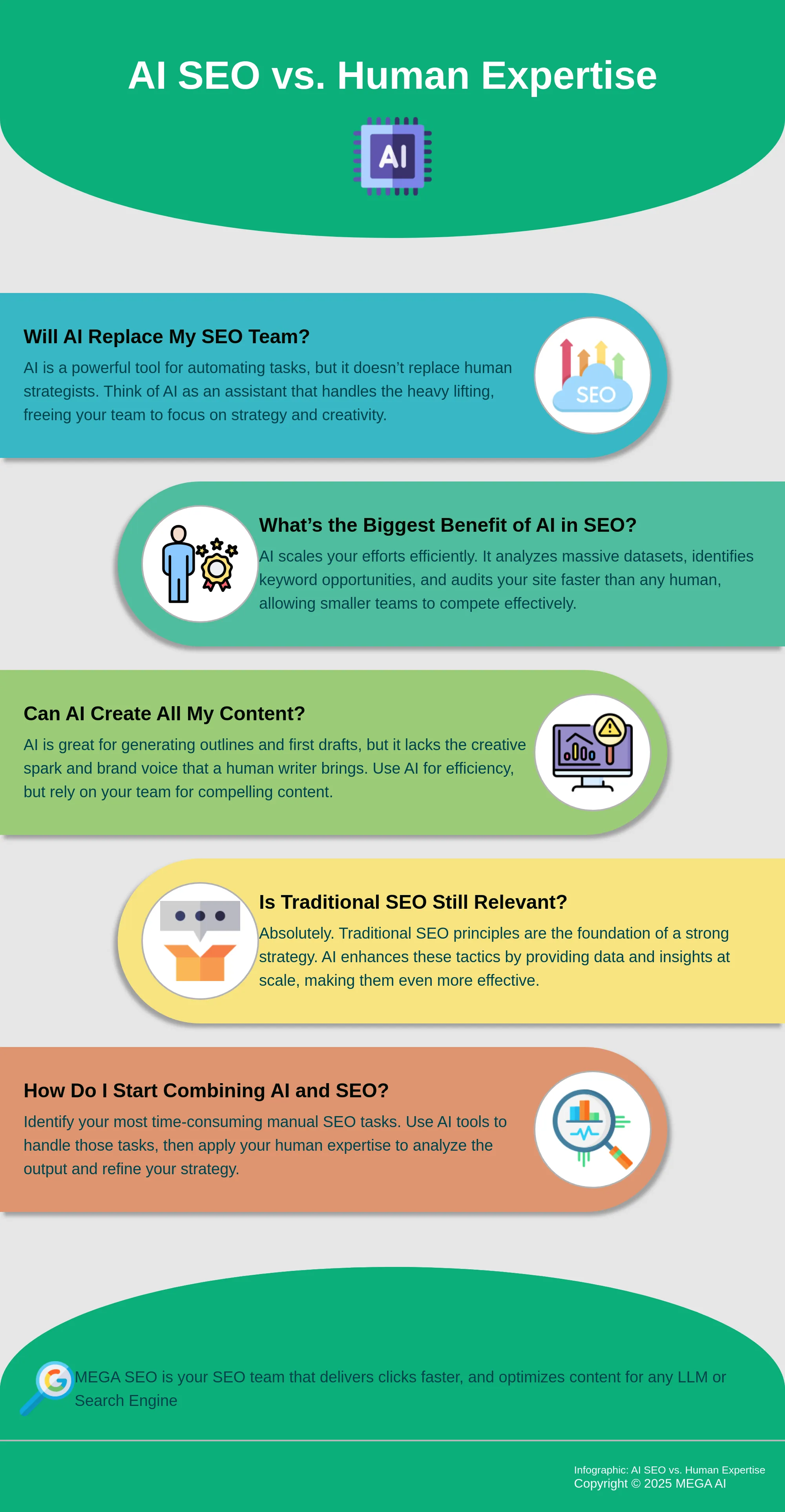
Does using AI for SEO mean I don't need a human strategist anymore? Not at all. Think of AI as a powerful assistant, not a replacement for your strategist. AI excels at processing massive amounts of data and automating repetitive tasks, which frees up your human experts to focus on what they do best: setting the overarching strategy, developing creative concepts, and understanding the nuances of your brand and audience. The most effective approach combines AI's efficiency with human insight.
What's the biggest advantage of using AI in my SEO workflow? The primary advantage is the ability to scale your efforts efficiently. AI can analyze thousands of competitor pages, identify keyword opportunities, and audit your entire site for technical issues in a fraction of the time it would take a human. This allows a small team or even a single person to manage a comprehensive SEO strategy that can compete with much larger organizations.
Can I rely on AI to create all of my content? While AI is a fantastic tool for generating outlines, researching topics, or creating first drafts, it's best not to rely on it for final content. AI lacks the genuine creativity, emotional intelligence, and unique brand voice that a human writer provides. The most compelling content requires a human touch to ensure it's not only optimized for search but also resonates with your audience and builds trust.
Is traditional SEO still relevant with all these new AI tools? Yes, traditional SEO principles are more important than ever. They are the foundation upon which a strong AI-driven strategy is built. Core practices like creating high-quality content, building authoritative links, and optimizing on-page elements are still what drive results. AI tools simply make executing these traditional tactics faster and more data-informed.
How can I start combining AI with my current SEO efforts? A great way to begin is by identifying your most time-consuming manual tasks and seeing where AI can help. For example, you could use an AI tool for initial keyword research or to run a technical audit of your site. Then, use your human expertise to analyze the AI's output, select the best keywords for your strategy, and prioritize which technical fixes to implement. This creates a balanced workflow from the start.