AI-powered search is no longer a future concept; it's here, and it’s changing how your customers find you. The primary goal is no longer just to rank on a results page. It's to become an authoritative source that AI models use to formulate their answers. This requires a deliberate shift in your SEO strategy. You need to create high-quality, human-centered content that is structured for AI consumption. This guide provides a clear plan to adapt your approach, covering content optimization, technical SEO, ethical practices, and how to measure what matters in this new era of search.
Key Takeaways
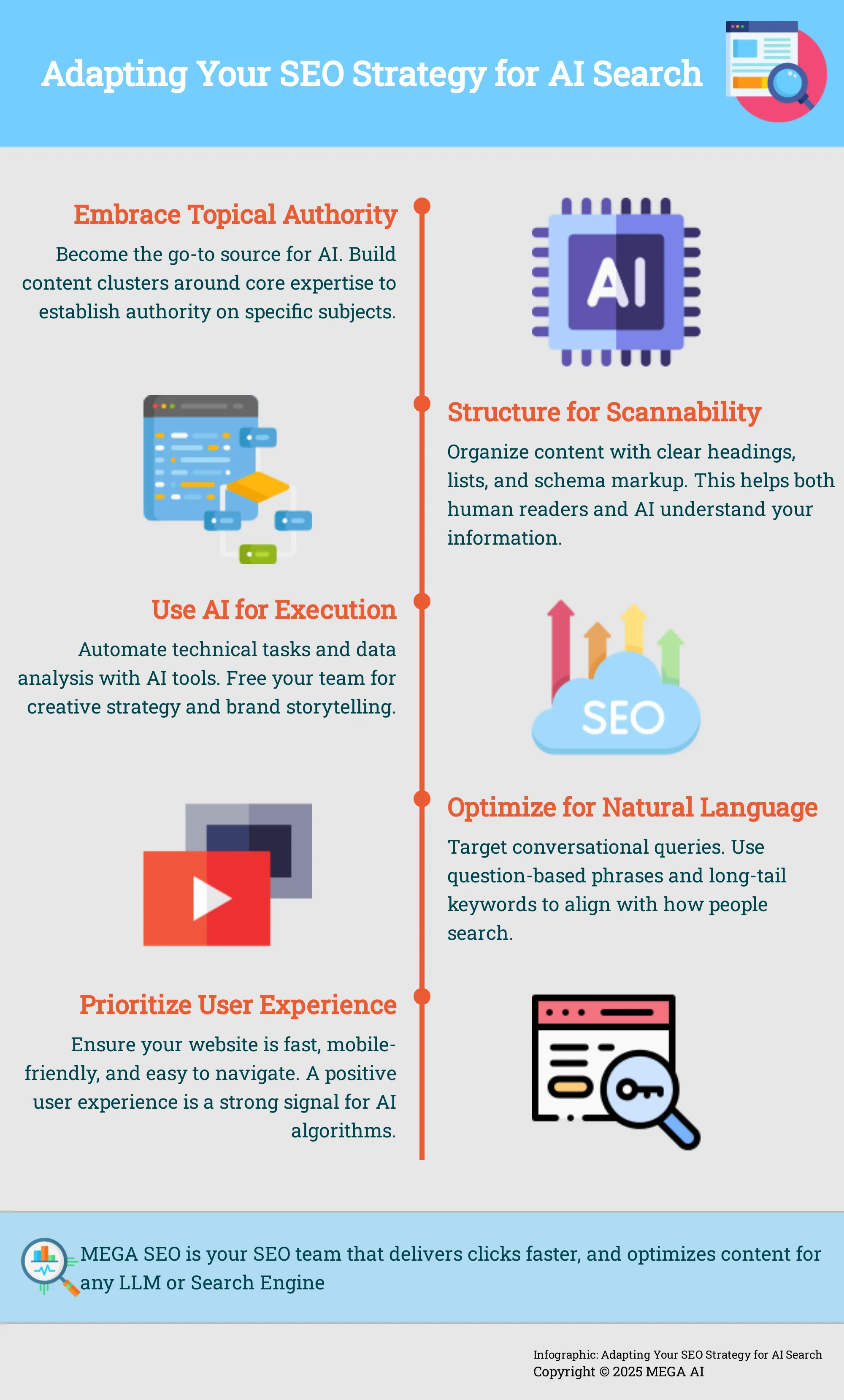
- Build topical authority to become the source: AI search prioritizes deep, comprehensive answers. Move beyond single keywords and create content clusters that establish your site as a go-to expert, making you a prime source for AI-generated results.
- Optimize for scannability and structure: Use clear headings, lists, and schema markup to organize your content. This not only helps human readers but also makes it easy for AI to pull specific information for snippets and overviews.
- Use AI for execution and humans for strategy: Let AI tools handle repetitive tasks like technical updates and data analysis. This allows your team to focus on what machines can't do, such as creative thinking, brand storytelling, and strategic oversight.
What is AI Search?
AI search represents a fundamental shift in how people find information online. Instead of just typing keywords and getting a list of blue links, users can now ask complex questions and receive direct, summarized answers compiled from multiple sources. Think of it as moving from a library card catalog to having a conversation with a librarian who has read every book. This change means our approach to SEO needs to evolve, too. The focus is less on simply ranking first and more on becoming a trusted source that the AI itself relies on to formulate its answers.
How AI search differs from traditional search
Traditional search engines present a ranked list of websites, leaving the user to click through and find the information they need. AI search, however, aims to speed up this process by delivering a comprehensive answer directly on the results page. As more people use these tools, getting your content referenced in an AI-generated response is key to increasing visibility and building authority.
These new AI-powered search engines don’t play by the same old rules. Instead of optimizing solely for search engine rankings, the strategy shifts toward how large language models (LLMs) interpret and present information. This new field, sometimes called AI Optimization (AIO), requires a different mindset. Your goal is to make your content so clear, authoritative, and well-structured that an AI model chooses it as a primary source for its answers.
Changes in ranking factors and user intent
While the technology is changing, many core SEO principles still apply. Understanding user intent, creating high-quality information, and structuring content logically remain as important as ever. The main difference is the heightened focus on creating human-centered content that directly addresses a user's query with genuine value. Generative AI prioritizes relevance and usefulness above all else.
This means your content needs to be the best, most helpful answer available. AI can also be a powerful ally in this process. You can use AI tools to improve keyword research, automate technical SEO tasks, and even get ahead of emerging trends. By using an AI SEO platform, you can ensure your content is continuously optimized to meet these new standards, keeping it relevant for both traditional search engines and the new wave of AI-powered search.
How to Adapt Your SEO Strategy for AI Search
As AI search becomes more integrated into how we find information, your SEO approach needs to evolve with it. It’s no longer just about ranking on a list of blue links. Now, the goal is to become a trusted source for AI-generated answers and summaries. Adapting your strategy means focusing on the quality, structure, and relevance of your content in a way that appeals to both human users and AI algorithms.
Optimize for natural language and conversational queries
People are increasingly using full questions to find information, like "what are the best running shoes for someone with flat feet?" AI search is built to understand and answer these conversational queries directly. To adapt, your content needs to mirror this natural language. Focus on creating articles that directly address the questions your audience has. As users turn to AI tools for answers, having your content referenced in those responses is key to building visibility and authority. Think of your content as a conversation, and use topic research to find common questions and structure your articles around providing clear, helpful answers.
Use structured data and schema markup
Structured data, or schema markup, is code you add to your website to help search engines understand your content's context. Think of it as giving AI a cheat sheet for your site. For example, you can mark up a recipe with its ingredients and cooking time, or an event with its date and location. Implementing structured data makes it easier for AI to pull specific details for its generated results, which can increase your visibility. By creating authoritative, clearly structured content, you align your site with how generative AI gathers information, making your pages a more attractive source for AI-powered summaries and answers.
Balance traditional keywords with AI-friendly content
Keywords aren't obsolete, but their role is changing. You still need to know what terms your audience is searching for, but the focus has shifted from single keywords to broader topics. Your goal is to build comprehensive, authoritative content that covers a subject in depth. This approach signals to both traditional and AI search engines that you're an expert. Use AI-powered SEO tools to identify core keywords and related subtopics. This allows you to create content that not only ranks for specific terms but also provides the rich, contextual information that AI models value when generating answers for users.
How to Optimize Content for AI Search
Optimizing your content for AI search means making it the most logical, helpful, and authoritative answer available. While many core SEO principles still apply, the rise of AI-generated summaries and conversational search requires a more deliberate approach. It’s no longer enough to just rank for a keyword; your content needs to be structured in a way that an AI can easily understand, digest, and present as a definitive answer. This involves a three-part focus: building undeniable authority, structuring content for AI consumption, and prioritizing a seamless user experience.
AI search engines are designed to synthesize information from multiple sources to provide a single, comprehensive answer. They prioritize content that is not only relevant but also trustworthy and well-regarded. Think of it as the AI doing the research for the user. Your goal is to become the primary source it cites. This means your content must be thorough, well-researched, and clearly demonstrate expertise. When an AI model scans the web for information, it looks for signals of quality. By creating content that is both deep and clear, you position your website as a reliable source, increasing the likelihood that your information will be featured in AI-generated results. This shift makes content quality and authority more critical than ever for maintaining visibility in search.
Create high-quality, authoritative content
AI search engines prioritize authoritative, high-ranking sources when generating answers. This makes a strong SEO strategy essential for gaining visibility. Your primary goal should be to establish topical authority. Instead of writing one-off articles, build content clusters around your core areas of expertise. This shows search engines that you are a go-to resource on a specific subject.
Focus on creating content that demonstrates experience, expertise, authoritativeness, and trustworthiness (E-E-A-T). Support your claims with data, cite credible sources, and feature author bios that highlight their qualifications. Tools like MEGA AI’s Maintenance Agent can help by identifying content gaps and adding new, relevant information to your existing articles, continuously strengthening their authority over time.
Optimize for AI-generated overviews and snippets
Generative engine optimization (GEO) is the practice of fine-tuning your content so it’s easily used in AI-generated responses. This means structuring your articles for scannability by both humans and machines. Use clear, descriptive headings (H2s, H3s) to break up your text. Incorporate bullet points, numbered lists, and FAQ sections that provide direct answers to common questions.
This formatting makes it simple for an AI to pull a specific section of your content to use as a snippet or part of a larger overview. When you directly answer a question like "How do I optimize content for AI," you increase the chances of your answer being featured. A well-organized article serves as a ready-made resource for AI, making your content a prime candidate for inclusion in AI Overviews.
Focus on user experience and engagement
Ultimately, AI models are designed to serve humans. That’s why you should focus on creating high-quality, human-centered content that aligns with search intent. If a user lands on your page and quickly leaves, it signals to the search engine that your content wasn't helpful. AI models interpret engagement metrics like time on page, scroll depth, and bounce rate as indicators of content quality.
Ensure your website is fast, mobile-friendly, and easy to use. Write in a clear, conversational tone that speaks directly to your audience’s needs. Use images, videos, and other media to make your content more engaging and easier to understand. By creating a positive user experience, you send strong signals that your content is valuable, making it more likely to be favored by AI search algorithms.
Technical SEO for AI Search
While high-quality content is your primary focus, the technical health of your website forms the foundation of your SEO strategy. AI search engines, just like their traditional counterparts, need to crawl, index, and understand your site efficiently. A strong technical setup ensures that your great content is discoverable and accessible, which is essential for ranking in AI-driven search results. Think of it as building a solid stage before putting on a great performance. Without it, even the best content can go unnoticed.
Prioritize mobile optimization and site speed
A seamless user experience is a major ranking signal, and for AI search, this is non-negotiable. Your website must be mobile-friendly and load quickly. AI models process incredible amounts of data, and a slow, clunky site is not only frustrating for users but also inefficient for search crawlers. A fast-loading, responsive website signals quality and authority. You can use tools like Google's PageSpeed Insights to check your performance and find areas for improvement. Ensuring your content is served on a technically sound site is a critical step that supports all your other SEO efforts.
Implement voice search optimization
The way people search is becoming more conversational, thanks to voice-activated devices like smart speakers and phone assistants. AI search is built to understand and respond to this natural language. To adapt, you should optimize for voice search by incorporating long-tail keywords and question-based phrases into your content. Structuring articles with clear Q&A sections can be very effective. This approach not only targets voice queries directly but also makes your content more likely to be featured in AI-generated summaries and answer boxes, positioning you as a helpful authority in your niche.
Prepare for new AI search tools
The world of search is changing quickly, and the tools we use today might look different tomorrow. The key to long-term success is to build a flexible and adaptive SEO strategy. This means staying informed about new AI search features and being ready to adjust your approach. An agile strategy allows you to test what works and pivot when necessary. Using a platform that automates technical updates and re-optimizes content as search engines evolve can give you a significant advantage. This ensures your strategy remains effective without requiring constant manual overhauls, letting you book a demo to see how automation can keep you ahead.
Ethical SEO in the Age of AI
As we integrate AI into our SEO workflows, it’s important to ground our strategies in ethical practices. Using AI responsibly isn't just about following rules; it's about building long-term trust with your audience and creating a sustainable digital presence. Ethical AI-driven SEO focuses on delivering genuine value to the user, not just finding clever ways to rank higher. This approach ensures your brand's reputation remains strong as search technologies continue to evolve. By prioritizing ethics, you create content that both users and search engines will favor for years to come. The core principle is simple: use AI to enhance human expertise, not to replace the critical thinking and empathy that create truly great content. This means being thoughtful about how you generate articles, how you represent information, and how you communicate your methods to your audience. It’s a shift from a purely technical mindset to one that blends technology with responsibility, ensuring your SEO efforts contribute positively to the online ecosystem. This commitment to ethical practices will differentiate your brand and build a loyal following that values authenticity and quality over quick wins and algorithm hacks.
Avoid manipulating AI algorithms
The temptation to find shortcuts with new technology is always there, but manipulating AI algorithms is a losing game. Tactics like generating massive amounts of low-quality, AI-spun content or trying to trick AI into ranking irrelevant pages will ultimately harm your site. Search engines are constantly refining their ability to detect these manipulative practices. Instead of trying to outsmart the algorithm, focus on using AI to genuinely improve your content. Use tools like MEGA AI's SEO suite to conduct thorough keyword research and produce high-quality, helpful articles that truly answer user questions. The goal is to use AI as a powerful assistant, not a tool for deception.
Promote fair and unbiased results
AI models learn from vast datasets, which can sometimes contain hidden biases. If left unchecked, these biases can lead to skewed or unfair search results. As marketers, it's our job to guide AI tools and ensure the content we produce is balanced, inclusive, and accurate. A successful strategy requires a combination of AI efficiency and human oversight. While an AI can draft an article, a human should always review it for tone, accuracy, and fairness. This balanced approach ensures your content serves a diverse audience and avoids perpetuating harmful stereotypes, building a brand that is seen as trustworthy and equitable.
Maintain transparency in your AI practices
Trust is the cornerstone of any good relationship, including the one you have with your audience. Being transparent about your use of AI is key to building and maintaining that trust. While you don't need to label every AI-assisted sentence, it's good practice to be open about how AI supports your content creation process. This helps users understand that you're leveraging technology to provide them with better, more comprehensive information. Understanding how AI-driven algorithms work allows you to adapt your strategy effectively and ethically. Platforms like MEGA AI are designed to make these complex processes clear, so you can focus on strategy while the AI handles the heavy lifting.
How to Measure and Adapt to AI Search
As AI reshapes the search landscape, the way you measure success and adjust your strategy must also evolve. Traditional metrics still have their place, but they no longer tell the whole story. Adapting means looking at new data points and embracing a more fluid, continuous approach to optimization. It’s less about chasing a specific rank and more about ensuring your content provides authoritative answers wherever users are asking questions.
This shift requires a new mindset and new tools. By focusing on visibility within AI-generated results and using AI-powered analytics, you can gain a competitive edge. The key is to stay informed, be flexible, and let data guide your next steps. Let’s look at how you can update your measurement framework and build a strategy of continuous improvement.
Update your analytics for AI search
Your analytics dashboard needs a refresh. While you’ll still track traffic and conversions, you need to add metrics that reflect AI search behavior. AI can help you anticipate emerging trends through predictive analytics, giving you a significant advantage.
Start tracking these new indicators of success:
- Visibility in AI Overviews: Monitor how often your brand or content appears in AI-generated summaries and answers.
- Referral Traffic from AI: Identify traffic coming from AI assistants or chat-based search interfaces.
- Citation Frequency: Track how many times AI models cite your website as a source.
- User Engagement on Featured Content: Analyze how users interact with the pages that AI surfaces most often.
Platforms like MEGA AI can help you move beyond basic keyword tracking. Our SEO tools provide deeper insights into how your content performs in an AI-driven ecosystem, helping you see what’s working and where to focus your efforts.
How to interpret AI-generated insights
Getting your content featured in an AI-generated response is a major win. It signals that the AI considers your content authoritative, relevant, and high-quality. As more users turn to AI for answers, being a cited source is crucial for increasing visibility and building your brand’s authority.
When you see your content being used by AI, analyze it to understand why it was chosen. Look for patterns in the topics, formats, and structure of the featured content. Does the AI prefer listicles, step-by-step guides, or pages with strong data points? Use these insights to inform your future content creation. This analysis helps you create more content that AI is likely to surface, creating a positive feedback loop that strengthens your online presence.
Adopt a strategy of continuous learning
The world of AI search is constantly changing, so your strategy needs to be dynamic. A "set it and forget it" approach won't work. Instead, commit to a cycle of continuous learning and adaptation. This means regularly reviewing your performance, staying updated on AI developments, and being ready to adjust your content strategy. The goal is to create high-quality, human-centered content that aligns with what users and AI value.
AI-powered tools can automate much of this adaptation. For example, MEGA AI’s Maintenance Agent can identify which articles need updates to improve their ranking potential. It can also re-optimize your existing content for new Google updates or even for different platforms like LLMs, ensuring your strategy remains effective. By using AI to maintain your content, you can focus on the creative and strategic work that only humans can do. See how it works when you book a demo with our team.
The Role of Humans in AI-Driven SEO
While AI is transforming SEO, it doesn’t make human expertise obsolete. Instead, it changes the role of the SEO professional from a hands-on tactician to a strategic leader. AI tools are powerful partners, but they require human guidance, creativity, and critical thinking to perform at their best. The future of SEO isn't about AI versus humans; it's about how humans can best use AI to achieve their goals. This partnership allows you to focus on high-impact activities that machines can't replicate, like building relationships and understanding your audience on a deeper level.
Balance AI automation with human creativity
AI tools are incredibly powerful for scaling your SEO efforts, from generating content ideas to automating technical fixes. They handle the repetitive, data-heavy tasks that used to take hours. However, relying solely on automation can lead to generic content that lacks a distinct brand voice or a unique point of view. The most effective strategy involves a balanced approach where AI and human expertise work together. Think of AI as your research assistant, providing data and drafts, while you act as the editor-in-chief, ensuring every piece of content is strategic, creative, and truly speaks to your audience.
Develop skills that complement AI
As AI handles more of the tactical SEO work, your role will shift toward strategy and creativity. Instead of competing with AI, focus on developing skills that enhance its output. This means getting better at strategic planning, understanding the nuances of user intent, and crafting compelling brand stories. The goal is to create high-quality, human-centered content that provides genuine value. Learning to use AI platforms effectively is also a critical skill. Mastering tools for SEO automation allows you to guide the technology, interpret its findings, and make informed decisions that drive results.
How to Prepare for the Future of AI Search
Staying ahead in SEO means preparing for what's next. As AI search evolves, your strategy must evolve with it. This doesn't mean overhauling your current efforts, but making smart adjustments to how you approach monetization, content, and automation. Focusing on these key areas will position your business for sustained success in a new search environment.
What is the impact on SEO monetization?
The rise of AI search is changing how businesses can monetize their online presence. With AI providing more direct answers, the traditional model of driving clicks to a webpage filled with ads is becoming less effective. Instead, the focus is shifting toward new models. AI search can speed up the marketing funnel by giving users comprehensive information upfront, which means your brand needs to be part of that initial answer. This might involve creating premium content, offering affiliate products within AI-generated responses, or using your established authority to drive direct conversions. The key is to think beyond the click and find new ways to capture value.
Strategies for an evolving AI search landscape
To adapt to this new landscape, your content strategy needs to be intentional and forward-thinking. The goal is to have your content referenced directly in AI-generated answers, which increases your visibility and establishes your brand as an authority. You can achieve this by creating authoritative, well-structured content that directly answers common user questions. Think of your content as a direct source for the AI. Marketers must take steps to prepare for generative AI search by focusing on clarity, depth, and structure, ensuring their information is easy for AI models to parse and present.
Use AI tools for SEO automation
Manually adapting to these changes is a monumental task, which is where AI tools become essential. Using AI for SEO automation allows you to scale your efforts effectively. These tools can improve keyword research by identifying conversational queries, automate technical SEO tasks to keep your site optimized, and help you create high-quality content that aligns with what AI search engines are looking for. By automating these processes, you can identify top-performing keywords, predict search trends, and optimize your content to rank higher, freeing up your team to focus on high-level strategy and creative work.
Related Articles
- Alternative Search Engines: Enhance Your Privacy & Find the Right Fit
- Boost Your SEO with Powerful AI Prompts
- AI Content for SEO: Benefits, Risks & Best Practices
- Schema Markup: The Ultimate Guide for 2024
- AI SEO: A Modern Guide to Optimizing for AI
Frequently Asked Questions
What is the most important change I should make to my SEO strategy for AI search? The biggest shift is moving your focus from simply ranking first to becoming a trusted, citable source of information. Your goal is for AI to use your content to build its answers. This means creating comprehensive, well-structured articles that directly address your audience's questions with clear, authoritative information.
Are keywords still relevant with AI search? Yes, but their function has evolved. Instead of focusing on single keywords, you should think more about the topics and conversational questions your audience uses. Keywords are now clues that help you understand user intent. Use them to build out in-depth content that covers a subject thoroughly, rather than just targeting a specific term.
Can I just use AI to generate all my content now? While AI is a powerful tool for research and drafting, relying on it exclusively can produce generic content that lacks a unique brand voice and perspective. The best approach is a partnership where AI handles the heavy lifting and a human editor provides the strategic oversight, creativity, and quality control. This ensures your content is accurate, helpful, and truly connects with your audience.
How can I track my performance in AI search results? Measuring success in AI search requires looking beyond traditional metrics like traffic and rank. You should start monitoring how often your content is featured or cited in AI-generated overviews and answers. This indicates that your content is seen as authoritative. Analyzing which pages get featured can also provide valuable insights into what type of content the AI prefers, helping you refine your strategy.
Does AI make SEO professionals unnecessary? Not at all. AI automates many of the repetitive, technical tasks, which frees up SEO professionals to focus on higher-level work. The role is shifting from a tactician to a strategist. Human expertise is still essential for understanding audience nuance, developing creative content strategies, and making informed decisions based on the data AI provides.